
Conscious CreativityFree preview
Creative thinking is a habit, not a lightning bolt.
Where do new ideas actually come from?Why does a strict rule make your work more original, not less?And how do you protect your attention when everything around you wants to scatter it?This course turns creative thinking into a calm, repeatable daily craft.
- Generate many distinct ideas before judging them, then select the strongest with clear criteria.
- Use constraints of form, time, material and subtraction to break past a blank page.
- Practise focused attention and deliberate rest while knowing what the research supports and where it stops.
- Improvise, prototype roughly, give and receive honest critique, and ship work in your own voice.
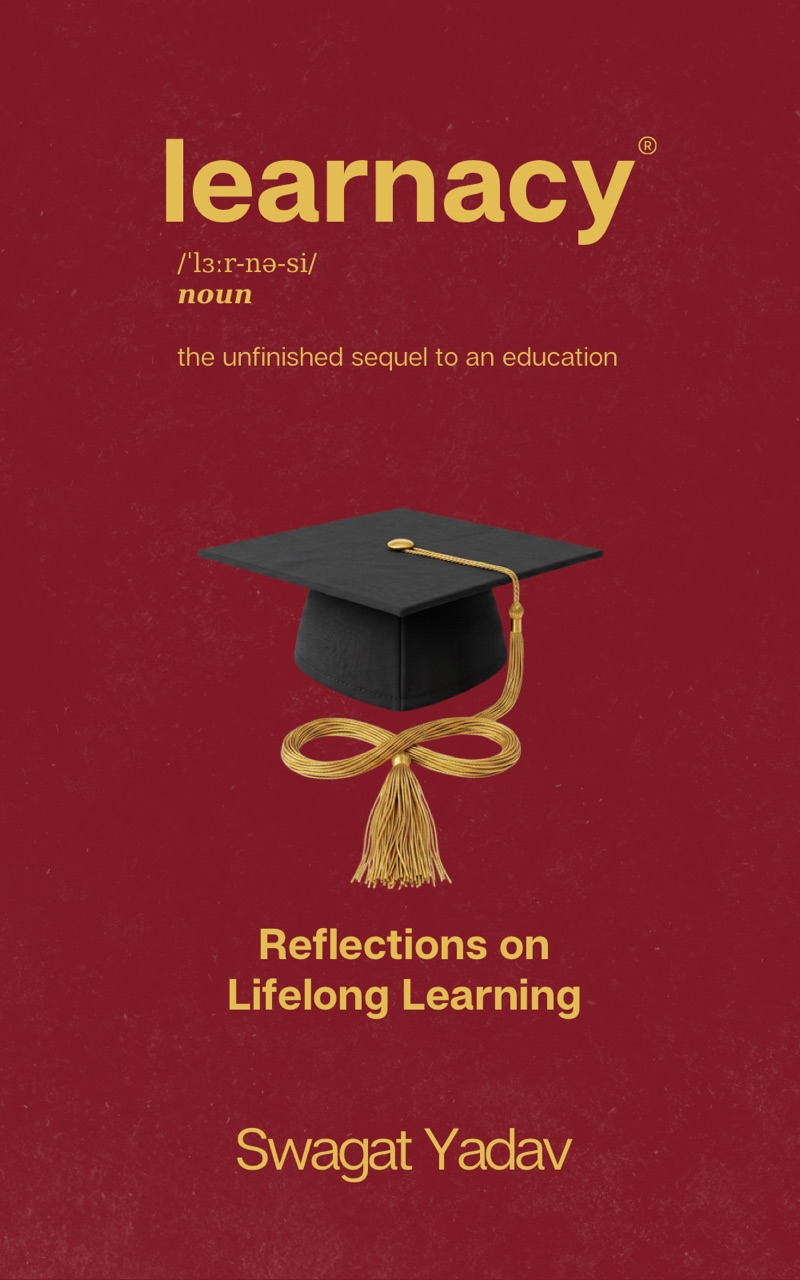 With Swagat YadavFounder and CEO, One Young India, and author of Learnacy
This course is for learning. Mindfulness and focus are taught as everyday practices with their research limits, never as therapy, diagnosis or a cure. It names no company or app to praise or blame, and takes no side in party politics.
The ideas you already have
You solve small puzzles, combine old habits and notice details every day.This course turns that quiet resourcefulness into a deliberate craft.
- Creativity is not a rare gift for a few artists; it is a daily habit of noticing, combining and testing.
- This course turns that habit into a calm, repeatable craft across four parts.
- Mindfulness and focus are taught as everyday practices with their research limits, never as therapy or a cure.
The card under the table leg
Fixing a wobbling table leg with a folded piece of card. Turning kitchen leftovers into a meal that had no recipe. Finding a calmer way to explain a hard point to a younger sibling when your first explanation failed. Rearranging your study bag so you stopped forgetting your keys. Did you do any of these at home yesterday?
Keep that answer in mind. Are you a creative person? Many students hesitate before answering. They picture a painter in a studio, a poet waiting for a mood, or a famous inventor struck by a bolt from the sky. If they do not paint or write verse, they say no.
Every one of those acts was creative. You noticed a gap, combined what was at hand, tested a rough solution, and adjusted it. You already practise creativity every day, without calling it that.
This course gives those habits a clear name, backs them with research, and helps you use them on purpose when you sit down to write, design or solve a public problem.
What does your gut say?
Three quick questions before we begin. There is no score, and nothing leaves this page. At the end of the course you will see your first answers next to what you know by then.
How this course works
Four parts and 26 chapters, then a wrap-up, about 12 hours, at your own pace. Each chapter has:
- a story from everyday life, a practice widget to try, and a question to argue about,
- an "In short" box at the top, so you can see the main points first,
- a link into World 101, Learnacy's map of what the world knows, starting with Meditation, Mindfulness and the Contemplative Mind,
- a note for your notebook, and
- a five-question check. Pass it with 4 right, as often as you need.
Pass every chapter check and the final round, and you get a certificate of completion with a link anyone can use to verify it.
Two promises. First, mindfulness and focus in this course are taught as practical everyday habits with sourced research and its honest limits, never as therapy, medical diagnosis or a cure. Second, every example tells you plainly whether it is a made-up teaching case or a sourced fact.
One rule runs through every page: questions are more important than answers. A writer or designer who asks a sharper question will always see further than one who rushes to the first tidy answer.
Explore in World 101
Set a five-minute timer and read Meditation, Mindfulness and the Contemplative Mind in World 101. Which of its habits could you try this week? When the timer stops, note a question you want to chase: the piece you write to finish the course may answer it.
Creativity is a practice you can start any morning, without waiting for a lightning bolt.
One everyday problem around me where I would like to bring fresh, careful thinking.
Where do ideas come from?
The story of the lone genius waiting for a sudden spark hides how real work happens.Most new ideas are bridges built between two older things that had not met yet.
- New ideas do not appear from nothing; they combine existing parts into a useful new bridge.
- Creative work moves through four stages: preparation, incubation, illumination and verification.
- Sudden insight (illumination) relies on prior preparation and must be tested by verification.
- Borrowing a working principle from home or another craft can get a stuck policy paper moving.
The tiffin carrier and the stepwell
Look at a steel tiffin carrier on a kitchen shelf. Is the round metal bowl new? No. Is a handle with a clip new? No. Yet when someone stacked three bowls into one locking frame so hot dal, rice and vegetables could travel together on a crowded train without spilling a drop, the combination changed how millions of people eat at work.
Or climb down into a traditional stone stepwell in western India. Is a well new? No, and neither is a flight of steps. Put them together in dry country, where the water sinks far below the surface between the monsoon and May, and you get a shade pavilion, a water tank and a staircase that meets the water at every season of the year.
Why do we still picture creativity as a solitary lightning bolt out of an empty sky? Because when we see a finished stepwell or read a finished white paper, the scaffolding has been taken away. We see the final arch, not the hundred old stones that were tried and moved first.
How a new idea gets built
What is a new idea? Start from the other end. The opposite of a creative idea is not an old idea. It is an isolated fact sitting in a drawer by itself. A creative idea is often a useful combination of two or more existing ideas, observations or crafts that had not been joined in that way before.
The psychologist Margaret Boden calls this combinational creativity, making unfamiliar combinations of familiar ideas, and treats it as one of three kinds of creativity, alongside exploring and transforming a style. Rani-ki-Vav, the 11th century stepwell at Patan in Gujarat, is one such combination: UNESCO describes it as a working water source designed as an inverted temple.
Gutenberg's printing press is usually explained the same way, as cast metal type joined to a screw press of the kind already used for wine and olive oil, though the museums that hold the presses call that borrowing a likely reconstruction rather than a documented fact.
Flashes of insight do happen: we have all felt an idea click into place while walking or washing our hands. But that click is step three. A classic account of creative thought breaks the process into four distinct stages. In his 1926 book The Art of Thought, Graham Wallas called those stages preparation, incubation, illumination and verification.
- Preparation: you study the problem, gather the facts, read what others have tried, and wrestle with the parts that do not fit.
- Incubation: you step away for a while, and your mind continues testing links below the surface.
- Illumination: two pieces click together into a promising shape.
- Verification: you return to the desk, test whether the idea actually works, and revise what fails.
Try skipping a stage. Can illumination happen without preparation? Almost never, because you cannot connect dots you have never collected. Can it stand without verification? No: plenty of our sudden flashes turn out to have a leak once we test them against real numbers.
Pair two worlds that have not met
Pick an everyday object from home and a real problem from a neighbourhood street, or spin a pair at random. Look at how the working rule of the object suggests a fresh approach to the problem.
The pairing
What transfers across
What a kitchen and a public programme share
At home, a family that wants to save cooking gas combines a tight lid, pre-soaked grain, and the residual heat of the stove, without inventing a new fuel. At the national level, when a public programme tries to deliver school meals or clean water across thousands of villages, the best policy ideas work the same way: they combine an existing local institution, a simple verification rule, and a familiar daily habit.
Not every random pairing is clever. Putting wheels on a teacup helps nobody. But when you are stuck on your white paper, staring harder at the same single subject rarely helps. Bringing in a working mechanism from another field gives your mind something concrete to test.
Is originality overrated in public problem solving?
When students write a white paper or enter a design challenge, judges often ask for "originality". Should public problem solvers aim to invent something new, or copy what already works elsewhere?
Most urgent problems in health, water and schooling already have a working solution in another district or country. Adapting a proven model saves time, money and human mistakes, while chasing novelty for its own sake wastes public resources on untested experiments.
Copying a solution from another city without rethinking it for local habits, budgets and climate is why so many imported programmes fail on the ground. Real adaptation requires fresh creative combination, not copy-and-paste.
A hard case. A town with a small budget wants to cut road injuries outside ten schools this term. Should the team design a brand-new street layout or copy the exact speed-table design used in a neighbouring town?
Check three local projects in your city: one copied unchanged, one adapted to local streets, and one built from scratch. Which one was still working two years later, and why?
Explore in World 101
How do designers move from a messy human need to a tested combination? Among the subjects Design Thinking links to in World 101, find one from a field outside design. What working rule from that field could you borrow for a problem in your own town?
Find the number
Pick one everyday object in your room (such as a bicycle, a ballpoint pen, or a ceiling fan). Count how many distinct older inventions had to be combined to make it work, and list at least 4 of those parts in your notebook.
Check your understanding
Five questions. Pass with 4 right; try as often as you like. Each answer comes with its reason.
You cannot connect dots you have never collected; preparation feeds the spark, and verification tests it.
Two separate subjects I know something about that I have never tried combining in a paper.
That was chapter 1 of 26
Next: observation, divergent and convergent thinking, incubation, analogy, creative constraints, poetic and frugal form, mindfulness and focus, improvisation, and creative courage. Four parts, about 12 hours, then the final round and your completion certificate.
Already a member? Continue in part 1. The check you passed here carries over when you are logged in. Course home