

Managing MediaFree preview
Read the news.Guard your attention.
Who decides what counts as news?How can you tell a real video from a fake one?And why is it so hard to put the phone down?This course answers questions you meet on your own screen every day.
- Explain how news is made, and spot framing, bias and propaganda.
- Check a claim, a picture or a video before you believe or share it.
- See how a feed is built to hold your attention, and take some of it back.
- Protect your data and set your own rules for a healthy media diet.
 With Swagat YadavFounder and CEO, One Young India, and author of Learnacy
This course is for learning. It names no platform or app to praise or blame, and it takes no side in party politics.
Your attention is worth something
You read, watch and scroll every day, and most of it costs you nothing.Or does it?
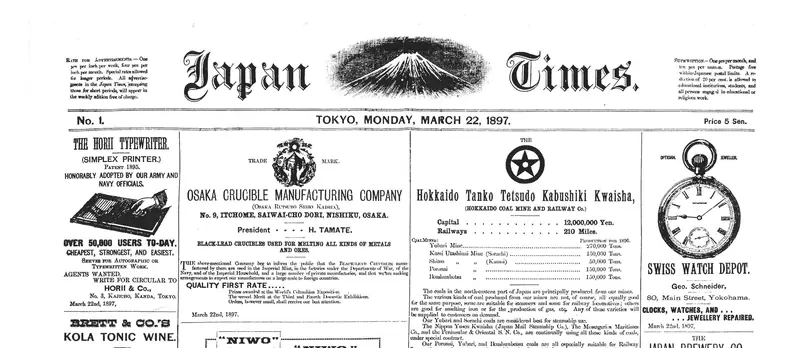
The first issue of the Japan Times, 22 March 1897. Readers paid 5 sen a copy; advertisers paid one yen an inch a week, and filled the front page.Scan: The Japan Times, public domain (published in 1897 by the Japan Times, with no named author), via Wikimedia Commons. Cropped by One Young India.
- Most media costs you no money; you pay with your attention.
- Knowing how others compete for your attention is how you keep some of it.
- The habit that matters most: ask who made this, and why.
The price of free news
Is the news free? Most of it, yes. You pay nothing to scroll, watch a video or read a headline. So who pays the reporters, the editors, the camera crews, the servers? Somebody does. And if you are not paying with money, what are you paying with?
If you are not paying with money, what are you paying with?
Your answer
Anonymous: we count answers, nothing else.
With your attention. Every minute you spend on a screen is a minute someone has earned, and many of them sell that minute to advertisers. That is the first idea of this course: your attention is valuable, so other people compete for it. Knowing how they compete is how you keep some of it for yourself.
What do you think already?
Three quick questions before we begin. There is no score, and nothing leaves this page. At the end of the course you will see your first answers next to what you know by then.
How this course works
Four parts and 23 chapters, then a wrap-up, about 11 hours, at your own pace. Each chapter has:
- a story, something to try and a question to argue about,
- an "In short" box at the top, so you can see the main points first,
- a link into World 101, Learnacy's map of what the world knows,
- a note for your notebook, and
- a five-question check. Pass it with 4 right, as often as you need.
Pass every chapter check and the final round, and you get a certificate of completion with a link anyone can use to verify it.
One rule for the whole course: questions are more important than answers. For media, that is doubly true. The habit of asking "who made this, and why?" is worth more than any single fact you learn here.
Explore in World 101
Start on the map now. Open Social Media and Society in World 101, look around for five minutes, and ask of what you read there: who made this, and why?
If you are not paying for something with money, ask what you are paying with.
One app or site where I think I am paying with my attention, and what it gets from me.
How the news is made
Thousands of things happen in your city today. A handful become news.Who chooses, and how?
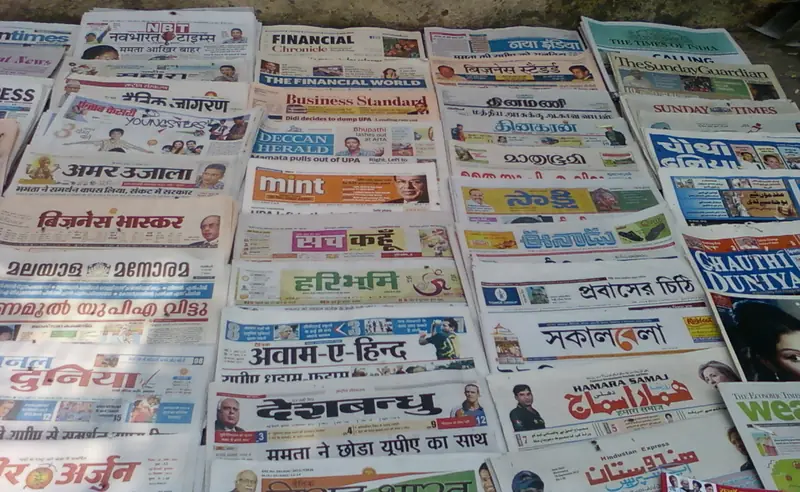
Newspapers in many languages for sale in New Delhi. Each front page is one newsroom's answer to this chapter's question: what counts as news today?Photo: "Indian Newspapers" by Shajankumar, CC BY-SA 3.0, via Wikimedia Commons. Cropped by One Young India. The crop is shared under the same licence.
- News is chosen by people at every step: reporters, editors, headline writers.
- Stories that are new, close, conflict-driven or about the famous are more likely to run.
- Slow, important stories are easy to miss.
- A report, an opinion and an advertisement are different things; ask which one you are reading.
From a street to your screen
It is a Tuesday morning. A water pipe bursts on a busy road, a school wins a science prize, a minister gives a speech, and a famous actor posts a photo. By evening, which of these is on the news?
Did anyone decide? Yes, many people. A reporter heard about the pipe from a reader's call. An editor chose the speech for the front page. Another chose the actor's photo because it would be read most. Nothing reaches you as "the news" without people choosing it, at every step.
By evening, which of these would you put first on the news?
Your answer
Anonymous: we count answers, nothing else.
Who touches a story before you see it?
Follow one story. A reporter finds it, from a press release, a phone call, a court record or their own eyes. They check it with sources: people who saw it, documents, officials. An editor decides whether it runs, how long it is and where it goes. Someone writes the headline, which many readers will see without reading the story. All of this happens against a deadline.
Why does the deadline matter? Because checking takes time, and the pressure to be first can beat the pressure to be right. That is where many errors come from.
Every message is made by someoneCrashCourse · 3 min
What to watch for How the people who make a message build their choices into it, and why two people can read the same message differently.
What makes something news?
Editors call it news value. A story is more likely to run if it is:
- new: it happened today, not last year;
- close: it happened near the readers;
- about conflict: a fight, a protest, a court case;
- about someone well known;
- unusual: a man bites a dog, not a dog bites a man;
- affecting many people: a price rise, a new rule, a storm.
Notice what is missing from the list: "important but slow". Rising groundwater levels, a slow improvement in schooling, a law working quietly. Slow stories often matter more than fast ones, and they are easy to miss.
Would it be news?
Six things that happened today, in a made-up city. Decide for each: would an editor run it?
India's news, and what looks like news
India has a very large news industry, and it works in many languages. On 31 December 2024 there were 1,54,362 periodicals, which means newspapers and magazines, registered with the Press Registrar General of India, according to the Ministry of Information and Broadcasting. Being registered is not the same as still publishing, and many of those titles had stopped.
The press registrar's own report for 2023-24 counted 58,603 periodicals registered in Hindi, more than in any other language, and 20,204 in English. Most of the news a family in India reads is not in English.
Not everything that looks like news is news. A report tells you what happened. An opinion or editorial tells you what the writer thinks about it. An advertisement is paid for by someone who wants to sell you something, even when it is made to look like a report. A careful reader asks first: which of these am I reading?
Report, opinion or advert? Decide, then tap to check.
Should news follow what readers click on?
Editors can now see, minute by minute, which stories people read. Should that decide what goes first?
News exists for readers. If people read a story, it interests them, and following their choices keeps a newsroom alive and paying its reporters.
People click on what is shocking or fun, not always on what matters. A newsroom that only follows clicks will miss slow, important stories that nobody clicks on until it is too late.
A hard case. A local paper that cannot survive without clicks. Is it better to run what readers want and stay open, or to run what matters and risk closing?
Compare what a newsroom's most-read list looks like with its front page over a month. What important stories would disappear if clicks alone decided?
Explore in World 101
Every news story passes through many hands before it reaches you. Open News, Journalism and Verification in World 101 and play editor with one of the subjects it links to: which story from that subject would make the front page, and which would be missed?
Find the number
Find one newspaper or news channel in a language you read, other than English. Write its name, its language, and one story it covered today that an English paper did not.
Check your understanding
Five questions. Pass with 4 right; try as often as you like. Each answer comes with its reason.
News is not what happened. It is what someone chose to tell you about what happened.
One important thing in my city that never makes the news, and why.
That was chapter 1 of 23
Next
- Framing and bias
- How propaganda works
- Who pays for the news
- How to check a claim
- Deepfakes
- The attention economy
- Your digital footprint
Four parts, about 11 hours, then the final round and your completion certificate.
Already a member? Continue in part 1. The check you passed here carries over when you are logged in. Course home