One Young India Press · The OYI Review
Bridging the Power Gap - A Comprehensive Study of Rural Electrification in India
By Puranjay Singla
✓ Certified publication · OYI-2026-CRASNK
Verify at oneyoungindia.com/certificate/OYI-2026-CRASNK
BRIDGING THE POWER GAP: A COMPREHENSIVE STUDY ON RURAL ELECTRIFICATION IN INDIA
By Puranjay Singla
Abstract
Rural electrification remains a significant developmental challenge in India. Despite the nation's robust foreign relations and growing self-dependency, achieving universal, reliable power access is not a simple task. This paper delves into the deep-seated socio-economic issues, potential flaws in India’s legal and regulatory frameworks for electricity, and the unique complexities of the problem within the Indian context. By adopting the perspective of rural stakeholders-drawn from data available in the public domain-this research uncovers the root causes and specific regional factors contributing to the power gap, offering a fresh outlook on potential solutions.
This extensive analysis covers a wide spectrum of issues, from the conceptual reasons for the power disparity between urban and rural areas to the lack of human and natural resources in this domain. It also leverages a specific feature in Uttar Pradesh’s electrification policy-where only households within 40 meters of an electricity pole qualify for a legal connection-to estimate the tangible effects of electrification through a rigorous statistical approach. The power lines carry not just electricity, but also the hopes and opportunities for underdeveloped communities to grow and thrive. In response, India has launched numerous policies, awareness drives, and infrastructural projects, allocating significant funds to address this crisis.
This paper provides a detailed review of these governmental efforts, alongside a critical analysis of their shortcomings. Furthermore, it presents and evaluates alternative solutions designed to bridge the remaining gaps, advocating for a strategic approach where the government intervenes by partnering with localized private companies. Such collaborations can help achieve sustainable energy goals and ensure that electricity becomes an accountable public good for all. The paper stands clear on defining the problem, its severity, and the necessary steps forward, including addressing governmental flaws, optimizing fund allocation, and fostering effective public-private partnerships.
Introduction
Access to electricity is widely recognized as a cornerstone of modern development, essential for lighting, refrigeration, education, and broad economic activity. Globally, Sustainable Development Goal 7 (SDG 7) explicitly calls for universal energy access by 2030. As of 2022, India has made monumental strides, with nearly all households having some form of electricity connection-a dramatic leap from previous decades. World Bank data indicates that approximately 98% of Indians now have at least basic access, placing the country on the cusp of universal coverage [6]. However, this figure masks a persistent divide, as rural areas continue to lag significantly behind their urban counterparts.
Despite this progress, much of rural India still faces a critical "power gap," characterized by frequent outages, low voltage, and chronically unmet demand. In 2019, the median rural household received less than 10 hours of electricity per day, compared to over 19 hours in cities [13]. The challenge has thus shifted from merely connecting villages-a milestone officially declared complete in 2018 [7]-to ensuring that every household, farm, and local enterprise receives a continuous and reliable power supply. With roughly 70% of the population residing in agrarian communities, effective electrification must support the modern needs of irrigation, small-scale industries, education, and evolving livelihoods [15].
Historically, India’s rural electrification rate has trailed the global average. In 2011, for instance, the global electrification rate was approximately 81.9%, whereas India’s was only 75.3%, with a mere 66.9% in rural areas [15]. This deficit has spurred numerous government programs, from early schemes like the Rajiv Gandhi Grameen Vidyutikaran Yojana (RGGVY), which established the initial rural grid, to later initiatives like Saubhagya, which connected over 21 million households [7]. Nevertheless, independent surveys reveal that around 2.4% of households, primarily in remote pockets of Uttar Pradesh, Bihar, and Madhya Pradesh, remain unconnected [6]. Furthermore, a staggering half of the population in the "ACCESS" states (Uttar Pradesh, Bihar, Odisha, etc.) experiences four or more hours of power outages daily [6].
This paper examines why India’s power gap persists and outlines a strategic path to bridge it. We will first define the core problems plaguing rural electrification. Next, we will review existing central government programs and analyze their outcomes. We will then explore the on-the-ground realities, including grid unreliability, financial challenges, and socio-economic barriers. Subsequently, we propose six innovative solutions not currently central to Indian policy, each analyzed through a comprehensive PASTEL framework. Finally, we compare these solutions to justify the most effective and pragmatic approach. This analysis draws on government reports, industry data, and academic research to ensure up-to-date, evidence-based recommendations.
Problem Definition
India’s rural electrification challenge is a multi-dimensional issue. While physical infrastructure has expanded dramatically over the last two decades, persistent problems with service quality, coupled with socio-economic barriers, prevent universal and reliable access. The issue is fundamentally a service gap problem, not merely an infrastructure deficit, rooted in a complex interplay of economic, technical, and governance factors.
1. Incomplete Household Coverage
Although official data declared 100% village electrification by April 2018 [7, 13], this milestone was based on an administrative definition that considers a village "electrified" if just 10% of its households have electricity access, alongside public institutions like schools or health centers [5, 13]. This definition creates a significant disparity between village-level statistics and actual household electrification.
Independent surveys from late 2018 indicated that while 91% of households were electrified nationwide, this left approximately 2 to 3%-millions of households-without a legal grid connection [6, 14]. More recent data reveals that while India overall has achieved 96.7% grid-electrified households, the rural-urban divide remains stark. In rural India, the grid electrification rate is 95.7%, but 3.2% of rural households remain completely unelectrified, compared to only 0.7% in urban areas.
These unelectrified households are disproportionately located in remote hamlets, forested regions, and socio-economically disadvantaged communities [2, 3, 6]. Key barriers to connection include:
Affordability: The inability to pay for internal wiring, security deposits, or recurring monthly bills [2, 11].
Documentation Gaps: A lack of official identity or property proof often prevents formal applications for a connection [6].
Social Marginalization: In some instances, hamlets inhabited by scheduled tribes or lower-caste communities are overlooked during electrification drives [2, 14].
Consequently, "universal" electrification statistics often mask the exclusion of those unwilling or unable to pay, as well as those relying on informal or illegal connections [14]. Fieldwork in officially "electrified" villages routinely uncovers clusters of homes still living in darkness [14].

2. Insufficient Hours and Reliability
For households that are connected, the hours of supply and voltage stability are major pain points. While the Ministry of Power claims rural areas now receive an average of 20 to 22 hours of electricity per day [9, 6], household surveys and energy audits reveal much lower median values in economically weaker states. In 2019, the median rural household in several states reported less than 10 hours of daily supply, punctuated by frequent and unpredictable outages [15].
Field data underscores the severity of this issue. States like Uttar Pradesh and Jharkhand experience among the longest daily power cuts in India, averaging around 7 hours. Bihar, Assam, and Chhattisgarh face over 5 hours of cuts per day. Even in relatively better-performing states like Haryana and Odisha, daily outages exceed 3 hours. Nationally, over 40% of households experience at least one power cut daily; in states like Jharkhand, this figure climbs above 80%.
Key reliability issues include:
Frequent Feeder Trips and Blackouts: These often exceed 6 hours daily in states like Bihar, Jharkhand, and Uttar Pradesh [6].
Voltage Drops: These fluctuations damage appliances and render power unusable for machinery like irrigation pumps [2, 6].
Poor Outage Communication: Most rural utilities lack systems to alert consumers about scheduled load-shedding [4].
The problem is particularly acute in states with weak transmission infrastructure and high rural loads from subsidized agriculture, which places immense strain on local feeders and transformers [2]. This uneven reliability means that an "electrified" status in official records often conceals deep disparities in usable, dependable power access.
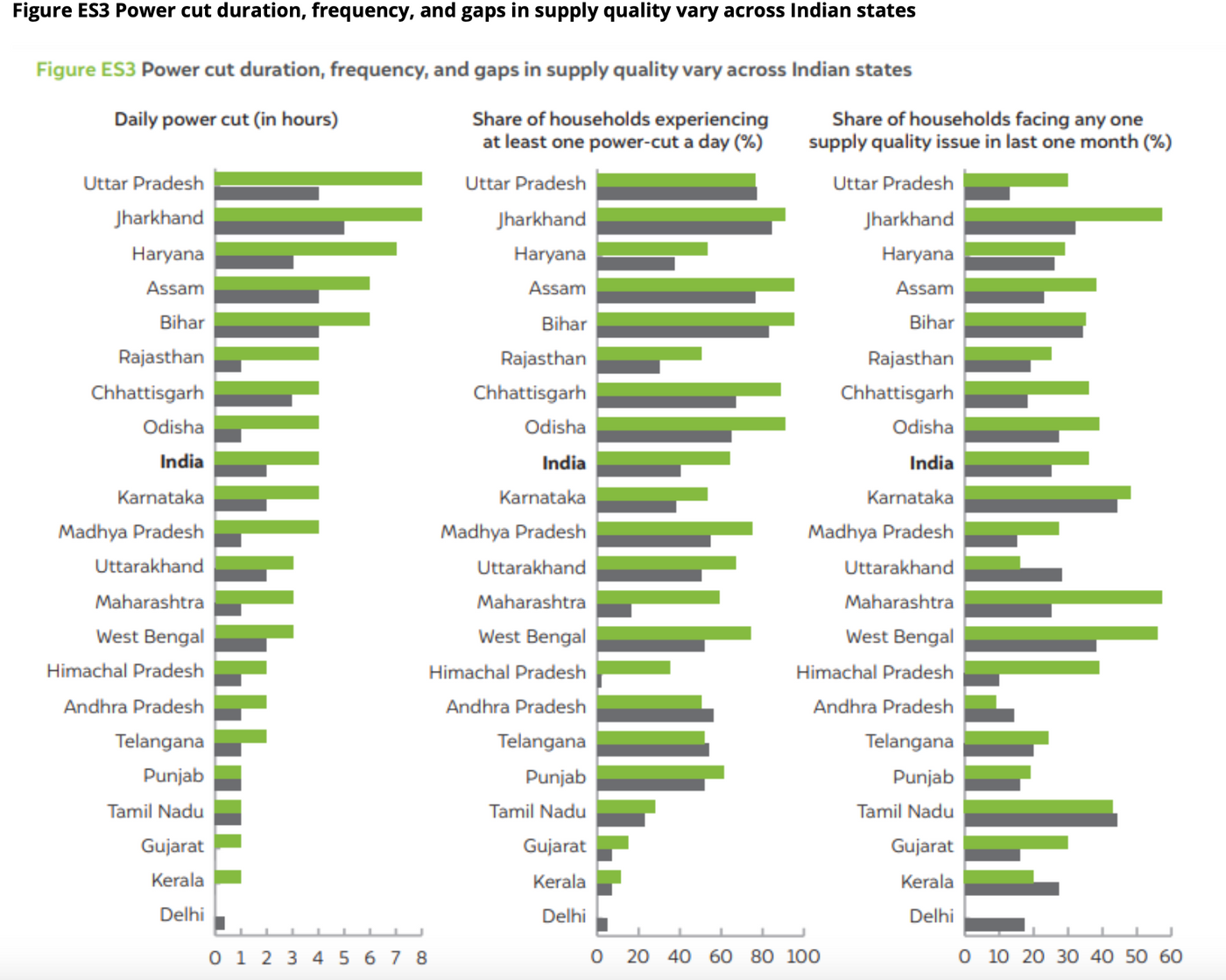
3. High Distribution Losses and Financial Stress
Distribution companies (Discoms) serving rural areas continue to struggle with high Aggregate Technical & Commercial (AT&C) losses, which in many states exceed 25 to 30%, far above the national target of 15% [4, 5]. In severely underperforming states like Jharkhand and Bihar, AT&C losses have historically surpassed 40%. Such losses cripple the financial viability of utilities and hinder their ability to reinvest in crucial infrastructure upgrades.
The drivers of these high losses are multi-layered:
Theft and Unauthorized Use: Illegal tapping of distribution lines remains widespread, accounting for 10 to 15% of total electricity supplied in some high-loss states [2, 4].
Low Metering Coverage: With millions of rural connections still unmetered, many households are billed on flat rates, leading to unaccounted energy consumption [6].
Subsidized Agricultural Tariffs: Politically motivated near-zero tariffs for agriculture, which consumes over 30% of electricity in states like Punjab and Haryana, create chronic revenue shortfalls and encourage over-consumption [5, 8].
This creates a vicious cycle: low revenues prevent maintenance and upgrades, leading to poor service quality. This, in turn, erodes consumers' willingness to pay, further increasing financial losses. The financial stress also forces Discoms to delay payments to power generators, resulting in load curtailments and rationing. Unless AT&C losses are drastically reduced, rural Discoms will remain trapped in a low-revenue, low-quality service loop.
4. Affordability and Demand-Side Constraints
Even modest electricity tariffs can strain rural household budgets. An average monthly bill of ₹500-₹800 can represent 5 to 8% of a low-income family's earnings, competing with essential expenses like food and healthcare [2, 4, 11]. Consequently, irregular payments and disconnections are common.
Subsidy regimes, particularly for agriculture, create further distortions. Large farmers often benefit from free electricity for irrigation, while small and marginal farmers, who constitute over 80% of the agricultural workforce, frequently lack the formal connections needed to access these subsidies [4].
On the demand side, rural electricity consumption remains low. The average rural household consumes only 50 to 80 kWh per month, compared to 180 to 220 kWh in urban areas. Appliance ownership is limited, and the productive use of power for income-generating activities is minimal. This low consumption reinforces the affordability challenge: if households do not perceive electricity as a source of tangible economic benefit, their willingness to pay declines.
5. Service Gap vs. Infrastructure Gap
The official narrative of "electrification" often obscures the significant qualitative gap between having infrastructure in place and having reliable, usable power [2, 14]. The administrative definition of an "electrified" village has allowed official statistics to overstate the actual level of meaningful energy access.
The infrastructure itself is often minimal and overloaded. Many villages are served by a single feeder line and one or two transformers, which frequently fail under excessive load. Decentralized renewable energy (DRE) solutions, such as solar home systems and micro-grids, have been deployed but suffer from high failure rates (30 to 40% in some states) due to weak maintenance frameworks and a lack of local technical capacity [1, 3, 17].
Ultimately, India's rural electrification challenge today is less about extending the physical grid and more about:
Closing the last-mile connection gap.
Ensuring reliable, high-quality, and affordable supply.
Aligning incentives for both utilities (to invest in service quality) and consumers (to pay for valued electricity).
Review of Existing Government Policies
Over the past two decades, India’s central government has launched several flagship schemes to advance rural electrification, primarily focusing on expanding physical connectivity and strengthening distribution infrastructure.
Rajiv Gandhi Grameen Vidyutikaran Yojana (RGGVY, 2005 to 2014)
Overview & Aims: RGGVY was India's first large-scale, centrally funded program to create electricity infrastructure in rural areas. Its objectives were to electrify all villages, provide free or subsidized connections to Below-Poverty-Line (BPL) households, and promote small off-grid solutions for remote habitations [1, 2].
What it Achieved: The program financed the construction of thousands of kilometers of rural lines, installed countless transformers and substations, and delivered millions of BPL connections. It created the foundational grid backbone that later schemes would build upon [1, 2].
Why it Fell Short: Its success was limited by a flawed metric design that equated "village electrified" with minimal household access. Rushed implementation led to poor quality control, and a lack of planning for operations and maintenance (O&M) meant that installed assets quickly degraded. The program also failed to stimulate productive electricity use, which is crucial for making rural electrification financially self-sustaining [1, 3].
Lessons Learned: Capital subsidies must be paired with robust O&M financing, quality assurance, and demand stimulation to ensure that physical assets translate into socio-economic benefits.
Deen Dayal Upadhyaya Gram Jyoti Yojana (DDUGJY, 2015-present)
Overview & Aims: DDUGJY aimed to improve the quality of rural power supply by segregating agricultural and domestic feeders, strengthening distribution networks, and completing village electrification. By separating farm and home connections, the scheme intended to provide more reliable power to households while managing agricultural loads more effectively [4, 5].
What it Achieved: DDUGJY financed widespread feeder segregation and network strengthening, significantly expanding substation capacity. It also led to the government's 2018 declaration that all census villages in India had been electrified [5, 6].
Why it Didn't Fully Deliver: The "village electrification" milestone again masked significant household connection gaps. Implementation varied sharply between states, with many continuing to suffer from poor supply quality. Furthermore, the scheme's capital investments were not sufficient to overcome the chronic financial ill-health of Discoms, which remained a major barrier to service improvement [4, 7, 10].
Lessons Learned: Infrastructure upgrades are ineffective without parallel reforms to improve the financial health of Discoms. A one-size-fits-all approach is insufficient; targeted support is needed for states with weaker institutional capacity.
Pradhan Mantri Sahaj Bijli Har Ghar Yojana (Saubhagya, 2017 to 2019)
Overview & Aims: Saubhagya was the first central scheme with the explicit goal of universal household electrification. It aimed to provide free or heavily subsidized connections to all willing rural and urban households by March 2019, using fast-track, digitally monitored connection drives [8, 11].
What it Achieved: The program delivered an astonishing number of new connections-official dashboards report between 21.8 and 28.6 million-dramatically increasing the count of electrified households nationwide [8, 11].
Why its "Universal" Claim is Contested: The scheme targeted only "willing" households, effectively excluding millions who did not apply due to lack of documentation, inability to pay future bills, or mistrust. Moreover, a connection did not guarantee usable supply; many newly connected households continued to receive poor-quality power. Data discrepancies between official dashboards and third-party surveys also cast doubt on the reported figures [4, 7, 8, 11].
Lessons Learned: Universal access policies must go beyond one-time connection drives. They require outreach to hard-to-reach households, documentary simplification, and robust post-connection support to ensure connections convert to regular, affordable usage. Independent verification is essential.
Revamped Distribution Sector Scheme (RDSS, 2021-present)
Overview & Aims: RDSS is not a connection drive but a systemic reform program designed to modernize distribution utilities. It links central grants and loans to performance improvements, such as reducing AT&C losses and closing revenue gaps. With a massive financial outlay of approximately ₹3.03 lakh crore, its key components include large-scale smart metering, feeder management, and IT integration [9, 10].
What it Targets: RDSS aims to reduce national AT&C losses to 12 to 15% and roll out millions of smart meters to improve billing and collection efficiency. Early action plans and pilot projects are already underway in several states [6, 13].
Why it Faces Uphill Challenges: The scheme demands complex technical and governance reforms that may exceed the capacity of weaker state utilities. The political economy of tariff reform and stricter revenue collection presents a major hurdle. Furthermore, there is a risk of a mismatch between capital investment in technology and the operational financing needed to sustain it [9, 6, 13].
Lessons Learned: For RDSS to succeed, it requires strong state-level implementation plans, social safeguards for vulnerable consumers, significant investment in human capital, and robust independent verification mechanisms to ensure that reported gains reflect real improvements in service quality and affordability.
To summarise, existing policies have successfully established a vast infrastructure network, but have not fully resolved the critical issues of last-mile coverage and service quality. The focus has been overwhelmingly on the supply side, with less attention paid to demand-side management or innovative, decentralized models.
Field Realities and Solutions
To design effective solutions, it is crucial to understand the on-the-ground conditions in rural India.
Supply Quality: Despite official claims, erratic supply remains the norm in many villages. In the six ACCESS states (Bihar, Jharkhand, MP, Odisha, UP, West Bengal), average rural supply improved to ~18.5 hours by 2020, but over 75% of households still experience unplanned outages at least once a week. Voltage fluctuations are also rampant, damaging equipment and disrupting daily life [6].
Consumption Patterns: Rural electricity usage is low, primarily limited to lighting and fans. Subsidized power for agriculture encourages groundwater over-extraction but generates little revenue for Discoms, while productive commercial or industrial demand is minimal [6].
Financial Stress on Discoms: Billing efficiency in rural areas is extremely low, with less than 60% of connections regularly billed in some regions. High costs of meter reading and poor collection mechanisms result in chronic financial losses, discouraging investment in network upgrades [6].
Local Perspectives: Field studies confirm that social and economic factors-such as an unwillingness to pay, poverty, and corruption-often limit the effectiveness of government schemes. Even after mass connection drives like Saubhagya, it is common to find clusters of households without legal connections [11].
These realities underscore that infrastructure alone is insufficient. However, the energy landscape is evolving. The falling costs of renewable energy and battery storage, combined with the spread of mobile communication, have created new opportunities for off-grid and hybrid solutions. Private entrepreneurs are increasingly active in this space, and international funds are financing innovative pilots. The following section proposes solutions that leverage these modern technologies and business models to bridge the power gap.
Solution 1: Decentralized Solar Microgrids
Concept: Install community-scale solar microgrids with battery storage to generate and distribute power locally. These can operate independently or in parallel with the main grid, supplying reliable power to homes, shops, and small enterprises. Companies like Husk Power and Tata Power have already demonstrated this model's success in India, providing 24/7 power at costs far below diesel generators [8, 10].
PASTEL Analysis:
Political: Aligns with national goals for clean energy and rural development but requires clearer state-level policies on licensing and tariffs for microgrid operators.
Social: Empowers local communities, creates jobs, and improves quality of life. High social acceptance, especially where the main grid is unreliable.
Technological: The technology (solar panels, batteries, smart meters) is mature, proven, and rapidly falling in cost. Maintenance is a challenge but manageable with proper operator models.
Economic: High initial capital cost but low operating costs. Can be economically sustainable through tariff revenues, carbon credits, and impact financing. Reduces local spending on expensive diesel fuel.
Legal: Operates in an evolving regulatory space. Draft national rules exist, but state implementation varies. Clearer legal frameworks are needed to reduce uncertainty for operators.
Environmental: Highly positive. Replaces polluting diesel generators and kerosene lamps, cutting CO₂ emissions and improving local air quality.
Solution 2: Pay-As-You-Go (PAYG) Solar Home Systems
Concept: Provide individual households with small solar home systems (panel, battery, lights) on a PAYG basis. Customers make small, regular payments via mobile money, gaining ownership over time. This model, successful in Africa, makes clean energy affordable for the poorest households without requiring a large upfront investment.
PASTEL Analysis:
Political: Complements government solarization goals and reduces pressure on state Discoms. Faces no significant political barriers as a private-market solution.
Social: Empowers low-income families by overcoming the primary cost barrier. High social impact, especially for women and children who benefit from safe, clean lighting.
Technological: Relies on proven, robust technology. Requires mobile network coverage for payments, which is widely available in India.
Economic: Turns a high capital cost into a manageable operating expense for users. Creates a viable market for private companies, supported by impact investors.
Legal: Minimal regulatory hurdles. Small, off-grid systems do not require licensing, making deployment straightforward.
Environmental: Positive impact by displacing kerosene and diesel, reducing indoor air pollution and carbon emissions on a per-household basis.
Solution 3: Private Distribution Franchises (Public-Private Partnerships)
Concept: A private firm or cooperative takes over billing, collection, and maintenance for a specific rural area under a long-term contract with the state utility. The franchisee leverages private sector efficiency to reduce losses and improve customer service, while the government retains control over the main grid infrastructure.
PASTEL Analysis:
Political: Politically sensitive due to fears of tariff hikes and opposition to privatization. However, it is supported by central government reform schemes (like RDSS) as a way to improve Discom health.
Social: Can improve accountability and service quality. However, strict enforcement of payments could create resentment among poorer households if not paired with strong social safety nets.
Technological: Requires modest technology like metering and billing software. Can be implemented with existing infrastructure, though smart meters would enhance efficiency.
Economic: Proven to significantly reduce financial losses and improve revenue collection. Creates a profit motive for efficiency, reducing the fiscal burden on the state.
Legal: A recognized model under India's Electricity Act. Success depends on well-drafted contracts that clearly define performance standards and revenue-sharing mechanisms.
Environmental: Neutral by itself, but can be positive by reducing energy wastage from losses and theft. Franchisees could also be incentivized to promote local renewable energy.
Solution 4: Community Energy Cooperatives
Concept: Villagers jointly invest in, own, and manage a local power system, typically based on renewable energy. The cooperative model leverages grassroots ownership, ensuring that costs and revenues remain within the community.
PASTEL Analysis:
Political: Aligns with India's cooperative tradition and goals of community empowerment. Likely to receive support from local governance bodies (Panchayati Raj).
Social: Fosters strong community ownership and commitment. Success depends heavily on local governance and social cohesion. Requires capacity building and training.
Technological: Utilizes proven, off-the-shelf renewable technologies. The main challenge is building local technical capacity for maintenance.
Economic: Pools local resources to lower per-household costs. Can access government loans and grants for rural development. Viability depends on strong governance and high collection rates.
Legal: Requires streamlined licensing processes for cooperatives to distribute power. Minor legal adjustments are needed to formalize the model.
Environmental: Strongly positive. Promotes local, sustainable, green development by prioritizing renewable resources.
Solution 5: Smart Grid and IoT-based Upgrades
Concept: Modernize existing rural distribution networks with smart meters, automated sensors, and data analytics. This technology allows for remote monitoring, quick fault detection, theft prevention, and optimized grid management, turning traditional networks into efficient "smart grids."
PASTEL Analysis:
Political: Aligns with national initiatives like "Digital India." Supported in principle by reform schemes like RDSS, but rural areas are often a lower priority for investment than urban centers.
Social: Empowers consumers with better information and more reliable service. Can improve transparency and satisfaction but requires public awareness campaigns to build trust.
Technological: Relies on mature, readily available technology. India has domestic manufacturing capacity for smart meters, and mobile networks cover most villages.
Economic: Requires significant upfront investment but offers long-term savings by reducing losses and cutting operational costs. The business case is strong, but financing remains a challenge.
Legal: Supported by existing electricity laws and regulations. Data privacy is a minor concern, and consumer protection frameworks are already in place.
Environmental: Modestly positive. Does not generate clean power but improves overall system efficiency, reduces energy wastage, and supports the future integration of renewables.
Solution 6: Hybrid Renewable Mini-Grids (Wind/Biomass)
Concept: Develop mini-grids that combine multiple local renewable resources-such as solar with wind, biomass, or micro-hydro-to ensure higher reliability. This hybrid approach maximizes the use of local resources and can provide consistent power even when a single source (like solar) is unavailable.
PASTEL Analysis:
Political: Aligns with the national push for renewable energy. However, implementation is limited, and coordinating across different ministries can be a challenge.
Social: Harnesses local resources and knowledge, fostering community ownership and creating rural jobs. High social acceptability due to its localized benefits.
Technological: The individual technologies are mature, but their integration adds complexity. Requires skilled engineering and operators for reliable performance.
Economic: Higher capital expenditure than single-source systems, but also higher reliability and capacity, which can serve larger commercial loads. Improved viability due to economies of scale.
Legal: Navigation is more complex than for single-source projects, as it may involve multiple types of permits (e.g., for wind, biomass, and land use).
Environmental: Offers very strong environmental returns by maximizing renewable energy utilization and resilience while managing local waste streams (biomass).
Comparative Evaluation and Recommendation
Dimension | Decentralized Solar Microgrids (1) | PAYG Solar (2) | Private Franchises (3) | Community Co-ops (4) | Smart Grids (5) | Hybrid Mini-Grids (6) |
Coverage & Scale | Village/Cluster | Household | Improves existing grid | Village/Community | Improves existing grid | Village Cluster |
Reliability | High (24/7) | Basic | Improves grid | Moderate-High | Improves grid | Very High |
Economic Viability | High (Proven) | High (Micro-level) | High (System-level) | Moderate | High (Long-term) | Moderate (High CapEx) |
Technical Complexity | Moderate | Low | Low | Moderate | Moderate-High | High |
Social Impact | High | Very High | Moderate | Very High | Moderate | High |
Recommendation
Among these diverse solutions, Decentralized Solar Microgrids (Solution 1) emerge as the most effective, scalable, and near-term solution for bridging India’s rural power gap. This recommendation is based on several key advantages:
Proven Success and Scalability: Companies like Husk Power and Tata Power have already demonstrated that the solar microgrid model is both technically and financially viable in the Indian context, with clear plans for scaling to thousands of communities [8, 10].
Rapid and Targeted Impact: Microgrids can be deployed far more quickly than central grid extensions, directly addressing the needs of unelectrified or poorly served areas with minimal delay.
High Reliability: When coupled with battery storage, solar microgrids can deliver the 24/7, high-quality power that rural communities need for both domestic life and economic development-a key deficiency of the current grid.
Economic and Environmental Synergy: They are cost-effective compared to diesel generators, create local economic opportunities, and directly contribute to India’s climate goals by displacing fossil fuels.
While other solutions have their merits-smart grids and franchises are crucial for improving existing networks, and PAYG and cooperatives are excellent for last-mile and community-led initiatives-solar microgrids strike the optimal balance of technical maturity, community benefit, and scalability.
Therefore, we recommend that India prioritize the deployment of solar microgrids as a flagship solution, supported by clear financing mechanisms and streamlined regulatory frameworks. This approach, supplemented by smart grid upgrades and PAYG models where appropriate, offers the fastest and most sustainable path to achieving genuinely inclusive and reliable rural electrification.

Conclusion
India's journey toward rural electrification is a story of remarkable progress shadowed by persistent challenges. While government initiatives have successfully extended infrastructure to nearly every village, this analysis demonstrates that true access goes beyond a mere connection. The "power gap" is now defined by reliability, quality, and affordability. To bridge this gap, India must move beyond conventional, top-down approaches and embrace innovative, decentralized solutions.
This study has proposed and evaluated six such approaches. Our analysis indicates that decentralized renewable energy solutions, particularly community-scale solar microgrids, offer the most promising path forward. They are technologically mature, economically viable, and environmentally sustainable. By leveraging India's abundant solar resources and fostering local business models, microgrids can deliver the reliable, 24/7 power that rural communities need to thrive.
Implementing this vision will require coordinated action: state governments must create clear regulations for microgrid licensing, financial institutions must develop affordable capital solutions, and implementers must engage communities to ensure local buy-in. The potential payoff is immense-not only in raising living standards and unlocking economic opportunities in rural India but also in advancing the nation's broader sustainable development and climate goals. The next wave of rural electrification must be about empowering communities from the ground up, ensuring that every household has not just a wire, but a gateway to a brighter future.
References
Sahu, A., et al. (2020). [Article on mini-grids / rural electrification]. ScienceDirect.
The Energy and Resources Institute (TERI). "Rural electrification: challenges and way ahead." TERI Opinion.
Revolve Media. "Overcoming barriers to energy access in rural India."
Council on Energy, Environment and Water (CEEW). Research on state of electricity access and coverage in India.
World Bank. (2015). Rural electrification background report.
Council on Energy, Environment and Water (CEEW). (2025). "Access to electricity, availability and electrification percentage in India." CEEW Data Portal.
Economic Diplomacy Division, Government of India. (2018). "100% rural electrification achieved in 2018." IndBiz (Ministry of Commerce & Industry).
Hitchens, K. (2022). "Solar microgrids to electrify 80 new communities in India." Microgrid Knowledge.
Ministry of Power, Government of India. (2025). Year End Review 2024. Press Information Bureau.
Sinha, P. (2021). "Solar Microgrids for Rural Electrification." Tata Power Newsroom.
Dutta, S. (2018). "Modi Announces 100% Village Electrification, But 31 Million Homes Are Still in the Dark." Forbes (referenced in Power For All analysis).
"Electricity sector in India." Wikipedia.
ET Energyworld. (2019). "Infographic: Cumulative distribution of hours of power supply in India."
Urpelainen, J. (2019). "Saubhagya scheme: millions remain without electricity." Power For All.
United Nations Environment Programme (UNEP). Renewable-energy-based rural electrification, the mini-grid experience from India.
Agrawal S, Mani S, Jain A, Ganesan K. (2020). State of Electricity Access in India: Insights from the India Residential Energy Survey (IRES) 2020. New Delhi: Council on Energy, Environment and Water.