

Parallel PoliticsFree preview
The politics behind the news,and the ideas that move nations.
Why do people obey rules they never voted for?Can the same votes elect different winners?And who really decides what happens between nations?This course shows how politics works, at home, in India and across the world, and gives every side its best case.
- Explain how a democracy works: power, the state, the three branches, laws and rights.
- Describe the main ideologies in the words of their own supporters and critics.
- Read the UN, the G20 and a multipolar world, and why cooperation between nations is hard.
- Compare electoral systems, and explain how India's Constitution works in practice.
 With Swagat YadavFounder and CEO, One Young India, and author of Learnacy
This course is for learning. It takes no side in party politics: no Indian party, candidate, leader or election is placed or judged. Ideologies are described in the words of their own supporters and critics, and wars and disputes only through neutral facts.
Politics is already in your day
You have never stood for election, and you may not be old enough to vote.But you have argued about rules, shared things out and lived by decisions you did not make.
- Politics is how people who disagree still live by one decision: at home, in class, in a country and in the world.
- This course takes no side: no Indian party, candidate, leader or election is placed or judged.
- Ideologies come in their supporters' words and their critics' words; wars and disputes only through neutral facts.
Who gets the remote?
Do you take part in politics? You may say no: politics is for grown-ups, for people on the news, for elections.
Then who decides who gets the television remote in your home, or whose turn it is to wash the dishes? Who made the seating plan or the uniform your class follows, a rule you never agreed to? When friends argue about where to go, what settles it: a vote, or the loudest voice?
Who gets the remote is a decision about power. The seating plan is authority. The vote, or the loudest voice, is a choice about how to decide.
Politics happens in parliament, and in every place where people who disagree must still live by one decision. A home. A class. A housing society. A country. The world. This course starts at home and walks out to the world, one step at a time.
When friends argue about where to go, what settles it?
Your answer
Anonymous: we count answers, nothing else.
What does your gut say?
Three quick questions before we begin. There is no score, and nothing leaves this page. At the end of the course you will see your first answers next to what you know by then.
How this course works
Four parts and 27 chapters, then a wrap-up, about 12 hours, at your own pace. Each chapter has:
- a story, something to try and a question to argue about,
- an "In short" box at the top, so you can see the main points first,
- a link into World 101, Learnacy's map of what the world knows, and sometimes a Learnacy Lab to play with,
- a note for your notebook, and
- a five-question check. Pass it with 4 right, as often as you need.
Pass every chapter check and the final round, and you get a certificate of completion with a link anyone can use to verify it.
Three promises. This course takes no side in party politics: no Indian party, candidate, leader or election is placed or judged, in a chapter or in a check.
Every ideology is described first in the words of its own supporters, then in the words of its critics. And every war or dispute is described only through neutral facts, with no side judged. When an example is made up, it says so.
One rule for the whole course: principles before personalities. We will talk about ideas, systems and rules, not about which politician you like. Ask what a rule does and why, before you ask who made it.
Explore in World 101
This course draws on four fields of World 101: political science and governance, law and justice, global challenges, and history. Each part opens with three subjects to explore. Start now: open Power, Authority and Legitimacy, spend five minutes there, and write down one question on who decides that you cannot answer yet.
And when you want to see how policy is actually made in India, step by step, this course points you to Model NITI Aayog, One Young India's course on public policy. See the Model NITI Aayog course.
Politics is wherever people who disagree must live by one decision, from my home to parliament.
One place in my life where people who disagree have to live by one decision, and how that decision gets made.
Who decides?
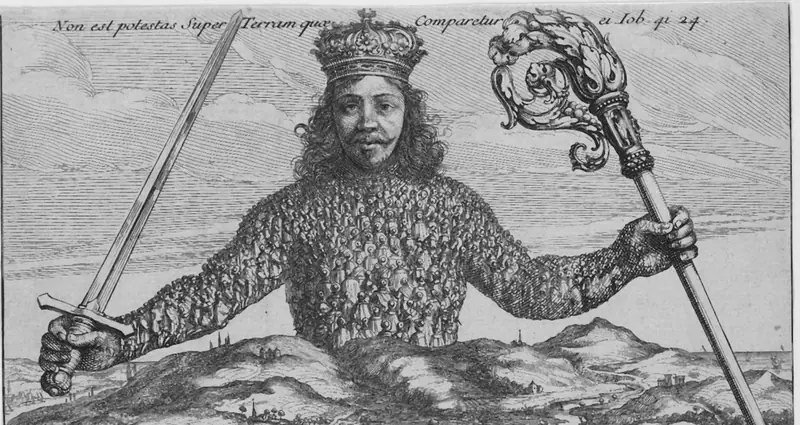
A referee is often the smallest person on the field.So why does everyone stop when the whistle blows?
From the title page of Leviathan by Thomas Hobbes, London, 1651: a crowned giant whose body is made of hundreds of tiny people.Engraving: Abraham Bosse, public domain (author died more than 70 years ago), via Wikimedia Commons. Cropped by One Young India.
- Power is the ability to make someone act; authority is power that people accept as rightful.
- Legitimacy is that acceptance. One classic account names three sources: tradition, personal appeal, and rules and offices.
- Modern democracies rest mostly on rules and offices: people obey the office, and leaders leave when the rules say so.
- The idea of a social contract says a government's authority is lent by the people.
The smallest person on the field
Think of a football match on your school ground. Twenty-two players, most of them bigger and faster than the referee. The whistle blows for a foul. The player who was fouled stops. The player who did the fouling stops too, even though he is sure he did nothing wrong. Could the referee force them to stop? No. Could the players simply carry on? Yes. So why do they stop?
Because they accept that she has the right to decide. Not the strength. The right. That difference, between being able to make people do something and being accepted as the one who should decide, is one of the oldest questions in politics. Who decides? And why do the rest of us go along?
The whistle blows for a foul. Think of your answer, then tap each card.
Power needs no agreement; authority needs people to accept it
Power is the ability to make someone do what they would not otherwise do. A senior who pushes to the front of the canteen queue has power over the juniors behind him. Power does not need anyone's agreement.
Authority is power that people accept as rightful. The referee has authority. So does a teacher who sets homework, or a court that settles a dispute. You may dislike the decision, but you accept that this person, in this role, may make it.
What is the opposite of authority? Force: power that nobody accepts. Authority without power is a referee nobody listens to, and that does not last long. A government needs both. It needs the ability to carry out its decisions, and it needs most people to accept that it should be the one making them.
Tradition, personal appeal or the rulebook?
Why do people accept some authority and not other authority? Political scientists call that acceptance legitimacy. A rule is legitimate when the people who live under it believe it is rightful, even when they dislike a particular decision.
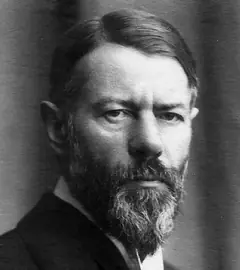
One classic account in political sociology describes three sources of legitimate authority. In plain words:
- Tradition: "it has always been done this way". A family elder, or a ruler whose family has always ruled.
- Personal appeal, often called charisma: people follow a leader because of who that person is.
- Rules and offices: people obey the office, not the person. The referee is obeyed because of the rulebook, and the next referee will be obeyed in the same way.
A modern democracy runs mostly on the third. A prime minister or a president is obeyed because of the office and the rules that gave it to them, and must leave when the rules say so. That is why the rules about how power changes hands matter so much.
At home, your parents' authority may rest partly on tradition and partly on love. In a nation, the government's authority is meant to rest on rules: a constitution, elections and laws.
Power or authority?
Five made-up scenes. In each one, is someone using power alone, or authority that the others accept?
Made-up scenes. Is each one power alone, or authority that the others accept?
The contract nobody signed
Why should anyone accept rules made by other people? One old answer is that people have, in some sense, agreed. Several European thinkers, centuries ago, called this the social contract: people give up some freedom to a government in return for order and protection, and the government's right to rule depends on that bargain.
They drew very different conclusions from the same idea, from a strong ruler who keeps the peace to a people who may withdraw their consent.
Nobody, you included, ever signed a social contract. So is it just a story? Partly, but it is a useful one. It says that a government's authority is borrowed, not owned. It is lent by the people, and the people can ask for it back. In a democracy, an election is the regular moment when they can.
I am not saying every rule you dislike is illegitimate. I am saying that "why should I obey this?" is a fair question, and a good government has an answer.
Why trade freedom for rules? The social contractCrashCourse · 5 min
What to watch for Why Hobbes thought people would give up some freedom for safety, and the rules we follow though we never agreed to them.
Before you read the two sides. Should students have a say in school rules?
Your answer now
Anonymous: we count answers, nothing else.
Should students have a say in school rules?
Many schools have a student council. Should students help make the rules they live by?
Rules that students help make are rules students are more likely to keep. Taking part teaches how to argue, listen and give way, which is what citizens do. And students know things about school life that adults miss.
A school must keep children safe and teach a full syllabus, and adults carry that responsibility. Students change every year and may vote for what is pleasant now rather than what is good later. Some decisions need experience.
A hard case. A rule on phones in class. Students vote to allow them; teachers believe phones harm learning. Whose view should decide, and why?
Find one rule in your school that students had a say in, and one they did not. Ask two students and one teacher how well each rule is kept. Does having a say change how well a rule is followed?
After the debate. Should students have a say in school rules?
Your answer after the debate
Anonymous: we count answers, nothing else.
Go deeper When the whistle stops counting
What happens when people stop accepting an authority? Sometimes they protest. Sometimes they quietly ignore it. Sometimes it collapses, and historians call the sudden collapse of a political order a revolution. You will meet one in Part 2, where the words "left" and "right" were born. Then come back to the referee: a revolution is what happens when enough players decide the whistle no longer counts.
Explore in World 101
Legitimacy is studied by political scientists, philosophers and historians. Open Power, Authority and Legitimacy in World 101 and see where it leads: Democracy is one next step. Why does legitimacy lead there?
Find the number
Find out how the head of your school, or the committee of your housing society, is chosen. Use its own rules, handbook or website. How many people take part in the choice, and which of the three sources of authority does it rest on?
Check your understanding
Five questions. Pass with 4 right; try as often as you like. Each answer comes with its reason.
"Why should I obey this?" is a fair question, and a good government has an answer.
One rule I follow, and the best reason I can give for obeying it.
That was chapter 1 of 27
Next
- The state
- Democracy
- The three branches and how a law is made
- Ideologies from left to right
- The United Nations and the G20
- Why nations struggle to cooperate
- Electoral systems
- India's Constitution in practice
Four parts, about 12 hours, then the final round and your completion certificate.
Already a member? Continue in part 1. The check you passed here carries over when you are logged in. Course home