
Curious ComputingFree preview
The machines and ideasrewriting the world.
How does a photo cross the world in a second?What is a chatbot really doing when it writes?And why can three ordinary facts about you give away who you are?This course opens up the machines you use every day, and shows the ideas inside them.
- Explain how a message travels across the internet, from your phone to a server and back.
- Read simple code, follow an algorithm step by step, and weigh its trade-offs.
- Say what AI is, how it learns, and where it fails.
- Protect your data and your accounts, and think like the people who defend systems.
 With Swagat YadavFounder and CEO, One Young India, and author of Learnacy
This course is for learning. It never asks for a password or any real personal data, names no company or app to praise or blame, and takes no side in party politics.
The machines you already use
You carry a computer, talk through a network and meet algorithms all day.This course opens them up, one idea at a time.
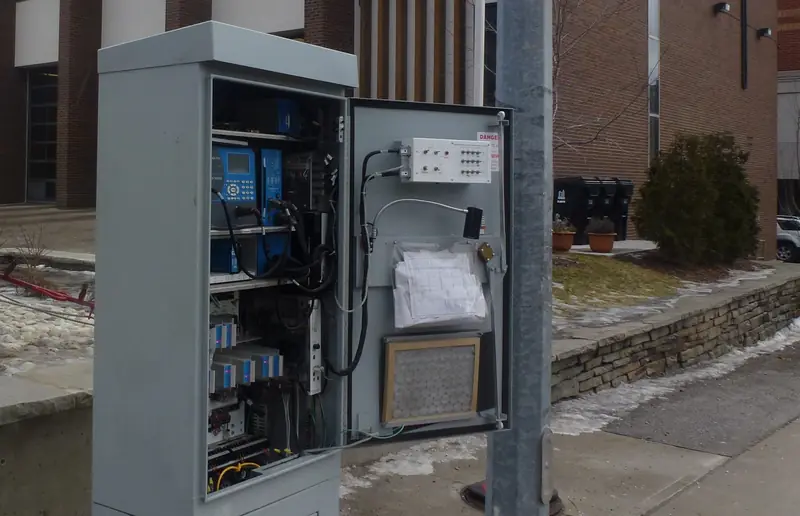
A traffic light controller at a street corner in Toronto, its door open. Inside the grey box are the circuit boards of a computer most people walk past.Photo: booledozer, public domain (released by its author), via Wikimedia Commons. Cropped by One Young India.
- You use many computers a day, most of them hidden inside other things.
- This course opens them up: the internet, code and algorithms, AI, and your data and security.
- It never asks for a password or real personal data; examples say whether they are made up or real.
How many computers have you used today, counting the hidden ones?
Your answer
Anonymous: we count answers, nothing else.
The computers you did not count
The phone that woke you up is a computer. So is the chip in the lift, the card reader at the shop and the box that runs the traffic signal. How many computers have you used today? One, maybe two? Count again.
When you sent a message, it crossed a network of other computers you will never see. When an app showed you a video, an algorithm chose it. When your phone recognised your face, a model that learned from examples made a guess.
You use many computers a day without seeing them. This course is about those machines and the ideas inside them: how the internet actually moves your messages, how code and algorithms work, what AI is and is not, and how to keep your data and your accounts safe.
Is that too much for one course? No. Every one of those ideas rests on a few simple ones, and you can learn the simple ones in an afternoon. The rest is putting them together.
What does your gut say?
Three quick questions before we begin. There is no score, and nothing leaves this page. At the end of the course you will see your first answers next to what you know by then.
How this course works
Four parts and 26 chapters, then a wrap-up, about 12 hours, at your own pace. Each chapter has:
- a story, something to try and a question to argue about,
- an "In short" box at the top, so you can see the main points first,
- a link into World 101, Learnacy's map of what the world knows, and often a Learnacy Lab to play with,
- a note for your notebook, and
- a five-question check. Pass it with 4 right, as often as you need.
Pass every chapter check and the final round, and you get a certificate of completion with a link anyone can use to verify it.
Two promises. This course never asks for a password or any real personal data, and nothing you type in it leaves your device except your answers to the checks and, if you ask for a certificate, the name on it.
And it names no company or app to praise or blame: when a chapter needs one, it says "a messaging app" or "a map app". Every example is made up and says so, or comes from a real source.
Two courses sit next door. Math Magicians teaches binary, ciphers, prime numbers and strong passwords. Managing Media teaches your digital footprint, deepfakes, chatbots that sound sure, and India's data protection law. This course links to them when it needs them, and goes further.
One rule for the whole course: questions are more important than answers. In computing, "how does that actually work?" opens every box. And it is normal not to know. Nobody understands every layer of a phone, not even the people who build them. Each of them knows a few layers well, and trusts the rest.
Explore in World 101
Open Computing Fundamentals in World 101 and browse it for five minutes. Save one question it raises in the note below: it may become the question you write on at the end of the course.
The machines I use every day are built from a few simple ideas, and I can learn them.
One machine or app I use every day that I would most like to understand from the inside.
A message in pieces
Your message does not travel as one thing.It is cut into pieces, each piece finds its own way, and the pieces are put back together at the other end.
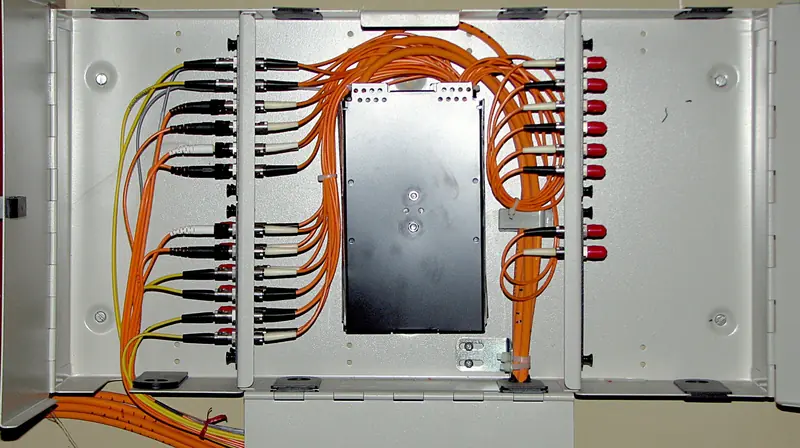
An optical fibre distribution frame with its doors open. Fibre cables come in from below, and short orange cords join one connector to another to send the light on its way.Photo: "Optical-fiber-distribution-frame-0a" by Adamantios, CC BY-SA 3.0, via Wikimedia Commons. Cropped by One Young India. The crop is shared under the same licence.
- A message is cut into packets: small pieces, each with an address and a number.
- Routers pass each packet one step closer; none of them knows the whole road.
- When a cable breaks, routers find another way, so the internet bends instead of breaking.
- The phone at the other end puts the packets back in order.
The photo that travelled in pieces
You take a photo and send it to a friend in another city. A moment later, it is on her screen. How did it get there? Did it fly through the air the whole way? No. Did it travel as one photo? Also no.
Your phone cut the photo into many small pieces. Each piece got a label with the address it was heading for, like an envelope.
The pieces left your phone by radio, reached a tower or your home router, and then raced along cables, passing from machine to machine. Some pieces took one road and some took another. At the other end, your friend's phone collected them, put them back in order and showed her the photo.
Nobody planned the whole journey. Each machine on the way decided only one thing: where to send the piece next. That is the surprising idea at the heart of the internet.
The photo's journey, from the story. Think of your answer, then tap each card.
Packets: the internet's envelopes
A packet is a small piece of data with a label on the front. The label says where the packet came from, where it is going, and which piece of the message it is. How big can one packet be? On Ethernet, the most common kind of wired network, a packet can be at most 1,500 bytes long, label included. Some networks allow larger or smaller ones.
Why cut a message into pieces at all? Think of a road. If one huge truck used the road, everyone else would wait behind it. If the load goes in many small vans, the road can carry vans from many people at once, mixed together. That is what the internet does.
Your photo, a video call next door and a stranger's email share the same cables, one small packet at a time.
The opposite is the old landline telephone. When you made a call, the network kept a whole line open just for you, from one end to the other, for as long as you talked, even in the silences. That is called circuit switching. The internet uses packet switching: no line is kept for you, and every packet finds its own way.
Routers: machines that know only the next step
A router is a computer whose job is to pass packets on. Your home Wi-Fi box is a small router. Large routers sit in buildings run by internet providers, joined to each other by cables.
Does a router know the whole road to your friend's phone? It does not, and it does not need to. It keeps a table that says, for each group of addresses, which neighbour is closer to them. A packet arrives, the router reads the address, sends the packet to that neighbour and forgets it. The next router does the same.
What happens if a cable is cut? The routers next to it notice, update their tables and send packets another way. The message still gets through, perhaps a little slower. Nobody has to fix the whole network by hand. That is why the internet bends instead of breaking.
Send a message in pieces
A made-up network: your phone, four routers and your friend's phone. Send a message and watch its packets take their own roads. Then cut a cable and send it again.
A made-up network. Each line is a cable between two machines; A to D are routers.
Why the pieces can arrive out of order
Packets that take different roads can arrive in a different order. Piece 5 might come before piece 2. So each label carries a number, and your friend's phone puts the pieces back in order before it shows anything. A piece that never arrives is asked for again; you will see how in chapter 4.
How does a photo reach a friend in a second? It is cut into labelled packets, each router sends each packet one step closer, and the phone at the other end rebuilds the photo from the pieces.
Three ways to share a networkCrashCourse · 4 min
What to watch for A line held open for each call, then whole messages passed from station to station, then small numbered packets that each find their own way.
The 2D version of every Learnacy lab is free with a Learnacy account.
Go deeper Where your provider meets everyone else's
Your packets often have to cross from your provider's network into someone else's. Providers meet at buildings called internet exchanges, where their routers are joined so traffic can pass straight across instead of taking a long way round. A country with exchanges in many cities keeps more of its own traffic close to home.
In June 2026 the government said the National Internet Exchange of India, NIXI, runs 79 of these exchanges across the country.
NIXI's own list places them in more than 60 towns and cities, from Srinagar in the north to Thiruvananthapuram in the south, and from Rajkot in the west to Guwahati in the east. Mumbai and Navi Mumbai have the most, with 7 locations between them, and nearby Thane and Vasai listed on their own.
Before you read the two sides. Where should the next rupee for networks go first?
Your answer now
Anonymous: we count answers, nothing else.
Faster internet for cities, or some internet for every village first?
Money for building networks is limited. Where should it go first?
A village with no connection loses the most: no online classes, no doctor on a video call, no government services from home. A first connection changes a life more than a faster one, so villages should come first.
Cities hold most users, businesses and hospitals. Faster networks there pay for themselves and fund the next expansion, so spending first where it earns most may connect villages sooner in the end.
A hard case. One budget. A remote school with no connection at all, or a city hospital whose network is too slow to send scans to specialists.
Find the share of people in your state who use the internet, from the telecom regulator's or the national statistics office's latest figures. Who would gain most from the next rupee spent?
After the debate. Where should the next rupee for networks go first?
Your answer after the debate
Anonymous: we count answers, nothing else.
Explore in World 101
The internet is many networks agreeing to carry each other's packets. Open Networks and the Internet in World 101 and find the thread that leads to International Relations. What could routers passing packets along have in common with countries dealing with each other?
Find the number
Find the number of internet subscribers in India in the latest quarterly "Indian Telecom Services Performance Indicators" report from the Telecom Regulatory Authority of India (TRAI). How many connect through mobile phones, and how many through a wire into the home? Write both, with the quarter.
Check your understanding
Five questions. Pass with 4 right; try as often as you like. Each answer comes with its reason.
The internet works because every machine on the way decides only one step.
One thing in my life that works because many small parts each do one simple job.
That was chapter 1 of 26
Next
- Names and addresses
- The cables under the sea
- The web
- Reading code
- Searching and sorting
- How machines learn
- Chatbots
- Anonymous data
- How attacks and defences really work
Four parts, about 12 hours, then the final round and your completion certificate.
Already a member? Continue in part 1. The check you passed here carries over when you are logged in. Course home