
A Peek Beyond the Point | CBSE Class 7 Maths Notes
On this page

This note covers smaller units of measurement, tenths, hundredths, thousandths, decimal place value, reading decimals, unit conversions, number lines, comparison, addition, subtraction, decimal sequences, estimation, and the interpretation and history of decimal notation.
Why do we need units smaller than one?
A unit is the chosen amount used as one in a measurement. A centimetre, written cm, is a unit of length. A whole number counts complete units without a fractional part, which is an amount smaller than one unit. An object need not measure an exact whole number of centimetres. Smaller equal parts help us describe its length more accurately.
Sonu watches his mother repair a toy using a screw. Two screws look the same to him, but closer observation shows that their lengths are slightly different. That small difference matters when choosing the screw that fits.
What is a tenth?
Definition: One-tenth is one of ten equal parts of a unit. It is written as the fraction 1/10. A fraction expresses a quantity in terms of equal parts. In a fraction, the denominator, below the fraction bar or after the slash, names the number of equal parts.
The numerator, above the fraction bar or before the slash, counts the parts taken. Thus 7/10 means seven one-tenths. The signs +, = and × mean addition, equality and multiplication respectively; brackets group quantities that are considered together.
A length of 2 + 7/10 cm contains two whole centimetres and seven further tenths of a centimetre. Begin at zero, move through two full units, and then count seven smaller divisions. The smaller divisions must represent equal lengths.
What the figure shows
Measuring screws with finer divisions
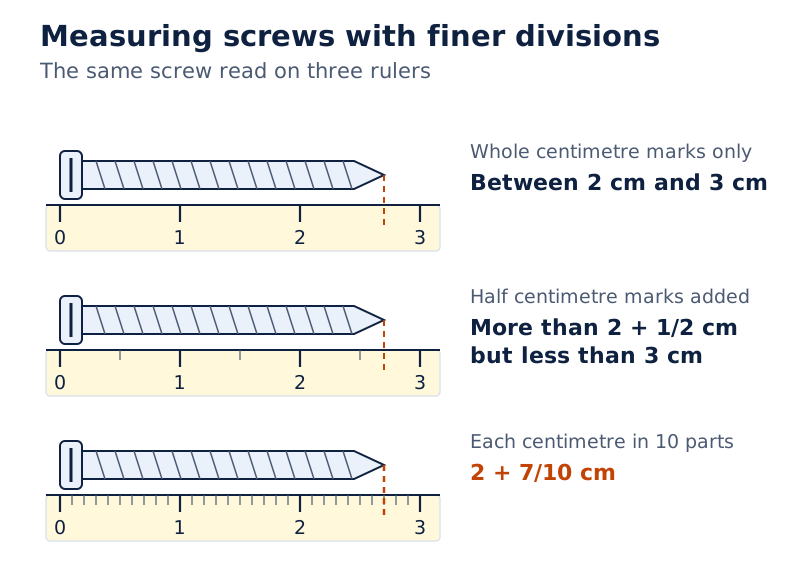
Drawings show screws above yellow rulers with increasingly fine divisions. For the first screw, the labels progress from between 2 cm and 3 cm to the precise length 2 + 7/10 cm.
Drawn by One Young India. Reference: NCERT Class 7, page 47
Property: Ten tenths make one unit
Since ten equal tenths fill one whole, 10 × 1/10 = 1. This allows a length to be expressed either in whole units and tenths or entirely in tenths. Both descriptions refer to the same quantity.
Worked example 1. Express a pencil length of 3 units and 4 tenths entirely in tenths.
Answer: Three units contain 30 tenths. Adding 4 tenths gives 34 tenths, so 3 + 4/10 = 34/10. Read the first form as three and four-tenths, and the second as thirty-four tenths.
How do we add and subtract lengths measured in tenths?
Addition combines quantities to give a sum, or total. Subtraction finds their difference, the amount by which one exceeds the other in these examples. The subtraction sign is −. When lengths use the same unit, whole units can be combined with whole units and tenths with tenths. Exchanging ten tenths for one unit is called regrouping.
How does regrouping help with addition?
Worked example 2. Sonu’s lower arm measures 2 + 7/10 units and his upper arm measures 3 + 6/10 units. Find their combined length.
Answer: The whole units give 2 + 3 = 5. The tenths give 7 + 6 = 13 tenths. Exchange 10 tenths for one unit. The result is 6 units and 3 tenths, or 6 + 3/10 units.
The same addition can be performed using tenths throughout. The two lengths become 27 tenths and 36 tenths. Their sum is 63 tenths, which contains 60 tenths and 3 tenths. Since 60 tenths make 6 units, both methods give the same result.
How does regrouping help with subtraction?
Worked example 3. Shylaja’s hand measures 12 + 4/10 units, including a palm measuring 6 + 7/10 units. Find the length of her longest, middle finger.
Answer: Subtract the palm length from the hand length. Rewrite 12 units and 4 tenths as 11 units and 14 tenths. Subtracting 6 units and 7 tenths leaves 5 units and 7 tenths. The finger measures 5 + 7/10 units.
The exchange changes how the starting length is written, while preserving its value. This is why the whole-unit count must fall by one when ten extra tenths are introduced. The calculation uses the same idea as regrouping whole numbers during subtraction.
Keep the measurement unit attached to the answer. These arm and hand measurements are expressed in units; they should not be relabelled as centimetres without information specifying that unit.
How do hundredths and thousandths extend tenths?
A hundredth, written 1/100, is one of one hundred equal parts of a unit. Divide each tenth into ten equal parts. There are ten tenths in the unit, so this creates one hundred smaller parts altogether.
Finer divisions become useful when a length falls between two neighbouring tenth marks. Naming the surrounding tenths locates the length within an interval, meaning the stretch between those marks. Hundredth divisions allow a more precise reading within that interval.
What happens when the paper is folded?
Worked example 4. A sheet of paper measures 8 units and 9 tenths. It is folded in half along its length. Express the folded length using units, tenths and hundredths.
Answer: The folded length is 4 units, 4 tenths and 5 hundredths. This can also be written as 4 units and 45 hundredths, because 4 tenths contain 40 hundredths.
What the figure shows
Reading the folded paper
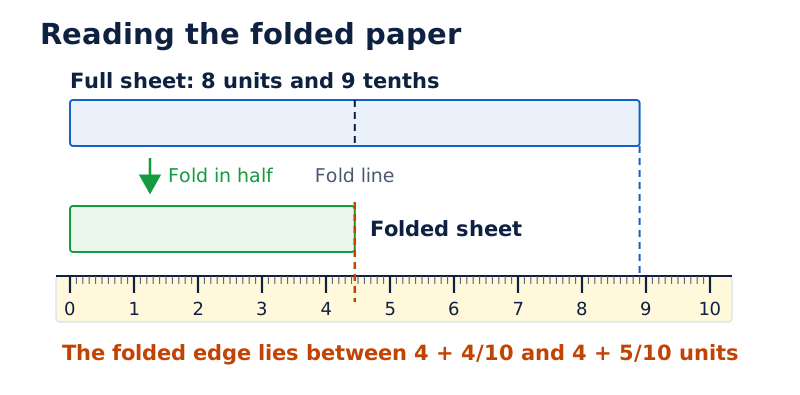
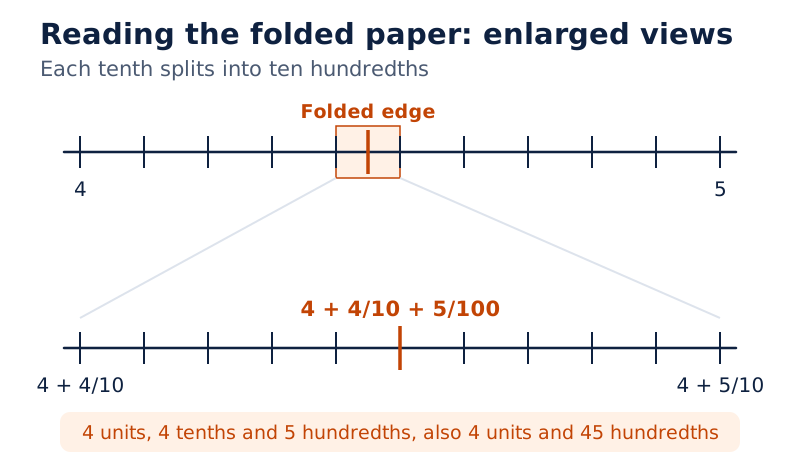
The drawing places the full sheet and folded sheet above rulers. Enlarged views show the folded edge between 4 + 4/10 and 4 + 5/10, with smaller divisions locating it at 4 + 4/10 + 5/100.
Drawn by One Young India. Reference: NCERT Class 7, page 53
Property: Each place divides into ten of the next smaller place
Ten hundredths make one tenth. Dividing a hundredth into ten equal parts gives a thousandth, written 1/1000. Ten thousandths therefore make one hundredth, and one thousand thousandths make one whole unit.
| Smaller parts | Equivalent quantity |
|---|---|
| 10 tenths | 1 unit |
| 10 hundredths | 1 tenth |
| 100 hundredths | 1 unit |
| 10 thousandths | 1 hundredth |
| 1000 thousandths | 1 unit |
The extension can continue beyond thousandths. Each move towards a smaller place divides the previous place value by ten. The symbol ÷ means division. This repeated relationship connects whole-number places with the smaller fractional places.
How does the decimal point tell us each digit’s value?
Place value is the value associated with a digit’s position. In 281, the digit 2 represents hundreds, 8 represents tens and 1 represents ones. A digit is a single symbol used in writing a number.
Moving one place left multiplies the place value by ten; moving one place right divides it by ten. Extending this arrangement beyond the ones place gives tenths, hundredths and thousandths. The decimal system is this system of writing numbers based on ten.
Definition: The decimal point is the dot separating the whole-number part from the fractional part. A whole-number part counts complete units; a fractional part describes the remaining amount smaller than one unit.
How can the same digits describe different quantities?
| Quantity | Decimal notation |
|---|---|
| 7 hundreds and 5 ones (700 + 0 + 5) | 705 |
| 7 tens and 5 tenths (70 + 0 + 5/10) | 70.5 |
| 7 units and 5 hundredths (7 + 0/10 + 5/100) | 7.05 |
Notation means a way of writing quantities using symbols. The decimal point distinguishes the three quantities in the table. In 7.05, zero preserves the tenths position, leaving the 5 in the hundredths position.
How should decimals be read aloud?
Read 70.5 as seventy point five and 7.05 as seven point zero five. Read the digits after the point separately. Thus 0.274 is zero point two seven four: 2 tenths, 7 hundredths and 4 thousandths.
Worked example 5. Write 234 tenths in decimal notation.
Answer: Split 234/10 into 200/10 + 30/10 + 4/10. These quantities are 20, 3 and 4 tenths. Adding them gives 23.4, read as twenty-three point four.
Choosing tenths is not the only possible division of a unit. A unit can be divided into quarters or other equal parts. Tenths are particularly convenient here because they continue the tenfold relationship already used in whole-number place value.
How do decimals help us convert units of length?
Conversion means expressing the same measurement using a different unit. A millimetre is written mm, and a metre is written m. Since 1 cm contains 10 mm, one millimetre is one-tenth of a centimetre.
Consequently, 1 mm = 0.1 cm. A measurement written in centimetres can include tenths that correspond to millimetres. The number and the unit together describe the length, so changing the unit also changes the numerical expression.
How are millimetres related to centimetres?
For 12 mm, separate 10 mm from the remaining 2 mm. The first part is 1 cm, and the remaining part is 2 tenths of a centimetre. Therefore, 12 mm is 1.2 cm.
In the reverse direction, 5.6 cm contains 5 whole centimetres and 6 tenths of a centimetre. Each centimetre contains 10 mm. The five centimetres contribute 50 mm and the six tenths contribute 6 mm, giving 56 mm altogether.
| Length in the smaller unit | Same length in the larger unit |
|---|---|
| 1 mm | 0.1 cm |
| 5 mm | 0.5 cm |
| 12 mm | 1.2 cm |
| 56 mm | 5.6 cm |
| 1 cm | 0.01 m |
| 10 cm | 0.1 m |
How are centimetres related to metres?
There are 100 cm in 1 m, so each centimetre is one-hundredth of a metre. The hundredths place is therefore essential when converting centimetres to metres. Likewise, a millimetre is one-thousandth of a metre.
Worked example 6. Express 15 cm in metres, using 1 m = 100 cm.
Answer: Each centimetre is 1/100 m. Hence 15 cm = 15/100 m = 10/100 m + 5/100 m. This is one tenth and five hundredths of a metre, or 0.15 m.
How do we express grams and paise as decimals?
The same place-value reasoning applies to weight and money. A kilogram, written kg, contains 1000 grams, written g. A gram is therefore one-thousandth of a kilogram. This conversion uses three places after the decimal point.
For money, a rupee, represented by ₹, contains 100 paise; the singular is paisa. One paisa is one-hundredth of a rupee. Here the hundredths place records individual paise.
How are grams written in kilograms?
1 g = 0.001 kg, so 5 g = 0.005 kg. The zeros show that there are no whole kilograms, tenths of a kilogram or hundredths of a kilogram in this amount. The 5 belongs in the thousandths place.
Worked example 7. Express 254 g in kilograms, using 1 kg = 1000 g.
Answer: Write 254 g as 254/1000 kg. Split this into 200/1000 + 50/1000 + 4/1000 kg. The parts are 2 tenths, 5 hundredths and 4 thousandths of a kilogram. Thus 254 g = 0.254 kg.
A milligram, written mg, is a still smaller unit. Since 1 g contains 1000 mg, one milligram is 0.001 g. The conversion depends on which pair of units is being compared.
How are paise written in rupees?
Since one paisa is 0.01 rupee, 75 paise is 75/100 rupee. Splitting 75 hundredths into 70 hundredths and 5 hundredths gives 7 tenths and 5 hundredths, or ₹0.75.
| Starting quantity | Equivalent decimal measurement |
|---|---|
| 5 g | 0.005 kg |
| 10 g | 0.010 kg |
| 254 g | 0.254 kg |
| 1 mg | 0.001 g |
| 1 paisa | 0.01 rupee |
| 75 paise | 0.75 rupee |
Notice that 10 g is written as 0.010 kg here. The final zero does not contribute an additional quantity. Reading the place values prevents confusion between a small weight and a much larger one.
How can we locate decimals on a number line?
A number line represents numbers as positions along a line. To locate a decimal, identify the whole units around it, then divide the relevant interval into equal smaller parts. The size of a division follows from the labelled endpoints.
For 1.4, start with the interval from 1 to 2. Divide that one-unit interval into ten equal parts. Each part is one-tenth. Count four such parts after 1 to reach 1.4.
What the figure shows
Locating 1.4
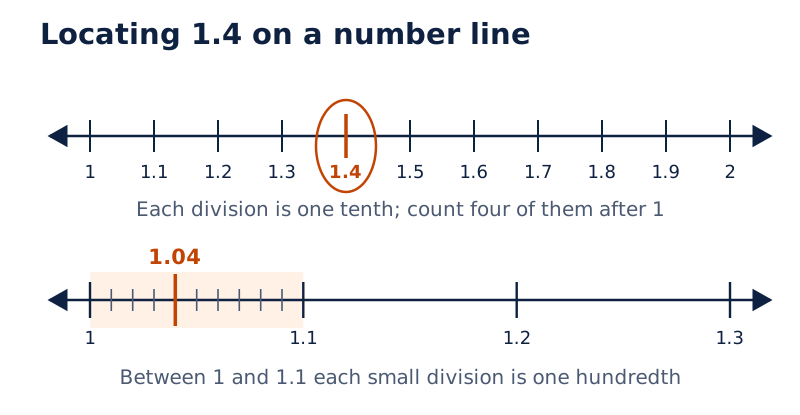
A number line is labelled from 1 to 2 in tenths. The mark at 1.4 is circled. Below it, a more finely divided line marks 1.04 between 1 and 1.1.
Drawn by One Young India. Reference: NCERT Class 7, page 70
How do successive enlargements locate thousandths?
Successively enlarging an interval makes smaller differences visible. To locate 4.185, first find the interval from 4 to 5. Next focus on 4.1 to 4.2, then on 4.18 to 4.19. Thousandth divisions within that final interval locate the number.
What the figure shows
Successive number-line enlargements
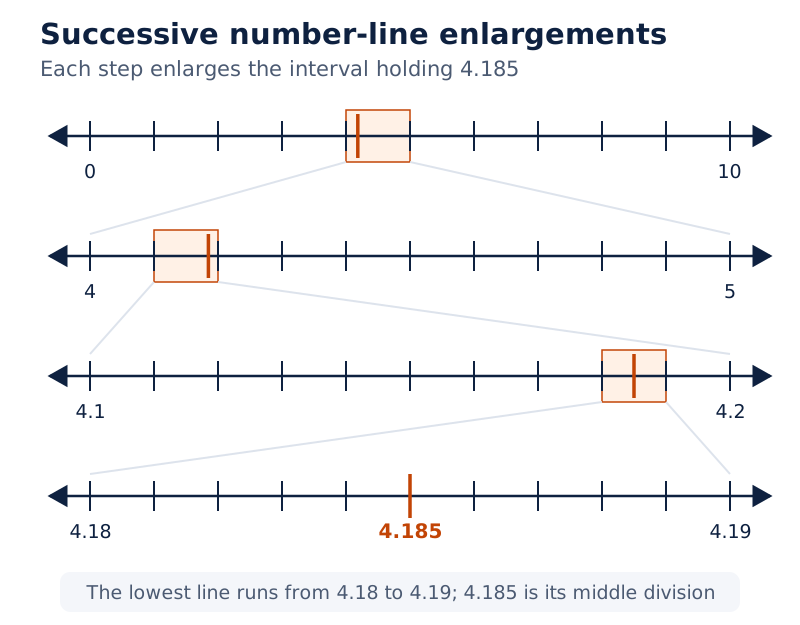
Linked number lines enlarge the relevant interval step by step. The lowest line runs from 4.18 to 4.19 and marks 4.185 at its middle division.
Drawn by One Young India. Reference: NCERT Class 7, page 71, figure (a)
Does each small division mean one-tenth?
The endpoints must be checked before naming a division. In a line where the interval from 5 to 10 is divided into ten equal parts, the whole interval spans five units. Each division is therefore half a unit, rather than one-tenth.
The point labelled b represents 7.5 and lies halfway between 5 and 10 in that example. Counting tick marks without finding the division size can give an incorrect reading. First establish the total interval, then determine what each equal part represents.
How do zeros affect decimal comparison?
Some zeros preserve positions, while others at the end of the fractional part simply record additional empty places. A reliable comparison therefore examines corresponding place values. Counting how many digits a number has is not enough to decide its size.
Property: Trailing fractional zeros preserve value
0.2 = 0.20 = 0.200 because all three numbers represent two tenths. The added hundredths and thousandths are zero. A trailing fractional zero is a zero added at the right-hand end of the digits after the decimal point.
However, 0.2, 0.02 and 0.002 describe different quantities. The digit 2 occupies the tenths, hundredths and thousandths places respectively. Moving it to a smaller place changes its contribution to the number.
How do we compare corresponding digits?
- Begin with the digits in the highest place value, also called the most significant digits.
- If they agree, compare the digits in the next smaller place.
- Continue until a place has different digits in the two numbers.
- The larger digit at that first differing place identifies the greater number.
Worked example 8. Compare 6.456 and 6.465.
Answer: Both have 6 units and 4 tenths. At the hundredths place, the first has 5 and the second has 6. Therefore 6.465 is greater than 6.456. The comparison is settled before considering the thousandths digits.
The signs < and > mean less than and greater than. Ascending order means smallest to largest; descending order means largest to smallest. The comparison above can be written as 6.456 < 6.465.
How do we identify the closest decimal?
Among 0.9, 1.1, 1.01 and 1.11, the closest to 1 is 1.01. The neighbouring candidates are 0.9 and 1.01. Their distances from 1 are ten hundredths and one hundredth respectively, so 1.01 is closer.
How do we add decimal numbers correctly?
Decimal addition combines matching places. Write units beneath units, tenths beneath tenths and hundredths beneath hundredths. This puts the decimal points in one column. The same regrouping used for whole-number addition then applies to the fractional places.
Priya needs 2.7 m of cloth for a skirt, and Shylaja needs 3.5 m for a kurti. Their tenths total 12 tenths, which make one unit and two tenths. Together with the five whole metres, the total is 6.2 m.
How does carrying work across several places?
Carrying records the larger-place unit created by regrouping ten smaller-place units. Ten hundredths become one tenth, just as ten ones become one ten. The decimal point does not interrupt this place-value relationship.
Worked example 9. Find 75.345 + 86.691.
Answer: The thousandths give 5 + 1 = 6. The hundredths give 4 + 9 = 13, so retain 3 hundredths and carry 1 tenth. The tenths give 3 + 6 + 1 = 10, so retain 0 tenths and carry 1 unit.
The units give 5 + 6 + 1 = 12: retain 2 units and carry 1 ten. The tens give 7 + 8 + 1 = 16 tens, or 1 hundred and 6 tens. The sum is 162.036.
The zero in the tenths place of 162.036 matters. It shows that no tenths remain after regrouping, while keeping the 3 in the hundredths place and the 6 in the thousandths place.
What if the fractional parts have different lengths?
Equivalent decimal forms can make the columns easier to see. Adding zeros at the end of the fractional part supplies matching places without changing the quantity. Aligning the last written digits alone would combine unlike places and give an incorrect sum.
A useful check is to read the result by place value. Each carried amount should have entered the place immediately to the left. This connects the compact written calculation with the quantities being combined.
How do we subtract decimals using regrouping?
Decimal subtraction also requires matching places in the same columns. Begin at the smallest place being used. If that column has too few smaller units to subtract the required amount, exchange one unit from the next larger place.
This exchange is often called borrowing, but the important idea is regrouping. One larger-place unit becomes ten smaller-place units. Reduce the larger-place count when making the exchange so that the total starting quantity stays unchanged.
How can two consecutive exchanges be made?
Worked example 10. Find 15.34 − 2.68.
Answer: Start with 15 units, 3 tenths and 4 hundredths. Exchange 1 tenth for 10 hundredths, giving 15 units, 2 tenths and 14 hundredths. Then exchange 1 unit for 10 tenths, giving 14 units, 12 tenths and 14 hundredths.
Subtract 8 hundredths from 14 hundredths to get 6 hundredths. Subtract 6 tenths from 12 tenths to get 6 tenths. Subtract 2 units from 14 units to get 12 units. The difference is 12.66.
The exchanges explain each changed digit in the written subtraction. They do not create extra length or extra quantity. The same starting number is being expressed using a combination more convenient for removing the required amount.
How can a missing hundredths place be handled?
For 25.9 − 6.47, write the first number as 25.90. Exchange one of its nine tenths for ten hundredths. This gives 25 units, 8 tenths and 10 hundredths before subtraction.
Removing 6 units, 4 tenths and 7 hundredths leaves 19 units, 4 tenths and 3 hundredths. Therefore the difference is 19.43. Writing the zero hundredths makes the required exchange easier to organise.
In the cloth example, 3.5 m − 2.7 m gives 0.8 m. The difference answers how much longer Shylaja’s cloth is, whereas addition answers how much cloth the two need altogether.
How do decimal sequences and estimates help us reason?
A sequence is an ordered list of numbers, and each number in it is a term. To extend a decimal sequence, examine how one term changes to the next. The change may involve addition or subtraction.
How can the repeating change be found?
In 4.4, 4.8, 5.2, 5.6, 6.0, each term is obtained by adding 0.4. Check the change across the given terms before continuing. A sequence can pass through a whole number without changing its rule.
Other sequences involve smaller changes, such as 4.4, 4.45, 4.5. Place value helps compare these terms even though they have different numbers of written fractional digits. Writing equivalent decimal forms can make their differences clearer.
What can an estimate tell us before calculation?
An estimate gives an approximate result or a range containing the result. Estimating before calculating may help identify a mistake. For addition, the whole-number parts give useful reference points without requiring the full fractional calculation.
Consider 25.936 + 8.202. Each number lies above its whole-number part and below the next whole number. Thus their sum is greater than 25 + 8 and less than 25 + 1 + 8 + 1.
Sonu proposes extending this observation to any two decimal numbers. Treat that general statement as a claim to investigate. The particular example supports a result between the two whole-number bounds, but it does not by itself establish every possible case.
Note: An estimate and an exact calculation serve different purposes. First use the size of the numbers to judge a reasonable range. Then perform the place-value calculation and compare its result with that range.
Both sequence work and estimation depend on seeing the value represented by the decimal digits. They encourage checking how a number changes, instead of treating the decimal point as a mark inserted after an otherwise unrelated whole-number calculation.
Why must decimal-looking notation be interpreted carefully?
A point between digits does not automatically mean that the digits to its right are tenths or hundredths of the unit named. Check the convention being used and the relationship between the units before interpreting the number.
How do hours, feet and cricket overs differ?
Worked example 11. Sarayu is told that a bus will arrive 4.5 hours after noon. Given that one hour contains 60 minutes, find the arrival time.
Answer: One-tenth of an hour is 6 minutes. Five tenths are 30 minutes. Therefore 4.5 hours means 4 hours and 30 minutes after noon, so the bus arrives at 4:30 p.m., meaning after midday.
A foot, abbreviated ft, contains 12 inches. Consequently, 2.5 ft means 2 ft and 6 inches. It does not mean 2 ft and 5 inches. The fractional part must be interpreted as a fraction of a foot.
In cricket, an over contains 6 balls in the notation discussed here. A display of 5.5 overs means 5 overs and 5 balls. The part after the point is a ball count, rather than five tenths of an over.
How did decimal notation develop?
Decimal fractions have denominators such as 10, 100 and 1000. They occur in the eighth-century arithmetic and algebra works of Śhrīdharāchārya. Around 950 CE, Abūl Ḥassan al-Uqlīdisī described decimal notation in essentially its modern form in a book on Indian arithmetic.
Later conventions included marks, colours and indicators of the number of fractional places. John Napier and Christopher Clavius used a point or period, while François Viète used a comma. Several countries currently use a comma to separate the whole-number and fractional parts.
Unit and decimal-point errors can produce serious mistakes. A correct interpretation requires both the number and its unit. The hours, feet and cricket examples show why reading the digits alone is insufficient.
Glossary
- Unit — A chosen amount treated as one when a quantity is measured.
- Tenth — One of ten equal parts into which a whole unit is divided.
- Hundredth — One of one hundred equal parts of a unit, or one-tenth of a tenth.
- Thousandth — One of one thousand equal parts of a unit, or one-tenth of a hundredth.
- Place value — The value associated with a digit’s position within a written number.
- Decimal point — The dot separating a number’s whole-number part from its fractional part.
- Decimal system — A number-writing system based on ten, extending place values into fractional quantities.
- Regrouping — Exchanging quantities between neighbouring places while keeping the total numerical value unchanged.
- Conversion — Expressing a measurement in another unit without changing the quantity measured.
- Number line — A line representing numbers by positions, with equal numerical intervals equally spaced.
- Ascending order — An arrangement of numbers from the smallest value to the largest value.
- Sequence — An ordered list of numbers whose successive terms can follow a rule.
Common errors and misconceptions
- Misconception: More decimal digits must mean a greater number. Correct: Compare corresponding places. For 6.456 and 6.465, the hundredths decide the comparison: 6.465 is greater.
- Misconception: Adding a zero at the end of a fractional part increases the value. Correct: 0.2, 0.20 and 0.200 all represent two tenths.
- Misconception: Zero can be inserted anywhere without changing a decimal. Correct: In 0.2, 0.02 and 0.002, the 2 occupies different places, so the quantities differ.
- Misconception: Add or subtract decimals by aligning their last written digits. Correct: Align corresponding place values and decimal points so that like quantities are combined.
- Misconception: A small number-line division always represents one-tenth. Correct: Use the endpoints and number of equal divisions. Ten divisions from 5 to 10 each represent half a unit.
- Misconception: 4.5 hours means four hours and five minutes. Correct: The fractional half-hour is 30 minutes, so 4.5 hours after noon is 4:30 p.m.
- Misconception: 2.5 ft means 2 ft and 5 inches. Correct: With 12 inches in a foot, half a foot is 6 inches, giving 2 ft and 6 inches.
Exam-style questions with model answers
Q1. Read 7.05 aloud and explain the place values of its digits. [2 marks]
- Read 7.05 as seven point zero five, saying each digit after the decimal point separately.
- It contains 7 units, 0 tenths and 5 hundredths. The zero keeps the 5 in the hundredths place.
Q2. Using 1 kg = 1000 g, express 254 g in kilograms. Explain the fractional place values in your answer. [3 marks]
- One gram is one-thousandth of a kilogram. Therefore 254 g is 254/1000 kg, because the given number of grams counts that many thousandths of a kilogram.
- Separate 254 thousandths into 200 thousandths, 50 thousandths and 4 thousandths. These represent 2 tenths, 5 hundredths and 4 thousandths respectively.
- Write these digits in their corresponding places. The conversion is 254 g = 0.254 kg, with zero whole kilograms.
Q3. Compare 6.456 and 6.465 using place value, and explain why counting decimal digits does not decide this comparison. [3 marks]
- Both numbers contain 6 whole units, so their whole-number parts are equal. Each also has 4 in the tenths place, leaving the comparison unresolved at that stage.
- The hundredths digits differ: 6.456 has 5 hundredths, whereas 6.465 has 6 hundredths. This is the first differing place when reading from the highest place value.
- Therefore 6.456 < 6.465. Both have the same number of decimal digits; it is the values at corresponding positions that determine their order.
Q4. Calculate 75.345 + 86.691, explaining the regrouping in each place from thousandths through tens. [5 marks]
- Align the decimal points so that matching places occupy the same columns. In the thousandths column, 5 + 1 = 6, leaving 6 thousandths without carrying.
- In the hundredths column, 4 + 9 = 13. Exchange 10 hundredths for 1 tenth, leaving 3 hundredths and carrying 1 into the tenths column.
- The tenths column now contains 3 + 6 + 1 = 10 tenths. Exchange these for 1 unit, leaving zero tenths in the result.
- The units column contains 5 + 6 + 1 = 12 units. Retain 2 units and carry the remaining 10 units as 1 ten.
- The tens column gives 7 + 8 + 1 = 16 tens. This is 1 hundred and 6 tens, so the final sum is 162.036.
Q5. Calculate 15.34 − 2.68, showing the exchanges needed before subtracting. [4 marks]
- Write the numbers with aligned decimal points. The starting quantity contains 15 units, 3 tenths and 4 hundredths; the quantity being removed contains 2 units, 6 tenths and 8 hundredths.
- Exchange 1 tenth for 10 hundredths. The starting quantity is now 15 units, 2 tenths and 14 hundredths.
- Exchange 1 unit for 10 tenths. It now contains 14 units, 12 tenths and 14 hundredths, without changing its total value.
- Subtract corresponding quantities: 14 − 8 gives 6 hundredths, 12 − 6 gives 6 tenths, and 14 − 2 gives 12 units. The answer is 12.66.
Q6. A bus arrives 4.5 hours after noon. Given that one hour is 60 minutes, calculate its arrival time and explain the meaning of 0.5 hour. [2 marks]
- One-tenth of an hour is 6 minutes, so 0.5 hour is five tenths, or 30 minutes.
- Four hours and thirty minutes after noon is 4:30 p.m. The decimal part represents part of an hour, not a separate minute count.
Q7. Mahi buys 0.25 kg of beans, 0.3 kg of carrots, 0.5 kg of potatoes, 0.2 kg of capsicums and 0.05 kg of ginger. Calculate the total weight, showing successive subtotals. [5 marks]
- All five weights are already in kilograms, so no unit conversion is required. Set up the addition as 0.25 + 0.30 + 0.50 + 0.20 + 0.05 kg.
- Begin with the beans and carrots. Their combined weight is 0.25 + 0.30 = 0.55 kg, with tenths and hundredths aligned.
- Add the potatoes to this subtotal. The calculation 0.55 + 0.50 = 1.05 kg regroups ten tenths into one whole kilogram.
- Include the capsicums next: 1.05 + 0.20 = 1.25 kg. This subtotal accounts for the first four of the five listed items.
- Finally add the ginger: 1.25 + 0.05 = 1.30 kg. Mahi’s total purchase therefore weighs 1.30 kg, also written as 1.3 kg.
Q8. Milk volume is measured in litres. Pinto supplies 3.79 litres, 4.2 litres and 4.25 litres of milk on the first three days. His total for six days is 25 litres. Find the quantity supplied during the last three days together. [3 marks]
- First calculate the total for the first two days: 3.79 + 4.20 = 7.99 litres. The added zero keeps the second day’s quantity unchanged while aligning hundredths.
- Add the third day’s supply: 7.99 + 4.25 = 12.24 litres. This is the combined supply during the first three days.
- Subtract that amount from the six-day total: 25.00 − 12.24 = 12.76 litres. Therefore Pinto supplied 12.76 litres during the last three days together.
Key takeaways
- Dividing a unit into smaller equal parts allows measurements to describe lengths more accurately than whole units alone.
- Ten tenths make one unit, ten hundredths make one tenth, and ten thousandths make one hundredth.
- The decimal point separates the whole-number and fractional parts; read the digits after it one at a time.
- Conversions express the same measurement in different units, using the relationship between the original and replacement units.
- Locate decimals by dividing number-line intervals equally, checking the labelled endpoints before deciding each division’s value.
- Compare corresponding places from left to right; adding trailing fractional zeros does not change a decimal’s value.
- Add and subtract decimals with matching places aligned, regrouping ten smaller-place units as one larger-place unit when needed.
- Interpret decimal-looking notation with its unit and context, especially for hours, feet and cricket overs.
Test yourself
How many hundredths make one tenth?
Ten hundredths make one tenth, because each tenth divides into ten equal hundredth parts.
Why is 0.274 read as zero point two seven four?
The digits after the point name separate places: 2 tenths, 7 hundredths and 4 thousandths.
Using 1 cm = 10 mm, express 5.6 cm in millimetres.
It is 56 mm: five centimetres give 50 mm, and six tenths of a centimetre give 6 mm.
Using 100 paise = 1 rupee, express 75 paise in rupees.
Seventy-five paise is 75 hundredths of a rupee, written as ₹0.75.
Do 0.2, 0.20 and 0.200 represent different quantities?
No. All three represent two tenths; the trailing fractional zeros contribute no extra quantity.
Which is closest to 1: 0.9, 1.1, 1.01 or 1.11?
The closest is 1.01. Its distance from 1 is just one hundredth.
Priya needs 2.7 m of cloth and Shylaja needs 3.5 m. What is their total?
The total is 6.2 m. Twelve tenths regroup as one unit and two tenths.
With six balls in an over, what does the cricket display 5.5 overs mean?
It means five overs and five balls; this display is not ordinary decimal notation.
Write about it
Turn a question from this chapter into a paper.
The Writing Studio has a structure guide, a rubric and citation tools for 15 formats, from essays to research papers. Drafting is free with an account. Learnacy Essential adds feedback from an AI writing coach and submission to The OYI Review.
Learnacy Essential is ₹1,499 for the year. Publication depends on review and is not guaranteed.