
Learnacy Labs
Learn by doing.
Learnacy Labs has 286 interactive labs, and a flagship lab for each of seven subjects. Open a lab, change the inputs and watch what happens, then answer a few questions to check you have the idea. Start with a flagship lab, follow a guided journey, or browse all 286. The 2D version of every lab is free with a Learnacy account. The 3D labs come with Learnacy Essential.
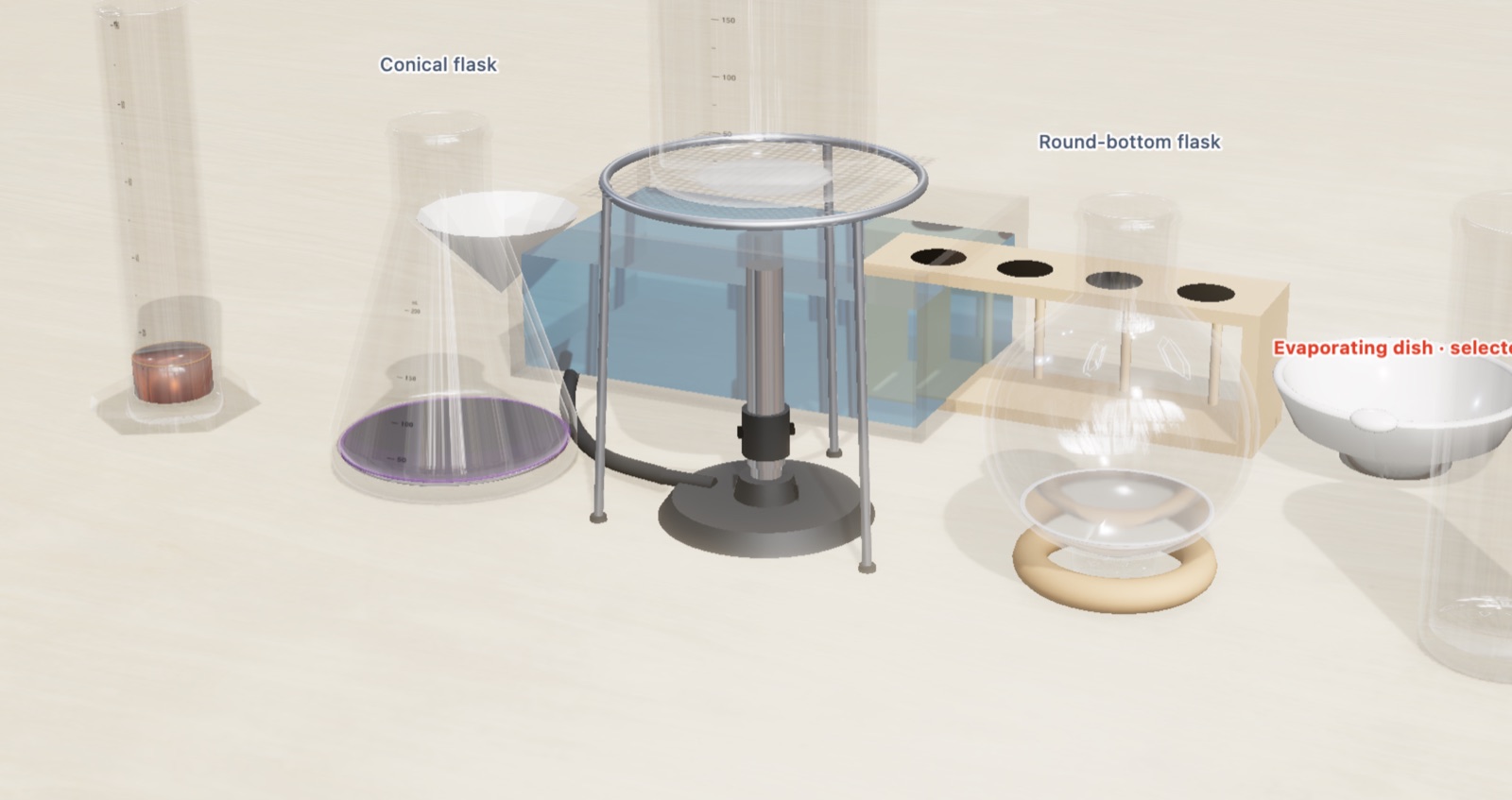
Flagship Chemistry
A real lab table, in 3D.
Pick apparatus from the tray. Pour, heat, cork and tube. Collect a gas over water and test it with a splint. Every reaction is explained as it happens. Stuck on a step? The lab shows you, or does it for you.
Seven flagship labs.
One flagship lab for each subject, built from its experiments. All seven open in 2D, and four are ready in 3D today: Chemistry, Physics, Geography and Biology.
2DDraw it, drag it, measure it. Every subject’s lab, light and fast.
Every reagent on one bench. Pour, heat, stir, and test the gas.
Open the lab Physics The Universe→One universe, from two galaxies to the nucleus of an atom. Fling a planet, land on a world and work at the Earth’s benches.
Open the lab Geography The Earth→A rendered Earth: seasons, pressure belts, planetary winds, ocean currents, climates.
Open the lab Biology The Cell→From a single cell to a whole ecosystem, with the heart and the leaf in between.
Open the lab Mathematics Maths Studio→Curves you can bend, solids you can slice, chance you can throw.
Open the lab Economics Market Floor→Where buyers and sellers meet, where money is born, and why prices move.
Open the lab Computer Science Machine Room→Bits, gates, algorithms, and the machine that runs them.
Open the lab3D · with Learnacy EssentialIn beta. Walk into the lab and run the experiment yourself.
A photoreal bench: real glass, a boiling beaker, a pH meter, and the gas tests.
Open in 3D Physics The Universe→The same universe in 3D: turn the sky round the Sun and its planets, fling a body and land on a world. The ground, its benches, the atom and the nucleus open in 2D beside it.
Open in 3D Geography The Earth→The globe itself: spin it, tilt it through the year, and watch the systems move.
Open in 3D Biology The Cell→The same cell in 3D: turn it round and change its bath. The seven rooms open in 2D beside it.
Open in 3DStart with a guided module
46 themed journeys across six subjects. Each weaves a handful of labs into one story, with a guided walk-through and a check at every step. Work through one at your own pace, or open any single lab from the full catalogue below.
Mathematics8
Watch randomness pile into the bell curve, then read its spread, bands and rogue readings.
Algebra and equations→Move an equation like a balance, split a square into its tiles, read a curve's sign from where it crosses, ride the powers of ten, steer a parabola by its turning point, and pin the single spot where two lines meet.
Graphs and functions→Read any straight line off the grid, measure the gap between two points, feed numbers through a machine and watch the point appear, then slide, stretch, chain and undo those machines to see where every curve comes from.
Trigonometry→Turn a right triangle into three simple ratios, wrap those ratios around a circle, and watch that circle unroll into a wave you can read, solve and reshape.
Calculus→Walk one curve from its steepness at a single point to the area trapped beneath it, and turn that pair of ideas into chasing a root, reading a moving car, and folding the roomiest possible box.
Shape and space→Cut awkward shapes into plain rectangles, stand squares on right triangles, stack unit cubes into solids and slice clean through them, until every area and volume becomes something you can see rather than a formula you recall.
Numbers and sequences→Walk the number line as a place you can stand, fold sequences into shapes you can total at a glance, and read a number's hidden structure in the rectangles and roots it packs into.
Reading data→You will weigh data on a balancing plank, watch a single stray point tilt the average, fold a scatter of dots into five plain numbers, and fling darts until pure chance hands you π and the odds you predicted.
Physics8
Falling, forces, collisions and flight: the whole logic of motion, one experiment at a time.
Electricity and circuits→Predict what the meters read, then wire it and watch. One law, two ways to wire, and the real behaviour of cells and capacitors, one circuit at a time.
Electric and magnetic fields→You will point the force between two charges, find the spot where a field falls silent, trace a magnet's curving reach, bend a moving charge into a circle, and watch a plunging magnet conjure a current out of nothing.
Waves and sound→You will read a wave's speed straight off its crests, bounce and bend it off barriers and boundaries, squeeze two waves into perfect silence, and catch the pitch of a passing siren before it reaches you.
Light and optics→Follow one ray of light as it bends through a lens, turns back inside glass, then arrives as a single grain of energy that kicks an electron loose and paints a coloured line in a star's spectrum.
Heat and gases→Predict what the particles do, then watch them do it: read temperature and pressure off their jostling, squeeze a gas, mix a hot cloud with a cold one until they agree, and time a mug as it cools towards the room.
Inside the nucleus→Follow one unstable nucleus from a single random tick, through the dependable halving curve, to the fixed steps that carry a heavy atom all the way down to a stable resting place.
Forces, springs and orbits→You will feel how a spring hoards energy as it stretches, watch a crash spend that energy while momentum stays intact, time a pendulum by its length alone, and launch a probe until it falls in, circles, or climbs clear of a gravity well.
Chemistry7
Drop elements in, pull electrons, measure atoms and predict Mendeleev’s gap.
Reactions and amounts→You will take reactions apart and set them back in balance, watch two clear liquids throw down a solid and a nail plate itself in copper, then cross freely between a count of particles too small to see and a mass you can read on a balance.
Acids and bases→Walk from a single number on a scale to the exact drop where an acid and a base cancel, reading each curve and mixture the way a chemist actually does.
The behaviour of gases→Squeeze, warm, pin and mix gases until the four simple laws feel obvious, then fold them into one equation that explains how hard a gas pushes back and how fast it leaks, spreads and races.
Bonds and shapes→You will pull atoms together and watch a shared pair snap into a bond, hand electrons across to balance charges into a formula, fold molecules into the shapes they really take, and name whole families of carbon compounds from a single group.
Rates, energy and equilibrium→Watch particles collide, read a rate off a rising curve, climb an energy hill and slide down the far side, then steady a reaction into a living balance you can nudge whichever way you like.
Atoms and the periodic table→You will build atoms proton by proton, watch identity and mass fall out of the counts, then step back and read the whole periodic table like a map: its trends, its families, and the staircase that splits metal from non-metal.
Biology7
Read the genetic tape one letter at a time, from a strand of DNA to a finished protein.
Inside the cell→Move water across a living membrane, feel a plant cell stiffen, meter diffusion and pumps, watch a growing cell starve its own core, and push an enzyme until every site is jammed.
Genes and inheritance→Split each parent's alleles down the rails, count the boxes where they meet, and read the future of a cross, from a lone one-in-four all the way to the whole nine to three to three to one.
The working body→Walk from a single heartbeat out to a nerve's spark: send blood through the heart's two loops, watch pressure rise and fall, throttle a vessel and feel the flow collapse, pull a breath by dropping the pressure, trade gases across a gradient, and fire an all-or-nothing signal down a nerve.
How plants make food→Run the reaction that feeds a leaf, find the single factor holding it back, and trace why every green leaf must trade water to make its own food.
Populations and ecosystems→Push a population up an exponential climb, bend it flat against a fence, set predators chasing prey in circles, trace energy thinning tenfold up the ladder, and watch a hidden colour win its share across the generations.
Reading DNA→Read either strand of the double helix, carry the gene out as a message, build the protein it spells, then change one letter and watch the protein change with it.
Computer Science6
Search, sort and recurse, and feel why some methods stay fast as the data grows.
How computers count→Start from a single row of on-or-off switches and build all the way up to the logic a machine reasons with, reading the very same bits as numbers, colours, letters and true-or-false.
Graphs and paths→Turn dots and lines into a way of thinking: spread a search outward and dive it deep, weigh routes by cost, wire every node together for the least, order tangled tasks, and flood a maze to find its exit.
Inside the machine→Step inside a tiny processor and drive it by hand: move a value from memory cell to register to arithmetic unit, bend the program counter into loops and branches, stack up nested function calls, and watch a number wrap right around when it runs out of room.
Organising data→You will move a value into a row and watch the whole row shuffle, re-hook a single arrow to slip one in for free, serve the same arrivals two opposite ways, drop a key straight into its place, walk one path down a tree, and let the smallest value rise to the top. Each time, you will feel exactly what each shape makes cheap and what it makes dear.
Sorting and searching→Put a shuffled row of bars in order four different ways: eyeballing the smallest, sliding each bar home, splitting the row down to single bars, and racing everything around a pivot. Then feel exactly where each method spends its effort.
Economics10
Find the price where a market clears, then move supply, demand and a price cap.
Markets and prices→You will slide a single price up and down a market and watch queues form, trades pay off, buyers dig in or walk away, a tax split itself between two sides, and a wage floor leave workers standing in line. By the end, a supply-and-demand diagram reads like a story you can predict.
Auctions and bidding→Sit at one table and sell a single item four different ways, learn when bidding your honest value is the safe move and when to quietly bid below it, and spot the trap that makes the winner overpay.
Strategy and game theory→Sit across the small tables where two rivals decide, find the one cell nobody wants to leave, and watch why sensible people so often talk themselves into the worst room in the house.
Money and banking→You will follow a single rupee as it multiplies through the banking system, balance a bank's books, weather a run, and pull the central bank's levers to steer prices and inflation.
How people choose→Start with a purse and two shelves, watch a single bead settle on the happiest bundle it can afford, then move prices and income around it until demand itself takes shape.
The whole economy→Follow a single pound as it circles the whole economy, becoming spending, income and output at once, swelling through the multiplier, settling at one level, and holding its real worth even as prices move.
Firms, costs and profit→Crowd a workshop floor, watch each extra unit come out dearer than the last, and follow that rising cost all the way to the price where a firm decides how much to make, when to run at a loss, and when to stop the belt.
Trade and specialisation→You'll move a fixed crew between a bakery and a loom, watch the trade-offs trace a frontier, and uncover why two benches that each make only what they give up least for can both end up richer than either could alone.
Growth, inflation and interest→Across this module you follow money as it grows, doubles, and quietly loses ground to rising prices, until you can tell what a rate is really worth.
Mathematics
63 labsAlgebra
An equation says two expressions are equal. Because they stay equal only if you do the same operation to both sides, you can peel away everything wrapped around x. Use each operation's inverse until x stands alone.
Foundational (a + b)² Unpacked→A square of side a+b splits into a² + 2ab + b². Explore the tiles; in Challenge, compute one you can’t see.
Foundational Zeros of a Polynomial→A polynomial is zero exactly where it crosses the x-axis. Between those roots its sign flips in turn: a strip of + and − beneath the curve.
Core Powers of Ten as Zoom→An exponent is how far you have zoomed the number line: every power of ten is one rung, and any number is a mantissa times the rung it rides on.
FoundationalLines & Coordinates
Every straight line is a starting height b lifted by a steepness m. It is a staircase of rise over run you can read straight off the grid.
Core Distance Between Points→The straight-line distance between two grid points is the hypotenuse of the right triangle their horizontal and vertical gaps make.
CoreNumbers & Sequences
A chain of signed jumps lands at their running sum whatever the order. The path, its peak and its dip are entirely yours to arrange.
Foundational Irrationals on the Line→Root two is the unit square’s diagonal swung down onto the line. It is an exact point whose decimal never repeats and never lands on a tick at any zoom.
Core The Gauss Staircase→Equal steps build a staircase; flip a copy on top and every column reaches the same height, so the sum is half a clean rectangle.
Core Halving Strips to a Limit→Strips that each take a fixed fraction of the last pack toward a wall they never pass: infinitely many pieces, one finite sum a ÷ (1 − r).
AdvancedTrigonometry
On a right triangle the three trig ratios are just measured lengths divided: opposite, adjacent and hypotenuse in three pairings.
Core The Unit Circle→On a circle of radius one, the point at angle θ has coordinates (cos θ, sin θ). Cosine is simply how far across, and sine is how far up.
Core Special Angles→The angles 30°, 45° and 60° come from two fixed triangle templates, so their sine, cosine and tangent are exact values worth knowing by heart.
Core Solving a Right Triangle→A leaning ladder is a right triangle you can solve: two measurements fix the third by Pythagoras, and any two sides give the angle of elevation.
Core Radians as Arc Length→A radian is arc length measured in radii: the arc a central angle cuts is exactly the radius times the angle, so a full turn is 2π.
Core The Sine Wave→A point riding a circle draws the sine wave as its height unrolls; in Challenge, find every angle in a full turn that shares a given sine.
Core Amplitude, Period and Phase→A sine wave is set by four dials: amplitude, period, phase and baseline. Each one moves the curve in its own separate way.
AdvancedCalculus
The derivative is the curve’s slope at a point; a chosen slope may be worn by two points, one, or none, and the tangent settles onto each.
Advanced The Limit of the Secant→A secant through two nearby points has an average slope. Shrink the gap to nothing and it settles on the exact slope, which is the derivative.
Advanced Newton’s Method→To find where a curve crosses zero, ride its tangent down to the axis and repeat; each hop lands far nearer the root.
Advanced Position, Speed & Acceleration→The slope of the position graph is velocity. The slope of the velocity graph is acceleration. These are three linked views of one moving car.
Core The Fundamental Theorem→Accumulating a rate and measuring a rate are inverse operations. The signed area under a velocity-time graph is the net change in position. The slope of that running area, instant by instant, is the velocity again.
Advanced The Integral as Area→The definite integral is the exact area trapped under a curve. Rectangles estimate it, and thinner ones close on the true value.
Advanced Riemann Sums→Left rectangles fall short of the area under a rising curve and right ones overshoot; the true area is caught between them.
Core Maxima, Minima & the Best Box→A peak or a valley of a quantity is where its slope is zero; folding a sheet into a box, the best fold is exactly that flat point.
AdvancedProbability & Statistics
Stack the data on a plank and the mean is the one place the fulcrum can sit without the plank tipping; the median is where a divider leaves equal halves; the mode wears the crown on the tallest stack.
Foundational Outliers: Mean vs Median→One far dot tilts the whole plank, so the mean chases it. The median divider, which only counts dots, hardly moves.
Core Spread: Range, MAD & SD→Every dot gets a stick to the mean; the range is the whole plank in use, the MAD is the average stick, and the SD is the average stick after the long ones have been squared up.
Core Quartiles & Box Plots→A box plot is the plank folded into five numbers: the box holds the middle half of the dots, whiskers reach the ordinary extremes, and anything past 1.5 boxes beyond is flagged.
Core Histograms & Bin Width→The same dots regroup into different bars as the bin width slides: narrow bins show every bump, wide bins smooth the shape and can move the tallest bar.
Foundational Scatter & the Line of Best Fit→Every point hangs a residual stick from the line; the least-squares line is the one position where the squares built on those sticks add up to the least.
Advanced Correlation: Strength & Sign→Cross the scatter at the two means: points in the agreeing quadrants push r up, points in the disagreeing ones push it down, and how tightly the cloud hugs a line sets how far from zero it gets.
Advanced Sampling the Bell→Draw readings at random from a hidden batch and they pile into a hump; a handful wanders, a big sample settles onto the batch's own centre and spread, and the smooth bell is what an endless sample would build.
Core The Bell and Its Bands→The share of a bell inside a band is the area under it, and measured in spreads that share never changes: about 68% inside one spread, 95% inside two, 99.7% inside three, whatever the mean and spread.
Core z: Spreads from the Mean→A reading only says how rare it is once you measure it in spreads from the mean; that number, z, fixes the share of the bell below it, so the same z means the same percentile on any bell.
Core One Rogue Reading→Drop one wild reading into a tidy set and the mean is dragged a share of the rogue's distance while the median takes half a step at most; more tidy readings dilute the rogue's pull on the mean.
Foundational What Are the Odds?→Probability is the long-run fraction: load a glass urn to a target chance of red, then draw two balls with and without replacing the first and watch the frequency settle onto the fraction you predicted.
Foundational Finding π by Chance→Fling darts at a square with an inscribed quarter circle: the share landing inside is the area ratio π⁄4, so four times it estimates π. Order is wrung out of pure randomness.
Playful Sample Space & Equally Likely Outcomes→Lay out every face of a die as the sample space, paint the faces that make an event, and read its probability straight off as favourable faces over the total. Then watch trials confirm it.
Foundational Two Dice & the Sum→Every pair of dice is one cell in an n-by-n grid: paint the cells that make a target sum, count them over all the cells for its probability, and see thousands of rolls build a triangle that peaks at n plus one.
Core With vs Without Replacement→Draw a red and keep it, and the very next draw changes before your eyes: the urn is one ball smaller with one fewer red, so conditional probability is just reading the shrunken urn.
Core Expected Value as a Balance Point→A spinner of equal sectors pays out numbers. Slide the fulcrum under the payoff line until it balances and you have found the expected value: the long-run average the plank settles level upon.
Advanced The Law of Large Numbers→One roll is unpredictable and the dice have no memory, but the running fraction of an event calms down over thousands of rolls and homes in on its true probability: a convergence trace that stops wobbling.
CoreFunctions
A function is a machine: put a number in, gears multiply and add, one number comes out. Every in-out pair is a point on its line.
Foundational Shifts, Stretches & Flips→Any graph can be moved without redrawing it: a(x − h) + k slides it across and up, stretches it, and flips it, leaving the original as a ghost.
Core Composition: Order Matters→Chaining two machines is not symmetric: doing one then the other usually gives a different result from the reverse order.
Advanced Inverses & the Line y = x→An inverse undoes a function, and its graph is the original reflected across y = x, provided every horizontal line meets the curve just once.
AdvancedAngles & Polygons
Numbers & Primes
Every rectangle you can lay from n tiles is a pair of factors; a prime yields only the flat 1-by-n strip.
Foundational Meeting Again: LCM & GCD→Two hop trains first land together at the lowest common multiple; the largest tile paving both step-bars is the greatest common divisor, and their product is p × q.
CoreSolids & Volume
A box holds as many unit cubes as one flat layer times the number of layers. That is what volume counts.
Foundational Prisms and Cylinders (V = Bh)→Any solid with a constant cross-section holds base area times height, whether the base is a rectangle, a triangle or a circle.
Core Cones, Pyramids and the One Third→A cone or pyramid holds exactly one third of the prism or cylinder that shares its base and height.
Core A Sphere in its Cylinder→A sphere fills exactly two thirds of the snuggest cylinder around it. This is the result Archimedes prized above all.
Advanced Nets and Surface Area→Unfold a box flat and its skin is six rectangles; the surface area is simply their total.
Core Cross-Sections of a Cube→A single flat cut through a cube reveals a polygon of three to six sides, depending only on how the plane is tilted.
AdvancedPhysics
49 labsOptics
A lens bends rays; where they meet again is the image, and 1/v = 1/f − 1/u says exactly where.
Advanced Refraction→Light bends when it changes speed at a boundary; Snell’s law says by how much, and past the critical angle it reflects instead.
Core Reflection in a Plane Mirror→A flat mirror forms a virtual image as far behind the glass as the object is in front.
FoundationalQuantum physics
Shine light on a metal: below a threshold frequency nothing leaves, however bright; above it, electrons fly out at once with an energy set by the colour, not the brightness.
Core Stopping Voltage & Planck’s Constant→A negative collector turns back the ejected electrons; the voltage that just stops the fastest one measures KE_max directly, and plotting it against frequency gives a straight line whose slope is h/e for every metal.
AdvancedNuclear physics
Each unstable nucleus decays at a random moment, yet a dish of them empties on a dependable curve: the count halves every half-life, and the smaller the dish, the more the real count wobbles around that rule.
Foundational Half-Life→Read the half-life off the curve, predict when the count reaches any target, and see that activity halves in step with the count.
Core Nuclear Equations→Alpha, beta and gamma emission each move a nucleus a fixed step on the chart of neutrons against protons; balance A and Z on both sides and the daughter is fixed.
Core Decay Chains→A heavy nucleus reaches stability through a zig-zag of alphas and betas; from the start and end points alone you can count how many of each it took.
AdvancedElectricity
Close the loop and the carriers everywhere move at one rate set by voltage over resistance; the meters, placed the right way, read it off.
Core Series and Parallel→One path shares the current and splits the voltage; two paths share the voltage and split the current, and the bulbs show it in their glow.
Core Kirchhoff’s Rules→Charge is never lost at a junction and energy is never lost round a loop: the carrier streams add up, and the potential staircase closes.
Advanced Power and Brightness→A bulb’s glow follows its power, current squared times resistance, which is why the same two bulbs swap brightness when you rewire them.
Core Internal Resistance→A real cell loses volts inside itself whenever current flows, so its terminal voltage sags under load and a short circuit is limited only by what is inside.
Advanced The Potential Divider→Sliding a tap along a resistor picks off any fraction of the cell voltage, and a load across the output pulls that fraction down.
Core Charging a Capacitor→Charge rushes onto empty plates then slows as their voltage rises to meet the cell; the timescale is set by resistance times capacitance.
Advanced The Unknown Resistor→Push known currents through a sealed component and read the voltage; the pattern of readings tells you what is inside.
CoreElectrostatics
Two charges push or pull along the line joining them with a force that grows as the product of the charges and falls as the square of the distance; you will point the force, size it and find the separation that quarters it.
Core Electric Field Lines→Field lines stream out of positive charges and into negative ones, and between two charges there is a null point where the pushes cancel; you will locate it, place a marker on it and find the potential there.
Core Potential and Equipotentials→Potential is the energy per unit charge, φ = k q ÷ r, and its contours ring each charge, crowding where the field is strong and always crossing field lines at right angles; you will read them, place one and cost the work to bring a charge in.
AdvancedMagnetism
A bar magnet's field lines leave the north pole and curve back into the south, and a compass sits along them everywhere; you will point a needle, predict a flip and use the inverse-cube fall-off.
Core The Field Around a Wire→A straight current wraps a circular magnetic field around itself, its direction given by the right-hand grip rule; you will aim a compass, predict the flip on reversing the current and use the one-over-r fall-off.
Core A Charge Moving in a Field→A charge crossing a magnetic field is pushed sideways by F = qv×B, curving into a circle of radius mv÷qB whose period is independent of speed; you will call the turn, the radius and the time.
AdvancedMechanics
A launched ball arcs under gravity alone: its range is v² sin 2θ ÷ g and its flight time 2 v sin θ ÷ g, so you can aim it, plant the landing flag and call the time.
Core Free Fall and Impact Speed→Every dropped object gathers speed at the same rate, so it lands at √(2 g h) after √(2h ÷ g), whatever its mass; you will read the speedometer and time the fall.
Foundational Hooke’s Law and Spring Energy→A spring stretches in exact proportion to the load, x = F ÷ k, and banks ½ k x² of energy; you will hang weights, mark where the hook settles and call the energy stored.
Core Forces on a Slope→On a ramp the weight splits into a part pressing in (balanced by the normal force) and a part along the slope (fought by friction); you will pick the net direction, size the normal arrow and call the friction.
Core Sliding on an Incline→A block holds on a slope until tan θ beats the friction coefficient μ, then slides with a = g(sin θ − μ cos θ); you will predict the release, call the acceleration and time the descent.
Core Momentum in Collisions→When two carts collide, total momentum is unchanged; you will predict the moving cart’s fate, mark the struck cart’s speed and prove the momentum survives.
Core Elastic and Inelastic Collisions→Momentum survives every collision, but kinetic energy survives only a clean bounce; you will judge how much energy a sticky crash keeps, size the loss and contrast it with the elastic case.
Advanced The Simple Pendulum→A pendulum’s period depends only on its length, growing with √L and ignoring mass and small swing size; you will compare two lengths, set the ratio and call the new period.
CoreThermal physics
Temperature is nothing but the average kinetic energy of jostling particles: the hotter the gas, the faster they fly. But because that energy depends on speed squared, a particle's typical speed grows only as the square root of temperature. So doubling the speed needs four times the temperature.
Foundational Squeezing a Gas (Boyle’s Law)→Pressure is the drumming of particles on the walls. Squeeze the same gas into less room at fixed temperature and the drumming, which is the pressure, rises in exact inverse proportion.
Core Mixing to One Temperature→Put a hot cloud and a cold cloud together and collisions share the energy until both read one temperature: the count-weighted mean. You will predict it, and the heat the hot side gives up.
Core Conduction and Insulators→Heat crawls along a solid bar from hot to cold; through copper it races, through wood it barely moves, and the time to warm the far end grows as the square of the length.
Core Specific Heat Capacity→The same energy warms a light block or a metal far more than a heavy block or water, because Q = m c ΔT; you will predict which climbs higher and by how much.
Core Latent Heat and Melting→Heat ice steadily and its temperature climbs, then stalls at a flat plateau while it melts, then climbs again; you will read the plateau off a heating curve and time the melt.
Core Newton’s Cooling Curve→A hot mug cools fast at first and ever more slowly as it nears the room, because the rate follows the gap; the excess above the room halves every cooling-time.
AdvancedWaves
Crests leave at the tap rate and travel at the water's speed, so their spacing is fixed by v = f λ; you will lay a ruler on the crests and time one to the probe.
Foundational Reflection of Waves→Straight crests bounce off a barrier at the same angle they arrive, measured from the normal; tilt the barrier and aim the reflected wave.
Foundational Refraction of Waves→Crossing into water where they travel slower, crests bunch up and swing toward the normal while their frequency stays fixed; you will size the new wavelength and compute the new angle.
Core Diffraction Through a Gap→A wave squeezing through a gap about one wavelength wide fans out almost in a semicircle, while a wide gap barely bends it; the ratio gap ÷ λ decides.
Core Two-Source Interference→Two sources in step paint the tank with calm lines where crest meets trough; the path difference decides what any point feels, and d ÷ λ decides how many calm lines there are.
Core Standing Waves on a String→A string driven at n times its fundamental locks into n loops with nodes that never move; you will count them, place them and name the frequency.
Core Resonance→Push a string in step with its own natural rhythm and small pushes build a huge swing; push at any other rate and the reflections cancel your effort.
Core The Doppler Effect→A moving source piles its crests up ahead and stretches them behind, so a probe ahead counts more crests per second; you will predict the count and the squeezed wavelength.
AdvancedChemistry
41 labsReactions
Atoms are never created or destroyed. Set the coefficients so every element matches on both sides.
Core Precipitation→Two clear solutions can make a solid: when ions meet a partner they cannot stay dissolved with, they drop out.
Core Displacement→A more reactive metal pushes a less reactive one out of its salt; the colour fades as the copper plates the nail.
CoreStoichiometry
Molar mass is a fixed grams-per-mole exchange rate, set by the substance itself, that converts between a count of particles too small to weigh individually and a mass you can read on a balance.
Core Molar Mass, Atom by Atom→A molecule’s molar mass is nothing more than the masses of its atoms added up. Here you can build the molecule and read the total off the bench, atom by atom.
FoundationalAcids & Bases
pH is the negative logarithm of hydrogen-ion concentration, so each unit is a tenfold change.
Advanced Neutralisation→An acid cancels a base mole for mole; an indicator shows the exact moment the beaker tips from one to the other.
Core Strong Acid-Strong Base Titration→Run a strong base into a strong acid and the pH leaps through 7 at the equivalence point. This is where moles of base equal moles of acid.
Core Weak Acid-Strong Base Titration→A weak acid's curve starts higher, rises gently through a buffer region, and hands you its pKa at the half-equivalence point.
StretchGases
Squeeze a gas at fixed temperature and the wall hits crowd together: pressure times volume stays constant.
Core Charles’s Law→Heat a gas under a free piston and it lifts the weights until the pressure is back where it was: volume grows in step with kelvin temperature.
Core Pressure and Temperature→Pin the piston and heat: the walls cannot give, so faster hits show up straight on the gauge. Pressure rises in proportion to kelvin temperature.
Core Avogadro’s Law→Pump more particles under a free piston and it rises so that the volume tracks the count: equal volumes at the same P and T hold equal numbers.
Core The Ideal Gas Equation→Change volume and temperature at once and the effects multiply: PV ÷ NT is the one number this chamber can never shake.
Advanced Dalton’s Partial Pressures→Each gas in a mixture hits the walls as if it were alone, so the gauge simply adds their shares: total pressure is the sum of the partial pressures.
CoreKinetic Theory
Temperature is a whole spread of speeds, not one number: heat the gas and the histogram slides right and flattens, its peak growing as the square root of T.
Advanced Diffusion and Effusion→Two gases at one temperature share an energy, not a speed: the lighter one moves faster, mixes faster, and slips through a pinhole more often, in the ratio √(m₂ ÷ m₁).
CoreBonding
Drag atoms together and watch a shared pair of electrons appear as a stick; keep sharing until every atom sits on a full octet, and the Lewis structure builds itself.
Core Valence & the Octet Rule→Every atom bonds exactly as many times as it needs to reach eight outer electrons, no more and no fewer, and the bench refuses any bond that would break the rule.
Foundational Ionic Bonding & Formulas→A metal hands its outer electrons to a non-metal; both become charged ions, and the formula is simply the ratio that makes the charges cancel.
Core Ionic Formulas from Charges→A metal hands electrons to a non-metal; each becomes a charged ion, and the formula is just the whole-number ratio that makes the charges cancel.
CoreMolecular Shape
Count the things around a central atom, bonds and lone pairs alike, and the molecule folds into the shape that keeps them as far apart as possible.
Core Polarity & Electronegativity→The more electronegative atom pulls the shared electrons its way, giving each bond an arrow; whether the whole molecule is polar depends on whether those arrows cancel.
AdvancedThe Atom
Build an atom from protons, neutrons and electrons and watch its identity, mass number and charge fall out of the counts. The number of protons alone decides which element it is.
Foundational Isotopes & Mass Number→Two atoms of one element can carry different numbers of neutrons. They are isotopes: same protons, same chemistry, different mass.
CorePeriodicity
Atomic radius, electronegativity and ionisation energy change smoothly across the table. Paint them as a heat-map and the trends read straight off the colours.
Core Groups & Families→The columns of the table are families that share an outer-shell count, so the alkali metals, the halogens and the noble gases each behave as a set.
Foundational Drop It In: Reaction Vigour→Drop an element into water or onto hot iron wool and read the vigour: the alkali metals grow fiercer down the column, the halogens fade, and a noble gas does nothing at all.
Foundational Pull an Electron→Tug the outer electron off any atom and read what it cost: the price rises across a row as protons pile onto the same shell, and falls down a column as the electron moves out a shell.
Core Measure Two Atoms→Put two atoms on the calipers and read their radii side by side: atoms grow down a column, one shell at a time, and shrink across a row as the same shell is pulled in tighter.
Foundational Predict From the Neighbours→Call the weight of an element's cube from the four cells around it, then weigh it: the map predicts what you have not measured, which is exactly how Mendeleev called gallium and germanium before anyone found them.
CoreRates of Reaction
Watch A and B bounce: most collisions do nothing, and only the fast, head-on ones flash into C. So anything that makes collisions more frequent or harder speeds the reaction up.
Core Reaction Rate→Product builds along a curve, and its steepness is the rate: read the average rate as the slope of a bracket between two times, and the instantaneous rate as the slope of the tangent.
CoreEnergetics
Every reaction has a hill to climb: a ball rolls up to the transition state and over, and the reverse reaction climbs the same peak from the other side, so its barrier is the forward one minus the energy change.
Core Catalysts→A catalyst opens a lower path over the hill: the ghost curve dips, the same collisions now succeed far more often, and because both barriers drop by the same amount the equilibrium position never moves.
CoreEquilibrium
In a closed box the forward and reverse reactions never stop, but once they fire at equal rates the counts stop drifting. This is a living balance you can measure as the equilibrium constant Kc.
Advanced Le Chatelier's Principle→Stress a balanced reaction (add a reactant, remove a product, squeeze it, heat it) and it shifts to oppose you. A catalyst, speeding both ways equally, is the one change that shifts nothing.
AdvancedBiology
38 labsGenetics
Each parent chip splits and sends one allele down each gamete rail; the four cells fill as the pairs meet, and the offspring ratio you predicted emerges from counting boxes and raining seeds.
Foundational The Test Cross→You cannot read a genotype by looking, but cross the mystery parent with a homozygous recessive tester and the offspring give it away: 100% dominant means AA, half means Aa, none means aa.
Core Dihybrid Cross & Independent Assortment→Two genes, each with two alleles, assort independently: two double-heterozygotes send four kinds of gamete down the rails, filling a 4×4 grid whose sixteen cells settle into the famous 9 : 3 : 3 : 1.
AdvancedCirculation
The heart is two pumps in one: the right side drives blood to the lungs, the left round the body, and one-way valves keep every squeeze moving forward.
Foundational Cardiac Output: Rate × Stroke Volume→Blood pumped per minute is simply how often the heart beats times how much it moves each beat; change either and the output follows.
Core Blood Pressure: Systole and Diastole→Arterial pressure rises as the ventricles squeeze and falls as they rest, so it swings between a systolic high and a diastolic low that the gauge and trace both show.
Core Vessel Radius and Flow→Flow through a vessel follows the fourth power of its radius, so a small narrowing throttles the flow far more than it seems it should.
AdvancedBreathing
Pulling the diaphragm down enlarges the chest, which drops the pressure inside below atmospheric by Boyle’s law, so air streams in; letting go reverses it.
Core Gas Exchange at the Alveolus→At the air sac, oxygen crosses into the blood and carbon dioxide crosses out, each down its own gradient, and the crossing slows as the gradients shrink.
CoreCells
Water crosses the membrane toward the more concentrated side until the two concentrations match, so a cell swells, shrinks or holds depending on its bath.
Core Turgor and Plasmolysis→A plant cell wall turns incoming water into pressure instead of bursting, and a strong bath pulls the membrane away from that wall.
Core Diffusion and Fick’s Law→Random walks produce a steady net drift from crowded to sparse, and the rate is the product of the gradient, the permeability and the number of open channels.
Core Selective Permeability→The bilayer lets small non-polar molecules slip through anywhere, while ions and sugars stay put until a channel of their own type is installed.
Foundational Active Transport and ATP→A pump can push particles against their gradient only by spending ATP, and the ATP comes from mitochondria fed with oxygen and glucose.
Advanced Surface Area to Volume→As a cell grows, its volume outruns its surface, so the ratio 6 ÷ s falls and the deep interior can no longer be fed through the faces.
Core Enzyme Kinetics→Rate rises with substrate and then flattens because every socket is busy; the curve is not drawn, it emerges from the docking.
Advanced Enzyme Inhibition→A competitive inhibitor steals sockets and raises the apparent Km; a non-competitive one switches enzymes off and lowers Vmax.
AdvancedPopulations
With resources unlimited, every individual reproduces at the same per-capita rate, so the number added in each interval is proportional to the population already present. Increase feeds on its own size, and the population multiplies by a fixed factor every step.
Core Carrying Capacity & Logistic Growth→No field is limitless: drag the fence to set the carrying capacity and watch growth race while there is room, then bend over into a flat-topped S as crowding bites. This is the logistic curve.
CoreEcosystems
Predators can only boom after their prey. Watch the two curves chase each other round and round, the predator peak always lagging the prey peak, and read the lag straight off the chart.
Advanced Food Chains, Webs & Trophic Levels→Every species sits on a trophic level (producer, primary, secondary, tertiary) and the arrows follow the energy up. Pull a species out and watch the cascade ripple through what it ate and what ate it.
Core Energy Pyramid & the 10% Rule→The pyramid bars are the live energy ledger of the field: each level keeps only about a tenth of the energy below it, so energy shrinks tenfold up every step. This is why top predators are so few.
Core Competition & Exclusion→Put two grazers on one grass and the better feeder squeezes the other out. Watch one curve climb as the other fades, then add a second food and see both persist. This is the competitive exclusion principle in action.
AdvancedMolecular Genetics
Every rung of the ladder is a locked pair (A with T, C with G), so one strand dictates the other. Fill the blanks, then watch the helix unzip and copy itself, one old strand kept in each daughter.
Foundational Transcription: DNA to mRNA→RNA polymerase unwinds the gene and reads just one strand, the template, laying down a complementary RNA base by base. The copy comes out matching the other strand, the coding strand, with uracil wherever the DNA had thymine: a portable message the cell can carry out and use.
Core Translation & the Codon Table→The ribosome moves along the mRNA three bases at a time, and for each codon a matching transfer RNA (its anticodon pairing with the codon) brings the one amino acid that codon specifies, adding it to a growing chain until a stop codon releases the finished protein.
Core Mutations & Their Consequences→One changed base can do nothing, swap a single bead, cut the chain short, or garble everything after it. Watch the mutant protein build beside a ghost of the original and see silent, missense, nonsense and frameshift for what they are.
Advanced From Gene to Protein→Edit one letter of a short gene, release it, and watch the reader copy it onto a tape and the ribosome read the tape three letters at a time; the notebook keeps the edit and the chain, so a silent swap, a changed bead and an early stop are things you ran, not things you were told.
Core The Triplet Code and the Reading Frame→Cut one letter from a gene and every bead after the cut is scrambled; cut two and it is still scrambled; cut three and one bead is missing while the rest come back, which is how the code was shown to be read in threes.
AdvancedPlants
A leaf takes in carbon dioxide and water and, using light captured in its chloroplasts, builds glucose and releases oxygen. This is an equation you can balance and watch run.
Foundational Limiting Factors→The rate of photosynthesis is set by whichever of light, carbon dioxide and temperature is in shortest supply. Lift that one and the rate climbs; lift the others and nothing happens.
Core Light and the Inverse-Square Law→Light from a lamp spreads out as it travels, so the intensity at the leaf falls with the square of the distance. Move the lamp twice as far and the leaf gets a quarter of the light.
Core The Compensation Point→A leaf both photosynthesises and respires; the compensation point is the light level where the two exactly balance, so below it the leaf loses more than it makes and the net meter reads negative.
Advanced The Action Spectrum→Chlorophyll absorbs red and blue light strongly but reflects green, so red and blue drive photosynthesis while green light produces almost no bubbles. This is exactly why leaves look green.
Core Stomata and Guard Cells→Pairs of guard cells swell in the light to open the stomatal pore and let carbon dioxide in. They go limp in the dark or under drought to close it, so the leaf trades gas for water.
Core Transpiration→Water pulled up the xylem escapes as vapour through the open stomata, and it leaves faster in wind and dry air. That loss is the price the leaf pays for opening its pores to feed.
CoreComputer Science
36 labsBoolean Logic
A logic gate combines one or two input bits into a single output bit by a fixed rule, and which rule you pick (AND, OR, NOT, XOR) is what makes one gate different from another.
Foundational Combining Gates→Wiring gates together composes them into a single new Boolean function, and since each of the n inputs can be on or off, that function must answer 2^n possible input combinations.
CoreAlgorithms
Neighbours swap when out of order; each pass carries the largest unsettled bar to the right, and the swap count equals the inverted pairs.
Foundational Selection Sort→Each pass scans the unsorted part for its smallest bar and swaps it into place: many comparisons, few swaps.
Foundational Insertion Sort and Inversions→Each bar is lifted and slid left into a sorted prefix; the total number of shifts is exactly the number of inverted pairs.
Core Merge Sort→Split the row down to singles, then zip sorted runs together level by level: about n log n comparisons however the input is arranged.
Core Quicksort and the Pivot→Partition the row around a pivot so smaller bars go left and larger go right; the pivot lands in its final place and each side is sorted the same way.
Core Binary Search→On a sorted row, opening the middle door and halving the range each time finds a target in about log2 N probes, while linear search plods door by door.
Core Recursion and the Call Stack→A recursive call waits for the calls it makes; the tree of calls grows and unwinds while the stack column rises and falls, and a cache prunes the tree to a single chain.
Core How Algorithms Scale→Two sorters race on the same bars while their comparison counters tick; doubling n costs a quadratic sorter about four times the work and an n log n sorter little more than double.
CoreNumber systems
A number is just a row of switches, each worth double the one to its right; flip on the places that add up to your target and read the same value at once in decimal, hex and binary.
Foundational Hexadecimal: Four Bits at a Time→Split a byte into two nibbles of four bits and each becomes a single hex digit 0 to F, so a whole byte fits in two tidy characters. This is the shorthand every colour code and memory address is written in.
Core Negative Numbers: Two's Complement→Bend the number line into a ring of 256 positions and let the top switch count as minus 128: now one byte holds −128 to 127, and negating a number is simply flip every bit and add one.
AdvancedArithmetic
Add two bytes the way the hardware does: column by column from the right. Whenever a column tops one it passes a carry token to its left, sometimes rippling the whole way and spilling off the top as overflow.
Core Bit Shifts: Doubling & Halving→Slide every bit one place along and the value doubles or halves in a single move. This is the fastest multiply and divide a processor owns, with bits shoved off the end simply lost.
CoreGraphs
A graph is dots joined by lines; a node's degree is how many lines touch it, and the degrees always sum to twice the edges.
Foundational Breadth-First Search→A queue spreads the search outward in rings of equal hop distance, so the first time a node is reached is by a shortest chain of edges.
Core Depth-First Search→A stack drives the search deep along one tendril to a dead end, then backtracks. This is the opposite temperament to breadth-first search.
Core Shortest Path (Dijkstra)→With edge weights as costs, Dijkstra settles the nearest node first and relaxes its edges, so the fewest-hops route is often not the cheapest.
Advanced Minimum Spanning Tree→Kruskal joins every node with the least total weight by adding edges lightest first and skipping any that would close a loop.
Advanced Topological Order→A directed graph of tasks and prerequisites can be laid out left to right so every arrow points forward, unless a cycle makes an order impossible.
Core A Maze Is a Graph→Turn a grid maze into a graph: cells are nodes and open neighbours are edges. A breadth-first flood finds the shortest way through.
PlayfulMachine model
A program counter steps through memory; each instruction is fetched, decoded and executed, moving values through the registers and the ALU one cycle at a time.
Foundational Variables Are Memory Cells→A variable is just a named memory cell; LOAD copies a cell into a register, STORE writes it back, and swapping two variables needs a register to hold a value mid-flight.
Foundational Loops Are Jumps→A loop is nothing but a jump that moves the program counter backwards while a flag holds. Change the jump or its condition and the loop counts differently or never stops.
Core Conditionals and Flags→CMP subtracts without storing, setting the Zero and Carry flags. A following conditional jump reads those flags to choose a branch. This is how if/else is built.
Core Functions and the Call Stack→CALL pushes a return address and jumps; RET pops it and jumps back. Nested calls stack their return addresses into a tower that grows on the way in and shrinks on the way out.
Core Recursion and Stack Overflow→A recursive function calls itself, stacking a fresh frame each time. With no base case reached in time, the tower keeps growing until it collides with data. This is a stack overflow.
Advanced Integer Overflow→An 8-bit register holds only 0 to 255. Add past the top and it wraps to a small number with the carry flag lit. Arithmetic is really done modulo 256.
CoreData structures
An array is a row of equal cells at consecutive addresses: any index is one jump away, but inserting in the middle shoves every later cell one slot right.
Foundational Linked Lists and Pointers→A linked list scatters its nodes anywhere in memory and threads them with pointers: inserting re-hooks two arrows and moves nothing, but reaching a position costs a walk.
Core Stack and Queue→The same script of pushes and pops gives different answers on a stack (last in, first out) and a queue (first in, first out), and a ring buffer lets the queue wrap.
Foundational Hash Tables and Collisions→A hash function sends each key straight to a bucket; when two keys share one, they chain or probe onward, and a rising load factor is the signal to resize.
Core Binary Search Tree→Values fall left if smaller and right if larger, so a search costs only the depth of the path. The catch is a sorted feed, which grows a stick.
Core Binary Heap and Priority Queue→A heap keeps the smallest value at the root of a complete tree stored as an array: inserts bubble up, extract-min sifts down, and the parent of index i is floor((i − 1) / 2).
AdvancedEconomics
59 labsMarkets
A crowd of buyers and sellers and one price tag: watch the auctioneer tick the price until every willing buyer finds a willing seller, then solve the crossing yourself.
Core Shortage & Surplus→Hold the price away from the crossing and a queue forms: unserved buyers below it and unsold sellers above it. The queue is exactly the gap between the two lines.
Foundational Consumer & Producer Surplus→Every matched pair walks away with a gain. The buyer paid less than it was worth, and the seller got more than it cost. Those gains stack into two triangles on the graph.
Core Demand & Supply Shocks→News moves one line, not the price directly: the crowd re-sorts, a queue forms at the old price, and the auctioneer walks the tag to the new crossing.
Core Price Elasticity of Demand→Pinch the demand line steeper and the same cost shock moves the price more and the quantity less: elasticity is how readily buyers walk away.
AdvancedAuctions
One item, one table, four ways to sell it. Watch the clock climb and paddles drop, fall until a hand goes up, or envelopes open together. See who pays what.
Core Second-Price Auctions & Truthful Bidding→When the winner pays the runner-up's bid, your own bid never sets the price. So bidding exactly your value is the safe move, and bidding more can only ever hurt.
Core Bid Shading in First-Price Auctions→When the winner pays their own bid, everyone bids below their value. With more rivals at the table, the shading shrinks.
Advanced The Winner's Curse→When the item is worth the same to everyone but nobody knows how much, the most optimistic guess wins. On average, it has guessed too high.
AdvancedGame theory
Drag your chip onto the 2×2 table: an equilibrium is the cell where your row is your best reply to their column and their column is their best reply to your row. Nobody wants to move.
Core Dominant Strategies→Compare your rows column by column: a row that wins every comparison is dominant, you play it without guessing, and the other player's best reply to it tells you where the game ends.
Foundational The Prisoner's Dilemma→A move that is best whatever the other player does is dominant. When both players have one, the coins can pour into the cell both would rather avoid.
Core Repeated Games & Cooperation→Play the same table again and again against tit-for-tat and defecting stops paying: the first-round gain is swallowed by every round of punishment that follows.
Advanced Tragedy of the Commons→Every boat does better by fishing a little harder this season. When they all do, the pond that could have fed them forever empties before their eyes.
CoreMoney & Banking
One deposit becomes many: each bank keeps a slice in the vault and lends the rest, the loan is spent and banked again, and the money supply climbs with every hop.
Foundational The Money Multiplier→The chain is a geometric series: it sums to the first deposit divided by the reserve ratio, so a lower ratio makes a longer chain and a bigger multiplier.
Core Leaks & Excess Reserves→Coins pocketed by borrowers never re-enter the chain, and banks that lend less than allowed pass less on: both shrink each hop and stop the thermometer lower.
Advanced A Bank's Balance Sheet→Reserves and loans on the left, deposits on the right, and the two columns always level: change any one bar and the sheet tells you what must move with it.
Core Bank Runs & the Lender of Last Resort→Depositors queue, coins leave one by one, and the vault runs dry long before the loans come home, unless insurance stops the panic or the central bank lends against the loan book.
Core Central-Bank Tools→An open-market purchase is just a new sack dropped onto Bank 1, and the reserve ratio is the divider on every counter: two levers on the same chain.
AdvancedConsumer choice
A purse of fixed size strings a rope between "all Y" and "all X": every bundle you can afford hangs on or under it, and every extra X costs you a fixed number of Y.
Foundational Diminishing Marginal Utility→The first unit on a shelf lifts the happiness meter the most and each one after lifts it less. So a mix of goods beats a pile of one.
Foundational The Consumer Optimum→Buy whichever next unit gives more happiness per rupee, and the bead walks to the bundle where the two shelves pay the same per rupee. This is the top of the meter.
Core Moving the Rope→More income moves the whole rope outward. A single price change pins one end and swings the other. Scaling everything together leaves the rope exactly where it was.
Core Income & Substitution Effects→When a price rises the bead moves in two steps: it slides along a compensated rope (dearer X, swap towards Y), then drops with the purse (poorer overall). For an inferior good, the second step pushes back.
Advanced Indifference Curves→Rings of equal happiness bloom around the board; the best bundle is where the rope just kisses the highest ring it can reach, and there the ring's slope equals the price ratio.
Advanced Demand, Drawn by Choice→Tilt the rope price by price and the best bead leaves a trail. That trail is the demand curve for X, and its shape depends on what X means to you.
AdvancedMacroeconomics
Money is water in a ring: households pour spending into firms, firms pour wages and profit back, and every unit spent is somebody's income. The loop holds its level only while what leaks out is poured back in.
Foundational Leakages & Injections→Saving, tax and imports drain the loop; investment, government spending and exports refill it. The level moves toward whichever side is bigger until the two match.
Core The Spending Multiplier→A sack of new spending goes round the loop again and again, a little smaller each lap, and the level ends up higher than the sack by the multiplier 1/(1 − ρ).
Core Where the Loop Settles→Start the loop at any level and each period moves it toward the one value where next period equals this one: Y = (C0 + injections)/(1 − ρ).
Core Value Added & Double Counting→Counting every sale in a chain of production counts the wheat again in the flour and again in the bread; only each stage's value added sums to the final price.
Core GDP as Expenditure and as Income→Every unit spent at the firms' till is a unit of somebody's income, so GDP counted as C + I + G + (X − M) equals GDP counted as wages, rent and profit.
Core Nominal versus Real GDP→Turn the price dial and the nominal meter climbs while the coins merely grow bigger; real GDP strips the price change out to show what was actually produced.
CoreProduction & Cost
Add workers to a floor with a fixed number of machines and output rises, then slows: once every machine is taken each extra worker queues for machine time and adds less than the one before.
Core Marginal Cost→Every unit stacks a block of extra cost on the pile; the newest block is the marginal cost, and on a floor with diminishing returns each block is taller than the last.
Core Fixed, Variable and Average Cost→Spread the fixed slab over more units and the average falls. Keep going and the rising blocks pull it back up. That is the U-shaped average cost curve, with its bottom exactly where the two effects balance.
Core Profit Maximisation→A price-taking firm keeps the belt running while the next block costs less than the price, and stops at the first block that costs more: profit is largest where marginal cost meets the price.
Core Shutdown Point→When the price falls below the lowest average variable cost even the first unit loses money on its own account, so the firm stops the belt and swallows only the fixed cost; above that level it keeps producing at a loss because output trims the loss.
Advanced Break-Even Price→The break-even price is the lowest average total cost: the price line just touches the bottom of the ATC curve, the profit rectangle collapses to nothing, and the firm covers every cost with nothing to spare.
AdvancedFinance
Coins land in the jar every year and each year’s handful is bigger than the last, because the interest itself starts earning. Watch the layers thicken and call the year the goal line falls.
Core Simple versus Compound Interest→Two jars, same coins, same rate: one gets the same handful every year, the other a growing one. The gap between them opens slowly at first and then runs away.
Foundational Doubling Time & the Rule of 70→Seventy divided by the rate in percent is a quick estimate of how many years the jar takes to double. The exact year comes from multiplying (1 + i) until it passes 2, and the two sometimes disagree by a year.
CoreInflation
Price tags tick up at different speeds; the CPI costs one fixed basket year after year, and inflation is how much that cost rose since last year.
Core Real versus Nominal Value→The jar’s number can climb while the pile of baskets it buys shrinks: the nominal bar rises with interest, the real bar only rises if interest beats inflation.
Core The Fisher Relation→The real interest rate is what the nominal rate leaves after prices have risen: exactly (1 + i)/(1 + π) − 1, which the quick guess i − π overstates whenever interest beats inflation.
AdvancedMoney
Print more money to chase the same shelf and, a year later, every tag scales by the same factor: M·V = P·Y with velocity and output fixed makes the price level proportional to the money stock.
Advanced Central-Bank Rates & Inflation Targeting→Nudge the rate lever above neutral and the inflation gauge cools next year. Nudge it below and it heats. Steer it onto the target band without overshooting into deflation.
AdvancedMarkets & Policy
A bar the price cannot cross turns a passing queue into a permanent one, but only if it sits on the far side of the crossing.
Core Tax Wedge & Incidence→A per-unit tax drives a wedge between what buyers pay and what sellers keep; who bears it depends on the slopes, not on who hands the coins over.
Advanced Labour Market & the Minimum Wage→A wage is simply the price of an hour of work, settling where the jobs firms want to fill meet the workers willing to fill them. Hold the wage above that level with a minimum wage and firms offer fewer jobs while more workers want in. The gap between them is workers left queueing.
CoreProduction & Trade
A bench with a fixed crew cannot bake more without sewing less: drag workers between the bakery and the loom and the bundles you make trace a line. This line is the production-possibility frontier.
Foundational Opportunity Cost→Move one worker from the loom to the bakery: the shirt pile shrinks by exactly what the loaf pile grows in cost terms. The opportunity cost of a loaf is the slope of the frontier.
Foundational Inside, On & Beyond the Frontier→Park a worker in the aisle and the bundle drops inside the frontier; every bundle on the line needs everyone busy; nothing beyond it can be made at all.
Core Increasing Opportunity Cost→When workers differ, the first one you move into the bakery is the natural baker and costs few shirts. The last is the natural sewer and costs many. The frontier bows outward.
Core Absolute vs Comparative Advantage→One bench may bake more per worker and still be the wrong bench to bake: what matters for trade is who gives up fewer shirts per loaf, not who bakes the most.
Core Specialisation & Gains from Trade→Let each bench make only what it makes cheaply, run a cart between them, and both end up with bundles their own frontiers could never reach.
Core Terms of Trade→The cart's rate must sit between the two opportunity costs: slide it toward one bench's cost and that bench's gain vanishes; push it past and that bench loses.
Advanced Growth Shifts the Frontier→More workers push the whole frontier outward; a better oven or loom swings only one end. Either way, bundles that were beyond reach come inside.
Core