
Accounting for Partnership: Basic Concepts | CBSE Class 12 Accountancy Notes
On this page

This note covers partnership and its deed, rules that apply when the deed is silent, partners’ capital and current accounts, profit appropriation, interest on capital and drawings, guaranteed profit, and past adjustments.
What makes a business a partnership?
A partnership is a relationship between persons who agree to share the profits of a business carried on by all or any of them acting for all. Those persons are individually partners and collectively a firm. The name used for the business is the firm’s name. The firm has no separate legal entity apart from its partners.
Which features must be present?
- At least two persons come together. The prescribed maximum number of partners in a firm is 50.
- They make an agreement to do business and share its profits and losses. The agreement may be oral or written.
- The agreement concerns a business. Mere joint ownership of property does not create a partnership.
- All partners, or any one acting for all, may carry on the business. This is mutual agency.
- The partners agree to share the business’s profits. Sharing its losses is implied.
- Partners have joint and several liability to third parties for acts of the firm done while they are partners. Their liability is unlimited.
Mutual agency is central to the relationship. A partner who carries on the firm’s business acts both as a principal and as an agent of the other partners. That partner can bind the others through business acts and is also bound by their acts concerning the firm.
Sharing property alone is different. If Rohit and Sachin jointly buy a plot, they are co-owners. If they buy and sell land as a business to earn profit, their relationship can be a partnership. The difference is the business agreement and the ability to act for one another.
Definition: Mutual agency means that the firm’s business may be carried on by all partners or by any partner acting for all.
What does a partnership deed contain, and what happens when it is silent?
A partnership deed is the written document containing the agreed terms of partnership. A written agreement is preferred because it helps avoid disputes by recording the partners’ rights and duties clearly, although the Partnership Act does not require the agreement to be written. The clauses may be changed with the consent of all partners.
What do partners usually record?
The deed usually identifies the firm, its main business and the partners. It records each partner’s capital, the accounting period, the start of partnership, bank account operation, and the ratio for sharing profits and losses. It can also set rates for interest on capital, loans and drawings, and provide for salary or commission.
Other usual terms cover an auditor’s appointment, partners’ rights and duties, loss from a partner’s insolvency, settlement on dissolution, resolution of disputes, and rules for admission, retirement or death of a partner. These terms matter because the deed, where it speaks, supplies the agreement used in partnership accounting.
Which accounting rules apply without an express term?
| Matter | Rule when the deed is silent |
|---|---|
| Profit and loss | Partners share equally, regardless of their capital contributions. |
| Interest on capital | No interest is allowed as a matter of right. |
| Interest on drawings | No interest is charged. |
| Partner’s loan to the firm | Interest is allowed at 6% per annum. |
| Salary or other remuneration for firm’s work | No partner is entitled to it without an agreement. |
A partner who makes a profit from a firm transaction, its property, business connection or name must account for that profit to the firm, subject to the partners’ contract. The same applies to profit from a competing business of the same nature. These are distinct from the rules on dividing the firm’s own profit.
Note: A larger capital contribution does not change the equal profit sharing rule when the deed is silent.
How do fixed and fluctuating capital methods differ?
Each partner’s transactions must be recorded in the firm’s books. The two methods differ in where transactions other than additions or withdrawals of capital are posted. Under the fixed capital method, each partner has a Capital Account and a separate Current Account. Under the fluctuating capital method, each partner has one Capital Account.
How does fixed capital work?
The fixed Capital Account changes when a partner introduces additional capital or permanently withdraws part of it. The Current Account records drawings, interest on drawings, salary, commission, interest on capital and the share of profit or loss. Fixed capital normally has a credit balance; a Current Account can have a credit or debit balance.
In the balance sheet, fixed capital appears on the liabilities side. A Current Account with a credit balance also appears on the liabilities side. A debit balance in a Current Account appears on the assets side.
How does fluctuating capital work?
The single Capital Account receives the same adjustments directly. Credits such as fresh capital, interest on capital, salary, commission and profit share increase its balance. Drawings, interest on drawings and a loss share reduce it. Its balance therefore changes over time and can sometimes be a debit balance. In the absence of an instruction, this is the method used.
| Point | Fixed capital | Fluctuating capital |
|---|---|---|
| Accounts per partner | Capital Account and Current Account | One Capital Account |
| Additional capital | Credited to Capital Account | Credited to Capital Account |
| Drawings and interest on drawings | Debited to Current Account | Debited to Capital Account |
| Salary, commission and interest on capital | Credited to Current Account | Credited to Capital Account |
| Profit or loss share | Posted to Current Account | Posted to Capital Account |
| Balance | Capital changes only with capital additions or permanent withdrawals | Capital changes with each partner adjustment |
What the figure shows
Fixed capital and current account proformas
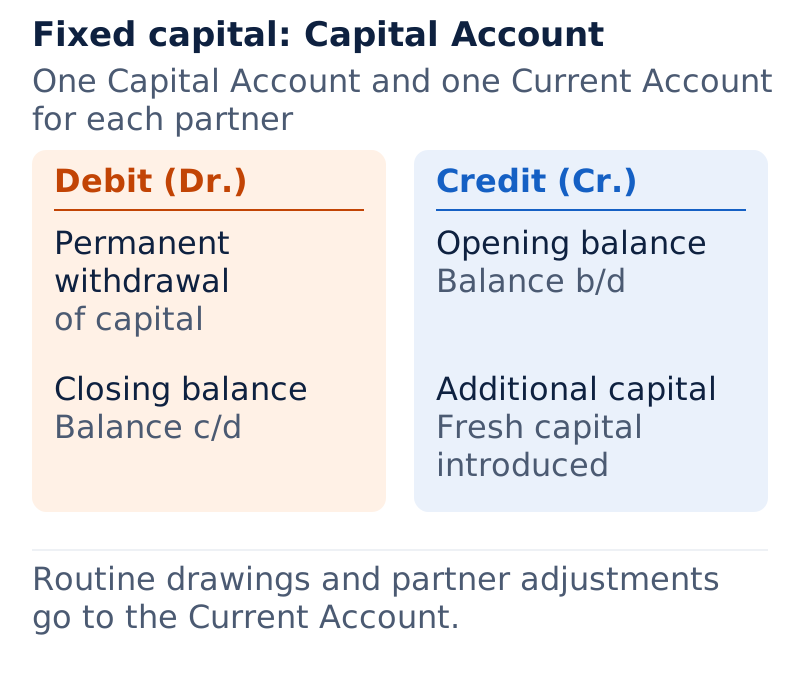
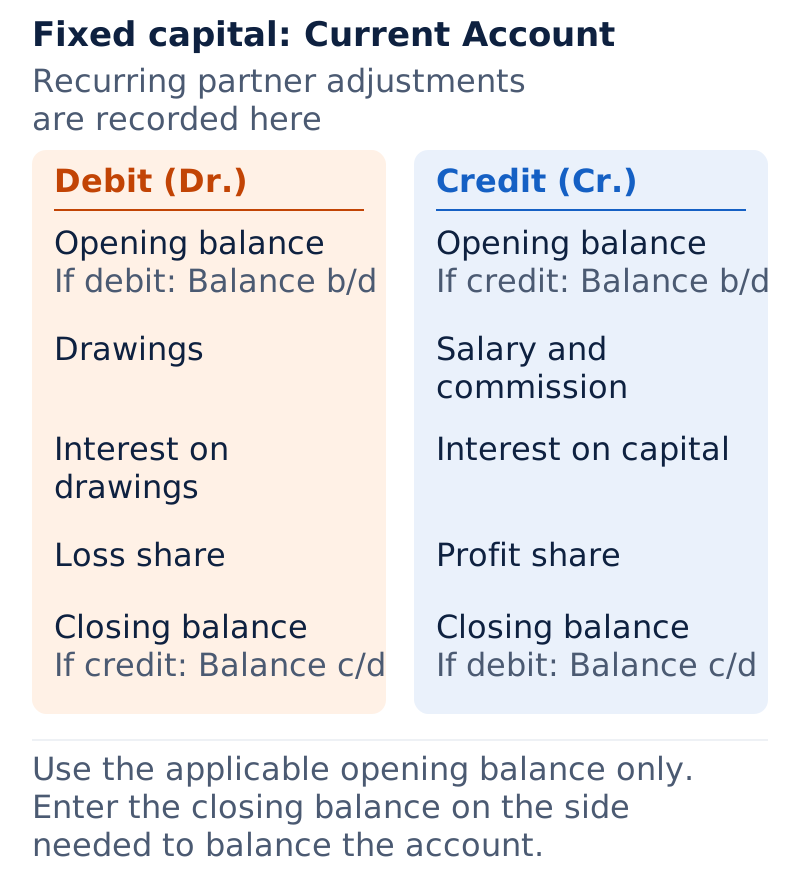
The upper two-sided account places permanent capital withdrawal and closing balance on the debit side, and opening balance and fresh capital on the credit side. The lower account places drawings, interest on drawings and loss on the debit side, with salary, commission, interest on capital and profit on the credit side.
Drawn by One Young India. See Fig. 1.1 in your NCERT textbook
How are partners’ capital and current accounts laid out?
A two-sided ledger account has a debit side and a credit side. In a fixed Capital Account, the opening balance and new capital are on the credit side. A permanent withdrawal of capital and the closing balance are on the debit side. Routine personal drawings belong in the Current Account, not in fixed capital.
Where do recurring partner adjustments appear?
For fixed capital, debit the Current Account for drawings, interest on drawings and loss share. Credit it for interest on capital, salary, commission and profit share. A debit opening balance is entered on the debit side; a credit opening balance is entered on the credit side. The closing balance is entered on the side needed to balance the account.
For fluctuating capital, use those same debit and credit sides in the partner’s Capital Account. Fresh capital joins the credit side and permanent capital withdrawal joins the debit side. This produces a single closing balance that reflects capital and the partner’s other transactions.
What the figure shows
Fluctuating capital account proforma
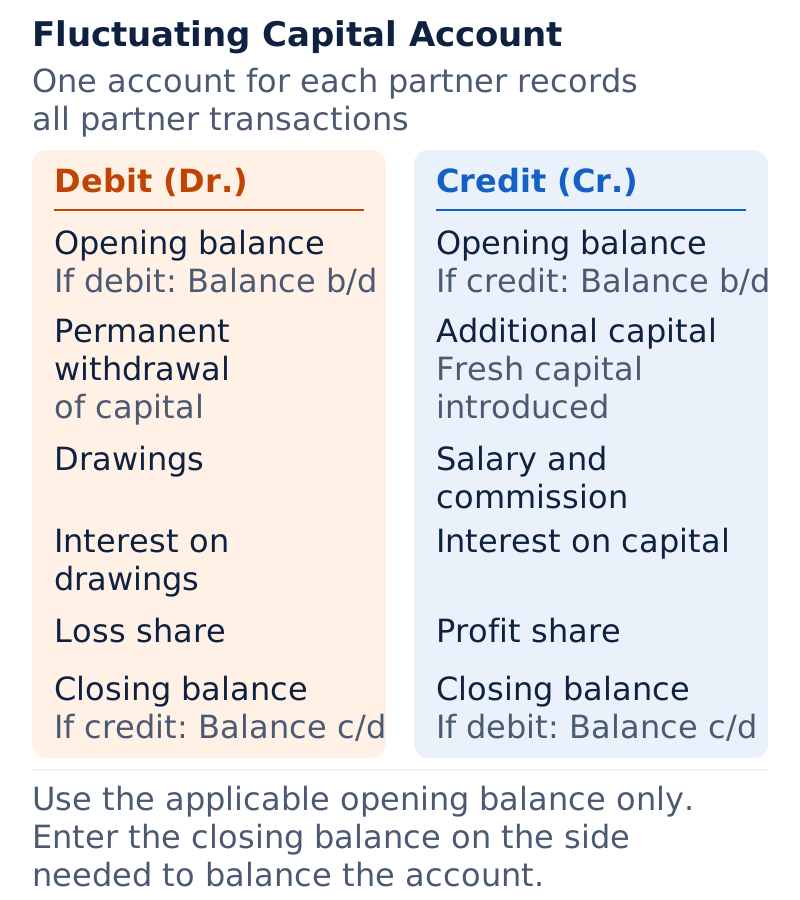
The debit side lists drawings, interest on drawings and a loss share; the credit side lists new capital, salary, interest on capital and a profit share. Opening and closing balances are placed according to whether each is debit or credit.
Drawn by One Young India. See Fig. 1.2 in your NCERT textbook
Worked example 1. Sameer and Yasmin start with capitals of ₹15,00,000 and ₹10,00,000 and add ₹3,00,000 and ₹2,00,000 in October. Sameer draws ₹30,000 and Yasmin ₹20,000. Interest on drawings is ₹1,800 and ₹1,200. They receive interest on capital of ₹82,500 and ₹55,000, salary of ₹20,000 to Sameer, and commission of ₹10,000 to Sameer and ₹7,000 to Yasmin, and profit shares of ₹60,000 and ₹40,000.
Answer: Fixed capital closes at ₹18,00,000 for Sameer and ₹12,00,000 for Yasmin. Their Current Accounts close at credit balances of ₹1,40,700 and ₹80,800. Under fluctuating capital, the Capital Accounts close at ₹19,40,700 and ₹12,80,800.
| Account | Side | Particulars | Sameer ₹ | Yasmin ₹ |
|---|---|---|---|---|
| Fixed Capital | Credit | Opening balance | 15,00,000 | 10,00,000 |
| Fixed Capital | Credit | Additional capital through Bank | 3,00,000 | 2,00,000 |
| Fixed Capital | Debit | Closing balance | 18,00,000 | 12,00,000 |
| Current | Debit | Drawings | 30,000 | 20,000 |
| Current | Debit | Interest on drawings | 1,800 | 1,200 |
| Current | Debit | Closing credit balance | 1,40,700 | 80,800 |
| Current | Credit | Interest on capital | 82,500 | 55,000 |
| Current | Credit | Salary | 20,000 | Nil |
| Current | Credit | Commission | 10,000 | 7,000 |
| Current | Credit | Profit share | 60,000 | 40,000 |
The Current Account check is explicit: Sameer’s credits are ₹82,500 + ₹20,000 + ₹10,000 + ₹60,000 = ₹1,72,500; debits are ₹30,000 + ₹1,800 = ₹31,800; the difference is ₹1,40,700. Yasmin’s credits are ₹55,000 + ₹7,000 + ₹40,000 = ₹1,02,000; debits are ₹20,000 + ₹1,200 = ₹21,200; the difference is ₹80,800. Adding each current balance to fixed capital gives the fluctuating balance.
How is the Profit and Loss Appropriation Account prepared?
The Profit and Loss Appropriation Account extends the firm’s Profit and Loss Account. It begins with the net profit or loss and records agreed partner appropriations. The balance is the profit or loss distributed to partners in their sharing ratio. It is separate from the ordinary expense calculation in the Profit and Loss Account.
Which side receives each item?
| Side | Particulars in the proforma |
|---|---|
| Debit | Net loss transferred from Profit and Loss Account |
| Debit | Interest on partners’ capital |
| Debit | Partner’s salary and partner’s commission |
| Debit | Partners’ Capital or Current Accounts for distributed profit |
| Credit | Net profit transferred from Profit and Loss Account |
| Credit | Interest on partners’ drawings |
| Credit | Partners’ Capital or Current Accounts for distributed loss |
When the firm has a loss, interest on capital, salary and remuneration are normally not allowed as appropriations. If the deed expressly makes an allowance a charge against profit, it is payable even if profits are insufficient or the firm incurs a loss. Distribute the resulting profit or loss among the partners in their profit sharing ratio.
What the figure shows
Profit and Loss Appropriation Account proforma
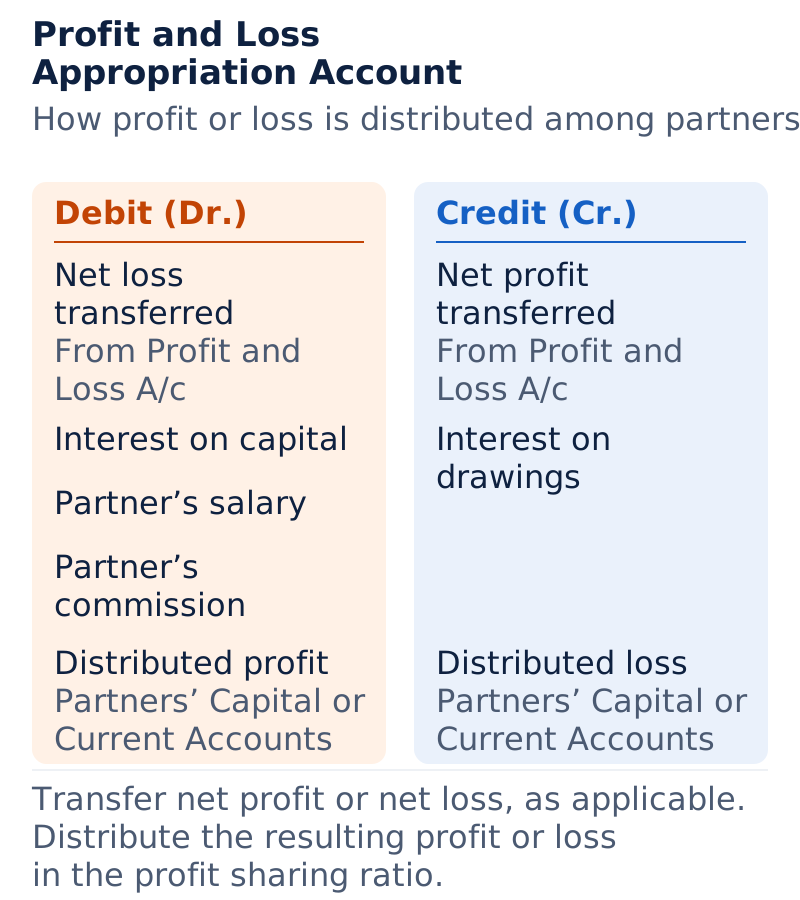
The debit side shows a transferred loss, interest on capital, partner salary, partner commission and distributed profit. The credit side shows transferred profit, interest on drawings and distributed loss.
Drawn by One Young India. See Fig. 1.3 in your NCERT textbook
What are the journal entries?
These entries use a partner’s Capital Account under the fluctuating method or Current Account under the fixed method. Each line is shown as debit followed by the corresponding credit.
| Transaction | Debit | Credit |
|---|---|---|
| Transfer net profit | Profit and Loss A/c | Profit and Loss Appropriation A/c |
| Transfer net loss | Profit and Loss Appropriation A/c | Profit and Loss A/c |
| Allow interest on capital | Interest on Capital A/c | Partners’ Capital or Current A/cs |
| Transfer interest on capital | Profit and Loss Appropriation A/c | Interest on Capital A/c |
| Charge interest on drawings | Partners’ Capital or Current A/cs | Interest on Drawings A/c |
| Transfer interest on drawings | Interest on Drawings A/c | Profit and Loss Appropriation A/c |
| Allow partner salary | Salary to Partner A/c | Partner’s Capital or Current A/c |
| Transfer partner salary | Profit and Loss Appropriation A/c | Salary to Partner A/c |
| Allow partner commission | Commission to Partner A/c | Partner’s Capital or Current A/c |
| Transfer partner commission | Profit and Loss Appropriation A/c | Commission to Partner A/c |
| Distribute remaining profit | Profit and Loss Appropriation A/c | Partners’ Capital or Current A/cs |
| Distribute loss | Partners’ Capital or Current A/cs | Profit and Loss Appropriation A/c |
How is a profit appropriation calculated and checked?
Start with net profit from the Profit and Loss Account. Add interest on drawings, which is charged to partners and credited to appropriation. Deduct agreed interest on capital, partner salary and partner commission. Share the balance among partners in the agreed ratio, or equally if the deed gives no ratio.
- Write net profit on the credit side of the Appropriation Account.
- Credit interest on drawings and total the credit side.
- Debit each agreed allowance to partners.
- Divide the remaining profit in the profit sharing ratio and debit those shares.
- Check that the debit total equals the credit total, then post each partner’s share.
Residual profit = Net profit + Interest on drawings − Interest on capital − Partner salary − Partner commission. This is the amount divided in the profit sharing ratio, provided the profit covers the appropriations.
Worked example 2. Amit, Babu and Charu share profits 3:2:1. Net profit is ₹35,660. Their interest on drawings is ₹270, ₹180 and ₹90. Amit receives salary of ₹1,000 per month; Babu receives commission of ₹5,000. Interest on their capitals at 6% is ₹3,000, ₹2,400 and ₹1,800.
Answer: Credit net profit ₹35,660 and interest on drawings ₹540, making ₹36,200. Debit salary ₹12,000, commission ₹5,000 and interest on capital ₹7,200. The residual is ₹12,000, shared as Amit ₹6,000, Babu ₹4,000 and Charu ₹2,000. Both sides total ₹36,200.
| Side | Profit and Loss Appropriation Account particulars | Amount ₹ |
|---|---|---|
| Debit | Amit’s salary | 12,000 |
| Debit | Babu’s commission | 5,000 |
| Debit | Interest on capital: Amit 3,000, Babu 2,400, Charu 1,800 | 7,200 |
| Debit | Profit shares: Amit 6,000, Babu 4,000, Charu 2,000 | 12,000 |
| Debit total | Total appropriations and profit shares | 36,200 |
| Credit | Net profit | 35,660 |
| Credit | Interest on drawings: Amit 270, Babu 180, Charu 90 | 540 |
| Credit total | Total profit and interest on drawings | 36,200 |
This account records partner salary and commission as appropriations. The chapter’s separate example of Amitabh and Babul treats a manager’s commission and interest on Amitabh’s loan as Profit and Loss Account charges before it brings net profit into the Appropriation Account.
How is interest on capital worked out?
Interest on capital is allowed when partners expressly agree to it. It is calculated at the agreed rate for the period during which each amount of capital remained in the business. Fresh capital introduced during the year earns interest from its introduction. If capital is withdrawn, the amount remaining thereafter earns interest for the rest of the period.
Interest on capital = Capital × Annual rate × Time in years. When time is measured in months, use months ÷ 12. Compute each period separately when capital changes, then add the period amounts.
What if the opening capital is missing?
Work backwards from closing capital by reversing every movement already posted to the Capital Account during the year. Add debits such as drawings, capital withdrawals, interest on drawings and loss shares; deduct credits such as additional capital, profit shares, salary, commission and interest on capital. Under the fixed capital method, reverse only capital additions and withdrawals in the Capital Account, because routine partner adjustments belong in the Current Account.
Worked example 3. Saloni starts on 1 April 2019 with ₹2,00,000. She adds ₹50,000 on 1 July and withdraws ₹30,000 from capital on 1 October. Interest is 8% per annum for the year ending 31 March 2020.
Answer: ₹2,00,000 × 8% × 3/12 = ₹4,000; ₹2,50,000 × 8% × 3/12 = ₹5,000; ₹2,20,000 × 8% × 6/12 = ₹8,800. Her interest on capital is ₹17,800.
If the deed is silent, no interest on capital is allowed. When agreed interest on capital is treated as an appropriation, it is not allowed in a loss year; if available profit is insufficient, distribute that profit in the ratio of interest due, leaving no residual profit. If the deed expressly treats interest on capital as a charge against profit, allow the full agreed amount even when profits are insufficient or there is a loss.
Worked example 4. Anupam and Abhishek have capitals of ₹1,50,000 and ₹2,00,000. Their deed provides interest at 8% per annum, but the profit available is only ₹14,000.
Answer: Full interest would be ₹12,000 and ₹16,000, totalling ₹28,000. Available profit is half of that amount, so credit interest of ₹6,000 to Anupam and ₹8,000 to Abhishek. The ₹14,000 is exhausted.
How is interest on drawings calculated?
Drawings are amounts a partner withdraws for personal use. Interest is charged only when the partners expressly agree to it. The calculation uses the agreed annual rate and the period each withdrawal remains outstanding up to the end of the accounting year.
When are withdrawals equal and regular?
For equal monthly drawings, the average period depends on timing. First day of every month gives 6½ months; last day gives 5½ months; the middle gives 6 months. For equal quarterly drawings, first day of each quarter gives 7½ months and last day gives 4½ months.
Average period = (Period of first drawing + Period of last drawing) ÷ 2. Then interest on drawings = Total drawings × Annual rate × Average period ÷ 12, with the average period expressed in months.
| Regular withdrawal timing | Average period | Result for the stated example |
|---|---|---|
| ₹3,000 at the start of each month, 9% per annum | 6½ months | ₹36,000 × 9% × 6.5/12 = ₹1,755 |
| ₹3,000 at the end of each month, 9% per annum | 5½ months | ₹36,000 × 9% × 5.5/12 = ₹1,485 |
| ₹30,000 at the start of each quarter, 8% per annum | 7½ months | ₹1,20,000 × 8% × 7.5/12 = ₹6,000 |
| ₹30,000 at the end of each quarter, 8% per annum | 4½ months | ₹1,20,000 × 8% × 4.5/12 = ₹3,600 |
When are withdrawal dates or amounts different?
Use the product method. Multiply each withdrawal by the number of months it remains withdrawn. Add the products, then multiply their sum by the annual rate and by 1/12. If only total drawings are supplied and no dates are given, treat them as evenly withdrawn throughout the year and use a six-month average period.
Worked example 5. Shahnaz withdraws ₹16,000, ₹15,000, ₹10,000, ₹14,000 and ₹11,000 with remaining periods of 12, 9, 5, 3 and 1 months. Charge interest at 7% per annum.
Answer: The products are ₹1,92,000, ₹1,35,000, ₹50,000, ₹42,000 and ₹11,000. Their sum is ₹4,30,000. Interest is ₹4,30,000 × 7% ÷ 12 = ₹2,508.33, approximately ₹2,508.
How does a guaranteed minimum profit change the distribution?
A partner may be guaranteed a minimum share of profit. First calculate each partner’s share in the agreed ratio. If the guaranteed partner’s normal share falls short, the difference is the deficiency. The guaranteeing partner or partners bear it in the agreed ratio. If one partner alone gives the guarantee, that partner bears the whole deficiency.
Deficiency = Guaranteed minimum − Share under the profit sharing ratio, when the guarantee exceeds the normal share. The guarantee reallocates the firm’s total profit; it does not increase that total.
- Determine the profit sharing ratio and calculate each normal profit share.
- Compare the guaranteed partner’s normal share with the minimum.
- Calculate the deficiency if the normal share is smaller.
- Deduct the deficiency from the guaranteeing partners in their agreed ratio.
- Add the deficiency to the guaranteed partner’s share and verify that all final shares total the firm’s profit.
Worked example 6. Madhulika, Rakshita and Kanishka share ₹1,20,000 in the ratio 2:3:1. Kanishka is guaranteed ₹25,000, and Madhulika and Rakshita bear the deficiency in their 2:3 ratio.
Answer: Normal shares are ₹40,000, ₹60,000 and ₹20,000. Kanishka’s deficiency is ₹5,000. Madhulika bears ₹2,000 and Rakshita ₹3,000. Final shares are ₹38,000, ₹57,000 and ₹25,000, totalling ₹1,20,000.
If Rakshita alone gives that guarantee, she bears all ₹5,000. The final shares become Madhulika ₹40,000, Rakshita ₹55,000 and Kanishka ₹25,000. The guaranteed partner receives the same minimum, but the burden on the other partners differs.
How are past errors adjusted after profits have been distributed?
A past adjustment corrects an omission or error discovered after final accounts and profit distribution. Examples include omitted interest on capital, interest on drawings, interest on a partner’s loan, salary or commission. An adjustment may also follow a retrospective change in the deed or accounting system.
The accounts can be corrected through a Profit and Loss Adjustment Account or by a direct entry between the affected partners’ Capital Accounts. For fixed capital, the corresponding partner adjustments are reflected in their Current Accounts.
How is the net effect found?
- Calculate the amount each partner should have received or paid under the omitted term.
- Calculate how that omission affected the profit previously distributed.
- Compare the correct and recorded effect for each partner.
- Debit partners who received too much or paid too little.
- Credit partners who received too little or paid too much, and confirm total debits equal total credits.
Worked example 7. Rameez and Zaheer share profits equally. Their capitals are ₹50,000 and ₹1,00,000. Agreed interest on capital at 6% was omitted before profits were divided.
Answer: They should receive ₹3,000 and ₹6,000 interest. The resulting ₹9,000 reduction in distributable profit would reduce each earlier profit share by ₹4,500. Rameez therefore received ₹1,500 too much; Zaheer received ₹1,500 too little. Debit Rameez’s Capital A/c ₹1,500 and credit Zaheer’s Capital A/c ₹1,500.
Through the adjustment account, debit Profit and Loss Adjustment A/c ₹9,000 and credit Rameez’s Capital A/c ₹3,000 and Zaheer’s Capital A/c ₹6,000. Then debit each partner’s Capital A/c ₹4,500 and credit Profit and Loss Adjustment A/c ₹9,000. Both routes give the same net correction.
The firm’s final accounts otherwise follow the usual financial statement process. The additional partnership account is the Profit and Loss Appropriation Account, which shows how profit or loss is distributed among partners.
Glossary
- Partnership — a relationship formed by persons agreeing to share profits of a business carried on by all or any acting for all.
- Partner — a person who has entered into a partnership agreement with one or more other persons.
- Firm — the collective name for the persons who have entered into partnership with one another.
- Mutual agency — the relationship under which a partner may conduct the firm’s business on behalf of all partners.
- Partnership deed — a written document containing the partners’ agreed terms about their business and relationship.
- Fixed capital — capital that remains unchanged except when additional capital is introduced or capital is permanently withdrawn.
- Current Account — an account used with fixed capital to record a partner’s drawings, interest, remuneration and profit or loss share.
- Fluctuating capital — capital whose balance changes as partner transactions and profit or loss shares are posted directly to it.
- Profit and Loss Appropriation Account — the account that records partner appropriations and the distribution of remaining profit or loss.
- Interest on capital — an agreed allowance calculated on a partner’s capital for the period it remains in the firm.
- Interest on drawings — an agreed charge on a partner’s personal withdrawals for the period they remain outstanding.
- Product method — a way to calculate drawings interest by multiplying each withdrawal by its outstanding period.
- Guaranteed profit — a minimum profit share assured to a partner, with any deficiency borne by the guarantor.
- Past adjustment — a correction to partners’ accounts for an omission or error discovered after profit distribution.
Common errors and misconceptions
- Misconception: A partnership agreement must be written. Correct: An oral agreement is valid, although a written deed is preferred.
- Misconception: Larger capital automatically earns a larger profit share. Correct: Partners share equally when the deed is silent on the ratio.
- Misconception: Interest on capital is automatic. Correct: It requires an express agreement.
- Misconception: Drawings always bear interest. Correct: Interest on drawings needs an express agreement.
- Misconception: A partner’s loan is treated like capital interest. Correct: A loan to the firm earns 6% per annum when there is no contrary agreement on the rate.
- Misconception: Drawings go directly to fixed capital. Correct: Routine drawings go to the partner’s Current Account under fixed capital.
- Misconception: The guaranteed share is added to the firm’s profit. Correct: The deficiency is transferred from the guaranteeing partners’ shares.
- Misconception: A past omission requires all old accounts to be rewritten. Correct: A Profit and Loss Adjustment Account or direct partner account entry can correct it.
Exam-style questions with model answers
Q1. What is mutual agency? [2 marks]
- Mutual agency means the partnership business may be conducted by all partners or by any partner acting for all. A partner carrying on business is both a principal and an agent: that partner can bind the others through acts of the firm and is bound by their business acts.
Q2. State the accounting rules when the partnership deed is silent. [4 marks]
- Profits and losses are shared equally, regardless of the partners’ capital contributions. No interest on capital is allowed and no interest on drawings is charged. A partner is not entitled to salary or other remuneration for the firm’s work without agreement. A partner’s business loan to the firm earns interest at 6% per annum.
Q3. Distinguish fixed capital from fluctuating capital. [4 marks]
- Fixed capital uses two accounts per partner: Capital Account and Current Account. Additional or permanently withdrawn capital changes the Capital Account; drawings, interest, remuneration and profit or loss share pass through the Current Account. Fluctuating capital uses one Capital Account per partner. All those transactions are posted directly to it, so the balance changes. A fixed Capital Account normally carries a credit balance, while a fluctuating Capital Account can sometimes carry a debit balance.
Q4. Prepare the profit distribution for Amit, Babu and Charu using net profit ₹35,660, drawings interest ₹540, salary ₹12,000, commission ₹5,000 and capital interest ₹7,200; their ratio is 3:2:1. [5 marks]
- Credit the Appropriation Account with net profit ₹35,660 and interest on drawings ₹540. Total credit is ₹36,200. Debit salary ₹12,000, commission ₹5,000 and interest on capital ₹7,200, a total of ₹24,200. The remaining ₹12,000 is divided in the ratio 3:2:1: Amit receives ₹6,000, Babu ₹4,000 and Charu ₹2,000. Debit these profit shares to the Appropriation Account and credit the partners’ Capital or Current Accounts. Debits and credits both total ₹36,200.
Q5. Calculate interest on drawings for equal monthly withdrawals of ₹3,000 at the beginning and at the end of each month, at 9% per annum. [3 marks]
- For equal monthly withdrawals at the beginning of each month, the average period is 6½ months. At the end of each month it is 5½ months. Multiply total withdrawals by the agreed annual rate and by the average period divided by 12. For ₹3,000 monthly at 9% per annum, total drawings are ₹36,000. Beginning withdrawals give ₹1,755; end withdrawals give ₹1,485.
Q6. Show how a guaranteed minimum changes the division of ₹1,20,000 between Madhulika, Rakshita and Kanishka in the ratio 2:3:1. Kanishka is guaranteed ₹25,000 by the other two in their 2:3 ratio. [5 marks]
- Before guarantee, the shares are ₹40,000 to Madhulika, ₹60,000 to Rakshita and ₹20,000 to Kanishka. Kanishka is short of the ₹25,000 minimum by ₹5,000. Madhulika bears 2/5 of the deficiency, or ₹2,000; Rakshita bears 3/5, or ₹3,000. Their revised shares are ₹38,000 and ₹57,000. Kanishka receives ₹20,000 + ₹5,000 = ₹25,000. The final shares total ₹1,20,000, the firm’s profit.
Q7. Pass the direct journal entry when Rameez and Zaheer omit capital interest of ₹3,000 and ₹6,000 before sharing profits equally. [3 marks]
- The total omitted interest is ₹9,000. If it had been allowed, each partner’s share of distributable profit would have fallen by ₹4,500. Rameez’s net correction is ₹3,000 credit less ₹4,500 debit, so his account must be debited ₹1,500. Zaheer’s net correction is ₹6,000 credit less ₹4,500 debit, so his account must be credited ₹1,500. Entry: Rameez’s Capital A/c Dr. ₹1,500; To Zaheer’s Capital A/c ₹1,500.
Key takeaways
- A partnership requires an agreement to carry on business, share profits and act for one another; mutual agency distinguishes it from mere co-ownership.
- A written partnership deed records terms, while the Partnership Act supplies accounting rules where the partners have made no express agreement.
- When the deed is silent, partners share profits equally, receive no capital interest or remuneration, and pay no drawings interest.
- Fixed capital uses a Capital Account plus a Current Account; fluctuating capital posts all partner adjustments in one Capital Account.
- The Profit and Loss Appropriation Account starts with net profit or loss and records partner appropriations before sharing the balance.
- Capital interest depends on the amount and period invested; drawings interest depends on the amount and period withdrawn.
- A guaranteed partner’s deficiency is deducted from the guarantors’ profit shares, so the final distribution still totals the firm’s profit.
- Past omissions can be corrected through a Profit and Loss Adjustment Account or a direct entry between affected partners’ accounts.
Test yourself
Does a larger capital contribution change the profit sharing ratio when the deed is silent?
No. In the absence of an agreed profit sharing ratio, partners share profits and losses equally irrespective of their capital contributions.
Where are routine drawings posted when capital is fixed?
They are debited to the partner’s Current Account. The fixed Capital Account changes when capital is added or permanently withdrawn.
Which account receives interest on drawings when it is transferred for appropriation?
Interest on Drawings A/c is debited and Profit and Loss Appropriation A/c is credited.
What average period applies to equal quarterly drawings at the end of each quarter?
The average period is 4½ months, based on outstanding periods of 9, 6, 3 and 0 months.
How is an omitted partner allowance corrected after profits have been distributed?
Calculate each partner’s proper allowance and the resulting change to profit shares, then make an adjustment through Profit and Loss Adjustment Account or directly in partner accounts.
Who bears a guaranteed profit deficiency if one partner alone gives the guarantee?
The sole guaranteeing partner bears the full deficiency. The guaranteed partner’s final share rises by that amount, while the firm’s total profit stays the same.