
Constructions | ICSE Class 10 Maths Notes
On this page
This note covers tangents from an external point, perpendicular and angle bisectors, circles through triangle vertices, circles touching triangle sides, and circles circumscribed about or inscribed in regular hexagons, with construction steps, geometric reasons and checks.
What do the words in a construction question mean?
A geometrical construction locates points and draws lines or circles using stated geometric conditions. A ruler draws straight lines; compasses transfer lengths and draw circles or arcs. An arc is a part of a circle's boundary.
A circle consists of points at a fixed distance from a fixed point in a plane. The fixed point is its centre; the fixed distance is its radius. The plural of radius is radii. A chord joins two points on the circle. A diameter is a chord through its centre.
A tangent is a straight line having exactly one point in common with a circle. This shared point is the point of contact. A secant is a line meeting the circle at two distinct points. An external point lies outside the circle.
How should labels and symbols be read?
Capital letters name points. Thus AB denotes the segment joining points A and B, or its length when used in an equation. The symbol = means equal, and ∠ABC means the angle between BA and BC, with its vertex, or corner, at B.
The symbol ° denotes degrees, a unit for measuring angles. A right angle measures 90°. Perpendicular lines meet at a right angle. A midpoint divides a segment into two equal parts. To bisect a segment or angle means to divide it into two equal parts.
Definition: A circle circumscribed about a polygon passes through its vertices. A circle inscribed in a polygon touches all its sides. A polygon is a closed figure made from straight line segments; its corners are its vertices.
These two instructions require different distances. For a circumscribed circle, measure from its centre to a vertex. For an inscribed circle, use the perpendicular distance from its centre to a side. Choosing the centre and choosing the radius are separate parts of the construction.
How do perpendicular bisectors and angle bisectors locate centres?
A perpendicular bisector passes through a segment's midpoint at right angles to the segment. Its points are equidistant, meaning equally distant, from the segment's endpoints. An angle bisector divides an angle into two equal angles. An internal bisector lies inside the angle. Its points are equidistant from the lines forming that angle.
How is a perpendicular bisector constructed?
- Take the segment AB whose perpendicular bisector is required. Set the compasses to a distance greater than half AB, so that arcs drawn from the endpoints can intersect.
- With A as centre, draw arcs on both sides of AB. Keep the same compass opening for the next step.
- With B as centre, draw arcs cutting the earlier arcs at two points. Name these intersection points X and Y.
- Draw XY. It is the perpendicular bisector of AB. Its intersection with AB gives the midpoint of AB.
Both X and Y are equally distant from A and B because each was formed using the same radius from the two endpoints. The line through these points therefore identifies the required locus, the set of points satisfying a stated condition.
How is an internal angle bisector constructed?
- For angle ABC, draw an arc centred at B meeting the arms BA and BC at points D and E respectively. The arms are the two rays forming the angle. A ray starts at one point and continues indefinitely in one direction.
- With D and E as centres and the same compass opening, draw arcs that meet at F inside the angle.
- Join B to F. The ray BF, starting at B and continuing through F, is the internal angle bisector.
- Use the bisector lying inside the triangle when finding the centre of a circle that must lie inside and touch its sides.
The distance from a point to a line means the length of the perpendicular drawn from the point to that line. It does not mean the length of an arbitrary slanting segment. This distinction explains why angle bisectors locate centres of circles touching two intersecting lines.
Note: Perpendicular bisectors compare distances to points. Angle bisectors compare perpendicular distances to lines. Identify which kind of equal distance the required circle needs before drawing either construction.
Which circle properties justify the constructions?
A theorem is a mathematical statement established by proof. The following properties connect the construction steps to the conditions the finished figure must satisfy.
Theorem: A tangent is perpendicular to the radius at contact
Let O be a circle's centre and P its point of contact with tangent XY. Then OP is perpendicular to XY. The right angle occurs at P, where the radius reaches the tangent, rather than at the centre or at an external point.
For a reason, take another point Q on XY. It lies outside the circle, so OQ is longer than OP. Thus OP is the shortest segment from O to the tangent line. The shortest distance from a point to a line is perpendicular to that line.
What the figure shows
Radius and tangent
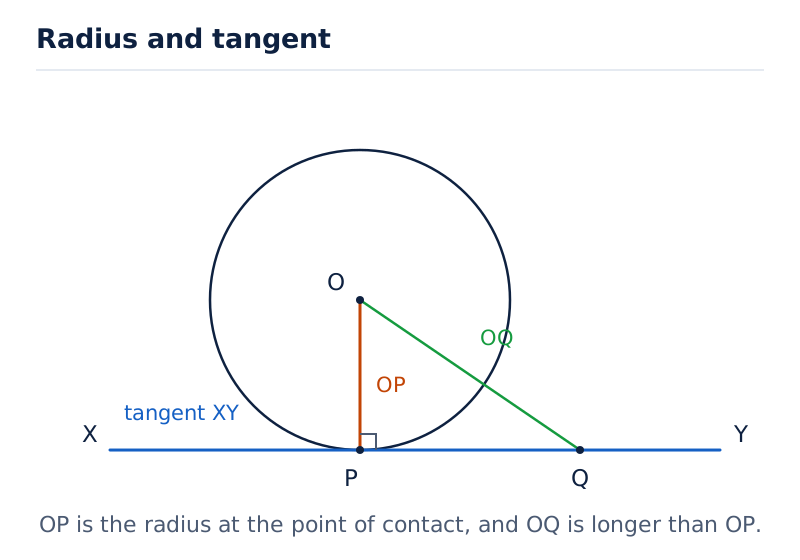
The circle has centre O and touches line XY at P. OP joins the centre to contact. Q is another point on the line, and OQ is also drawn.
Drawn by One Young India.
Theorem: Tangents from the same external point have equal lengths
Let P be an external point, and let PQ and PR touch a circle with centre O at Q and R. Join OQ, OR and OP. The triangles OQP and ORP are right-angled at Q and R, and their radii OQ and OR are equal.
They also share OP, their hypotenuse, the side opposite the right angle. The RHS congruence rule, meaning right angle, hypotenuse and one corresponding side, makes the triangles congruent: equal in shape and size. Their corresponding sides PQ and PR are therefore equal.
What the figure shows
Equal tangent lengths
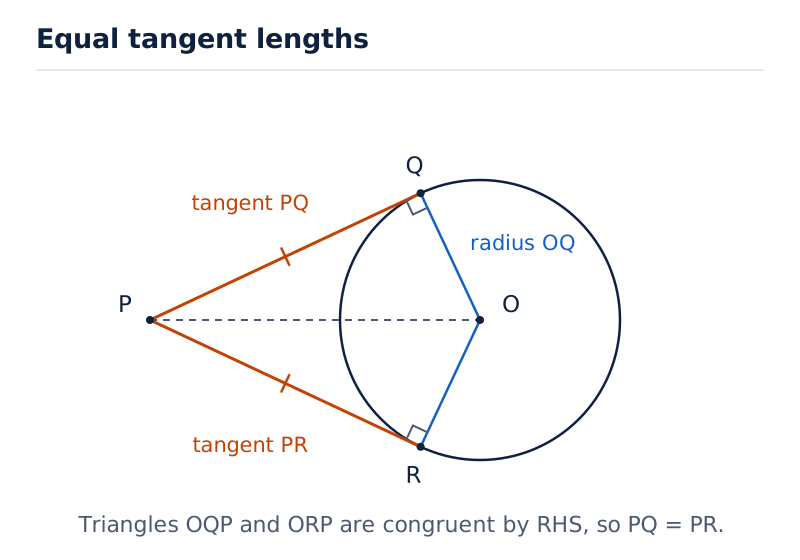
External point P is joined to contact points Q and R on the circle with centre O. The diagram also joins O to P, Q and R.
Drawn by One Young India.
Theorem: An angle in a semicircle is a right angle
A semicircle is half a circle, bounded by a diameter and its arc. If OP is a diameter and T is another point on the circle, ∠OTP is 90°. Here T is the vertex of the angle, and the angle's arms join it to the diameter's endpoints.
This result supplies the right angle needed to construct tangents. An auxiliary circle, meaning an extra circle used to carry out the construction, can make the radius of the original circle perpendicular to a line from the external point.
How are two tangents constructed from an external point?
Start with a given circle whose centre is O and a given point P outside it. The task is to locate the contact points before drawing the tangent lines. A line aimed at the circle by eye does not establish the required right angle.
What are the steps?
Worked example 1. Construct the tangents from a given external point P to a given circle with centre O.
Answer: Construct a circle with OP as diameter. Its intersections with the original circle give contact points T and U, because ∠OTP and ∠OUP are each 90°. Join P to T and U.
- Join the centre O to the external point P. Construct the perpendicular bisector of OP and mark its midpoint M.
- With M as centre and MO as radius, draw an auxiliary circle. Since MO equals MP, this circle passes through both O and P.
- Mark the two intersections of the auxiliary circle with the original circle as T and U.
- Join PT and PU. These are the required tangent segments. Extend them if complete tangent lines are required.
- Join OT and OU to display the radii through the contact points. Retain the auxiliary circle and midpoint construction so that the method can be followed.
Why does the construction work?
OP is a diameter of the auxiliary circle. Therefore ∠OTP and ∠OUP are right angles. Since T and U also lie on the original circle, OT and OU are its radii. PT and PU are perpendicular to those radii at their endpoints.
A line through a point on a circle perpendicular to its radius is a tangent there. Consequently PT and PU touch the original circle at T and U. The auxiliary circle identifies those points; it is not the circle to which the final tangents are being drawn.
Diagram
Two tangents from an external point
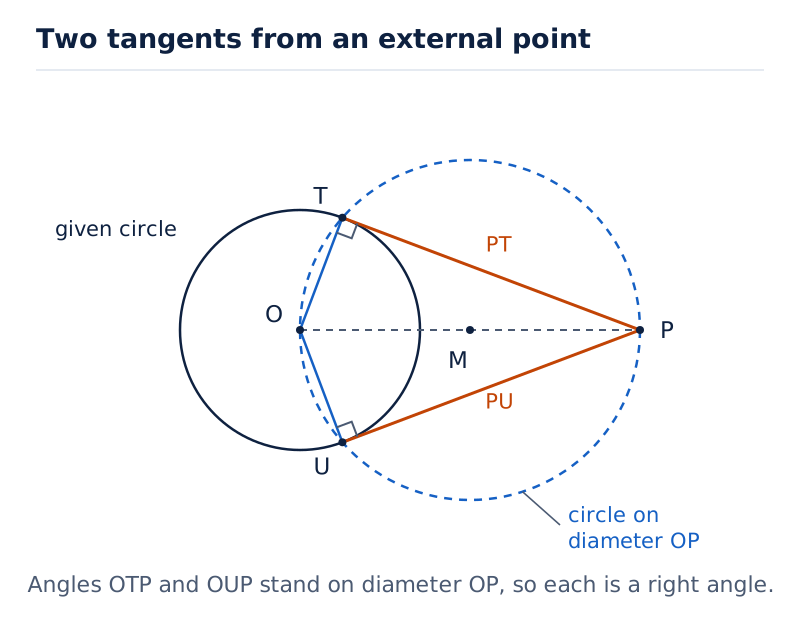
Draw the given circle with centre O, external point P and midpoint M of OP. Add the circle on diameter OP, its intersections T and U with the given circle, and segments PT, PU, OT and OU.
Drawn by One Young India.
As a check, PT equals PU. This equality follows from the tangent theorem. Equal measured lengths support an accuracy check, but the geometric justification remains the pair of right angles obtained from the auxiliary circle.
How can right triangles check tangent lengths?
For a circle with centre O, external point P and contact point T, triangle OTP is right-angled at T. The Pythagoras theorem states that the square of a right triangle's hypotenuse equals the sum of the squares of its other two sides.
Thus OP² = OT² + PT². The superscript ² means the square of a length, and + means addition. OP is the hypotenuse, OT is the radius, and PT is the tangent length. Rearranging gives PT² = OP² − OT², where − means subtraction.
What do the numerical checks look like?
Worked example 2. A circle has centre O and radius 5 centimetres, abbreviated cm. Its tangent at P meets a line through O at Q, with OQ = 12 cm. Find PQ.
Answer: OP is perpendicular to PQ, so OQ is the hypotenuse. PQ² = OQ² − OP² = 12² − 5² = 119 cm². Therefore PQ = √119 cm, where √ denotes the non-negative square root and cm² means square centimetres.
Worked example 3. From external point Q, a tangent to a circle has length 24 cm. Q is 25 cm from the centre. Find the radius.
Answer: Let O be the centre and T the contact point. OT² = OQ² − QT² = 25² − 24² = 49 cm². Hence the radius OT = 7 cm. The centre-to-external-point distance is the hypotenuse.
Worked example 4. A is 5 cm from a circle's centre, and the tangent from A has length 4 cm. Find the radius.
Answer: Let O be the centre and T the point of contact. OT² = OA² − AT² = 5² − 4² = 9 cm². Therefore OT = 3 cm. The radius meets the tangent at a right angle at T.
These calculations check the geometry rather than replacing it. A tangent construction requires locating the contact points and drawing the lines through the external point. A calculated length alone does not locate either contact point on the circle.
Check the position first. An interior point has no tangent through it, a point on the circle has one tangent, and an external point has two. The auxiliary-circle method above is stated for an external point, where the two contact points are distinct.
How is a circle circumscribed about a triangle?
Let ABC be a given triangle, with vertices A, B and C not on one straight line. A circumcircle passes through all three vertices. Its centre is the circumcentre, and its radius is the distance from that centre to any vertex.
The required centre must be equidistant from A and B, so it lies on the perpendicular bisector of AB. It must also be equidistant from B and C, so it lies on the perpendicular bisector of BC. Their intersection gives the centre.
What are the steps and their justification?
Worked example 5. Construct the circumcircle of a given triangle ABC.
Answer: Construct perpendicular bisectors of AB and BC, meeting at O. Each bisector crosses its side at 90°. With centre O and radius OA, draw the circle. It passes through A, B and C because OA = OB = OC.
- Keep the given triangle ABC visible. Construct the perpendicular bisector of AB using equal-radius arcs from A and B.
- Construct the perpendicular bisector of BC using equal-radius arcs from B and C. Extend either bisector as necessary until they meet.
- Name their intersection O. Since O is on the first bisector, OA = OB. Since it is on the second, OB = OC.
- Set the compasses to OA. With O as centre, draw the circle through A. The equal distances ensure that it also passes through B and C.
The third side's perpendicular bisector passes through the same point because OA = OC. It can be used to check the centre. It is not necessary to locate a separate centre for each pair of vertices.
Diagram
Triangle and circumcircle
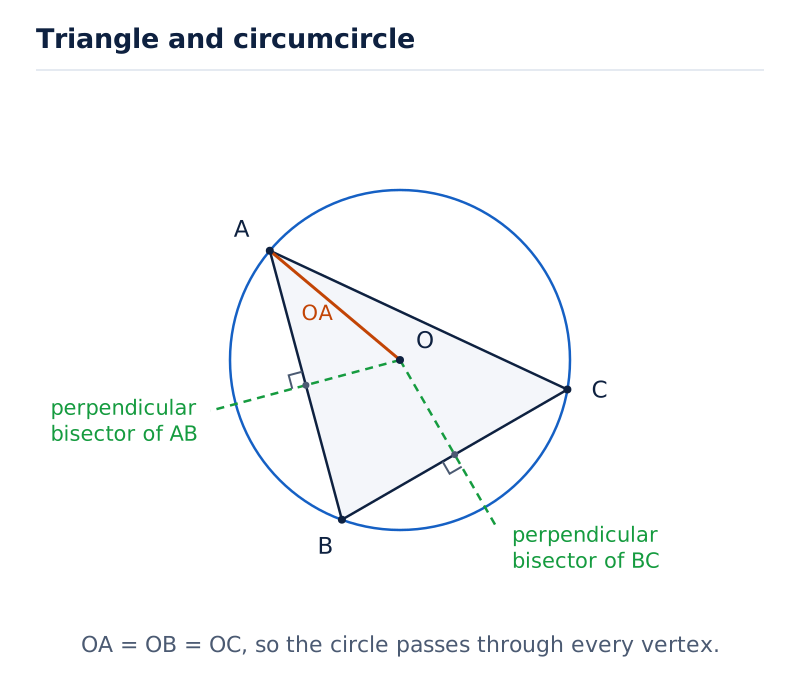
Draw triangle ABC, the perpendicular bisectors of AB and BC, their intersection O, and the circle with centre O through A, B and C. Mark a radius from O to a vertex.
Drawn by One Young India.
Do not replace a perpendicular bisector with a line drawn from the opposite vertex to a side's midpoint. Such a line is a median; it need not be perpendicular to that side. The circumcentre is determined by equal distances to vertices, not by the triangle's apparent middle.
How is a circle inscribed in a triangle?
An incircle lies inside a triangle and touches each of its three sides. Its centre is the incentre, the intersection of the triangle's internal angle bisectors. Its radius, called the inradius, is the perpendicular distance from the incentre to any side.
For a given triangle ABC, a point on the internal bisector of angle ABC has equal perpendicular distances from AB and BC. A point also on the internal bisector of angle BCA has equal perpendicular distances from BC and CA. The intersection therefore has equal distances from all three sides.
How do you obtain the correct radius?
Worked example 6. Construct the incircle of a given triangle ABC.
Answer: Construct the internal angle bisectors at B and C, meeting at I. Draw ID perpendicular to BC, where D is on BC, so ∠IDB = 90°. Draw the circle with centre I and radius ID. It touches all three sides.
- Construct the internal bisector of angle ABC. Construct the internal bisector of angle BCA and mark their intersection I.
- From I, draw an arc cutting the line BC at two points E and F. Keep one compass opening for this arc, so IE = IF.
- Construct the perpendicular bisector of EF. It passes through I. Mark its intersection with BC as D; ID is the perpendicular distance required.
- With I as centre and ID as radius, draw the incircle. D is its point of contact with BC.
The centre I is equally distant from all three side-lines. A circle with that common perpendicular distance as radius touches each side. Joining I to a vertex would produce a different length and would not give the inradius.
Diagram
Triangle and incircle
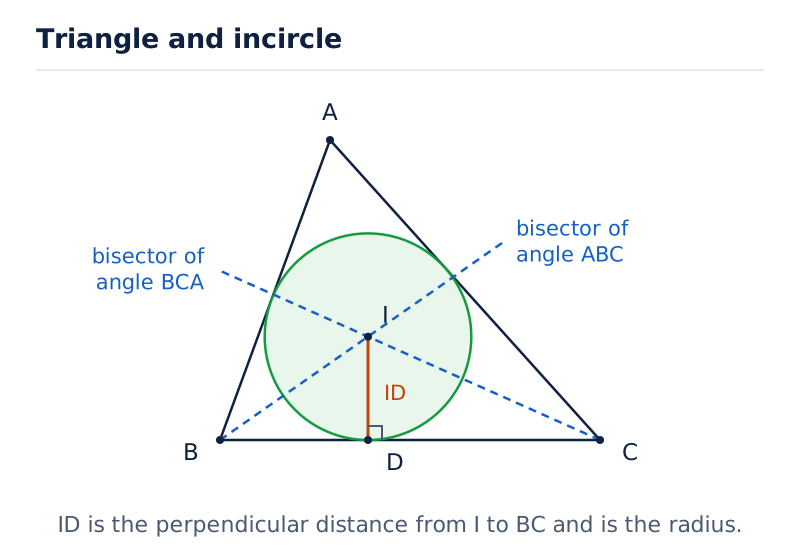
Draw triangle ABC and its internal bisectors at B and C meeting at I. Draw ID perpendicular to BC with D on BC. Add the circle with centre I and radius ID, touching all three sides.
Drawn by One Young India.
Check contact, not crossing. The circle should touch each side without cutting across it. Its radius to each contact point is perpendicular to the corresponding side. The remaining internal angle bisector also passes through I and provides a further check on the centre.
What makes the regular hexagon constructions possible?
A regular hexagon is a polygon with six equal sides and six equal interior angles. An interior angle lies inside the polygon between adjacent sides. Name its vertices A, B, C, D, E and F consecutively around the boundary.
Its centre is equally distant from all six vertices and equally distant from all six sides. These are two different sets of distances. The vertex distance is the circumradius, the radius of the circumscribed circle. The perpendicular side distance is the inradius.
How are the centre and vertices related?
Join the centre O to the six vertices. The six equal angles around O together make one full turn of 360°, so each is 60°. Each triangle formed by two adjacent radii and their joining side is equilateral, meaning that its three sides are equal.
Consequently, the side of a regular hexagon equals its circumradius. This explains the familiar construction of a regular hexagon in a circle: a compass opening equal to the circle's radius steps off six equal chords around its boundary.
- Draw a circle with a given centre and radius, and choose a point A on it.
- Keep the compasses open to the radius. Starting from A, mark successive points B, C, D, E and F around the circle using that unchanged opening.
- Continue consistently around the boundary, choosing the next point rather than returning to the previous one.
- Join consecutive vertices and then F to A. The six equal chords form the regular hexagon.
A radius to a vertex does not end on the interior of a side. The perpendicular from O to a side does. In the equilateral triangle formed by that side and two radii, the perpendicular reaches the side's midpoint and is shorter than a radius to a vertex.
This difference is essential when drawing both circles. The circumcircle reaches the corners; the incircle reaches the sides. The two circles have the same centre for a regular hexagon, but they do not have the same radius.
How are circles circumscribed about and inscribed in a regular hexagon?
Begin with a given regular hexagon ABCDEF, named consecutively around its boundary. If its centre is not already marked, construct it from the geometry. Perpendicular bisectors of two adjacent sides locate a point equally distant from their endpoints.
How is the circumcircle drawn?
Worked example 7. Construct a circle circumscribed about a given regular hexagon ABCDEF.
Answer: Construct the perpendicular bisectors of AB and BC, each meeting its side at 90°, and call their intersection O. With centre O and radius OA, draw the circle through the six vertices. OA is also equal to the hexagon's side.
- Construct the perpendicular bisector of AB with equal-radius arcs from A and B.
- Construct the perpendicular bisector of BC in the same way. Mark the intersection of the bisectors as O.
- Set the compasses to OA, the distance from the centre to a vertex.
- Draw the circle with centre O. Check that it passes through A, B, C, D, E and F.
Regularity ensures that the vertices share the same distance from O. The circle passes through vertices rather than touching each side at its midpoint. Each side of the hexagon is a chord of this circle.
How is the incircle drawn?
Worked example 8. Construct a circle inscribed in a given regular hexagon ABCDEF.
Answer: Find its centre O from perpendicular bisectors of AB and BC. Let M be the midpoint of AB. OM meets AB at 90°. Draw the circle with centre O and radius OM; it touches every side at its midpoint.
- Locate O using the perpendicular bisectors of adjacent sides, if it is not already marked.
- Mark M where the perpendicular bisector of AB meets AB. Thus M is the midpoint of that side.
- Use OM as the radius. It is the perpendicular distance from the centre to AB and is also the distance to each other side.
- Draw the circle with centre O and radius OM. Check contact with all six sides, with no crossing of a side.
Diagram
Both circles of a regular hexagon
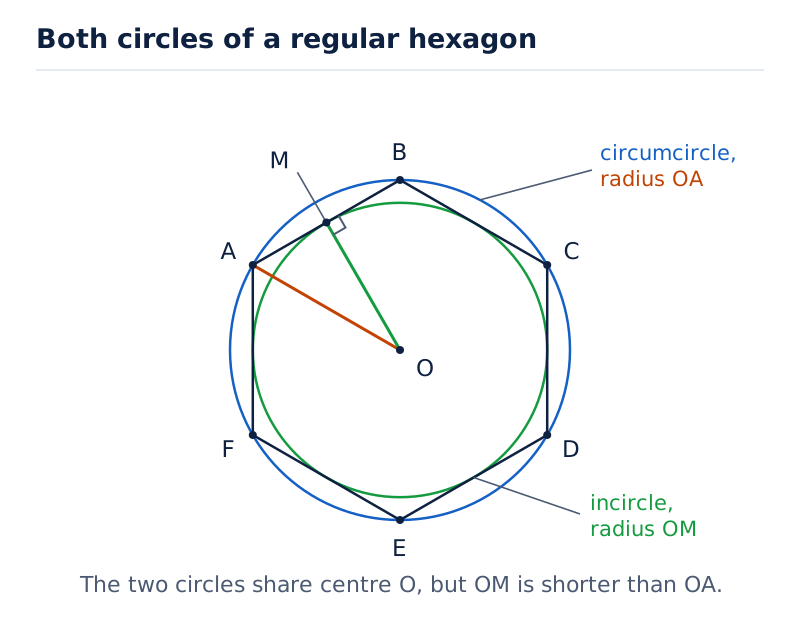
Draw regular hexagon ABCDEF and centre O. Mark midpoint M of AB. Draw the outer circle with radius OA through the vertices and the inner circle with radius OM touching the sides.
Drawn by One Young India.
How do you choose and check the required construction?
Read whether the requested circle must pass through points or touch sides. These phrases describe different conditions. In a triangle, they lead to different methods of locating the centre. In a regular hexagon, the centre is shared, but the radius still changes.
Which method belongs to each task?
| Required construction | How to locate the centre or contact | Final drawing |
|---|---|---|
| Tangents from external point P | Circle on diameter OP, where O is the given centre | Join P to both intersections with the given circle |
| Triangle circumcircle | Intersection of perpendicular bisectors of sides | Circle with radius from centre to vertex |
| Triangle incircle | Intersection of internal angle bisectors | Circle with perpendicular centre-to-side distance as radius |
| Regular hexagon circumcircle | Intersection of perpendicular bisectors of adjacent sides | Circle through all six vertices |
| Regular hexagon incircle | The same regular hexagon centre | Circle using the perpendicular distance to a side |
Keep a clear distinction between the given figure, the auxiliary construction and the required result. Name a new point when it is introduced. In particular, the centre of the auxiliary circle used for tangents is the midpoint of the centre-to-external-point segment.
Review the result against the original condition. A circumcircle should pass through every required vertex. An incircle should touch every required side. A tangent should pass through the specified external point and be perpendicular to the radius at contact.
Finally, supply the geometric reason. Equal-distance loci justify the centres, while the angle in a semicircle justifies the tangent contact points. These reasons explain why the steps work even when a drawing contains small practical inaccuracies.
Glossary
- Tangent — A straight line having exactly one point in common with a circle.
- Point of contact — The shared point where a tangent touches its circle.
- External point — A point outside a circle, from which two tangents can be drawn.
- Perpendicular bisector — A line passing through a segment's midpoint at right angles to the segment.
- Angle bisector — A ray dividing an angle into two angles of equal size.
- Locus — The set of points satisfying a specified geometric condition.
- Auxiliary circle — An additional circle used to locate points needed in a construction.
- Circumcircle — A circle passing through all the vertices of a polygon.
- Circumcentre — The centre of a triangle's circumcircle, equidistant from its three vertices.
- Incircle — A circle inside a polygon that touches every side of that polygon.
- Incentre — The intersection of a triangle's internal angle bisectors, equidistant from its sides.
- Inradius — The radius of an incircle, measured perpendicularly from its centre to a side.
- Regular hexagon — A polygon having six equal sides and six equal interior angles.
- Hypotenuse — The side opposite the right angle in a right-angled triangle.
Common errors and misconceptions
- Misconception: The auxiliary circle for tangents has the original centre O. Correct: Its centre is the midpoint of OP, where P is the external point; OP is its diameter.
- Misconception: Tangents can be drawn from any point inside a circle. Correct: No tangent passes through an interior point. The two-tangent construction requires an external point.
- Misconception: Any two equal segments from an external point are tangents. Correct: Each must touch the circle and be perpendicular to the radius at its contact point.
- Misconception: Triangle angle bisectors locate the circumcentre. Correct: Perpendicular bisectors locate the circumcentre; internal angle bisectors locate the incentre.
- Misconception: The distance from the incentre to a vertex is the inradius. Correct: Use the perpendicular distance from the incentre to a side.
- Misconception: A median is necessarily a perpendicular bisector. Correct: A median joins a vertex to the opposite side's midpoint but need not meet that side at right angles.
- Misconception: A regular hexagon's incircle and circumcircle have equal radii. Correct: They share a centre, but the side-distance radius is shorter than the vertex-distance radius.
Exam-style questions with model answers
Q1. Distinguish the circumcircle and incircle of a triangle by stating what each meets or touches. [2 marks]
- The circumcircle passes through all three vertices of the triangle.
- The incircle lies inside the triangle and touches all three sides, with a perpendicular radius at each contact.
Q2. A given circle has marked centre O, and a marked point P lies outside it. Describe how to construct both tangents using ruler and compasses, and justify the contact points. [5 marks]
- Join O to P. Construct the perpendicular bisector of OP using equal-radius arcs from its endpoints. Mark the midpoint of OP as M.
- With M as centre and MO as radius, draw an auxiliary circle through O and P. Thus OP is a diameter of this circle.
- Mark its two intersections with the given circle as T and U. Join PT and PU to obtain the required tangent segments.
- Join OT and OU. Since angles OTP and OUP stand on diameter OP of the auxiliary circle, each is a right angle.
- OT and OU are radii of the original circle. PT and PU are perpendicular to them at T and U, so they are tangents there.
Q3. Given a drawn triangle ABC with non-collinear vertices, describe the construction of its circumcircle and explain why it passes through all three vertices. Non-collinear means not lying on one straight line. [4 marks]
- Construct the perpendicular bisector of AB using equal-radius arcs centred at A and B. Every point on it is equidistant from A and B.
- Construct the perpendicular bisector of BC and mark its intersection with the first bisector as O.
- The bisector properties give OA = OB and OB = OC. Therefore O is equally distant from all three vertices.
- With O as centre and OA as radius, draw the circle. The equal vertex distances ensure that it passes through A, B and C.
Q4. Given a drawn triangle ABC, describe how to construct its incircle using ruler and compasses. Explain the choice of centre and radius. [5 marks]
- Construct the internal bisector of angle ABC and the internal bisector of angle BCA. Mark their intersection I, inside the given triangle.
- The first bisector makes I equally distant from AB and BC. The second makes it equally distant from BC and CA, so all three perpendicular distances are equal.
- With I as centre, draw an arc cutting the line BC at E and F. Construct the perpendicular bisector of EF, which passes through I.
- Let that perpendicular meet BC at D. ID is the perpendicular distance from I to BC, and is the required radius.
- Draw the circle with centre I and radius ID. The equal perpendicular distances make this circle touch each of the three sides.
Q5. Given a drawn regular hexagon ABCDEF, describe how to construct both its circumcircle and its incircle. Explain why the radii differ. [5 marks]
- Construct the perpendicular bisectors of adjacent sides AB and BC. Name their intersection O, the centre of the given regular hexagon.
- Set the compasses to OA and draw the circle with centre O. This is the circumcircle, since every vertex of the regular hexagon is equally distant from O.
- Mark M where the perpendicular bisector of AB meets AB. M is the side's midpoint, and OM is perpendicular to AB.
- With centre O and radius OM, draw the incircle. Regularity makes O equally distant from all six sides, so the circle touches each side.
- OA reaches a vertex, whereas OM reaches a side perpendicularly. OM is shorter than OA, so the concentric circles, meaning circles with a common centre, have different radii.
Q6. A circle has centre O and radius 5 cm. Its tangent at P meets a line through O at Q, with OQ = 12 cm. Find PQ, explaining the geometric reason for your calculation. [3 marks]
- Join OP. It is the radius to the point of contact P, so OP is perpendicular to tangent PQ. Thus triangle OPQ is right-angled at P.
- OQ is the hypotenuse. By Pythagoras, PQ² = OQ² − OP² = 12² − 5² = 119 cm².
- Taking the positive square root, because PQ is a length, gives PQ = √119 cm. The given radius and centre-to-external-point distance supply both lengths needed.
Q7. PQ and PR are tangents from external point P to a circle with centre O, touching it at Q and R. Prove that PQ = PR. [3 marks]
- Join OQ, OR and OP. The radii OQ and OR are perpendicular to their respective tangents, so triangles OQP and ORP are right-angled at Q and R.
- OQ = OR because both are radii of the same circle. OP is the common hypotenuse. Therefore the triangles are congruent by the RHS rule.
- Corresponding sides of congruent triangles are equal. Hence the tangent segments PQ and PR have equal lengths, establishing PQ = PR.
Key takeaways
- A tangent meets a circle at one point and is perpendicular to the radius through that point.
- To construct external tangents, use an auxiliary circle whose diameter joins the original centre to the external point.
- The two intersections of the auxiliary and original circles give the required tangent contact points.
- Perpendicular bisectors locate a triangle's circumcentre because their points are equally distant from the side endpoints.
- Internal angle bisectors locate a triangle's incentre; its perpendicular distance to a side gives the inradius.
- A regular hexagon's circumcircle passes through its vertices, and its circumradius equals the length of a side.
- A regular hexagon's incircle shares the circumcircle's centre but uses the shorter perpendicular distance to a side.
- Check every construction against its defining condition, and explain the geometric property that makes the construction work.
Test yourself
Where is the right angle between a tangent and a radius?
It is at the point of contact, where the radius meets the tangent.
For tangents from external point P to a circle with centre O, where is the auxiliary circle's centre?
It is the midpoint of OP; the segment OP is the auxiliary circle's diameter.
Why does the auxiliary circle locate tangent contact points?
Each intersection lies on a circle with the centre-to-external-point segment as diameter, producing the required right angle.
Which lines locate a triangle's circumcentre?
The perpendicular bisectors of two sides intersect at its circumcentre, equally distant from all three vertices.
Why is a segment from the incentre to a vertex unsuitable as the inradius?
The inradius is the perpendicular distance to a side, not the distance to a vertex.
What is the relationship between a regular hexagon's side and circumradius?
They are equal, because the centre and adjacent vertices form an equilateral triangle.
Where does a regular hexagon's incircle touch each side?
It touches each side at its midpoint, reached perpendicularly from the hexagon's centre.
From external point Q, a tangent is 24 cm long and the distance to the centre is 25 cm. What is the radius?
The radius is √(25² − 24²) = 7 cm, using the right angle between radius and tangent.
Write about it
Turn a question from this chapter into a paper.
The Writing Studio has a structure guide, a rubric and citation tools for 15 formats, from essays to research papers. Drafting is free with an account. Learnacy Essential adds feedback from an AI writing coach and submission to The OYI Review.
Publication depends on review and is not guaranteed.