
Equilibrium | ISC Class 11 Chemistry Notes
On this page

This note covers physical and chemical equilibrium, equilibrium constants, Le Chatelier’s principle, industrial applications, acid-base theories, ionisation, pH, indicators, common ions, buffers, salt hydrolysis, solubility products and selective precipitation.
What makes equilibrium dynamic?
A reversible reaction can proceed in both directions under the conditions considered. Reactants form products in the forward direction; products regenerate reactants in the reverse direction. An irreversible reaction proceeds effectively towards products under the stated conditions. The symbol ⇌ represents opposing processes occurring in the same system.
Chemical equilibrium is reached when forward and reverse reaction rates become equal. In a closed system, which does not exchange matter with its surroundings, concentrations then remain constant at a given temperature. Constant composition does not mean that reactions have stopped.
Definition: Dynamic equilibrium is the condition in which opposing processes continue at equal rates, producing no net change in the measurable properties of the system.
How is equilibrium approached?
Consider A + B ⇌ C + D, where A and B represent reactants and C and D represent products. Starting with reactants, product formation initially predominates. As products accumulate, the reverse reaction becomes more important, until the two rates become equal.
What the figure shows
Attainment of chemical equilibrium
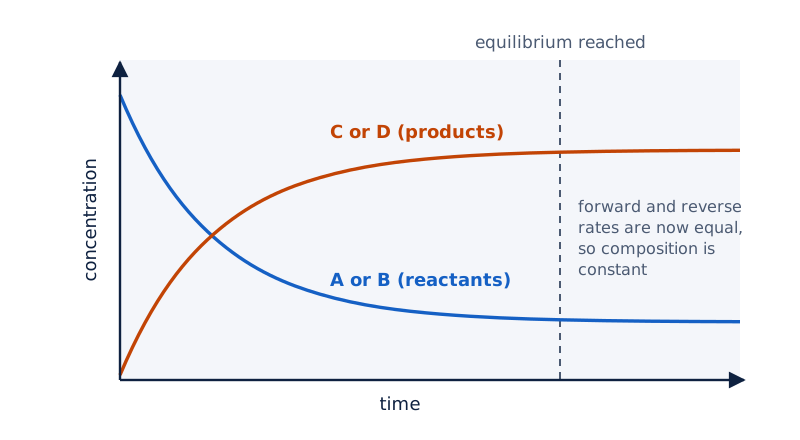
Concentration is on the vertical axis and time on the horizontal axis. The curve labelled A or B falls, while C or D rises. Both become horizontal beyond the dashed line marked equilibrium, at different concentrations.
Drawn by One Young India.
An equilibrium mixture contains reactants and products, not necessarily in equal concentrations. Some reactions proceed nearly to completion; others form only small amounts of products, while some retain appreciable amounts of both sides.
Equilibrium can be approached from either direction. For hydrogen and iodine forming hydrogen iodide, the same equilibrium mixture is obtained from either side when temperature, volume and total numbers of hydrogen and iodine atoms are the same.
How do physical equilibria behave?
Physical equilibrium involves opposing physical changes without a net chemical conversion. A phase is a physically distinct part of a system, such as a solid, liquid or gas. In equations, (s), (l), (g) and (aq) mean solid, liquid, gas and dissolved in water, respectively.
Which opposing changes balance?
| Equilibrium | Opposing processes | Constant feature |
|---|---|---|
| Ice ⇌ liquid water | Melting and freezing | Masses remain unchanged when the phases coexist without heat exchange at the equilibrium temperature and pressure. |
| Liquid water ⇌ water vapour | Evaporation and condensation | Vapour pressure remains constant at a fixed temperature. |
| Solid iodine ⇌ iodine vapour | Sublimation and deposition | The violet vapour reaches a constant colour intensity. |
| Solid sugar ⇌ dissolved sugar | Dissolution and crystallisation | The saturated solution has a constant concentration at a given temperature. |
Sublimation is conversion directly from solid to vapour; deposition is the reverse change. A saturated solution contains the amount of dissolved solute that can coexist with undissolved solute at that temperature. Solute means the substance dissolved, and solvent means the dissolving medium.
Ice and water coexist at 273 K and atmospheric pressure in an insulated system. K is the symbol for kelvin, the unit of absolute temperature. The normal melting point is the solid-liquid equilibrium temperature at atmospheric pressure.
What the figure shows
Measuring equilibrium vapour pressure
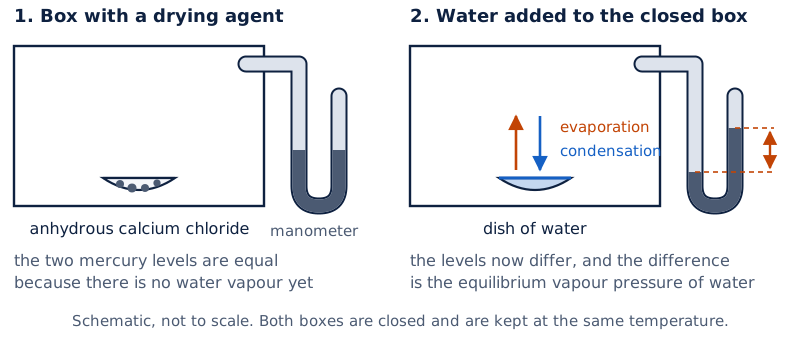
Two enclosed boxes are shown connected to U-shaped pressure tubes. The first contains a dish labelled anhydrous calcium chloride; the second contains a dish of water. The liquid levels in the connected tubes differ between the two drawings.
Drawn by One Young India.
Equilibrium vapour pressure is the pressure exerted by vapour in equilibrium with its liquid at a specified temperature. It increases with temperature. The normal boiling point is the liquid-vapour equilibrium temperature at atmospheric pressure. In an open dish, escaping vapour disperses, preventing this closed-system balance.
How are equilibrium constants written and interpreted?
The law of mass action, in its equilibrium form, relates equilibrium concentrations at constant temperature. For aA + bB ⇌ cC + dD, the lower-case letters a, b, c and d are stoichiometric coefficients: the numbers multiplying substances in the balanced equation.
Square brackets mean molar concentration, measured in moles per litre, mol L⁻¹, also written M. Here mol denotes mole, the amount-of-substance unit; L denotes litre. Kc is the equilibrium constant expressed using concentrations.
Kc = ([C]ᶜ[D]ᵈ)/([A]ᵃ[B]ᵇ)
Every concentration in this expression is an equilibrium value. Products appear in the numerator and reactants in the denominator. Each exponent comes from the balanced equation. For dinitrogen (N₂) and dihydrogen (H₂) forming ammonia (NH₃), N₂(g) + 3H₂(g) ⇌ 2NH₃(g), Kc = [NH₃]²/([N₂][H₂]³).
What changes when the equation changes?
At a fixed temperature, a specified reaction has a unique equilibrium constant independent of initial concentrations. Reversing the equation gives the reciprocal constant. Multiplying every coefficient by the same factor raises the original constant to that power. Adding reaction equations multiplies their constants.
A homogeneous equilibrium has reactants and products in one phase. A heterogeneous equilibrium involves more than one phase. Pure solids and pure liquids have constant concentration and are omitted from the simplified equilibrium expression, although the phases must remain present.
For calcium carbonate decomposing, CaCO₃(s) ⇌ CaO(s) + CO₂(g), Kc = [CO₂]. Adding more pure calcium carbonate does not change this expression while both solid phases are present.
Worked example 1. Phosphorus pentachloride (PCl₅) dissociates into phosphorus trichloride (PCl₃) and chlorine (Cl₂). At 500 K, PCl₅(g) ⇌ PCl₃(g) + Cl₂(g) has equilibrium concentrations [PCl₃] = [Cl₂] = 1.59 M and [PCl₅] = 1.41 M. Find Kc.
Formula: Kc = [PCl₃][Cl₂]/[PCl₅]. Substitute: Kc = (1.59 × 1.59)/1.41. Answer: Kc = 1.79 mol L⁻¹ in the concentration-unit convention.
How are Kp, Kc and their units related?
Partial pressure is the pressure contributed by one gas in a mixture. Kp is the equilibrium constant written using equilibrium partial pressures. For aA(g) + bB(g) ⇌ cC(g) + dD(g), use pA, pB, pC and pD for the respective partial pressures.
Kp = (pCᶜpDᵈ)/(pAᵃpBᵇ)
The ideal gas equation is pV = nRT, where p is pressure, V is volume, n is amount in moles, T is absolute temperature and R is the gas constant. With pressure in bar and volume in litres, R = 0.0831 bar L mol⁻¹ K⁻¹.
The S.I. unit of pressure is pascal. The S.I. unit of volume is cubic metre. The S.I. unit of amount of substance is mole. The S.I. unit of temperature is kelvin. The S.I. unit of molar concentration is mol m⁻³.
Derivation: Relationship between Kp and Kc
- For each ideal gaseous species, p = (n/V)RT = [gas]RT, because n/V is its molar concentration.
- Substitute pA = [A]RT and the corresponding expressions for the other gases into Kp.
- Separate the concentration ratio from the temperature factor: Kp = Kc(RT)⁽ᶜ⁺ᵈ⁾⁻⁽ᵃ⁺ᵇ⁾.
- Define Δn = (c + d) − (a + b), the gaseous product coefficient sum minus the gaseous reactant coefficient sum.
Count gaseous substances only. For hydrogen iodide formation Δn = 0, so Kp = Kc. For ammonia formation Δn = −2, so Kp = Kc/(RT)².
Which unit convention is being used?
If concentrations or pressures are inserted as dimensional quantities, the apparent units follow from the exponents. For N₂O₄(g) ⇌ 2NO₂(g), Kc has units mol L⁻¹ and Kp has units bar. For hydrogen iodide formation, the units cancel.
Thermodynamic equilibrium constants use ratios to standard states, specified reference states, and are dimensionless. The concentration standard state is 1 M and the gas pressure standard state is 1 bar. Keep that convention distinct from the dimensional concentration and pressure forms used in elementary calculations.
Note: Use absolute temperature and a gas constant compatible with the pressure and volume units. The pressure conversion 1 Pa = 1 N m⁻² uses pascal (Pa), newton (N) and metre (m); 1 bar = 10⁵ Pa.
How can equilibrium composition be calculated?
The magnitude of Kc indicates the extent of a reaction, not how quickly equilibrium is reached. Values greater than 10³ suggest products predominate and reaction proceeds nearly to completion. Values below 10⁻³ suggest reactants predominate. Intermediate values allow appreciable concentrations of both sides.
The reaction quotient Qc uses the Kc expression with current concentrations, which need not be equilibrium values. If Qc < Kc, net reaction proceeds forwards; if Qc > Kc, it proceeds backwards; equality indicates equilibrium.
How does an initial-change-equilibrium calculation work?
- Write the balanced equation and list initial concentrations.
- Define an unknown concentration change, x, in mol L⁻¹.
- Use stoichiometric coefficients to express every equilibrium concentration in terms of x.
- Substitute these concentrations into Kc and solve, rejecting physically impossible roots.
- Calculate all concentrations and check them in the equilibrium expression.
Worked example 2. Carbon monoxide (CO) reacts with water vapour (H₂O) to form carbon dioxide (CO₂) and hydrogen: CO(g) + H₂O(g) ⇌ CO₂(g) + H₂(g). Kc = 4.24 at 800 K. Initially [CO] = [H₂O] = 0.10 M and neither product is present. Find the equilibrium concentrations.
Formula: Kc = x²/(0.10 − x)²; x = 0.10√Kc/(1 + √Kc), where x is the concentration of each product formed. Substitute: x/(0.10 − x) = √4.24.
Answer: x ≈ 0.067 mol L⁻¹. Thus [CO₂] = [H₂] = 0.067 M and [CO] = [H₂O] = 0.033 M. Equal concentrations of both reactants are consumed.
Worked example 3. A closed 1 L vessel initially contains 3.00 mol PCl₅ at 380 K, with no PCl₃ or Cl₂. For PCl₅(g) ⇌ PCl₃(g) + Cl₂(g), Kc = 1.80 mol L⁻¹. Find the equilibrium composition.
Formula: c = n/V; Kc = x²/(c − x), where c is initial concentration and x the concentration dissociated. Substitute: x² + 1.80x − 5.40 = 0.
Answer: The positive root gives x ≈ 1.59 mol L⁻¹. Therefore [PCl₃] = [Cl₂] = 1.59 M and [PCl₅] = 1.41 M. A negative dissociated concentration is impossible.
How does Le Chatelier’s principle predict a shift?
Definition: Le Chatelier’s principle states that a system at equilibrium responds to a change in an equilibrium condition in a direction that reduces or counteracts the effect of that change.
An equilibrium shift changes composition towards a new equilibrium. Adding a reactant or product favours its consumption. Removing a substance favours its replacement. At constant temperature these changes alter the reaction quotient, while the equilibrium constant remains unchanged.
How do pressure and temperature differ?
| Disturbance | Predicted response | Condition |
|---|---|---|
| Compression | Favours the side with fewer gas molecules. | Gaseous coefficient sums differ; temperature is constant. |
| Expansion | Favours the side with more gas molecules. | Gaseous coefficient sums differ; temperature is constant. |
| Heating | Favours the endothermic direction, which absorbs heat. | The equilibrium constant changes. |
| Cooling | Favours the exothermic direction, which releases heat. | The equilibrium constant changes. |
| Adding a catalyst | Equilibrium is reached faster without a change in equilibrium composition. | The temperature is unchanged. |
The symbol ΔH means reaction enthalpy change, the heat absorbed at constant pressure. An exothermic reaction has negative ΔH; an endothermic reaction has positive ΔH. Heating decreases the equilibrium constant of an exothermic reaction and increases that of an endothermic reaction.
An inert gas does not participate in the reaction. Adding it at constant volume and temperature leaves reacting-gas partial pressures unchanged, so equilibrium is undisturbed. At constant total pressure and temperature, adding inert gas expands the mixture and favours the side with more gaseous molecules when the counts differ.
A catalyst provides a faster reaction pathway. It accelerates both directions without changing the equilibrium constant or final composition. For gas reactions with equal gaseous coefficient sums, a volume change does not favour either direction in the ideal-gas treatment.
How are equilibrium ideas applied to product yield?
What favours ammonia and sulphur trioxide?
In the Haber process, N₂(g) + 3H₂(g) ⇌ 2NH₃(g) is exothermic. Low temperature and high pressure favour ammonia at equilibrium. However, very low temperature slows reaction. An iron catalyst allows a satisfactory rate at temperatures where the ammonia equilibrium concentration is reasonably favourable.
Operating conditions are around 500°C and 200 atm, where °C means degrees Celsius and atm means atmosphere, a pressure unit. Ammonia is liquefied and removed from the reaction mixture, promoting further formation. The catalyst helps the rate; it does not increase the equilibrium yield at the same temperature.
In the contact process, sulphur dioxide is oxidised: 2SO₂(g) + O₂(g) ⇌ 2SO₃(g). The forward reaction is exothermic and reduces gaseous mole number. Lower temperature and increased pressure favour sulphur trioxide at equilibrium; platinum or divanadium penta-oxide increases the otherwise slow reaction rate.
What favours dissociation and ester hydrolysis?
For dinitrogen tetroxide, N₂O₄(g) ⇌ 2NO₂(g), dissociation absorbs heat. Heating or reducing pressure favours brown nitrogen dioxide. Cooling or compression favours colourless dinitrogen tetroxide. The brown colour therefore becomes more intense on heating.
What the figure shows
Temperature and nitrogen oxide equilibrium
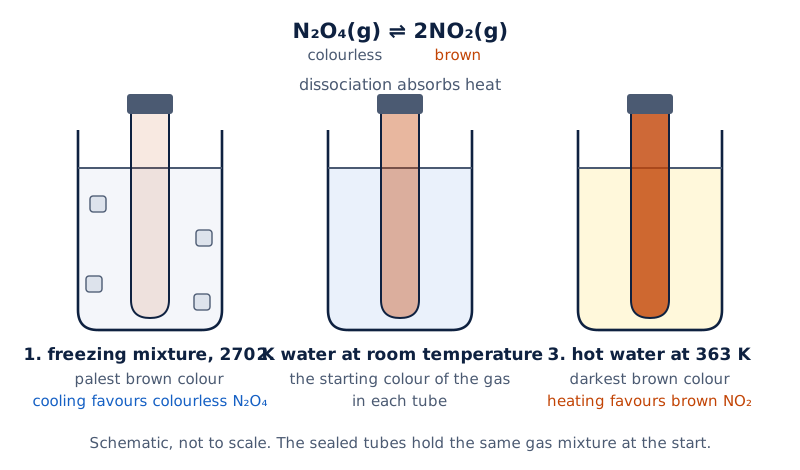
Three beakers contain sealed tubes. The freezing-mixture beaker is labelled 270 K, the middle beaker contains water at room temperature, and the third contains water at 363 K. The gas appears palest in the cold beaker and darkest in the hot beaker.
Drawn by One Young India.
Ester hydrolysis is reaction of an ester with water to form an acid and alcohol. Ethyl ethanoate, CH₃COOC₂H₅, reacts reversibly with water to form ethanoic acid, CH₃COOH, and ethanol, C₂H₅OH: CH₃COOC₂H₅ + H₂O ⇌ CH₃COOH + C₂H₅OH.
Using excess water or removing a product favours hydrolysis. Increasing acid or alcohol favours the reverse process, ester formation. An acid catalyst accelerates approach to equilibrium in both directions. Pressure is not a useful control for this liquid-phase equilibrium in the way it is for gaseous equilibria.
How do electrolytes and acid-base theories differ?
An electrolyte conducts electricity in aqueous solution through mobile ions. A non-electrolyte, such as sugar, does not conduct in aqueous solution. A cation is positively charged; an anion is negatively charged. Strong electrolytes are ionised almost completely, while weak electrolytes are only partially dissociated.
Dissociation separates ions already present in an ionic solid, as with sodium chloride. Ionisation forms ions from neutral molecules, as with acids in water. A weak electrolyte establishes an equilibrium between unionised molecules and ions.
| Theory | Acid | Base |
|---|---|---|
| Arrhenius | Produces hydrogen ions in water. | Produces hydroxide ions in water. |
| Brønsted-Lowry | Donates a proton. | Accepts a proton. |
| Lewis | Accepts an electron pair. | Donates an electron pair. |
What are conjugate pairs?
The proton, H⁺, is a hydrogen ion. In aqueous notation H⁺ represents a hydrated proton; H₃O⁺ is the hydronium ion. OH⁻ is the hydroxide ion. A conjugate acid-base pair differs by one proton, with the corresponding change in charge.
In NH₃ + H₂O ⇌ NH₄⁺ + OH⁻, ammonia accepts a proton and water donates one. NH₄⁺/NH₃ and H₂O/OH⁻ are conjugate pairs. In reaction with hydrochloric acid, water instead accepts a proton. Its ability to act as either acid or base is called amphiprotic behaviour.
Arrhenius theory is restricted to aqueous solutions. Brønsted-Lowry theory explains proton transfer. Lewis theory also covers reactions without proton transfer: boron trifluoride, BF₃, accepts an electron pair from ammonia. BF₃ is the Lewis acid and NH₃ the Lewis base; their combination uses ammonia’s lone, unshared electron pair.
How do ionisation constants and Ostwald’s law measure strength?
Let HA represent a weak monoprotic acid, which can donate one proton per molecule; A⁻ is its conjugate base. For HA + H₂O ⇌ H₃O⁺ + A⁻, Ka is the acid ionisation constant. At a given temperature, larger Ka means stronger acid.
Ka = [H₃O⁺][A⁻]/[HA]
For a weak base B, its conjugate acid is BH⁺. The base equilibrium is B + H₂O ⇌ BH⁺ + OH⁻. Kb = [BH⁺][OH⁻]/[B], where Kb is the base ionisation constant. Larger Kb means stronger base at the same temperature.
Derivation: Ostwald’s dilution law
Let c be the initial concentration of HA and α its degree of ionisation, the fraction of original acid molecules ionised. Assume no added common ion and negligible hydrogen-ion contribution from water.
- The equilibrium concentration of unionised acid is c(1 − α).
- Each ionised molecule supplies one hydronium ion and one A⁻ ion, so each ion concentration is cα.
- Substitution gives Ka = (cα)²/[c(1 − α)] = cα²/(1 − α).
- For small α, replace 1 − α by approximately 1, giving Ka ≈ cα² and α ≈ √(Ka/c).
Ka = cα²/(1 − α)
This is Ostwald’s dilution law for a weak monoprotic electrolyte in this concentration treatment. Dilution lowers c and increases α. It does not increase Ka at constant temperature. The approximation fails when ionisation is appreciable; retain the denominator and solve the quadratic instead.
Worked example 4. Hypochlorous acid, HOCl, has Ka = 2.5 × 10⁻⁵ for this problem. Find hydronium concentration and percentage ionisation in a 0.08 M solution, neglecting water ionisation.
Formula: Ka = x²/(0.08 − x); α = x/0.08, where x is hydronium concentration. Substitute: for small ionisation, x² ≈ (2.5 × 10⁻⁵)(0.08).
Answer: x ≈ 0.00141 mol L⁻¹ (1.41 × 10⁻³ M). Percentage ionisation, 100α, is approximately 1.76%. Since the ionised fraction is small, the denominator approximation is consistent.
How do multistage ionisation and water determine pH?
A polyprotic or polybasic acid can donate more than one proton per molecule. For a dibasic acid H₂X, with X representing the acid residue, successive stages are H₂X ⇌ H⁺ + HX⁻ and HX⁻ ⇌ H⁺ + X²⁻.
The first and second ionisation constants are Ka₁ and Ka₂. Ka₁ = [H⁺][HX⁻]/[H₂X] and Ka₂ = [H⁺][X²⁻]/[HX⁻]. Later ionisation constants are smaller because removing a positive proton from an increasingly negative ion is more difficult.
Phosphoric acid, H₃PO₄, loses protons successively to form H₂PO₄⁻, HPO₄²⁻ and PO₄³⁻, with a separate constant for each step. Degrees of ionisation must therefore be associated with particular stages; counting ionisable protons does not imply complete release of all of them.
A polyacidic base, capable of accepting successive protons, also has stages. Carbonate, CO₃²⁻, accepts a proton from water to form hydrogen carbonate, HCO₃⁻, and OH⁻; hydrogen carbonate can accept another to form carbonic acid, H₂CO₃, and OH⁻. Each stage has its own base constant.
What are Kw, pH and pOH?
Water undergoes self-ionisation: 2H₂O(l) ⇌ H₃O⁺(aq) + OH⁻(aq). Its ionic product, Kw, is the product of equilibrium hydronium and hydroxide concentrations: Kw = [H₃O⁺][OH⁻]. At 298 K, Kw = 1.0 × 10⁻¹⁴ in molar concentration notation.
Activity is effective concentration relative to a standard state. pH is the negative base-ten logarithm of hydrogen-ion activity. For dilute solutions, pH ≈ −log[H⁺], using the numerical concentration in mol L⁻¹. Here log means logarithm to base ten.
Similarly, pOH = −log[OH⁻], pKw = −log Kw, pKa = −log Ka and pKb = −log Kb, with the same standard-state convention. Consequently, pH + pOH = pKw, which equals 14 at 298 K.
Neutrality means [H₃O⁺] = [OH⁻]; neutral pH is 7 at 298 K. An acidic solution has more hydronium than hydroxide; a basic solution has the reverse. Kw changes with temperature, so the value 7 is temperature-specific.
For a conjugate pair, multiplying its acid and base expressions cancels the conjugate species: KaKb = Kw. Thus pKa + pKb = pKw. Pair the acid with its own conjugate base, not an unrelated base.
How are pH indicators chosen?
An acid-base indicator changes colour as pH changes. Its differently coloured forms participate in an equilibrium. For a weak-acid indicator HIn, where In⁻ represents its conjugate base, HIn + H₂O ⇌ H₃O⁺ + In⁻. Changing hydronium concentration changes the relative amounts of these forms.
In titrimetry, a measured volume of one solution reacts with another to determine concentration. The equivalence point is reached when the reactants are present in the proportions required by the balanced equation. The end point is the observed indicator change used to recognise completion.
Which indicator matches the titration?
| Acid-base combination | Indicator choice | Reason for selection |
|---|---|---|
| Strong acid and strong base | Methyl orange or phenolphthalein | Either can detect the sharp change near equivalence. |
| Weak acid and strong base | Phenolphthalein | Its colour change suits the alkaline region near equivalence. |
| Strong acid and weak base | Methyl orange | Its colour change suits the acidic region near equivalence. |
| Weak acid and weak base | No suitable ordinary visual acid-base indicator | The pH change does not provide a sharp visual end point. |
Phenolphthalein is colourless in acidic medium and pink in alkaline medium. Added hydroxide removes hydrogen ions, favouring the coloured ionised form. With weak acid in the flask and strong alkali added, the visible end-point change is from colourless to pink.
Methyl orange is yellow in alkaline medium and pinkish red in acidic medium. For most acid-base titrations, an indicator can be selected whose colour change occurs close to equivalence.
How do common ions and buffers control pH?
The common ion effect is an equilibrium shift caused by adding a substance that supplies an ionic species already present. Adding sodium acetate to acetic acid supplies acetate ions and shifts CH₃COOH ⇌ H⁺ + CH₃COO⁻ towards unionised acid, suppressing further ionisation.
Likewise, ammonium chloride supplies NH₄⁺ to aqueous ammonia. For NH₃ + H₂O ⇌ NH₄⁺ + OH⁻, the shift towards the left lowers hydroxide formation. Aqueous ammonia is also conventionally called ammonium hydroxide and represented as NH₄OH in this treatment.
How does a buffer resist small additions?
A buffer solution resists pH change on dilution or addition of small amounts of acid or alkali. An acidic buffer contains a weak acid and its salt with a strong base, such as acetic acid and sodium acetate.
Added H⁺ combines with acetate to form acetic acid. Added OH⁻ reacts with acetic acid to form acetate and water. These reactions limit the change in free hydrogen-ion concentration. The word small matters: the buffer’s components must remain available to consume the added acid or base.
A basic buffer contains a weak base and its salt with a strong acid, such as ammonia and ammonium chloride. Ammonia consumes added H⁺; ammonium ions react with added OH⁻. The common ion also suppresses ionisation of the weak component.
What is the Henderson equation?
Rearrange Ka = [H⁺][A⁻]/[HA] to obtain [H⁺] = Ka[HA]/[A⁻]. Taking negative logarithms gives the Henderson-Hasselbalch equation: pH = pKa + log([A⁻]/[HA]).
For a weak acid buffer, most A⁻ comes from the salt and only a very small fraction of HA ionises. Hence the ratio is approximated by salt concentration divided by acid concentration. For equal molar concentrations of acetic acid and sodium acetate, pH is around 4.76 when pKa = 4.76.
For a basic buffer, pOH = pKb + log([BH⁺]/[B]). Find pH using pKw − pOH. Dilution leaves the concentration ratio unchanged in this buffer approximation. Use concentrations in the final mixture, after any neutralisation that has occurred.
Why do salts hydrolyse and change pH?
Salt hydrolysis is the reaction of a salt’s cation, anion or both with water to form the corresponding weak acid or base. Dissolving a salt therefore does not automatically give a neutral solution. The parent acid and base determine which ions react.
Which ion reacts with water?
| Salt type | Example and hydrolysis | Solution character |
|---|---|---|
| Strong acid and strong base | Sodium chloride; its ions do not hydrolyse appreciably. | Neutral. |
| Weak acid and strong base | Sodium acetate: CH₃COO⁻ + H₂O ⇌ CH₃COOH + OH⁻. | Basic. |
| Strong acid and weak base | Ammonium chloride: NH₄⁺ + H₂O ⇌ NH₃ + H₃O⁺. | Acidic. |
| Weak acid and weak base | Ammonium acetate; both ions interact with water. | Depends on the relative acid and base strengths. |
Let cₛ denote the analytical salt concentration, meaning the amount dissolved per unit solution volume before allowing for hydrolysis. Let Kh be the hydrolysis equilibrium constant. For small hydrolysis of a salt of a weak monoprotic acid and strong base, Kh = Kw/Ka and [OH⁻] ≈ √(Khcₛ).
Taking logarithms gives pH ≈ ½(pKw + pKa + log cₛ). For a salt of a strong acid and weak base, Kh = Kw/Kb, [H⁺] ≈ √(Khcₛ), and pH ≈ ½(pKw − pKb − log cₛ).
In these expressions cₛ is the numerical concentration in mol L⁻¹. They assume dilute behaviour, small hydrolysis and negligible water contribution compared with the ions produced. Very dilute solutions require water ionisation to be included.
For a salt of a weak acid and weak base in the usual treatment, pH ≈ ½(pKw + pKa − pKb). At 298 K this becomes 7 + ½(pKa − pKb). Ammonium acetate with pKa = 4.76 and pKb = 4.75 gives pH = 7.005.
How do solubility products explain selective precipitation?
Molar solubility S is the amount of salt dissolving per litre to produce a saturated solution. The solubility product, Ksp, is the equilibrium product of ion concentrations, each raised to its stoichiometric coefficient, for a sparingly soluble salt in contact with its saturated solution.
For BaSO₄(s) ⇌ Ba²⁺ + SO₄²⁻, Ksp = [Ba²⁺][SO₄²⁻]. Pure solid is omitted. In pure water, when other reactions are negligible, each ion concentration equals S, giving Ksp = S².
Worked example 5. Barium sulphate has Ksp = 1.1 × 10⁻¹⁰ at 298 K. Find its molar solubility in pure water, neglecting other ion reactions.
Formula: Ksp = S². Substitute: S = √(1.1 × 10⁻¹⁰). Answer: S = 0.0000105 mol L⁻¹ (1.05 × 10⁻⁵ M).
For nickel(II) hydroxide, Ni(OH)₂(s) ⇌ Ni²⁺ + 2OH⁻, Ksp = [Ni²⁺][OH⁻]². In pure water, ignoring other ion sources, [Ni²⁺] = S and [OH⁻] = 2S, giving Ksp = 4S³. Constants alone cannot compare solubilities of salts with different dissolution stoichiometries.
Worked example 6. Find the molar solubility of Ni(OH)₂ in 0.10 M NaOH, given Ksp = 2.0 × 10⁻¹⁵. Treat NaOH as completely dissociated and neglect other reactions.
Formula: Ksp = S(0.10 + 2S)²; S ≈ Ksp/(0.10)² when 2S is negligible beside 0.10. Substitute: S ≈ (2.0 × 10⁻¹⁵)/(0.10)².
Answer: In 0.10 mol L⁻¹ NaOH, S = 2.0 × 10⁻¹³ mol L⁻¹. Here 2S is negligible beside 0.10 M.
How are cation groups separated?
The ionic product Qsp uses the actual ion concentrations, whether or not equilibrium has been reached. When Qsp > Ksp, precipitation is favoured; Qsp = Ksp describes saturation; Qsp < Ksp allows further dissolution if solid is present.
In qualitative salt analysis, ions are identified through characteristic reactions. Controlling the precipitating-ion concentration allows one group to precipitate while others remain dissolved. Group II sulphides precipitate with hydrogen sulphide, H₂S, in acidic solution: added H⁺ suppresses its ionisation, keeping sulphide-ion concentration low.
For Group III, ammonium chloride suppresses ionisation of ammonium hydroxide and controls OH⁻ concentration, allowing hydroxides such as those of iron(III) and aluminium to precipitate selectively. For Group IV, the ammoniacal medium permits a higher sulphide concentration, precipitating sulphides of zinc, manganese, nickel and cobalt.
Glossary
- Dynamic equilibrium — A state where opposing processes continue at equal rates without a net change in measurable properties.
- Equilibrium constant — The fixed equilibrium ratio of product to reactant activities or concentration terms at a specified temperature.
- Reaction quotient — An equilibrium-style ratio evaluated using current composition, which may differ from the equilibrium composition.
- Partial pressure — The pressure contributed by an individual gaseous component of a gas mixture.
- Le Chatelier’s principle — The prediction that a disturbed equilibrium responds in a direction that counteracts the imposed change.
- Conjugate pair — An acid and base related by the loss or gain of exactly one proton.
- Degree of ionisation — The fraction of the initial electrolyte molecules that have ionised under the stated conditions.
- Ionic product of water — The product of hydronium and hydroxide concentrations at a given temperature in the concentration treatment.
- pH — The negative base-ten logarithm of hydrogen-ion activity, approximated using molar concentration in dilute solution.
- Common ion effect — A shift in equilibrium caused by adding an ionic species already present in that equilibrium.
- Buffer solution — A solution resisting pH change on dilution or addition of small amounts of acid or alkali.
- Salt hydrolysis — Reaction of a salt’s ions with water, forming weak acid or base and potentially changing pH.
- Solubility product — The equilibrium ion-concentration product for a sparingly soluble salt, with each concentration raised to its stoichiometric coefficient.
- Equivalence point — The titration stage at which reactants have combined in the proportions required by their balanced equation.
Common errors and misconceptions
- Misconception: Equilibrium means reactions have stopped. Correct: Both directions continue at equal rates, leaving no net composition change.
- Misconception: Reactant and product concentrations must be equal. Correct: They remain constant at equilibrium but need not equal each other.
- Misconception: Pure solids belong in every equilibrium expression. Correct: Their constant contribution is incorporated into the equilibrium constant.
- Misconception: Any pressure increase gives the same shift. Correct: Compression differs from adding inert gas at constant volume, which leaves reacting-gas partial pressures unchanged.
- Misconception: A catalyst improves equilibrium yield. Correct: It speeds the approach to equilibrium without changing its composition at fixed temperature.
- Misconception: Neutral pH is 7 at every temperature. Correct: Neutrality means equal hydronium and hydroxide concentrations; pH 7 applies at 298 K.
- Misconception: Dilution changes a weak acid’s Ka. Correct: It changes degree of ionisation; Ka remains fixed at constant temperature.
- Misconception: Every salt has solubility equal to √Ksp. Correct: Derive the relationship from its dissolution equation and include common ions.
Exam-style questions with model answers
Q1. Explain why chemical equilibrium is dynamic, and state whether reactant and product concentrations must be equal. [2 marks]
- Forward and reverse reactions continue at equal rates, so there is no net change in composition.
- Reactant and product concentrations remain constant at equilibrium, but they need not be equal to one another.
Q2. Derive the relationship between Kp and Kc for aA(g) + bB(g) ⇌ cC(g) + dD(g), treating all gases as ideal. Define the symbols used. [5 marks]
- Kp uses equilibrium partial pressures and Kc uses equilibrium molar concentrations. A, B, C and D are gaseous substances; a, b, c and d are their balanced-equation coefficients.
- From pV = nRT, each partial pressure is p = [gas]RT. Here V is volume, n is amount in moles, R is the gas constant and T is absolute temperature.
- Substitute this expression into Kp = (pCᶜpDᵈ)/(pAᵃpBᵇ), replacing each species pressure by its equilibrium concentration multiplied by RT.
- Collect the concentration ratio as Kc and the remaining factor as RT raised to (c + d) − (a + b).
- Therefore , where Δn is the gaseous product coefficient sum minus the gaseous reactant coefficient sum.
Q3. For CO(g) + H₂O(g) ⇌ CO₂(g) + H₂(g), Kc = 4.24 at 800 K. Initially [CO] = [H₂O] = 0.10 mol L⁻¹ and both product concentrations are zero. Calculate all equilibrium concentrations. [4 marks]
- Let x mol L⁻¹ of each product form. The coefficients are all unity, so the equilibrium concentrations of both reactants are 0.10 − x.
- Substitution in the equilibrium expression gives Kc = x²/(0.10 − x)² = 4.24.
- Taking the positive square root gives x/(0.10 − x) = √4.24. Solving gives x ≈ 0.067 mol L⁻¹.
- Therefore [CO₂] = [H₂] = 0.067 mol L⁻¹ and [CO] = [H₂O] = 0.033 mol L⁻¹. All concentrations are physically positive.
Q4. For the exothermic Haber equilibrium N₂(g) + 3H₂(g) ⇌ 2NH₃(g), explain the effects of compression at constant temperature, cooling, ammonia removal, an iron catalyst and adding inert gas at constant volume and temperature. [5 marks]
- Compression favours ammonia formation because the gaseous coefficient sum decreases from four on the reactant side to two on the product side.
- Cooling favours the forward exothermic reaction, increasing the equilibrium ammonia yield. However, very low temperature also slows the reaction rate.
- Removing ammonia lowers its concentration. Net forward reaction replaces some of the removed product as the mixture approaches a new equilibrium.
- The iron catalyst accelerates forward and reverse reactions. It helps the mixture reach equilibrium faster without altering the equilibrium composition at the same temperature.
- Inert gas at constant volume and temperature leaves the reacting-gas partial pressures unchanged. Consequently, it produces no equilibrium shift even though total pressure rises.
Q5. A weak monoprotic acid HA has initial concentration c and degree of ionisation α. Assume no common ion and negligible ionisation of water. Derive Ostwald’s dilution law and explain dilution’s effect at constant temperature. [4 marks]
- For HA ⇌ H⁺ + A⁻, the equilibrium concentration of HA is c(1 − α), while each ion concentration is cα.
- The acid ionisation constant is Ka = [H⁺][A⁻]/[HA], giving Ka = cα²/(1 − α).
- When α is small, 1 − α is approximately unity, so Ka ≈ cα² and α ≈ √(Ka/c).
- At constant temperature Ka is unchanged. Dilution lowers c, increasing α; if ionisation becomes appreciable, the small-α approximation must be abandoned.
Q6. At 298 K, a buffer contains 0.20 M NH₄Cl and 0.10 M NH₃. Given pKb(NH₃) = 4.75, pKw = 14.00 and log 2 = 0.301, calculate its pH using the Henderson equation. [3 marks]
- For the basic buffer, pOH = pKb + log([NH₄⁺]/[NH₃]). Approximate the ammonium concentration by the stated salt concentration, since the salt supplies most ammonium ions.
- The concentration ratio is 0.20/0.10 = 2. Therefore pOH = 4.75 + 0.301 = 5.051.
- Use pH + pOH = pKw at the given temperature: pH = 14.00 − 5.051 = 8.949, approximately 8.95.
Q7. At 298 K, ammonium acetate is a salt of a weak acid and weak base with pKa = 4.76 and pKb = 4.75. Given pKw = 14.00, calculate pH using the weak-acid/weak-base salt approximation. [2 marks]
- Use pH = ½(pKw + pKa − pKb) because both ions of the salt undergo hydrolysis.
- Substituting gives pH = ½(14.00 + 4.76 − 4.75) = 7.005, slightly above the neutral value at 298 K.
Q8. Ni(OH)₂(s) ⇌ Ni²⁺(aq) + 2OH⁻(aq) has Ksp = 2.0 × 10⁻¹⁵. Calculate its molar solubility in 0.10 M NaOH. Assume complete NaOH dissociation, dilute-solution behaviour and no other ion reactions. Check your approximation. [4 marks]
- Let S be the molar solubility of nickel hydroxide. Then [Ni²⁺] = S and the total hydroxide concentration is 0.10 + 2S.
- The solubility product is Ksp = [Ni²⁺][OH⁻]² = S(0.10 + 2S)².
- Assuming 2S is negligible beside 0.10, S = (2.0 × 10⁻¹⁵)/(0.10)² = 2.0 × 10⁻¹³ mol L⁻¹.
- Twice this solubility is negligible compared with 0.10 M, confirming the approximation. The added hydroxide common ion strongly suppresses dissolution.
Key takeaways
- Dynamic equilibrium has equal opposing rates and constant composition, while reactant and product concentrations need not be equal.
- Write equilibrium expressions from balanced equations, use equilibrium values and omit pure solid and pure liquid terms.
- The ideal-gas relationship between Kp and Kc depends on the difference between gaseous product and reactant coefficient sums.
- Concentration and volume disturbances change reaction quotients; temperature changes the equilibrium constant for the specified reaction.
- Use acid and base ionisation constants to compare strength, and state the assumptions behind weak-electrolyte approximations.
- Neutrality requires equal hydronium and hydroxide concentrations; the familiar neutral pH of seven applies at 298 K.
- Common ions suppress ionisation, buffers resist small pH disturbances, and salt hydrolysis explains acidic or basic salt solutions.
- Relate solubility to the balanced dissolution equation, then compare ionic product with solubility product to predict precipitation.
Test yourself
What stays equal at dynamic equilibrium?
The rates of the opposing processes are equal; the concentrations of reactants and products need not be equal.
Why is solid calcium carbonate omitted from its decomposition equilibrium expression?
Its concentration is constant while the pure solid phase remains present, so its contribution is incorporated into the constant.
If Qc exceeds Kc, which net direction is favoured?
The reverse direction is favoured, consuming products and forming reactants until the equilibrium ratio is restored.
What is the conjugate base of HCO₃⁻?
It is CO₃²⁻, formed by loss of one proton from the hydrogen carbonate ion.
Why does dilution increase weak-electrolyte ionisation?
For small ionisation, α ≈ √(Ka/c); decreasing concentration increases the ionised fraction while Ka stays fixed at constant temperature.
Which indicator suits a weak acid titrated with a strong base?
Phenolphthalein suits this titration because its colour change occurs in the alkaline region near equivalence.
How does acetate protect an acetic acid buffer against added acid?
Acetate ions combine with added hydrogen ions to form acetic acid, limiting the change in free hydrogen-ion concentration.
When does an ionic product predict precipitation?
Precipitation is favoured when the actual ionic product exceeds the solubility product at that temperature.
Write about it
Turn a question from this chapter into a paper.
The Writing Studio has a structure guide, a rubric and citation tools for 15 formats, from essays to research papers. Drafting is free with an account. Learnacy Essential adds feedback from an AI writing coach and submission to The OYI Review.
Learnacy Essential is ₹1,499 for the year. Publication depends on review and is not guaranteed.