
Force | ICSE Class 10 Physics Notes
On this page
Watch & explore
Start with a few high-quality watches, then dive into the notes below.
Try an idea before you read. Apply the principles of moments and conditions of equilibrium to solve real-world mechanical balance scenarios. Explore →

This note covers translational and rotational motion, the moment of a force, clockwise and anticlockwise moments, couples, equilibrium, the principle of moments, balance calculations, centre of gravity, uniform circular motion, and centripetal and centrifugal force.
How do translation and rotation differ?
A force can change how a body moves as a whole, how it turns, or both. To describe these effects, distinguish translational motion from rotational motion. The distinction matters for extended objects because the point where a force acts can affect the result.
What happens during translation?
In pure translation, all particles of a rigid body have the same velocity at any instant. A rectangular block sliding down an inclined plane without turning illustrates this motion. Different points of the block move together, and its orientation remains unchanged.
A rigid body is an ideal body whose shape and the distances between its particles remain unchanged. Real bodies can deform, but they may be treated as rigid when their deformation is negligible for the situation being considered.
What happens during rotation?
During rotation about a fixed axis, points away from that axis describe circles centred on it. Points on the axis remain stationary. A ceiling fan and a potter's wheel are examples. The fixed line about which turning occurs is the axis of rotation.
| Feature | Pure translation | Rotation about a fixed axis |
|---|---|---|
| Motion of points | All have the same instantaneous velocity | Points away from the axis travel in circles |
| Orientation | Remains unchanged | Changes as the body turns |
| Example | A block sliding without turning | A rotating ceiling fan |
A cylinder rolling down an incline combines translation and rotation. Its motion as a whole and its turning must both be considered. Calling every moving object a translating object can therefore conceal an important part of its motion.
A door turns about its hinges, while a bicycle pedal helps turn the crank about its axle. These examples direct attention to the same question: how effectively does the applied force produce turning about the chosen axis?
What is the moment of a force?
Definition: The moment of a force about a point or axis measures its turning effect. Its magnitude equals the force multiplied by the perpendicular distance from the point or axis to the force's line of action.
Let τ, the Greek letter tau, denote the moment magnitude, F the force magnitude, and d the perpendicular distance from the pivot to the line of action. Then τ = Fd. A moment is also called a torque.
Which distance belongs in the calculation?
For a known moment and a non-zero arm, the required force is F = τ/d. For a known moment and a non-zero force, the required perpendicular distance is d = τ/F. These rearrangements use the same three quantities defined above.
The line of action is the straight line along which a force acts. The moment arm is the shortest distance from the pivot to that line. It is measured at right angles to the line of action, rather than automatically along the object.
If the line of action passes through the pivot, its perpendicular distance from the pivot is zero. Its moment about that pivot is therefore zero. A force can be present and still have no turning effect about a particular axis.
For a fixed force, increasing the perpendicular distance increases the moment. This explains why a door is easier to turn by pushing near its outer edge than close to its hinges, provided the push has the same suitable direction.
How does force direction affect turning?
If the point of application is fixed, a force perpendicular to the line joining that point to the pivot gives the greatest moment. Turning the force towards that joining line reduces its moment arm. Acting directly along the joining line gives no moment.
A downward force on a bicycle pedal has zero turning effect when its line of action passes through the crank axle. Its effectiveness changes as the crank turns. The relevant distance is from the axle to the force's line of action.
Diagram
Moment arm
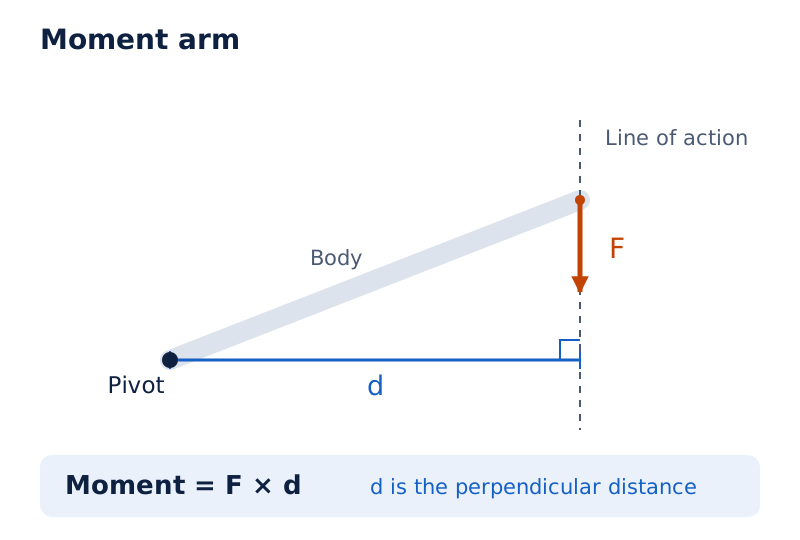
Draw a pivot and a force arrow acting away from it. Extend the arrow into a straight line of action. From the pivot, draw and label the perpendicular distance d to that line, with a right-angle mark.
Drawn by One Young India.
How are moments given units and directions?
The SI unit of moment of force is newton metre, written N m. It follows from multiplying force in newtons by perpendicular distance in metres. A moment of one newton metre results from a one-newton force with a one-metre perpendicular arm.
The SI unit of force is newton, written N. The SI unit of length is metre, written m. The SI unit of mass is kilogram, written kg. The SI unit of acceleration is metre per second squared, written m/s².
How do SI and cgs units compare?
In the centimetre-gram-second system, the force unit is the dyne and the moment unit is dyne cm. The force conversion is 1 N = 10⁵ dyne, while the length conversion is 1 m = 100 cm.
Combining the two conversions gives 1 N m = 10⁷ dyne cm. Convert centimetres to metres before multiplying by a force in newtons when the answer is required in N m. Keep the unit attached to the final result.
How are clockwise and anticlockwise moments distinguished?
A moment is clockwise if it tends to turn the body in the direction of clock hands, as viewed in the diagram. An anticlockwise moment tends to turn it the other way. Judge the turning tendency about the specified pivot.
For calculations in one plane, a common convention takes anticlockwise moments as positive and clockwise moments as negative. State the convention and use it consistently. The sign records the turning sense; it does not replace the unit.
Note: A downward force is not automatically clockwise. Its turning sense depends on which side of the pivot its line of action lies. Sketch the pivot before assigning signs.
Moment and work share the dimensional combination of force and length, but describe different physical quantities. Use N m for a moment. A force may exert a moment even when the body has not yet turned.
What is a couple, and why does it turn a body?
A couple consists of two equal, parallel forces acting in opposite directions along different lines of action. Their resultant force is zero, but their turning effects reinforce one another. An initially resting, otherwise free rigid body can therefore turn without translational acceleration.
Opening a bottle by turning its lid illustrates a couple applied by the fingers. A steering wheel can also be turned by opposite tangential forces applied on opposite sides. Both forces must be considered when assessing the turning effect.
Derivation: Moment of a couple
Let F be the magnitude of either force, D the perpendicular separation of their lines of action, and C the couple's moment magnitude. Choose a pivot on one force's line of action.
- The force whose line passes through the chosen pivot has zero moment about it.
- The other force has perpendicular distance D from that pivot, so its moment magnitude is FD.
- The total moment is therefore the magnitude of either force multiplied by the separation of the two lines.
C = FD
The force in this expression is one of the two equal forces, not their sum. The separation D is the complete perpendicular distance between the lines of action.
Why does the choice of point not change the answer?
Choose a point between the force lines. Let their perpendicular distances from this point be a and b. The two moments have the same turning sense, and a + b = D. Hence C = Fa + Fb = F(a + b) = FD.
The result is independent of which point between the force lines is chosen. For a point outside them, let x be its distance from the nearer line. The moments oppose, giving C = F(x + D) − Fx = FD again.
Moving the reference point changes the individual moment arms but not the couple's total moment. Equal opposite forces along the same line instead have no couple arm and no net turning effect.
What the figure shows
A pair of forces producing a couple
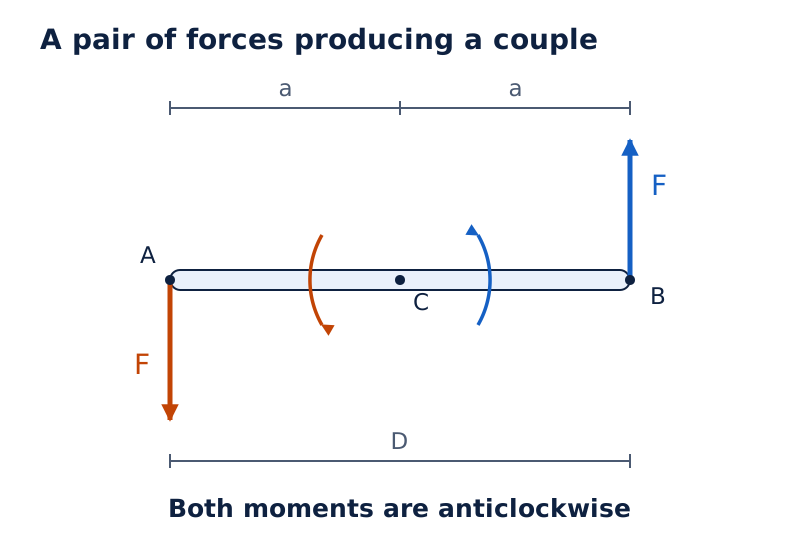
A horizontal rod AB has midpoint C. Equal forces act downwards at A and upwards at B. The two marked half-lengths are equal, and the turning arrows show the same anticlockwise tendency.
Drawn by One Young India.
What conditions are needed for equilibrium?
An extended rigid body needs both translational equilibrium and rotational equilibrium to be in mechanical equilibrium. Checking only whether the forces cancel is insufficient. The same forces may still produce an unbalanced turning effect.
What does translational equilibrium require?
The vector sum of the external forces must be zero. In a problem with vertical forces only, the total upward force must equal the total downward force. If horizontal forces are present, their balance must also be checked separately.
For a body of mass m, let W denote its weight and g the acceleration due to gravity. Then W = mg. Mass is measured in kilograms, whereas weight is a force measured in newtons. Convert masses to weights when adding forces.
What does rotational equilibrium require?
The total external moment about the chosen point must be zero. For forces acting in one plane, the total clockwise moment must equal the total anticlockwise moment. All moments being compared must refer to the same point.
| Condition | What is balanced? | Consequence |
|---|---|---|
| Translational equilibrium | External forces | No linear acceleration of the centre of mass |
| Rotational equilibrium | External moments | No angular acceleration about a fixed axis |
| Static equilibrium | Forces and moments, with the body initially at rest | The body remains at rest |
Equal opposite forces forming a couple satisfy force balance but not moment balance. Conversely, equal downward forces at opposite ends of a light rod can have cancelling moments about its midpoint while their resultant force remains downward.
Equilibrium does not by itself mean rest. Zero resultant force means no change in the motion of the centre of mass. In balance experiments, the body is also at rest, so the equilibrium observed is static.
Note: A support reaction may have zero moment about the support and still be essential to force balance. Omitting it from the moment equation does not mean that the force is absent.
How does the principle of moments explain a balance?
Definition: For a body in equilibrium, the sum of clockwise moments about a point equals the sum of anticlockwise moments about the same point. This is the principle of moments.
Consider a light horizontal lever with a fulcrum, its pivot, between two downward forces. Let F₁ and F₂ be those forces, and d₁ and d₂ their respective perpendicular distances from the fulcrum. Let R be the upward support reaction.
Derivation: Balance of two opposing moments
- The support reaction acts through the fulcrum, so its moment about the fulcrum is zero.
- Place F₁ to the left and F₂ to the right. Their moments have opposite turning senses.
- Taking anticlockwise as positive, rotational equilibrium gives F₁d₁ − F₂d₂ = 0.
- Move the clockwise term to the other side to equate the two moment magnitudes.
F₁d₁ = F₂d₂
Vertical force balance separately gives R = F₁ + F₂. This form assumes the lever's weight is negligible. If it is not negligible, include its weight at its centre of gravity in the force equation and, when appropriate, in the moment equation.
A smaller force can balance a larger force by acting through a longer perpendicular arm. The balancing condition concerns force multiplied by distance, rather than the equality of the two forces alone.
What the figure shows
Forces on a balanced lever
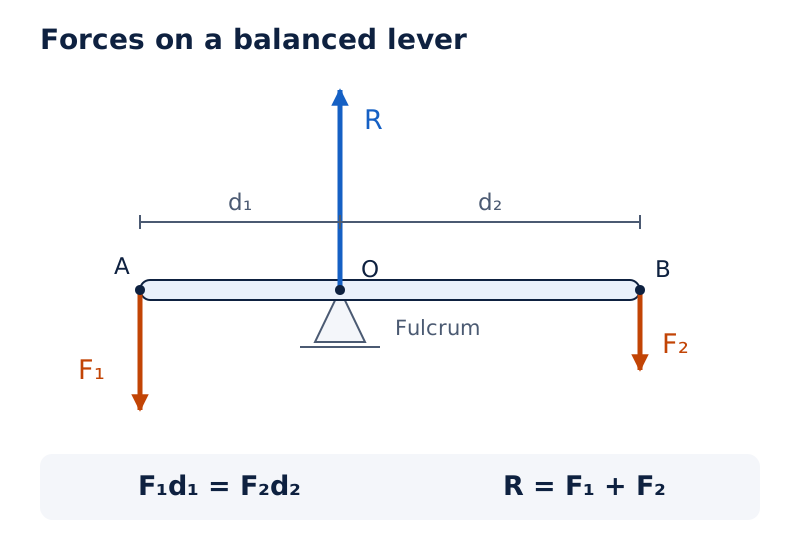
A horizontal bar AB is supported at O. Forces F₁ and F₂ act downwards at its ends; reaction R acts upwards at O. Distances d₁ and d₂ run from the support to the respective ends.
Drawn by One Young India.
Before substituting values, identify the chosen pivot and label each force's perpendicular distance from it. A scale reading gives a position on the rule; the moment arm is the difference between that position and the pivot position when the force is perpendicular.
How can two spring balances verify the principle of moments?
Suspend a metre rule horizontally from two vertical spring balances and hang slotted weights from it. The balances measure the upward supporting forces. The rule's own weight and the suspended weights act downward, so the setup tests both force and moment balance.
What measurements are required?
Locate the rule's centre of gravity by balancing it first. Determine its weight, and note the positions of the two supports and every hanging load. Check the balances' zero readings and keep their pulls vertical while the rule settles.
- Record the spring-balance readings with the loaded rule horizontal and stationary.
- Draw all forces, including the rule's weight at its measured centre of gravity.
- Choose one support as the reference point and measure each perpendicular moment arm from it.
- Calculate the clockwise and anticlockwise moment totals in consistent units and compare them.
- Repeat with different load positions and check that the two totals agree within experimental uncertainty.
What equations should agree?
For supports at the rule's ends, let R₁ and R₂ be the left and right upward readings, L the support separation, W the rule's weight, and P a single added load's weight. Let x and y be their respective distances from the left support.
Force balance gives R₁ + R₂ = W + P. Taking moments about the left support gives R₂L = Wx + Py. These equations assume vertical forces and that the weights act between the two end supports.
The left support force has no moment about itself. The right support force opposes the moments of the downward weights. If several loads are present, include a separate weight-times-distance term for each load.
Note: Do not omit the rule's weight simply because the experiment concerns hanging weights. Its moment vanishes only when its line of action passes through the point about which moments are being taken.
Useful checks include keeping the rule horizontal, reading scales at eye level, avoiding contact with other objects, and recording distances from a common reference. Disagreement should prompt a check of force directions, zero readings, omitted weights and distance measurements.
How are numerical problems on moments solved?
Begin with a force diagram. Mark the pivot, the lines of action, the centre of gravity and all relevant distances. Decide which forces produce clockwise moments and which produce anticlockwise moments. Then apply force balance and moment balance as separate conditions.
How do two supports share an uneven load?
Worked example 1. A uniform, homogeneous bar is 70 cm long and has mass 4.00 kg. Knife edges support it 10 cm from each end. A 6.00 kg mass hangs 30 cm from the left end. Find both upward reactions, using g = 9.8 m/s².
Formula: W = mg; R₁ + R₂ = W + P. Here W is the bar's weight, P the hanging weight, and R₁ and R₂ the left and right reactions.
Substitute: W = 4.00 × 9.8 = 39.2 N; P = 6.00 × 9.8 = 58.8 N. The bar's centre is 35 cm from the left end. From the left support, the right support, bar's centre and hanging load are 0.50 m, 0.25 m and 0.20 m away.
Moment balance gives 0.50R₂ = 39.2 × 0.25 + 58.8 × 0.20 = 21.56 N m.
Answer: R₂ = 43.12 N and R₁ = 98.00 − 43.12 = 54.88 N, both upwards.
The support nearer the hanging load carries the larger reaction. Their sum equals the total weight, providing a separate check on the moment calculation. Do not place the bar's weight at the hanging load's position.
How can a balance reveal an unknown mass?
Worked example 2. A metre stick balances at its centre. Two coins, each of mass 5 g, are placed together at the 12.0 cm mark. The loaded stick balances at the 45.0 cm mark. Find the stick's mass.
Formula: Equal opposing moments give m₁gd₁ = m₂gd₂, where m₁ is the combined coin mass, m₂ the stick's mass, and d₁ and d₂ their distances from the new pivot. The same gravitational acceleration g cancels.
Substitute: The coins have combined mass 10 g and arm 45.0 − 12.0 = 33.0 cm. The stick's weight acts at 50.0 cm, with arm 50.0 − 45.0 = 5.0 cm. Thus 10 × 33.0 = m₂ × 5.0.
Answer: m₂ = 66 g. Using grams and centimetres on both sides is valid here because the common conversion factors and g cancel.
How does the position of a car's weight affect its supports?
Worked example 3. A stationary car has mass 1800 kg. Its front and rear axles are 1.8 m apart, and its centre of gravity is 1.05 m behind the front axle. On level ground, assume equal sharing between the two wheels on each axle. Find each wheel's upward reaction. Use g = 9.8 m/s².
Formula: W = mg; Rᶠ + Rʳ = W. Here Rᶠ and Rʳ are the total front and rear axle reactions.
Substitute: W = 1800 × 9.8 = 17640 N. Taking moments about the front axle gives Rʳ × 1.8 = 17640 × 1.05. Thus Rʳ = 10290 N and Rᶠ = 7350 N.
Answer: Each rear wheel supports 5145 N; each front wheel supports 3675 N.
How are the reactions on a leaning ladder calculated?
Worked example 4. A 3 m ladder of mass 20 kg leans against a frictionless wall, with its foot 1 m from the wall. Its weight acts at its midpoint. Find the wall and floor reactions, taking .
Formula: , and , where W is weight, N the upward floor reaction, F the friction towards the wall and H the horizontal wall reaction. The total floor reaction has magnitude .
Substitute: The height reached is . The weight's perpendicular arm about the foot is . Thus .
Taking moments about the foot gives , so . Force balance gives and .
Hence . Its angle above the horizontal towards the wall is .
Answer: The wall reaction is approximately 34.65 N away from the wall. The floor reaction is approximately 199 N, directed upwards and towards the wall at about to the horizontal.
These problems use the same two conditions despite different arrangements. A convenient pivot eliminates an unknown reaction from the moment equation, but that reaction must still appear in the force-balance equations.
What is centre of gravity, and how is it found?
The centre of gravity is the point through which a body's resultant weight may be considered to act. The combined gravitational forces on its parts have zero total moment about this point. Its position matters whenever a body's own weight enters a balance problem.
Where is it in regular bodies?
In a uniform gravitational field, the centre of gravity coincides with the centre of mass, which depends on mass distribution. For homogeneous, symmetrical bodies, symmetry helps locate it. The requirement of uniform mass distribution must not be dropped.
| Uniform body | Centre of gravity | Reason |
|---|---|---|
| Thin straight rod | Midpoint | Equal mass distribution on opposite sides |
| Circular disc | Geometrical centre | Symmetry around the centre |
| Circular ring | Geometrical centre of the ring | Opposite portions balance |
| Solid sphere | Geometrical centre | Symmetry of its mass distribution |
The ring shows that the centre of gravity need not lie within the material. A geometrically central point is not automatically the centre of gravity of a non-uniform object. Extra mass on one side changes the distribution that determines the balance point.
How is an irregular lamina investigated?
A lamina is a thin sheet. An irregular cardboard lamina can be balanced horizontally on a pencil tip by trial and adjustment. The successful support point is its centre of gravity: the upward support balances its weight without an unbalanced turning effect.
- Suspend the lamina freely from a point near its edge.
- Use a plumb line through that point to mark the vertical on the lamina.
- Suspend it from another point and mark the new vertical.
- Locate the intersection of the marked lines and check it with a further suspension.
When the lamina hangs at rest, its centre of gravity lies on the vertical through the suspension point. Otherwise its weight would exert an unbalanced moment about the support. Intersecting verticals therefore locate the same point in the lamina.
What the figure shows
Centre of gravity by suspension
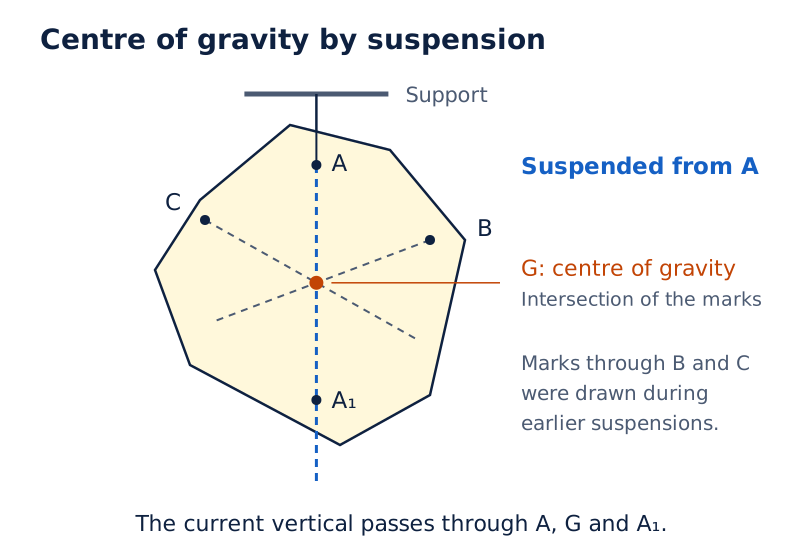
An irregular lamina hangs below a support. Marked suspension points A, B and C have dashed lines passing through a common point G, the centre of gravity. The vertical through A continues through G to A₁.
Drawn by One Young India.
Why is uniform circular motion accelerated?
Uniform circular motion means movement around a circular path at constant speed. Speed describes how fast the object travels. Velocity includes direction as well as speed, so a constant speed does not guarantee a constant velocity.
Which way do velocity and acceleration point?
At any point on the circle, velocity is directed along the tangent in the direction of motion. As the object moves, this tangent changes direction. The changing velocity means that acceleration is present even though the speed remains constant.
The acceleration is towards the centre of the circle and is called centripetal acceleration. Its magnitude remains constant for a fixed circle and constant speed, but its direction changes continually. It is therefore not a constant acceleration vector.
What the figure shows
Velocity and acceleration on a circle
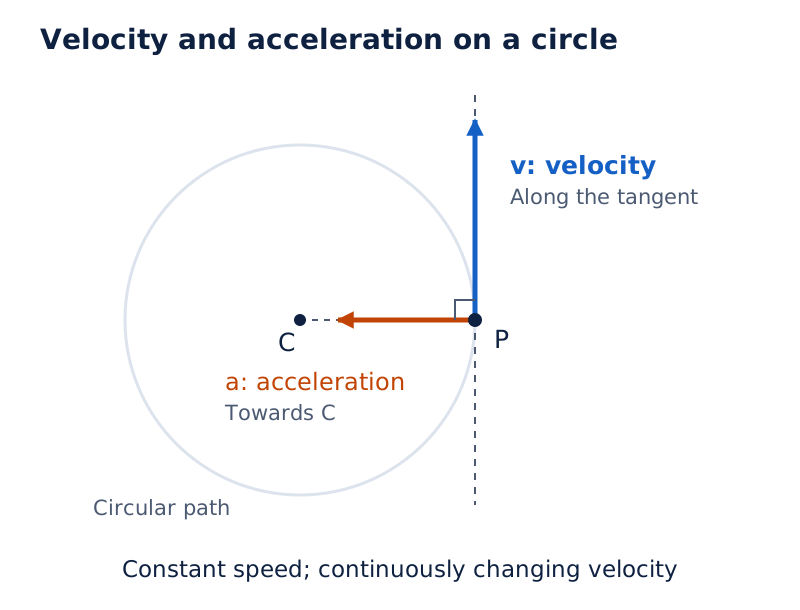
At a point P on a circular arc, the velocity arrow v follows the tangent. The acceleration arrow a points towards centre C, along the inward radius. Here v labels velocity and a labels acceleration.
Drawn by One Young India.
A thorough analysis of centripetal acceleration was first published in 1673 by Christiaan Huygens, who lived from 1629 to 1695. It was probably known to Newton some years earlier. The central physical distinction remains the difference between constant speed and changing velocity.
How can speed and inward acceleration be calculated?
Worked example 5. An insect moves steadily in a circular groove of radius 12 cm, completing 7 revolutions in 100 s. Find its angular speed, linear speed and acceleration magnitude. Is its acceleration vector constant?
Formula: , , and . Here n counts revolutions, t is elapsed time, f is frequency, r is radius, is angular speed, v is linear speed and a is centripetal acceleration magnitude.
Substitute: , giving . Then and .
Answer: The angular speed is approximately 0.44 rad/s, the linear speed is 5.3 cm/s and the acceleration magnitude is 2.3 cm/s². Velocity is tangential. Acceleration points towards the centre, so its direction changes and its vector is not constant.
Worked example 6. A stone tied to a string 80 cm long moves at constant speed in a horizontal circle, completing 14 revolutions in 25 s. Find the magnitude and direction of its acceleration.
Formula: , and , where r is the circle's radius, f its revolution frequency, v its speed and a its centripetal acceleration magnitude.
Substitute: Convert the radius: . The frequency is . Thus .
Using the unrounded speed, .
Answer: The acceleration is approximately 9.9 m/s², directed radially inwards towards the centre of the circle.
What provides centripetal force?
Centripetal force describes the resultant inward force needed to produce circular motion. It is supplied by an actual interaction: tension for a stone whirled on a string, gravity for a planet's curved motion, or friction for a car turning on a level road.
It is not an extra force to add beside tension, gravity or friction when one of these already supplies the required inward resultant. Identify the physical interaction first, then explain its centre-directed role.
How does centrifugal force differ?
Centrifugal force is an apparent outward force introduced when describing motion from a rotating frame of reference. In the frame rotating with an object in uniform circular motion, this apparent force balances the real inward force. The frame must be specified.
| Feature | Centripetal force | Centrifugal force |
|---|---|---|
| Direction | Towards the centre | Away from the centre |
| Nature | Resultant inward force from real interactions | Apparent force used in a rotating frame |
| Purpose | Accounts for inward acceleration in an inertial description | Accounts for the rotating frame's description |
Centripetal and centrifugal forces are not a Newton's third-law pair, because a third-law pair acts on different bodies, whereas both of these are described as acting on the same stone. For a whirled stone, the string pulls the stone inward, while the stone pulls the string oppositely. That interaction pair acts on different bodies.
If the string breaks, the stone initially continues along the tangent in an inertial view, with any remaining forces then affecting its path. It does not need a real radial outward force to leave the circular path.
Glossary
- Rigid body — An ideal body whose shape and distances between its particles remain unchanged during motion.
- Translation — Motion in which all particles of a rigid body share the same instantaneous velocity.
- Axis of rotation — The line about which a body turns during its rotational motion.
- Moment of force — The turning effect measured by force multiplied by its perpendicular distance from a reference point.
- Line of action — The straight line along which an applied force acts on a body.
- Moment arm — The perpendicular distance between the pivot and the force's line of action.
- Couple — Two equal, opposite, parallel forces with different lines of action, producing a turning effect.
- Fulcrum — The point of support about which a lever is free to turn.
- Equilibrium — A condition in which the relevant resultant external force and resultant external moment vanish.
- Centre of gravity — The point through which the resultant weight of a body may be considered to act.
- Lamina — A thin sheet whose centre of gravity can be investigated by balancing or suspension.
- Uniform circular motion — Motion along a circular path at constant speed with a continuously changing velocity direction.
- Centripetal force — The resultant inward force responsible for acceleration towards the centre of a circular path.
- Centrifugal force — An apparent outward force introduced when motion is described from a rotating reference frame.
Common errors and misconceptions
- Misconception: Moment depends only on the force. Correct: It also depends on the perpendicular distance from the reference point to the line of action.
- Misconception: The distance along a rod is always the moment arm. Correct: It is the moment arm only when the force acts perpendicular to the rod.
- Misconception: Equal opposite forces always prevent turning. Correct: Equal opposite forces on different parallel lines form a couple and can turn the body.
- Misconception: Zero resultant force proves complete equilibrium. Correct: An extended body must also have zero resultant external moment for mechanical equilibrium.
- Misconception: A support force with zero moment can be omitted everywhere. Correct: It still contributes to the balance of forces.
- Misconception: Centre of gravity must lie within the material. Correct: A uniform ring's centre of gravity lies at its geometrical centre, in the empty space.
- Misconception: Constant speed means zero acceleration. Correct: Circular motion changes velocity direction, so inward acceleration remains present.
- Misconception: Centripetal and centrifugal forces form an action-reaction pair. Correct: Centrifugal force is a rotating-frame apparent force; third-law interaction pairs act on different bodies.
Exam-style questions with model answers
Q1. Define moment of force and give its SI unit. [2 marks]
- Moment of force is its turning effect, measured by force multiplied by the perpendicular distance from the reference point to its line of action.
- Its SI unit is newton metre, written N m.
Q2. Explain why a couple can turn an initially stationary free rigid body although its resultant force is zero. [3 marks]
- A couple consists of equal, opposite, parallel forces acting along different lines. Their vector sum is zero, so they produce no translational acceleration.
- Their moments have the same turning sense and add together, producing a non-zero resultant moment.
- The body can therefore start rotating without its centre of mass accelerating. Equal opposite forces on the same line would not produce this couple.
Q3. A uniform 70 cm bar of mass 4.00 kg rests horizontally on knife edges 10 cm from each end. A 6.00 kg mass hangs 30 cm from its left end. Calculate both upward reactions. Take gravitational acceleration as 9.8 m/s². [5 marks]
- Let R₁ and R₂ be the left and right reactions. The bar weighs 4.00 × 9.8 = 39.2 N, acting at its midpoint, 35 cm from the left end. The hanging load weighs 58.8 N.
- Vertical equilibrium gives R₁ + R₂ = 39.2 + 58.8 = 98.0 N. Both reactions act upwards against these weights.
- Take moments about the left support. Its reaction has zero moment there. The other support is 0.50 m away; the bar's weight and load act at distances 0.25 m and 0.20 m.
- Therefore 0.50R₂ = 39.2 × 0.25 + 58.8 × 0.20 = 21.56 N m, so R₂ = 43.12 N.
- Finally R₁ = 98.0 − 43.12 = 54.88 N. The reactions sum to the full weight, as required.
Q4. A metre stick alone balances at its 50.0 cm mark. Two 5 g coins are placed together at 12.0 cm; the loaded stick balances at 45.0 cm. Find the stick's mass. [3 marks]
- Let M be the stick's mass in grams. Its weight acts at the original balance point, 50.0 cm. Its arm about the new pivot is 5.0 cm.
- The combined coin mass is 10 g, with an arm of 45.0 − 12.0 = 33.0 cm.
- Equating opposing moments cancels the common gravitational acceleration and unit conversions: M × 5.0 = 10 × 33.0. Therefore M = 66 g.
Q5. Describe how to locate the centre of gravity of an irregular cardboard lamina by suspension, and explain why the method works. [4 marks]
- Suspend the lamina freely from a point near its edge and allow it to settle. Use a plumb line through the suspension point to mark a vertical.
- Repeat the suspension and vertical marking from a different point.
- The intersection of the verticals identifies the centre of gravity; a further suspension checks this location.
- At rest, the weight's line of action passes through the suspension point. Otherwise it would have an unbalanced moment and turn the lamina. Each marked vertical therefore passes through the same centre of gravity.
Q6. A stone moves at constant speed in a circle, held by a string. Explain its velocity, acceleration and inward force. What direction does it initially follow if the string breaks? [4 marks]
- Velocity is tangential to the circle. Its magnitude is constant, but its direction changes continuously, so velocity is not constant.
- The stone has centripetal acceleration directed towards the centre.
- Tension in the string supplies the inward force responsible for this acceleration.
- If the string breaks, the stone initially continues in the tangential direction of its velocity at release. Other forces, such as gravity, can then change its subsequent path.
Q7. Describe a verification of the principle of moments using a metre rule, two spring balances and slotted weights. Include the rule's own weight and the equilibrium checks. [5 marks]
- Find the rule's weight and centre of gravity. Suspend it horizontally from two vertical spring balances, then hang slotted weights at measured positions and let it settle.
- Record both upward balance readings, all downward weights and their positions. Check that the total upward force equals the combined weight of the rule and loads.
- Choose one support as the reference point. Calculate every force's perpendicular distance from that point, including the distance of the rule's centre of gravity.
- Compare the total clockwise and anticlockwise moments. The force at the chosen support has zero moment about that support.
- Repeat for other load positions. Agreement within measurement uncertainty supports the principle, provided the rule remains stationary and the forces and distances are recorded correctly.
Q8. Distinguish centripetal force from centrifugal force and explain why they are not a Newton's third-law pair. [3 marks]
- Centripetal force is the resultant real inward force needed for circular motion. It can be supplied by interactions such as tension, friction or gravity.
- Centrifugal force is an apparent outward force introduced in a rotating frame of reference.
- A third-law pair consists of equal and opposite interaction forces acting on different bodies. For a stone and string, the string's pull on the stone and the stone's pull on the string form that pair. Centripetal and centrifugal forces are described as acting on the same stone, and centrifugal force is only apparent, so they are not such a pair.
Key takeaways
- The moment of a force depends on its magnitude and the perpendicular distance between its line of action and the pivot.
- Use clockwise and anticlockwise turning tendencies consistently, and calculate all moments about the same reference point.
- A couple has zero resultant force but a turning effect equal to either force multiplied by the separation of their lines.
- Mechanical equilibrium requires both force balance and moment balance; satisfying just one condition is insufficient for an extended body.
- Include a body's own weight at its centre of gravity when calculating support reactions and moments.
- In uniform gravity, homogeneous rods, rings, discs and spheres have centres of gravity at their geometrical centres.
- Uniform circular motion has constant speed but changing velocity, with acceleration and resultant force directed towards the centre.
- Centrifugal force belongs to a rotating-frame description and must not be mistaken for the reaction to centripetal force.
Test yourself
When can a non-zero force have zero moment about a pivot?
When its line of action passes through the pivot, so its perpendicular moment arm is zero.
What changes if the same force acts farther from a pivot with a larger perpendicular arm?
Its moment increases because moment equals force multiplied by perpendicular distance from the pivot.
Why must the two forces in a couple have different lines of action?
The separated lines provide a non-zero couple arm, allowing the equal opposite forces to produce a turning effect.
Why is taking moments about a support often useful?
The support reaction has zero moment there, eliminating that unknown from the moment equation.
Where does the weight of a uniform straight rod act in a balance calculation?
It acts through the rod's centre of gravity, at its midpoint in a uniform gravitational field.
Why are two different suspension positions needed to locate an irregular lamina's centre of gravity?
One suspension gives a line containing the centre; a second line locates it at their intersection.
How can circular motion have constant speed and non-zero acceleration?
The direction of velocity changes continuously, even though its magnitude remains constant throughout the motion.
What real force supplies the centripetal force for a stone whirled on a string?
The tension exerted by the string on the stone supplies the required inward force.
Try it
ICSE Class 10 Physics: Force, Moments, and Equilibrium Interactive
Apply the principles of moments and conditions of equilibrium to solve real-world mechanical balance scenarios.
1You are setting up an experiment with a uniform metre rule pivoted at the 40 cm mark. The rule's own weight (M) acts downward at its geometric centre (50 cm mark), producing a clockwise moment. If you place a counter-mass m at the 10 cm mark, what value of m is required to maintain rotational equilibrium?
According to the Principle of Moments, the sum of anticlockwise moments must equal the sum of clockwise moments. The rule's weight acts at the 50 cm mark with a distance arm of (50 − 40) = 10 cm, creating a clockwise moment of M × 10 cm. The counter-mass at the 10 cm mark has an arm of (40 − 10) = 30 cm. Equating m × 30 cm = M × 10 cm gives m = M / 3.
Equal mass would only balance the ruler if both masses were placed at equal perpendicular distances from the pivot. Because the counter-mass is placed at a distance of 30 cm while the rule's centre of weight is only 10 cm from the pivot, a smaller mass is needed.
Because torque is the product of force and perpendicular distance (F × d), placing the counter-mass farther from the pivot (30 cm vs. 10 cm) increases its turning effect per unit mass, meaning less mass (M / 3) is needed, not more.
2An airplane is cruising horizontally at constant altitude and speed, where engine thrust equals air drag and lift equals weight. How should this state be classified under the conditions for mechanical equilibrium?
Equilibrium does not require the absence of forces, but rather that the resultant linear force and resultant torque are both zero (∑ F = 0 and ∑ τ = 0).
A body is in dynamic equilibrium when it remains in a state of uniform motion (constant velocity) under the action of balanced forces. Here, thrust balances drag and lift balances weight, satisfying the condition for translational equilibrium (∑ F = 0) without linear acceleration.
Static equilibrium applies only when a body remains completely at rest under the simultaneous action of multiple forces. Since the airplane is moving at constant velocity, it is in dynamic equilibrium.
Mastering mechanical equilibrium requires balancing both linear forces (translational equilibrium) and moments of force about a pivot (rotational equilibrium).