
Sound | ICSE Class 10 Physics Notes
On this page
Watch & explore
Start with a few high-quality watches, then dive into the notes below.
Try an idea before you read. Explore key wave mechanics and reflection principles through this 2-step scenario interactive. Explore →

This note covers sound waves, reflection, echoes and their uses, SONAR, natural and damped vibrations, forced vibrations and resonance, loudness and intensity, pitch and frequency, quality and waveforms, and noise pollution.
What quantities describe a sound wave?
Sound is a form of energy produced by vibrating objects. A vibration is a to and fro motion about a mean position, the position about which an object oscillates. Sound needs a material medium, such as air, water or a solid, to travel.
In air, sound travels as a longitudinal wave: particles vibrate parallel to the direction in which the disturbance travels. A compression has greater density than the average, while a rarefaction has lower density. Density means mass per unit volume.
The disturbance transfers energy through the medium. Individual particles oscillate about their mean positions instead of travelling all the way from the source to the listener. This distinction is essential when interpreting a picture of a sound wave.
How are frequency and time period related?
Frequency, f, is the number of complete oscillations per second. Time period, T, is the time for one complete oscillation. Let n be the number of oscillations counted during a time t.
f = n/t
T = t/n
f = 1/T
T = 1/f
The wavelength, λ, pronounced lambda, is the distance between successive compressions or successive rarefactions. A crest is the highest point of a density graph; a trough is its lowest point. Successive crests, or successive troughs, are one wavelength apart.
| Quantity | Meaning and unit |
|---|---|
| Frequency | The SI unit of frequency is hertz, written Hz. SI means International System of Units. One hertz means one oscillation per second. |
| Time period | The SI unit of time period is the second, written s. |
| Wavelength | The SI unit of wavelength is the metre, written m. |
| Wave speed | The SI unit of speed is metre per second, written m/s. |
Worked example 1. At a fixed position, 10 density oscillations occur in 2 s. Calculate frequency and time period.
Formula: f = n/t; T = 1/f. Substitute: f = 10/2 = 5 Hz; T = 1/5 s. Answer: frequency = 5 Hz and time period = 0.2 s.
How are speed, wavelength and frequency connected?
Wave speed, v, describes how fast a disturbance travels through a medium. It is different from the back and forth motion of individual particles. In one time period, a particular crest advances through a distance equal to one wavelength.
Derivation: the wave-speed relation
- Consider a wave with wavelength λ and time period T. In time T, the disturbance moves through distance λ.
- Speed is distance divided by time, so v = λ/T.
- Frequency f = 1/T. Replacing 1/T by f gives the relation between speed, frequency and wavelength.
v = fλ
v = λ/T
λ = v/f
In most media, such as air, speed depends on the medium rather than the source or frequency. With the medium and its conditions unchanged, increasing frequency reduces wavelength. Sound speed in air increases with temperature or humidity; a numerical problem must specify the speed to use.
Worked example 2. Human hearing roughly spans 20 Hz to 20 kHz, where kHz means kilohertz and 1 kHz = 1000 Hz. Find the corresponding wavelengths using v = 344 m/s.
Formula: λ = v/f. Substitute: λ = 344/20 m and λ = 344/20000 m. Answer: 17.2 m at 20 Hz; 0.0172 m, or 1.72 cm, at 20 kHz. Here cm means centimetre.
Worked example 3. Thunder is heard 5 s after a lightning flash. Use sound speed 340 m/s and light speed 300000 km/s, where km means kilometre. Assume light arrives almost instantaneously. Estimate the distance to the strike.
Formula: d = vt, where d is the distance to the strike and t is the sound travel time. Substitute: d = 340 × 5 m. Answer: about 1700 m, or 1.7 km. This is a one-way journey.
Worked example 4. A density-distance graph for sound in steel has successive crests 50 m apart. Find wavelength, frequency and time period using v = 5000 m/s.
Formula: f = v/λ; T = 1/f. Substitute: λ = 50 m; f = 5000/50 Hz; T = 1/100 s. Answer: wavelength = 50 m, frequency = 100 Hz and time period = 0.01 s.
What the figure shows
Sound in steel
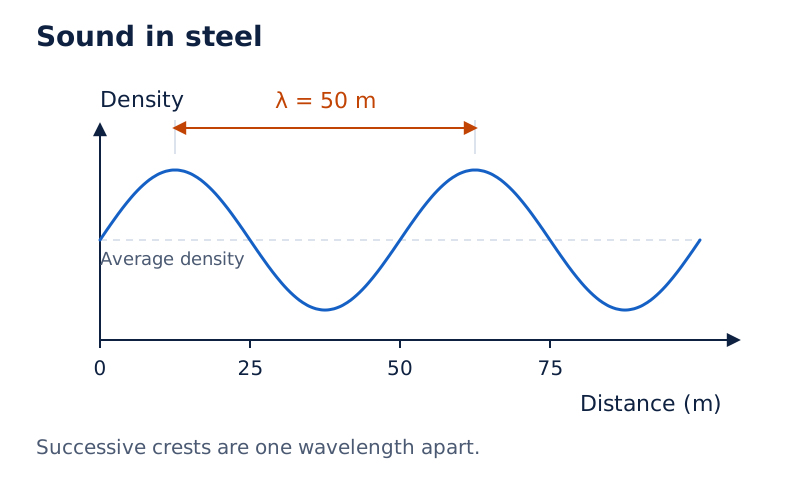
Density is on the vertical axis and distance in metres on the horizontal axis. The smooth curve repeats over 50 m; the marked distance positions include 25, 50 and 75 m.
Drawn by One Young India.
How does sound reflect from a surface?
Reflection of sound is the bouncing back of sound from an obstacle. Sound can reflect from solid or liquid surfaces. The sound approaching the surface is the incident sound; the sound travelling away after reflection is the reflected sound.
A normal is a line drawn perpendicular to the reflecting surface at the point where sound meets it. Perpendicular means at a right angle. Angles in the laws of reflection are measured from this normal, rather than from the surface.
What are the laws of reflection?
- The angle between the incident direction and the normal equals the angle between the reflected direction and the normal.
- The incident direction, reflected direction and normal at the point of incidence lie in the same plane.
The point of incidence is the point where the incoming sound meets the surface. A ray diagram uses lines to indicate directions of travel. It does not imply that particles travel along those lines from the source to the reflector.
Hard, smooth surfaces produce stronger echoes. Soft surfaces, such as curtains, tend to absorb sound, while rough surfaces scatter it in different directions. A reflected sound therefore need not be heard clearly as a separate repetition.
The time at which a reflection reaches a listener also matters. A nearby wall may reflect sound, yet the reflected sound arrives too soon to be distinguished from the original. Reflection and the perception of a separate echo are related but different ideas.
Note: Keep the reflecting surface and its normal distinct. When comparing the incident and reflected directions, use angles measured from the normal and keep the surface fixed.
When is a reflected sound heard as an echo?
An echo is a repetition of sound heard after it reflects from a distant object. A shout near a mountain, cliff or long corridor may be heard again after some time. The repeated sound has travelled a longer path than the original sound.
To hear two sounds separately, their arrival times must differ by at least 0.1 s. In a small room, reflections arrive too quickly for the brain to separate them from the original sound. The minimum distance for an echo therefore depends on sound speed.
Derivation: distance from the echo time
Let d be the distance from a source and listener at the same position to a reflecting surface. Let t be the time between emission and reception of the echo, and v the sound speed, assumed constant along the path.
- The outgoing sound travels distance d from the source to the reflecting surface.
- The returning sound travels another distance d to the listener, so the total path is 2d.
- Distance equals speed multiplied by time. Thus 2d = vt, and dividing by two gives the one-way distance.
d = vt/2
t = 2d/v
At 340 m/s, sound travels 340 × 0.1 = 34 m in 0.1 s. This includes the outward and return journeys. The minimum reflector distance is therefore 34/2 = 17 m under these conditions.
Worked example 5. A clap in an empty corridor produces an echo after 0.5 s. Calculate the distance from the wall if sound travels at 340 m/s.
Formula: d = vt/2. Substitute: d = 340 × 0.5/2 m. Answer: the wall is 85 m away. Sound travels 170 m altogether.
The factor of two belongs to the complete reflected journey. It must not be inserted into the thunder calculation, where the sound travels directly from the lightning strike to the observer. Identify the path before selecting the formula.
How do echoes help animals, fishermen and doctors?
Echolocation means locating objects by sensing reflected sound. An animal or instrument sends sound into its surroundings and receives reflections from objects. These echoes provide information about objects that cannot be seen clearly.
Most bats emit short bursts of ultrasonic waves. Ultrasonic waves, also called ultrasound, have frequencies above 20 kHz, beyond the human audible range. By sensing the returning echoes, bats can determine the positions of obstacles and prey while flying and hunting in darkness.
Dolphins, whales and some birds also use echolocation for navigation and hunting. The principle is the return of a sound signal from an object. It does not require that the emitted signal be audible to humans.
What the figure shows
Echolocation by bats
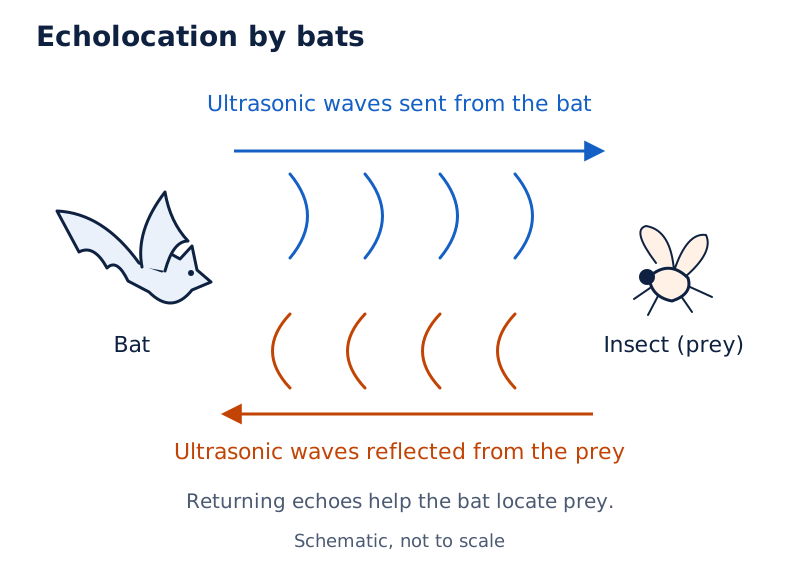
The drawing shows a bat facing an insect. Two labelled sets of curved wave lines show ultrasonic waves sent from the bat and ultrasonic waves reflected from the prey.
Drawn by One Young India.
Where are reflected ultrasonic waves useful?
| Application | Role of the sound signal |
|---|---|
| Animal navigation | Returning echoes help an animal locate nearby obstacles and prey. |
| Fishing | Fishermen use underwater echoes to help locate shoals, meaning groups of fish. |
| Medical imaging | Ultrasonography uses ultrasound to image internal organs without surgery; returning echoes provide information about internal structures. |
| Underwater exploration | Reflections help locate objects such as submarines and shipwrecks. |
Ultrasonography is the use of ultrasound to form images inside the body. It should be distinguished from another medical use of ultrasound: breaking kidney stones into smaller pieces that can pass out of the body. Stone-breaking is not the same operation as collecting echoes to form an image.
For a numerical distance calculation, an echo time must be combined with the speed of sound in the relevant medium. An underwater calculation uses the stated water speed, rather than automatically using a value for air.
How does SONAR measure an underwater distance?
SONAR stands for sound navigation and ranging. It sends ultrasonic waves into water and analyses the reflected waves to obtain information about underwater objects. Such information can include their distance, direction and speed.
For a simple distance measurement, the important observation is the time between sending a pulse and receiving its echo. A pulse is a short burst of sound. The pulse travels to the object and then returns, so the measured time covers both journeys.
What are the steps in a distance calculation?
- Identify the reflecting object and the route taken by the outgoing and returning sound.
- Record the total echo time and the given sound speed in water.
- Multiply speed by total time to obtain the complete sound path.
- Divide that path by two to find the one-way distance, provided the outgoing and returning distances are equal.
Worked example 6. A naval SONAR signal sent into seawater returns after 0.90 s. The sound speed is 1530 m/s. How far away is the reflecting object?
Formula: d = vt/2. Substitute: one-way time = 0.90/2 = 0.45 s; d = 1530 × 0.45 m. Answer: the object is 688.5 m away.
What the figure shows
Functioning of SONAR
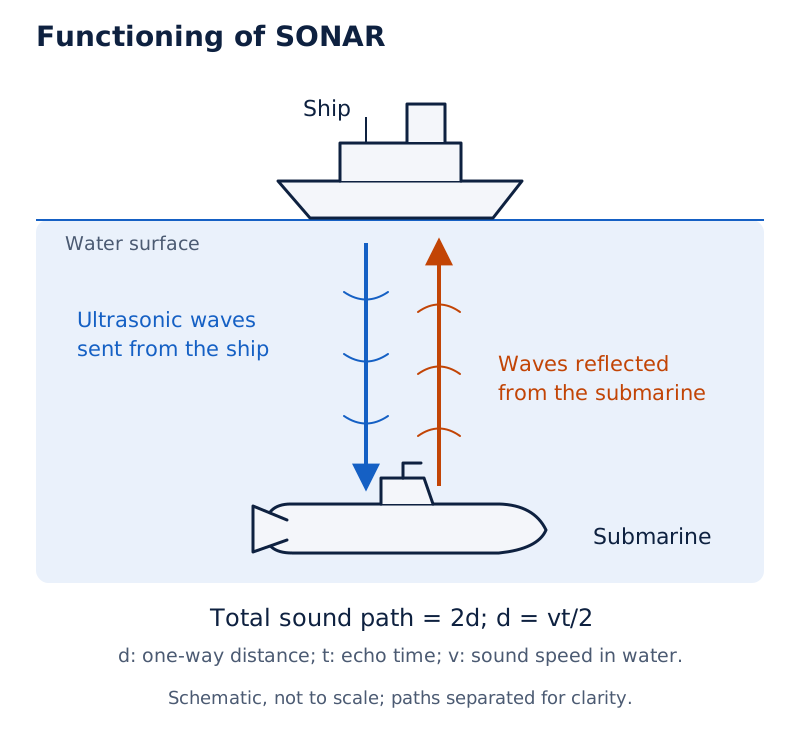
A ship is shown at the water surface and a submarine below it. Labelled wave paths show ultrasonic waves sent from the ship and waves reflected from the submarine.
Drawn by One Young India.
If the echo comes from the seabed directly below the instrument, the one-way distance gives the depth below it. If the reflector is an underwater object in another direction, the calculation gives distance along the sound path, rather than automatically giving vertical depth.
A unit check helps prevent errors: a speed in metres per second multiplied by a time in seconds gives a distance in metres. Dividing by two changes the path length but does not change its unit.
What are natural and damped vibrations?
Natural vibrations occur when a disturbed system is left to vibrate without a continuing external periodic force. Its natural frequency is a frequency at which that system can vibrate freely. A periodic force is a force that repeats at regular intervals.
A tuning fork illustrates a vibrating sound source. It is a U-shaped metal bar with a stem, usually made of steel or aluminium. Its two arms are called prongs or tines. Gently striking a prong on a soft rubber pad starts its vibrations.
Why does a vibration die away?
In practice, vibrating bodies lose mechanical energy through friction and other processes. Damped vibrations are vibrations whose amplitude decreases with time because energy is lost. For a vibrating body, amplitude means its maximum displacement, or change in position, from the mean position.
Friction is a force that resists relative motion. Damping transfers energy out of the organised vibration, so the motion eventually dies away. An ideal undamped vibration would maintain its amplitude because it would not lose energy.
| Feature | Ideal undamped natural vibration | Damped vibration |
|---|---|---|
| Energy | No loss of vibration energy | Vibration energy is progressively lost |
| Amplitude | Remains constant | Decreases with time |
| Continuing external drive | Not required in the ideal model | No continuing drive is needed for a freely dying vibration |
A real tuning fork that has been struck and then left alone gives a fading sound. Its vibration is free of a continuing drive but is also damped. Thus, describing the cause of a vibration and describing its energy loss answer different questions.
Strings and air columns can have several natural frequencies. For a simple comparison, identify the particular vibration being discussed. Do not assume that every object has just one possible frequency of vibration.
How do forced vibrations produce resonance?
Forced vibrations are maintained by an external periodic influence. The driving influence repeatedly supplies energy to the vibrating system. The frequency of this repeated influence is called the driving frequency.
After the initial motion settles, a periodically driven system vibrates at the driving frequency. The size of its response depends on how that frequency compares with its natural frequencies and on the damping present.
Definition: Resonance is the especially large response of a vibrating system when the driving frequency is equal or close to one of its natural frequencies. It is a special case of forced vibration.
How can an air column demonstrate resonance?
A glass tube partly filled with water contains an air column above the water. A vibrating tuning fork near the open end can drive that air into vibration. Changing the air-column length changes the natural frequencies available to the column.
When the driving frequency is close to a natural frequency of the air column, resonance occurs and the sound becomes markedly louder. The large response comes from the matching of frequencies, rather than merely from placing any vibrating object near any tube.
| Question | Forced vibration generally | Resonance |
|---|---|---|
| Is there an external drive? | Yes, a periodic influence maintains the motion | Yes, resonance is a driven response |
| Must frequencies match closely? | Not for every forced vibration | The drive is equal or close to a natural frequency |
| What happens to amplitude? | It depends on the drive and the system | The response becomes especially large |
Damping limits the resonant response. A real system loses energy, so resonance does not mean an unlimited increase in amplitude. The distinction between driving frequency, natural frequency and amplitude is central to explaining what happens.
In musical instruments, strings and air columns provide vibrating systems with characteristic frequencies. Their responses help explain why construction and adjustment matter. The same general ideas connect a freely vibrating source, a driven system and a resonant response.
How do loudness and intensity differ?
Loudness describes how strong or weak a sound seems to a listener. Sounds with larger amplitude are heard as louder, while those with smaller amplitude sound softer. Loudness also depends on the listener's hearing ability, so it is a subjective property.
Subjective means dependent on perception. Objective means measurable independently of an individual's impression. Intensity is objective, whereas loudness describes the experience of hearing. The two terms therefore should not be treated as interchangeable physical quantities.
Definition: Intensity is the sound energy passing each second through unit area perpendicular to the direction of propagation. The SI unit of intensity is watt per square metre, written W/m². A watt is one joule of energy transferred per second; the joule is the SI unit of energy.
How is amplitude represented?
For a density graph, sound-wave amplitude is the maximum change in air density above or below its average value. This differs from the displacement amplitude of a vibrating object. Both describe the size of an oscillation, but they measure different quantities.
What the figure shows
Low and high amplitude
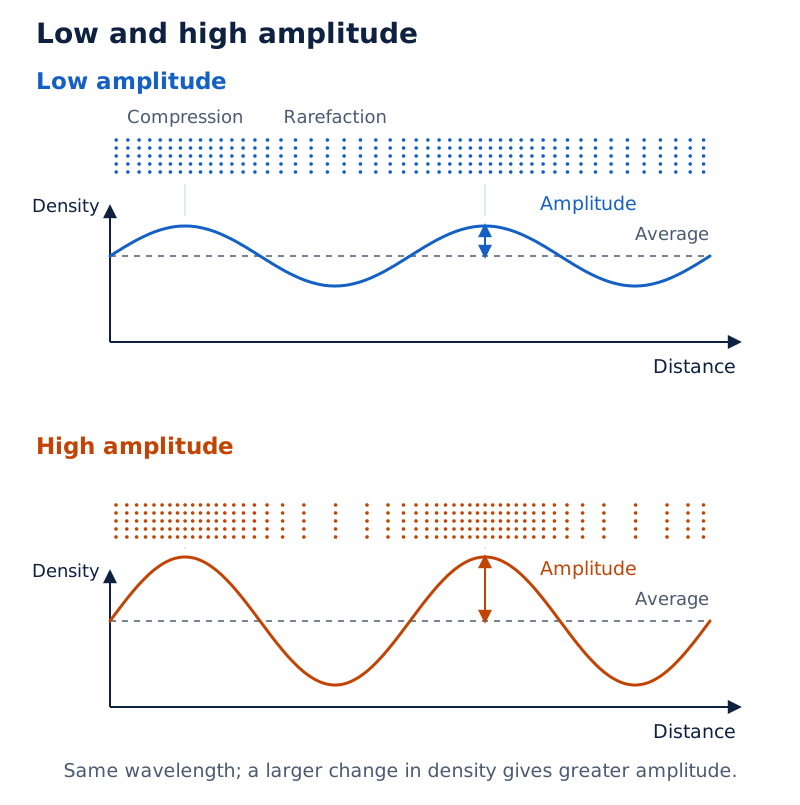
Both panels show particle-density bands above density-distance curves. The amplitude arrows extend from the dashed average-density line to a crest. The high-amplitude panel has taller crests and deeper troughs.
Drawn by One Young India.
A larger-amplitude sound wave carries more energy. As sound spreads farther from its source, the energy spreads over a larger area and intensity decreases. This helps explain why a source sounds softer when the listener moves farther away.
Sound level is expressed in decibels, written dB. Normal conversation is about 60 dB, while firecrackers can exceed 100 dB. Even a small rise in decibel level represents a large rise in intensity; the level is not a direct reading in W/m².
When comparing sounds, keep the property being compared clear. A greater density amplitude concerns the size of the wave disturbance. A greater frequency concerns how often the disturbance repeats. Increasing one does not define an increase in the other.
How does frequency affect pitch?
Pitch is the human perception associated with sound frequency. A shrill sound has a high pitch, while a deep sound has a low pitch. In general, higher-pitched sounds have higher frequencies and lower-pitched sounds have lower frequencies.
The exact mathematical relationship between perceived pitch and frequency is complicated. Frequency is a measurable repetition rate, while pitch describes the listener's experience. It is therefore more accurate to state their general dependence than to call them identical quantities.
How can pitch and loudness be distinguished?
| Characteristic | Physical connection | Useful contrast |
|---|---|---|
| Pitch | Related to frequency | Shrill versus deep |
| Loudness | Related to amplitude and the listener's hearing | Loud versus soft |
| Time period | Reciprocal of frequency | A shorter period means more oscillations per second |
A whistle or siren is an example of a high-pitched sound. Thunder or an aircraft rumble is an example of a low-pitched sound. A loud sound need not be high-pitched: loudness and pitch answer different questions about what is heard.
The human audible range is roughly 20 Hz to 20000 Hz. This range varies from person to person and decreases with age. Frequencies below 20 Hz are called infrasonic; frequencies above 20 kHz are called ultrasonic.
These terms classify frequency, not loudness. Ultrasound does not mean an extremely loud audible sound. Dogs, cats, bats and dolphins can detect ultrasound, while elephants can detect infrasound. Human hearing does not cover all the vibrations that animals can detect.
An octave is the interval between notes whose fundamental frequencies are in the ratio two to one, such as 200 Hz and 400 Hz. The fundamental is the lowest frequency in the musical note. This example concerns frequency, not a doubling of loudness.
Why can instruments sound different at the same pitch?
Quality, also called timbre, distinguishes sounds that have the same pitch and loudness. A flute, ektara and tabla can sound different even when playing the same note at the same loudness. Their sounds have different waveforms.
A waveform is the shape of the graph representing a wave's variation. A tone has a single frequency. A musical note combines a lowest frequency, the fundamental, with higher frequencies called overtones.
What determines a note's quality?
The pattern and intensities of the overtones influence the waveform and hence the quality. An instrument's shape, material and construction affect this combination. Thus, equal fundamental frequencies do not require identical sound patterns.
Usually, everyday sounds contain a mixture of many frequencies. A tuning fork or oral whistling can produce a nearly single-frequency sound. Plucking a tanpura string or singing produces a musical note with a richer combination of frequencies.
What the figure shows
A tone and a musical note
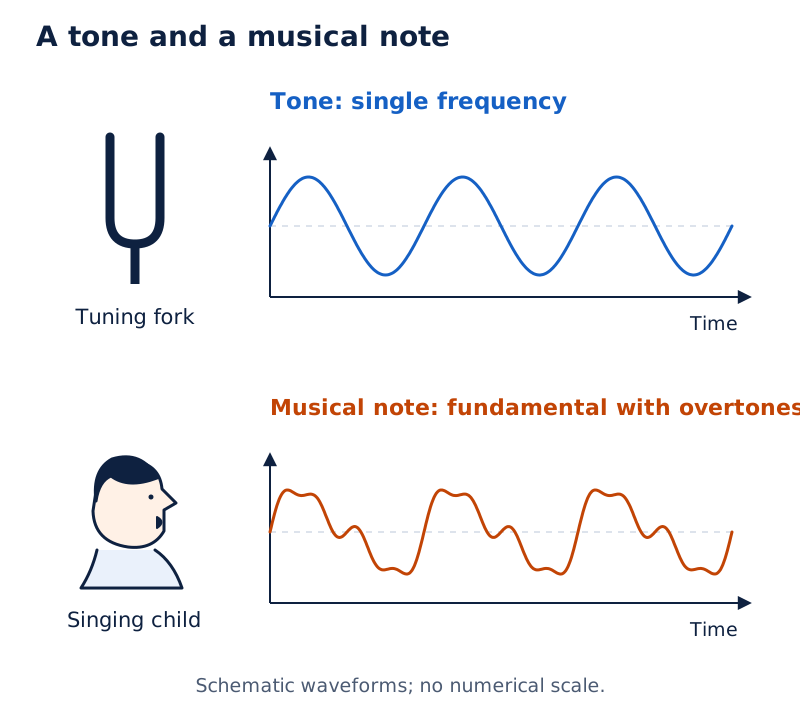
The upper drawing pairs a tuning fork with a smooth repeating curve. The lower drawing pairs a singing child with a more complex repeating curve. The axes do not carry numerical scales.
Drawn by One Young India.
Indian string instruments such as the sarangi, sitar and veena often use extra strings to enrich the combination of frequencies. In a tabla or mridangam, the black central patch on the drum-head membrane is called the syaahi. It alters the membrane's vibrations.
Acoustics is the study of sound. Sir C. V. Raman studied Indian percussion instruments, including the tabla and mridangam, to understand their rich sounds. His Nobel Prize in Science was for the Raman Effect in light, rather than for these studies of musical sound.
To compare two sound graphs, first check what the axes represent and whether their scales match. A change in height indicates amplitude; a change in repetition rate on a time graph indicates frequency. A change in the repeated shape helps show a difference in quality.
How do reverberation and noise affect listening?
Reverberation is the persistence of sound after its source stops because sound undergoes multiple reflections. In a large hall, sound can reflect from different surfaces and continue reaching a listener after the original emission has ended.
A separate echo is a recognisable repetition delayed sufficiently from the original sound. Reverberation involves overlapping reflections. Reflections arriving less than 0.05 s apart can sustain this persistence; a distinct echo requires an arrival gap of at least 0.1 s.
How can a hall control reflections?
Auditoriums and concert halls are designed to have desirable reverberation so that speech and music can be heard clearly. Excessive or unwanted reverberation can make sound garbled. Sound-absorbing panels, upholstered chairs, curtains and other soft, porous surfaces reduce unwanted reflections.
The Whispering Gallery of the Gol Gumbaz in Bijapur, Karnataka, illustrates the effects of architectural design on sound. Its design allows even a faint whisper to be heard multiple times across the large dome.
What is noise pollution?
Noise is unwanted or harmful sound. Exposure above recommended sound levels, especially for long durations, can affect health, sleep and hearing. Prolonged exposure to loud sound can lead to hearing loss. Both the sound level and duration of exposure matter.
A pleasant sound is not automatically harmless at every level or duration. The distinction between music and unwanted noise does not remove the effects of prolonged loud exposure. Sound level and a listener's perception address different aspects of the same situation.
Keeping loud sound lower and reducing the duration of exposure are practical ways to reduce exposure. Curtains and sound-absorbing materials address reflected sound in rooms. These measures act on different parts of a listening situation: the source, the time of exposure and the surroundings.
Across these applications, separate the physical event from its perception. Reflection describes what the wave does, intensity describes energy transfer, and loudness describes what the listener experiences. This distinction connects echoes, room acoustics and noise pollution.
Glossary
- Compression — A region in a sound wave where the medium's density is above its average value.
- Rarefaction — A region in a sound wave where the medium's density is below its average value.
- Frequency — The number of complete oscillations per second, measured in hertz.
- Wavelength — The distance between successive compressions or successive rarefactions in a sound wave.
- Amplitude — The maximum departure from a mean value, measured as displacement for a vibrating body or density change for a density wave.
- Echo — A repetition heard when reflected sound arrives sufficiently later than the original sound.
- Echolocation — Locating objects by sending sound and sensing its reflection from them.
- SONAR — Sound navigation and ranging, using underwater sound signals and their reflections to investigate objects.
- Natural frequency — A frequency at which a system can vibrate freely after being disturbed.
- Damped vibration — A vibration whose amplitude decreases with time as the system loses energy.
- Forced vibration — A vibration maintained by an external influence that acts periodically on the system.
- Resonance — An especially large response when a driving frequency is equal or close to a system's natural frequency.
- Intensity — Sound energy passing per second through unit area perpendicular to the direction of propagation.
- Timbre — The quality that distinguishes sounds of the same pitch and loudness through their different waveforms.
- Reverberation — Persistence of sound after emission stops, caused by multiple reflections from surrounding surfaces.
Common errors and misconceptions
- Misconception: Air particles travel from a tuning fork to the listener. Correct: Energy travels through the medium while its particles oscillate about their mean positions.
- Misconception: Multiplying echo time by speed gives the wall distance. Correct: It gives the outward and return path together; divide by two for the one-way distance.
- Misconception: Every reflected sound is heard as a distinct echo. Correct: The reflection must arrive sufficiently later; nearby reflections can merge with the original sound.
- Misconception: Every forced vibration is resonance. Correct: Resonance requires the driving frequency to be equal or close to a natural frequency and produces an especially large response.
- Misconception: A natural vibration cannot be damped. Correct: A real system left to vibrate freely can lose energy and show decreasing amplitude.
- Misconception: A louder sound must have a higher pitch. Correct: Loudness relates to amplitude and hearing, while pitch relates to frequency.
- Misconception: Loudness and intensity are identical measurements. Correct: Intensity measures energy transfer; loudness depends on how a listener perceives the sound.
- Misconception: Instruments playing the same note must sound identical. Correct: Their overtones and waveforms can differ, giving different quality or timbre.
Exam-style questions with model answers
Q1. State the two laws of reflection of sound. [2 marks]
- The angle of incidence equals the angle of reflection, with both angles measured from the normal to the reflecting surface.
- The incident direction, reflected direction and normal at the point of incidence lie in the same plane.
Q2. A person claps and receives an echo from a wall after 0.5 s. The speed of sound is 340 m/s, and the person remains at the point of emission. Calculate the wall distance and explain the factor of two. [3 marks]
- The sound goes from the person to the wall and returns to the same position. The stated 0.5 s therefore measures the time for two equal path lengths.
- The complete distance travelled is speed × time = 340 × 0.5 = 170 m.
- The one-way wall distance is half the complete path: 170/2 = 85 m. The factor of two accounts for the return journey.
Q3. A naval SONAR pulse returns from an underwater object after 0.90 s. Take sound speed in seawater as 1530 m/s and assume equal outward and return distances. State what SONAR stands for, describe its signal and calculate the object distance. [4 marks]
- SONAR stands for sound navigation and ranging. It uses sound signals to obtain information about objects underwater.
- It sends ultrasonic waves into water and detects the reflected waves returning from the object.
- The one-way travel time is half the total echo time: 0.90/2 = 0.45 s.
- The object distance is speed × one-way time = 1530 × 0.45 = 688.5 m.
Q4. Define natural, damped and forced vibrations. Explain the frequency condition for resonance and why the resonant amplitude does not grow without limit in a real system. [5 marks]
- Natural vibrations occur when a disturbed system is left to vibrate without a continuing external periodic force. Its free vibration has characteristic natural frequencies.
- Damped vibrations lose energy through friction and other processes. Their amplitude decreases with time, and the motion eventually dies away.
- Forced vibrations are maintained by a repeating external influence that supplies energy. After the initial motion settles, they follow the driving frequency.
- Resonance is an especially large forced response when the driving frequency is equal or close to a natural frequency of the system.
- Real systems have damping and lose energy. This energy loss limits the response, so resonance does not imply unlimited amplitude.
Q5. A flute and a tabla play the same note at the same loudness, but a listener distinguishes them. Explain the difference using quality, fundamental frequency, overtones and waveform. [4 marks]
- The distinguishing characteristic is quality, also called timbre. It can differ even when pitch and loudness are the same.
- A musical note contains a lowest frequency called the fundamental, together with higher frequencies called overtones.
- The instruments can have different patterns and intensities of overtones, producing different repeating waveforms.
- Their shape, material and construction affect this frequency mixture. The listener therefore recognises different sound qualities despite the matched note and loudness.
Q6. Sound in steel travels at 5000 m/s. The distance between successive crests on its density-distance graph is 50 m. Determine its wavelength, frequency and time period. [3 marks]
- Successive crests are one wavelength apart, so the wavelength is 50 m. This is the spatial length of one complete wave cycle.
- Using speed = frequency × wavelength, frequency = 5000/50 = 100 Hz, corresponding to 100 complete oscillations per second.
- Time period is the reciprocal of frequency. Therefore time period = 1/100 = 0.01 s, the duration of one complete oscillation at a fixed position.
Q7. Distinguish loudness from intensity in two points. [2 marks]
- Loudness is subjective: it describes how strong a sound seems and depends on the listener's hearing ability.
- Intensity is objective: it measures sound energy passing per second through unit area perpendicular to propagation.
Q8. Explain echolocation by bats, giving the kind of signal most bats emit, what happens to it, the information obtained, and one other animal that uses echolocation. [4 marks]
- Most bats emit short bursts of ultrasonic waves, which have frequencies above the human upper audible limit.
- The waves encounter nearby objects and some sound is reflected back towards the bat as echoes.
- By sensing these echoes, the bat determines the positions of obstacles and prey while navigating or hunting in darkness.
- Dolphins also use echolocation for navigation and hunting, applying the same general principle of locating objects from reflected sound.
Key takeaways
- Sound transfers energy through a material medium; its particles oscillate about their mean positions instead of travelling with the wave.
- Echo distance is half the product of sound speed and total return time when outward and return distances are equal.
- A distinct echo needs an arrival gap of at least 0.1 s; its minimum reflector distance depends on sound speed.
- Echolocation and SONAR use reflected signals to locate objects, while medical ultrasound can form images inside the body.
- Natural vibrations describe a system's free response; damping describes energy loss and the resulting decrease in amplitude.
- Resonance is an especially large forced response when the driving frequency is equal or close to a natural frequency.
- Loudness depends on perception, intensity measures energy transfer, pitch relates to frequency, and quality depends on waveform.
- Multiple reflections produce reverberation; absorbing surfaces reduce unwanted reflections, while prolonged loud exposure can damage hearing.
Test yourself
Why is the total echo path twice the wall distance for a stationary source and listener at the same point?
The sound travels to the wall and then returns over an equal distance to the listener.
What makes a sound wave longitudinal in air?
Air particles vibrate parallel to the direction in which the sound disturbance propagates.
Why does a real tuning fork's sound fade after it is struck?
It loses vibration energy through damping, so its amplitude decreases and the sound becomes softer.
What special frequency condition distinguishes resonance from forced vibration generally?
The driving frequency must be equal or close to one of the system's natural frequencies.
Does ultrasound mean sound that is extremely loud?
No. Ultrasound means sound with a frequency above 20 kHz, rather than sound of great loudness.
Why can equal-pitched instruments have different timbres?
Their overtones can have different patterns and intensities, producing different waveforms and therefore different qualities.
What is the difference between an echo and reverberation?
An echo is a distinguishable delayed repetition. Reverberation is the persistence of sound through multiple overlapping reflections.
Why must a SONAR problem state the sound speed in water?
The distance calculation depends on the speed in the actual medium; an air-speed value cannot simply be substituted.
Try it
Sound - ICSE Class 10 Physics Study Notes
Explore key wave mechanics and reflection principles through this 2-step scenario interactive.
1A sound generator in a room at 20°C is adjusted so that its frequency doubles from 512 Hz to 1024 Hz. Based on the wave equation and properties of sound in a given medium, what happens to the wave's speed and wavelength?
The text states that in a given medium, the speed of sound is independent of frequency and remains nearly constant. Therefore, speed does not double.
According to the text, the speed of sound in a given medium is nearly constant and independent of frequency. Applying the universal wave equation v = fλ, if the frequency doubles to 1024 Hz, the wavelength is halved to about 0.335 m.
In a given medium, sound speed does not increase with frequency, and by v = fλ, increasing frequency causes the wavelength to decrease, not increase.
2You are standing 10 meters away from a large, flat wall in air at 20°C (speed of sound ≈ 343 m/s) and clap your hands. Will you hear a distinct echo?
Although sound reflects off hard surfaces, the text explains that the reflected sound must reach the ear at least 0.1 s after the original sound for a distinct echo to be heard, which requires a minimum distance.
The text states that the human ear cannot separate two sounds closer than 0.1 s. Using v = 2d/t with t = 0.1 s and v ≈ 343 m/s gives d = (343 × 0.1)/2 ≈ 17.2 m (at least about 17 m). At 10 m, the reflected sound returns too quickly to be distinguished as an echo.
While loudness depends on amplitude, hearing a distinct echo is strictly constrained by the 0.1 s time separation limit (minimum distance of ~17.2 m), which cannot be bypassed by increasing amplitude.
In any given medium, sound speed remains constant regardless of frequency or amplitude, and hearing distinct reflections requires satisfying the minimum 0.1-second time delay set by human hearing.