
Latent heat | ICSE Class 10 Physics Notes
On this page

This note covers changes of state, melting and freezing, latent heat, specific latent heat of fusion, heating curves for water, heat calculations in separate stages, mixtures containing ice, and physical phenomena involving melting and refreezing.
What changes when a substance melts or freezes?
Matter, the material of physical objects, normally exists as a solid, liquid or gas. These are its physical states, also called phases. A change of state is a transition between these forms, such as solid ice becoming liquid water.
Melting, or fusion, is the change from solid to liquid. Freezing is the reverse change, from liquid to solid. Here, fusion means the physical process of melting.
How are heat and temperature different?
Temperature indicates how hot or cold a body is. Heat is energy transferred because of a temperature difference. Heat passes from the hotter body to the colder body when they exchange energy in this way.
Heating does not necessarily produce a temperature rise. When ice is melting, heat is supplied but its temperature remains constant until melting is complete. The energy transfer changes the state rather than raising the temperature during this interval.
Definition: The melting point is the temperature at which the solid and liquid forms of a substance coexist in thermal equilibrium. Thermal equilibrium means that they have the same temperature, with no net heat transfer between them because of a temperature difference.
Why must the pressure be specified?
The melting point depends on the substance and on pressure, the force acting perpendicular to a surface per unit area. The normal melting point is the melting point at standard atmospheric pressure, the reference pressure of the atmosphere.
At standard atmospheric pressure, ice melts at 0 °C, where °C denotes degrees Celsius. During melting, both ice and water are present. Once all the ice has melted, further heating can raise the water's temperature.
During freezing at the same pressure, water releases heat while changing into ice. A constant reading on a thermometer, an instrument that measures temperature, during this change does not mean that energy transfer has stopped. Identify both the state and the direction of heat transfer before describing what happens.
What is specific latent heat of fusion?
Latent heat refers here to heat absorbed or released during a change of state without a temperature change. To compare substances independently of the amount present, use the heat transferred per unit mass, where mass measures the quantity of matter. This quantity is the specific latent heat.
Definition: Specific latent heat of fusion is the heat required per unit mass to change a solid into liquid at its melting point, without changing its temperature, at the specified pressure.
Let Q be the heat transferred, m the mass changing state, and L the specific latent heat of fusion. In this note, L always refers to fusion unless another process is explicitly named.
L = Q/m
Derivation: How does the definition give the heat required?
- The specific latent heat L states the heat required for each unit mass undergoing fusion.
- A mass m requires m times that heat when the entire mass changes state under the same conditions.
- Multiplying the defining relation L = Q/m by m gives the total heat required for fusion.
Q = mL
Rearranging also gives m = Q/L. Use this form when the available heat and the specific latent heat are known and the mass melted is required. The mass in this equation is the mass that actually melts.
What does the value for ice mean?
At standard atmospheric pressure, a value of 3.33 × 10⁵ J kg⁻¹ for ice means that 1 kg of ice at 0 °C requires 3.33 × 10⁵ J to become water at 0 °C. J means joule, the unit of energy; kg means kilogram.
The value of specific latent heat also depends on pressure and is usually quoted at standard atmospheric pressure. Use the value supplied in a numerical question consistently; do not replace it with another rounded value recalled from memory.
Note: Melting absorbs heat; freezing releases heat. For the same mass changing between the same solid and liquid states at the same temperature and pressure, the magnitudes of these heat transfers are equal.
How do the units and the two heat equations differ?
Two different processes require two different calculations. A substance can warm or cool while remaining in one state, or it can change state at constant temperature. A problem involving both processes must be separated into stages.
Specific heat capacity, represented here by c, is the heat required per unit mass for a unit rise in temperature without a change of state. Its value depends on the substance and its temperature.
Let T₁ be the initial temperature and T₂ the final temperature. The symbol ΔT, read as “change in temperature”, denotes their difference:
ΔT = T₂ − T₁
Q = mcΔT
Equivalently, c = Q/(mΔT) when the temperature change is non-zero and no state change occurs. For a cooling calculation using positive heat-loss magnitudes, subtract the lower final temperature from the higher initial temperature.
Which units belong to each quantity?
SI means the International System of Units.
| Quantity | Unit statement | Meaning in a calculation |
|---|---|---|
| Heat Q | The SI unit of heat is the joule, J. | Energy absorbed or released. |
| Mass m | The SI unit of mass is the kilogram, kg. | Amount of substance being heated or changing state. |
| Temperature T | The SI unit of temperature is the kelvin, K. | Celsius readings may also specify temperatures. |
| Specific heat capacity c | The SI unit of specific heat capacity is J kg⁻¹ K⁻¹. | Energy per kilogram per kelvin of temperature change. |
| Specific latent heat L | The SI unit of specific latent heat is J kg⁻¹. | Energy per kilogram changing state. |
A temperature interval has the same numerical value in kelvin and degrees Celsius. The unit J kg⁻¹ means joules per kilogram; J kg⁻¹ K⁻¹ means joules per kilogram per kelvin.
Why is there no temperature factor in Q = mL?
Fusion takes place without a temperature change at the melting point. Multiplying mL by a temperature rise would therefore misrepresent the process. Conversely, applying mcΔT to the melting interval would give zero because ΔT is zero, although heat is being absorbed.
When mass is given in grams, use compatible units throughout: 1000 g equals 1 kg. Keep the phase-change calculation distinct from any warming of the ice before melting or warming of the resulting water afterwards.
How does the heating curve for water show latent heat?
A heating curve plots temperature against time or against heat supplied. It shows which intervals involve rising temperature and which involve a change of state. Read the horizontal-axis label before interpreting the length of an interval.
What happens in successive stages?
- Ice below its melting point warms. Its temperature rises towards 0 °C at standard atmospheric pressure. It remains solid during this stage.
- Ice melts at 0 °C. Ice and liquid water coexist. Heat is absorbed while the temperature stays constant until the ice has melted.
- Liquid water warms. After melting finishes, continued heating raises the water's temperature towards its boiling point.
- Water boils. Its temperature becomes steady again as it changes into vapour. Vaporisation is the change from liquid to gas; steam is water in its gaseous state.
Under ordinary atmospheric conditions, the water temperature rises to nearly 100 °C before becoming steady during boiling. The boiling point is the temperature at which liquid and vapour coexist in thermal equilibrium at the specified pressure.
What the figure shows
Heating ice with time
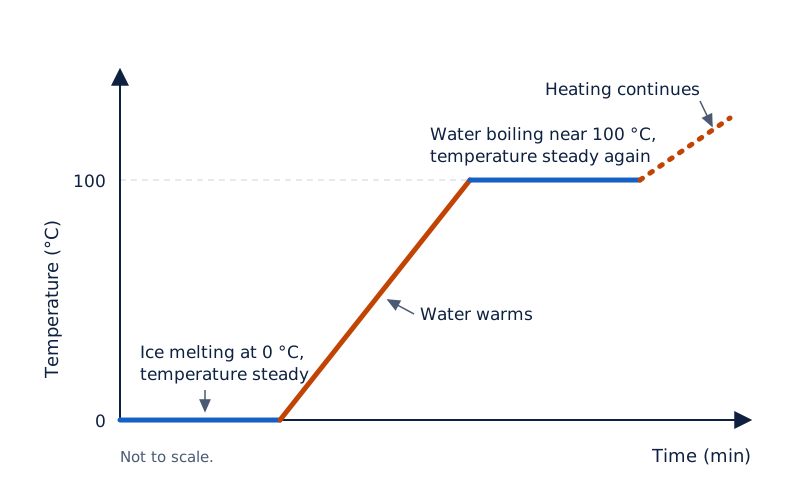
The vertical axis is temperature in °C and the horizontal axis is time in minutes. A horizontal interval at 0 °C precedes a rising line and a horizontal interval at 100 °C. A dotted rising continuation follows. The graph is not to scale.
Drawn by One Young India.
What do horizontal and sloping portions mean?
A plateau is a horizontal portion of the graph. Temperature stays constant while heat changes the state. A rising portion represents heating within one state. Neither kind of portion means that the heater must have been switched off.
What the figure shows
Temperature against supplied heat
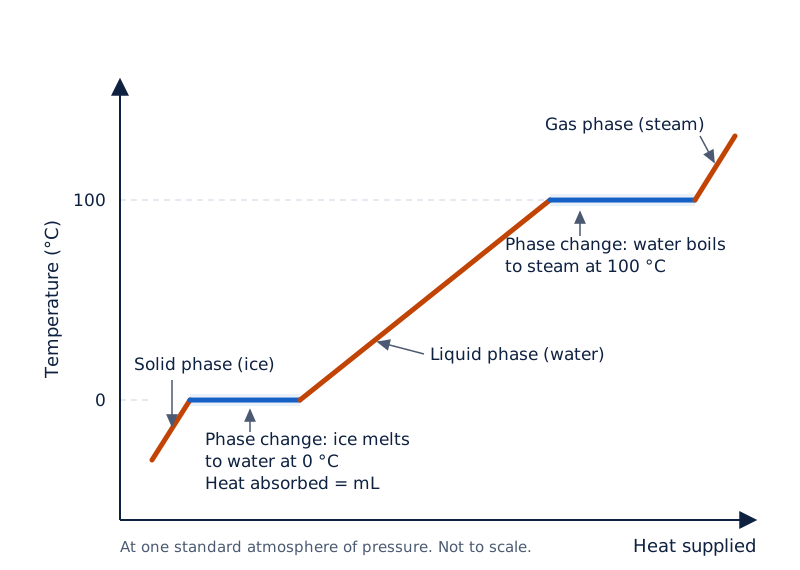
The vertical axis shows temperature and the horizontal axis shows heat. Rising portions are labelled solid phase, liquid phase and gas phase. Horizontal blue phase-change regions occur at 0 °C and 100 °C. The graph is at one standard atmosphere of pressure and is not to scale.
Drawn by One Young India.
The sloping portions do not all have the same slope, meaning temperature rise per unit increase along the horizontal axis, because the specific heat capacities of the different states are unequal. On the heat axis, the melting interval represents energy mL. On a time axis, interpreting duration as energy requires a constant rate of heat supply.
How can melting be observed and explained experimentally?
The link between heat supply and a steady temperature can be observed while heating ice in a beaker. A thermometer measures temperature. It does not directly measure the total energy supplied to the sample.
What observations should be recorded?
- Place ice cubes in a beaker and measure their initial temperature.
- Heat slowly using a constant heat source, recording temperature every minute.
- Stir the ice-water mixture continuously and observe whether solid ice remains.
- Plot temperature against time and identify the melting interval and the later temperature rise.
During melting, the temperature remains unchanged while ice is still present in the mixture. Continued heat supply changes solid ice into liquid water. After the whole of the ice becomes water, continued heating produces a temperature rise.
If the ice begins below its melting point, first identify its warming interval. The statement about constant temperature applies to the melting stage, not to every possible initial condition of an ice sample.
How should an explanation connect observation and cause?
A complete explanation identifies the observation, the energy transfer and the state change. Saying only “the thermometer stays at zero” misses the reason. Saying only “latent heat” names the idea without explaining what the absorbed energy does.
State instead that heat continues to enter the ice-water mixture, the temperature stays at the melting point, and the absorbed energy converts ice into water. When no solid remains, that phase-change stage is complete.
The same distinction guides graph reading. A flat line does not mean that no energy is being supplied. It means temperature is constant over that part of the process. Observing the remaining ice helps connect the graph with what is happening in the beaker.
Constant pressure is part of this interpretation: melting point depends on pressure. Record the physical conditions along with the observations rather than treating a particular melting temperature as independent of its surroundings.
How are calculations split into warming, melting and warming again?
A multistage calculation adds the heat transfers for physically different steps. Trace the initial state, each change of state, and the final state before substituting numbers. Do not continue the calculation beyond the final state requested.
For the following examples, use 3 kg of ice initially at −12 °C, an ice specific heat capacity of 2100 J kg⁻¹ K⁻¹, a water specific heat capacity of 4186 J kg⁻¹ K⁻¹, and L = 3.35 × 10⁵ J kg⁻¹. Assume standard atmospheric pressure and no heat absorbed by the container or surroundings.
How much heat is needed before and during melting?
Worked example 1. Warm the 3 kg ice sample from −12 °C to 0 °C. Let Q₁ be the heat absorbed in warming the ice.
Formula: Q₁ = mcΔT. Substitute: Q₁ = 3 × 2100 × [0 − (−12)]. Answer: 75,600 J. The temperature interval is 12 K and the sample is still ice at the end of this stage.
Worked example 2. Melt the same 3 kg of ice at 0 °C completely to water at 0 °C. Let Q₂ be the heat absorbed in fusion.
Formula: Q₂ = mL. Substitute: Q₂ = 3 × 3.35 × 10⁵. Answer: 1,005,000 J. The temperature is unchanged, but the whole sample has become liquid.
Worked example 3. Find the heat required to take the original ice at −12 °C to water at 0 °C. Let Qₐ be the heat for these two stages together.
Formula: Q₁ = mcΔT; Q₂ = mL; Qₐ = Q₁ + Q₂. Substitute: Qₐ = 75,600 + 1,005,000. Answer: 1,080,600 J. Both warming the solid and melting it are necessary to reach the specified final state.
What if the resulting water is also heated?
Worked example 4. Continue heating the resulting 3 kg of water from 0 °C to liquid water at 100 °C, without converting it to steam. Let Q₃ be this additional heat and Qₜ be the heat for all three stages.
Formula: Q₃ = mcΔT; Qₜ = Q₁ + Q₂ + Q₃. Substitute: Q₃ = 3 × 4186 × 100 = 1,255,800 J. Answer: the additional heat is 1,255,800 J and the total from ice at −12 °C is 2,336,400 J.
Qₜ = Q₁ + Q₂ + Q₃
These results illustrate why the initial and final states matter as much as their temperatures. “Water at 100 °C” and “steam at 100 °C” are different final states. Reaching the boiling point is not the same process as converting the liquid into vapour.
Use the specific heat capacity of the state being heated. The ice value belongs to the first stage; the water value belongs to the last. The fusion stage uses neither of those capacities because its temperature does not change.
How is heat balanced when ice is mixed with warm water?
Calorimetry means measuring heat. The method of mixtures balances the energy lost by a hotter material against the energy gained by colder material, provided no heat escapes to the surroundings. A calorimeter is a vessel used for such measurements.
When ice initially at 0 °C melts in warm water and the final temperature is above 0 °C, its heat gain has two parts. First it melts; then the resulting water warms. Omitting either part gives an incomplete balance.
Derivation: What is the balance for ice initially at its melting point?
Let H be heat lost by the initially warm water, F heat used in melting the ice, and W heat used in warming the resulting water. These symbols denote positive energy amounts.
- The warm water cools to the final mixture temperature and supplies heat H.
- The ice absorbs heat F to become water at its melting point.
- The melted ice absorbs further heat W to reach the final temperature.
- If heat exchange with the container and surroundings is negligible, the two gains together equal the loss.
H = F + W
How can a mixture measurement determine L?
Worked example 5. Mix 0.15 kg of ice at 0 °C with 0.30 kg of water at 50 °C. The final temperature is 6.7 °C. Find L, using water's specific heat capacity of 4186 J kg⁻¹ K⁻¹. Assume all ice melts and neglect heat exchange with the container and surroundings.
Formula: H = mcΔT for the warm water; W = mcΔT for the melted ice; F = mL for fusion. Substitute: H = 0.30 × 4186 × (50 − 6.7) = 54,376.14 J; W = 0.15 × 4186 × 6.7 = 4206.93 J.
Answer: 0.15L = 54,376.14 − 4206.93 = 50,169.21 J, so L = 334,461.4 J kg⁻¹, approximately 3.34 × 10⁵ J kg⁻¹.
The masses in the two temperature-change terms are different. The initially warm water has mass 0.30 kg, while the water produced by melting has mass 0.15 kg. Both finish at the same temperature, but they start their cooling or warming stages differently.
A final temperature above the melting point is consistent with complete melting in this calculation. If ice remains in equilibrium with water at standard atmospheric pressure, the mixture is instead at 0 °C; do not assume that every mixture problem ends with all ice melted.
How can the amount of ice melted by a hot solid be found?
A hot solid can supply heat to ice as the solid cools. If the ice is already at its melting point, energy reaching it can produce fusion. The maximum mass melted follows from the available heat divided by the specific latent heat.
How is the maximum heat available identified?
The maximum melting calculation assumes that all the heat released by the hot solid reaches the ice and is used in melting. A large remaining ice-water mixture at standard atmospheric pressure fixes the final temperature at 0 °C.
Worked example 6. A copper block of mass 2.5 kg is initially at 500 °C and is placed on a large ice block at 0 °C. Find the maximum mass melted. Use copper's specific heat capacity of 0.39 J g⁻¹ K⁻¹ and L = 335 J g⁻¹. Neglect other heat transfers and take the final copper temperature as 0 °C.
Formula: Q = mcΔT for copper; mᵢ = Q/L, where mᵢ is the mass of ice melted. Substitute: copper mass = 2500 g; Q = 2500 × 0.39 × (500 − 0) = 487,500 J.
Answer: mᵢ = 487,500/335 = approximately 1455 g, or 1.46 kg of ice. The result is a maximum under the stated assumptions.
Why are the assumptions part of the answer?
The heat lost by copper supplies the energy for fusion. There is no warming stage for the initial ice in this problem because it starts at 0 °C. There is no added warming stage for the meltwater because the final mixture remains at the melting point.
If some released heat warms other objects or escapes to the surroundings, less is available for fusion. The calculated mass therefore cannot be described as an unconditional prediction of what every practical arrangement will melt.
Unit consistency is especially important here. Because both given material constants use grams, converting the copper mass to grams keeps the substitution consistent. The resulting melted mass also comes out in grams before conversion to kilograms.
In any heat-balance problem, give each mass a physical identity. The mass of the hot copper is not the mass of ice melted. They enter different parts of the energy calculation and need not be equal.
How does latent heat explain cooling and refreezing?
Melting allows ice to absorb heat without immediately becoming warmer. This explains why the presence of ice matters in cooling: heat can continue to enter the melting ice-water system while its temperature remains at the melting point.
Why is melting ice useful in an icebox?
An icebox stores material with ice inside an insulating enclosure. Insulation reduces heat transfer through the enclosure. As heat enters and melts the ice, energy is absorbed in fusion. The amount melted depends on the heat received and the specific latent heat.
Ice at 0 °C can absorb fusion heat before the resulting water warms. Liquid water already at 0 °C has no melting stage left. For equal masses reaching the same higher final temperature, the ice therefore absorbs an additional amount mL.
What happens when water freezes?
Water must release heat to change into ice at its freezing point. Cooling water to 0 °C and freezing it are distinct stages, just as warming ice to 0 °C and melting it are distinct stages.
For a given mass, the heat released in freezing equals the heat absorbed in the reverse melting process at the same temperature and pressure. Do not add a temperature-rise factor to this energy, and state explicitly that heat leaves the water.
What is regelation?
Regelation is refreezing after pressure-induced melting. A loaded wire can pass through an ice slab without splitting it. Increased pressure beneath the wire lowers the melting temperature there; after the wire passes, the water above it freezes again.
What the figure shows
Loaded wire through ice
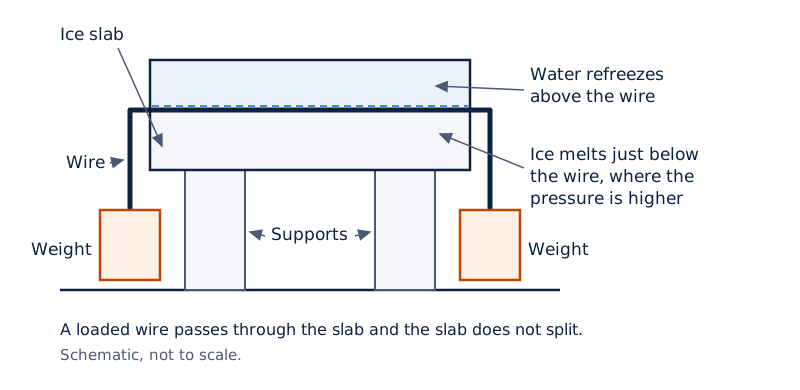
An ice slab rests across two supports. A wire passes over the slab, with weights hanging from its ends. The drawing shows the arrangement used to observe the wire passing through the ice while the slab remains together.
Drawn by One Young India.
This process brings together the pressure dependence of the melting point and the reversal of a change of state. Describe both melting below the wire and refreezing above it. Calling the process merely “cutting the ice” misses why the slab does not split.
Glossary
- Heat — Energy transferred between bodies or regions because they have different temperatures.
- Temperature — A measure of the relative hotness or coldness of a body.
- Change of state — A transition between physical forms such as solid, liquid and gas.
- Fusion — The change of a substance from its solid state into its liquid state.
- Freezing — The change from liquid to solid, accompanied by release of latent heat.
- Melting point — Temperature at which solid and liquid coexist in thermal equilibrium at a specified pressure.
- Latent heat — Heat absorbed or released during a change of state without a temperature change.
- Specific latent heat of fusion — Heat required per unit mass for melting at the melting point without changing temperature.
- Specific heat capacity — Heat required per unit mass for a unit temperature rise without changing state.
- Heating curve — A graph showing temperature against time or heat supplied during heating.
- Calorimetry — Measurement of heat, including calculations from the heat exchanged between materials.
- Thermal equilibrium — A condition of equal temperature with no net heat transfer caused by temperature differences.
- Regelation — Refreezing of water after ice has melted under increased pressure.
Common errors and misconceptions
- Misconception: Supplying heat must raise temperature. Correct: During melting at constant pressure, energy changes the state while the temperature stays at the melting point.
- Misconception: Ice below 0 °C begins melting immediately when heated at standard atmospheric pressure. Correct: It first warms to its melting point; fusion is a separate stage.
- Misconception: Specific latent heat has a temperature unit in its denominator. Correct: Its unit is J kg⁻¹. Specific heat capacity has the different unit J kg⁻¹ K⁻¹.
- Misconception: Use mcΔT to calculate heat absorbed during melting. Correct: Use mL for fusion. The melting interval has no temperature change but still requires heat.
- Misconception: Ice mixed with warm water absorbs heat only while melting. Correct: If the final temperature is above 0 °C, the melted water must also be warmed.
- Misconception: Freezing absorbs the same heat as melting. Correct: Freezing releases heat; the magnitude equals that for the reverse melting process under the same conditions.
- Misconception: Any heat-balance calculation applies regardless of losses. Correct: Equating the stated loss and gains requires accounting for heat absorbed by the container and exchanged with the surroundings, or explicitly neglecting them.
Exam-style questions with model answers
Q1. Define specific latent heat of fusion and give its SI unit. [2 marks]
- It is the heat required per unit mass to change a solid into liquid at its melting point, without changing temperature, at the specified pressure.
- Its SI unit is joule per kilogram, written J kg⁻¹.
Q2. Pure ice and water at 0 °C are heated at constant standard atmospheric pressure. Explain why the temperature stays constant while ice remains, and state what happens after it all melts if heating continues. [3 marks]
- While melting occurs, ice and water coexist at the melting point. The mixture remains at 0 °C under the stated pressure.
- The supplied heat is absorbed as latent heat of fusion, converting solid ice into liquid water rather than raising the temperature.
- Once all the ice has melted, continued heating raises the temperature of the liquid water until its next change of state begins.
Q3. Calculate the heat needed to melt 3 kg of ice at 0 °C into water at 0 °C. Use specific latent heat of fusion L = 3.35 × 10⁵ J kg⁻¹. Neglect heat absorbed by the container and surroundings. [3 marks]
- The ice starts at its melting point and finishes as water at the same temperature, so the required heat is the heat of fusion.
- Use Q = mL, where Q is heat absorbed and m is mass. Substitution gives Q = 3 × 3.35 × 10⁵.
- Therefore Q = 1,005,000 J. No additional term for warming the ice or water is needed for these initial and final states.
Q4. Find the heat required to change 3 kg of ice at −12 °C into water at 0 °C at standard atmospheric pressure. Use ice specific heat capacity c = 2100 J kg⁻¹ K⁻¹ and specific latent heat of fusion L = 3.35 × 10⁵ J kg⁻¹. Neglect heat absorbed by the container and surroundings. [5 marks]
- Separate the process into warming the solid ice to its melting point and then melting it. The final state is water at 0 °C, so no later warming stage is required.
- The temperature rise of the ice is 0 − (−12) = 12 K. Use the specific heat capacity of ice for this stage.
- The warming heat is Q₁ = mcΔT = 3 × 2100 × 12 = 75,600 J, where m is the mass and ΔT the temperature rise.
- The fusion heat is Q₂ = mL = 3 × 3.35 × 10⁵ = 1,005,000 J. This energy changes the state without increasing temperature.
- The total heat is Q₁ + Q₂ = 75,600 + 1,005,000 = 1,080,600 J. Both stages absorb energy, so their heat requirements are added.
Q5. Ice of mass 0.15 kg at 0 °C is mixed with 0.30 kg of water at 50 °C. All the ice melts and the final temperature is 6.7 °C. Find the specific latent heat of fusion of ice. Use water specific heat capacity 4186 J kg⁻¹ K⁻¹ and neglect heat exchange with the container and surroundings. [5 marks]
- The initially warm water supplies heat while cooling from 50 °C to 6.7 °C. Its heat loss is 0.30 × 4186 × (50 − 6.7) = 54,376.14 J.
- The melted ice becomes water at 0 °C and then warms to 6.7 °C. This warming requires 0.15 × 4186 × 6.7 = 4206.93 J.
- Let L be the specific latent heat of fusion in J kg⁻¹. The heat required to melt the ice, before warming that water, is 0.15L.
- Equating heat lost and total heat gained gives 54,376.14 = 0.15L + 4206.93, so the fusion heat alone is 50,169.21 J.
- Divide by the ice mass: L = 50,169.21/0.15 = 334,461.4 J kg⁻¹, approximately 3.34 × 10⁵ J kg⁻¹. The warming term must not be included in L.
Q6. A 2.5 kg copper block at 500 °C cools to 0 °C on a large ice block initially at 0 °C. All its released heat melts ice. Calculate the maximum mass melted, using copper specific heat capacity 0.39 J g⁻¹ K⁻¹ and ice specific latent heat of fusion 335 J g⁻¹. [4 marks]
- Convert the copper mass to 2500 g because both supplied material constants use grams. Its temperature fall is 500 K.
- The heat released by copper is mass × specific heat capacity × temperature fall: 2500 × 0.39 × 500 = 487,500 J.
- All this energy is available for fusion. The mass of ice melted is heat divided by specific latent heat: 487,500/335.
- The maximum melted mass is approximately 1455 g, or 1.46 kg. It is a maximum because the question assigns all the released heat to melting ice.
Key takeaways
- Melting changes solid to liquid; freezing reverses this change and releases the heat absorbed during melting under the same conditions.
- Specific latent heat of fusion is energy per unit mass for melting without changing temperature, with SI unit J kg⁻¹.
- Use Q = mL for fusion and Q = mcΔT for temperature changes without a change of state.
- A heating-curve plateau represents a change of state at constant temperature while heat continues to enter the substance.
- Split an ice-heating calculation into the stages actually required by its initial and final temperatures and states.
- In ice-water mixtures, distinguish heat for melting from heat for warming the water produced after melting.
- Balance all relevant heat losses and gains, stating when heat exchange with the container and surroundings is neglected.
- Use each question's supplied constants consistently, keep mass units compatible, and attach the appropriate unit to every calculated result.
Test yourself
What does the word fusion mean in this topic?
Fusion means melting, the change of a substance from solid to liquid.
Why can heat enter melting ice without raising its temperature?
The absorbed heat changes solid ice into liquid water at the melting point instead of producing a temperature rise.
What is the SI unit of specific latent heat of fusion?
It is joule per kilogram, J kg⁻¹, because the quantity is energy transferred per unit mass changing state.
What distinguishes a time-axis heating curve from a heat-axis heating curve?
One records elapsed time; the other records supplied energy. Time intervals represent energy intervals directly only when the rate of heat supply is constant.
Which two gains occur when ice at its melting point becomes water above that temperature?
The ice first absorbs heat to melt. The resulting liquid then absorbs heat to rise to the final temperature.
Does freezing absorb or release latent heat?
Freezing releases latent heat to the surroundings as liquid changes into solid.
What assumption allows heat lost by warm water to equal heat gained by added ice?
Heat exchange with the container and surroundings must be negligible for heat lost by the warm water to equal heat gained by the added ice.
What is regelation in the loaded-wire demonstration?
Ice melts beneath the wire under increased pressure, and the water refreezes above it after the wire passes.
Write about it
Turn a question from this chapter into a paper.
The Writing Studio has a structure guide, a rubric and citation tools for 15 formats, from essays to research papers. Drafting is free with an account. Learnacy Essential adds feedback from an AI writing coach and submission to The OYI Review.
Learnacy Essential is ₹1,499 for the year. Publication depends on review and is not guaranteed.