
Geometric Twins | CBSE Class 7 Maths Notes
On this page
This note covers congruent figures, matching parts of triangles, conditions for triangle congruence, geometric constructions, insufficient measurements, and the angles of isosceles and equilateral triangles.
What makes two figures geometric twins?
Definition: Congruent figures have the same shape and size. They can be superimposed, meaning placed one over the other so that they fit exactly.
A figure may be rotated, or turned, or flipped, or turned over, before checking whether it fits another figure. Its position on the page does not decide congruence. The complete figures must overlap exactly.
Why are two arm lengths insufficient?
Consider a signboard symbol formed by two straight arms meeting at a corner. Label the endpoints A and C and the meeting point B. These letters name points; AB and BC name the line segments, or straight portions, joining the named points.
In measurements, AB also means the length of segment AB. The symbol = means “is equal to”, and cm means centimetres. If AB = 4 cm and BC = 8 cm, several symbols are possible because the opening between the arms can vary.
An angle measures the opening between two arms meeting at a point. The notation ∠ABC names the angle at B, with B written in the middle. The symbol ° means degrees, the unit used here to measure angles.
Worked example 1. Recreate the two-arm symbol with AB = 4 cm, BC = 8 cm and ∠ABC = 80°.
Answer: Draw BC with length 8 cm. At B, make an angle of 80° with BC. Mark A at a distance of 4 cm from B along the other arm. The lengths and the angle together fix the symbol's shape and size.
How can measurements replace tracing?
Tracing a large symbol may be difficult. Measurements provide another way to reproduce it, but they must contain enough information. For this two-arm figure, both lengths and the angle between them are sufficient; the lengths alone leave the opening undetermined.
To compare two such symbols, therefore, compare their arm lengths and the angle between the matching arms. Merely noticing that their arms are equally long does not establish that the complete symbols are congruent.
How can congruence be checked by matching parts?
A triangle is a figure bounded by three straight sides. Its corner points are called vertices; one corner is a vertex. The notation ΔABC means the triangle with vertices A, B and C. Its sides are AB, BC and AC.
When congruent triangles overlap exactly, certain vertices, sides and angles fit over one another. These are corresponding parts. Establish the matching before writing the statement of congruence, since the order of the letters records which parts belong together.
What does the order of letters mean?
The symbol ≅ means “is congruent to”. In ΔABC ≅ ΔXYZ, A corresponds to X, B to Y and C to Z. The first letters match, the second letters match and the third letters match.
Here ∠A is a shorter name for the angle at A within the stated triangle. The same convention applies to the other single-letter angle names. Corresponding angles and corresponding side lengths of congruent triangles are equal.
| Kind of part | Corresponding pairs in ΔABC ≅ ΔXYZ |
|---|---|
| Vertices | A and X; B and Y; C and Z |
| Sides | AB and XY; BC and YZ; AC and XZ |
| Angles | ∠A and ∠X; ∠B and ∠Y; ∠C and ∠Z |
Reordering the vertices is possible if the matching is preserved. For this correspondence, ΔACB ≅ ΔXZY is correct. Writing ΔACB ≅ ΔXYZ changes the proposed matching of the second and third vertices and is incorrect for the stated correspondence.
Which measurements describe other figures?
A circle consists of points at a fixed distance from its centre; that distance is its radius. Equal radii give congruent circles. A rectangle has four right angles, each measuring 90°. Matching its length and breadth gives a congruent rectangle.
Thus, the measurements needed depend on the figure. For a circle, use its radius. For a rectangle, compare the two side lengths meeting at a corner. For triangles, the different combinations of side and angle measurements need closer investigation.
Why do three side lengths establish triangle congruence?
Meera and Rabia need a cardboard cutout matching a large triangular frame. They measure its sides as 40 cm, 60 cm and 80 cm. Meera argues that these lengths are sufficient, so measuring the angles separately is unnecessary.
Result: SSS congruence
SSS means Side Side Side. If the three side lengths of one triangle equal the three corresponding side lengths of another, the triangles are congruent. The construction using circles explains why the lengths determine the shape as well as the size.
Worked example 2. Construct a triangle whose side lengths are 4 cm, 6 cm and 8 cm, and compare the two possible positions of its third vertex.
Answer: Draw AB = 6 cm. Draw a circle with centre A and radius 4 cm, and another with centre B and radius 8 cm. Name their intersections E and F. Then AE = AF = 4 cm, BE = BF = 8 cm and AB = 6 cm. Hence ΔABE ≅ ΔABF by SSS.
An intersection is a point where the drawn circles or lines meet. E and F lie on opposite sides of AB. Their two triangles can be compared by tracing, by superimposing cutouts or by folding along AB.
Here AB acts as a line of symmetry, a line across which the two parts match when folded. The second intersection does not produce a different shape or size: it produces another congruent triangle.
How is SSS used with measured triangles?
Worked example 3. In ΔRED, RE = 3.5 cm, ED = 5 cm and RD = 6 cm. In ΔJAM, JA = 3.5 cm, AM = 5 cm and JM = 6 cm. Identify the congruence.
Answer: RE = JA, ED = AM and RD = JM, so all 3 corresponding side pairs are equal. R corresponds to J, E to A and D to M. Therefore ΔRED ≅ ΔJAM by SSS.
Equal side lengths determine the correspondence in this example. E and A each join the sides of lengths 3.5 cm and 5 cm. Matching these vertices first helps place the remaining vertices in the correct order.
How does a rectangle demonstrate a common-side proof?
A diagonal joins two non-adjacent vertices of a figure. Draw diagonal BD in rectangle ABCD. It divides the rectangle into ΔABD and ΔCDB. A common side belongs to both triangles, so it supplies an equality without requiring a separate measurement.
What the figure shows
Rectangle divided by a diagonal
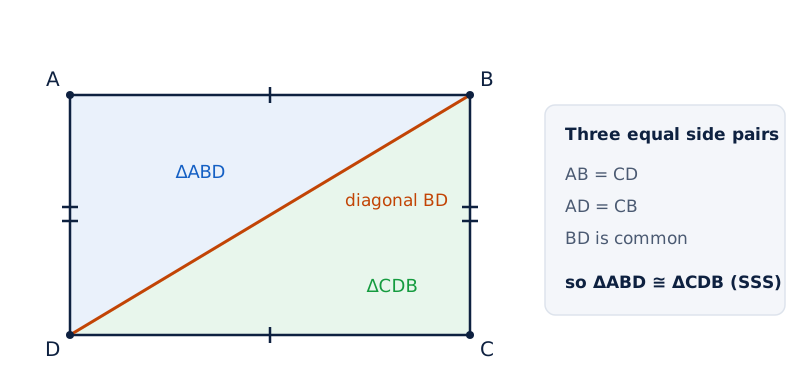
A is at the upper left, B at the upper right, C at the lower right and D at the lower left. Segment BD joins the lower left and upper right corners, dividing the rectangle into two triangles.
Drawn by One Young India. See Fig. 1.1 in your NCERT textbook
Which three equalities prove congruence?
- The opposite sides AB and CD of the rectangle are equal.
- The opposite sides AD and CB of the rectangle are equal.
- BD is common to the two triangles, giving the third equal side pair.
- The three equal side pairs satisfy SSS, so ΔABD ≅ ΔCDB.
The correspondence is A with C, B with D, and D with B. The common segment occurs as BD in the first triangle and DB in the second. These names describe the same length, but their reversed order follows the matching of endpoints.
Why can a plausible matching be wrong?
Trying to match A with C, B with B and D with D would place AB over CB. Those two rectangle sides need not be equal. That proposed overlap therefore does not establish congruence, even though the triangles themselves are congruent.
This distinction separates two tasks: proving that a congruence condition holds and writing the correct vertex order. Equalities should support both tasks. Begin with the sides known to match, then check that the written triangle names reproduce those matches.
The rectangle also shows why a shared side should be stated explicitly. After the opposite-side equalities, the common diagonal supplies exactly the missing side comparison needed for SSS. No numerical side length is needed for this argument.
Why does SAS work while equal angles alone are insufficient?
Triangles with angles 30°, 70° and 80° can have the same shape but different sizes. Therefore, triangles with the same set of angles need not be congruent. Angle information alone does not fix their side lengths.
Result: SAS congruence
An included angle is the angle between the two sides being considered. For sides AB and AC, it is the angle at A. SAS means Side Angle Side: equal corresponding side pairs and equal included angles guarantee congruence.
Worked example 4. For ΔABC and ΔXYZ, AB = XY = 6 cm, AC = XZ = 5 cm and ∠A = ∠X = 30°. Are the triangles congruent?
Answer: The 30° angles lie between the two given sides in each triangle. AB matches XY, AC matches XZ and the included angle at A matches the included angle at X. Thus ΔABC ≅ ΔXYZ by SAS.
How does the construction fix the triangle?
Begin with AB of length 6 cm. At A, draw the second arm making 30° with AB. Mark C at a distance of 5 cm along that arm, then join B to C. These instructions fix the positions of the three vertices up to congruence.
Constructing the second triangle using the matching measurements produces the same shape and size. The angle fixes the opening of the measured sides, while their lengths fix where the other endpoints lie along those arms.
When deciding whether SAS applies, ask which sides form the stated angle. An angle elsewhere in the triangle is a non-included angle, meaning it is not between the two stated sides. Replacing the included angle with a non-included angle changes the condition.
This location check is essential. “Two sides and an angle” is not a complete statement of SAS. The angle must be the one enclosed by the two sides whose corresponding lengths are known to be equal.
Why does SSA not guarantee congruence?
SSA means Side Side Angle, with the given angle not included between the stated sides. This information does not guarantee congruence. A construction can produce two non-congruent triangles, meaning triangles that do not have both the same shape and the same size, satisfying the same measurements.
How do two different triangles arise?
An arc is a portion of a circle. A base is the side chosen as the starting side for the construction. The letter l below names the sloping line.
Worked example 5. Draw PQ = 6 cm and a line named l making 30° with PQ at P. An arc with centre Q and radius 4 cm meets that line at R and S on the same side of PQ. Compare ΔPQR and ΔPQS.
Answer: Both triangles have the side PQ = 6 cm and angle 30° at P. Also QR = QS = 4 cm because both intersection points lie on the arc. Yet the two triangles have different shapes and sizes. The given two sides and non-included angle therefore do not guarantee congruence.
Drawing a sufficiently long arc matters because it reveals both intersections rather than hiding one possible third vertex.
The given angle is at P, while the sides of known length are PQ and QR, or PQ and QS. These measured sides meet at Q, so the angle at P is not their included angle.
What conclusion is justified?
The correct conclusion is SSA does not guarantee congruence. Do not replace it with a claim that triangles satisfying SSA cannot be congruent. There are special cases in which these measurements do establish congruence, including the right-triangle case considered later.
Compare this construction with the SSS construction. Two circle intersections on opposite sides of the base there give congruent triangles. Here two intersections along the same sloping direction give different triangles. The number of possible third vertices alone does not settle whether their triangles are congruent.
How do two angles and their included side establish congruence?
The included side lies between the two specified angles. In a triangle with angles given at B and C, that side is BC. The angles determine the directions from the ends of the side, and the side length fixes the distance between those endpoints.
Result: ASA congruence
ASA means Angle Side Angle. If two corresponding angles and their included sides are equal in two triangles, the triangles are congruent. The equality of the included side supplies the size information missing when only angles are known.
Worked example 6. In ΔABC and ΔXYZ, BC = YZ = 5 cm, ∠B = ∠Y = 50° and ∠C = ∠Z = 30°. Establish congruence.
Answer: BC and YZ are the included sides between the given angles. The 50° angles match, the 5 cm sides match and the 30° angles match. Hence ΔABC ≅ ΔXYZ by ASA, with A corresponding to X, B to Y and C to Z.
How can the construction be planned?
- Draw the given side BC with length 5 cm.
- At B, construct an arm making the given angle of 50° with BC.
- At C, construct an arm making 30° with CB on the same side of BC.
- Name their intersection A to complete the triangle with the required measurements.
The matching construction for the second triangle gives a congruent figure. The side joins the vertices of the two known angles, so the specified measurements fit the ASA arrangement directly.
Reading the triangle names in order gives the complete correspondence. The vertex opposite BC is A, while the vertex opposite YZ is X. These remaining vertices correspond after B has been matched with Y and C with Z.
Why does AAS also guarantee congruence?
AAS means Angle Angle Side. It uses two equal corresponding angles and a corresponding side that is not included between them. This condition guarantees congruence because the missing angles can be found and the information rearranged into ASA.
How does the angle sum supply the missing angle?
The angle-sum property states that the three angles inside a triangle add up to 180°. Subtract the two known angles from this total to obtain the third. The sign − means subtraction. Equal pairs of known angles therefore leave equal third angles.
Worked example 7. In ΔABC and ΔXYZ, ∠A = ∠X = 35°, ∠C = ∠Z = 75° and BC = YZ = 4 cm. Show that the triangles are congruent.
Answer: ∠B = 180° − 35° − 75° = 70°, and ∠Y = 70° by the same calculation. Now ∠B = ∠Y, BC = YZ = 4 cm and ∠C = ∠Z. These are two angles and their included side, so ΔABC ≅ ΔXYZ by ASA. The original information satisfies AAS.
In the original data, BC is not the side joining the vertices A and C of the given angles. After finding angle B, BC becomes the included side between angles B and C.
What the figure shows
Two angles and a non-included side
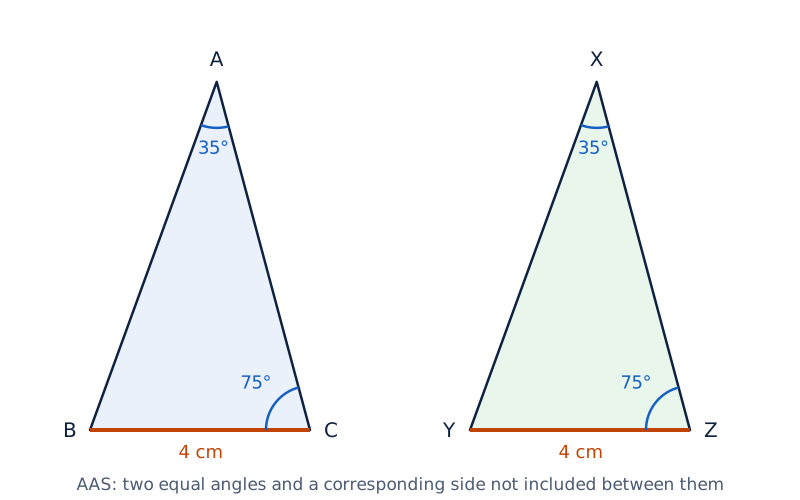
The first triangle has A at the top and B and C at the ends of a base labelled 4 cm. Its angles at A and C are labelled 35° and 75°. The second triangle has corresponding labels X, Y and Z with the same measurements.
Drawn by One Young India. See Fig. 1.2 in your NCERT textbook
Why should AAS not be confused with SSA?
AAS supplies two angles, allowing the third to be calculated. SSA supplies two sides and a non-included angle, which can leave different triangles possible. The letters name different information, and changing their order changes which condition is under discussion.
What makes RHS a special congruence condition?
A right-angled triangle contains a right angle of 90°. Its hypotenuse is the side opposite that angle. Identify the right angle first, then locate the opposite side, before deciding whether the measurements satisfy the condition.
Result: RHS congruence
RHS means Right Hypotenuse Side. Two right-angled triangles are congruent if their hypotenuses and one other pair of corresponding sides are equal. The right angles, equal hypotenuses and equal other sides must all be established.
Worked example 8. For ΔABC and ΔXYZ, ∠B = ∠Y = 90°, BC = YZ = 4 cm and AC = XZ = 5 cm. Decide whether congruence follows.
Answer: AC and XZ are opposite the right angles, so they are the hypotenuses, each of length 5 cm. BC and YZ are matching other sides, each of length 4 cm. Both triangles are right-angled. Therefore ΔABC ≅ ΔXYZ by RHS.
What does the construction show?
For the construction, draw QR = 4 cm. At Q, draw a line l perpendicular to QR, meaning that the lines meet at a right angle. With centre R and radius 5 cm, draw an arc meeting l at P, then join PR.
The downward extension of l also meets the arc. The triangle obtained below QR is congruent to the one above it. The second possible position therefore does not give a different size or shape, unlike the earlier SSA example.
RHS is a special case involving two side measurements and a non-included right angle. Its success does not make SSA a general congruence condition. It shows why the precise angle and the role of each given side must be checked.
When recording the argument, name the hypotenuses explicitly. A statement listing two side equalities without identifying the right angles leaves out an essential part of the RHS condition.
How can congruence establish another equal side?
Congruence is useful for finding equal parts that were not given initially. First establish a valid condition using known measurements or geometric relationships. Then use the resulting correspondence to identify the additional equal sides or angles.
How do midpoint information and intersecting lines combine?
A midpoint divides a line segment into two equal lengths. Suppose segments AD and BC intersect at O, which is the midpoint of both. Therefore AO = OD and BO = OC.
Vertically opposite angles are the angles opposite each other when two straight lines intersect. They are equal, so ∠AOB = ∠DOC. These are the included angles between the two known pairs of equal sides.
- Use O being the midpoint of AD to state AO = OD.
- Use O being the midpoint of BC to state BO = OC.
- Use the intersecting lines to state ∠AOB = ∠DOC.
- Apply SAS to obtain ΔAOB ≅ ΔDOC, then conclude AB = DC from corresponding sides.
The correspondence is A with D, O with O and B with C. The vertex O is shared, but the other two vertices must still be matched according to the equal sides. AB consequently matches DC.
Which conditions should be checked?
| Condition | Information that must match |
|---|---|
| SSS | All three corresponding side lengths |
| SAS | Two corresponding sides and their included angle |
| ASA | Two corresponding angles and their included side |
| AAS | Two corresponding angles and a corresponding non-included side |
| RHS | A right angle, the hypotenuse and one other corresponding side |
Keep the evidence separate from the conclusion. In the midpoint problem, AB = DC is what is being established. It should follow after SAS has been justified, rather than being assumed among the starting equalities.
How does congruence explain equal angles in special triangles?
An isosceles triangle has two equal sides. The angles opposite those sides are equal. Congruence explains this property by dividing the triangle into two right-angled triangles and comparing their parts.
Property: Angles opposite equal sides are equal
Take ΔABC with AB = AC. Construct an altitude AD from A to BC: this is a perpendicular segment from the vertex A to the opposite side, meeting it at D. Hence ∠ADB = ∠ADC = 90°.
AB and AC are equal hypotenuses, and AD is a common side. Thus ΔADB ≅ ΔADC by RHS. Their corresponding angles at B and C are equal. This proves the required relationship using congruence.
Worked example 9. In isosceles ΔABC, AB = AC and ∠A = 80°. Find ∠B and ∠C.
Answer: Since AB = AC, ∠B = ∠C. The two angles together measure 180° − 80° = 100°. Dividing that total equally gives ∠B = ∠C = 50°.
Property: Each equilateral-triangle angle is 60°
An equilateral triangle has all three sides equal. In ΔABC, equality of AB and AC gives ∠B = ∠C. Equality of AB and BC gives ∠A = ∠C. Therefore all three angles are equal.
Worked example 10. Find each angle of an equilateral triangle. The sign × means multiplication.
Answer: Its 3 angles are equal and their total is 180°. Thus 3 × each angle = 180°, giving each angle = 60°.
How does the property apply to a circle?
Worked example 11. A is the centre of a circle, B and C lie on the circle, and ∠BAC = 120°. Find ∠B and ∠C in ΔABC.
Answer: AB and AC are radii of the same circle, so AB = AC and ∠B = ∠C. Their sum is 180° − 120° = 60°. Hence ∠B = ∠C = 30°.
In each calculation, establish equality before sharing the remaining angle total. The side information explains why the unknown angles are equal; the angle-sum property then determines their measures.
Glossary
- Congruent figures — Figures having the same shape and size that fit exactly when placed over one another.
- Superimposition — Placing one figure over another to check whether the complete figures overlap exactly.
- Corresponding parts — Vertices, sides and angles that match when congruent triangles are made to overlap exactly.
- Included angle — The angle formed between the two sides being considered in a triangle.
- Included side — The side joining the vertices of the two angles being considered in a triangle.
- SSS — Side Side Side, the congruence condition using three pairs of equal corresponding side lengths.
- SAS — Side Angle Side, the congruence condition using two sides and their included angle.
- ASA — Angle Side Angle, the congruence condition using two angles and their included side.
- AAS — Angle Angle Side, the congruence condition using two angles and a corresponding non-included side.
- SSA — Side Side Angle, two sides and a non-included angle, which does not guarantee congruence.
- RHS — Right Hypotenuse Side, the congruence condition for right triangles with equal hypotenuses and another matching side.
- Hypotenuse — The side opposite the right angle in a right-angled triangle.
- Altitude — A perpendicular segment drawn from a triangle's vertex to the opposite side in the construction used here.
- Isosceles triangle — A triangle with two equal sides and equal angles opposite those sides.
- Equilateral triangle — A triangle with three equal sides and three equal angles, each measuring sixty degrees.
Common errors and misconceptions
- Misconception: Rotating or flipping a figure prevents congruence. Correct: A figure can be rotated or flipped before superimposition to check whether it fits exactly.
- Misconception: Equal angles guarantee congruent triangles. Correct: Triangles with the same set of angles need not be congruent because their sizes can differ.
- Misconception: Any two equal sides and an equal angle satisfy SAS. Correct: SAS requires the angle included between the two given sides.
- Misconception: SSA means the triangles cannot be congruent. Correct: SSA does not guarantee congruence; special cases such as RHS do guarantee it.
- Misconception: Triangle names can be reordered independently. Correct: The vertex order must preserve the correspondence between the matching sides and angles.
- Misconception: A common side contributes no information. Correct: A side shared by two triangles supplies an equality that may complete a congruence condition.
- Misconception: An isosceles triangle must have three angles of 60°. Correct: Its equal sides give equal opposite angles; an equilateral triangle has all three angles equal to 60°.
Exam-style questions with model answers
Q1. What are congruent figures, and how may they be moved before checking the fit? [2 marks]
- Congruent figures have the same shape and size and fit exactly when superimposed.
- A figure may be rotated or flipped before it is placed over the other figure to check the fit.
Q2. In ΔRED, RE = 3.5 cm, ED = 5 cm and RD = 6 cm. In ΔJAM, JA = 3.5 cm, AM = 5 cm and JM = 6 cm. Establish congruence and its correspondence. [3 marks]
- RE = JA = 3.5 cm, ED = AM = 5 cm and RD = JM = 6 cm, so all three pairs of corresponding side lengths are equal.
- R corresponds to J, E corresponds to A and D corresponds to M, as seen by matching the equal sides at their endpoints.
- Therefore ΔRED ≅ ΔJAM by the SSS condition, which establishes congruence using the three side pairs.
Q3. For ΔABC and ΔXYZ, AB = XY = 6 cm, AC = XZ = 5 cm and ∠A = ∠X = 30°. Explain why the triangles are congruent. [3 marks]
- The given side equalities pair AB with XY at 6 cm and AC with XZ at 5 cm.
- The angle at A lies between AB and AC, while the angle at X lies between XY and XZ. These included angles are both 30°.
- Two corresponding sides and their included angles are equal, so SAS applies and gives ΔABC ≅ ΔXYZ with the stated vertex order.
Q4. For ΔABC and ΔXYZ, ∠A = ∠X = 35°, ∠C = ∠Z = 75° and BC = YZ = 4 cm. Calculate the missing angles and prove congruence using ASA. [5 marks]
- The angles in each triangle total 180°. In ΔABC, subtract the two known angles to obtain ∠B = 180° − 35° − 75° = 70°.
- Apply the same angle-sum property to ΔXYZ. Its two known angles are also 35° and 75°, so ∠Y = 70°.
- The corresponding angles at B and Y are therefore equal. The given angles at C and Z are also equal, each measuring 75°.
- The side between these angle pairs is BC in the first triangle and YZ in the second. Both included sides measure 4 cm.
- ASA now gives ΔABC ≅ ΔXYZ. The original data are an AAS arrangement, since the originally given side was not included between the originally given angles.
Q5. For ΔABC and ΔXYZ, ∠B = ∠Y = 90°, BC = YZ = 4 cm and AC = XZ = 5 cm. Prove congruence, identifying the hypotenuses. [3 marks]
- The angles at B and Y are both 90°, so the triangles are right-angled and the RHS condition can be considered.
- AC and XZ lie opposite the right angles. They are therefore the hypotenuses, and both have the given length of 5 cm.
- BC and YZ are another pair of equal corresponding sides, each 4 cm. Hence ΔABC ≅ ΔXYZ by RHS.
Q6. Segments AD and BC intersect at O. O is the midpoint of both segments. Prove that AB = DC. [5 marks]
- Because O is the midpoint of segment AD, it divides that segment into equal lengths. Therefore AO = OD.
- Because O is also the midpoint of segment BC, the lengths on its two sides are equal. Therefore BO = OC.
- The two straight segments intersect at O. Hence ∠AOB and ∠DOC are vertically opposite angles and have equal measures.
- These equal angles are included between the equal side pairs. Thus ΔAOB ≅ ΔDOC by SAS, matching A with D, O with O and B with C.
- AB and DC are corresponding sides of these congruent triangles. Corresponding side lengths are equal, so the required conclusion is AB = DC.
Q7. In ΔABC, AB = AC and ∠A = 80°. AD is drawn perpendicular to BC, meeting BC at D. Use congruence to find ∠B and ∠C. [5 marks]
- Since AD is perpendicular to BC, ∠ADB = ∠ADC = 90°. Thus ΔADB and ΔADC are right-angled triangles.
- The sides opposite their right angles are AB and AC. These are equal by the given information, so the hypotenuses match.
- The triangles share side AD, giving an equal pair of other sides. Together with the right angles and equal hypotenuses, this establishes ΔADB ≅ ΔADC by RHS.
- The corresponding angles at B and C are therefore equal. Using the angle sum in ΔABC, their total is 180° − 80° = 100°.
- Two equal angles share the remaining 100° equally. Consequently ∠B = 50° and ∠C = 50°, completing both the congruence argument and the calculation.
Q8. A is the centre of a circle. B and C lie on the circle, and ∠BAC = 120°. Find ∠B and ∠C in ΔABC, giving reasons. [3 marks]
- AB and AC join the centre to points on the same circle, so they are equal radii. Hence ΔABC is isosceles.
- Angles opposite equal sides are equal, giving ∠B = ∠C. The three triangle angles total 180°, so ∠B + ∠C = 180° − 120° = 60°.
- Since these two angles are equal and together measure 60°, each is half that total. Therefore ∠B = ∠C = 30°.
Key takeaways
- Congruent figures have the same shape and size and can fit exactly when superimposed after turning or flipping.
- The order of vertices in a congruence statement records the corresponding vertices, sides and angles.
- SSS establishes triangle congruence when all three pairs of corresponding side lengths are equal.
- SAS requires the included angle between the two sides, while ASA requires the included side between two angles.
- AAS guarantees congruence because the angle-sum property supplies the missing angle and allows ASA to be used.
- SSA does not guarantee congruence, but equal hypotenuses and another matching side establish RHS congruence in right triangles.
- Congruence shows that angles opposite equal sides are equal, allowing missing isosceles-triangle angles to be calculated.
- All three angles of an equilateral triangle are equal and sum to 180°, making each angle 60°.
Test yourself
Do equal arm lengths alone fix the two-arm signboard symbol?
No. The angle between the arms can vary, so its measure is also needed to fix the shape and size.
In ΔABC ≅ ΔXYZ, which side corresponds to AC?
AC corresponds to XZ because A corresponds to X and C corresponds to Z.
Do angles of 30°, 70° and 80° determine a triangle's size?
No. Triangles with these angles can have different sizes and therefore need not be congruent.
Which angle is included between sides AB and AC?
The included angle is ∠BAC, the angle at their common endpoint A.
Why does AAS allow an ASA argument?
The angle-sum property makes the third angles equal, supplying matching angles at both ends of the given side.
Where is the hypotenuse in a right-angled triangle?
The hypotenuse is the side opposite the triangle's right angle.
If AB = AC and ∠A = 80° in ΔABC, what are the other angles?
∠B and ∠C are equal. Their total is 100°, so each angle measures 50°.
Why is each equilateral-triangle angle 60°?
All three angles are equal and their sum is 180°, so each is one-third of 180°.
Write about it
Turn a question from this chapter into a paper.
The Writing Studio has a structure guide, a rubric and citation tools for 15 formats, from essays to research papers. Drafting is free with an account. Learnacy Essential adds feedback from an AI writing coach and submission to The OYI Review.
Publication depends on review and is not guaranteed.