
Money and Banking | ICSE Class 10 Economics Notes
On this page
Watch & explore
Start with a few high-quality watches, then dive into the notes below.
Try an idea before you read. Step into the shoes of an economic decision-maker to explore how banking operations and credit creation shape liquidity and trade. Explore →
Learnacy Labs Try it hands-on: open the Money & Banking lab
This note covers barter and the evolution of money, legal tender, the functions of money, bank deposits, cheque payments, commercial bank lending, primary and derivative deposits, credit creation, central bank functions, quantitative and qualitative credit controls, and demonetisation.
What is money, and why is barter inconvenient?
Definition: Money is a generally accepted medium of exchange. Barter means exchanging goods or services directly for other goods or services without using money.
Why must wants coincide under barter?
A barter transaction requires a double coincidence of wants. Each participant must want what the other offers. Possessing something valuable is therefore insufficient: its owner must find a suitable exchange partner before obtaining the desired commodity.
A shoe manufacturer who wants wheat must find a wheat farmer who wants shoes. A farmer who wants clothes cannot complete that particular exchange, even though both people have useful goods. Searching for the right partner takes time and effort.
Money separates selling from buying. The manufacturer can sell shoes to someone who wants them, receive money, and then buy wheat from another person. The wheat seller need not want shoes because the payment received can purchase other goods.
What other problems arise?
Barter also makes comparison and storage of value difficult. Without a common monetary unit, goods must be valued against other goods. A person with surplus rice may have difficulty preserving wealth because rice is perishable and occupies storage space.
A future exchange involving stored rice also requires someone who wants rice at that time. Selling the rice for money reduces this difficulty. The money can be kept for later purchases, although rising prices can reduce what it buys.
| Problem under barter | How money helps |
|---|---|
| Finding someone with exactly opposite wants | A common medium separates sale from purchase. |
| Comparing the exchange values of different goods | Prices express values in a common monetary unit. |
| Keeping perishable goods for future exchange | Money offers a more convenient store of purchasing power. |
Diagram
Barter and monetary exchange
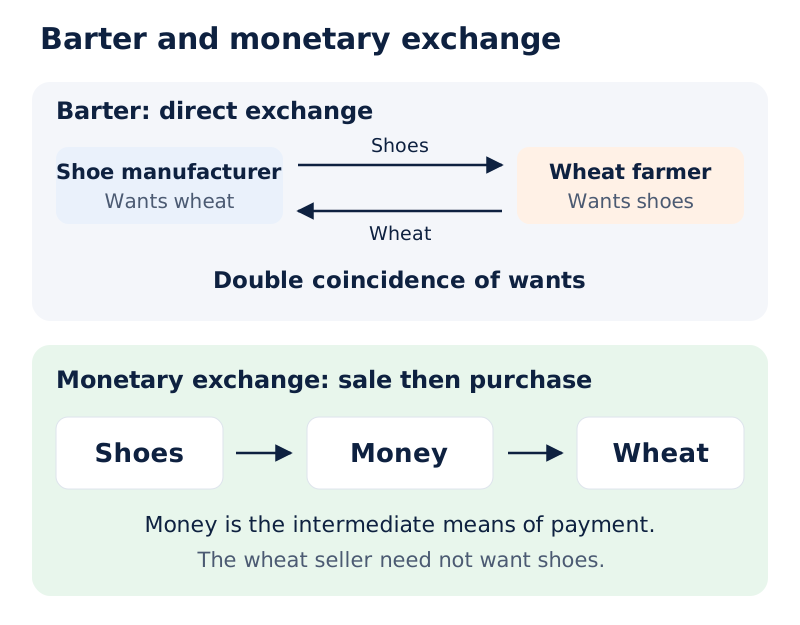
Draw one route showing shoes exchanged directly for wheat, requiring matching wants. Below it, draw shoes → money → wheat. Label money as the intermediate means of payment.
Drawn by One Young India.
How did money evolve, and what is legal tender?
From commodities to currency
Objects such as grains and cattle served as money in early India. Metallic coins made from gold, silver and copper came later. Modern forms include currency notes, coins and bank deposits that can be used for payments.
The material used for money need not itself be worth the amount printed on it. A currency note has little value as paper. Its acceptance rests on the authority behind its issue and its recognised use for making payments.
Money therefore depends on acceptance, rather than on being made from a precious metal. A gold coin and a modern paper note may both facilitate exchange, but the sources of their value differ. Modern currency is backed by the issuing authority.
Legal recognition and general acceptance
Definition: Legal tender is money recognised by law that a creditor cannot refuse in settlement of a debt or transaction, subject to the applicable legal conditions.
This is the legal approach to money: attention is on what the law recognises as a means of payment. The broader economic approach also includes demand deposits because they can be transferred to settle purchases.
The Reserve Bank of India (RBI) issues banknotes, while the Government of India issues coins. Commercial banks cannot create currency notes merely by lending. Their contribution to money creation takes the form of deposits.
Fiat money derives its monetary value from the issuing authority rather than a matching value of its material. A cheque, however, is an instruction to transfer a deposit. It is not itself legal tender, and a recipient may decline payment by cheque.
Note: General acceptability and legal tender status are different ideas. Demand deposits form part of money, but a cheque drawn against them does not have the same legal tender status as valid currency.
What are the four functions of money?
Exchange and measurement
As a medium of exchange, money is the intermediate means through which goods and services are bought and sold. The shoe manufacturer can receive money for shoes and spend it on wheat. This removes the need for double coincidence of wants.
As a measure of value, or unit of account, money provides a common way to state prices. A wristwatch priced at ₹500 has its value expressed in rupees, where ₹ is the symbol for the Indian rupee.
Common prices make relative values easier to compare. Comparing the price of a pen with that of a pencil reveals how many pencils have the same monetary value as one pen. The comparison does not require direct barter.
Worked example 1. A pencil costs ₹2 and a pen costs ₹10. Calculate the pen's value in pencils and the purchasing power of ₹1 in pencils.
Answer: One pen has the value of ₹10 ÷ ₹2 = 5 pencils. One rupee represents 1 ÷ 2 = 0.5 pencil in value. The fraction expresses purchasing power, not a requirement that a shop sell half a pencil.
Future payment and storage
As a standard of deferred payment, money provides the unit in which a payment due later is stated and settled. Credit arrangements involve a promise of future payment. Using money allows the amount owed to be expressed clearly.
As a store of value, money carries purchasing power from the present into the future. Someone who sells surplus rice can retain the money instead of storing all the rice. Money generally requires less storage space and does not spoil like rice.
These functions are related but distinct. A price tag expresses value; making payment completes an exchange. Keeping money postpones spending; promising repayment creates a future obligation. The same money can perform different functions at different stages of a transaction.
The store-of-value function works best when purchasing power is reasonably stable. A general rise in prices means that the same monetary amount buys less. Holding money therefore does not guarantee preservation of its purchasing power.
What do commercial banks do, and which deposits do they accept?
Banks as borrowers and lenders
A commercial bank accepts deposits from the public and uses funds for lending or investment. The Banking Regulation Act, 1949 provides the legal framework associated with this banking activity. Banks connect people with surplus funds to people who require funds.
Depositors have a claim on their bank. The bank, in turn, acquires a claim on borrowers when it advances loans. Accepting deposits and granting advances are closely connected functions, rather than unrelated services.
State Bank of India is an example of a commercial bank. Commercial banking includes both public sector and private sector banks. Their everyday dealings with customers differ from the central bank's role in regulating money and the banking system.
How do the deposit accounts differ?
| Deposit | Main feature | Purpose or access |
|---|---|---|
| Savings deposit | Encourages individual saving and earns interest. | Combines saving with withdrawals under account conditions. |
| Current deposit | Permits withdrawals up to the balance without prior notice. | Supports frequent receipts and payments. |
| Fixed deposit | Places a sum with the bank for an agreed period. | Normally earns a higher interest rate than a savings deposit; early withdrawal can reduce interest. |
| Recurring deposit | Builds savings through regular instalments over an agreed period. | Accumulates a maturity amount from repeated saving and interest. |
Demand deposits are repayable on demand. Savings and current account balances can support payments through banking facilities. Time deposits, such as fixed deposits, have an agreed maturity period. The distinction concerns access to funds, rather than who owns them.
Banks generally charge borrowers a higher interest rate than they pay on deposits. This difference provides a major source of income. It should not be confused with final profit, since running the bank also involves expenses.
Alongside these primary functions, banks transfer funds, collect cheques and provide services such as bill payments and lockers. These services help customers manage money, but they should be distinguished from accepting deposits and extending credit.
How do demand deposits and cheque payments work?
A payment can move deposits without moving cash
A cheque instructs a bank to pay a stated amount from the drawer's account to the named recipient. The drawer is the person issuing the cheque; the payee is the person entitled to receive its payment.
In the shoe manufacturer's example, M. Salim pays his leather supplier by cheque. The supplier deposits it into his own bank account. Payment is completed by transferring a deposit balance, rather than handing currency directly from buyer to seller.
- The payer writes a cheque instructing the bank to make the payment.
- The recipient deposits the cheque into a bank account.
- Through the banking process, the payer's deposit balance is reduced.
- The recipient's deposit balance increases by the amount transferred.
The cheque shown for this transaction is payable to Prem Kumar for ₹57,000 and bears the date 10 June 2016. These are details of that illustrated transaction, rather than a rule fixing the amount or date of cheque payments.
What the figure shows
Labelled cheque
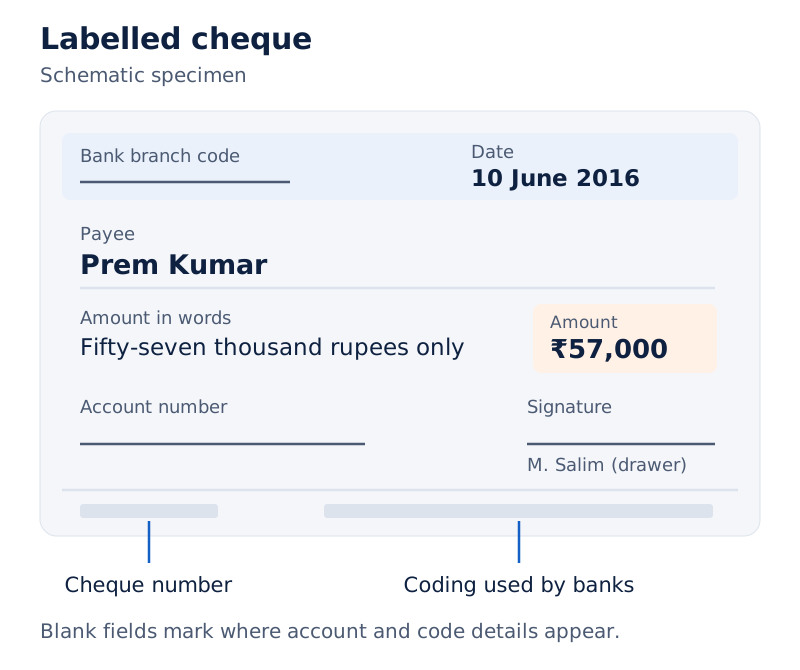
The specimen shows the payee, amount, date and signature. Its labels identify the account number, bank branch code, cheque number and coding used by banks.
Drawn by One Young India.
Why does a deposit count as money?
Demand deposits can be used directly for payments and withdrawn when required. This makes them part of modern money alongside currency. Banks are essential to these payments because they maintain the accounts and carry out transfers.
An ordinary cheque transfer reallocates an existing balance between customers. It does not, by itself, create a new loan. This differs from credit creation, where a bank's advance gives rise to an additional deposit and a matching borrower obligation.
Electronic banking also enables account-based transactions. Customers can use permitted services to transfer funds or pay bills electronically. A payment method should not be confused with the money it transfers: a card or instruction gives access to funds.
How do banks advance loans, and what determines their terms?
Methods of advancing credit
Credit is an arrangement in which a lender supplies money, goods or services against a promise of future payment. Bank advances can finance homes, cultivation and business activity. Their usefulness depends partly on whether repayment can be managed.
| Method | How it provides funds |
|---|---|
| Term loan | A specified sum is lent for an agreed period, with agreed repayment conditions. |
| Cash credit | A borrower can draw funds up to a sanctioned limit, commonly against security. |
| Overdraft | A bank permits an account holder to withdraw more than the account balance, up to an agreed limit. |
| Discounting a trade bill | The bank pays the holder before the bill falls due, after deducting a discount, and collects the amount at maturity. |
These are different ways of making credit available. An overdraft adds an authorised borrowing facility to an account. Discounting converts a claim payable in the future into funds available now. A loan agreement sets the borrower's repayment obligation.
Interest, security and repayment
The principal is the amount borrowed. Interest is the charge for borrowing. Collateral is an asset offered as security: if repayment fails, the lender may recover payment by selling the pledged asset under the loan conditions.
The terms of credit include the interest rate, collateral, documentation and repayment arrangements. A bank assesses these conditions before lending. The purpose of a loan alone does not tell us whether its terms are manageable for the borrower.
Megha's housing loan is ₹5 lakh, at an annual interest rate of 12 per cent, repayable over 10 years through monthly instalments. She supplies employment and salary documents. The bank retains the house papers as collateral until repayment with interest is complete.
Monthly instalments depend on the agreed method of calculating interest and repaying principal. A loan amount, annual interest rate and repayment period do not by themselves justify calculating monthly instalments using simple interest.
Credit has contrasting outcomes in other cases. Salim finances a 3,000-pair shoe order with supplier credit and an advance for 1,000 pairs, then repays after delivery. Swapna's groundnut crop fails after pest damage, and debt eventually forces her to sell part of her land.
How does access to formal credit differ?
What the figure shows
Sources of credit in rural India, 2019
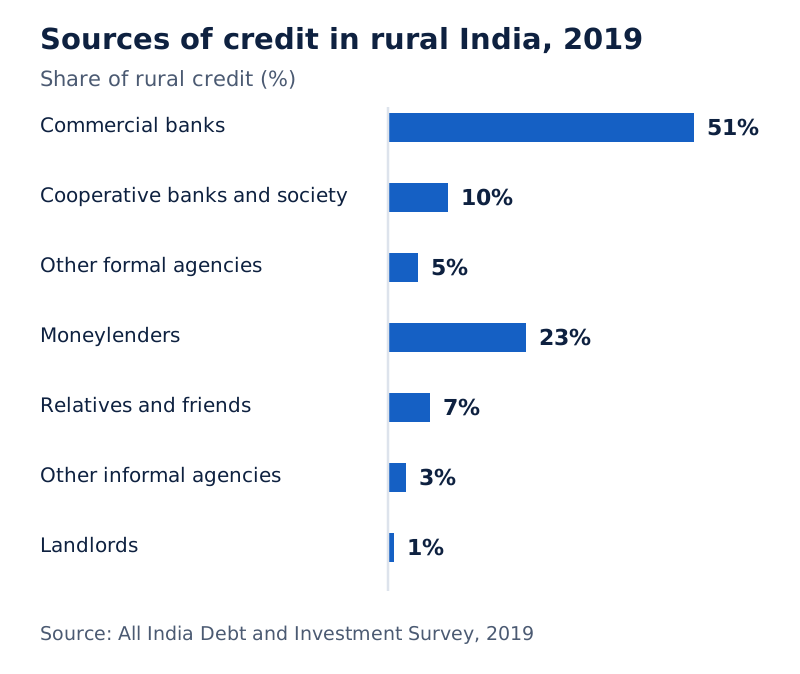
The pie chart divides rural credit among seven sources. Commercial banks account for 51 per cent, cooperative banks and society for 10 per cent, and other formal agencies for 5 per cent.
Moneylenders account for 23 per cent, relatives and friends for 7 per cent, other informal agencies for 3 per cent, and landlords for 1 per cent. Commercial banks supply the largest share; moneylenders are the largest informal source.
Drawn by One Young India.
What the figure shows
Formal and informal loans of urban households
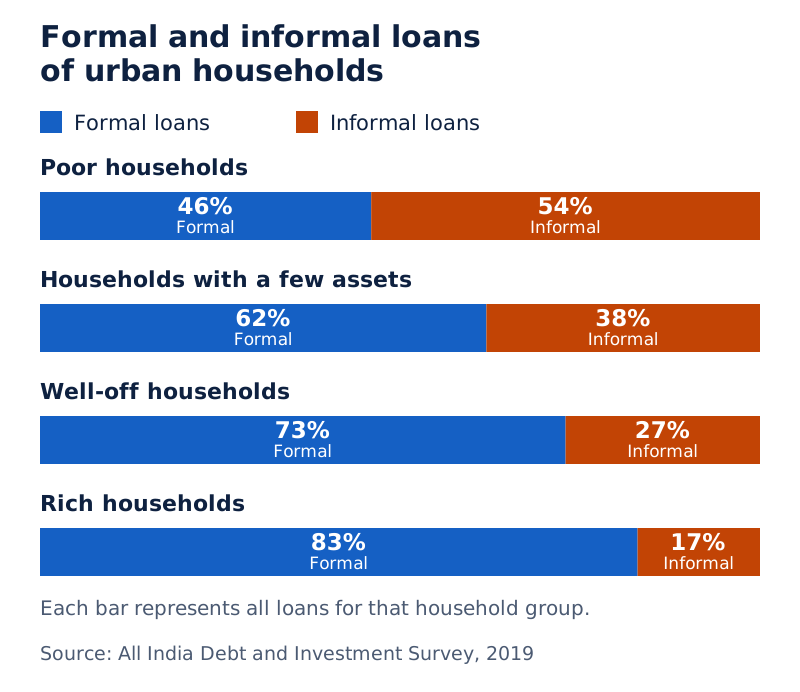
Four pie charts compare household groups. Blue represents formal loans and orange represents informal loans. For poor households, the shares are 46 per cent formal and 54 per cent informal.
Households with a few assets obtain 62 per cent formally and 38 per cent informally; well-off households obtain 73 per cent formally and 27 per cent informally. Rich households obtain 83 per cent formally and 17 per cent informally.
The formal share rises across the groups from poor to rich. Rich households have greater access to cheaper formal credit, while poor households rely more heavily on informal lenders, who generally charge higher interest.
Drawn by One Young India.
How do primary and derivative deposits create bank credit?
The distinction between the two deposits
A primary deposit arises when a customer deposits money with a bank. A derivative deposit arises through the bank's lending activity. When a loan is credited to an account, the borrower receives a spendable deposit and owes the bank a corresponding debt.
Banks can lend because depositors do not normally withdraw every balance simultaneously. They retain reserves for withdrawals and lend within the permitted limits. A bank therefore needs to balance earning interest with being able to meet its obligations.
In the goldsmith illustration, Lala holds 100 kilograms of deposited gold and has issued receipts for it. He lends 25 kilograms to Ramu, who pays Ali. When Ali redeposits that gold, receipts outstanding represent 125 kilograms, although the gold stock has not increased.
The example illustrates how claims usable as money can expand through lending and redepositing. It does not mean the goldsmith manufactures gold. Similarly, commercial bank credit creation expands deposit money rather than producing currency notes.
A simplified bank's accounts
In the following simplified model, assets consist only of reserves and loans. Reserves are funds retained to meet banking requirements; loans are amounts owed by borrowers. Deposits are liabilities because the bank owes those balances to account holders.
Assets = Reserves + Loans
Net worth = Assets − Liabilities
Net worth is the excess of assets over liabilities. These equations describe the simplified accounts used here. They do not claim that a real bank has no buildings, investments or other assets.
Worked example 2. Ms Fernandes deposits ₹100 in a fictional bank. The bank holds all ₹100 as reserves, has no loans and has deposit liabilities of ₹100. Find assets and net worth.
Answer: Assets = ₹100 + ₹0 = ₹100. Net worth = ₹100 − ₹100 = ₹0. The customer's deposit is a liability of the bank, although it is an asset from the customer's viewpoint.
A loan can therefore appear in opposite ways in two sets of accounts: it is the bank's asset and the borrower's debt. Keeping the viewpoint explicit prevents confusing depositors' ownership claims with money belonging freely to the bank.
What limits credit creation, and how does the reserve example work?
Reserves constrain lending
The required reserve ratio is the proportion of deposits that must be retained as reserves in the simplified model. A higher ratio leaves less scope for credit creation from a given initial reserve amount. Banks cannot expand deposits without regard to reserve requirements.
Assume there is one bank, no currency remains outside it, every loan returns as a deposit, and the bank lends all funds available beyond required reserves. These assumptions allow the model to show the potential expansion of deposits clearly.
Let r mean the required reserve ratio expressed as a decimal, R the available reserves, and D total deposits supported at the limit. Let m denote the deposit multiplier. All monetary amounts use the same currency unit.
Required reserves = r × Deposits
m = 1 ÷ r
D = R ÷ r
Following the lending rounds
Worked example 3. Leela deposits ₹100. The required reserve ratio is 20 per cent, or 0.20. All loan funds return to the same bank as deposits. Find the first loan, the next loan and the final deposit total under the model's assumptions.
Answer: The first required reserve is 0.20 × ₹100 = ₹20, leaving ₹80 to lend to Jaspal Kaur. Deposits become ₹180. Required reserves become 0.20 × ₹180 = ₹36, leaving ₹100 − ₹36 = ₹64 for the next loan to Junaid.
Answer: The multiplier is 1 ÷ 0.20 = 5. Final deposits are ₹100 ÷ 0.20 = ₹500. Of these, ₹100 are the original deposit and ₹400 are additional deposits created through lending. The final reserves remain ₹100.
| Position | Total deposits | Required reserves | Lending position |
|---|---|---|---|
| Before the first advance | ₹100 | ₹20 | ₹80 available for the first loan |
| After the first loan returns as a deposit | ₹180 | ₹36 | ₹64 available for the next loan |
| At the final limit | ₹500 | ₹100 | ₹400 in total outstanding loans |
The final ₹400 is cumulative lending, not another loan made after deposits reach ₹500. This distinction matters because the full ₹100 reserve is already required at that point. No further expansion is possible under these assumptions.
Worked example 4. Keep reserves at ₹100 and the same no-cash-leakage assumptions, but raise the required reserve ratio to 25 per cent, or 0.25. Find supported deposits and total loans.
Answer: The multiplier becomes 1 ÷ 0.25 = 4. Supported deposits are ₹100 ÷ 0.25 = ₹400. Total loans are ₹400 − ₹100 = ₹300. A higher reserve ratio reduces the lending capacity supported by the same reserves.
These reserve percentages are assumptions for explanation, not statements of the currently prescribed rates. Actual lending also depends on borrowers, repayments and banks' willingness to lend; the model isolates the reserve constraint.
What is a central bank, and how does the RBI serve the economy?
The monetary authority
A central bank regulates currency and credit and stands at the centre of the banking system. India's central bank is the Reserve Bank of India, established in 1935. Its responsibilities concern the monetary system as a whole.
The central bank differs from a commercial bank that deals directly with depositors and borrowers in ordinary banking business. Both are connected with money, but their principal functions and relationships are different.
| Central bank function | What it means |
|---|---|
| Monopoly of banknote issue | Has the sole right to issue banknotes; ordinary commercial banks cannot issue them. |
| Bankers' bank | Holds bank reserves and provides support to the banking system. |
| Government's banker, agent and adviser | Conducts government banking business, acts on its behalf and advises on financial matters. |
| Custodian of foreign exchange | Holds and manages the country's foreign exchange reserves. |
| Lender of last resort | Provides assistance to banks when other sources of funds are unavailable. |
Understanding the relationships
As bankers' bank, the RBI holds reserves of commercial banks. Just as an individual holds a deposit with a commercial bank, that bank can hold funds with the central bank. This links ordinary banking with central monetary control.
As the government's banker, it handles government accounts and payments. Its agency role includes acting for the government in financial operations. Advice concerns monetary and financial matters; these roles should not be confused with making every government spending decision.
As custodian of foreign exchange reserves, the RBI holds reserves used in the country's external monetary dealings. Foreign exchange concerns currencies of other countries. This responsibility differs from keeping the ordinary domestic savings deposits of individual customers.
The lender-of-last-resort function provides a source of support when banks cannot obtain needed funds elsewhere. It helps sustain confidence in the banking system. It does not remove the need for commercial banks to maintain reserves and assess their lending responsibly.
How do quantitative credit controls influence bank lending?
Controlling the overall volume of credit
Monetary policy uses central bank measures to influence money and credit. Quantitative controls act on their overall volume, rather than directing lending towards or away from a particular use. The main controls here are bank rate, open market operations and reserve requirements.
The bank rate is the rate at which the central bank lends to commercial banks. Raising it makes borrowing from the central bank more costly and tends to restrain bank lending. Lowering it tends to encourage credit expansion.
Open market operations involve the central bank buying or selling government securities. A security represents a financial claim. When the RBI buys securities, its payments add funds to the banking system. When it sells securities, buyers' payments withdraw funds.
Reserve requirements
The Cash Reserve Ratio (CRR) requires banks to maintain a prescribed cash balance with the central bank relative to the specified deposit liabilities. Increasing this requirement absorbs more funds into compulsory reserves and reduces lending capacity, other things remaining the same.
The Statutory Liquidity Ratio (SLR) requires a prescribed proportion of liabilities to be maintained in eligible liquid assets, such as cash, gold and approved securities. These assets remain with the bank, unlike the cash reserve maintained with the RBI.
| Measure | Action tending to restrict credit | Action tending to expand credit |
|---|---|---|
| Bank rate | Raise the rate. | Lower the rate. |
| Open market operations | Sell government securities. | Buy government securities. |
| CRR | Increase the required cash reserve proportion. | Reduce the required cash reserve proportion. |
| SLR | Increase the required liquid asset proportion. | Reduce the required liquid asset proportion. |
- The central bank changes a rate, conducts a securities transaction or changes a reserve requirement.
- The cost or availability of funds for commercial banks changes.
- Banks adjust the credit they are willing and able to provide.
- Deposits and the supply of money respond through the lending process.
The direction of the central bank's transaction matters. A purchase by the RBI injects funds, even though it is a sale from the seller's viewpoint. Always identify whose action is being described before explaining its effect.
How do qualitative controls differ from quantitative controls?
Selecting the direction and conditions of credit
Qualitative credit controls influence the allocation or conditions of lending. Their focus is on particular uses or categories of credit. Quantitative controls chiefly influence the overall amount of credit through rates, reserves and securities operations.
Margin requirements determine the gap between the value of the security offered and the loan permitted against it. A larger required margin means a smaller loan against the same collateral value. A smaller margin permits a larger loan, subject to other lending conditions.
A margin is not the same as an interest rate. Interest concerns the cost of borrowing over time. The margin concerns how much of the collateral's value can be financed through the advance.
Rationing and persuasion
Credit rationing restricts the amount of credit available to particular borrowers or uses. By fixing limits, the central bank can discourage excessive lending in selected directions. This concerns access to credit, rather than a uniform change in the cost of every loan.
Moral suasion means persuasion by the central bank. It uses advice, requests or appeals to encourage commercial banks to follow a desired lending policy. Its immediate method is persuasion rather than a compulsory reserve calculation.
| Control | Immediate focus |
|---|---|
| Margin requirement | The permitted loan relative to the value of collateral. |
| Credit rationing | Limits on lending for selected borrowers or uses. |
| Moral suasion | Banks' voluntary cooperation with the central bank's guidance. |
The distinction can be tested by asking what changes first. A higher cash reserve requirement changes funds available for the banking system's lending. A higher margin on selected secured advances changes the amount that can be borrowed against those particular securities.
Both groups of controls influence credit, and their effects can interact. Calling a measure qualitative does not imply that it has no effect on the quantity of lending. The classification identifies its main method and target.
What is demonetisation, and how is it connected with banking?
Withdrawal of legal tender status
Demonetisation is the withdrawal of the legal tender status of specified currency. The affected notes cease to perform their previous legal role, subject to the transition arrangements. Demonetisation is therefore different from an ordinary transfer between bank accounts.
In November 2016, India's old ₹500 and ₹1,000 notes were demonetised. Replacement currency included new ₹500 and ₹2,000 notes. These denominations describe that historical exercise, rather than the present status of every note issued during it.
The stated aims included addressing black money, corruption, counterfeit currency and financing of terrorism. These are policy objectives. Naming an objective does not establish that it was fully achieved or that the policy had no costs.
Effects on transactions and deposits
People brought affected currency into banks under the announced arrangements. Depositing money shifted funds towards bank accounts and the formal financial system. Bank deposits could then support transactions through cheques, account transfers and other payment facilities.
The shortage of usable currency disrupted economic activity and produced queues outside banks and automated teller machines. People who relied on cash faced difficulties making ordinary payments while replacement currency was being supplied.
The episode also encouraged greater use of electronic payments. Digital payments move funds through banking and payment systems without requiring a cash handover for each transaction. They illustrate how payments can continue through deposits even when physical currency is less convenient.
A balanced explanation distinguishes the change in legal status, the intended objectives and the observed disruption to cash transactions. It also separates currency from deposits: changing the legal status of specified notes does not make all bank balances invalid.
Money and banking are thus closely connected. Currency provides one means of payment, demand deposits provide another, commercial banks organise lending and transfers, and the central bank influences the overall monetary conditions in which these activities take place.
Glossary
- Money — A generally accepted medium through which people exchange goods and services and make payments.
- Barter — Direct exchange of goods or services for other goods or services without using money.
- Double coincidence of wants — A situation in which each participant wants exactly what the other participant offers in exchange.
- Legal tender — Money recognised by law that cannot be refused in settlement of a debt or transaction, subject to the relevant legal conditions.
- Fiat money — Money whose monetary value depends on the issuing authority rather than the value of its material.
- Demand deposit — A bank deposit repayable on demand and usable for payments through available account facilities.
- Time deposit — A deposit placed with a bank for an agreed period before its maturity.
- Collateral — An asset pledged to secure repayment of a loan if the borrower fails to repay.
- Primary deposit — A deposit created when a customer places money with a commercial bank.
- Derivative deposit — A deposit arising from a bank's lending activity, accompanied by a corresponding loan obligation.
- Credit creation — Expansion of bank deposits through lending, subject to reserves and other constraints on banks.
- Central bank — The monetary institution responsible for regulating currency and credit and supporting the banking system.
- Open market operations — Purchases and sales of government securities by the central bank to influence available funds.
- Moral suasion — Central bank persuasion encouraging commercial banks to cooperate with a desired credit policy.
- Demonetisation — Withdrawal of the legal tender status of specified currency under announced transition arrangements.
Common errors and misconceptions
- Misconception: Barter requires only that both parties possess useful goods. Correct: Their wants must also coincide: each must want the particular good that the other is offering.
- Misconception: Money consists only of notes and coins. Correct: Demand deposits also form part of money because they can support payments through bank transfers and cheque facilities.
- Misconception: A cheque is legal tender because it transfers money. Correct: It is an instruction to a bank, and a recipient can decline cheque payment.
- Misconception: A deposit belongs to the bank without any repayment obligation. Correct: The deposit is the customer's asset and the bank's liability, since the bank owes the customer that balance.
- Misconception: Credit creation means commercial banks print currency. Correct: Banks create deposit money through lending; banknote issue belongs to the monetary authority.
- Misconception: ₹400 in the final reserve example is an extra final-round loan. Correct: It is total outstanding lending once deposits reach ₹500 against ₹100 of reserves.
- Misconception: RBI purchases of securities reduce banking funds. Correct: Purchases add funds through payment to sellers; sales withdraw funds through payments received from buyers.
- Misconception: Demonetisation automatically proves that every policy objective was achieved. Correct: Its legal meaning, intended aims and economic effects are distinct matters that require separate explanation.
Exam-style questions with model answers
Q1. Define double coincidence of wants and explain why money removes its necessity. [2 marks]
- Double coincidence of wants exists when each participant wants exactly what the other offers.
- Money lets a person sell to one buyer and purchase from another seller, so the seller need not want the purchaser's original goods.
Q2. Explain any three functions of money. [3 marks]
- As a medium of exchange, money allows people to sell goods for money and use the proceeds to buy other goods, avoiding direct barter.
- As a measure of value, it expresses different prices in a common unit, making comparison possible.
- As a store of value, it allows purchasing power to be kept for future spending, although rising prices can reduce its real value.
Q3. A pencil costs ₹2 and a pen costs ₹10. Find the value of one pen in pencils and identify the money function used in making this comparison. [2 marks]
- The relative value is ₹10 divided by ₹2, so one pen has the monetary value of five pencils.
- This uses money as a measure of value or unit of account, since both prices are expressed in rupees.
Q4. Distinguish savings, current and fixed deposits, and explain why a cheque is different from a demand deposit. [4 marks]
- Savings deposits encourage individual saving and earn interest, but withdrawals are restricted in amount and in number within a given period.
- Unlike savings deposits, current deposits suit frequent receipts and payments and permit withdrawals up to the available balance at any time without prior notice.
- Unlike savings and current deposits, fixed deposits place money with the bank for an agreed period and generally offer higher interest than savings deposits.
- A demand deposit is the account holder's claim on the bank. A cheque is an instruction transferring a stated amount from that claim to a recipient; it is not itself legal tender.
Q5. Leela deposits ₹100 in a one-bank economy. The required reserve ratio is 20 per cent. No currency leaves the bank, every loan returns as a deposit, and all excess reserves are lent. Calculate the first advance, the next advance after redeposit, final deposits and total credit created. Explain the limit. [5 marks]
- The bank initially requires reserves of 20 per cent of ₹100, which is ₹20. It can therefore make a first advance of ₹80.
- When that advance returns as a deposit, total deposits become ₹180. Required reserves become ₹36, leaving ₹100 minus ₹36, or ₹64, available for the next advance.
- The deposit multiplier is one divided by the reserve ratio expressed as a decimal: 1 ÷ 0.20 = 5. Final deposits equal ₹100 multiplied by 5, or ₹500.
- Total additional deposits and outstanding loans are ₹500 minus ₹100, or ₹400.
- At ₹500 of deposits, the entire ₹100 reserve is required. Further lending would breach the model's reserve requirement, so expansion stops.
Q6. Explain five functions of the Reserve Bank of India as central bank. [5 marks]
- It has the monopoly of banknote issue, meaning the sole right to issue banknotes. Ordinary commercial banks cannot print banknotes to meet loan demands; their money creation occurs through deposits.
- It acts as bankers' bank by holding commercial bank reserves and supporting the functioning of the banking system.
- It acts as the government's banker, agent and adviser, handling government banking business, acting on its behalf in financial operations and providing financial advice.
- It is custodian of foreign exchange reserves, holding and managing reserves associated with the country's external monetary dealings.
- It acts as lender of last resort, providing support when banks cannot obtain needed funds elsewhere. This role helps maintain confidence but does not replace banks' own responsibility to manage reserves.
Q7. Explain how a higher bank rate, an RBI sale of government securities and a higher cash reserve requirement tend to restrict credit. [3 marks]
- A higher bank rate makes borrowing from the central bank more expensive for commercial banks and tends to discourage their credit expansion.
- An RBI sale of government securities withdraws funds as buyers pay for them, reducing reserves available to support bank lending.
- A higher cash reserve requirement makes banks retain a larger prescribed proportion of liabilities with the central bank. With other conditions unchanged, less is available for advances.
Q8. Explain margin requirements, credit rationing and moral suasion as qualitative controls. [3 marks]
- Margin requirements determine the gap between collateral value and the permitted advance. Raising the margin reduces borrowing against the same security.
- Credit rationing limits lending to selected borrowers or uses, influencing where credit is allocated.
- Moral suasion uses central bank advice, requests and persuasion to obtain commercial banks' cooperation with lending policy. These measures chiefly target credit conditions or direction rather than applying a uniform reserve change.
Q9. Define demonetisation. Explain the November 2016 Indian example, stating the affected old denominations, one objective and one difficulty associated with the change. [4 marks]
- Demonetisation means withdrawing the legal tender status of specified currency under announced arrangements.
- In November 2016, India's old ₹500 and ₹1,000 notes were affected. Replacement currency included new ₹500 and ₹2,000 notes.
- One stated objective was addressing black money. Other stated concerns included counterfeit currency, corruption and terrorism financing.
- A shortage of usable currency disrupted cash transactions and led to queues at banks and automated teller machines. An intended objective should be distinguished from proof of its complete achievement.
Key takeaways
- Money removes the need for double coincidence of wants by separating the sale of one commodity from the purchase of another.
- The four money functions are medium of exchange, measure of value, standard of deferred payment and store of value.
- Demand deposits support payments, while cheques instruct banks to transfer balances and do not themselves become legal tender.
- Commercial banks accept deposits, provide credit and payment services, and must balance lending with their obligations to depositors.
- Primary deposits arise from money deposited by customers; derivative deposits arise through lending and carry corresponding borrower obligations.
- Reserve requirements limit credit creation; the simple multiplier assumes redeposit of lending proceeds and no currency leakage.
- The central bank issues banknotes, serves banks and government, holds foreign exchange reserves and acts as lender of last resort.
- Quantitative controls influence overall credit, while qualitative controls target lending conditions or allocation; demonetisation changes specified currency's legal status.
Test yourself
Why might a shoe producer fail to barter shoes for wheat?
The wheat seller may not want shoes. Barter requires each party to want what the other offers.
Which money function is used when prices are stated in rupees?
Money acts as a measure of value or unit of account, allowing prices to be compared.
Why can inflation weaken money's store-of-value function?
When prices generally rise, a given sum of money buys fewer goods and services than before.
Is a customer's deposit an asset or a liability of the bank?
It is a liability of the bank, because the bank owes that amount to the customer.
With ₹100 of reserves and a 25 per cent reserve ratio, what deposits can the no-leakage model support?
It supports ₹100 divided by 0.25, or ₹400 of deposits, when all excess reserves are lent and proceeds redeposited.
What happens to funds when the RBI buys government securities?
Its payment adds funds to the banking system and tends to support an expansion of credit.
How does an increased collateral margin affect an advance?
It reduces the loan permitted against the same collateral value, other lending conditions remaining unchanged.
What is the central difference between demonetisation and a cheque transfer?
Demonetisation withdraws legal tender status from specified currency; a cheque transfer reallocates an existing bank deposit.
Try it
ICSE Class 10 Economics Study Notes: Mastering Money and Banking
Step into the shoes of an economic decision-maker to explore how banking operations and credit creation shape liquidity and trade.
1Imagine a depositor places an initial cash deposit of ₹2,000 into Bank A, and the Central Bank mandates a Cash Reserve Ratio (CRR) of 20%. According to the credit creation mechanism, what is the total credit generated across the banking system, and how is it calculated?
The text provides the exact formula: Total Credit = Initial Deposit × (1 / CRR). With a CRR of 20% (0.20), the money multiplier is 1 / 0.20 = 5. Multiplying the initial deposit of ₹2,000 by 5 yields ₹10,000 in total credit.
While Bank A keeps 20% (₹400) in reserve, it lends out the remaining 80% (₹1,600). That lent money gets deposited into other banks, continuing the lending cycle and expanding total credit rather than removing money from circulation.
The text states that commercial banks do not print currency—the RBI holds the monopoly on note issue. Banks create credit solely through the deposit and fractional lending multiplier process.
2A business owner approaches a commercial bank to secure a loan, authorize the bank to collect dividends on her behalf, and rent a safe deposit locker. How are these activities classified and monetized by the bank?
Advancing loans is a primary function, locker facilities are general utility services, and commercial banks do not issue currency notes.
According to the text, granting advances is a primary function of commercial banks, collecting dividends on behalf of customers is a secondary agency function, and the spread (the difference between higher lending rates and lower deposit rates) is the bank's primary source of profit.
Contingent functions refer to money's role in maximizing utility and distributing national income. The Central Bank acts as a lender of last resort to commercial banks during financial crises, not as a source of normal commercial profit.
You have mastered the mechanics of money and banking—from understanding how the fractional reserve system multiplies credit to categorizing the essential functions and profit models of commercial banks.