
Quadratic Equations | ISC Class 11 Maths Notes
On this page

This note covers quadratic equations, the quadratic formula, the nature of roots, relations between roots and coefficients, equations with related or common roots, quadratic functions, maximum and minimum values, and linear, quadratic and rational inequalities.
What makes an equation quadratic?
Standard form and roots
A polynomial in a variable is a sum of constant multiples of its non-negative integer powers. Its degree is the highest power with a non-zero coefficient, where a coefficient is the number multiplying a power of the variable.
Definition: A quadratic equation in the unknown x has standard form ax² + bx + c = 0. Here a, b and c are real coefficients, a ≠ 0, and c is the constant term. Real numbers are numbers represented on the number line.
The symbol ≠ means “is not equal to”. The signs > and < mean greater than and less than; ≥ and ≤ allow equality as well. The condition a ≠ 0 ensures degree two. The coefficients b or c may be zero. An equation must be simplified before its degree is decided: terms of the highest displayed power may cancel. A linear equation has degree one.
A root or solution is a value of x that makes the equation true. A zero of a polynomial is a value that makes the polynomial zero. Thus, the zeroes of ax² + bx + c are the roots of ax² + bx + c = 0.
Theorem: Fundamental Theorem of Algebra
Every non-constant polynomial with complex coefficients has a complex root. Consequently, a polynomial of degree n has n complex roots counted with multiplicity; n denotes a positive integer. Multiplicity counts how many times the corresponding factor is repeated.
A complex number has form u + iv, with real numbers u and v and imaginary unit i defined by i² = −1. Here u is the real part and v the imaginary part. When v = 0 the number is real; otherwise it is non-real.
A quadratic therefore has two roots when repeated roots are counted. It need not have two distinct real roots. Distinct means different in value; two equal roots correspond to one value occurring twice.
Worked example 1. Decide whether x(x + 1) + 8 = (x + 2)(x − 2) is quadratic.
Answer: Expanding gives x² + x + 8 = x² − 4. Cancelling x² and rearranging gives x + 12 = 0. This has degree one, so the original equation is linear, not quadratic.
How do factorisation and the quadratic formula find roots?
Factorisation rewrites an expression as a product. For a product of two real or complex numbers to equal zero, at least one factor must equal zero. This zero-product property turns a factorised quadratic equation into two linear equations.
Worked example 2. Solve 2x² − 5x + 3 = 0 by factorisation.
Answer: Split −5x into −2x − 3x. Then 2x² − 2x − 3x + 3 = 2x(x − 1) − 3(x − 1) = (2x − 3)(x − 1). Therefore 2x − 3 = 0 or x − 1 = 0, giving x = 3/2 or x = 1.
Derivation: the quadratic formula
Completing the square means rearranging a quadratic into a squared linear expression plus a constant. Let D denote the discriminant, defined by D = b² − 4ac.
The symbol √ denotes the non-negative square root of a non-negative real number. The symbol ± means take the plus and minus choices separately.
- Multiply ax² + bx + c = 0 by 4a to obtain 4a²x² + 4abx + 4ac = 0.
- Add b² − 4ac to the appropriate sides: 4a²x² + 4abx + b² = b² − 4ac.
- Recognise the square: (2ax + b)² = D. For D ≥ 0, this gives 2ax + b = ±√D.
- Subtract b and divide by 2a, which is non-zero, to obtain the two possible values of x.
x = (−b ± √D)/(2a). This formula gives the roots directly from the coefficients.
For D < 0, use ±i√(−D) in place of ±√D to obtain the complex roots. The denominator 2a divides the entire numerator. Keep brackets around negative coefficients when calculating D, especially when squaring b.
An irrational number is a real number that cannot be written as a ratio of two integers. Leave such roots in exact square-root form unless an approximation is requested.
Worked example 3. Solve 2x² − 6x + 3 = 0.
Answer: Here a = 2, b = −6 and c = 3. Hence D = (−6)² − 4 × 2 × 3 = 12. The formula gives x = (6 ± √12)/4 = (3 ± √3)/2. Both roots are real and irrational.
How does the discriminant describe the nature of the roots?
Result: the three discriminant cases
The discriminant D = b² − 4ac determines whether a quadratic with real coefficients has distinct real roots, equal real roots or non-real roots. Calculate it after writing the equation in standard form, so that all signs belong to the correct coefficients.
| Condition | Nature of roots | Root form |
|---|---|---|
| D > 0 | Two distinct real roots | (−b + √D)/(2a) and (−b − √D)/(2a) |
| D = 0 | Two equal real roots | −b/(2a), repeated twice |
| D < 0 | Two non-real complex conjugate roots | (−b + i√(−D))/(2a) and (−b − i√(−D))/(2a) |
The symbols > and < mean greater than and less than. Two complex numbers are conjugates when they have the same real part and opposite imaginary parts, as u + iv and u − iv do.
For rational coefficients, meaning coefficients expressible as ratios of integers with non-zero denominators, the real roots are rational precisely when D is a square of a rational number. If D is positive but not a rational square, both roots are irrational.
For integer coefficients this becomes the familiar perfect-square test: a non-negative perfect-square discriminant gives rational roots. The coefficient condition matters; the sign of D alone does not distinguish rational roots from irrational roots.
Worked example 4. Classify and find the roots of 3x² − 2x + 1/3 = 0.
Answer: D = (−2)² − 4 × 3 × (1/3) = 0. The roots are equal, each being −b/(2a) = 2/6 = 1/3. Thus 1/3 is a repeated real root.
Worked example 5. Find the complex roots of 2x² − 4x + 3 = 0.
Answer: D = (−4)² − 4 × 2 × 3 = −8. There are no real roots. The complex roots are (4 ± i√8)/4 = 1 ± i√2/2, which form a conjugate pair.
Note: “No real roots” does not mean “no roots”. A negative discriminant excludes real solutions while leaving two non-real complex solutions.
How are the roots related to the coefficients?
Result: sum and product of roots
Let α, pronounced alpha, and β, pronounced beta, denote the two roots of ax² + bx + c = 0, counted with repetition. Define their sum S and product P by S = α + β and P = αβ.
The factorised polynomial is a(x − α)(x − β). Expanding gives ax² − a(α + β)x + aαβ. Comparing this with ax² + bx + c identifies equal coefficients of matching powers of x.
Consequently, S = −b/a and P = c/a. These relations hold for equal roots and for non-real conjugate roots as well as for distinct real roots. They often avoid the need to calculate each root separately.
Worked example 6. Find the roots of 3x² + 5x − 2 = 0 and verify their sum and product.
Answer: 3x² + 5x − 2 = (3x − 1)(x + 2), so the roots are 1/3 and −2. Their sum is 1/3 − 2 = −5/3 = −b/a. Their product is (1/3)(−2) = −2/3 = c/a.
Identity: expressions built from the roots
An identity is an equality valid for every permitted value of its variables. Expanding the square of S gives S² = α² + 2αβ + β². Subtracting twice the product therefore gives α² + β² = S² − 2P.
Similarly, (α − β)² = S² − 4P. Substituting the coefficient relations gives S² − 4P = D/a². Thus equal roots make this squared difference zero, connecting the root relations to the discriminant test.
When P ≠ 0, neither root is zero. Combining fractions then gives 1/α + 1/β = S/P. State this restriction before using reciprocals, since the reciprocal of zero is undefined. Expansions and coefficient comparisons remain valid without choosing an order for α and β.
How do reciprocal roots and roots related by a square constrain an equation?
Reciprocal and equal roots
Two roots are reciprocal when one is the multiplicative inverse of the other: α = 1/β. Their product is then one. Since P = c/a, a quadratic has reciprocal roots precisely when c = a, with a ≠ 0.
This condition does not by itself say the roots are real. If real reciprocal roots are required, also require D ≥ 0. Keeping existence and the stated relationship separate prevents a coefficient condition from being mistaken for a complete classification.
For equal roots, α = β, so S² = 4P. Using S = −b/a and P = c/a gives b² = 4ac, equivalently D = 0. For real coefficients their common value is −b/(2a).
When one root is the square of the other
Suppose the roots can be labelled t and t², where t denotes the root being squared. Their sum and product become S = t + t² and P = t³. Use both relations together; either one alone loses part of the information.
Expanding the cube of the sum gives S³ = t³ + 3t⁴ + 3t⁵ + t⁶. Replacing t³ by P and t + t² by S yields the condition S³ = P(1 + 3S + P).
In terms of coefficients this necessary condition is −b³ = ac(a − 3b + c). It is obtained by multiplying the preceding equality by a³. Treat it as a way to generate candidate coefficient values, then verify the original relationship.
For verification, solve t² + t = S and retain values satisfying t³ = P. Their pairs t, t² must be roots of the original equation. If real roots are stipulated, retain real t and check the discriminant condition as well.
Note: A relationship such as “one root is the square of the other” permits relabelling the roots. Do not assume that an arbitrary first root must be the one that is squared.
How do we form equations with given or transformed roots?
Building an equation from its roots
For roots α and β, begin with (x − α)(x − β) = 0. Expansion produces x² − Sx + P = 0, where S and P are their sum and product. This is a monic quadratic, meaning its leading coefficient is one.
Multiplication by any non-zero constant produces an equivalent equation with the same roots. Multiplication by zero would erase the equation, so it is excluded. The roots determine an equation up to a non-zero constant multiple.
Worked example 7. Form a quadratic equation whose roots have sum −3 and product 2.
Answer: Insert S = −3 and P = 2 into x² − Sx + P = 0. This gives x² + 3x + 2 = 0. Its factorisation is (x + 1)(x + 2) = 0, confirming the required sum and product.
Transforming both roots
To form an equation with new roots, calculate the sum and product of those new roots first. Let y be the unknown in the new equation. Using a new variable keeps the original roots separate from the transformed values.
| New roots | New sum | New product |
|---|---|---|
| α² and β² | S² − 2P | P² |
| α³ and β³ | S³ − 3PS | P³ |
| 1/α and 1/β, with P ≠ 0 | S/P | 1/P |
The cube-sum identity follows by expanding (α + β)³ and subtracting 3αβ(α + β). Thus the equation with roots α³ and β³ is y² − (S³ − 3PS)y + P³ = 0.
The reciprocal-root equation is y² − (S/P)y + 1/P = 0. Replacing S and P by their coefficient expressions and clearing the denominator gives cy² + by + a = 0, provided c ≠ 0.
Transformed roots can coincide even when original roots differ. The sum-and-product construction still works because it retains repeated roots. There is no need to expand radical expressions individually when the required symmetric combinations already follow from S and P.
How can an equation be reduced to quadratic form?
Simplification and substitution
An equation is reducible to quadratic form if simplification or a substitution converts it into a quadratic equation. First expand brackets and collect like terms. A displayed cubic power, meaning a third power, may cancel between the two sides.
Worked example 8. Reduce (x + 2)³ = x³ − 4 to quadratic form and solve it.
Answer: Expansion gives x³ + 6x² + 12x + 8 = x³ − 4. Hence 6x² + 12x + 12 = 0, or x² + 2x + 2 = 0. Its discriminant is −4, so the complex roots are x = −1 ± i.
A substitution introduces a new variable for a repeated expression. For real constants A, B and C with A ≠ 0, consider Ax⁴ + Bx² + C = 0. Setting t = x² gives At² + Bt + C = 0.
Solve for t first, then solve x² = t for each result. If only real x are wanted, retain t ≥ 0. A positive t gives x = ±√t, while t = 0 gives x = 0. Negative t gives no real x.
Keeping the original restrictions
The domain of an expression is the set of permitted input values. An expression involving division excludes values that make its denominator zero. Record such restrictions before clearing fractions, and test candidate answers in the original equation.
For an equation containing a square root, isolating the radical and squaring can produce extra candidate solutions. Squaring makes opposite quantities equal after they are squared, even when they were unequal before that step.
Use a complete sequence: state the domain, make the substitution, solve the quadratic, reverse the substitution, and verify the results. The roots of the auxiliary quadratic are intermediate values; they are not automatically the answers for the original variable.
How do we identify a common root of two quadratic equations?
Eliminating the quadratic term
A common root is a number that satisfies both equations. Consider ax² + bx + c = 0 and px² + qx + r = 0, where p, q and r are real coefficients of the second equation and both a and p are non-zero.
Let t denote a possible common root. Then at² + bt + c = 0 and pt² + qt + r = 0. Multiply the first equation by p and the second by a, then subtract to eliminate t².
The resulting equation is (pb − aq)t + pc − ar = 0. If pb − aq ≠ 0, this determines the only possible common root: t = (ar − pc)/(pb − aq).
- Check that the two given equations remain quadratic for the coefficient values under consideration.
- Eliminate the quadratic term and solve the resulting linear equation, provided its coefficient is non-zero.
- Substitute the candidate into an original quadratic to obtain any required condition on the coefficients.
- Check the candidate in both equations, rather than treating the eliminated equation as sufficient evidence.
Exceptional cases
If pb − aq = 0 but pc − ar ≠ 0, subtraction gives a non-zero constant equal to zero. There can be no common root. Dividing by pb − aq in this case would be invalid.
If both pb − aq and pc − ar are zero, the corresponding coefficients are proportional. Since a and p are non-zero, one equation is a non-zero multiple of the other. Both equations then have the same roots, including any repeated root.
These alternatives explain why elimination requires a separate denominator check. A necessary equation for a common root can either identify a candidate, contradict its existence, or hold identically. Each outcome needs its own conclusion.
What do quadratic graphs show about roots and extreme values?
The parabola and its intercepts
A quadratic function assigns each real input x the output f(x) = ax² + bx + c. The notation f(x) means the function value at x. Its graph consists of points (x, y), with horizontal coordinate x and vertical coordinate y = f(x).
The graph is a parabola, a curve opening upwards when a > 0 and downwards when a < 0. Its intersections with the horizontal x-axis have y = 0, so their x-coordinates are real roots of the corresponding equation.
What the figure shows
Quadratic zeroes
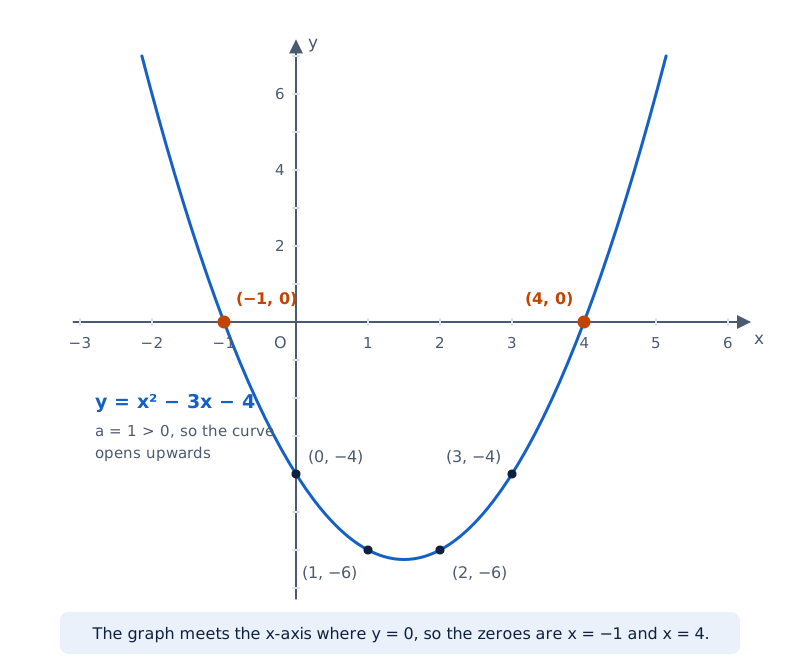
The upward-opening graph of y = x² − 3x − 4 crosses the horizontal axis at (−1, 0) and (4, 0). The labelled points include (0, −4), (1, −6), (2, −6) and (3, −4).
Drawn by One Young India.
The y-intercept is the point where the graph meets the vertical axis. Substituting x = 0 gives (0, c). This is different from the x-intercepts, which require solving f(x) = 0.
Result: vertex and maximum or minimum
The vertex is the turning point of the parabola. Completing the square gives f(x) = a(x + b/(2a))² − D/(4a). Thus the vertex has coordinates (−b/(2a), −D/(4a)).
If a > 0, the squared term contributes a non-negative amount, so the minimum value is −D/(4a). If a < 0, it contributes a non-positive amount, so the maximum value is −D/(4a). Both occur at x = −b/(2a).
The line x = −b/(2a) is the axis of symmetry: points equally far to its left and right have equal function values. These extrema concern the function over all real inputs; a restricted domain needs its own check.
What the figure shows
Two real roots and a repeated root
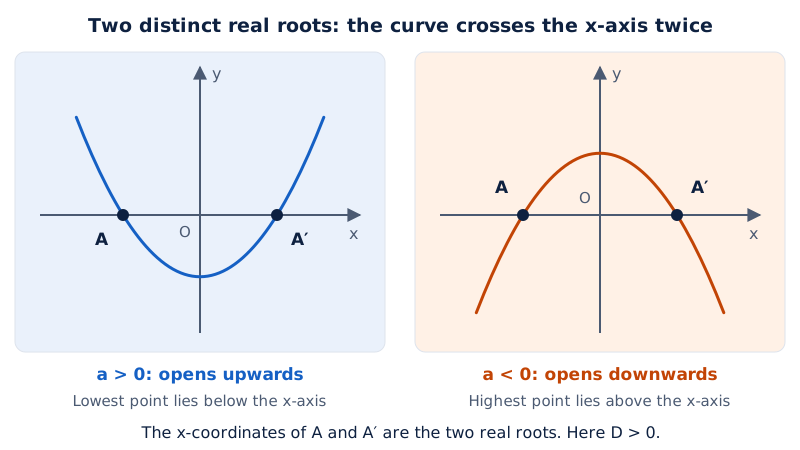
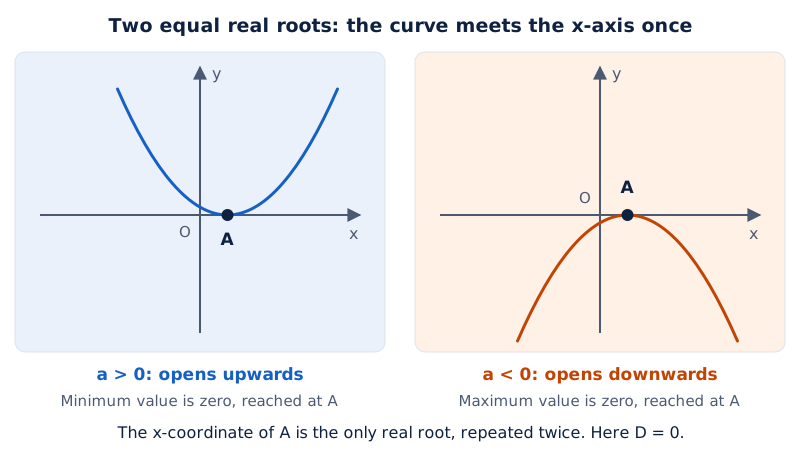
Figure 2.3 shows upward- and downward-opening parabolas crossing the x-axis twice at points labelled A and A′. Figure 2.4 shows each opening direction meeting the axis at a single point A.
Drawn by One Young India.
How is the sign of a quadratic determined?
Distinct real roots
The sign of a quadratic describes whether its value is positive, zero or negative for particular real inputs. With distinct real roots labelled so that α < β, write f(x) = a(x − α)(x − β).
For x < α, both bracketed factors are negative, so their product is positive. For α < x < β, the factors have opposite signs, so their product is negative. For x > β, both factors are positive.
Multiplication by a supplies the final sign. A positive leading coefficient preserves these product signs; a negative leading coefficient reverses them. At either root the value is zero, so endpoints must be handled separately.
| Position of x | Sign when a > 0 | Sign when a < 0 |
|---|---|---|
| x < α | Positive | Negative |
| α < x < β | Negative | Positive |
| x > β | Positive | Negative |
| x = α or x = β | Zero | Zero |
Equal roots and non-real roots
When D = 0, f(x) = a(x − α)². Away from α its sign is the sign of a; at α its value is zero. There is no change of sign across a repeated root because the squared factor is positive on both sides.
When D < 0, the function has no real zero and has the sign of a for every real x. This also follows from f(x) = a[(x + b/(2a))² + (−D)/(4a²)], whose bracket is strictly positive.
Therefore f(x) is strictly positive for every real x exactly when a > 0 and D < 0. Strict negativity everywhere requires a < 0 and D < 0. Allowing equality changes these discriminant conditions to D ≤ 0, where ≤ means less than or equal to.
How does the method of intervals solve quadratic inequalities?
Intervals and boundary points
An inequality compares expressions using <, >, ≤ or ≥. Strict inequalities use < or > and exclude equality. Non-strict inequalities use ≤ or ≥ and allow equality. A solution set contains every permitted value that makes the comparison true.
An interval is an unbroken set of real numbers. Parentheses exclude finite endpoints, while square brackets include them. The symbol ∞ means infinity, indicating no finite bound, and takes a parenthesis. The symbol ∪ joins sets by taking their union.
The method of intervals separates the number line at real roots and examines the sign on each resulting interval. First bring every term to one side. Factor if possible, then use the factor signs and include zeroes only when equality is permitted.
Worked example 9. Solve x² + x − 6 ≥ 0 for real x.
Answer: x² + x − 6 = (x + 3)(x − 2), so the boundary values are −3 and 2. The product is positive for x < −3 and x > 2, negative between them, and zero at both boundaries. The solution is (−∞, −3] ∪ [2, ∞).
For that inequality, a number-line representation uses filled points at −3 and 2 and shaded rays extending outwards. Filled points include the endpoints. Hollow points would be required if the same comparison were strict.
Repeated factors
Worked example 10. Solve x² − 6x + 9 ≥ 0 for real x.
Answer: x² − 6x + 9 = (x − 3)². A real square is non-negative, so every real x satisfies the inequality, including x = 3 where equality holds. The solution is (−∞, ∞).
Do not alternate signs mechanically at every boundary. A repeated factor of even multiplicity does not change sign as its root is crossed. Examine the factor itself, or test the product on each interval, to distinguish repeated roots from simple roots.
When a quadratic has no real roots, there are no real boundary points to insert. Its sign is constant and follows the leading coefficient, so the inequality either holds for all real inputs or for none.
How should linear and rational inequalities be handled?
Linear inequalities and the direction of comparison
A linear inequality has degree one after simplification. Adding or subtracting the same quantity on both sides preserves its direction. Multiplying or dividing both sides by a positive number also preserves the direction; using a negative number reverses it.
Worked example 11. Solve 4x + 3 < 6x + 7 for real x.
Answer: Subtract 6x and 3 from both sides to obtain −2x < 4. Division by −2 reverses the inequality, giving x > −2. The solution interval is (−2, ∞), excluding the endpoint −2.
On a number line, this solution has a hollow point at −2 and a shaded ray to the right. Stating the domain matters: asking for integer solutions would retain only integers from that ray, rather than every real number in the interval.
Rational expressions and excluded values
A rational expression is a quotient of polynomials. Write a rational inequality as F(x)/G(x) ≤ k, where F and G denote real polynomials, G(x) is non-zero at permitted inputs, and k is a real constant.
Bring the comparison to zero: [F(x) − kG(x)]/G(x) ≤ 0. The real zeroes of the numerator and denominator divide the number line into intervals. Numerator zeroes can satisfy a non-strict inequality; denominator zeroes are excluded from its domain.
- Record every real value at which the original denominator vanishes.
- Combine terms into one quotient and factor its numerator and denominator where possible.
- Arrange the real critical values, meaning numerator or denominator zeroes, in increasing order and determine the sign between them.
- Select intervals of the required sign, including permitted numerator zeroes for a non-strict comparison and excluding all original denominator zeroes.
Multiplication by G(x) without knowing its sign is unsafe: the comparison reverses on intervals where G(x) is negative. An alternative is multiplication by G(x)², which is positive throughout the domain, giving [F(x) − kG(x)]G(x) ≤ 0 with G(x) ≠ 0.
Note: Cancelling a common factor can simplify the quotient, but it does not restore an input excluded by the original denominator. Keep those exclusions in the final solution set.
Glossary
- Quadratic equation — An equation that has degree two after simplification and has a non-zero leading coefficient.
- Root — A value of the unknown that makes the given equation true on substitution.
- Discriminant — The expression b² − 4ac, which classifies the roots of a quadratic with real coefficients.
- Multiplicity — The number of times a root occurs through repetition of its corresponding factor.
- Rational number — A number expressible as a ratio of two integers with a non-zero denominator.
- Irrational number — A real number that cannot be expressed as a ratio of two integers.
- Complex conjugates — Two complex numbers with equal real parts and imaginary parts that are negatives of one another.
- Reciprocal roots — Two non-zero roots whose product equals one, each being the other's multiplicative inverse.
- Common root — A value that satisfies each of two given polynomial equations when substituted.
- Monic quadratic — A quadratic polynomial or equation whose coefficient of the squared variable is one.
- Vertex — The turning point of a parabola, where its maximum or minimum value occurs.
- Domain — The set of input values for which an expression or function is defined.
- Method of intervals — A method that divides the number line at critical values and examines signs between them.
- Rational expression — A quotient of polynomials, defined only where its denominator does not equal zero.
Common errors and misconceptions
- Misconception: Any equation displaying x² is quadratic. Correct: Expand and collect terms first. Quadratic terms can cancel, leaving a linear equation.
- Misconception: A negative discriminant means there are no solutions. Correct: It means no real roots; there are two non-real conjugate roots.
- Misconception: A positive discriminant guarantees rational roots. Correct: For rational coefficients, also check whether the discriminant is a square of a rational number.
- Misconception: The sum of the roots is b/a. Correct: The sum is −b/a; the product is c/a, including the coefficient signs.
- Misconception: Eliminating x² proves the resulting value is a common root. Correct: Elimination gives a candidate, which must satisfy both original equations.
- Misconception: Every root makes the quadratic change sign. Correct: A repeated root of a quadratic gives zero without a sign change across it.
- Misconception: An inequality keeps its direction when divided by a negative number. Correct: Reverse the direction, including the corresponding non-strict symbol.
- Misconception: A cancelled denominator factor permits its zero in the final answer. Correct: The original expression remains undefined there, so exclude it.
Exam-style questions with model answers
Q1. Find the discriminant of 2x² − 4x + 3 = 0 and state the nature of its roots. [2 marks]
- The coefficients are a = 2, b = −4 and c = 3, so D = b² − 4ac = 16 − 24 = −8.
- Since D < 0, the equation has no real roots. Its two roots are non-real complex conjugates.
Q2. Solve 2x² − 5x + 3 = 0 by factorisation and check the sum of the roots. [3 marks]
- Split the middle term using −2 and −3, whose sum is −5 and product is 6: 2x² − 5x + 3 = 2x² − 2x − 3x + 3.
- Grouping gives 2x(x − 1) − 3(x − 1) = (2x − 3)(x − 1). Equating each factor to zero gives x = 3/2 or x = 1.
- The sum is 3/2 + 1 = 5/2. This agrees with −b/a = −(−5)/2 = 5/2 for the given equation.
Q3. Solve 2x² − 6x + 3 = 0 using the quadratic formula, and classify the roots. [4 marks]
- The equation is already in standard form, with real coefficients a = 2, b = −6 and c = 3.
- Its discriminant is D = b² − 4ac = (−6)² − 4 × 2 × 3 = 12.
- Substitution in x = (−b ± √D)/(2a) gives x = (6 ± √12)/4 = (3 ± √3)/2.
- The discriminant is positive and is not a perfect square. Since the coefficients are integers, the two roots are distinct, real and irrational.
Q4. Let α and β be the roots of ax² + bx + c = 0, where a, b and c are real and a ≠ 0. Derive an equation in y whose roots are α³ and β³. [5 marks]
- Define S as the sum α + β and P as the product αβ. Comparing coefficients in a(x − α)(x − β) gives S = −b/a and P = c/a.
- Expand the cube of the sum: S³ = α³ + β³ + 3αβ(α + β). Therefore the sum of the required roots is α³ + β³ = S³ − 3PS.
- The product of the required roots is α³β³ = (αβ)³ = P³. This calculation remains valid when the original roots coincide.
- An equation with the required sum and product is y² − (S³ − 3PS)y + P³ = 0.
- Substituting the coefficient expressions and multiplying by non-zero a³ gives a³y² + (b³ − 3abc)y + c³ = 0.
Q5. For real coefficients a, b and c with a ≠ 0, let f(x) = ax² + bx + c and D = b² − 4ac. Complete the square to find its extreme value over real x, stating when it is a maximum or a minimum. [5 marks]
- Factor a from the variable terms to obtain f(x) = a[x² + (b/a)x] + c. This is valid because the leading coefficient is non-zero.
- Add and subtract b²/(4a²) inside the brackets. The expression becomes f(x) = a(x + b/(2a))² + c − b²/(4a).
- Since D = b² − 4ac, the constant remainder is −D/(4a). Thus f(x) = a(x + b/(2a))² − D/(4a).
- For a > 0, the squared contribution is non-negative. The minimum value is −D/(4a), attained when x = −b/(2a).
- For a < 0, the squared contribution is non-positive. The maximum value is −D/(4a), attained at the same input x = −b/(2a).
Q6. Solve x² + x − 6 ≥ 0 for real x by the method of intervals. State which endpoints are included. [4 marks]
- Factor the quadratic as x² + x − 6 = (x + 3)(x − 2). The real roots −3 and 2 divide the number line into three open intervals.
- For x < −3 both factors are negative; for x > 2 both are positive. The product is positive on both outer intervals.
- Between −3 and 2 the factors have opposite signs, so the product is negative and these values do not satisfy the inequality.
- At −3 and 2 the product is zero, which is allowed. The solution is (−∞, −3] ∪ [2, ∞), with both finite endpoints included.
Q7. Solve 4x + 3 < 6x + 7 for real x. Give interval notation and describe its number-line representation. [3 marks]
- Subtract 6x and 3 from both sides of the inequality. This preserves the direction and gives −2x < 4.
- Divide both sides by −2. Because this divisor is negative, reverse the comparison to obtain x > −2.
- The solution interval is (−2, ∞). On a number line, draw a hollow point at −2 and shade the ray to the right; the endpoint is excluded because the inequality is strict.
Q8. Consider ax² + bx + c = 0 and px² + qx + r = 0, where all coefficients are real and a and p are non-zero. Derive the common-root candidate when pb − aq ≠ 0, explain how to verify it, and discuss pb − aq = 0. [5 marks]
- If t is a common root, it satisfies at² + bt + c = 0 and pt² + qt + r = 0 simultaneously.
- Multiply the first equality by p and the second by a. Subtraction eliminates t², leaving (pb − aq)t + pc − ar = 0.
- When pb − aq ≠ 0, the only candidate is t = (ar − pc)/(pb − aq). Substitute this value into both original equations to establish whether it is actually common.
- If pb − aq = 0 but pc − ar ≠ 0, the eliminated equality is impossible. Therefore the two quadratics have no common root.
- If both differences vanish, the coefficient triples are proportional because a and p are non-zero. The equations are equivalent and have the same roots, counted with repetition.
Key takeaways
- Simplify an equation before identifying its degree, and retain the non-zero leading coefficient condition when using quadratic formulae.
- The discriminant determines whether roots are distinct real, repeated real or non-real; rationality requires an additional coefficient and square-root check.
- Root sums and products connect coefficients to roots and allow equations with transformed roots to be constructed without solving individually.
- Reciprocal roots have product one, while a square relationship requires both the sum and product conditions to be satisfied.
- A candidate common root obtained by elimination must satisfy both original equations, and a zero elimination coefficient requires separate treatment.
- The vertex occurs at x = −b/(2a); the leading coefficient determines whether its function value is a maximum or minimum.
- With distinct real roots, a quadratic has the sign of its leading coefficient outside the roots and the opposite sign between them.
- Inequality solutions require careful endpoint decisions; original denominator zeroes remain excluded even when a common factor is cancelled.
Test yourself
Why is a ≠ 0 required in ax² + bx + c = 0?
It ensures that the squared term remains present, giving degree two. It also makes division by a in the quadratic formula legitimate.
For real coefficients, what does D = 0 tell you about the roots?
The roots are equal and real. Each is −b/(2a), so there is one distinct root occurring with multiplicity two.
When rational coefficients give D > 0, what distinguishes rational from irrational roots?
The roots are rational if D is the square of a rational number; otherwise both real roots are irrational.
What coefficient condition gives reciprocal roots in ax² + bx + c = 0?
The product c/a must equal one, giving c = a. Real reciprocal roots additionally require a non-negative discriminant.
If α + β = S and αβ = P, what is α³ + β³?
It is S³ − 3PS, obtained by expanding the cube of the sum and subtracting the mixed terms.
For a < 0 and D < 0, what sign does ax² + bx + c have for real x?
It is negative for every real input. There are no real zeroes, and its sign follows the negative leading coefficient.
Why does (x − 3)² ≥ 0 include every real x?
A real square cannot be negative. It equals zero at x = 3 and is positive at every other real input.
Can a denominator zero be included when a rational inequality allows equality?
No. Equality can include a numerator zero only where the original quotient is defined; division by zero remains excluded.
Write about it
Turn a question from this chapter into a paper.
The Writing Studio has a structure guide, a rubric and citation tools for 15 formats, from essays to research papers. Drafting is free with an account. Learnacy Essential adds feedback from an AI writing coach and submission to The OYI Review.
Publication depends on review and is not guaranteed.