
Secondary Activities | CBSE Class 12 Geography Notes
On this page

Secondary activities, value addition, manufacturing, modern large-scale production, industrial location, footloose industries, classification by size, raw materials, products and ownership, cottage industries, agro-processing, high-technology industries and technopolies.
How do secondary activities add value to natural resources?
Secondary activities transform raw materials into more valuable products. They include manufacturing, processing and construction, including infrastructure. Resources from farms, forests, mines and the sea acquire greater usefulness through these activities.
What does value addition mean?
Cotton in the boll has limited use. When converted into yarn, it becomes more valuable and can be used to make clothes. Similarly, iron ore from a mine becomes useful for making machines and tools after conversion into steel.
The important connection is between a resource and its transformation. Cotton, yarn and clothes illustrate how processing changes what a material can be used for. Iron ore, steel and machinery show how manufacturing also supplies materials and equipment for further production.
Definition: Manufacturing transforms raw materials into finished goods of higher value for sale in local or distant markets.
How wide is the meaning of manufacturing?
Manufacturing literally means making by hand, but its present meaning includes machine-made goods. Its range extends from handicrafts and plastic toys to iron and steel, delicate computer components and space vehicles. It may use modern machinery or very simple production methods.
Power, specialised labour and mass production of standardised commodities are characteristic of manufacturing in factory settings. However, manufacturing also includes household production. The scale and technique of production therefore matter when describing a particular manufacturing activity.
An industry, understood as a manufacturing unit, has a geographical location, a management system and accounting records. The term is also used more broadly, as in the entertainment industry and tourism industry, whose activities are not necessarily carried out in factories.
Note: The expression manufacturing industry makes the production of goods explicit. The wider word industry is also used for activities outside factories.
What characterises modern large-scale manufacturing?
Modern large-scale manufacturing combines specialised work, mechanisation, technological innovation and a complex organisation. It produces large quantities of standardised goods through the coordinated use of workers, machinery and capital.
How do specialisation and mechanisation change production?
Under the craft method, factories make only a few pieces to order, so costs are high. In mass production, each worker repeatedly performs one task, producing large quantities of standardised parts. This involves an extreme division of labour.
Mechanisation means using gadgets to accomplish tasks. Automation is its advanced stage: the manufacturing process proceeds without the aid of human thinking during production. Automatic factories use feedback and closed-loop computer control systems.
Technological innovation relies on research and development. It helps control quality, eliminate waste and inefficiency, and combat pollution. Complex machinery and specialised work enable the production of more goods with less effort and lower costs.
Such production requires vast capital, large organisations and an executive bureaucracy. The organisational structure is therefore part of large-scale manufacturing, alongside machinery and the production techniques used inside the factory.
Why is manufacturing geographically concentrated?
Major concentrations of modern manufacturing occupy less than 10 per cent of the world's land area. The nations containing these concentrations have become centres of economic and political power. Manufacturing sites occupy much smaller areas than agriculture because their processes are more intensive.
The American corn belt comparison illustrates this contrast. An area of 2.5 sq km usually includes about four large farms. The same area could contain several large integrated factories employing thousands of workers.
| Feature | American corn belt farming example | Possible manufacturing use of the same area |
|---|---|---|
| Area | 2.5 sq km | The same 2.5 sq km |
| Production units | Usually about four large farms | Could contain several large integrated factories |
| Workers | About 10-20 workers | Could employ thousands of workers |
| Persons supported by farming | 50-100 persons | The industrial comparison concerns workers employed |
The words usually, about and could matter: this is an illustrative comparison of land-use intensity, rather than a fixed employment requirement for every farm or factory.
How do markets, raw materials and energy influence industrial location?
Industries seek to maximise profits by reducing costs. A location with lower production costs is therefore attractive. Access to markets, raw materials and energy helps explain why different industries choose different places.
Why is access to a market important?
A market consists of people who demand goods and have the purchasing power to buy them. The existence of such a market is the most important factor in industrial location. Population alone does not express the full meaning of a market.
Remote areas with few inhabitants offer small markets. Developed regions of Europe, North America, Japan and Australia provide large global markets because purchasing power is very high. Densely populated South and South-east Asia also provide large markets.
Some products reach buyers across the world. Aircraft manufacturing and the arms industry have global markets. This contrasts with industries serving smaller markets, while retaining the same basic requirement: there must be demand backed by the ability to purchase.
When does proximity to raw materials matter?
Industrial raw materials should be cheap and easy to transport. Industries using cheap, bulky and weight-losing materials are located close to their sources. Steel, sugar and cement illustrate the importance of raw-material access in location.
Perishability also matters. Agro-processing takes place close to farm produce, while dairy products are processed close to milk supplies. In these cases, the nature of the material helps explain the need for proximity to its source.
How does the need for energy affect location?
Industries using more power are located close to energy supplies. The aluminium industry is an example. Coal was earlier the main source of energy; hydroelectricity and petroleum are also important sources for many industries.
| Location factor | Reason for its importance | Example |
|---|---|---|
| Market | Demand must be supported by purchasing power | Large global markets in developed regions |
| Bulky or weight-losing materials | Access to the source influences location | Steel, sugar and cement |
| Perishable materials | Processing needs proximity to the supply | Farm produce and milk |
| Energy | Power-intensive production needs access to energy | Aluminium |
These factors operate together with labour, transport, communication, government policy and industrial linkages. A complete explanation of industrial location therefore considers their combined operation.
How do labour, transport, policy and industrial links shape location?
Labour supply is important because some forms of manufacturing still require skilled workers. Increasing mechanisation, automation and flexibility in industrial processes have reduced industry's dependence on labour. Reduced dependence does not mean that skilled labour has ceased to matter.
Why are transport and communication essential?
Efficient transport brings raw materials to factories and carries finished goods to markets. Transport costs influence the location of industrial units. Western Europe and eastern North America have highly developed transport systems that have encouraged industrial concentration.
Modern industry is inseparably connected with transport systems. Improvements in transport have contributed to integrated economic development and regional specialisation in manufacturing. These links concern both the movement of inputs and the distribution of finished products.
Communication supports the exchange and management of information. It therefore serves a different industrial need from transport, even though both are important facilities for the functioning and development of industries.
What do government policy and agglomeration contribute?
Governments adopt regional policies to promote balanced economic development. Establishing industries in particular areas is one way of pursuing that objective. Industrial location is thus influenced by public policy as well as access to resources and markets.
Agglomeration economies are benefits that industries obtain from being near a leading industry and other industries. Linkages between industries create savings. The location of one industry can therefore become relevant to the location of others.
How are footloose industries different?
Footloose industries can locate in a wide variety of places. They do not depend on a specific raw material, whether weight-losing or otherwise. They largely depend on component parts obtainable anywhere.
They produce in small quantities and employ a small labour force. They are generally not polluting. Accessibility through the road network is the important locational factor for them.
Note: Footloose does not mean unaffected by location. These industries have flexibility concerning raw materials, but accessibility by road remains important.
The distinction is between dependence on a particular raw-material source and freedom to obtain components from different places. It should not be confused with the classification of industries by size, ownership or the final use of their products.
How are industries classified, and what distinguishes cottage manufacturing?
Manufacturing industries can be classified by size, inputs or raw materials, output or products, and ownership. These classifications answer different questions about production, rather than forming a single list of mutually exclusive industries.
What the figure shows
Classification of Industries
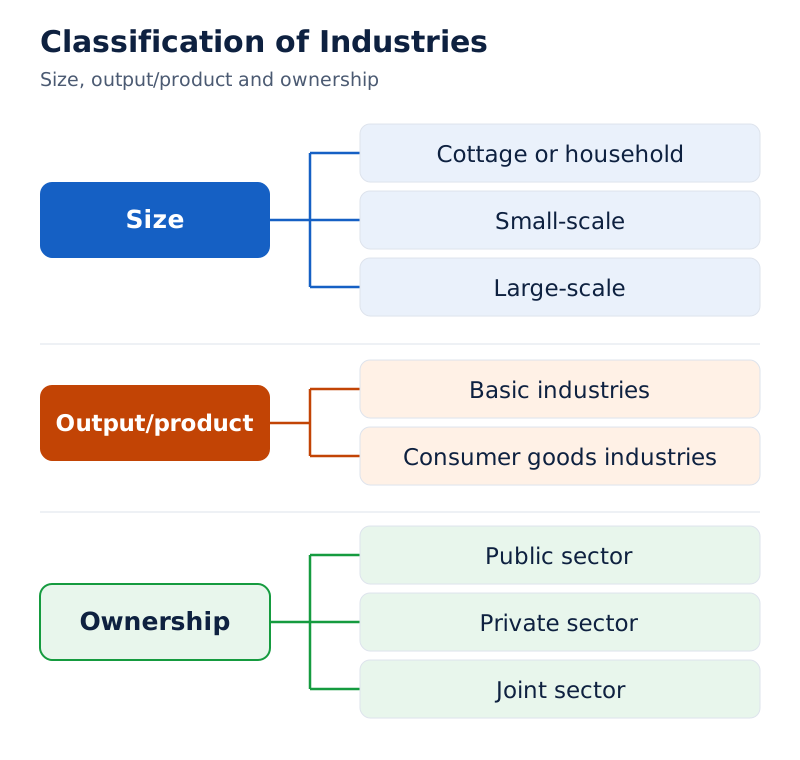
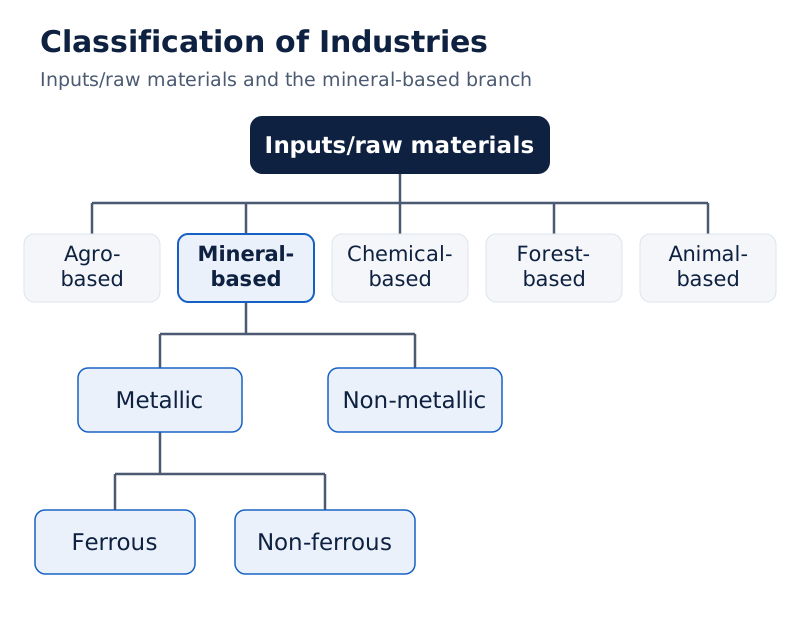
The branching chart separates size, inputs/raw materials, output/product and ownership. Size divides into cottage or household, small-scale and large-scale. Output divides into basic and consumer goods; ownership divides into public, private and joint sectors.
Drawn by One Young India. See Fig. 5.1 in your NCERT textbook
The raw-material branch contains agro-based, mineral-based, chemical-based, forest-based and animal-based industries. The mineral branch further separates metallic from non-metallic minerals, and metallic minerals into ferrous and non-ferrous categories.
What determines industrial size?
The amount of capital invested, number of workers employed and volume of production determine industrial size. On this basis, industries are grouped into household or cottage, small-scale and large-scale manufacturing.
Household or cottage manufacturing is the smallest manufacturing unit. Artisans work in their homes, using local raw materials and simple tools. Family members or part-time workers help with production.
Products may be consumed by the household, sold in local village markets or exchanged through barter. Capital and transport have relatively little influence because commercial significance is low and most tools are locally devised.
Products include foodstuffs, fabrics, mats, containers, tools, furniture, shoes, pottery and bricks. Goldsmiths make ornaments of gold, silver and bronze. Bamboo and locally available forest wood are also used for artefacts and crafts.
Case study: What do cottage-industry photographs from north-eastern India show?
Photographs: Household production and cottage goods (NCERT Class 12 Figures 5.2(a), 5.2(b) and 5.3). The photographs show a man making pots in a courtyard in Nagaland, a man weaving a bamboo basket beside a road in Arunachal Pradesh, and cottage-industry products displayed for sale in Assam.
These examples connect artisan craft work with everyday products and local selling. The pottery and basket-making photographs show individual artisans at work, while the Assam photograph shows a display of finished goods for sale.
How do small-scale and large-scale manufacturing differ?
Small-scale manufacturing differs from household production in its techniques and place of manufacture. Production takes place in a workshop outside the producer's home or cottage. It uses local raw materials, simple power-driven machines and semi-skilled labour.
Such manufacturing creates employment and increases local purchasing power. India, China, Indonesia and Brazil have developed labour-intensive small-scale manufacturing to provide work for their populations. Its importance therefore includes both production and employment.
What does large-scale manufacturing require?
Large-scale manufacturing requires a large market, varied raw materials, enormous energy supplies, specialised workers, advanced technology and large capital. Assembly-line mass production is an important part of this system.
| Feature | Small-scale manufacturing | Large-scale manufacturing |
|---|---|---|
| Raw materials | Local raw materials | Various raw materials |
| Workforce | Semi-skilled labour | Specialised workers |
| Technology | Simple power-driven machines | Advanced technology and assembly-line mass production |
| Economic role or requirement | Employment and increased local purchasing power | Large markets and large capital |
Photograph: Passenger car assembly in Japan (NCERT Class 12 Figure 5.4). The photograph shows car bodies along assembly lines inside a factory, with extensive overhead equipment and supporting structures.
How are large-scale industrial regions grouped?
Large-scale manufacturing developed during the last 200 years in the United Kingdom, north-eastern U.S.A. and Europe. It has now spread to almost all over the world.
| Aspect of large-scale manufacturing | Quantitative detail | Geographical setting |
|---|---|---|
| Land covered by major concentrations of modern manufacturing | Less than 10 per cent of the world's land area | Concentrated in a few places |
| Period of development of large-scale manufacturing | Last 200 years | United Kingdom, north-eastern U.S.A. and Europe, followed by diffusion to almost all over the world |
By their manufacturing system, the major industrial regions fall into two broad types. Traditional large-scale industrial regions are thickly clustered in a few more developed countries. High-technology large-scale industrial regions have spread to less developed countries.
This distinction concerns the system and geographical pattern of manufacturing. It complements classification by size: large-scale production itself can be associated with traditional industrial concentrations or with the diffusion of high-technology industries.
What are agro-based industries and agri-business?
Agro-based industries process raw materials from fields and farms into finished products for rural and urban markets. The connection with agriculture is through the source of the material being processed.
Which activities belong to agro-processing?
Major examples include food processing, sugar, pickles, fruit juices, beverages such as tea, coffee and cocoa, spices, oils and fats, textiles using cotton, jute and silk, and rubber. These products illustrate the range of farm materials used in manufacturing.
Food processing includes canning, cream production, fruit processing and confectionery. Drying, fermenting and pickling are preserving techniques known since ancient times. Before the Industrial Revolution, their application was limited to the demands of that period.
Processing and preserving are thus related parts of agro-processing. The raw material comes from the farm, but the manufacturing activity transforms it into a finished product intended for a rural or urban market.
How is agri-business organised?
Agri-business is commercial farming on an industrial scale. It is often financed by businesses whose main interests lie outside agriculture. Large corporations in the tea plantation business provide an example.
Agri-business farms are large, mechanised, highly structured and dependent on chemicals. They may be described as agro-factories. The term concerns the industrial organisation of commercial farming, while agro-processing concerns the conversion of farm materials into products.
Case study: What does the Nilgiri tea example show?
Photograph: Tea garden and tea factory in the Nilgiri Hills (NCERT Class 12 Figure 5.5). The photograph shows a tea garden with planted slopes in the foreground and a factory building behind them, in the Nilgiri Hills of Tamil Nadu.
The tea garden and factory bring the agricultural setting and the processing building into the same view. Tea is an agro-based beverage industry, and tea plantations also provide an example in the discussion of agri-business.
How do mineral, chemical, forest and animal materials support industries?
Classification by raw material identifies the inputs on which manufacturing depends. Alongside agro-based industries, the main categories are mineral-based, chemical-based, forest-based and animal-based industries.
How do mineral-based industries differ?
Mineral-based industries use minerals as raw materials. Ferrous metallic minerals contain iron and support industries such as iron and steel. Non-ferrous metallic minerals are used by aluminium, copper and jewellery industries.
Mineral-based production also includes industries using non-metallic minerals. Cement and pottery are examples. Therefore, mineral-based industry is a wider category than industries processing metals alone.
What raw materials do chemical industries use?
Chemical-based industries use natural chemical minerals. Petroleum, or mineral oil, supplies the petrochemical industry. Industries associated with salts, sulphur and potash also use natural minerals.
Other chemical industries use materials obtained from wood and coal. Synthetic fibres and plastics are further examples of chemical-based industries. Their classification concerns the chemical basis of production and the materials used.
| Input category | Raw material or source | Industrial use |
|---|---|---|
| Ferrous metallic minerals | Iron-bearing minerals | Iron and steel |
| Non-metallic minerals | Non-metallic mineral inputs | Cement and pottery |
| Chemical minerals | Petroleum | Petrochemicals |
| Forest products | Wood, bamboo and grass | Paper |
| Animal materials | Wool | Woollen textiles |
How do forests and animals supply manufacturing?
Forest-based industries use major and minor forest products. Timber supplies furniture-making, while wood, bamboo and grass supply paper production. Lac is another forest product used as an industrial raw material.
Photograph: Pulp mill in Alaska (NCERT Class 12 Figure 5.6). The photograph shows a mill beside water, with logs in the foreground and wooded hills behind. Its location is the timber area of Ketchikan in Alaska.
Animal-based industries obtain leather for leather products and wool for woollen textiles from animals. Ivory is obtained from elephants' tusks. These examples identify animal sources of materials within the raw-material classification.
How are industries classified by products and ownership?
Classification by output distinguishes goods that serve as inputs for further production from goods used directly by consumers. Classification by ownership instead concerns who owns and manages the industry.
What distinguishes basic and consumer goods industries?
Basic industries make products used as raw materials to manufacture other goods. Iron and steel are used to make machines and tools. Machinery for the textile industry helps connect basic production with clothes for consumers.
The connection from a mineral resource to a consumer product can be followed through these stages:
- Iron ore is obtained from mines as a raw material that requires conversion before the uses described here.
- The ore is converted into steel, which can be used to manufacture valuable machines and tools.
- Iron and steel provide material for making machinery for the textile industry, linking one industry with another.
- The textile industry produces clothes for consumers, connecting industrial inputs with goods used by people.
Consumer goods industries, also called non-basic industries, produce goods for direct consumption. Examples include bread, biscuits, tea, soaps, toiletries, writing paper and televisions. The intended use of the output is the basis of the distinction.
Who owns and manages industries?
| Ownership category | Ownership or management | Economic context |
|---|---|---|
| Public sector | Owned and managed by governments | Socialist countries have many state-owned industries |
| Private sector | Owned by individual investors and managed by private organisations | Industries in capitalist countries are generally privately owned |
| Joint sector | Managed by joint stock companies, or sometimes established and managed together by public and private sectors | Public and private participation can occur together |
Mixed economies contain both public and private enterprises. This describes the presence of both sectors in the economy, while joint-sector management concerns the arrangement for managing industries. The two expressions should therefore be distinguished.
What distinguishes high-technology industries and technopolies?
High technology, or high-tech, represents the latest generation of manufacturing activities. Its defining feature is intensive research and development leading to products of an advanced scientific and engineering character.
How do work and production differ?
Professional or white-collar workers form a large share of the workforce. These highly skilled specialists greatly outnumber the actual production workers, described as blue-collar workers. Workforce composition is therefore an important characteristic of high-tech manufacturing.
Examples include robotics on assembly lines, computer-aided design and manufacturing, electronic controls in smelting and refining, and the continuing development of new chemical and pharmaceutical products. These illustrate applications of advanced knowledge within industrial production.
High technology is therefore not simply a label for large factories. It concerns intensive research, advanced products and specialist work. The emphasis on scientific and engineering development helps distinguish it within the wider field of manufacturing.
What does the high-tech industrial landscape look like?
The landscape features neatly spaced, low, modern and dispersed office-plant-lab buildings. These contrast with massive assembly structures, factories and storage areas. The arrangement of buildings is a visible feature of this form of manufacturing.
Planned business parks for high-tech start-ups form part of regional and local development schemes. This connects the development of high-tech activities with the planning of spaces for new enterprises.
What are technopolies?
Technopolies are regionally concentrated, self-sustained and highly specialised high-tech industries. Silicon Valley near San Francisco and Silicon Forest near Seattle are examples. Regional concentration, self-sustaining activity and specialisation all belong to the concept.
Manufacturing contributes significantly to the world economy. Iron and steel, textiles, automobiles, petrochemicals and electronics are among its most important industries. High-tech production forms part of this wider manufacturing economy, alongside industries differing in size, materials, products and ownership.
Glossary
- Secondary activities — Activities that add value to natural resources through manufacturing, processing and construction, including infrastructure.
- Manufacturing — The transformation of raw materials into finished goods of higher value for local or distant markets.
- Mass production — Production of large quantities of standardised parts through workers repeatedly performing specialised tasks.
- Mechanisation — The use of gadgets that accomplish tasks within the production process.
- Automation — The advanced stage of mechanisation in which manufacturing proceeds without the aid of human thinking during production.
- Market — People who demand goods and possess the purchasing power needed to buy them from sellers.
- Agglomeration economies — Benefits and savings arising from proximity and linkages between a leading industry and other industries.
- Footloose industries — Industries able to locate widely because they do not depend on specific raw materials and largely use widely obtainable components.
- Cottage manufacturing — The smallest manufacturing unit, using local materials and simple tools in artisans' homes with family or part-time labour.
- Agro-processing — Processing raw materials from fields and farms into finished products for rural and urban markets.
- Agri-business — Commercial farming on an industrial scale, often financed by businesses with main interests outside agriculture.
- Basic industries — Industries whose products are used as raw materials for making other goods.
- Consumer goods industries — Industries producing goods consumed directly by people, also described as non-basic industries.
- High-tech industries — Manufacturing activities applying intensive research and development to products of advanced scientific and engineering character.
- Technopolies — High-tech industries that are regionally concentrated, self-sustained and highly specialised in their activities.
Common errors and misconceptions
- Misconception: Manufacturing means only making things by hand. Correct: That is its literal meaning, but manufacturing also includes goods made by machines, from simple products to advanced components.
- Misconception: A large population automatically provides purchasing power. Correct: A market requires both demand and the ability to purchase goods; purchasing power is part of its definition.
- Misconception: Mechanisation and automation are identical. Correct: Automation is the advanced stage of mechanisation, proceeding without the aid of human thinking during the manufacturing process.
- Misconception: Footloose industries have no important location requirement. Correct: They have flexibility concerning raw materials, but accessibility by road network remains important.
- Misconception: Small-scale manufacturing is simply household production. Correct: It uses a workshop outside the home, simple power-driven machinery and semi-skilled labour, distinguishing it from cottage production.
- Misconception: Mineral-based industries use metallic minerals alone. Correct: They also use non-metallic minerals, as illustrated by cement and pottery industries.
- Misconception: Mixed economies and joint-sector industries mean the same thing. Correct: Mixed economies contain public and private enterprises; joint-sector industries have the management arrangements described under joint ownership.
- Misconception: High-tech production workers outnumber professional specialists. Correct: Highly skilled white-collar specialists greatly outnumber actual blue-collar production workers in high-tech industry.
Exam-style questions with model answers
Q1. What are secondary activities? Give an example of value addition. [2 marks]
- Secondary activities add value to natural resources through manufacturing, processing and construction.
- Cotton in the boll becomes more valuable when transformed into yarn, which can be used to make clothes.
Q2. Explain three characteristics of footloose industries. [3 marks]
- Footloose industries can be located in many places because they do not depend on a specific raw material. They largely use component parts that can be obtained anywhere.
- They produce in small quantities, employ a small labour force and are generally not polluting industries.
- Accessibility through the road network is the important factor in their location, despite their flexibility concerning raw-material sources.
Q3. Explain five characteristics of modern large-scale manufacturing. [5 marks]
- Specialisation: Mass production uses workers repeatedly performing a particular task to produce large quantities of standardised parts. This differs from making a few costly, made-to-order pieces.
- Mechanisation: Gadgets perform tasks, while automation represents the advanced stage. Automatic factories use feedback and closed-loop computer control systems.
- Innovation: Research and development support quality control, the elimination of waste and inefficiency, and efforts to combat pollution.
- Organisation: Complex technology, extreme division of labour, vast capital, large organisations and executive bureaucracy support production at lower cost and with less effort.
- Concentration: Major manufacturing concentrations occupy less than 10 per cent of the world's land area. Industrial processes use space more intensively than agriculture.
Q4. Explain five factors influencing industrial location. [5 marks]
- Markets: Industries need buyers with demand and purchasing power. The existence of a market is the most important factor in location.
- Raw materials: Industries using cheap, bulky and weight-losing inputs locate near their sources. Perishable farm produce and milk also encourage nearby processing.
- Energy: Power-intensive industries, such as aluminium, locate close to energy supplies. Coal, hydroelectricity and petroleum are important industrial energy sources.
- Transport: Efficient transport moves raw materials to factories and finished goods to markets. Its costs influence location, while developed networks encourage industrial concentration.
- Agglomeration: Proximity to leading industries and other industries creates savings through their linkages. These benefits operate together with other factors when determining location.
Q5. Distinguish household, small-scale and large-scale manufacturing. [3 marks]
- Household manufacturing takes place in artisans' homes, using local raw materials and simple tools with family or part-time labour. Products may be consumed, sold locally or bartered.
- Small-scale manufacturing operates in workshops outside homes, using local materials, simple power-driven machines and semi-skilled labour.
- Large-scale manufacturing needs large markets and capital, varied raw materials, enormous energy, specialised workers, advanced technology and assembly-line mass production.
Q6. Distinguish basic industries from consumer goods industries, with examples. [3 marks]
- Basic industries make products that other industries use as raw materials. Iron and steel supply material for manufacturing machines and tools.
- The link from iron and steel to textile machinery and then to clothes shows how industrial output supports further production.
- Consumer goods industries make products used directly by consumers. Examples include bread, biscuits, tea, soaps, toiletries, writing paper and televisions.
Q7. Describe high-tech industries and explain the term technopolies. [5 marks]
- High-tech manufacturing applies intensive research and development to products of an advanced scientific and engineering character. It represents the latest generation of manufacturing activities.
- Highly skilled professional white-collar workers form a large share of employment and greatly outnumber the actual blue-collar production workers.
- Examples include assembly-line robotics, computer-aided design and manufacturing, electronic control of smelting and refining, and new chemical and pharmaceutical products.
- The landscape consists of neatly spaced, low, modern and dispersed office-plant-lab buildings. Planned business parks for start-ups are part of regional and local development schemes.
- Technopolies are regionally concentrated, self-sustained and highly specialised high-tech industries. Silicon Valley near San Francisco and Silicon Forest near Seattle are examples.
Q8. Explain the classification of industries by ownership. [3 marks]
- Public-sector industries are owned and managed by governments. Socialist countries have many state-owned industries, while mixed economies contain both public and private enterprises.
- Private-sector industries belong to individual investors and are managed by private organisations. Industries in capitalist countries are generally privately owned.
- Joint-sector industries are managed by joint stock companies, or sometimes established and managed together by public and private sectors.
Key takeaways
- Secondary activities add value to resources by transforming raw materials through manufacturing, processing and construction.
- Modern large-scale manufacturing combines specialised tasks, mechanisation, research and development, complex organisation and concentrated industrial locations.
- Industrial location reflects the combined operation of markets, materials, labour, energy, transport, communication, government policy and industrial linkages.
- Footloose industries largely use widely obtainable components, but accessibility through road networks remains important for their location.
- Size depends on invested capital, employment and production volume; cottage, small-scale and large-scale manufacturing differ in organisation and techniques.
- Raw-material classifications include agro-based, mineral-based, chemical-based, forest-based and animal-based industries, each connecting production with particular inputs.
- Basic industries supply inputs for further production, while consumer goods industries produce goods for direct consumption.
- High-tech industries rely on intensive research and skilled specialists; concentrated, self-sustained and highly specialised examples are called technopolies.
Test yourself
What makes demand into a market for manufactured goods?
People must have both demand for goods and the purchasing power to buy them.
Why are dairy products processed near milk supplies?
Milk is perishable, making proximity to the source of the raw material important for processing.
What determines the size of an industry?
The amount of capital invested, number of workers employed and volume of production determine industrial size.
How does small-scale manufacturing differ in location from cottage production?
Small-scale manufacturing takes place in a workshop outside the producer's home, while cottage production takes place at home.
Which forest materials are used in paper manufacturing?
Wood, bamboo and grass are forest materials used by the paper industry.
What are agglomeration economies?
They are benefits and savings arising from proximity and linkages between a leading industry and other industries.
What are the defining features of technopolies?
Technopolies are high-tech industries that are regionally concentrated, self-sustained and highly specialised.
Where are Silicon Valley and Silicon Forest located?
Silicon Valley is near San Francisco, while Silicon Forest is near Seattle.
Write about it
Turn a question from this chapter into a paper.
The Writing Studio has a structure guide, a rubric and citation tools for 15 formats, from essays to research papers. Drafting is free with an account. Learnacy Essential adds feedback from an AI writing coach and submission to The OYI Review.
Learnacy Essential is ₹1,499 for the year. Publication depends on review and is not guaranteed.