
The Industrial Revolution and the Rise of Imperialism | ICSE Class 8 History & Civics Notes
On this page
This note covers the Industrial Revolution, production before factories, England’s early industrial growth, major inventions, workers and urban life, imperialism, colonial trade, and the consequences for India and other colonised societies.
What was the Industrial Revolution, and what came before factories?
Definition: The Industrial Revolution was the major transformation in production associated with the growing use of machines, factories and new sources of power, beginning in Britain.
Industrialisation means the development of industrial production. It changed how goods were made, how work was organised and how producers reached their customers. The term “revolution” describes the importance of these changes; it does not mean that every industry changed suddenly.
How did production work before factories?
Proto-industrialisation was large-scale production for an international market before the factory system. In seventeenth- and eighteenth-century Europe, merchants supplied money to rural producers. Artisans, or skilled craft workers, and peasant families produced goods in their homes.
Town production was restricted by guilds, associations that controlled entry into crafts, production, competition and prices. Merchants therefore turned to the countryside. Poor peasants welcomed the additional income, especially as access to common land declined and small farms could not employ whole families.
Family production and agriculture could continue together. Merchants linked the different stages of cloth production and arranged sales. Spinning turned fibres into yarn, meaning thread; weaving made yarn into cloth. Goods could reach distant markets without being made in a factory.
What changed with the factory?
A factory brought workers and production processes together under one management. England’s earliest factories appeared by the 1730s, and their number multiplied in the late eighteenth century. Richard Arkwright’s cotton mill, a factory for processing cotton, brought expensive machines and different production processes under one roof.
Owners could supervise work, check quality and regulate labour more closely. This contrasted with production scattered among village households. However, workshops and household production continued alongside mills. Industrial history therefore includes the changing relationship between factories and smaller producers.
Why did industrialisation begin in England?
Britain became the first industrial nation through a combination of resources, trade, labour and technical change. England was its early centre of factory development. A single invention cannot explain why a whole system of production expanded.
What resources and economic conditions helped?
England had accessible coal, a fuel, and iron ore, a mineral from which iron is extracted. Coal supported steam power, while iron supplied material for machinery and transport. Navigable rivers, ports and coastal shipping helped move bulky goods.
Capital means money or resources invested in production. Merchants accumulated capital through trade. Overseas trading connections helped secure supplies and customers. A market is the arrangement through which goods are bought and sold, rather than simply a physical marketplace.
Expanding world trade and the acquisition of overseas territories increased demand for goods. Rural families already possessed manufacturing skills through household production. Peasants moving towards towns also enlarged the supply of workers, although plentiful labour could discourage industrialists, owners or investors in industrial enterprises, from buying expensive machines.
How did cotton connect these advantages?
Raw materials are inputs used to make other goods. Raw cotton fed British textile production, while inventions raised output per worker. Britain imported, or bought from abroad, 2.5 million pounds of raw cotton in 1760 and 22 million pounds in 1787. Here, pounds measure weight, not money.
The figures show increasing demand for cotton inputs; they do not directly measure the number of factories or workers. Trade supplied materials, investment paid for machinery, and machines allowed production to grow. These developments reinforced one another.
England’s early start therefore involved both material resources and human organisation. Machines needed finance, supplies, workers and buyers. Equally, the availability of workers did not guarantee secure employment or a share in the profits earned by manufacturers.
Which inventions changed production and transport?
The important inventions changed particular tasks. A machine that spun thread did not itself weave cloth, while a steam engine supplied power rather than producing a finished textile. Distinguishing these functions makes the sequence of industrial change easier to understand.
What changed in textiles?
James Hargreaves devised the Spinning Jenny in 1764. One wheel operated several spindles, rotating parts used in spinning, so a worker could spin several threads at once. The machine increased the speed of spinning and reduced labour demand.
Richard Arkwright created the cotton mill, bringing machinery and production processes together. Inventions also improved carding, the preparation of fibres before spinning. Increased output depended on improvements across the production process, as well as on the organisation of work.
What the figure shows
A Spinning Jenny
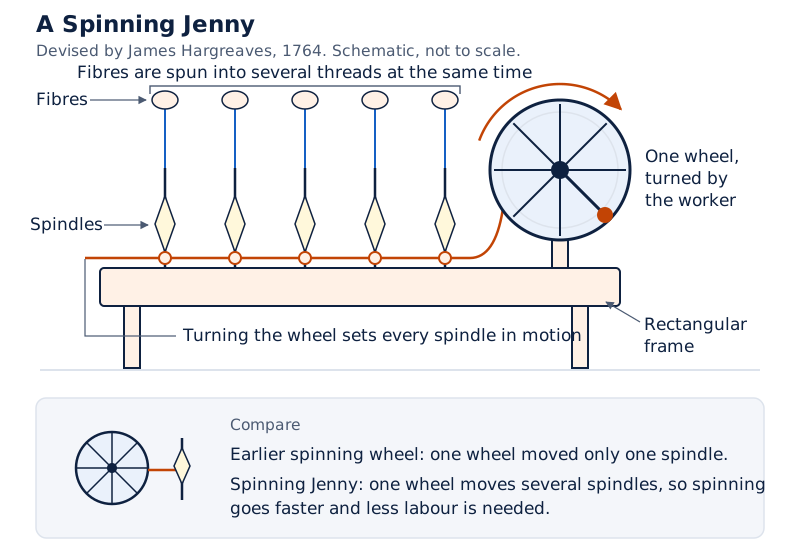
This is T.E. Nicholson’s drawing of 1835. It shows a rectangular frame, a large wheel and rows labelled “spindles”. The arrangement illustrates the operation of several spindles with one wheel.
Drawn by One Young India.
What changed in power and transport?
James Watt improved Newcomen’s steam engine and patented the new engine in 1781. A patent is a legal right protecting an invention. Mathew Boulton manufactured the improved model. Watt improved an existing engine; describing him as the inventor of every form of steam engine is inaccurate.
| Development | Main contribution |
|---|---|
| Spinning Jenny | Spun several threads at the same time. |
| Steam engine | Provided mechanical power for industrial work. |
| Railways and steamships | Helped carry people and goods across greater distances. |
| Refrigerated ships | Kept perishable food cold during long journeys. |
Refrigeration means cooling to preserve goods. Before refrigerated shipping, live animals travelling to Europe could die, lose weight or become unfit to eat. Transporting frozen meat reduced shipping costs and helped lower European meat prices.
How did factory production compare with hand production?
Mechanisation, the use of machines to perform production tasks, spread unevenly. Cotton led the first phase of British industrialisation up to the 1840s. Iron and steel then became increasingly important as railway construction raised demand for metals.
Railways expanded in England from the 1840s and in the colonies, territories under outside rule, from the 1860s. By 1873, British iron and steel exports, goods sold abroad, were worth about 77 million pounds sterling, Britain’s currency, double the value of cotton exports.
However, even at the end of the nineteenth century, less than 20 per cent of Britain’s total workforce worked in technologically advanced industrial sectors.
Why did hand labour continue?
New machines were costly, often broke down and required expensive repairs. Industrialists were cautious about buying them. The availability of inexpensive labour also reduced the attraction of machinery that required a large initial investment.
In industries where production varied with the season, industrialists usually preferred hand labour. Workers could be hired for busy periods. Demand was also often for goods with intricate designs or particular shapes, rather than identical products made in large quantities.
| Point of comparison | Hand production | Machine production |
|---|---|---|
| Product variety | Could meet demand for intricate designs and specific shapes. | Was oriented towards standardised goods for a mass market. |
| Employer’s costs | Could use abundant, inexpensive labour. | Required costly equipment and repairs. |
| Organisation | Continued in households and small workshops. | Concentrated processes and supervision in mills. |
| Demand | Upper-class British buyers valued carefully finished handmade goods. | Machine-made goods were exported to colonies. |
Note: Industrialisation did not mean the immediate disappearance of hand production. The typical mid-nineteenth-century worker was a traditional craftsperson or labourer, rather than a machine operator.
How did different social groups experience industrial change?
The same change could benefit an owner and threaten a worker. Industrialisation affected people differently according to their resources, skills and access to employment. Looking at distinct social groups, groups sharing economic or social circumstances, reveals these differences.
What did merchants and industrialists seek?
Industrialists owned or invested in industrial enterprises. They sought regular supplies, controlled costs and buyers for their products. Factory organisation made closer supervision possible. However, some employers retained hand labour because machinery was expensive or seasonal demand made permanent equipment less attractive.
In India, some merchants invested wealth earned through trade in factories. Others operated within increasingly restricted trading networks. An entrepreneur is someone who organises a business and takes its risks; industrial opportunities were shaped by access to finance and colonial controls.
What happened to workers and job-seekers?
Large numbers of rural people travelled to British towns seeking work. Friends and relatives could help them enter factories, but many lacked such connections. Some waited for weeks and spent nights under bridges or in shelters before finding employment.
Seasonal employment meant that a busy period could be followed by unemployment. Wages, payments for labour, increased somewhat in the early nineteenth century, but this did not necessarily improve welfare. Rising prices and fewer days of work could reduce what a family could afford.
How were women and artisan households affected?
Women who survived by hand spinning feared losing their work when spinning machinery entered the woollen industry. They began attacking the new machines. Their resistance reflected a threat to income and survival, rather than simply an inability to understand technical change.
In Indian weaving households, women and children worked at different stages of production. Company orders could absorb the labour of an entire family. Some weavers leased out their small plots and concentrated on weaving, increasing their dependence on the cloth trade.
What were the consequences for cities and everyday life?
Urbanisation means the growth of towns and the increasing concentration of people in them. Industrial employment attracted rural migrants, meaning people who moved from the countryside. Yet migration did not guarantee a job, adequate housing or a steady income.
What new opportunities appeared?
After the 1840s, British urban building activity expanded. Roads were widened, railway stations built, tunnels dug and drainage laid. The transport industry employed more workers, while construction created opportunities beyond work inside textile mills.
From the 1850s, railway stations appeared across London. Their construction required workers for digging, scaffolding, brickwork and ironwork. Job-seekers moved between sites, showing how industrial change also created demand for labour outside the immediate operation of machines.
Why were the gains uneven?
A wage is payment for labour. Its purchasing power means the goods it can buy. A higher wage rate did not necessarily give a worker greater purchasing power if food and other prices rose. Unemployment could reduce annual earnings despite a better daily rate.
During the prolonged Napoleonic War, rising prices significantly reduced the real value of workers’ earnings. Seasonal demand also exposed families to periods without wages. New production methods must therefore be judged alongside employment security and the cost of living.
Technology could improve consumption too. Refrigerated ships made meat cheaper in Europe. Many, though not all, poorer Europeans could add meat, butter and eggs to diets previously dominated by bread and potatoes. The qualification matters because benefits were not shared by everyone.
What was imperialism, and why did industrial powers expand overseas?
Definition: Imperialism is the extension of a state’s power over other peoples or territories through political, military or economic control.
Colonialism involves the establishment and maintenance of rule over another territory. A colony is a territory under such outside control. Imperialism is the wider policy of domination; colonial rule is one way in which it operates.
How did industrial interests encourage expansion?
Growing industries required raw materials and sought overseas markets for manufactured goods. British textile production connected imported raw cotton with cloth sold abroad. Control over trade and territory helped powerful states and companies direct these exchanges to their advantage.
European interests in Africa included land and minerals. They sought plantations and mines producing crops and minerals for export. A plantation is a large agricultural estate producing commercial crops. Access to resources also required access to workers.
Rival powers competed for territory. In 1885, major European powers met in Berlin to divide Africa between them. Britain and France enlarged their overseas territories, while Belgium and Germany became new colonial powers. These developments linked commercial interests with political domination.
How did transport support imperial expansion?
Railways and larger ships helped move goods more cheaply and quickly. Colonisation also stimulated investment and improvements in transport. The relationship worked in both directions: technology supported expansion, while colonial demands encouraged further technological development.
- Industrial growth increased demand for materials and buyers.
- Overseas trade connected producers with distant suppliers and markets.
- Colonial power helped control territories, resources and trading conditions.
- Transport investment supported the movement of export goods.
This sequence describes an important connection, not a rule that every overseas trade relationship became a colony. European trading companies exercised power in India before the full expansion of British factory production. Industrialisation strengthened older forms of overseas domination.
How did colonial control affect Indian production and trade?
India supplies a major South Asian example of the relationship between industrialisation and imperialism. Before machine industries, Indian silk and cotton goods dominated international textile markets. Colonial power then changed both the organisation of production and the conditions of sale.
How did the East India Company control weavers?
The East India Company was an English trading company that acquired political power in India. After gaining such power, it asserted a monopoly, an exclusive right to trade, and tried to remove competing traders from its cloth supply network.
It appointed a gomastha, a paid agent who supervised weavers, collected supplies and checked cloth quality. Weavers received advances, loans given before production to buy materials. Those accepting them had to supply the Company and could not sell that cloth to another trader.
Low prices and coercion, meaning pressure enforced through threats or force, restricted weavers’ independence. Many resisted, migrated or refused further loans. Company power after the 1760s did not initially reduce textile exports, because fine Indian textiles remained in demand in Europe.
What changed as British mills expanded?
British manufacturers pressed for import duties, taxes on goods entering a country, to protect their home market. They also sought sales in India. Indian weavers faced declining opportunities to sell cloth abroad and competition from cheap machine-made British cloth.
In 1811-12, piece-goods, meaning lengths of cloth, accounted for 33 per cent of India’s exports, goods sold abroad. By 1850-51, the share was no more than 3 per cent. These figures show a change in export composition, not the disappearance of all weaving.
Indian factories also developed: Bombay’s first cotton mill was established in 1854 and began production in 1856. Bengal’s first jute mill was established in 1855. Jute is a fibre used for products such as sacks. Production changed under colonial constraints, but India was not left without industrial activity.
What wider impacts did imperialism have on colonised societies?
Imperialism connected distant economies while reducing the freedom of many producers and workers. Exports are goods sold abroad, while imports are goods bought from abroad. Who controlled those exchanges affected who gained from expanding trade.
How did resources and labour serve imperial interests?
In India, raw cotton exports increased while manufactured textile exports declined. Between 1812 and 1871, raw cotton’s share of exports rose from 5 per cent to 35 per cent. This was a change in the share of exports, not a measure of total cotton production.
In west Punjab, British irrigation canals supported wheat and cotton production for export. Peasants from other parts of Punjab settled the irrigated areas. Such changes linked farming more closely with distant markets and the priorities of colonial trade.
In Africa, colonial employers sought labour for mines and plantations. Taxes payable through wage earnings, altered inheritance rules and restrictions on movement pushed people towards employment under European control. Expanded trade could therefore accompany a loss of economic independence.
What did migration mean for Indian labourers?
Indentured labour was work under a binding contract for a specified period, associated with paying for passage to a new country or home. Indian contracts promised return travel after five years of plantation work. Many recruits hoped to escape poverty or oppression.
Agents sometimes misled recruits about travel, work and living conditions. On arrival, labourers faced harsh conditions and few legal rights. Tamil migrants also travelled to Ceylon and Malaya, while workers were recruited for tea plantations in Assam.
From the 1900s, Indian nationalist leaders opposed indenture as abusive and cruel. The system was abolished in 1921. Most indentured workers stayed after their contracts ended, or returned to their new homes after a short visit to India.
Note: Faster transport and expanding trade did not automatically create freedom. Industrial growth, colonial coercion and the survival of smaller producers existed together.
What does the timeline show about industrialisation and imperialism?
A timeline places developments in chronological order, meaning order by date. The dates below distinguish invention, expanding trade, new factories and imperial expansion. They show that these developments overlapped rather than following one simple sequence everywhere.
| Date | Development | Significance |
|---|---|---|
| 1730s | Earliest factories appeared in England. | Factory organisation began before its later rapid expansion. |
| 1760 | Britain imported 2.5 million pounds of raw cotton. | Imported material supplied textile production. |
| 1764 | Hargreaves devised the Spinning Jenny. | Several threads could be spun together. |
| 1781 | Watt patented his improved steam engine. | Steam technology continued to develop. |
| 1787 | British raw cotton imports reached 22 million pounds. | Cotton input demand had expanded. |
| 1790 | A magistrate reported resistance to spinning machinery. | Mechanisation threatened some workers’ livelihoods. |
| 1811-12 | Piece-goods were 33 per cent of Indian exports. | Cloth still formed a substantial export share. |
| 1850-51 | That share was no more than 3 per cent. | Textile exports had lost their earlier position. |
| 1854 | Bombay’s first cotton mill was established. | Factory production developed within colonial India. |
| 1855 | Bengal’s first jute mill was established. | A further branch of factory industry developed. |
| 1862 | Four cotton mills were working in Bombay. | The city’s factory industry expanded. |
| 1872 | A Central Provinces census, or population survey, report described weavers’ difficulties. | Official records documented competitive pressures. |
| 1873 | Iron and steel exports exceeded cotton exports in value. | Metals had become central to British industrial trade. |
| 1874 | Madras’s first spinning and weaving mill began production. | Industrial development extended to another region. |
| 1885 | European powers met in Berlin over Africa’s division. | Territorial competition accompanied economic expansion. |
| 1921 | Indentured labour migration from India was abolished. | An abusive labour system formally ended. |
The cotton import figures compare inputs to British industry. The Indian cloth figures compare shares of exports. Different measures answer different questions; neither series by itself tells us the earnings or working conditions of every producer.
How do historical sources reveal different experiences of industrialisation?
Primary sources are records or objects originating in the period being studied, including contemporary reports and images. Secondary sources are later accounts that interpret evidence. Neither category removes the need to examine purpose, viewpoint and limitations.
What can official reports and workers’ accounts show?
A magistrate’s report of 1790 described opposition to spinning machines and women’s loss of work. It is useful evidence of conflict, but its hostile language towards protesters also reflects the standpoint of an official protecting a manufacturer’s property.
The Central Provinces Census Report of 1872 described Koshti weavers’ difficulties in competing with Manchester goods and their movement into wage labour. A census is an official population survey. Its report records a particular community’s experience, not every Indian producer’s situation.
Will Thorne’s account of seeking work in London in 1881 describes hardship and help from an existing workmate. It illustrates the importance of personal connections. One life story offers detail that averages can hide, but it cannot establish that every worker followed the same path.
What can pictures reveal or conceal?
What the figure shows
Dawn of the Century
This illustrated music-book cover, published by E.T. Paull in 1900, shows a central female figure holding a flag above a winged wheel. Transport and machines surround her. It is an illustration, not a photograph.
The image associates machinery with progress. It helps explain enthusiasm about technology, but does not measure workers’ welfare. Comparing such images with employment accounts and trade records produces a fuller understanding of industrialisation’s achievements and its unequal consequences.
Glossary
- Industrial Revolution — A major transformation in production involving the growing importance of machines, factories and new sources of power.
- Proto-industrialisation — Large-scale production for an international market before factories, organised through merchants and rural households.
- Guild — An association of producers controlling entry, production, competition and prices within a particular craft or trade.
- Capital — Money or other resources invested in production, machinery or the organisation of a business.
- Mechanisation — The use of machines to perform tasks previously carried out through human or other forms of labour.
- Spinning Jenny — A machine enabling one worker to operate several spindles and spin several threads at the same time.
- Urbanisation — The growth of towns and the increasing concentration of people in urban settlements.
- Imperialism — The extension of a state’s power over other peoples or territories through political, military or economic control.
- Colonialism — The establishment and maintenance of outside rule over another territory and its people.
- Monopoly — An exclusive right or control over the production or trade of particular goods.
- Gomastha — A paid Company agent who supervised weavers, collected supplies and examined the quality of cloth.
- Import duty — A tax on goods entering a country, which can protect local producers from foreign competition.
- Indentured labour — Work under a binding contract for a specified period, associated with payment for passage to another country or home.
- Primary source — A record or object originating in the period studied, examined for evidence about that period.
Common errors and misconceptions
- Misconception: Industry began with factories. Correct: Merchants organised large-scale production for international markets in rural households before the factory system developed.
- Misconception: The Spinning Jenny wove finished cloth. Correct: It spun several threads together; weaving turned yarn into cloth.
- Misconception: James Watt created steam power from nothing. Correct: Watt improved Newcomen’s existing steam engine and patented his improved engine in 1781.
- Misconception: Machines quickly replaced all hand workers. Correct: Technological change was slow, and households, workshops and skilled manual production continued alongside factories.
- Misconception: Higher wages necessarily meant greater welfare. Correct: Prices and the number of days worked affected what workers could afford and earn overall.
- Misconception: Company political power immediately ended Indian textile exports. Correct: Exports did not initially decline after the 1760s, because fine Indian textiles remained in demand.
- Misconception: Colonial transport improvements benefited everyone equally. Correct: Improved movement of goods could coexist with coercion, lost livelihoods and trade serving imperial interests.
- Misconception: Declining textile exports prove that all Indian weaving vanished. Correct: They show reduced export importance; smaller producers survived, and Indian factories also developed.
Exam-style questions with model answers
Q1. Before factories, merchants financed rural households producing for international markets. Later, mills gathered machinery and processes under one management. State two differences in production organisation shown by this information. [2 marks]
- Earlier production was scattered among rural households, while mills brought machinery and production processes together in one place.
- Merchants coordinated household producers from outside their homes, while factory management directly supervised the processes gathered inside the mill.
Q2. Hargreaves’s Spinning Jenny of 1764 operated several spindles with one wheel. Watt improved Newcomen’s existing steam engine and patented his new engine in 1781. State one contribution of each inventor. [2 marks]
- Hargreaves increased spinning capacity by enabling a worker to operate several spindles together with one wheel.
- Watt developed an improved version of Newcomen’s steam engine, rather than creating the first steam engine from nothing.
Q3. A manufacturer can hire abundant, inexpensive labour. New machines cost a great deal and often need expensive repairs. Orders rise and fall with the season. Explain three reasons for retaining hand labour in these circumstances. [3 marks]
- Abundant, inexpensive workers reduce the financial pressure to replace labour with machinery. The employer can meet production needs without first purchasing costly equipment.
- Expensive machines require a large initial investment, while breakdowns add repair costs. These risks make the proposed machinery less attractive to the manufacturer.
- Seasonal orders make labour needs fluctuate. The manufacturer can hire workers for busy periods instead of investing heavily in machinery for changing demand.
Q4. Company weavers received loans before production, had to deliver cloth to the gomastha, could not sell it to other buyers and received very low prices. Using these facts, explain four restrictions on their independence. [4 marks]
- Advance loans tied the weavers financially to the Company before the cloth was completed, making their production dependent on its lending arrangements.
- Compulsory delivery to the gomastha gave the Company’s agent control over the destination of the finished cloth and the collection of supplies.
- The prohibition on selling to other buyers removed the weavers’ freedom to choose between competing purchasers offering different terms.
- Very low prices, combined with restricted choice of buyer, left the weavers with little room to improve their returns through bargaining elsewhere.
Q5. British manufacturers wanted cotton supplies and overseas cloth markets. They pressed for import duties in Britain and British cloth sales in India. Cheap machine-made imports competed with Indian cloth. Between 1812 and 1871, raw cotton’s share of Indian exports rose from 5 per cent to 35 per cent. Explain five connections between industrial growth and colonial trade shown here. [5 marks]
- British industrial growth increased the demand for raw cotton, connecting the expansion of textile manufacturing with the search for material supplies from overseas producers.
- Manufacturers also wanted overseas customers for finished cloth. Their interest in Indian sales connected increased production with the search for a larger market.
- Import duties protected the British home market against foreign cloth. Government trade policy therefore supported the interests of manufacturers operating within Britain.
- Cheap machine-made British cloth competed with Indian production. Greater output abroad could consequently put pressure on the market available to Indian weavers.
- The rise in raw cotton’s export share from 5 per cent to 35 per cent shows a shift in India’s export composition towards raw materials supplying overseas textile industries. Colonial trade increasingly linked India’s agricultural production to the input needs of industrial manufacturers.
Q6. Consider six pieces of evidence: factories increased output; machines were expensive and often broke down; seasonal workers faced unemployment; higher prices reduced wages’ purchasing power; refrigerated shipping made meat cheaper for many, though not all, poorer Europeans; colonial expansion reduced freedoms and livelihoods in many places. Give six conclusions showing why industrialisation’s effects were mixed. [6 marks]
- Higher factory output shows an increase in productive capacity. This was an important economic achievement, although the evidence alone does not establish how its benefits were distributed.
- Machinery brought financial risks as well as productive possibilities. Purchase costs and breakdowns could make employers cautious about adopting new equipment.
- Employment opportunities did not necessarily provide steady work throughout the year. Seasonal unemployment exposed workers to periods when they could not earn wages.
- A wage must be judged alongside prices. When prices rose, workers could buy fewer goods even without a reduction in the money they received.
- Refrigerated shipping improved access to meat for many poorer Europeans. Retaining “though not all” recognises that the benefit did not reach everyone.
- Colonial expansion could connect economies while damaging livelihoods and freedoms. Economic growth therefore did not necessarily mean greater security or independence for colonised people.
Q7. A magistrate’s report of 1790 condemned protesters while describing women losing work to spinning machines. Will Thorne’s account of 1881 described obtaining work through a workmate. A music-book illustration of 1900 celebrated machines as progress. Explain one historical use or limitation of each source. [3 marks]
- The magistrate’s report provides evidence of job losses and resistance, but its condemnation of protesters shows that it presents the conflict from a particular official viewpoint.
- Thorne’s account illustrates how a personal connection helped one job-seeker. It offers a detailed experience without proving that all workers found employment in this way.
- The illustration reveals enthusiasm for machines and technological progress. It cannot establish workers’ actual living conditions merely by presenting an optimistic picture of industrial change.
Key takeaways
- Industrial production for international markets existed in rural households before factories gathered machinery and processes under central management.
- England’s industrial growth depended on connected advantages in resources, trade, investment, labour and technical innovation.
- The Spinning Jenny changed spinning, while steam engines supplied power; distinguish each invention’s particular function.
- Machines spread slowly because they were expensive, while hand labour continued to meet seasonal and specialised demand.
- Workers’ welfare depended on prices and employment duration, as well as on the wages they received.
- Industrial demand for materials and markets reinforced imperial control over trade, resources and labour overseas.
- Indian weavers faced Company restrictions and British competition, but household production and new Indian factories continued.
- Historical reports, personal accounts and images reveal different viewpoints that must be compared before drawing general conclusions.
Test yourself
What made proto-industrialisation industrial even though it lacked factories?
It involved large-scale production for international markets, with merchants coordinating the work of rural households.
What did the Spinning Jenny produce: yarn or finished woven cloth?
It produced yarn by spinning several threads at once; weaving was a separate operation.
Why is “Watt improved the steam engine” more accurate than saying he invented the first one?
Watt developed an improved version of the engine already produced by Newcomen, patenting his new engine in 1781.
Why could abundant workers slow the adoption of machines?
Inexpensive labour reduced employers’ incentive to purchase costly machinery, especially when repairs were also expensive.
Why can a higher daily wage fail to improve a worker’s life?
Rising prices reduce purchasing power, while fewer days of employment can reduce overall earnings.
How did Company advances restrict weavers?
Weavers accepting loans had to deliver their cloth to the Company’s gomastha and could not sell it to another buyer.
What is the difference between imperialism and colonialism?
Imperialism is the broader extension of power over other peoples or territories; colonialism establishes and maintains outside rule over a territory.
Why should an illustration celebrating machines be compared with workers’ accounts?
It shows enthusiasm about progress, while workers’ accounts can reveal unemployment, hardship and experiences absent from the optimistic image.
Write about it
Turn a question from this chapter into a paper.
The Writing Studio has a structure guide, a rubric and citation tools for 15 formats, from essays to research papers. Drafting is free with an account. Learnacy Essential adds feedback from an AI writing coach and submission to The OYI Review.
Learnacy Essential is ₹1,499 for the year. Publication depends on review and is not guaranteed.