
The Other Side of Zero | CBSE Class 6 Maths Notes
On this page
This note covers positive and negative integers, zero, Bela’s Building of Fun, comparing numbers, addition and subtraction, additive inverses, number lines, the token model, credits and debits, heights, temperatures, integer puzzles and Brahmagupta’s rules.
What are integers, and what lies on the other side of zero?
The counting numbers begin with 1, 2, 3, 4 and continue without an end. Zero represents nothing. To describe numbers below zero, we need negative numbers. These extend our understanding of numbers beyond counting objects.
A positive number is greater than zero. A negative number is less than zero. The sign + before a number indicates positive, while the sign − indicates negative. Usually we drop the + sign on positive numbers and simply write them as 1, 2, 3.
Definition: Integers are zero, the positive counting numbers and their negatives. They include …, −4, −3, −2, −1, 0, 1, 2, 3, 4, … . The dots mean that the sequence continues.
What makes zero special?
Zero is neither positive nor negative. We do not put a positive or negative sign in front of it. The positive integers continue without an end in one direction, and the negative integers continue without an end in the other direction.
A number line represents numbers by their positions along a line. A drawing that begins at zero and continues only to the right shows a number ray. Including negative numbers to the left of zero completes it to a number line.
The negative integers appear in the order −1, −2, −3 as we move leftwards from zero. This is the direction of decreasing numbers. The positive integers appear to the right of zero, in the direction of increasing numbers.
How does Bela’s Building of Fun explain signed numbers?
Bela’s Building of Fun has floors above and below the ground. A reference point is the position from which other positions are measured. Here, the ground floor, called the Welcome Hall, is the reference point and is labelled Floor 0.
The lift has a + button for going up and a − button for going down. Pressing + once moves the lift up one floor. Pressing − once moves it down one floor. A signed number records both the number of floors and the direction.
| Place | Floor | Movement from the Welcome Hall |
|---|---|---|
| Book Store | +3 | Three floors up |
| Art Centre | +2 | Two floors up |
| Food Court | +1 | One floor up |
| Welcome Hall | 0 | No movement |
| Toy Store | −1 | One floor down |
| Video Games shop | −2 | Two floors down |
Can a number describe both a position and a movement?
Yes. Floor +3 names the position of the Book Store. A movement of +3 means going up three floors from wherever the lift starts. Similarly, −3 can name a floor below ground or describe a movement down three floors.
The meaning depends on the question. To locate a floor, measure from Floor 0. To follow a movement, begin at the stated starting floor. Keeping these two meanings separate helps us understand addition and subtraction.
What the figure shows
Bela’s Building of Fun
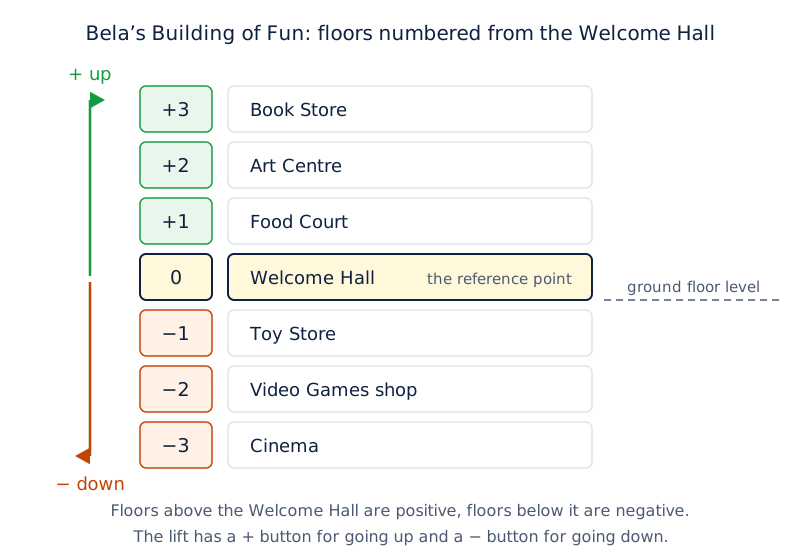
The drawing shows the Welcome Hall between the Food Court above and the Toy Store below. The Art Centre and Book Store are higher; the Video Games shop and Cinema are lower.
Drawn by One Young India. Reference: NCERT Class 6, page 244, unnumbered illustration
How do we compare positive and negative integers?
To compare numbers is to decide whether one is smaller than, greater than or equal to another. The symbol < means “is less than”, > means “is greater than”, and = means “is equal to”.
Property: Position determines order
In the building, the lower floor has the smaller number. On a horizontal number line, the number farther left is smaller. The number farther right is greater. These are two ways to represent the same ordering of integers.
Floor +3 is below Floor +4, so +3 < +4. Floor −4 is below Floor −3, so −4 < −3. Looking only at the digits 4 and 3 would give the wrong comparison for these negative integers.
Worked example 1. Compare −5 and −3 on the number line.
Answer: −5 is to the left of −3, so −5 < −3. Equivalently, −3 > −5. Among these two negative integers, the one nearer zero is greater.
Every negative integer is less than zero, while every positive integer is greater than zero. Consequently, a positive integer is greater than a negative integer. For example, −3 < 2 even though the digit 3 is larger than the digit 2.
What the figure shows
Integers on a number line
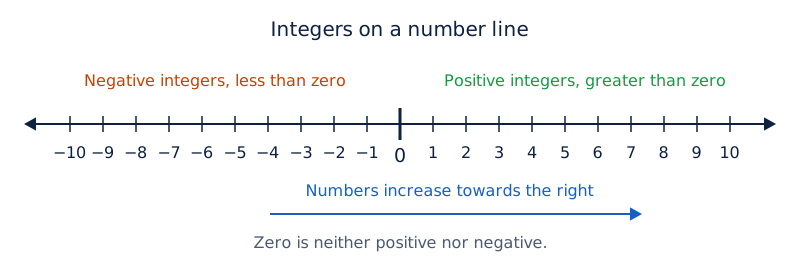
The horizontal line marks integers from −10 through 0 to 10. Negative labels lie to the left of zero and positive labels to its right, with arrows showing that the line continues.
Drawn by One Young India. Reference: NCERT Class 6, page 252, unnumbered figure
Increasing order means arranging numbers from smaller to larger, as when reading the number line from left to right. Decreasing order reverses that arrangement. Always keep the minus sign with its number when comparing or arranging negative integers.
How does addition describe movement and cancellation?
Addition can describe a starting position followed by a movement. The starting floor is where the lift begins; the target floor is where it finishes. Between numbers, + means add. This differs from + before a number, which identifies its positive sign.
The relationship is Starting Floor + Movement = Target Floor. Brackets group a signed number so that its sign is easy to distinguish from the operation. In (+1) + (+2), the first number gives the starting floor and the second gives the upward movement.
Worked example 2. Start at the Food Court on Floor +1 and move up two floors. Find the target floor.
Answer: (+1) + (+2) = +3. The lift reaches Floor +3, which is the Book Store. The movement is +2; the final position is +3.
How do we combine two movements?
Addition also combines movements. Gurmit presses + twice and then − three times. The upward and downward movements partly cancel. The resulting movement is one floor down, written (+2) + (−3) = −1.
This calculation gives movement relative to where Gurmit began. It does not, by itself, name his final floor. When finding a final floor, include the starting floor as well as the combined movement.
Property: A number and its additive inverse sum to zero
A sum is the result of addition. The additive inverse of a number is the number that gives zero when added to it. Opposite movements cancel completely. Thus −3 is the additive inverse of +3, and +3 is the additive inverse of −3.
Worked example 3. Basant starts on Floor 0 and presses +3 by mistake. What movement cancels this?
Answer: He should press −3, because (+3) + (−3) = 0. Moving up three floors and then down three floors returns him to the ground floor.
Similarly, (−2) + (+2) = 0. The additive inverse is useful both for returning to the reference point and for rewriting subtraction. For a non-zero number, its inverse has equal size without the sign and the opposite sign. The inverse of zero is zero, because 0 + 0 = 0.
How does subtraction find the movement needed?
Subtraction can mean taking away, but it can also mean finding the change needed to make one quantity equal to another. Between numbers, the symbol − means subtract. Before a number, it indicates that the number is negative.
If one person has ₹10 and another has ₹6, the missing amount can be written as 6 + ? = 10. Here, ₹ means rupees, and ? stands for the unknown number. The same question is expressed by 10 − 6 = ?.
How do starting and target positions enter the calculation?
In the lift model, Target Floor − Starting Floor = Movement needed. The order matters: write the target first and subtract the starting floor. The answer includes a sign because movement can be upward or downward.
Worked example 4. The lift starts at the Art Centre on Floor +2. Its target is the Sports Centre on Floor +5. Find the movement.
Answer: (+5) − (+2) = +3. The lift must move up three floors. Check by adding the movement to the starting floor: (+2) + (+3) = +5.
| Starting floor | Target floor | Subtraction and movement |
|---|---|---|
| −2 | −1 | (−1) − (−2) = +1, one floor up |
| +3 | −1 | (−1) − (+3) = −4, four floors down |
| −2 | +2 | (+2) − (−2) = +4, four floors up |
The last row crosses zero. Moving from −2 to zero and then to +2 is an upward movement throughout. A negative starting floor does not make the movement negative; direction is decided by where the target lies relative to the start.
Use the missing-number interpretation to check a subtraction. Add the calculated movement to the starting number. If it reaches the target number, the subtraction and its sign agree with the journey.
How can number lines handle larger integers?
The lift idea extends to a mineshaft, a shaft through which a lift travels in a mine. A mine is a place where minerals are extracted by digging into rock. Ground level is zero; levels above it are positive and levels below it are negative.
Here the numbers describe metres above or below ground, rather than floor numbers. The symbol m means metres, a unit of length. The relationships between starting level, movement and target level remain the same.
Worked example 5. A lift starts 90 metres below ground and moves down another 55 metres. Find its target level.
Answer: (−90) + (−55) = −145. The target level is 145 metres below ground. Both the initial level and the downward movement have negative signs.
What is an unmarked number line?
An unmarked number line initially shows only zero. Other positions and movements can be marked as needed. This makes it convenient to work with larger integers without drawing every intervening integer.
Worked example 6. Evaluate 85 + (−60) using a number line.
Answer: Begin at 85 and move 60 steps left because the movement is negative. The target is 25, so 85 + (−60) = 25. The movement stays on the positive side of zero.
What the figure shows
Addition on an unmarked number line
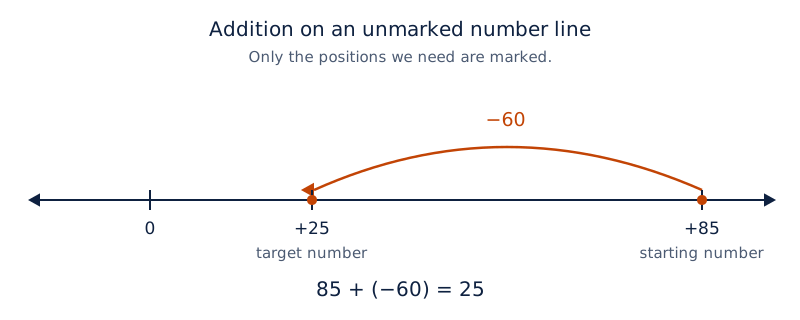
Zero, +25 and +85 are labelled on a horizontal line. A curved arrow labelled −60 points leftwards from +85 to +25.
Drawn by One Young India. Reference: NCERT Class 6, page 254, unnumbered figure
For subtraction, imagine travelling from the starting number to the target number. In (−100) − (+250), the start is +250 and the target is −100. The corresponding missing-number statement is 250 + ? = −100, giving a movement of −350.
There is no need to stop at the limits of a building or mine drawing. An imagined lift or number line can continue without an end in both directions, allowing addition, subtraction and comparison of larger integers.
What rules make integer addition and subtraction easier?
Brahmagupta’s rules bring together the patterns seen in lifts and number lines. A sum is the result of addition. A difference is the result of subtraction. The signs of the numbers help determine how to calculate each result.
How do we add numbers with different signs?
| Numbers being added | Rule | Example |
|---|---|---|
| Both positive | Add and keep the result positive. | 2 + 3 = 5 |
| Both negative | Add the numbers without their signs, then place a minus sign before the result. | (−2) + (−3) = −5 |
| One positive and one negative | Compare their sizes without signs. Subtract the smaller from the greater and use the sign of the greater. | −5 + 3 = −2 |
| A number and its additive inverse | The opposite quantities cancel. | 2 + (−2) = 0 |
| A number and zero | The number stays unchanged. | −2 + 0 = −2 |
In the mixed-sign rule, “greater” refers to the number’s size without its sign. It does not mean that a negative integer becomes greater than a positive integer. If the sizes are equal, the numbers are additive inverses and the sum is zero.
Property: Subtraction is addition of the additive inverse
To subtract an integer, add its additive inverse instead. Keep the first number unchanged, change subtraction to addition, and replace the second number by its inverse. This works for positive numbers, negative numbers and zero.
Worked example 7. Evaluate (+2000) − (−200).
Answer: The inverse of −200 is +200. Therefore, (+2000) − (−200) = (+2000) + (+200) = +2200. In the lift interpretation, this is the upward movement from −200 to +2000.
Similarly, (+7) − (+5) becomes (+7) + (−5), while (+8) − (−2) becomes (+8) + (+2). The operation changes together with the sign of the number being subtracted. Changing just one of these does not express the same calculation.
Property: Zero and subtraction have precise roles
Subtracting a number from itself gives zero. Subtracting zero leaves a number unchanged. Subtracting a number from zero gives its inverse. Examples are 2 − 2 = 0, −2 − 0 = −2, and 0 − (−2) = 2.
Addition can also be rewritten as subtraction: replace the number being added by its inverse and subtract it. This reverses the same relationship, connecting both operations through additive inverses.
How does the token model explain addition?
A token is a counter used to represent a number. In the token model, a positive token represents +1 and a negative token represents −1. The lift attendant takes a positive green token for each upward button press and a negative red token for each downward press.
Definition: A zero pair consists of one positive token and one negative token. Their combined value is zero, so putting in or taking out a zero pair does not change the total value.
The attendant begins on Floor 0 with an empty pocket. If his pocket later contains five positive and three negative tokens, three zero pairs cancel. Two positive tokens remain, showing that he has reached Floor +2.
How do we calculate by cancellation?
- Represent each number using tokens of the appropriate sign.
- Bring the two groups together to represent their addition.
- Pair each positive token with a negative token wherever possible.
- Remove the zero pairs and read the value of the remaining tokens.
Worked example 8. Use tokens to add +5 and −8.
Answer: Put together five positive tokens and eight negative tokens. Remove five zero pairs. Three negative tokens remain, so (+5) + (−8) = −3. The remaining tokens determine the negative sign of the answer.
What the figure shows
Cancelling tokens
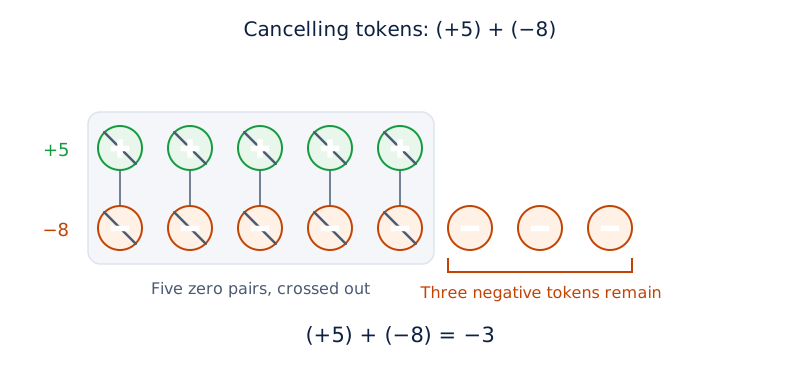
Five green positive tokens are paired with five of eight negative tokens and crossed out. Three negative tokens remain uncrossed on the right.
Drawn by One Young India. Reference: NCERT Class 6, page 256, unnumbered illustration
The model explains why adding numbers with opposite signs involves subtraction of their sizes. Each zero pair removes one token of each sign. Whichever sign has tokens left determines the sign of the sum; complete cancellation gives zero.
How can we subtract tokens when there are too few to remove?
In the token model, subtraction means removing the tokens that represent the number being subtracted. To calculate (+5) − (+4), remove four positive tokens from five positive tokens. One positive token remains, giving +1.
For (−7) − (−5), begin with seven negative tokens and remove five negative tokens. Two negative tokens remain, so the result is −2. Notice that subtracting negative tokens removes negative value.
Why can we add zero pairs first?
Sometimes the starting group does not contain enough tokens of the required sign. A zero pair changes the available tokens but contributes no value. Adding enough zero pairs allows the removal to be carried out without changing the starting number.
Worked example 9. Use tokens to evaluate (+5) − (+6).
Answer: Start with five positive tokens. Add one zero pair, giving six positive tokens and one negative token. Remove the six positive tokens. The negative token remains, so (+5) − (+6) = −1.
Worked example 10. Use tokens to evaluate +4 − (−6).
Answer: Start with four positive tokens. Add six zero pairs, creating ten positive tokens and six negative tokens. Remove the six negative tokens. Ten positive tokens remain, so +4 − (−6) = +10.
What the figure shows
Subtracting negative tokens
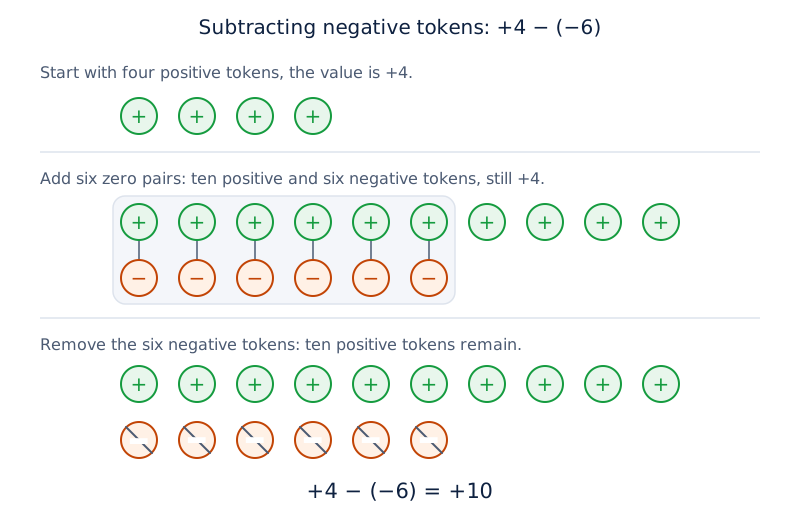
Four positive tokens are shown first. After six zero pairs are added, the drawing has ten positive and six negative tokens. The six negatives are crossed out, leaving the positives.
Drawn by One Young India. Reference: NCERT Class 6, page 258, unnumbered illustration
This gives a concrete explanation of the inverse rule. Removing six negative tokens has the same effect on the value as adding six positive tokens. The result can increase even though the operation is subtraction.
When explaining a token calculation, state what you begin with, how many zero pairs you add, which tokens you remove and what remains. The signs of the tokens are just as important as their number.
Where do we use integers in money, heights and temperature?
Integers describe quantities on opposite sides of a reference value. In a bank account, the reference is a balance of zero. For heights, it can be ground level or sea level. For Celsius temperatures, zero marks the freezing point of water.
How do credits and debits affect a balance?
A credit adds money to a bank account; a debit takes money from it. The balance is the amount in the account after the transactions, meaning money paid in or taken out. Credits can be represented by positive numbers and debits by negative numbers.
Starting with ₹100, a credit of ₹60 raises the balance. A debit of ₹30 then lowers it, and a further debit of ₹150 can take it below zero. The sign records whether the resulting balance is positive or negative.
Some banks allow a balance to become negative temporarily. Some banks also charge an additional amount, in the form of interest or a fee, if this happens. Here, interest or a fee means an additional charge.
In general, it is better to try to keep a positive bank balance. The possibility of a negative balance is useful for understanding signed numbers, but permission to have one is not a rule for every bank.
What do positive and negative heights mean?
Sea level is the reference level used to measure the heights of geographical features. Its height is 0 m. Positive heights are above sea level; negative heights are below it. A negative height does not mean that the feature has no location.
A geographical cross section shows a side view of an imagined vertical slice through the Earth at a location. It can show mountains and lower areas together, with sea level providing the common zero reference.
How do negative temperatures work?
Temperature measures how hot or cold something is. The unit degrees Celsius is written °C. On this scale, 0°C is the freezing point of water. Temperatures above it are positive, and temperatures below it are negative.
The thermometers show 40°C and 15°C, while the Leh exercise includes readings of 14°C, 8°C, −2°C and −4°C. These illustrate that a temperature can be below zero. Read its sign as carefully as the numerical part.
How do integer grids and games practise these ideas?
A hollow integer grid has numbers around its border and an empty centre. In the grids considered here, the top row, bottom row, left column and right column each have the same sum. This common value is called the border sum.
How do we check a border sum?
Check each of the four sides separately. Finding the correct sum for the top row alone does not establish the border sum of the grid. The other row and both outer columns must give the same result.
| Side of the first grid | Calculation | Sum |
|---|---|---|
| Top row | 4 + (−1) + (−3) | 0 |
| Bottom row | (−1) + (−1) + 2 | 0 |
| Left column | 4 + (−3) + (−1) | 0 |
| Right column | (−3) + 1 + 2 | 0 |
Another grid activity asks you to circle a number, strike out its row and column, and then choose an unstruck number. Continue until no unstruck number remains, then add the circled numbers. The selection −1, 9, −7 and −2 gives −1.
How does integer Snakes and Ladders work?
Two players each have one pawn, and both start at zero. A player can win by reaching either −50 or +50, without deciding the destination before or during play. A pawn is the playing piece moved around the board.
Each player rolls two dice: one has numbers +1 to +6, and the other has numbers −1 to −6. After a roll, the player may add or subtract the numbers in either order. A positive result means movement towards +50; a negative result means movement towards −50.
These activities connect calculation with decisions. In a grid, check whether several sums agree. In the game, compare the results of the available operations before choosing a movement. Both activities require attention to the operation and the signs.
How did the understanding of negative numbers develop?
The first known instances of negative numbers occurred in accounting. Positive and negative values helped describe credits and debits. Their development connects the practical recording of money with a broader understanding of arithmetic.
What were the early contributions?
The Chinese work The Nine Chapters on Mathematical Art, completed by the first or second century CE, represented positive and negative numbers using red and black rods. CE means Common Era, a way of naming years.
Kautilya discussed credits and debits in the Arthaśhāstra, around 300 BCE, including the recognition that an account balance could be negative. BCE means Before Common Era. The Bakśhālī manuscript, from around 300 CE, used a special symbol after a number to indicate a negative number.
What did Brahmagupta contribute?
In 628 CE, Brahmagupta’s Brāhma-sphuṭa-siddhānta gave a general treatment of positive numbers, negative numbers and zero on an equal footing. His explicit arithmetic rules include the addition and subtraction rules practised here.
Acceptance elsewhere took many centuries. Zero and negative numbers were accepted and further studied in the Arab world by the ninth century, before reaching Europe by the thirteenth century. Many European mathematicians still did not accept negative numbers even in the eighteenth century.
Glossary
- Integer — Zero, a positive counting number or the negative of a positive counting number.
- Positive integer — A counting number greater than zero, lying to the right of zero on the number line.
- Negative integer — An integer less than zero, written with a minus sign and lying to the left of zero.
- Zero — The integer that is neither positive nor negative and serves as a reference for signed positions.
- Number line — A line representing number positions, with smaller numbers to the left of larger numbers.
- Additive inverse — The number which gives zero when added to the given number.
- Starting position — The position at which a journey or a number-line movement begins.
- Target position — The position to be reached after making the required movement from the starting position.
- Zero pair — One positive token together with one negative token, having a combined value of zero.
- Credit — An addition of money to a bank account, represented by a positive number.
- Debit — Money taken from a bank account, represented as a negative change in its balance.
- Border sum — The common sum of each outer row and outer column in the hollow integer grids considered here.
Common errors and misconceptions
- Misconception: Zero is positive because it has no minus sign. Correct: Zero is neither positive nor negative. It separates positive and negative integers on the number line.
- Misconception: −5 is greater than −3 because 5 is greater than 3. Correct: −5 lies to the left of −3, so −5 is the smaller integer.
- Misconception: A movement of +2 means the lift finishes on Floor +2. Correct: The final floor also depends on the starting floor. Starting at +1 and moving +2 leads to +3.
- Misconception: Adding a negative number moves right along the number line. Correct: A negative movement goes left. In 85 + (−60), the target is 25.
- Misconception: Subtraction makes the result smaller in every case. Correct: Subtracting a negative number adds its positive inverse. For example, +4 − (−6) = +10.
- Misconception: Adding zero pairs changes the number represented by tokens. Correct: Each pair has value zero. The number of tokens changes, but their total value stays the same.
- Misconception: To find movement, subtract the target from the starting position. Correct: Use target minus start. From −2 to +2, the movement is (+2) − (−2) = +4.
Exam-style questions with model answers
Q1. State whether zero is positive or negative. Compare −4 and −3 using their positions on a number line. [2 marks]
- Zero is neither positive nor negative. It is the reference separating positive and negative integers.
- −4 lies to the left of −3 on the number line, so −4 < −3.
Q2. A lift starts at the Food Court on Floor +1 and moves up two floors. The Book Store is on Floor +3. Write an addition statement and identify the destination. [2 marks]
- The addition statement is (+1) + (+2) = +3, using starting floor plus movement to find the target floor.
- The lift reaches Floor +3, so its destination is the Book Store.
Q3. A lift must travel from Floor −2 to Floor +2. State the subtraction rule for movement, calculate the movement and check your result using addition. [3 marks]
- Movement is found by subtracting the starting floor from the target floor. Here, the target is +2 and the starting floor is −2.
- The required calculation is (+2) − (−2) = +4. The positive answer means moving upwards through four floors.
- Check using addition: (−2) + (+4) = +2. Adding the movement to the start reaches the required target.
Q4. Each positive token represents +1 and each negative token represents −1. Explain (+5) + (−8) by stating the starting tokens, zero pairs, remaining tokens and result. [4 marks]
- Represent +5 with five positive tokens and −8 with eight negative tokens, then place both groups together for addition.
- Make five zero pairs. Each pair contains one positive and one negative token, so its combined value is zero.
- Remove these five pairs. All five positive tokens have been cancelled, and three negative tokens remain.
- The remaining tokens represent −3. Therefore, (+5) + (−8) = −3, with the negative sign determined by the tokens left over.
Q5. Each positive token represents +1, each negative token represents −1, and a zero pair contains one of each. Explain +4 − (−6) in five stages: initial tokens, difficulty, added pairs, removal and result. [5 marks]
- Begin with four positive tokens to represent +4. At this stage there are no negative tokens in the starting group.
- The subtraction asks us to remove six negative tokens, because the number being subtracted is −6. The starting group does not contain them.
- Add six zero pairs. Their total value is zero, so the represented number remains +4, although the collection now has ten positive and six negative tokens.
- Remove the six negative tokens from the collection, as required by the subtraction. The ten positive tokens are left untouched.
- The remaining value is +10, so +4 − (−6) = +10. Removing negative tokens has increased the value represented by the remaining collection.
Q6. A lift is modelled on an unrestricted vertical number line. It starts at −200 and must reach +2000. Explain the movement through zero, find the total, write the subtraction and state the equivalent addition. [5 marks]
- From the starting level −200, the lift first moves upwards by +200 to reach zero. This completes the part of the journey below zero.
- From zero, it continues upwards by +2000 to reach the target +2000. Both parts of the journey have positive movement.
- The combined upward movement is +2200. It includes the movement needed to get to zero as well as the movement beyond zero.
- Using target minus start, the subtraction statement is (+2000) − (−200) = +2200. The result describes movement rather than the target level.
- Subtracting −200 is equivalent to adding its inverse, +200. Thus the same calculation is (+2000) + (+200) = +2200.
Q7. A hollow grid has top row 4, −1, −3; middle row −3, an empty centre, 1; and bottom row −1, −1, 2. Calculate each outer row and column to verify its border sum. [4 marks]
- The top row gives 4 + (−1) + (−3) = 0, because the two negative numbers together cancel the positive four.
- The bottom row gives (−1) + (−1) + 2 = 0. The two negative ones cancel the positive two.
- The left column gives 4 + (−3) + (−1) = 0, again combining opposite quantities of equal total size.
- The right column gives (−3) + 1 + 2 = 0. All four sides agree, so the border sum is zero.
Q8. Evaluate 85 + (−60) on a number line. State the starting point, direction and size of movement, and final result. [3 marks]
- The starting point is 85 on the positive side of the number line. This is the first number in the addition.
- The added number is −60, so move 60 steps to the left. Its minus sign gives the direction of movement.
- The movement ends at 25, which remains to the right of zero. Therefore, 85 + (−60) = 25.
Key takeaways
- Integers include positive counting numbers, zero and the negatives of counting numbers; zero itself is neither positive nor negative.
- Numbers increase towards the right on a number line, so a negative integer farther left is smaller.
- Addition can combine movements or give a target position by adding a movement to a starting position.
- A number and its additive inverse sum to zero, just as equal movements in opposite directions cancel.
- Find the required movement by subtracting the starting position from the target position, keeping their order clear.
- Subtracting an integer means adding its additive inverse; subtracting a negative integer therefore adds its corresponding positive integer.
- A positive token and a negative token form a zero pair, which can be added or removed without changing value.
- Credits, debits, heights and Celsius temperatures use signs to describe quantities relative to a chosen zero reference.
Test yourself
What does −2 mean as a floor number in Bela’s building?
It means a floor two levels below the ground floor, which is numbered zero.
Which is greater, −3 or −4? Explain.
−3 is greater because it lies to the right of −4 on the number line.
What is the additive inverse of +3, and why?
Its additive inverse is −3, because (+3) + (−3) = 0.
What does a combined lift movement (+2) + (−3) mean?
The combined movement is −1: two floors up followed by three floors down gives one floor down overall.
How is (+8) − (−2) rewritten as addition?
It becomes (+8) + (+2), because the additive inverse of −2 is +2.
Why may we add a zero pair before subtracting tokens?
A zero pair adds no value, but supplies one token of each sign for the removal.
What does a negative height relative to sea level mean?
It means a position below sea level, with sea level taken as the zero reference.
What does 0°C represent, and what do negative Celsius temperatures indicate?
0°C is the freezing point of water. Negative Celsius temperatures are below that reference temperature.
Write about it
Turn a question from this chapter into a paper.
The Writing Studio has a structure guide, a rubric and citation tools for 15 formats, from essays to research papers. Drafting is free with an account. Learnacy Essential adds feedback from an AI writing coach and submission to The OYI Review.
Learnacy Essential is ₹1,499 for the year. Publication depends on review and is not guaranteed.