
Atoms | ISC Class 12 Physics Notes
On this page

This note covers atomic structure, alpha-particle scattering, Rutherford’s nuclear model, distance of closest approach, Bohr’s hydrogen atom, orbital radius and speed, electron energies, energy levels, hydrogen spectral series, and calculations of emitted or absorbed radiation.
What does atomic structure tell us about an atom?
An atom is electrically neutral overall: its positive and negative charges balance. An electron is a negatively charged constituent found outside the nucleus. The nucleus is the small central region containing the entire positive charge and most of the atom’s mass.
A proton carries positive elementary charge, whereas a neutron has no electric charge. Protons and neutrons are collectively called nucleons. The nucleus contains protons and, except for ordinary hydrogen, also neutrons.
How are the constituents counted?
The atomic number Z counts protons, the neutron number N counts neutrons, and the mass number A counts all nucleons. These are dimensionless counts. The mass number is not a mass measured in kilograms.
A = Z + N
For a neutral atom, the number of electrons equals Z. Let e denote the magnitude of the charge on an electron, approximately 1.6 × 10⁻¹⁹ coulomb. The coulomb, symbol C, measures electric charge. Nuclear charge is +Ze; the total electronic charge is −Ze.
For example, a gold nucleus with A = 197 and Z = 79 contains 79 protons and 118 neutrons. Ordinary hydrogen has one proton and one electron. It is particularly useful for studying the connection between atomic structure and radiation.
How did the early models differ?
In Thomson’s model, positive charge fills the atom uniformly, with electrons embedded in it. In Rutherford’s model, positive charge is concentrated in a nucleus and electrons move around it. Scattering experiments distinguish these arrangements because concentrated charge can produce a strong deflection during a close encounter.
Atomic dimensions are about 10⁻¹⁰ metre, whereas Rutherford’s experiments suggested nuclear dimensions of about 10⁻¹⁵ to 10⁻¹⁴ metre. Most of an atom is therefore empty space. The metre, symbol m, is the SI unit of length; SI means the International System of Units.
How did alpha-particle scattering reveal the nucleus?
An alpha-particle, written α-particle, is a helium nucleus carrying charge +2e. Scattering means a change in its direction of motion. Geiger and Marsden directed a narrow beam of these particles towards a thin gold foil to investigate the distribution of charge inside atoms.
What was the experimental arrangement?
Lead bricks restricted particles from a radioactive source to a narrow beam. The beam struck the gold foil. A movable detector containing a zinc sulphide screen and a microscope recorded scattered particles. Each impact on the screen produced a brief light flash, called a scintillation.
The scattering angle θ measures the change from the incident direction. By moving the detector, the number of particles arriving at different angles could be compared over a given time interval. The apparatus operated in a vacuum.
What the figure shows
Geiger-Marsden arrangement
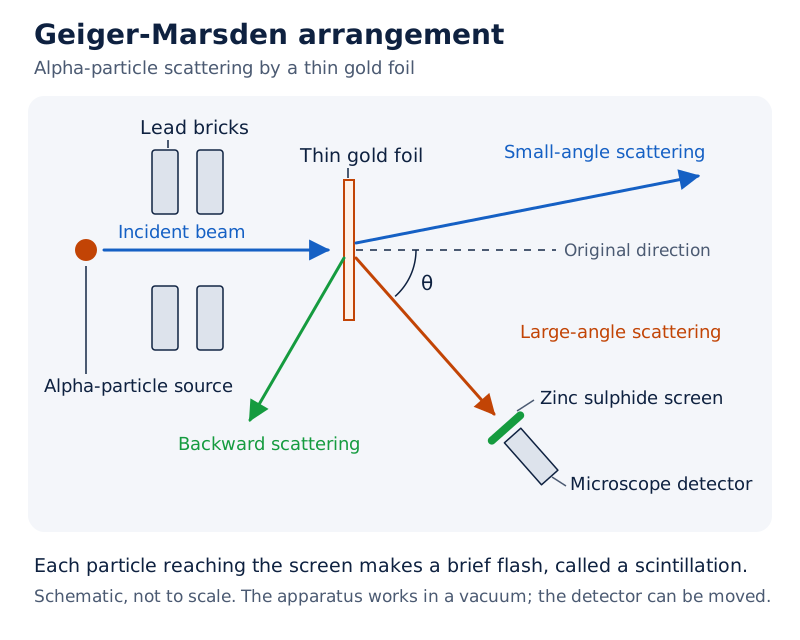
The drawing labels the alpha-particle source, lead bricks, incident beam, thin gold foil, zinc sulphide screen and microscope detector. Arrows show small-angle, large-angle and backward scattering; θ marks a scattering angle.
Drawn by One Young India.
How do observations support the nuclear model?
| Observation | Interpretation |
|---|---|
| Most particles pass through the foil with little deflection. | Most of the atomic volume is empty space. |
| Only about 0.14% scatter by more than 1°. | Close encounters with the concentrated positive charge are uncommon. |
| About 1 in 8000 deflect by more than 90°. | A very small central region can exert a large repulsive force. |
The positively charged alpha-particle is repelled by the positive nucleus. Large deflections require a close approach to this concentrated charge. The atomic electrons, being so light, do not appreciably affect the alpha-particles. The observations support concentration of the entire positive charge and most atomic mass in the nucleus.
For a thin foil, it can be assumed that a particle suffers not more than one scattering during passage. The gold nucleus is much heavier than the alpha-particle, so treating it as stationary is a reasonable approximation. These assumptions matter when interpreting the experiment.
How is the distance of closest approach calculated?
The distance of closest approach d is the minimum centre-to-centre separation between an incoming alpha-particle and the target nucleus. For a head-on approach to a heavy, approximately stationary nucleus, the particle slows under electrical repulsion, stops momentarily, and reverses direction.
Let K be its initial kinetic energy, the energy associated with motion, and U the electrostatic potential energy of the interacting charges. Energy is measured in joules, symbol J. The SI unit of energy is the joule. Potential energy is taken as zero at infinite separation.
Write k = 1/(4πε₀), where k is the electrostatic force constant, ε₀ is the permittivity of free space, and π is the circle constant. Approximately, k = 9.0 × 10⁹ N m² C⁻². Here N denotes newton, the force unit, rather than neutron number.
Derivation: Closest approach from conservation of energy
- Far from the nucleus, the interaction potential energy is negligible, so the initial mechanical energy is K.
- At the head-on turning point, the alpha-particle is momentarily at rest. Its initial kinetic energy has become electrostatic potential energy.
- The charge product is (2e)(Ze), so the potential energy at separation d is U = 2kZe²/d.
- Conservation of mechanical energy gives K = 2kZe²/d. Rearranging gives the required separation.
d = 2kZe²/K
The expression applies to a head-on approach under electrostatic repulsion, provided recoil of the heavy nucleus is neglected. For a fixed target, greater incident energy gives a smaller closest approach. For fixed incident energy, a larger nuclear charge gives a larger turning distance.
An electron volt, symbol eV, is the energy an electron gains through a potential difference of one volt. Potential difference is energy transferred per unit charge; a volt, symbol V, equals one joule per coulomb.
Worked example 1. An alpha-particle approaches gold head-on with energy 7.7 MeV, approximately 1.2 × 10⁻¹² J. MeV means million electron volts; 1 eV = 1.6 × 10⁻¹⁹ J. Given Z = 79, k = 9.0 × 10⁹ N m² C⁻² and e = 1.6 × 10⁻¹⁹ C, find d.
Formula: d = 2kZe²/K. Substitute: d = 2 × 9.0 × 10⁹ × 79 × (1.6 × 10⁻¹⁹)²/(1.2 × 10⁻¹²). Answer: d ≈ (3.0 m) × 10⁻¹⁴.
Note: Closest approach supplies an upper limit to nuclear size. It is not automatically the nuclear radius: the alpha-particle can reverse without touching the nucleus. A femtometre, also called a fermi, is 10⁻¹⁵ m.
Why could Rutherford’s model not explain stable line spectra?
A spectrum describes the wavelengths present in radiation. Wavelength λ is the distance over which a wave repeats. The SI unit of wavelength is the metre. Atomic wavelengths are conveniently expressed in nanometres, symbol nm, with 1 nm = 10⁻⁹ m.
An emission line spectrum contains distinct bright lines on a dark background. A low-pressure atomic gas, usually excited by an electric current, emits specific wavelengths. Each element has a characteristic pattern, connecting its radiation to its internal structure.
What does classical physics predict?
An electron following a circular path changes direction continually, so it is accelerated even if its speed stays constant. The inward force needed for circular motion is the centripetal force. Electrostatic attraction towards the nucleus supplies that force in Rutherford’s model.
- Classical electromagnetic theory predicts that an accelerating charged particle emits electromagnetic radiation.
- A revolving electron should therefore lose energy continuously as it radiates.
- Its orbit should shrink, making it spiral towards the nucleus instead of maintaining a stable atom.
- Its changing orbital motion should produce continuously changing radiation frequencies, contrary to observed discrete spectral lines.
Frequency ν is the number of wave cycles per second. The SI unit of frequency is the hertz, symbol Hz, equal to one cycle per second. A second, symbol s, is the SI unit of time. Frequency and wavelength describe different aspects of the same radiation.
How does absorption differ from emission?
An absorption line spectrum contains dark lines in an otherwise continuous spectrum. When white light passes through a gas, atoms absorb selected wavelengths. Those wavelengths correspond to the gas’s emission lines. The dark lines indicate reduced transmitted intensity at the absorbed wavelengths.
Rutherford’s nuclear model successfully explains the concentration of charge revealed by scattering. It does not explain atomic stability or the characteristic line spectrum. Those are separate failures: explaining a small nucleus does not by itself determine allowed electron energies.
What are Bohr’s three postulates for hydrogen?
Bohr’s model combines the nuclear picture with restrictions on allowed electron motion and radiation. A postulate is an assumption on which the model is built. The hydrogen atom considered here has nuclear charge +e, so Z = 1.
Which orbits are allowed?
- Stationary states: an electron may revolve in certain stable orbits without emitting radiant energy. Each permitted state has a definite total energy.
- Quantised angular momentum: permitted orbits have angular momentum equal to an integral multiple of h/(2π). Quantisation means that only specified discrete values are allowed.
- Radiative transitions: an electron may move from a higher-energy stationary state to a lower one, emitting a photon with energy equal to the difference between those states.
Here h is Planck’s constant, approximately 6.6 × 10⁻³⁴ J s. L is angular momentum: for circular motion it is the product of electron mass, speed and orbit radius. The positive integer n, called the principal quantum number, labels permitted states.
L = nh/(2π)
The SI unit of angular momentum is kilogram metre squared per second, written kg m² s⁻¹. The kilogram, symbol kg, is the SI unit of mass. Planck’s constant has the same dimensions as angular momentum.
When is a photon emitted?
A photon is a quantum, or discrete packet, of electromagnetic radiation. Let Eᵢ and Eᶠ denote the initial and final atomic energies. For emission, Eᵢ is greater than Eᶠ and the photon has positive energy.
hν = Eᵢ − Eᶠ
A stationary electron is not motionless: “stationary” refers to a definite, unchanging energy state. Nor does the electron radiate continuously while following a permitted orbit. The radiation frequency comes from the energy difference during a transition, not directly from its frequency of revolution.
How are the orbital radius and electron speed derived?
Let mₑ denote electron mass, vₙ its speed and rₙ the orbital radius in state n. The mass is approximately 9.1 × 10⁻³¹ kg. The SI unit of speed is metre per second, written m s⁻¹. These expressions describe circular orbits in Bohr’s hydrogen model.
Derivation: Radius and speed of an allowed orbit
- Coulomb attraction supplies the centripetal force: mₑvₙ²/rₙ = ke²/rₙ². Multiplying by rₙ² gives mₑvₙ²rₙ = ke².
- The angular momentum condition is mₑvₙrₙ = nh/(2π). Dividing the force relation by this condition gives vₙ = 2πke²/(nh).
- Rearrange the angular momentum condition to rₙ = nh/(2πmₑvₙ), then substitute the speed just found.
- The permitted radius is rₙ = n²h²/(4π²mₑke²), equivalently ε₀n²h²/(πmₑe²).
vₙ = 2πke²/(nh)
rₙ = n²h²/(4π²mₑke²)
The Bohr radius a₀ is the radius of the first allowed orbit, approximately 5.3 × 10⁻¹¹ m. The first-orbit speed is approximately 2.2 × 10⁶ m s⁻¹. Radius grows as n², while speed decreases as 1/n.
rₙ = a₀n²
Worked example 2. For hydrogen, take a₀ = 5.3 × 10⁻¹¹ m. Find the second and third orbit radii.
Formula: r₂ = 4a₀; r₃ = 9a₀. Substitute: r₂ = 4 × 5.3 × 10⁻¹¹; r₃ = 9 × 5.3 × 10⁻¹¹. Answer: r₂ = (2.12 m) × 10⁻¹⁰ and r₃ = (4.77 m) × 10⁻¹⁰.
How can a known binding energy give radius and speed?
A binding energy is the positive energy needed to free a bound electron. If the total energy is E, its magnitude is written |E|. In a hydrogen orbit, the energy and force relations give the radius and speed used below.
Worked example 3. Hydrogen requires 13.6 eV to separate into a proton and electron. Use |E| = 13.6 × 1.6 × 10⁻¹⁹ J, k = 9.0 × 10⁹ N m² C⁻², e = 1.6 × 10⁻¹⁹ C and mₑ = 9.1 × 10⁻³¹ kg.
Let r and v denote this orbit’s radius and speed. Formula: r = ke²/(2|E|); v = √(ke²/(mₑr)). Substitute: r = 9.0 × 10⁹ × (1.6 × 10⁻¹⁹)²/(2 × 2.176 × 10⁻¹⁸), then use this radius in v. Answer: r ≈ (5.3 m) × 10⁻¹¹ and v ≈ (2.2 m s⁻¹) × 10⁶.
How are kinetic, potential and total energies related?
For the electron in state n, write its kinetic, potential and total energies as Kₙ, Uₙ and Eₙ, respectively. The total energy is their sum. Set electrostatic potential energy to zero when electron and nucleus are infinitely far apart.
Derivation: Energy of a hydrogen orbit
- The centripetal-force equation gives mₑvₙ² = ke²/rₙ. Therefore Kₙ = ½mₑvₙ² = ke²/(2rₙ).
- Opposite charges attract, so their potential energy relative to infinite separation is Uₙ = −ke²/rₙ.
- Add the two contributions: Eₙ = Kₙ + Uₙ = −ke²/(2rₙ). Hence Uₙ = −2Kₙ and Eₙ = −Kₙ.
- Substitute rₙ = ε₀n²h²/(πmₑe²). This gives Eₙ = −mₑe⁴/(8ε₀²h²n²).
Eₙ = −13.6/n² eV
Kₙ = 13.6/n² eV
Uₙ = −27.2/n² eV
The negative total energy signifies a bound electron. Energy must be supplied to separate it from the nucleus. Kinetic energy remains positive; a negative total energy does not imply a negative speed or negative kinetic energy.
Worked example 4. Hydrogen has total energy −13.6 eV in its ground state, the lowest-energy state with n = 1. Find the electron’s kinetic and potential energies, using 1 eV = 1.6 × 10⁻¹⁹ J.
Formula: K₁ = −E₁; U₁ = 2E₁. Substitute: K₁ = 13.6 eV and U₁ = −27.2 eV. Answer: K₁ ≈ (2.18 J) × 10⁻¹⁸ and U₁ ≈ (−4.35 J) × 10⁻¹⁸.
What changes as the orbit becomes larger?
As n increases, kinetic energy decreases, potential energy becomes less negative, and total energy becomes less negative. The electron is less tightly bound even though its total energy increases. Moving outward therefore requires an input of energy.
The three energies must be kept distinct when interpreting a question. A quoted energy of −13.6 eV refers to the total energy in the ground state; the energy needed for removal from that state is positive 13.6 eV.
How do energy levels describe excitation and ionisation?
The ground state is the lowest-energy state, n = 1. An excited state is an allowed state above it. At room temperature, most hydrogen atoms are in the ground state. Energy gained in collisions or by absorbing a suitable photon can excite an atom.
Excitation energy is the energy required to raise the atom from a specified lower state to a specified higher state. Ionisation energy is the minimum energy needed to remove its electron completely from the specified state.
What the figure shows
Hydrogen energy levels
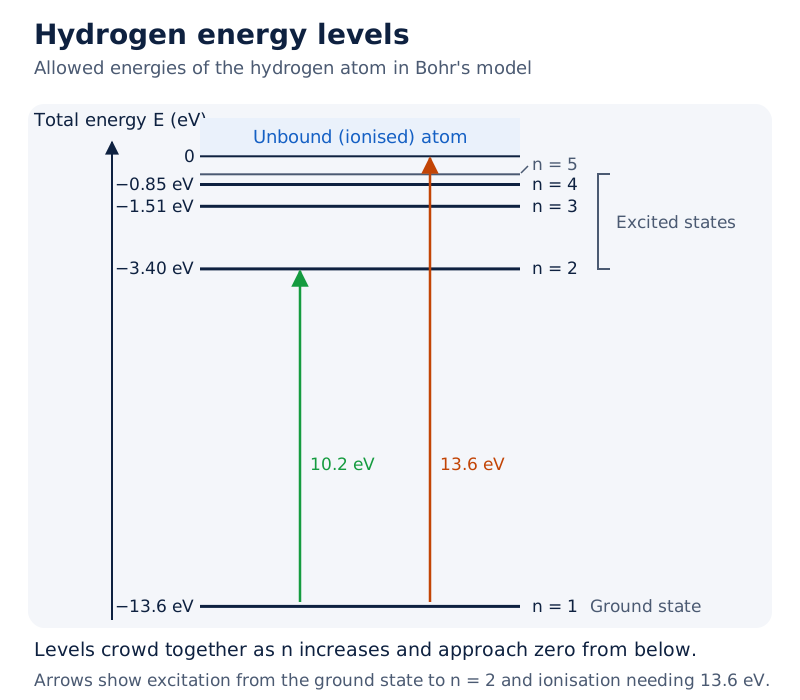
Horizontal lines mark the ground state at −13.6 eV and excited states including −3.40 eV, −1.51 eV and −0.85 eV. The zero-energy boundary separates bound levels from the shaded region labelled “Unbound (ionised) atom”.
Drawn by One Young India.
How should the energy diagram be read?
The levels crowd together as n increases. The zero of energy corresponds to an electron infinitely far from the nucleus and at rest. Above zero, free-electron energies form a continuum, meaning a continuous range rather than separated bound levels.
Let ΔE mean an energy difference, with its direction stated. For excitation from the ground state to n = 2, ΔE = −3.40 − (−13.6) = 10.2 eV. To reach n = 3 using the displayed rounded energies requires 12.09 eV.
Ground-state hydrogen requires 13.6 eV for ionisation. From an excited state, the minimum removal energy is smaller. Excitation and ionisation are therefore different processes: excitation can leave the electron bound, whereas ionisation removes it.
Why can one element emit several lines?
An excited atom can lose energy by making a transition to a lower state and emitting a photon. A sample contains many atoms, so different transitions can occur among them. Each allowed energy difference produces its own radiation frequency.
An energy-level diagram represents energies, not physical orbit sizes. Vertical separations show energy differences. The increasing crowding of levels is consistent with the 1/n² dependence of the total energy; it does not mean that the orbital radii crowd together.
How are the five hydrogen spectral series organised?
A spectral series groups emission transitions ending at the same lower energy level. Let n₁ denote the lower-level principal quantum number and n₂ the higher-level number. For emission, n₂ is greater than n₁; both are positive integers.
The Rydberg constant R for hydrogen is 109,677 cm⁻¹, equivalent to 1.09677 × 10⁷ m⁻¹. Here cm means centimetre. An inverse-length unit is required because wavenumber, 1/λ, is the number of wavelengths per unit length.
1/λ = R(1/n₁² − 1/n₂²)
Balmer obtained an empirical formula for a group of hydrogen lines in 1885. An empirical formula fits observed results without deriving them from an atomic model. Rydberg extended the wavelength pattern to different series; Bohr’s 1913 model supplied a physical explanation through quantised energies.
Which final level identifies each series?
| Series | n₁ | n₂ | Spectral region |
|---|---|---|---|
| Lyman | 1 | 2,3.... | Ultraviolet |
| Balmer | 2 | 3,4.... | Visible |
| Paschen | 3 | 4,5.... | Infrared |
| Brackett | 4 | 5,6.... | Infrared |
| Pfund | 5 | 6,7.... | Infrared |
Visible radiation is light detected by the human eye; ultraviolet has shorter wavelengths, and infrared longer wavelengths, than visible light. For each series, substitute its fixed n₁ into the Rydberg formula. Lyman uses 1 − 1/n₂²; Balmer uses 1/4 − 1/n₂².
For Paschen, the bracket is 1/9 − 1/n₂²; for Brackett, 1/16 − 1/n₂²; for Pfund, 1/25 − 1/n₂². Multiply the relevant bracket by R to obtain 1/λ, then take the reciprocal to obtain λ.
What the figure shows
Hydrogen emission lines
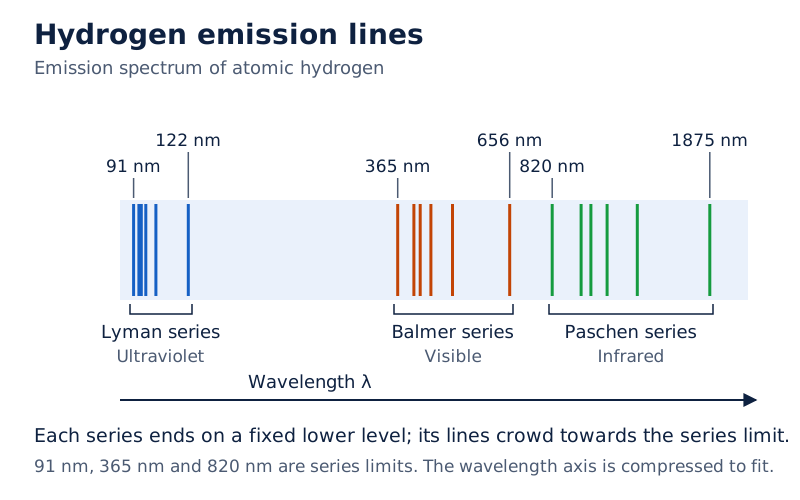
The diagram groups vertical lines into Lyman, Balmer and Paschen series. Its wavelength arrow points to the right. Printed labels include 91 nm and 122 nm, 365 nm and 656 nm, and 820 nm and 1875 nm.
Drawn by One Young India.
What is a series limit?
The series limit is approached as n₂ increases without bound while n₁ stays fixed. The term 1/n₂² tends to zero. This gives the largest wavenumber and therefore the shortest wavelength in that series. The first line instead connects n₂ = n₁ + 1 to n₁.
Use R in m⁻¹ to obtain wavelength in metres, then convert to nm. The tabulated region labels identify the familiar series classification; the Balmer lines converge towards a limit near 365 nm, beyond the visible range.
How are photon frequency and wavelength calculated?
For a photon travelling in vacuum, let c be the speed of light, approximately 3.0 × 10⁸ m s⁻¹. Its frequency and wavelength obey c = νλ. Let Eγ denote photon energy; the subscript γ identifies the photon.
ν = Eγ/h
λ = c/ν
For emission, Eγ is the higher atomic energy minus the lower atomic energy. For absorption between bound levels, the incoming photon must provide precisely the energy difference needed to reach the higher state. In either case, photon energy is positive.
How should a numerical solution be organised?
- Identify the initial and final states, and determine whether energy is emitted or absorbed.
- Calculate the positive energy gap from the two level energies or the hydrogen energy formula.
- Convert electron volts into joules if Planck’s constant is given in J s.
- Divide photon energy by h for frequency; then divide c by frequency for wavelength.
- Express the final atomic wavelength in nm, using 1 nm = 10⁻⁹ m.
Worked example 5. Two atomic levels differ by 2.3 eV. Find the frequency emitted in a downward transition, given h = 6.6 × 10⁻³⁴ J s and 1 eV = 1.6 × 10⁻¹⁹ J.
Formula: Eγ = 2.3 × 1.6 × 10⁻¹⁹ J; ν = Eγ/h. Substitute: ν = 3.68 × 10⁻¹⁹/(6.6 × 10⁻³⁴). Answer: ν ≈ (5.6 Hz) × 10¹⁴.
Worked example 6. Hydrogen absorbs a photon and moves from n = 1 to n = 4. Find the photon frequency and wavelength. Use Eₙ = −13.6/n² eV, h = 6.6 × 10⁻³⁴ J s, c = 3.0 × 10⁸ m s⁻¹ and 1 eV = 1.6 × 10⁻¹⁹ J.
Formula: Eγ = E₄ − E₁; ν = Eγ/h; λ = c/ν. Substitute: Eγ = −0.85 − (−13.6) = 12.75 eV = 2.04 × 10⁻¹⁸ J. Answer: ν ≈ (3.09 Hz) × 10¹⁵ and λ ≈ 97.1 nm.
These calculations use rounded constants, so their results should not be presented as exact wavelengths. A larger photon energy means a higher frequency and shorter wavelength. Always preserve the sign of each atomic level until forming the positive energy gap.
What does Bohr’s model explain, and where does it fail?
Bohr’s model accounts for the main features of the hydrogen spectrum by connecting discrete radiation frequencies with discrete energy differences. It also gives a ground-state ionisation energy of 13.6 eV, in excellent agreement with the experimental value.
Why is its scope limited?
A hydrogenic atom or ion has a nucleus and one electron. Hydrogen, singly ionised helium and doubly ionised lithium are examples. The radius, speed and energy expressions developed here use Z = 1 and therefore refer specifically to hydrogen.
The model cannot be extended successfully even to a two-electron atom such as helium. Each electron interacts with the nucleus and with other electrons. The simple one-electron force calculation does not include those electron-electron interactions.
It also fails to explain the relative intensities of spectral lines, meaning their comparative strengths. Some hydrogen transitions produce stronger lines than others. Correctly predicting line frequencies does not explain these intensity differences.
How do units help distinguish the quantities?
Use distinct units to keep orbital and radiation quantities separate. In dimensional notation below, M represents mass, ℓ represents length, T represents time and Q represents electric charge. These dimension symbols are distinct from the physical quantities used earlier.
| Quantity | SI unit | Dimensions |
|---|---|---|
| Radius or wavelength | m | ℓ |
| Speed | m s⁻¹ | ℓT⁻¹ |
| Energy | J | Mℓ²T⁻² |
| Frequency | Hz | T⁻¹ |
| Angular momentum or Planck’s constant | J s | Mℓ²T⁻¹ |
| Rydberg constant | m⁻¹ | ℓ⁻¹ |
| Electrostatic force constant k | N m² C⁻² | Mℓ³T⁻²Q⁻² |
| Permittivity ε₀ | C² N⁻¹ m⁻² | Q²T²M⁻¹ℓ⁻³ |
For example, dividing an energy by Planck’s constant gives inverse time, the dimensions of frequency. Dividing c by frequency then gives a length. Such checks complement the physics: they can expose a missing conversion without changing which transition is being described.
Glossary
- Nucleus — Small central region containing the entire positive charge and most of an atom’s mass.
- Atomic number — Number of protons in a nucleus, equal to electron number in a neutral atom.
- Mass number — Total number of protons and neutrons in an atomic nucleus.
- Alpha-particle — Helium nucleus carrying two units of positive elementary electric charge.
- Closest approach — Minimum centre-to-centre separation reached between an incident particle and a target nucleus.
- Stationary state — Allowed atomic state with definite energy in which an electron does not continuously radiate.
- Principal quantum number — Positive integer labelling allowed states in Bohr’s model of the hydrogen atom.
- Ground state — Lowest-energy state of an atom, corresponding to n = 1 for hydrogen.
- Excitation energy — Energy needed to raise an atom between two specified bound energy states.
- Ionisation energy — Minimum energy required to remove an electron completely from a specified atomic state.
- Photon — Discrete packet of electromagnetic radiation whose energy equals Planck’s constant multiplied by frequency.
- Spectral series — Group of emission lines arising from transitions ending at the same lower energy level.
- Wavenumber — Reciprocal of wavelength, measuring the number of wavelengths per unit length.
- Hydrogenic species — Atom or ion consisting of a positively charged nucleus and one electron.
Common errors and misconceptions
- Misconception: Rutherford placed all atomic mass in the nucleus. Correct: Most of the mass and the entire positive charge are concentrated there; electrons also have mass.
- Misconception: Closest approach directly measures nuclear radius. Correct: It provides an upper limit; an alpha-particle can reverse before touching the nucleus.
- Misconception: A stationary state contains a motionless electron. Correct: In Bohr’s model the electron revolves without continuously emitting radiation.
- Misconception: Negative total energy means negative kinetic energy. Correct: Kinetic energy is positive, while the more negative potential energy makes the total negative.
- Misconception: A larger n makes hydrogen’s total energy more negative. Correct: The energy approaches zero from below, and the electron becomes less tightly bound.
- Misconception: Every downward transition belongs to the Balmer series. Correct: Balmer emission ends at n = 2; the final level determines the series.
- Misconception: Photon frequency equals orbital frequency. Correct: The photon frequency is obtained by dividing the transition energy difference by Planck’s constant.
- Misconception: Electron volts may be divided directly by a constant in J s. Correct: Convert the energy to joules first so that the calculation uses consistent units.
Exam-style questions with model answers
Q1. Define atomic number and mass number, and state their relationship to neutron number. [2 marks]
- Atomic number Z is the number of protons in the nucleus.
- Mass number A is the total number of protons and neutrons, so A = Z + N, where N is neutron number.
Q2. Explain three conclusions from the Geiger-Marsden observations: most alpha-particles pass through the foil, some are deflected, and very few turn through large angles. [3 marks]
- Most alpha-particles pass through with little deflection, showing that most of the atom’s volume is empty space rather than densely occupied matter.
- Deflections show repulsion between the positively charged alpha-particles and positive charge within the atom; this changes the particles’ direction of motion.
- Rare large deflections require a strong repulsive force during close encounters, supporting a very small nucleus containing the entire positive charge and most atomic mass.
Q3. An alpha-particle approaches a stationary gold nucleus head-on with kinetic energy K = 1.2 × 10⁻¹² J. Calculate its closest approach and explain its meaning. Use gold atomic number Z = 79, elementary charge e = 1.6 × 10⁻¹⁹ C and electrostatic constant k = 9.0 × 10⁹ N m² C⁻²; neglect nuclear recoil. [4 marks]
- At the head-on turning point the alpha-particle stops momentarily, so its initial kinetic energy becomes electrostatic potential energy.
- The alpha-particle and nuclear charges are 2e and Ze. Thus K = 2kZe²/d, where d is their closest centre-to-centre separation.
- Rearranging and substituting gives d = 2 × 9.0 × 10⁹ × 79 × (1.6 × 10⁻¹⁹)²/(1.2 × 10⁻¹²) ≈ 3.0 × 10⁻¹⁴ m.
- This separation gives an upper limit to nuclear size, since reversal can occur without contact with the nucleus.
Q4. State Bohr’s three postulates for hydrogen and use them to explain atomic stability and discrete emission frequencies. [5 marks]
- Electrons can revolve in certain stationary orbits without emitting radiant energy. Each such allowed state possesses a definite total energy.
- The allowed orbits satisfy L = nh/(2π), where L is angular momentum, h is Planck’s constant and n is a positive integer.
- During a transition to a lower-energy state, the atom emits a photon with energy hν = Eᵢ − Eᶠ, where ν is frequency and Eᵢ and Eᶠ are initial and final energies.
- The first postulate prevents continuous energy loss in an allowed orbit, avoiding the inward spiral predicted for a classical radiating electron.
- Only specified atomic energies are allowed, so their differences are discrete. Dividing each difference by h gives a corresponding discrete emission frequency.
Q5. Derive the allowed orbital radius of hydrogen from Coulomb attraction and Bohr’s angular-momentum condition. Treat the nucleus as stationary. Use electron mass mₑ, charge magnitude e, electrostatic constant k = 1/(4πε₀), Planck’s constant h and positive integer n; ε₀ is free-space permittivity. [5 marks]
- Let rₙ and vₙ be the radius and speed in state n. The attractive electrostatic force has magnitude ke²/rₙ².
- Equating that force to the required centripetal force gives mₑvₙ²/rₙ = ke²/rₙ², or mₑvₙ²rₙ = ke².
- Bohr’s quantisation condition gives mₑvₙrₙ = nh/(2π). Dividing the force relation by this condition yields vₙ = 2πke²/(nh).
- Rearrange the quantisation condition to rₙ = nh/(2πmₑvₙ), then insert the speed expression. The result is rₙ = n²h²/(4π²mₑke²).
- Using k = 1/(4πε₀), this becomes rₙ = ε₀n²h²/(πmₑe²). Therefore the allowed radius is proportional to n² for the hydrogen atom.
Q6. A hydrogen electron has total energy −13.6 eV in its ground state. Find its kinetic and potential energies and explain the sign of the total energy. [3 marks]
- For a circular hydrogen orbit, total energy E equals −K, where K is kinetic energy. Therefore the ground-state kinetic energy is +13.6 eV.
- Potential energy U equals −2K, so U = −27.2 eV. Adding K and U gives the stated total of −13.6 eV.
- The negative total energy shows that the electron is bound relative to a free electron at rest at infinite separation; positive energy must be supplied to remove it.
Q7. Hydrogen absorbs a photon and changes from n = 1 to n = 4, where n is the principal quantum number. Calculate the photon energy, frequency and wavelength. Use Eₙ = −13.6/n² eV, 1 eV = 1.6 × 10⁻¹⁹ J, Planck’s constant h = 6.6 × 10⁻³⁴ J s, light speed c = 3.0 × 10⁸ m s⁻¹ and 1 nm = 10⁻⁹ m. [5 marks]
- The given energy formula gives initial energy E₁ = −13.6 eV and final energy E₄ = −13.6/16 = −0.85 eV.
- For absorption, the photon supplies the increase in atomic energy. Thus its energy is E₄ − E₁ = −0.85 − (−13.6) = 12.75 eV.
- Converting this positive energy to joules gives 12.75 × 1.6 × 10⁻¹⁹ = 2.04 × 10⁻¹⁸ J, consistent with the units of h.
- Writing ν for photon frequency, ν = Eγ/h = 2.04 × 10⁻¹⁸/(6.6 × 10⁻³⁴) ≈ 3.09 × 10¹⁵ Hz, where Eγ is photon energy.
- Writing λ for wavelength, λ = c/ν ≈ 9.71 × 10⁻⁸ m = 97.1 nm. This is the wavelength of the absorbed photon.
Q8. Name the five hydrogen emission series ending at principal quantum numbers 1, 2, 3, 4 and 5, and state the Rydberg wavelength formula with its symbols. [3 marks]
- Transitions ending at n₁ = 1 form the Lyman series, while those ending at n₁ = 2 form the Balmer series; n₁ labels the lower level.
- Transitions ending at n₁ = 3, 4 and 5 form the Paschen, Brackett and Pfund series, respectively. The final level identifies the series.
- The formula is 1/λ = R(1/n₁² − 1/n₂²), where λ is wavelength, R is the hydrogen Rydberg constant, and n₂ is the upper-level integer, greater than n₁.
Key takeaways
- Rutherford scattering supports a small, positively charged nucleus containing most atomic mass, with most atomic volume empty.
- Head-on closest approach follows from energy conservation and supplies an upper limit to nuclear size.
- Bohr’s stationary states prevent continuous radiation, while quantised angular momentum restricts the allowed hydrogen orbits.
- Hydrogen orbital radius increases as n², electron speed decreases as 1/n, and total energy is −13.6/n² eV.
- Kinetic energy is positive, potential energy is negative, and their sum is negative for a bound electron.
- Excitation raises the electron to another bound state; ionisation removes it completely from the specified state.
- The final energy level identifies a hydrogen spectral series, while the energy gap determines photon frequency.
- Convert electron volts into joules before using Planck’s constant in J s, and express atomic wavelengths in nm.
Test yourself
Why do most alpha-particles pass through a thin gold foil?
Most atomic volume is empty space, so most particles do not pass close enough to a nucleus for a large deflection.
Does a closest approach of 3.0 × 10⁻¹⁴ m establish that exact nuclear radius?
No. It gives an upper limit because the alpha-particle can reverse before touching the nucleus.
What does “stationary” mean in a Bohr state?
The state has a definite energy and does not radiate continuously; the orbiting electron is not motionless.
If n doubles, how does the orbital radius in Bohr’s hydrogen model change?
The orbital radius becomes four times as large because it is proportional to n².
Why is ground-state total energy negative?
The electron is bound and has lower energy than a free electron at rest infinitely far from the nucleus.
What distinguishes a Balmer transition from a Paschen transition?
Balmer emission ends at n = 2, whereas Paschen emission ends at n = 3.
What happens to photon wavelength when its energy increases?
Its frequency increases and its wavelength decreases, since photon energy equals hν and wavelength equals c/ν.
Give two limitations of Bohr’s model.
It cannot successfully describe multi-electron atoms or account for the relative intensities of spectral lines.
Write about it
Turn a question from this chapter into a paper.
The Writing Studio has a structure guide, a rubric and citation tools for 15 formats, from essays to research papers. Drafting is free with an account. Learnacy Essential adds feedback from an AI writing coach and submission to The OYI Review.
Publication depends on review and is not guaranteed.