
Building Blocks in Economics: The Problem of Choice | CBSE Class 9 Economics Notes
On this page
This note covers needs and wants, limited resources, economic choices, opportunity cost, the production possibility curve, the work of economists, decisions about production, planned and market economies, mixed economies, and changes in India's economic system.
Why do needs and wants lead to economic choices?
Needs are essentials such as food, water and shelter. Wants include preferences such as gadgets, vacations and luxury items. Human wants are unlimited and keep changing. People may want to move from a bicycle to a motorbike and then to a car.
Economics studies how choices are made to use limited resources efficiently to satisfy needs and wants. Resources are factors used to produce goods and services. Goods are products, while services are activities supplied to meet people's requirements.
Where do choices arise?
A person may choose between spending pocket money on snacks and saving it for new shoes. A school library with five copies of a new storybook wanted by 20 students must decide who gets to read them first, whether students share, or whether to buy more.
These decisions concern the use of something limited. Money cannot meet every changing want at once. The available library books cannot meet all the students' requests at the same time. Choosing requires attention both to what people want and to what is available.
Economic choices also arise beyond the household. Farmers choose crops, enterprises choose production methods, and governments choose spending priorities. An enterprise is a business engaged in economic activity. The government may have to choose between spending more on highways and hospitals.
What the figure shows
Needs and wants
Two rows of pictures are labelled Needs and Wants. The first includes food, books and clothing; the second includes a smartphone, a watch and a car.
See Fig. 8.1 in your NCERT textbook
Why do limited resources have alternative uses?
Scarcity is the mismatch between unlimited wants and limited resources. Both natural and human-made resources are limited in quantity. Having several possible uses for them creates the need to choose.
Factors of production are resources used to produce goods and services. They include land, labour, capital and technology. Land includes natural resources; labour is human work; capital includes resources such as machinery used in production; technology concerns the methods and equipment used to produce. Natural resources include water and coal; human-made resources include capital and technology.
How can the same resource serve different purposes?
Money can be allocated to fruit or shoes. To allocate a resource means to decide how it will be used. Steel can be used in medical equipment, aircraft manufacturing and refrigerator manufacturing. Its usefulness for several purposes does not remove its limited availability.
What the figure shows
Alternative uses of steel
Three photographs show medical instruments, an aircraft engine and refrigerators. Their captions identify medical equipment, aircraft manufacturing and refrigerator manufacturing.
See Fig. 8.2 in your NCERT textbook
Households and whole economies therefore face the problem of using scarce resources well. An economy is the system of production, distribution, trade and consumption of goods and services within an area such as a country.
Production means making goods or providing services; distribution concerns how they reach people; trade means buying and selling; consumption means their use. Economic choices connect these activities because resources devoted to one use cannot simultaneously meet every competing use.
The purpose of choosing carefully is to meet needs and wants and improve people's quality of life. Simply listing what people would like does not settle how scarce resources should be shared among those purposes.
What is opportunity cost and why does it matter?
Definition: Opportunity cost is the value of what is given up when one alternative is chosen and other options are forgone.
A farmer with limited land, water and labour can choose to grow barley or wheat. Producing more barley means sacrificing some wheat. The wheat forgone is the opportunity cost of growing more barley in this example.
How does a choice reveal a sacrifice?
The benefit of a decision is easier to understand when considered alongside what must be given up. The farmer does not face a choice about crops without limits: the same limited resources have competing uses. Choosing more of one crop affects the amount of the other.
A student with ₹100, where ₹ means Indian rupees, faces a choice between buying a notebook and saving towards a tennis racket later. If the student buys the notebook, the forgone alternative is saving that money towards the racket.
The alternative is saving towards a later purchase, so the example does not establish that the tennis racket itself costs ₹100. Identifying exactly what is forgone prevents confusion between the money available now and an item's unstated price.
Decision-making improves when alternatives, opportunity costs and possible outcomes are considered together. Individuals, enterprises and governments all face choices of this kind. The concept helps them consider the use they give up when assigning resources to a preferred use.
A trade-off is a choice in which obtaining more of one thing involves giving up something else. The barley-and-wheat example makes this relationship visible because both the chosen output and the sacrificed output can be shown in quantities.
How does the production possibility curve show choice?
Definition: The Production Possibility Curve, abbreviated as PPC, shows different combinations of goods that can be produced using all available resources.
For the farmer choosing between barley and wheat, the following combinations show how output can change. Output means the quantity produced. The unit kg means kilogram. Letters A, B, C, D and E label five combinations of the two crops.
| Combination | Barley (in kg) | Wheat (in kg) |
|---|---|---|
| A | 0 | 100 |
| B | 25 | 90 |
| C | 50 | 70 |
| D | 75 | 40 |
| E | 100 | 0 |
How should the graph be read?
The x-axis, the horizontal axis, shows barley in kilograms. The y-axis, the vertical axis, shows wheat in kilograms. Plotting the combinations produces a downward-sloping curve. Moving from A towards E increases barley production and reduces wheat production.
What the figure shows
Production Possibility Curve
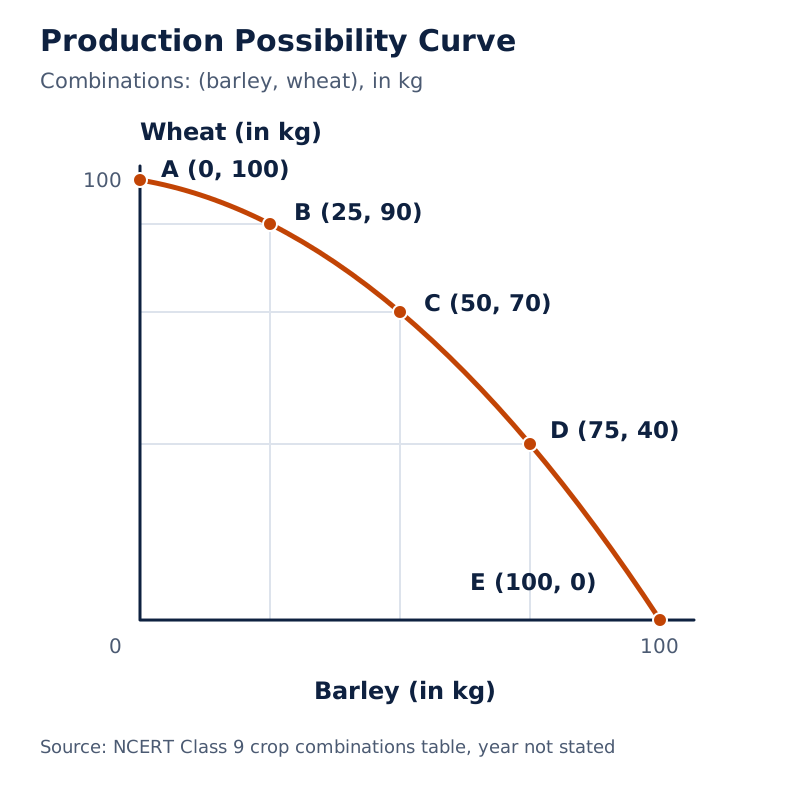
The horizontal axis is labelled Barley (in kg), and the vertical axis Wheat (in kg). Points A to E lie on a downward-sloping curve from the wheat-axis end to the barley-axis end.
Drawn by One Young India. See Fig. 8.3 in your NCERT textbook
At A, production is entirely wheat. At E, production is entirely barley. The intermediate combinations contain both crops. These are alternative combinations of output, rather than stages that every farmer must follow in a fixed sequence.
All points on the PPC show the maximum output possible through efficient resource use and avoidance of wastage. The curve therefore connects a production decision with the limits imposed by available resources.
Its usefulness lies in showing the sacrifice involved in increasing one output. Enterprises and governments can use this way of thinking for planning and decision-making. The graph does not remove scarcity; it presents the choices that scarcity makes necessary.
How can opportunity cost be worked out from crop combinations?
To compare two combinations, identify the extra barley produced and the wheat given up. The opportunity cost of the move is the lost wheat output. Keep the crop names and units attached to the numbers so that the two changes are not confused.
What happens between successive combinations?
Worked example 1. Combination A gives 0 kg of barley and 100 kg of wheat. Combination B gives 25 kg of barley and 90 kg of wheat. Find the extra barley and wheat sacrificed when moving from A to B.
Answer: Extra barley is kg. Wheat sacrificed is kg. The opportunity cost of this additional barley is 10 kg of wheat.
Worked example 2. Combination B gives 25 kg of barley and 90 kg of wheat. Combination C gives 50 kg of barley and 70 kg of wheat. Find the extra barley and wheat sacrificed when moving from B to C.
Answer: Extra barley is kg. Wheat sacrificed is kg. The opportunity cost of this additional barley is 20 kg of wheat.
Worked example 3. Combination C gives 50 kg of barley and 70 kg of wheat. Combination D gives 75 kg of barley and 40 kg of wheat. Find the extra barley and wheat sacrificed when moving from C to D.
Answer: Extra barley is kg. Wheat sacrificed is kg. The opportunity cost of this additional barley is 30 kg of wheat.
Worked example 4. Combination D gives 75 kg of barley and 40 kg of wheat. Combination E gives 100 kg of barley and 0 kg of wheat. Find the extra barley and wheat sacrificed when moving from D to E.
Answer: Extra barley is kg. Wheat sacrificed is kg. The opportunity cost of this additional barley is 40 kg of wheat.
Each comparison uses the quantities of both crops at the two chosen combinations. The results describe these particular combinations. They show why the wheat sacrifice must be calculated from the chosen pair of points rather than treated as identical for every move along the curve.
What does economics study and what do economists do?
The word Economics comes from the Greek oikonomia. It combines oikos, usually translated as household, and nemein, best translated as management. Economics therefore refers to household management, although its study extends from families to enterprises and nations.
Economic entities are participants in economic activity. They include consumers, producers, governments and financial institutions. Consumers use goods and services; producers make goods or supply services; financial institutions deal with money and finance. Economics examines how these participants interact.
What relationships are examined?
Economics considers how people work and earn wages, meaning payment for work; how wealth and resources are distributed; and how prices are determined in a market. A market is a physical or online place where products and services are bought and sold.
It also considers how education and technology encourage investment, meaning the commitment of resources for future production or returns. Government decisions and trade influence market prices and employment. These relationships affect the well-being of individuals and society.
Economists study alternatives, opportunity costs and potential outcomes to help people and institutions make decisions. Their work includes several connected activities:
| Area of work | What economists do |
|---|---|
| Policy-making | Guide governments on taxation or welfare spending. |
| Business consulting | Help firms plan growth or improve efficiency. |
| Research and education | Study economic trends and teach others. |
| Finance | Advise investors on where to invest. |
A policy is a course or principle of action adopted or proposed by an organisation or individual. Taxation raises money for government; welfare spending supports people's well-being. Business consulting means advising firms, and finance concerns the management and use of money.
These areas share an interest in choices. Advice about spending, business growth or investment becomes more useful when it considers both limited resources and the alternatives available.
Why do economic decisions need data and analysis?
Data are facts and statistics collected for reference or analysis. Good economic decisions rely on data and analysis rather than guesswork. Analysis means examining that information to understand alternatives, possible outcomes, risks and opportunities.
Families allocate money among essential items, non-essential items and savings. Essentials include food, medicines and school supplies. Non-essential purchases include jewellery, entertainment and restaurant meals. Savings are money put aside rather than spent immediately.
Governments use revenue, meaning money received, from taxation to plan spending on infrastructure and welfare programmes. Infrastructure includes facilities such as roads. Enterprises examine market trends and innovations, meaning new methods or products, to serve customers better and maximise profits.
Profit is the excess of total revenue over total costs. Economists use government reports and company financial statements, which record financial information, to study economic decisions. A survey systematically collects and analyses information about a population's conditions and behaviour.
What is the Economic Survey of India?
The Economic Survey of India is an annual document prepared by the Ministry of Finance and presented in Parliament before the Union Budget. The Union Budget is the central government's budget. The Survey reviews the country's economic performance during the past year.
It analyses agriculture, industry and services, as well as employment, inflation, education, health and infrastructure. Inflation means a rise in the general level of prices. The Survey also discusses future challenges and opportunities facing the economy.
The Survey helps people understand economic performance and the steps government may take to improve growth and development. It provides insights for policy decisions and acts as a blueprint for the upcoming Union Budget. Citizens also benefit from its clear explanation of economic data.
What should an economy produce and in what quantities?
Scarcity gives rise to three central questions: what to produce, how to produce, and for whom to produce. Together, these questions concern the products chosen, the methods used and the people who benefit from production.
What the figure shows
Key economic questions
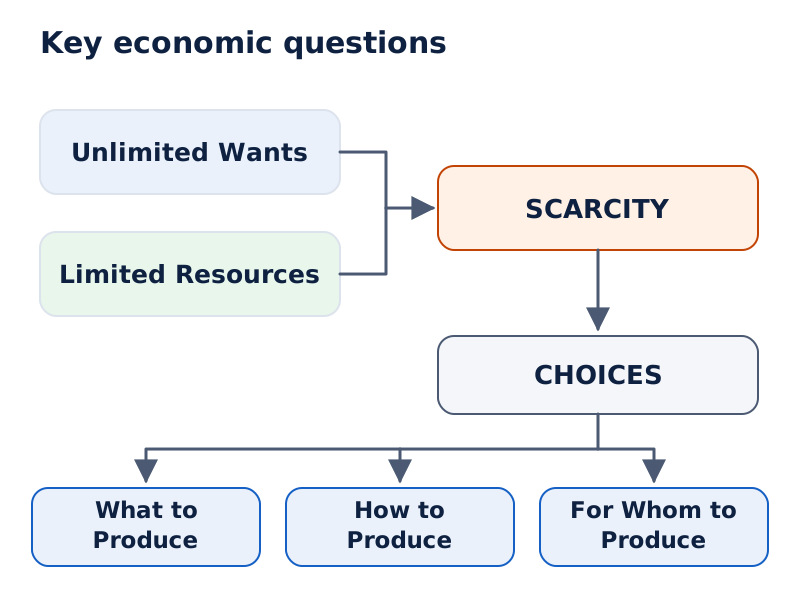
Unlimited Wants and Limited Resources lead to SCARCITY and then CHOICES. Three branches are labelled What to Produce, How to Produce and For Whom to Produce.
Drawn by One Young India. See Fig. 8.5 in your NCERT textbook
What to produce means deciding which goods and services, and what quantities of them, should be produced to meet the economy's needs over a given period. The decision must take account of competing uses of resources.
How does the crop example show a trade-off?
Farmers may choose between water-intensive crops, which require much water, such as sugarcane and paddy, and drought-resistant crops, which withstand dry conditions, such as millets and pulses. Sugarcane yields high profits and supports industries such as sugar.
Producing millets and pulses saves water, improves soil health and promotes sustainable agriculture, meaning farming that considers the continuing health and availability of its resources. Choosing sugarcane gives up gains from saved water and improved soil health.
This opportunity cost shows a trade-off between short-term economic gains and long-term sustainability. A production decision therefore involves more than the immediate benefit of the crop selected. It also concerns the benefits forgone and future consequences of resource use.
Similar trade-offs arise for companies, governments and consumers. Recognising opportunity cost makes the alternatives visible without pretending that scarce resources can meet every purpose simultaneously.
How do producers decide for whom to produce?
For whom to produce concerns the purpose of goods and services, their production and distribution, and who benefits. People differ in their needs, incomes, tastes and lifestyles. Producers decide which groups of consumers they want to serve.
Purchasing power means the ability to buy goods and services. Consumers' purchasing power and requirements influence the type of product offered. Shoes illustrate how a common product can be designed for several different groups.
How do different shoes serve different users?
| Type of footwear | Users and features |
|---|---|
| School shoes | For students; usually simple in design, durable and affordable. |
| Office-wear shoes | For working professionals; emphasise comfort, formal appearance and quality, often using leather or polished materials. |
| Sports shoes | For athletes and fitness enthusiasts; special rubber soles and lightweight materials provide grip, flexibility and support. |
| Casual shoes or slippers | For daily use; need to be comfortable yet affordable. |
The intended users also affect the materials selected. Leather shoes are generally targeted at office-goers and high-income customers. Rubber or synthetic shoes are aimed at sports players, factory workers or people needing affordable, durable footwear. Synthetic materials are human-made materials.
Producers examine what consumers like, how much money they have and the demand for the product. Demand concerns what buyers are willing and able to buy. These considerations connect the intended consumers with decisions about what to make.
Choosing suitable products and materials helps use limited resources well and avoid waste. The question is therefore about more than naming a group: it links people's requirements and means with the purpose and characteristics of production.
How is the method of production chosen?
How to produce means deciding which methods, resources and technologies will be used. A producer must select a suitable combination of land, labour, capital and technology. One decision is whether to automate processes or employ more labour.
Automation uses machines and technology to perform production tasks. Labour-intensive production uses more workers and less machinery. Capital-intensive production uses more machinery and technology and fewer workers. The choice depends on costs, technology and the product's nature.
Usually, agriculture and handicrafts rely more on labour, whereas steel and automobile manufacturing depend more on machinery. This comparison does not establish one method as appropriate for every producer. The availability and relative costs of resources also influence decisions.
What choices face a garment manufacturer?
Manual production relies on human work; mass production makes goods in large quantities. Incentives are measures that encourage a particular action. In the garment example, incentives for machinery can influence the producer's decision alongside labour laws.
| Consideration | Effect on the production choice |
|---|---|
| Cost of machinery | Expensive machines encourage reliance on labour; affordable machines may encourage a shift to automation. |
| Available technology | Advanced technology encourages machine use; limited technology leads to manual production. |
| Nature of clothing | Customised or designer clothes require skilled labour; mass-produced garments are better suited to machines. |
| Labour availability and cost | Cheap, easily available labour favours labour-intensive methods; costly or scarce labour makes machines more efficient. |
| Laws and regulations | Labour laws and incentives for machinery also influence the choice. |
The manufacturer therefore considers several conditions together. Affordable machines may lead to automation, but the nature of the garment still matters. A decision about designer clothing involves skilled labour, while the production of large quantities is better suited to machines.
The three economic questions are connected: the product and intended users influence suitable methods, while available resources affect what can be produced.
How does a planned economy make economic decisions?
An economic system defines how goods, services and resources are produced, consumed and distributed. Economic systems differ in how resources are organised and who controls decisions. A planned economy places major economic decisions with a central government planning authority.
This authority, such as a planning commission, decides what will be produced, how much will be produced, the methods used, who will use the output and at what prices. Resource allocation and prices are therefore determined by government.
How are ownership and enterprise activity organised?
Government owns most resources and sectors, including land, factories, banks and transport. Ownership concerns who possesses and controls resources. Private ownership is limited. Enterprises usually follow the central authority's targets rather than market demand.
Enterprises are heavily regulated through strict permits and licences to produce goods and services. Regulation means control through rules and requirements. Permits and licences are permissions required for the relevant activity. These controls restrict the number of enterprises operating in the market.
This limits competition, meaning rivalry among enterprises offering goods and services. There is consequently little motivation for enterprises to improve quality or innovate. The restriction on competition is connected to the controls on enterprise activity.
Examples of planned economies include the former Soviet Union, North Korea and Cuba. The important features are the central authority's major decisions, government ownership of most resources, limited private ownership, and production targets that enterprises usually follow.
Note: Government ownership of most resources is not the same claim as government ownership of every resource. Limited private ownership remains part of this description of a planned economy.
How does a market economy differ from a planned economy?
A market economy relies mainly on demand and supply to answer what, how and how much to produce, with little government intervention. Supply concerns what producers offer for sale. Market forces are the interaction of buyers' demand and producers' supply.
Factories, shops, land and other resources largely belong to individuals and private companies. Many producers offer similar products. This competition encourages better quality, lower prices and innovation in the production of goods and services.
What role does government retain?
Often, government acts like a referee in a football match. It ensures safety and law and order without controlling production or prices. Its role includes providing public goods and physical infrastructure. Government still plays an important role even in these economies.
Public goods are goods and services available to all without exclusion; their use by some people does not prevent others from using them. Examples include parks, roads, police services, street lights and basic education.
| Feature | Planned economy | Market economy |
|---|---|---|
| Major decisions | Made by a central government planning authority. | Made mainly through demand and supply. |
| Resource ownership | Government owns most resources; private ownership is limited. | Resources largely belong to individuals and private companies. |
| Competition | Strict controls restrict competition among private enterprises. | Many producers encourage quality improvements, lower prices and innovation. |
Prominent examples of market economies include the United States of America, Japan and Hong Kong. These examples do not imply an absence of government. The distinction concerns the main way economic choices are made and resources are allocated.
Keeping words such as mainly, largely and often matters when describing this system. Market decisions and a continuing government role can exist together.
How do mixed economies work and how has India changed?
A mixed economy combines features of planned and market economies. Government, private individuals and enterprises all play important roles in economic choices. The government and private sector coexist and compete, while private enterprises are regulated by government.
The private sector consists of enterprises under private ownership; the public sector consists of enterprises under government ownership. Large public sector companies also play a very important role in the market within a mixed economy.
How are government and market roles combined?
What the figure shows
Government and market in a mixed economy
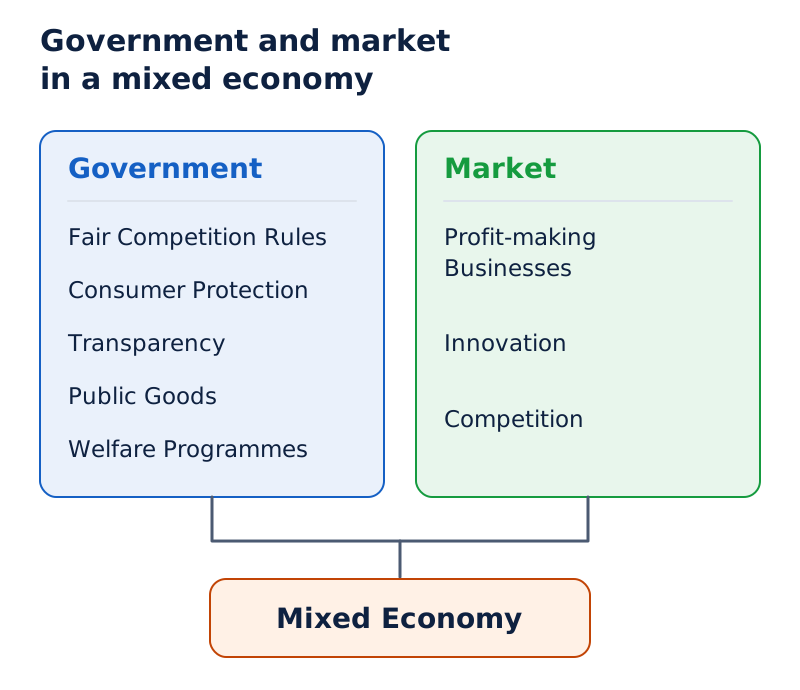
The Government branch lists Fair Competition Rules, Consumer Protection, Transparency, Public Goods and Welfare Programmes. The Market branch lists Profit-making Businesses, Innovation and Competition. Both connect to Mixed Economy.
Drawn by One Young India. See Fig. 8.8 in your NCERT textbook
Consumer protection concerns safeguarding consumers; transparency means openness in actions and information. Together with rules for fair competition, public goods and welfare programmes, these describe government functions alongside private business activity.
In reality, most economies have mixed features, permitting private ownership with some government regulation. Examples include India after 1991, China after 1978, Germany and Sweden. Even market economies such as the United States of America and Singapore have significant government involvement.
What changed in India around 1991?
In the decades after Independence, India followed a more state-led approach, meaning an approach in which government played a major directing role, similar to a planned economy. Government controlled industries, allocated resources and regulated production through licences and permits.
Banking, transport and heavy industries were among the key sectors dominated by the public sector. By 1991, India faced serious economic difficulties. Government introduced major economic reforms, meaning changes to economic policies and arrangements.
The reforms reduced excessive regulation, encouraged private enterprise, opened the economy to global trade and investment, and increased competition. These changes gradually moved India towards a more market-oriented system while retaining an important government role.
A mixed economy therefore combines decision-making mechanisms. It does not remove scarcity or the need to answer the three central questions. Most modern economies combine market and planned elements in deciding how resources will be produced, distributed and used.
Glossary
- Needs — Essential requirements of life, including food, water and shelter.
- Wants — Preferences such as gadgets, vacations and luxury items that are unlimited and keep changing.
- Resources — Natural or human-made factors used to produce goods and services.
- Scarcity — The mismatch between unlimited human wants and limited available resources.
- Opportunity cost — The value of what is given up when an alternative is chosen.
- Production Possibility Curve — A curve showing combinations of goods producible using all available resources.
- Economy — A system of production, distribution, trade and consumption within an area such as a country.
- Market — A physical or online place where products and services are bought and sold.
- Economic entities — Participants in economic activity, such as producers, consumers, government and enterprises.
- Data — Facts and statistics collected together for reference or analysis.
- Labour-intensive production — A production method using more workers and less machinery.
- Capital-intensive production — A production method using more machines and technology and fewer workers.
- Planned economy — An economic system in which government determines resource allocation and prices of goods and services.
- Market economy — An economic system in which market forces primarily determine resource allocation and prices.
- Mixed economy — An economic system combining market and planned features, with private enterprises and government playing important roles.
Common errors and misconceptions
- Misconception: Every preference is an essential need. Correct: Needs include food, water and shelter; wants include preferences such as gadgets, vacations and luxury items.
- Misconception: Scarcity concerns money alone. Correct: Natural and human-made resources are limited, and resources such as land, water and labour have competing uses.
- Misconception: Opportunity cost is the benefit of the chosen option. Correct: It is the value of what is forgone when that option is chosen.
- Misconception: Moving towards more barley on the illustrated PPC also increases wheat. Correct: Moving from A towards E increases barley and reduces wheat.
- Misconception: A planned economy means government owns every resource. Correct: Government owns most resources, while private ownership is limited.
- Misconception: Market economies have no government role. Correct: They rely mainly on market forces, but governments still play an important role.
- Misconception: India's reforms removed government from the economy. Correct: The reforms gradually increased market orientation while retaining an important role for government.
Exam-style questions with model answers
Q1. Define opportunity cost. A student has ₹100 and chooses to buy a notebook instead of saving that money towards a tennis racket later. Identify the forgone alternative. [2 marks]
- Opportunity cost is the value of what is given up when one alternative is chosen.
- The forgone alternative is saving the ₹100 towards a tennis racket later.
Q2. A farmer moves from combination B, producing 25 kg of barley and 90 kg of wheat, to combination C, producing 50 kg of barley and 70 kg of wheat. Calculate the additional barley, calculate the wheat sacrificed, and explain the opportunity cost. [3 marks]
- The additional barley is 50 minus 25, which gives 25 kg. This is the increase in barley output between the two combinations.
- The wheat sacrificed is 90 minus 70, which gives 20 kg. Wheat production falls as barley production rises.
- The opportunity cost of producing the additional 25 kg of barley is the 20 kg of wheat forgone.
Q3. Define the Production Possibility Curve. State the barley-and-wheat graph's axis labels and explain what its downward slope and points on the curve represent. [4 marks]
- The Production Possibility Curve shows different combinations of goods that can be produced using all available resources.
- Barley in kilograms is shown on the horizontal x-axis, while wheat in kilograms is shown on the vertical y-axis.
- The downward slope shows a trade-off: producing more barley involves sacrificing some wheat with the available resources.
- Points on the curve show maximum output through efficient use of resources and avoidance of wastage.
Q4. A farmer chooses between sugarcane, which yields high profits and supports the sugar industry, and millets and pulses, which save water, improve soil health and promote sustainable agriculture. Explain the production decision and its opportunity cost in three points. [3 marks]
- The farmer faces the question of what to produce: which crops should use the available resources to meet economic needs.
- Choosing sugarcane offers high profits and supports the sugar industry, but gives up the gains from saved water and improved soil health associated with millets and pulses.
- The choice therefore involves a trade-off between short-term economic gains and long-term sustainability, making opportunity cost relevant to the decision.
Q5. A garment manufacturer finds machines expensive, technology limited, skilled workers necessary for designer clothes, and labour cheap and easily available. Government labour laws and incentives for machinery also apply. Explain five considerations influencing the choice of production method. [5 marks]
- The cost of machinery matters. Expensive machines encourage reliance on labour; if machines become affordable, the manufacturer may shift towards automation.
- The level of technology matters. Limited technology leads towards manual production, whereas advanced technology encourages the use of machines in production processes.
- The nature of the product matters. Designer clothes require skilled labour, while mass-produced garments are better suited to machines and machine-based production methods.
- Labour availability and cost matter. Cheap and easily available labour favours labour-intensive production, which uses more workers and less machinery in the production process.
- Government rules matter. Labour laws and incentives for machinery influence the manufacturer's decision alongside costs, technology, product requirements and the availability of workers.
Q6. Explain five features of a planned economy, covering decision-making, ownership, production targets, regulation and competition. [5 marks]
- A central government planning authority makes all major economic decisions, including what and how much to produce, production methods, users of output and prices.
- Government owns most resources and sectors, including land, factories, banks and transport. Private ownership exists on a limited scale within this economic system.
- Enterprises usually follow targets set by the central authority rather than market demand. Production choices therefore reflect the authority's planning decisions and assigned targets.
- Strict permits and licences heavily regulate enterprises producing goods and services. These requirements restrict the number of enterprises that can operate in the market.
- Restricted enterprise activity limits competition among private enterprises. As a result, there is little motivation for firms to improve quality or introduce innovations.
Q7. Explain three ways in which the Economic Survey of India supports understanding and decision-making. [3 marks]
- It reviews India's economic performance during the past year and analyses sectors such as agriculture, industry and services, alongside other important economic areas.
- It discusses future challenges and opportunities and provides policymakers with insights, acting as a blueprint for the upcoming Union Budget.
- It explains economic data clearly for citizens, helping them understand economic performance and steps the government may take to improve growth and development.
Q8. Explain India's movement towards a more market-oriented mixed economy around 1991 in five points. Include the earlier approach, the trigger for reforms, the changes and the continuing government role. [5 marks]
- After Independence, India followed a more state-led approach similar to a planned economy, with government playing a major role in controlling industries and allocating resources.
- Production was regulated through licences and permits, while the public sector dominated key areas such as banking, transport and heavy industries in the economy.
- By 1991, serious economic difficulties led the government to introduce major economic reforms in response to the country's changing needs and challenges at that time.
- The reforms reduced excessive regulation, encouraged private enterprise, opened the economy to global trade and investment, and increased competition among participants in the economy.
- The changes gradually shifted India towards a more market-oriented system while retaining an important government role, combining market activity with continuing public involvement.
Key takeaways
- Unlimited, changing wants and limited resources make economic choices necessary for individuals, enterprises and governments.
- Opportunity cost is the value forgone when a decision assigns resources to one use instead of an alternative.
- The barley-and-wheat PPC illustrates the sacrifice of wheat needed to produce more barley using available resources.
- Economists use data and analysis to examine alternatives, opportunity costs, potential outcomes, risks and opportunities.
- Every economy must address what to produce, how to produce and for whom to produce.
- Production methods depend on costs, technology, product characteristics, resource availability and the country's laws and regulations.
- Planned economies rely on central government decisions, while market economies rely mainly on demand and supply.
- Mixed economies combine market and planned features; India's reforms increased market orientation while retaining an important government role.
Test yourself
What distinguishes needs from wants?
Needs are essentials such as food, water and shelter; wants include gadgets, vacations and luxury items.
What makes a resource scarce?
Its limited availability compared with unlimited wants creates scarcity and requires choices between competing uses.
Which crop is on each axis of the barley-and-wheat PPC?
Barley in kilograms is on the horizontal x-axis; wheat in kilograms is on the vertical y-axis.
A move from 75 kg barley and 40 kg wheat to 100 kg barley and 0 kg wheat sacrifices how much wheat?
It sacrifices 40 kg of wheat to produce an additional 25 kg of barley.
Which four factors of production are identified?
The four factors of production are land, labour, capital and technology.
Who prepares the Economic Survey of India, and when is it presented?
The Ministry of Finance prepares it annually, and it is presented in Parliament before the Union Budget.
Why is a market economy not an economy without government?
Government still plays an important role, including ensuring safety and law and order and providing public goods and infrastructure.
What was the direction of India's economic reforms?
They gradually increased market orientation through reduced regulation, private enterprise, global trade and investment, and competition, while retaining an important government role.
Write about it
Turn a question from this chapter into a paper.
The Writing Studio has a structure guide, a rubric and citation tools for 15 formats, from essays to research papers. Drafting is free with an account. Learnacy Essential adds feedback from an AI writing coach and submission to The OYI Review.
Learnacy Essential is ₹1,499 for the year. Publication depends on review and is not guaranteed.