
The Price Puzzle: What Drives the Market | CBSE Class 9 Economics Notes
On this page
This note covers demand, supply, their determinants, individual and market schedules, price determination, market equilibrium, changing market conditions, government regulation, public goods, and the limitations of government intervention.
What is demand, and how does price affect it?
Definition: Demand is the quantity of a product that people are willing and able to buy at a particular price, depending on their needs, preferences, season, trend, and income.
A wish to own something is not enough to create demand. The buyer must also have the ability to pay. Purchasing power measures how much one unit of a particular currency can buy at a particular time.
The law of demand describes an inverse relationship: when a product's price rises, its quantity demanded decreases; when its price falls, quantity demanded increases. An inverse relationship means that the two move in opposite directions, with other factors such as income and taste held constant.
How does Srivalli's mango purchase illustrate demand?
At the beginning of the mango season, prices are generally high and people tend to buy smaller quantities. As prices fall, people prefer larger quantities. Srivalli buys 1 kilogram at ₹150 per kilogram, 2 kilograms at ₹100, and 3 kilograms at ₹50.
The symbol ₹ denotes rupees, and kg means kilogram, the unit of quantity used for mangoes. Individual demand is what one consumer wants to buy at different prices, keeping other factors constant. A demand schedule presents these price and quantity pairs in a table.
| Price of mangoes per kg | Quantity demanded by Srivalli |
|---|---|
| ₹150 | 1 kg |
| ₹100 | 2 kg |
| ₹50 | 3 kg |
What the figure shows
Individual demand
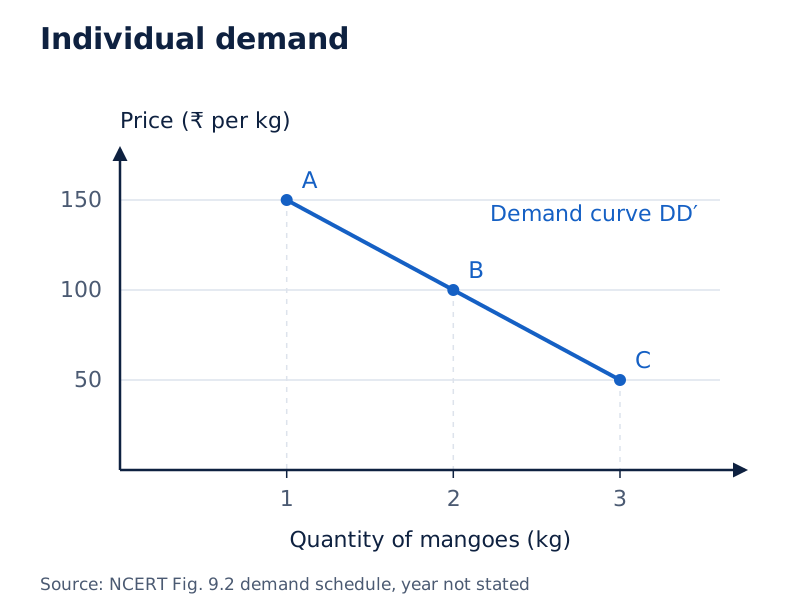
The vertical axis shows mango prices in rupees; the horizontal axis shows quantity in kilograms. Points A, B, and C mark 1 kg at ₹150, 2 kg at ₹100, and 3 kg at ₹50. The downward line DD′ is the demand curve, the graphical representation of the schedule.
Drawn by One Young India. See Fig. 9.2 in your NCERT textbook
Here A, B, and C label plotted points, while DD′ labels the demand line. Reading the graph requires pairing each quantity with its corresponding price. The downward slope represents the same relationship as the schedule, rather than an additional set of purchases.
How is market demand different from individual demand?
Market demand is the total quantity demanded by all potential buyers at different prices. It combines individual demands at each price. Srivalli's purchases alone show individual demand; adding Alex's and Israt's purchases gives market demand for this three-consumer example.
Let Q₁, Q₂, and Q₃ denote quantities demanded by Srivalli, Alex, and Israt respectively, and Qᴅ denote market quantity demanded. All quantities here are in kilograms. The sign + means addition, and = means equality.
| Price | Q₁: Srivalli | Q₂: Alex | Q₃: Israt | Market demand Qᴅ |
|---|---|---|---|---|
| ₹150 | 1 kg | 2 kg | 3 kg | 6 kg |
| ₹100 | 2 kg | 4 kg | 6 kg | 12 kg |
| ₹50 | 3 kg | 6 kg | 9 kg | 18 kg |
How do we combine the purchases?
Worked example 1. At ₹100 per kg, Srivalli demands 2 kg, Alex 4 kg, and Israt 6 kg. Find their market demand.
Answer: Market demand is at ₹100 per kg. Add quantities at the same price, rather than purchases from different price rows.
What the figure shows
Individual and market demand
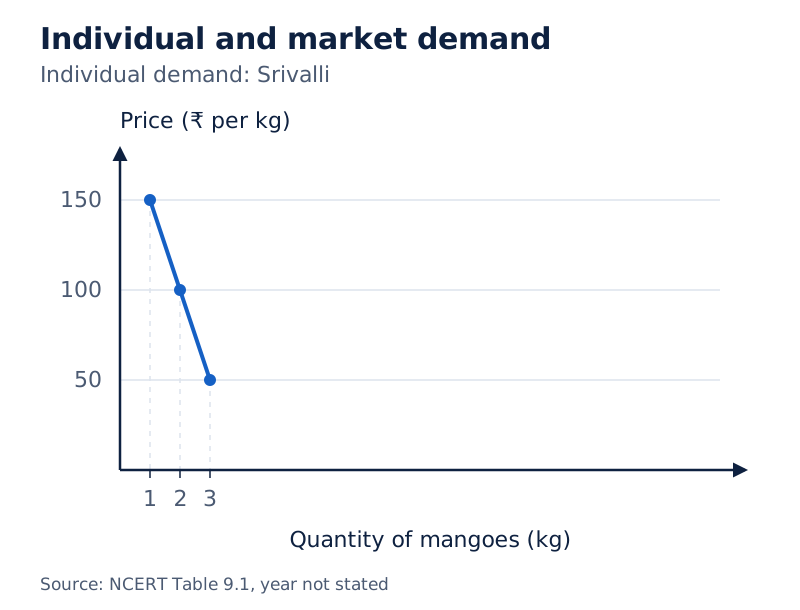
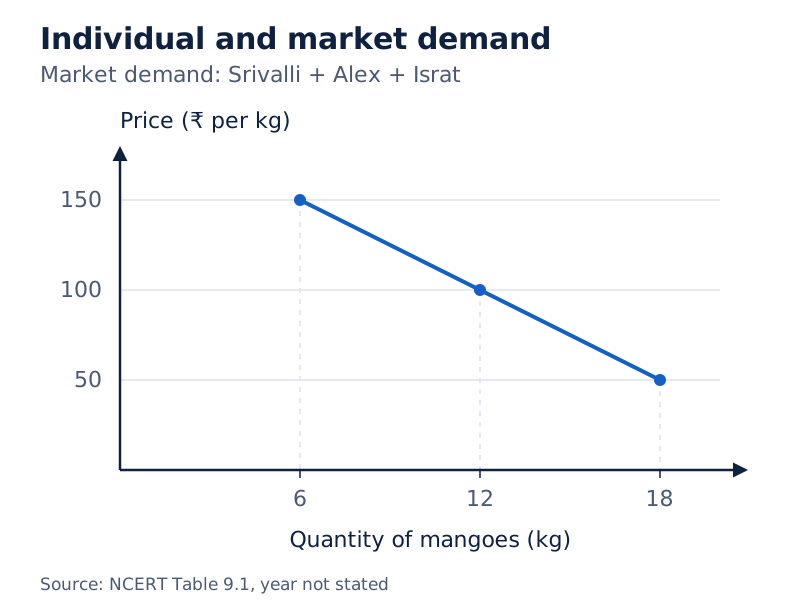
Two graphs show price vertically and quantity horizontally. The individual graph plots Srivalli's quantities of 1, 2, and 3 kg. The market graph plots 6, 12, and 18 kg at prices of ₹150, ₹100, and ₹50 respectively. Both demand lines slope downwards.
Drawn by One Young India. See Fig. 9.3 in your NCERT textbook
The market curve in this example is flatter than Srivalli's curve. The same price change produces a larger total quantity response because several consumers' purchases are combined. When price falls from ₹150 to ₹50, Srivalli's demand increases by 2 kg, while market demand increases by 12 kg.
This comparison keeps the price change the same for both curves. It shows why a single buyer's response and the combined response of buyers need to be distinguished when explaining the demand facing sellers in a market.
Which factors change demand besides the product's own price?
Related goods are products whose demand is interconnected: a change in the price or availability of one directly affects demand for the other. Their relationship helps explain why demand can change even when a product's own price remains the same.
How do substitutes and complements differ?
| Type | Meaning | Example and effect |
|---|---|---|
| Substitute goods | Goods that can replace one another | If coffee becomes more expensive while tea's price stays unchanged, coffee consumers may switch to tea. |
| Complementary goods | Goods generally used together to provide usefulness to the consumer | If movie tickets become more expensive, people may avoid the cinema, and demand for cinema popcorn may also fall. |
Consumers tend to replace a more expensive good with a relatively cheaper alternative. If Srivalli cannot afford mangoes, she may buy bananas. For complementary goods, an increase in demand for printers may also raise demand for printer cartridges even when cartridge prices are unchanged.
How do income, tastes, and population matter?
Higher household income enables consumers to buy more or choose better-quality products. An income rise generally increases confidence about spending, so quantity demanded for several goods rises even at unchanged prices. This does not mean that every good must experience higher demand.
Tastes and preferences are consumers' particular likes and choices. Srivalli likes mangoes and cannot substitute them with oranges, even when oranges are cheaper. A possible substitute therefore does not erase the role of personal preferences in a buying decision.
Population size and composition also shape demand. India's large domestic consumer demand contributes to economic growth. More children indicate greater demand for sports shoes; more working adults mean greater demand for formal shoes; more elderly people imply greater demand for comfortable shoes.
Utility means usefulness. The diminishing marginal utility principle says that additional usefulness declines as more of a product is consumed. Successive mangoes become less appealing; as their additional usefulness falls, willingness to pay also decreases, so demand falls.
How do seasons and expectations affect current demand?
Seasonality means that demand changes at different times of the year. Individuals may want different products as weather, festivals, and cultural habits change. These changes often depend on those conditions rather than on the product's price.
Bookshops become crowded at the start of a new academic session. Sweet shops attract customers during festivals. Sweaters and jackets are demanded during winter. Each example connects a change in demand with the timing of people's needs or preferences.
Why might buyers postpone or advance purchases?
Future price expectations are beliefs about whether prices will rise or fall. They influence current demand even when today's prices have not changed. Buyers expecting a price fall postpone purchases, reducing present demand. Buyers expecting a rise purchase immediately, increasing present demand.
People delay buying durables, meaning products intended for lasting use, before Diwali or the New Year because they expect festival discounts. The relevant change is their expectation about a future price, rather than an actual fall in the current price.
| Expected change | Buying decision | Effect on present demand |
|---|---|---|
| Prices expected to fall | Postpone purchases | Present demand decreases |
| Prices expected to rise | Buy immediately | Present demand increases |
Note: The law of demand examines price and quantity demanded while other factors remain constant. Income, preferences, seasonality, and expectations explain why demand can also change without a change in the product's own current price.
A new popular smartphone can attract queues and advance bookings even at a higher price. To understand such purchases, consider the factors affecting demand together. Price matters, but it is not the only influence on what consumers are willing and able to buy.
What is supply, and how is market supply calculated?
Definition: Supply is the quantity of a product that sellers are willing and able to offer at a particular price. Individual supply refers to the quantities offered by one seller at different prices.
The law of supply describes a direct relationship: quantity supplied increases as price increases and falls as price decreases. Higher prices increase profitability, the scope to earn profit. Profit is sales earnings remaining after costs. This encourages producers to increase output and attracts new firms to the market.
Market supply is the sum of individual supplies. In the mango example, seller A supplies 1 kg at ₹50 per kg, 2 kg at ₹100, and 3 kg at ₹150. Combining the offers of sellers A, B, and C gives the following schedule.
Here A, B, and C identify sellers; Qₛ denotes their combined quantity supplied. All seller quantities in this table are in kilograms.
| Price | Seller A | Seller B | Seller C | Market supply Qₛ in kg |
|---|---|---|---|---|
| ₹50 | 1 | 3 | 2 | 6 |
| ₹100 | 2 | 4 | 6 | 12 |
| ₹150 | 3 | 7 | 8 | 18 |
How is the total found at one price?
Worked example 2. At ₹150 per kg, seller A supplies 3 kg, seller B supplies 7 kg, and seller C supplies 8 kg. Calculate market supply.
Answer: Add all three sellers' quantities at ₹150 per kg: . The market supply is therefore 18 kg at that price.
What the figure shows
Individual and market supply
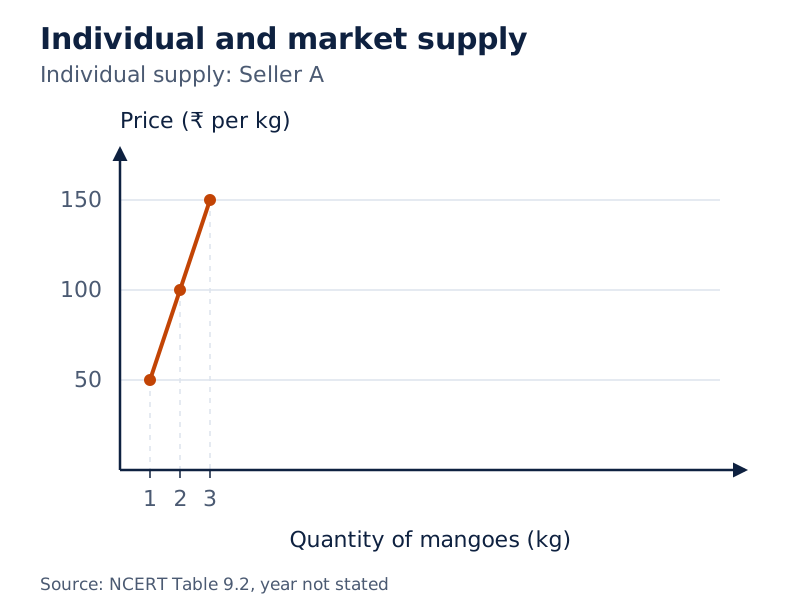
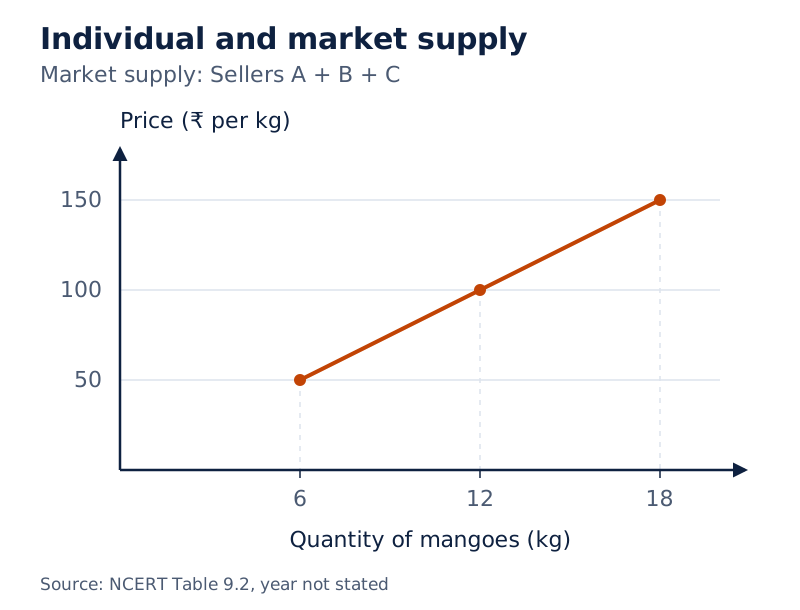
Both graphs place price on the vertical axis and mango quantity on the horizontal axis. Seller A's curve rises through 1, 2, and 3 kg at ₹50, ₹100, and ₹150. The market curve rises through 6, 12, and 18 kg at those prices.
Drawn by One Young India. See Fig. 9.5 in your NCERT textbook
At the beginning of the mango season, supply is low and mangoes are costly. Supply increases in mid-season and prices fall. The supply schedule describes sellers' responses to prices; the seasonal example shows that market prices also depend on available supply interacting with demand.
Which other factors influence supply?
A product's own price is not the only influence on its supply. The profitability of alternatives, number of sellers, technology, and future expectations also matter. Input costs, the costs of resources used in production, and conditions such as weather affect supply as well.
How do alternative products and technology affect production?
The prices of related goods influence a producer's choice. If wheat prices are low and chickpea prices high, a farmer will grow more chickpeas in the next season. Supply decisions therefore depend on what alternative products offer the supplier.
Improved technology reduces production costs, allowing producers to produce and supply more, and vice versa. With drip irrigation and weather sensors, crop production may rise. Cold storage during mango transport to distant markets increases market supply.
What the figure shows
Prices affecting supply decisions
The illustration places low wheat prices and lower profit on the left, and high chickpea prices and higher profit on the right. Central signposts show a farmer choosing between wheat and chickpeas, including the question of more chickpeas next season.
See Fig. 9.6 in your NCERT textbook
How do sellers and expectations change supply?
In the case where more sellers and increased production make market supply exceed demand, prices fall. Likewise, with fewer sellers, supply would be lower than demand and prices would rise. The comparison between supply and demand is essential to explaining the price outcome.
If producers expect a boom in demand, they produce more and supply rises. If they expect lower demand, they reduce production and supply falls. Expectations can also affect when existing goods are offered for sale.
Potato wholesalers who expect higher prices during the peak season might hold back supply now to sell later at higher prices. This example concerns the timing of supply. It differs from increasing production in anticipation of stronger future demand.
When analysing supply, identify the change first, then connect it to the producer's decision. A change in technology affects production conditions; a change in alternative crop prices affects what is grown; an expectation of higher prices may affect when goods reach buyers.
How do demand and supply determine market equilibrium?
Market prices emerge from interaction between what buyers are willing to pay and what sellers are willing to accept. Market equilibrium is the point at which quantity demanded equals quantity supplied. There is neither excess demand nor excess supply at that price.
A shortage, or excess demand, occurs when quantity demanded exceeds quantity supplied. A surplus, or excess supply, occurs when quantity supplied exceeds quantity demanded. The comparison must be made at the same price.
In the following schedule, Qᴅ means quantity demanded and Qₛ means quantity supplied, both in kilograms. The sign < means less than, and > means greater than. These quantities belong to this equilibrium example.
| Price in ₹ | Quantity demanded Qᴅ in kg | Quantity supplied Qₛ in kg | Relationship | Outcome |
|---|---|---|---|---|
| 40 | 38 | 6 | Qₛ < Qᴅ | Excess demand |
| 100 | 12 | 12 | Qₛ = Qᴅ | Market equilibrium |
| 150 | 8 | 43 | Qₛ > Qᴅ | Excess supply |
How do we identify the equilibrium row?
Worked example 3. At prices of ₹40, ₹100, and ₹150, demand is respectively 38, 12, and 8 kg, while supply is respectively 6, 12, and 43 kg. Find equilibrium.
Answer: At ₹100, . The equilibrium price is ₹100 and equilibrium quantity is 12 kg. The ₹40 row shows excess demand, while the ₹150 row shows excess supply.
What the figure shows
Market equilibrium
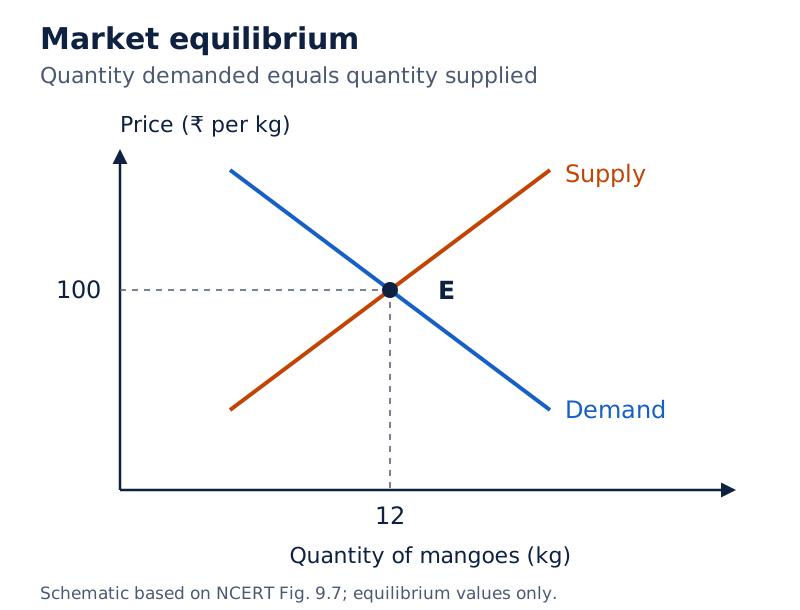
A downward demand line and an upward supply line meet at E, the equilibrium point. Dashed guides connect E to ₹100 on the vertical price axis and 12 kg on the horizontal quantity axis.
Drawn by One Young India. See Fig. 9.7 in your NCERT textbook
At equilibrium, the market is cleared: there is no shortage or surplus and no pressure for price to change. Prices tend to remain stable unless external factors change. The equilibrium price is the matching price; the equilibrium quantity is the quantity both sides accept there.
When supply is less than demand, prices rise; when supply exceeds demand, prices fall. Equilibrium brings the quantities into balance.
How should a demand and supply data exercise be read?
Read each schedule using its own quantities and labels. Do not transfer numbers from a previous mango example into a new dataset. Start by matching demand and supply at each price, then identify equality, excess supply, or excess demand.
The following exercise uses Q.D. for quantity demanded and Q.S. for quantity supplied. Both are measured in kilograms. Its values are:
| Price in ₹ | Q.D. in kg | Q.S. in kg |
|---|---|---|
| 10 | 5 | 25 |
| 20 | 10 | 20 |
| 30 | 15 | 15 |
| 40 | 20 | 10 |
| 50 | 25 | 5 |
What conclusions follow from these values?
Worked example 4. In this exercise, at ₹20 demand is 10 kg and supply is 20 kg; at ₹30 both are 15 kg; at ₹40 demand is 20 kg and supply is 10 kg. Identify the three outcomes.
Answer: At ₹20, supply exceeds demand, giving a surplus. At ₹30, both quantities are 15 kg, giving equilibrium. At ₹40, demand exceeds supply, giving a shortage. The equilibrium price is ₹30 and the equilibrium quantity is 15 kg.
Note: In this dataset, the listed quantity demanded rises and quantity supplied falls as price rises. These directions differ from the laws of demand and supply explained earlier. Interpret the given rows as they stand; do not interchange their labels or change their values.
The equality test still identifies the matching quantities. Distinguish that numerical comparison from a claim about the usual slopes described by the laws. A correct reading of the table reports what its numbers show without treating its unusual directions as the general rule.
Why does equilibrium keep changing in real markets?
In theory, equilibrium is the intersection of demand and supply. Real markets are dynamic, meaning that conditions and prices keep changing. Technology, wages, interest rates, wars, political events, pandemics, weather, and natural disasters alter demand and supply.
Real-world equilibrium is never stable and moves all the time. Markets keep adjusting towards a new equilibrium rather than fully settling at the previous one. A balanced quantity at one moment does not remove the influences that can change buying and selling decisions.
What happened to face masks during the pandemic?
- During the COVID-19 pandemic in 2020, demand for face masks increased rapidly.
- Supply could not catch up immediately, so mask prices rose significantly.
- Over time, suppliers adjusted to the increased demand and prices fell.
- Once the pandemic was over, demand reduced further and prices returned to pre-pandemic levels.
Why can the same hotel room have different tariffs?
A tariff here means the price charged for a hotel room. Consider a hotel in Goa with 100 rooms. Its room prices differ with season and demand, even though the example concerns the same hotel.
| Situation | Room tariff per night |
|---|---|
| Off-season weekday: Monday in July | ₹1,500 |
| Tourist-season weekend: Saturday in December | ₹8,000 |
| New Year's Eve: very high demand | ₹25,000 |
If a group tour cancels, the hotel may reduce its tariff by 40 per cent overnight to fill empty rooms. Per cent means out of a hundred. Hotels may also change tariffs several times a day to earn maximum revenue.
Revenue is money earned from sales or other operating activities before expenses are deducted. Hotel pricing considers the speed of bookings, nearby hotels' tariffs, local festivals, conferences or events, weather forecasts, days remaining before arrival, and past booking trends.
Present choices can also affect future supply. High demand for fast fashion, overfishing, and overuse of groundwater can harm future supply. Long-term sustainability involves considering future resources as well as immediate gains when thinking about market outcomes.
Why does the government regulate markets?
India has a market-based, regulated economy: prices depend on demand and supply, while government also plays a role. Markets allocate goods according to willingness and ability to pay. They do not always produce fair outcomes, especially when essential medicines become too expensive.
Government intervention means government action affecting how markets operate. It can protect consumers, workers, and producers from exploitation and injustice. Fairness in allocation matters particularly for vulnerable and low-income groups whose welfare may be threatened by unaffordable essentials.
How do price ceilings and price floors differ?
| Control | Meaning | Example or condition |
|---|---|---|
| Price ceiling | The maximum price a seller is permitted to charge | Maximum prices for essential medicines prevent overcharging. |
| Price floor | An imposed lower limit on price | A minimum wage sets a lower limit on workers' pay. An effective price floor must be above the market equilibrium price. |
A monopoly is a market structure in which a single seller or producer controls the entire supply of a unique product or service with no close substitutes. This gives the seller significant power over price and output.
When a single or a few sellers dominate a market, they can charge more and supply less than a competitive market would. Such dominance may bring higher prices, poorer quality, and restricted supply. Government regulates these practices by keeping prices and supplied quantities in check.
Which Indian regulators help ensure transparency?
- The Reserve Bank of India (RBI) regulates banking.
- The Central Consumer Protection Authority addresses violations of consumer rights and unfair trade practices.
- The Telecom Regulatory Authority of India (TRAI) regulates the telecommunications sector.
- The Securities and Exchange Board of India (SEBI) regulates the securities market.
What does the sanitiser example show?
During COVID-19, sanitiser demand surged, stocks ran out, and prices rose sharply. Some shopkeepers began hoarding, accumulating goods beyond immediate needs, typically because of expected shortages, price increases, or speculative motives. Some also engaged in black marketing, the illegal trade in banned or regulated goods and services.
The government declared sanitisers essential commodities under the Essential Commodities Act, 1955, and capped the maximum retail price at ₹100 for 200 ml bottles. Here ml means millilitre, a unit of liquid volume. Many companies began production, and sanitisers soon became widely available at fair prices.
Why are public goods provided by the government?
Public goods are goods and services provided by government for citizens' collective benefit. Roads, bridges, public parks, streetlighting, national defence, sanitation, and drainage are examples. Their provision supports public use, security, and improved living conditions.
Private companies usually do not provide these goods because they do not generate direct profit. The problem is not that people receive no benefit. Instead, a service may benefit many people while failing to attract enough voluntary payment to finance its provision.
What does the neighbourhood park example explain?
Suppose a neighbourhood needs a park that is expensive to build. If each family contributed ₹5,000, it could be built. However, many families may expect to use the park after other people have paid for it.
- Many families would benefit from having the park in their neighbourhood.
- The proposed contribution is ₹5,000 from each family to finance construction.
- Families may expect others to contribute and decide not to pay themselves.
- Not enough money is collected, so the park is never built despite the shared need.
This explains why goods benefiting everyone often require government provision or funding. Such action helps ensure social welfare, economic development, and equal access to essential services. The collective benefit can be substantial even when individual payments do not cover provision.
The government's role therefore extends beyond controlling prices. It also supplies services that support everyday life and shared needs. Streetlights, drainage, and national defence illustrate different benefits, from local living conditions to protection against external threats.
What are the limitations of government intervention?
Government regulation is required when markets are inefficient, but it must be implemented carefully. Excessive intervention can have adverse effects. Measures intended to improve welfare need to be understood alongside their effects on producers, small businesses, and future investment.
How can price controls reduce incentives?
If a maximum wheat price is fixed at ₹20 per kg while market forces set it at ₹30 per kg, farmers receive less than in a free market. Producers may lose motivation to supply, and this may lead to reduced production and shortages.
The term producer incentives refers here to the motivation to produce and supply. Price controls can weaken that motivation by reducing the return producers receive. A lower controlled price therefore does not by itself guarantee an adequate supply for consumers.
How can compliance become a burden?
Compliance means meeting required rules and procedures. Intervention often involves extensive regulations, licences, permits, and compliance procedures. These can hurt businesses, especially small enterprises, and hamper ease of doing business, or how simple it is to start, run, and close a business.
A small restaurant may need permissions for food safety, fire safety, pollution control, and local clearances. The time and cost involved can discourage small entrepreneurs, people starting and running businesses, from starting or expanding their activities. The burden concerns the effort required to meet multiple requirements.
How can regulation affect future production?
Heavy regulation and price controls reduce incentives to invest in new ideas or better technology. Farmers will not invest in improved seeds, irrigation, or technology if they cannot earn adequate returns. This reduces long-term productivity and output.
Note: Government intervention can protect welfare and provide public goods, while excessive regulation can damage incentives. The wheat example describes a possible shortage, not an automatic result of every government action.
A democratic government is accountable to the people and expected to act in their interest. Decisions about intervention therefore concern both access to goods and the conditions under which producers, workers, and businesses can continue to provide them.
Glossary
- Demand — Quantity of a product consumers are willing and able to buy at a particular price.
- Purchasing power — The amount that one unit of a particular currency can buy at a particular time.
- Individual demand — Quantity one consumer wants to buy at different prices, keeping other factors constant.
- Market demand — Total quantity demanded by all potential buyers at different prices in a market.
- Substitute goods — Goods that can replace each other, such as tea and coffee.
- Complementary goods — Goods generally used together to provide usefulness to the consumer.
- Diminishing marginal utility — The decline in additional usefulness as more of a product is consumed.
- Supply — Quantity of a product sellers are willing and able to offer at a particular price.
- Market supply — Total quantity offered by all individual sellers at a particular price.
- Market equilibrium — The point where quantity supplied equals quantity demanded, with neither shortage nor surplus.
- Price ceiling — An imposed maximum amount that a seller can charge for a product or service.
- Price floor — An imposed lower price limit, effective when set above the market equilibrium price.
- Monopoly — A single seller's control over the entire supply of a unique product or service without close substitutes.
- Public goods — Goods and services provided by government for the benefit of all citizens.
- Revenue — Money earned from sales or other operating activities before any expenses are deducted.
Common errors and misconceptions
- Misconception: Wanting something is sufficient to create demand. Correct: Demand requires willingness and the ability to pay at a particular price.
- Misconception: Market demand is one buyer's demand. Correct: It combines all potential buyers' quantities at each price.
- Misconception: Higher income always increases demand for every good. Correct: Higher income generally increases spending confidence and demand for several goods; tastes and preferences also matter.
- Misconception: Substitute and complementary goods have the same relationship. Correct: Substitutes can replace one another; complements are generally used together.
- Misconception: Equilibrium means that prices remain fixed forever. Correct: Equilibrium removes pressure for price change under existing conditions, but real market conditions constantly change.
- Misconception: A price ceiling sets a minimum price. Correct: A ceiling fixes the maximum permitted price; a floor sets a lower limit.
- Misconception: Government intervention cannot harm markets. Correct: Excessive intervention can reduce supply incentives, burden small businesses, and discourage investment in new ideas or technology.
Exam-style questions with model answers
Q1. Define demand and explain why merely wanting a product is insufficient. [2 marks]
- Demand is the quantity of a product that a consumer is willing and able to buy at a particular price.
- A desire alone does not establish demand. It must be supported by the ability to pay for the product.
Q2. At ₹100 per kg, Srivalli demands 2 kg of mangoes, Alex 4 kg, and Israt 6 kg. Calculate market demand and distinguish it from individual demand. [3 marks]
- Market demand combines the quantities demanded by all buyers at the same price. Here the relevant price for each buyer is ₹100 per kg.
- Adding their quantities gives 2 kg + 4 kg + 6 kg = 12 kg. Thus, market demand in this example is 12 kg.
- Individual demand concerns one consumer's purchases at different prices. Srivalli's 2 kg is her individual quantity demanded at this price, whereas 12 kg includes all three consumers.
Q3. At ₹50 per kg, three sellers supply 1 kg, 3 kg, and 2 kg of mangoes. At ₹150 per kg, they supply 3 kg, 7 kg, and 8 kg. Calculate both market supplies and explain the law illustrated. [3 marks]
- At ₹50 per kg, market supply is the sum of the three sellers' quantities: 1 kg + 3 kg + 2 kg = 6 kg.
- At ₹150 per kg, market supply is 3 kg + 7 kg + 8 kg = 18 kg. Each total combines quantities offered at the same price.
- The higher price is associated with greater quantity supplied, illustrating the direct relationship in the law of supply. Higher prices increase profitability and encourage producers to supply more.
Q4. Mango demand and supply are respectively 38 kg and 6 kg at ₹40, 12 kg and 12 kg at ₹100, and 8 kg and 43 kg at ₹150. Identify the outcome at each price and explain equilibrium. [5 marks]
- At ₹40, demand of 38 kg exceeds supply of 6 kg. The market has excess demand, also called a shortage, because buyers want more than sellers offer.
- At ₹100, quantity demanded and quantity supplied are both 12 kg. This is the equilibrium price, and 12 kg is the equilibrium quantity.
- At ₹150, supply of 43 kg exceeds demand of 8 kg. This is excess supply, also called a surplus, because the offered quantity exceeds buyers' demand.
- At equilibrium, the market is cleared: neither excess demand nor excess supply remains. There is no pressure for the price to change under the existing conditions.
- This balance does not make the price permanently fixed. Prices tend to remain stable unless external factors change, while real markets continually adjust to changing demand and supply.
Q5. Explain four influences on demand other than the product's own price: related goods, income, seasonality, and future price expectations. [4 marks]
- Related goods affect demand. Consumers may switch to a substitute when its alternative becomes more expensive, while complementary goods are generally used together.
- A rise in income enables more purchases or higher-quality choices. It generally increases spending confidence and quantity demanded for several goods at unchanged prices.
- Seasonality changes demand with weather, festivals, and cultural habits. Winter raises demand for sweaters and jackets, while festivals bring customers to sweet shops.
- Expected price falls encourage buyers to postpone purchases and reduce present demand. Expected price rises encourage immediate purchases and increase present demand even without a current price change.
Q6. A neighbourhood park could be built if each family contributed ₹5,000, but many families expect to use it after others pay. Explain the funding problem and the role of government. [3 marks]
- The park would benefit many families, but building it is expensive. Its usefulness to the neighbourhood does not guarantee that families will contribute voluntarily.
- Families may decide not to pay because they expect others to finance the park. Too little money is collected, so the park is never built despite the shared need.
- Goods benefiting everyone often require government provision or funding. This supports social welfare, economic development, and equal access to essential services when voluntary contributions do not finance them.
Q7. A maximum wheat price is fixed at ₹20 per kg while market forces set it at ₹30 per kg. Explain three possible problems with excessive government intervention, using this price control and multiple business permissions for food safety, fire safety, pollution control, and local clearances. [3 marks]
- Farmers receive less under the ₹20 maximum than at the ₹30 market price. Producers may lose motivation, leading to reduced production and possible shortages.
- Extensive permissions and compliance procedures can impose time and money costs. Small businesses may be discouraged from starting or expanding by requirements involving food safety, fire safety, pollution control, and local clearances.
- Heavy regulation and price controls reduce incentives to invest in new ideas or better technology. Inadequate returns discourage investment in improved seeds and irrigation, reducing long-term productivity and output.
Q8. Explain five ways in which government action can support welfare: essential-goods price ceilings, minimum wages, regulation of market dominance, market regulators, and public goods. [5 marks]
- A price ceiling fixes the maximum a seller can charge. Maximum prices for essential medicines help prevent overcharging and support access for vulnerable and low-income groups.
- A minimum wage establishes a lower limit on workers' pay. This illustrates a price floor and aims to ensure workers earn enough for their work.
- Dominant sellers may charge higher prices, restrict supply, or offer poorer quality. Government regulation keeps prices and quantities in check to protect consumer welfare.
- Regulators promote transparency in markets. The Reserve Bank of India regulates banking, while the Securities and Exchange Board of India regulates the securities market.
- Government provides public goods such as roads, parks, streetlighting, and national defence. Such goods benefit citizens and usually do not generate the direct profit needed to attract private provision.
Key takeaways
- Demand combines willingness and ability to buy; a desire unsupported by purchasing power is insufficient.
- The law of demand links higher prices with lower quantity demanded, keeping other factors constant.
- Income, related goods, tastes, population, seasons, and expectations influence demand beyond the product's own price.
- Supply rises with price under the law of supply; technology, alternatives, sellers, and expectations also influence supply.
- Market demand and market supply combine individual quantities at the same price, rather than across different price rows.
- Equilibrium matches quantity demanded with quantity supplied, but changing real-world conditions keep markets adjusting towards new balances.
- Government regulation protects welfare through price controls and oversight, while public provision supports goods benefiting all citizens.
- Excessive intervention can weaken supply incentives, burden small businesses with procedures, and discourage investment in better technology.
Test yourself
Why is the individual demand curve downward sloping?
It represents the inverse relationship between price and quantity demanded, assuming other factors such as income and taste remain constant.
What distinguishes substitute goods from complementary goods?
Substitutes can replace one another, such as tea and coffee. Complementary goods are generally used together, such as printers and printer cartridges.
How can expectations of festival discounts affect purchases today?
Buyers may postpone purchases because they expect lower future prices, reducing present demand even when current prices are unchanged.
Why might potato wholesalers hold back present supply?
They might expect prices to rise during the peak season and hold back goods to sell later at higher prices.
What does it mean for a market to be cleared?
Quantity demanded equals quantity supplied, leaving neither excess demand, or shortage, nor excess supply, or surplus.
When is a price floor effective?
A price floor must be set above the market equilibrium price to be effective as a lower price limit.
Why may a neighbourhood park need government funding?
Families may expect others to pay while still planning to use the park. Voluntary contributions may therefore be insufficient despite the shared benefit.
What is the difference between revenue and money remaining after expenses?
Revenue is money earned from sales or other operating activities before expenses are deducted. Profit is the amount remaining after expenses are deducted from revenue.
Write about it
Turn a question from this chapter into a paper.
The Writing Studio has a structure guide, a rubric and citation tools for 15 formats, from essays to research papers. Drafting is free with an account. Learnacy Essential adds feedback from an AI writing coach and submission to The OYI Review.
Learnacy Essential is ₹1,499 for the year. Publication depends on review and is not guaranteed.