
Dissolution of Partnership Firm | CBSE Class 12 Accountancy Notes
On this page

This note covers dissolution of partnership and dissolution of a firm, modes of dissolution, settlement of accounts, Realisation Account, journal entries, treatment of expenses and unrecorded items, partners’ capital and loan accounts, worked calculations, and final closure of the books.
What is dissolution of a partnership firm, and how does it differ from reconstitution?
Definition: Dissolution of a firm means dissolution of the partnership between all its partners. It ends the firm’s existence and requires its affairs to be wound up.
Section 39 of the Partnership Act, 1932 distinguishes the ending of relationships between all partners from a change affecting some partners. After dissolution of the firm, activity is confined to closing its affairs, selling assets, paying liabilities and settling partners’ claims.
When can the partnership change?
Dissolution of partnership changes the existing relationship between partners. The firm may continue its business under the same name if the partners so decide. Admission, retirement or death can therefore dissolve the existing partnership without necessarily closing the firm.
The partnership may also dissolve through a change in the existing profit-sharing ratio, insolvency of a partner, completion of the venture for which it was formed, or expiry of its specified period. Whether the firm continues must be distinguished from whether the old relationship continues.
| Basis | Dissolution of partnership with continuation | Dissolution of firm |
|---|---|---|
| Business | Business continues. | Business closes. |
| Assets and liabilities | Revaluation takes place and a new balance sheet is prepared. | Assets are realised and liabilities settled. |
| Economic relationship | Continues in a changed form. | Comes to an end. |
| Books | Closure is not required because business continues. | Accounts are closed. |
| Court | The change in partnership described here does not require court intervention. | A court may order dissolution. |
Firm dissolution necessarily includes dissolution of partnership. The reverse does not necessarily follow. This distinction also explains why revaluation of continuing assets and realisation of assets on closure serve different purposes.
How can a partnership firm be dissolved?
A firm may be dissolved without court intervention or by an order of the court. Identify the relevant condition before naming the mode. Consent, contractual terms, specified events and a court’s decision are distinct grounds, even though each may lead to closure.
What are the modes without a court order?
- By agreement: All partners may consent to dissolution, or the firm may dissolve in accordance with a contract between them.
- Compulsory dissolution: This occurs when all partners, or all except one, become insolvent; when the business becomes illegal; or when an event makes it unlawful for the partners to carry on business together.
- Specified contingencies: Subject to contract between partners, dissolution follows expiry of a fixed term, completion of the venture or ventures, death of a partner, or adjudication of a partner as insolvent.
- By notice: In a partnership at will, any partner may give written notice to the other partners signifying an intention to dissolve the firm.
The contractual qualification matters for contingencies. Death of a partner changes the partnership, but continuation of the firm depends on the agreement. Similarly, retirement by itself is not the stated ground for compulsory dissolution involving insolvency of all or all but one partner.
On what grounds may a court order dissolution?
At the suit of a partner, the court may order dissolution on the following grounds:
- A partner becomes insane.
- A partner becomes permanently incapable of performing duties as a partner.
- A partner commits misconduct likely to adversely affect the firm’s business.
- A partner persistently breaches the partnership agreement.
- A partner transfers the whole interest in the firm to a third party.
- The business cannot be carried on except at a loss.
- The court considers dissolution just and equitable on another ground.
Keep compulsory dissolution separate from dissolution by court. A court ground such as persistent breach concerns the basis on which a partner seeks an order, while illegality is itself a ground of compulsory dissolution.
How are losses and claims settled when the firm closes?
Section 48 of the Partnership Act, 1932 provides rules for settlement, subject to agreement among the partners. It deals separately with meeting losses and applying available assets. A partner’s advance to the firm has a different priority from that partner’s capital.
How are losses met?
Losses, including deficiencies of capital, are met first from profits, next from partners’ capital, and lastly, if necessary, by partners individually in their profit-sharing ratio. This order concerns the source from which losses are borne.
In what order are available assets applied?
The firm’s assets include sums contributed by partners to make good capital deficiencies. Apply these resources in the following order:
- Pay debts owed to third parties. Secured loans have precedence over unsecured loans.
- Pay partners proportionately for advances distinguished from capital, including partners’ loans.
- Pay partners proportionately what is due on capital account.
- Divide any residue among partners in their profit-sharing ratio.
Outside liabilities include creditors, bank loans, bank overdraft and bills payable. Partners’ loans follow these claims. Where the available amount cannot fully repay partners’ advances, payment at that stage is proportionate; capital settlement comes afterwards.
How are private debts distinguished from firm debts?
Under Section 49, firm property first meets firm debts. Any surplus is distributed according to partners’ claims and can then meet their private liabilities. A partner’s private property first meets private debts; any surplus may meet unpaid firm debts.
The partner’s private property does not include the personal property of the partner’s wife and children. Where firm assets are insufficient, the contribution comes from the partner’s net private assets after deducting private liabilities.
Net private assets = private assets − private liabilities. This expresses the resources remaining after the partner’s personal debts, rather than treating every privately owned asset as immediately available to the firm.
What does the Realisation Account record?
The Realisation Account measures the net profit or loss from realising assets and discharging liabilities. It brings together book values, actual sale proceeds, settlement amounts and realisation expenses. Its balance is transferred to partners’ capital accounts in their profit-sharing ratio.
Which balances enter the account?
Transfer assets at book values, excluding cash, bank balances and fictitious assets. Transfer external liabilities to the credit side. Debtors enter at their gross book value, while their provision for doubtful debts is credited separately.
The same separate treatment applies to a provision for depreciation where such an account is maintained. Transferring a provision is part of closing the existing balances; it does not represent a fresh cash receipt.
| Item | Debit side of Realisation | Credit side of Realisation |
|---|---|---|
| Opening balances transferred | Assets transferred at book values | External liabilities and relevant provisions |
| Cash transactions | Liabilities settled and firm-borne expenses paid | Proceeds of assets realised |
| Partner transactions | Liability assumed by a partner | Asset taken over by a partner |
| Closing transfer | Profit transferred to partners | Loss transferred to partners |
What the figure shows
Format of Realisation Account
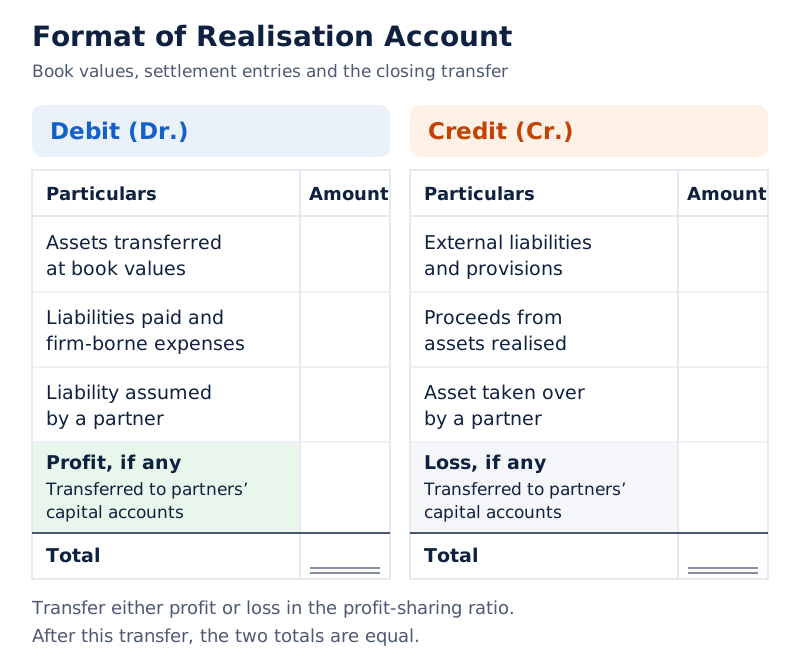
The account has a left debit side and right credit side, each with Particulars and Amount columns. Assets and payments appear on the left; liabilities, provisions and realisations appear on the right. Both sides end with totals.
Drawn by One Young India. See Fig. 4.1 in your NCERT textbook
What remains outside Realisation?
Cash and bank are already monetary balances used for settlement. General reserve and fictitious assets go directly to partners’ capital accounts. A loan payable to a partner is settled through that partner’s loan account, rather than being transferred as an external liability.
Realisation profit = credit total before profit transfer − debit total before profit transfer. Where debits exceed credits, the difference is a realisation loss. The balancing transfer closes the account after allocating the result to partners.
How are asset transfers, sales and partner takeovers recorded?
Distinguish the transfer of book value from the later disposal of an asset. The first entry closes the original asset account. The second records what the firm receives in cash or what a partner accepts as a charge against capital.
What are the basic asset entries?
| Transaction | Account debited | Account credited | Basis of amount |
|---|---|---|---|
| Transfer recorded assets | Realisation A/c | Individual asset accounts | Book values |
| Sell an asset | Bank A/c | Realisation A/c | Actual proceeds |
| Partner takes an asset | Partner’s Capital A/c | Realisation A/c | Agreed takeover value |
| Sell an unrecorded asset | Bank A/c | Realisation A/c | Actual proceeds |
| Partner takes an unrecorded asset | Partner’s Capital A/c | Realisation A/c | Agreed takeover value |
A partner’s takeover is not a bank receipt. Debiting capital reduces the cash ultimately payable to that partner. An unrecorded asset has no opening asset balance to transfer, but its sale or takeover must still be recognised.
How are debtors and their provision handled?
Worked example 1. Supriya and Monika have debtors of ₹21,500 and a provision for doubtful debts of ₹500. Debtors realise at a discount of 5%. Calculate the receipt and state the entries.
Answer: Debtors realised = ₹21,500 × 95 ÷ 100 = ₹20,425. Debit Realisation and credit Debtors ₹21,500. Debit Provision for Doubtful Debts and credit Realisation ₹500. Debit Bank and credit Realisation ₹20,425.
The discount is calculated on gross debtors, not the net balance-sheet figure of ₹21,000. Crediting the existing ₹500 provision separately ensures that both the gross asset and its earlier adjustment are closed without counting either twice.
An asset’s realised value may differ from its book value. Do not replace the book-value transfer with the receipt: retaining both amounts allows the Realisation Account to capture the financial effect of disposal.
How are liabilities and settlements with creditors recorded?
External liabilities are first transferred at their recorded amounts. Their later settlement is recorded at the amount actually paid or assumed by a partner. This separates the original obligation from any gain or loss on its discharge.
What entries apply to liabilities?
| Transaction | Debit | Credit |
|---|---|---|
| Transfer an external liability | Individual Liability A/c | Realisation A/c |
| Pay the liability through bank | Realisation A/c | Bank A/c |
| Partner assumes responsibility for a liability | Realisation A/c | Partner’s Capital A/c |
| Pay an unrecorded liability | Realisation A/c | Bank A/c |
Bank overdraft is an external liability and enters Realisation. A partner’s loan to the firm is different: its repayment is recorded by debiting Partner’s Loan Account and crediting Bank. Do not combine that loan with outside creditors.
Cash settlement = recorded liability − agreed discount. Apply this calculation where a liability is settled by a discounted cash payment. In Sita, Rita and Meeta’s case, the ₹2,000 creditor accepts 2% less, giving a payment of ₹1,960.
What if a creditor accepts an asset?
Where a creditor accepts an asset in full and final settlement, no separate entry is required for that settlement. If it is accepted as part payment, record the additional cash paid. If the creditor pays the firm an excess, debit Bank and credit Realisation for that receipt.
Worked example 2. A creditor owed ₹10,000 accepts office equipment worth ₹8,000 and receives the remaining ₹2,000 in cash. State the settlement entry after the recorded balances have been transferred.
Answer: The cash balance is ₹10,000 − ₹8,000 = ₹2,000. Record Realisation A/c Dr. ₹2,000; To Bank A/c ₹2,000. No additional journal entry is made for the equipment accepted by the creditor.
Unrecorded liabilities have no opening balance to transfer. Payment nevertheless reduces the result on realisation. After creditors and bills payable have been transferred, absence of information about their payment means they are treated as paid in full.
How are realisation expenses and a partner’s remuneration treated?
For realisation expenses, answer two separate questions: who must bear the expense, and who actually pays it? The payer determines whether Bank or a partner’s capital is involved. The agreement determines whether the expense is charged to Realisation or to that partner.
How does responsibility affect the entry?
| Responsibility and payment | Debit | Credit |
|---|---|---|
| Firm bears and pays expenses | Realisation A/c | Bank A/c |
| Firm bears expenses; partner pays for the firm | Realisation A/c | Partner’s Capital A/c |
| Partner bears expenses; firm pays | Partner’s Capital A/c | Bank A/c |
| Partner bears and pays expenses | No entry | No entry |
| Agreed remuneration for dissolution work | Realisation A/c | Partner’s Capital A/c |
Note: If a partner agrees to bear realisation expenses and the payer is not stated, payment is understood to have been made by that partner.
Remuneration is recorded separately from actual expense payments. It credits the partner for undertaking dissolution work. Actual costs borne and paid personally by that partner do not also become a charge to the firm.
How do the expense cases work numerically?
Worked example 3. Anubha pays dissolution expenses of ₹7,800 on behalf of the firm. Record the entry.
Answer: Realisation A/c Dr. ₹7,800; To Anubha’s Capital A/c ₹7,800. The expense belongs to the firm, but the firm’s bank has not paid it. Crediting Anubha recognises the amount paid on its behalf.
Worked example 4. Shobha receives remuneration of ₹15,000 for dissolution work and agrees to bear the expenses. She personally pays actual expenses of ₹11,800. Record the treatment.
Answer: Realisation A/c Dr. ₹15,000; To Shobha’s Capital A/c ₹15,000. No entry is passed for her payment of ₹11,800 because she both bears and pays those expenses.
Worked example 5. Anubha receives remuneration of ₹12,000 and agrees to bear dissolution expenses. Actual expenses of ₹9,500 are paid by the firm. Record both entries.
Answer: Realisation A/c Dr. ₹12,000; To Anubha’s Capital A/c ₹12,000. Also record Anubha’s Capital A/c Dr. ₹9,500; To Bank A/c ₹9,500. The second entry charges the firm’s payment to the partner responsible for it.
Worked example 6. Anubha receives remuneration of ₹8,500 and agrees to bear expenses up to ₹6,000. She pays actual expenses of ₹7,600. Record the remuneration and excess expense.
Answer: Firm-borne excess = ₹7,600 − ₹6,000 = ₹1,600. Debit Realisation ₹8,500 and credit Anubha’s Capital ₹8,500. Separately debit Realisation ₹1,600 and credit Anubha’s Capital ₹1,600 for the excess she paid for the firm.
The last case has a limit on responsibility. Only the excess over that limit is an additional expense of the firm. The amount within the agreed limit receives no separate entry because Anubha bears and pays it herself.
How are realisation results, reserves and partners’ balances closed?
After recording asset disposals, liability settlements and expenses, balance the Realisation Account. A credit excess is profit; a debit excess is loss. Transfer this result in the partners’ profit-sharing ratio rather than in the ratio of their opening capitals.
Individual profit share = realisation profit × partner’s profit-sharing fraction. Apply the corresponding fraction to each partner. For a loss, calculate the shares in the same ratio but debit capital instead of crediting it.
Which way do the closing entries run?
| Item | Debit | Credit | Allocation |
|---|---|---|---|
| Realisation profit | Realisation A/c | Partners’ Capital A/cs | Profit-sharing ratio |
| Realisation loss | Partners’ Capital A/cs | Realisation A/c | Profit-sharing ratio |
| General reserve | General Reserve A/c | Partners’ Capital A/cs | Profit-sharing ratio |
| Fictitious assets | Partners’ Capital A/cs | Fictitious Asset A/c | Profit-sharing ratio |
Accumulated profits and reserves represent balances already belonging to the partners. Their transfer is separate from the gain or loss arising on dissolution. Fictitious assets are likewise cleared directly against partners’ capital rather than being treated as saleable assets.
How are loans and final cash dealt with?
A loan made by the firm to a partner is recovered by debiting Bank and crediting Loan to Partner. A loan due from the firm to a partner is repaid by debiting Partner’s Loan and crediting Bank. Keep the direction of the loan clear.
Transfer partners’ current account balances to their respective capital accounts. A partner whose final capital has a debit balance brings in cash: debit Bank and credit Partner’s Capital. Pay a final credit balance by debiting Partner’s Capital and crediting Bank.
The final reconciliation is essential: the total payable to partners must equal available cash and bank balances after other settlements and required contributions. Paying opening capitals before these adjustments would omit the effects of realisation, reserves and takeovers.
How are Supriya and Monika’s dissolution accounts prepared?
Supriya and Monika share profits in the ratio of 3:2. Their firm is dissolved on 31 March 2020. The following opening balances and settlement terms give the complete information needed for the accounts below.
What are the opening balances and settlement terms?
| Liability or capital | Amount ₹ | Asset | Amount ₹ |
|---|---|---|---|
| Supriya’s capital | 32,500 | Cash and bank | 40,500 |
| Monika’s capital | 11,500 | Stock | 7,500 |
| Sundry creditors | 48,000 | Debtors ₹21,500 less provision ₹500 | 21,000 |
| General reserve | 13,500 | Fixed assets | 36,500 |
| Total | 1,05,500 | Total | 1,05,500 |
Debtors realise at a 5% discount, stock for ₹7,000 and fixed assets for ₹42,000. Realisation expenses are ₹1,500, paid by the firm. Creditors are paid in full. The provision must be separated from debtors when the balances are transferred.
Worked example 7. Using these balances and terms, calculate total asset proceeds, realisation profit and the final payments to Supriya and Monika.
Answer: Debtors yield ₹20,425. Total proceeds are ₹20,425 + ₹7,000 + ₹42,000 = ₹69,425. Realisation profit is ₹2,925. Supriya receives ₹42,355 and Monika ₹18,070 after reserve and profit transfers.
How is the Realisation Account balanced?
Assets transferred = ₹7,500 + ₹21,500 + ₹36,500 = ₹65,500. Liabilities and provision credited total ₹48,000 + ₹500 = ₹48,500. Payments charged to Realisation total ₹48,000 + ₹1,500 = ₹49,500.
Credit entries before profit transfer total ₹48,500 + ₹69,425 = ₹1,17,925. Debit entries before profit transfer total ₹65,500 + ₹49,500 = ₹1,15,000. The difference is ₹2,925 profit, allocated ₹1,755 to Supriya and ₹1,170 to Monika.
Realisation Account, Dr. and Cr., amounts in ₹
| Debit particulars | Amount ₹ | Credit particulars | Amount ₹ |
|---|---|---|---|
| Stock | 7,500 | Provision for doubtful debts | 500 |
| Sundry debtors | 21,500 | Sundry creditors | 48,000 |
| Fixed assets | 36,500 | Bank: debtors realised | 20,425 |
| Bank: creditors paid | 48,000 | Bank: stock realised | 7,000 |
| Bank: realisation expenses | 1,500 | Bank: fixed assets realised | 42,000 |
| Supriya’s Capital: profit | 1,755 | No further entry | Not applicable |
| Monika’s Capital: profit | 1,170 | No further entry | Not applicable |
| Total | 1,17,925 | Total | 1,17,925 |
Profit appears on the debit side to close Realisation, while the same amounts are credited to partners’ capital accounts. This is the balancing transfer, not a further expense paid through Bank.
What are the journal entries?
Each row below is one balanced journal entry. All entries relate to 31 March 2020; the purpose column provides the narration.
| Purpose | Debit accounts and amounts ₹ | Credit accounts and amounts ₹ |
|---|---|---|
| Transfer assets | Realisation 65,500 | Stock 7,500; Sundry Debtors 21,500; Fixed Assets 36,500 |
| Transfer creditors and provision | Sundry Creditors 48,000; Provision for Doubtful Debts 500 | Realisation 48,500 |
| Receive asset proceeds | Bank 69,425 | Realisation 69,425 |
| Pay creditors and expenses | Realisation 49,500 | Bank 49,500 |
| Transfer realisation profit | Realisation 2,925 | Supriya’s Capital 1,755; Monika’s Capital 1,170 |
| Distribute general reserve | General Reserve 13,500 | Supriya’s Capital 8,100; Monika’s Capital 5,400 |
| Make final capital payments | Supriya’s Capital 42,355; Monika’s Capital 18,070 | Bank 60,425 |
How do capital balances reconcile with cash?
The reserve is divided as ₹13,500 × 3/5 = ₹8,100 and ₹13,500 × 2/5 = ₹5,400. It credits capital directly and does not increase the ₹2,925 realisation profit.
| Capital account posting | Side | Supriya ₹ | Monika ₹ |
|---|---|---|---|
| Balance brought down | Credit | 32,500 | 11,500 |
| General reserve | Credit | 8,100 | 5,400 |
| Realisation profit | Credit | 1,755 | 1,170 |
| Total credits | Credit total | 42,355 | 18,070 |
| Bank: final payment | Debit | 42,355 | 18,070 |
| Total debits | Debit total | 42,355 | 18,070 |
Available cash is ₹40,500 + ₹69,425 − ₹48,000 − ₹1,500 = ₹60,425. Final payments total ₹42,355 + ₹18,070 = ₹60,425. Thus the capital accounts close and the combined cash and bank balance is fully distributed.
How do Sita, Rita and Meeta’s accounts combine expenses and an unrecorded asset?
Sita, Rita and Meeta share profits and losses in the ratio of 2:2:1. At dissolution on 31 March 2017, their capitals are ₹5,000, ₹2,000 and ₹1,000 respectively. General reserve is ₹2,500 and creditors are ₹2,000.
What information determines the realisation result?
Assets are bank ₹2,500, stock ₹2,500, furniture ₹1,000, debtors ₹2,000, and plant and machinery ₹4,500. Each side of the balance sheet totals ₹12,500. The following terms determine the amounts recorded on dissolution.
- Plant and machinery realise ₹4,250, stock ₹3,500, debtors ₹1,850 and furniture ₹750.
- Sita bears all realisation expenses and receives remuneration of ₹60.
- Actual expenses of ₹450 are paid by the firm.
- Creditors accept 2% less than their recorded amount.
- An unrecorded asset of ₹250 is taken over by Rita at ₹200.
Worked example 8. Calculate the realisation profit and final capital payments using the complete balances and terms above.
Answer: Asset proceeds total ₹10,350 and creditors receive ₹1,960. Realisation credits are ₹2,000 + ₹200 + ₹10,350 = ₹12,550. Debits before profit transfer are ₹10,000 + ₹1,960 + ₹60 = ₹12,020. Profit is ₹530.
The ₹450 expense payment debits Sita’s Capital and credits Bank. It does not debit Realisation because Sita bears it. The ₹60 remuneration separately debits Realisation and credits Sita’s Capital. Rita’s takeover debits her capital and credits Realisation ₹200.
How are profit and reserve allocated?
Profit of ₹530 is split ₹212, ₹212 and ₹106. Reserve of ₹2,500 is split ₹1,000, ₹1,000 and ₹500. These credits combine with opening capital and the individual adjustments to determine each final payment.
| Capital calculation | Sita ₹ | Rita ₹ | Meeta ₹ |
|---|---|---|---|
| Opening capital | 5,000 | 2,000 | 1,000 |
| Add reserve share | 1,000 | 1,000 | 500 |
| Add realisation profit | 212 | 212 | 106 |
| Add remuneration | 60 | 0 | 0 |
| Deduct expenses paid for partner | 450 | 0 | 0 |
| Deduct asset taken over | 0 | 200 | 0 |
| Final bank payment | 5,822 | 3,012 | 1,606 |
Zero in the calculation table means that the particular adjustment does not apply to that partner. Rita is charged the agreed ₹200, not the unrecorded asset’s stated ₹250 value. Bank records no receipt for this takeover.
Does the Bank Account close?
| Bank posting | Debit ₹ | Credit ₹ |
|---|---|---|
| Opening balance | 2,500 | Not applicable |
| Realisation: asset proceeds | 10,350 | Not applicable |
| Realisation: creditors paid | Not applicable | 1,960 |
| Sita’s Capital: expenses | Not applicable | 450 |
| Sita’s Capital: final settlement | Not applicable | 5,822 |
| Rita’s Capital: final settlement | Not applicable | 3,012 |
| Meeta’s Capital: final settlement | Not applicable | 1,606 |
| Total | 12,850 | 12,850 |
Bank resources total ₹2,500 + ₹10,350 = ₹12,850. After creditors and expenses, ₹12,850 − ₹1,960 − ₹450 = ₹10,440 remains. Capital payments also total ₹5,822 + ₹3,012 + ₹1,606 = ₹10,440, completing the settlement.
Glossary
- Dissolution of partnership — A change in the existing relationship between partners, while the firm may continue its business.
- Dissolution of firm — Ending of the partnership between all partners, followed by winding up the firm’s affairs.
- Partnership at will — A partnership in which a partner may seek dissolution by giving written notice to the other partners.
- Realisation Account — An account used to determine profit or loss from realising assets and settling liabilities on dissolution.
- Book value — The recorded amount used when an asset balance is transferred into the Realisation Account.
- Realisation expenses — Costs incurred in the process of realising the firm’s assets and paying its liabilities.
- Unrecorded asset — An asset absent from the books whose sale or takeover is recorded during dissolution.
- Unrecorded liability — An obligation absent from the books whose settlement is recorded as a charge to Realisation.
- Partner’s loan — An advance by a partner to the firm, distinguished from capital when settling claims.
- Capital deficiency — A shortfall reflected in a partner’s final debit capital balance, requiring a contribution from that partner.
- Remuneration for dissolution — An agreed amount credited to a partner for undertaking work connected with the firm’s dissolution.
- Net private assets — The surplus of a partner’s private assets over private liabilities, available towards unpaid firm debts.
Common errors and misconceptions
- Misconception: Every dissolution of partnership closes the firm. Correct: The partnership relationship may change while the firm continues; dissolution of the firm ends its business.
- Misconception: Cash, bank and general reserve all go to Realisation. Correct: Cash and bank are retained for settlement, while general reserve is transferred directly to partners’ capital accounts.
- Misconception: Net debtors are transferred and the provision is also credited separately. Correct: Transfer gross debtors when the provision is transferred separately, avoiding a double adjustment.
- Misconception: Every asset takeover creates a bank receipt. Correct: A partner’s takeover debits that partner’s capital and credits Realisation at the agreed amount.
- Misconception: Expenses paid by a partner require no entry. Correct: If paid on the firm’s behalf, debit Realisation and credit the partner’s capital; no entry applies when the partner both bears and pays them.
- Misconception: A partner’s loan is repaid together with capital before outside creditors. Correct: Outside debts come first, partners’ advances next, and capital afterwards, subject to the settlement agreement.
- Misconception: Realisation profit is divided in the capital ratio. Correct: Realisation profit or loss is transferred in the profit-sharing ratio, irrespective of unequal opening capitals.
- Misconception: All amounts paid through Bank are realisation expenses. Correct: Bank also records liability payments, capital settlements and expenses paid on a partner’s behalf, each against its appropriate account.
Exam-style questions with model answers
Q1. Distinguish dissolution of partnership from dissolution of a firm in terms of business and books. [2 marks]
- Dissolution of partnership changes partners’ existing relationship, but business may continue and the books need not close.
- Dissolution of the firm ends its business, apart from winding-up activities, and its accounts are closed after settlement.
Q2. Subject to agreement among partners, state the order in which firm assets are applied under Section 48. [4 marks]
- First pay the firm’s debts to third parties. This includes outside liabilities, with secured loans taking precedence over unsecured loans.
- Next repay partners proportionately for advances distinguished from capital, including loans they made to the firm.
- Then pay partners proportionately the amounts due on their capital accounts.
- Finally divide any residue in the profit-sharing ratio. The resources available for settlement include contributions made by partners to meet capital deficiencies.
Q3. Debtors are ₹21,500 with provision for doubtful debts ₹500. They realise at a discount of 5%. Calculate the receipt and state all entries for their transfer and collection. [3 marks]
- Calculate collection on gross debtors: ₹21,500 × 95/100 = ₹20,425. The discount is not calculated on the net figure of ₹21,000.
- Transfer gross debtors: Realisation A/c Dr. ₹21,500; To Sundry Debtors A/c ₹21,500.
- Transfer the provision separately: Provision for Doubtful Debts A/c Dr. ₹500; To Realisation A/c ₹500.
- Record the collection: Bank A/c Dr. ₹20,425; To Realisation A/c ₹20,425. Both the asset and its provision are thereby closed.
Q4. A creditor owed ₹10,000 accepts office equipment worth ₹8,000 and ₹2,000 cash in settlement. The recorded balances have already been transferred to Realisation. Give the settlement entry. [2 marks]
- Realisation A/c Dr. ₹2,000; To Bank A/c ₹2,000.
- Record only the cash payment. No separate entry is required for the office equipment accepted by the creditor as part settlement.
Q5. Anubha is allowed ₹12,000 remuneration for dissolution work and agrees to bear its expenses. The firm pays actual expenses of ₹9,500. Give the entries and explain their treatment. [3 marks]
- For the remuneration, debit Realisation Account ₹12,000 and credit Anubha’s Capital Account ₹12,000. This records the firm’s agreed charge for her dissolution work.
- For expenses paid, debit Anubha’s Capital Account ₹9,500 and credit Bank Account ₹9,500.
- The actual expenses are Anubha’s responsibility under the agreement. Payment through the firm’s bank therefore reduces her capital entitlement instead of creating another charge to Realisation Account.
Q6. Anubha receives ₹8,500 remuneration and agrees to bear dissolution expenses up to ₹6,000. She pays actual expenses of ₹7,600. Calculate the firm-borne excess and give the entries. [3 marks]
- The excess borne by the firm is ₹7,600 − ₹6,000 = ₹1,600. Anubha has paid this excess on the firm’s behalf.
- For remuneration, record Realisation A/c Dr. ₹8,500; To Anubha’s Capital A/c ₹8,500.
- For the excess, record Realisation A/c Dr. ₹1,600; To Anubha’s Capital A/c ₹1,600.
- No separate entry is required for the ₹6,000 within her agreed responsibility, since she both bears and pays that amount.
Q7. Supriya and Monika share profits 3:2. Capitals are ₹32,500 and ₹11,500; general reserve ₹13,500; creditors ₹48,000; cash and bank ₹40,500; stock ₹7,500; gross debtors ₹21,500 with provision ₹500; fixed assets ₹36,500. On dissolution, debtors realise at 5% discount, stock ₹7,000 and fixed assets ₹42,000. The firm pays creditors in full and expenses ₹1,500. Calculate realisation profit, final capital payments and the cash check. [6 marks]
- Transfer assets at gross book values: ₹7,500 + ₹21,500 + ₹36,500 = ₹65,500. Credit Realisation with creditors ₹48,000 and provision ₹500, totalling ₹48,500.
- Debtors realise ₹21,500 × 95/100 = ₹20,425. Total proceeds are ₹20,425 + ₹7,000 + ₹42,000 = ₹69,425. Creditor and expense payments total ₹49,500.
- Realisation profit is ₹48,500 + ₹69,425 − ₹65,500 − ₹49,500 = ₹2,925. Allocate ₹1,755 to Supriya and ₹1,170 to Monika in their 3:2 ratio.
- Distribute reserve as ₹8,100 and ₹5,400. Supriya receives ₹32,500 + ₹8,100 + ₹1,755 = ₹42,355. Monika receives ₹11,500 + ₹5,400 + ₹1,170 = ₹18,070.
- Cash available is ₹40,500 + ₹69,425 − ₹49,500 = ₹60,425. This equals ₹42,355 + ₹18,070, so final payments exhaust the available balance.
Q8. Sita, Rita and Meeta share profits 2:2:1. Capitals are ₹5,000, ₹2,000 and ₹1,000; reserve ₹2,500; creditors ₹2,000. Assets are bank ₹2,500, stock ₹2,500, furniture ₹1,000, debtors ₹2,000 and plant ₹4,500. Stock realises ₹3,500, furniture ₹750, debtors ₹1,850 and plant ₹4,250. Creditors accept 2% less. Sita bears expenses and receives ₹60 remuneration; the firm pays actual expenses ₹450. Rita takes an unrecorded asset of ₹250 at ₹200. Calculate profit and final payments. [6 marks]
- Recorded assets transferred, excluding bank, total ₹10,000. Cash proceeds total ₹3,500 + ₹750 + ₹1,850 + ₹4,250 = ₹10,350. Creditors receive ₹2,000 × 98/100 = ₹1,960.
- Credit Realisation ₹2,000 for creditors, ₹10,350 for proceeds and ₹200 for Rita’s takeover. Debit it ₹10,000 for assets, ₹1,960 for creditors and ₹60 for remuneration. Profit is ₹12,550 − ₹12,020 = ₹530.
- Profit shares are ₹212, ₹212 and ₹106; reserve shares are ₹1,000, ₹1,000 and ₹500. Debit Sita’s Capital ₹450 for expenses paid by the firm and Rita’s Capital ₹200 for the asset.
- Final payments are Sita ₹5,000 + ₹1,000 + ₹212 + ₹60 − ₹450 = ₹5,822; Rita ₹2,000 + ₹1,000 + ₹212 − ₹200 = ₹3,012; Meeta ₹1,000 + ₹500 + ₹106 = ₹1,606.
- Available bank funds are ₹2,500 + ₹10,350 − ₹1,960 − ₹450 = ₹10,440. Final payments also total ₹10,440.
Key takeaways
- Dissolution of the firm ends the partnership between all partners and requires winding up, settlement and closure of accounts.
- Subject to agreement, settle outside debts before partners’ loans, then capital; divide any residue in the profit-sharing ratio.
- Transfer gross debtors to Realisation and their provision separately, preserving the distinction between book values and actual collections.
- Partner takeovers debit capital and credit Realisation; liabilities assumed by partners debit Realisation and credit their capital accounts.
- Expense entries depend on both responsibility and payment; agreed remuneration is recorded separately from actual expense payments.
- Realisation profit, realisation loss and general reserve are allocated in the profit-sharing ratio, with the appropriate debit or credit.
- Keep partners’ loans separate from capital, and distinguish loans made to partners from loans received from them.
- After all adjustments and settlements, final payments to partners must reconcile exactly with the cash and bank funds available.
Test yourself
Does admission of a new partner necessarily dissolve the firm?
No. It changes the existing partnership relationship, but the firm may continue its business.
How is bank overdraft treated on dissolution?
It is an external liability transferred to the credit of Realisation Account before settlement.
Which account is debited when a partner takes over an asset?
The partner’s capital account is debited, and Realisation is credited at the agreed takeover amount.
A partner bears and personally pays realisation expenses. What entry is needed?
No entry is required in the firm’s books for those expenses borne and paid personally.
How is general reserve distributed on dissolution?
Debit General Reserve Account and credit partners’ capital accounts in their profit-sharing ratio.
How is a realisation loss transferred?
Debit the partners’ capital accounts in their profit-sharing ratio and credit Realisation Account.
What is the entry when a partner brings cash to meet a final debit capital balance?
Debit Bank Account and credit that partner’s capital account for the cash contributed.
What must the final capital payments equal?
They must equal available cash and bank balances after other settlements and required partner contributions.