
Integrals | ISC Class 12 Maths Notes
On this page

This note covers antiderivatives, standard integration formulae, substitution, trigonometric integrals, partial fractions, integration by parts, quadratic and radical forms, definite integrals, the Fundamental Theorem of Calculus, and properties used to evaluate definite integrals.
What does integration mean, and why is there a constant?
Differentiation finds a function's derivative, or rate of change. Integration reverses this process: it seeks a function having a specified derivative. An antiderivative, also called a primitive, is one such function; the indefinite integral represents the whole family.
Let x be a real variable, f a given function, and F an antiderivative on an interval, meaning a connected range of real values. The notation F′(x), also written dF/dx, means the derivative of F with respect to x.
Definition: If F′(x) = f(x), then . Here ∫ is the integral sign, f(x) is the integrand, dx identifies x as the variable of integration, and C is an arbitrary real constant.
An arbitrary constant can take any fixed real value. Its derivative is zero. Consequently, adding C does not change the derivative of F. Different choices of C give different antiderivatives, all belonging to the same family.
Result: Antiderivatives differ by a constant
Two functions with the same derivative on an interval differ by a constant there. Thus, finding one antiderivative and adding C describes all antiderivatives on that interval. A stated function value can determine C and select a particular member of the family.
Worked example 1. Find F when F′(x) = 4x³ − 6 and F(0) = 3.
Answer: Integrating gives F(x) = x⁴ − 6x + C. Substituting x = 0 gives C = 3. Therefore F(x) = x⁴ − 6x + 3, whose derivative is 4x³ − 6.
The interval of definition matters throughout integration. Formulae involving division, logarithms or square roots must be used where their expressions are defined. A final answer should be checked by differentiation on the interval under consideration, rather than compared merely by appearance.
Which standard formulae and properties should you know?
A polynomial is a finite sum of constant multiples of non-negative integer powers of x. A coefficient is a constant multiplier of a power. The degree is the highest power with a non-zero coefficient. Integrate a polynomial one term at a time, keeping each coefficient attached to its term.
Property: Linearity of integration
Let g be another function with an antiderivative, and let k be a real constant. Sums and differences integrate term by term, and a constant multiplier can be taken outside the integral. This property is called linearity.
In the formulae below, n is a real exponent on a suitable real domain, e is the base of natural logarithms, and log means the natural logarithm. The notation |x| means the absolute value of x, its non-negative magnitude.
| Integrand | Indefinite integral | Condition |
|---|---|---|
| n ≠ −1; use an interval where the power is defined. | ||
| 1 | x + C | x real |
| 1/x | log |x| + C | x ≠ 0 |
| eˣ | eˣ + C | x real |
Angles in integration formulae are measured in radians, where an angle measures arc length divided by radius. The constant π is the circumference-to-diameter ratio of a circle. The abbreviations sin and cos mean sine and cosine; tan x = sin x/cos x.
The reciprocal functions are sec x = 1/cos x and cosec x = 1/sin x; cot x = cos x/sin x. Every formula involving these functions assumes its denominators are non-zero on the interval used.
| Integrand | Indefinite integral |
|---|---|
| sin x | −cos x + C |
| cos x | sin x + C |
| sec²x | tan x + C |
| cosec²x | −cot x + C |
| sec x tan x | sec x + C |
| cosec x cot x | −cosec x + C |
The power rule excludes n = −1 because its denominator would be zero. That case produces a logarithm. Also, linearity concerns sums and constant multiples: it does not give a rule for multiplying two indefinite integrals to integrate a product.
How does substitution reverse the chain rule?
Substitution introduces a new variable to simplify the integrand. It reverses the chain rule, the differentiation rule for a function of another function. Usually, we make a substitution for a function whose derivative also occurs in the integrand.
Let t denote the new variable. If t = f(x), then dt = f′(x) dx. The differential dt records the accompanying derivative factor. Replace both the expression and this factor so that the transformed integral contains a single variable.
Result: A function with its derivative
For a real exponent n ≠ −1, on a suitable interval, . For f(x) ≠ 0, the corresponding logarithmic form is .
- Identify an inner expression that can become t.
- Differentiate the substitution and obtain the relation between dt and dx.
- Rewrite the entire integral in t, including any constant multiplier.
- Integrate, substitute back in x, and add the arbitrary constant.
Worked example 2. Find .
Answer: Set t = x² + 1, giving dt = 2x dx. The integral becomes ∫ sin t dt = −cos t + C. Substituting back gives −cos(x² + 1) + C. Differentiation restores the factor 2x.
For constants a ≠ 0 and b, substituting t = ax + b gives dt = a dx. Hence , where n ≠ −1. The factor 1/a compensates for the derivative of the inner expression.
For trigonometric quotients, write tan x as sin x/cos x and substitute t = cos x. The negative derivative supplies the sign, giving ∫ tan x dx = −log |cos x| + C = log |sec x| + C.
Similarly, ∫ cot x dx = log |sin x| + C. Two further useful results are ∫ sec x dx = log |sec x + tan x| + C and ∫ cosec x dx = log |cosec x − cot x| + C.
How are powers of sine and cosine integrated?
An identity is an equality valid for every permissible value of its variable. Trigonometric identities can transform an unfamiliar integrand into a sum of standard ones. In particular, an exponent on sin or cos means a power of the function value.
Identity: Reducing even powers
Use the power-reduction identities sin²x = (1 − cos 2x)/2 and cos²x = (1 + cos 2x)/2. Each square becomes a constant plus a cosine term. When integrating cos 2x, retain the factor 1/2 from its inner derivative.
Worked example 3. Find ∫ cos²x dx.
Answer: Replace cos²x by (1 + cos 2x)/2. Thus ∫ cos²x dx = x/2 + sin 2x/4 + C. Differentiating gives 1/2 + cos 2x/2, which equals cos²x.
The corresponding sine result is ∫ sin²x dx = x/2 − sin 2x/4 + C. Applying the square identities again gives sin⁴x = (3 − 4 cos 2x + cos 4x)/8 and cos⁴x = (3 + 4 cos 2x + cos 4x)/8. These identities reduce fourth powers to three directly integrable terms.
Therefore ∫ sin⁴x dx = 3x/8 − sin 2x/4 + sin 4x/32 + C, while ∫ cos⁴x dx = 3x/8 + sin 2x/4 + sin 4x/32 + C.
How do odd powers suggest a substitution?
For sin³x, keep one factor sin x and replace sin²x by 1 − cos²x. The remaining sin x dx matches the differential of cos x with a minus sign. For cos³x, retain cos x dx and replace cos²x by 1 − sin²x.
Worked example 4. Find ∫ sin³x dx.
Answer: Write sin³x = (1 − cos²x) sin x. Put t = cos x, so dt = −sin x dx. Integrating −(1 − t²) gives −t + t³/3 + C. Hence the answer is −cos x + cos³x/3 + C.
The matching cosine result is ∫ cos³x dx = sin x − sin³x/3 + C. Different-looking trigonometric answers can be equivalent through identities, so derivative checking is useful when comparing forms.
How do standard quadratic forms guide integration?
A quadratic expression has degree two. Its sign pattern determines the relevant standard integral. Distinguish a sum of squares from a difference of squares, and distinguish a quadratic denominator from its square root. Here √ denotes the non-negative square root.
In the following table a is a positive constant. The functions sin⁻¹ and tan⁻¹ mean the principal inverse sine and inverse tangent; they are not reciprocals. Their values lie in [−π/2, π/2] and (−π/2, π/2), respectively. Square brackets include endpoints; round brackets exclude them.
| Integral | Standard result | Real-domain condition |
|---|---|---|
| All real x | ||
| x ≠ a and x ≠ −a | ||
| x ≠ a and x ≠ −a | ||
| |x| < a | ||
| All real x | ||
| |x| > a |
How does completing the square help?
Completing the square rewrites a quadratic using a squared linear expression and a constant. For constants a ≠ 0, b and c, write ax² + bx + c = a[(x + b/(2a))² + c/a − b²/(4a²)]. Then shift the variable.
Worked example 5. Find .
Answer: The denominator is (x − 3)² + 4. Set t = x − 3, so dt = dx. The integral becomes ∫ dt/(t² + 2²), giving (1/2)tan⁻¹((x − 3)/2) + C.
For a linear numerator px + q, where p and q are constants, compare it with the derivative 2ax + b of the denominator. Choose constants A and B so that px + q = A(2ax + b) + B.
This splits the problem into a logarithmic derivative term and a remaining standard quadratic integral. The same comparison works when the denominator is √(ax² + bx + c): its derivative-matching part integrates by substitution, while the remainder uses a reciprocal-root formula.
How do partial fractions simplify rational functions?
A rational function is a ratio P(x)/Q(x), where P and Q are polynomials and Q(x) ≠ 0. It is proper when the numerator's degree is less than the denominator's degree. Otherwise, polynomial division must first separate a polynomial part.
Partial fraction decomposition writes a proper rational function as a sum of simpler rational functions. The denominator's factors determine the required form. The coefficients are constants found by an identity, not new functions to integrate.
Which numerator belongs to each factor?
For distinct linear factors x − a and x − b, use A/(x − a) + B/(x − b), where a ≠ b and A, B are unknown constants. Multiply by the common denominator and compare coefficients or substitute convenient values into the resulting polynomial identity.
A repeated factor (x − a)² requires both A/(x − a) and B/(x − a)². An irreducible quadratic, meaning a quadratic with no real linear factorisation, requires a linear numerator. Thus a factor x² + bx + c takes a numerator Ax + B.
Worked example 6. Find , on an interval excluding −1 and −2.
Answer: Set 1 = A(x + 2) + B(x + 1). Comparing coefficients gives A + B = 0 and 2A + B = 1, so A = 1 and B = −1.
Integrating the two fractions gives log |x + 1| − log |x + 2| + C = log |(x + 1)/(x + 2)| + C.
Worked example 7. Find , where x ≠ 2, 3.
Answer: Division gives 1 + (5x − 5)/[(x − 2)(x − 3)]. The proper fraction equals −5/(x − 2) + 10/(x − 3). Integrating gives x − 5 log |x − 2| + 10 log |x − 3| + C.
Keep the polynomial part after division: it contributes to the antiderivative. Recombining the fractions checks the algebra before integration. Repeated linear factors also produce negative powers, so their integrals need not all be logarithms.
When should integration by parts be used?
Integration by parts comes from the derivative of a product. It replaces one product integral with another. Its usefulness depends on choosing functions so that the remaining integral is simpler or can be related back to the original integral.
Result: The integration-by-parts formula
Let u and v be differentiable functions of x, meaning their derivatives exist, with du = u′(x) dx and dv = v′(x) dx. Integrating the product rule gives . Choose v as one antiderivative of the factor represented by dv.
Usually, if one function is a power of x or a polynomial, it is chosen as the first function u. However, when the other function is logarithmic or inverse trigonometric, that function is taken first. Check whether the resulting integral actually becomes manageable.
Worked example 8. Find ∫ x cos x dx.
Answer: Choose u = x and dv = cos x dx. Then du = dx and v = sin x. Therefore ∫ x cos x dx = x sin x − ∫ sin x dx = x sin x + cos x + C.
A product can include the constant function 1. For ∫ log x dx, where x > 0, take u = log x and dv = dx. This yields x log x − ∫1 dx = x log x − x + C.
What happens when the original integral returns?
Let I denote the integral ∫ eˣ sin x dx and J denote ∫ eˣ cos x dx. Applying parts with eˣ first gives I = −eˣ cos x + J. A second application gives J = eˣ sin x − I.
Substitute the second relation into the first and collect the two copies of I. The result is I = eˣ(sin x − cos x)/2 + C. Returning to the original integral can therefore complete the calculation through an algebraic equation.
Another useful product-rule pattern is . Recognising the function and its derivative together avoids unnecessary repetition of integration by parts.
How are square roots of quadratic expressions integrated?
A radical is an expression containing a root. Square-root integrals differ from reciprocal-root integrals: moving the root from the denominator to the numerator changes the required formula. Integration by parts supplies three useful standard results.
For the following formulae a is a positive constant. Work on real intervals where the roots exist; for the first formula use |x| > a, and for the third use |x| < a when differentiating the displayed antiderivative.
| Integral | Antiderivative |
|---|---|
How is a general quadratic reduced?
Complete the square, shift the variable, and retain any multiplier removed from the root. The resulting expression becomes a sum or difference of squares. Match that precise form before using a formula; the signs of the logarithmic terms are different.
Worked example 9. Find .
Answer: Write x² + 2x + 5 = (x + 1)² + 4. Substitute t = x + 1, giving ∫√(t² + 2²) dt.
The answer is .
For an integral with an additional factor px + q, define Q(x) = ax² + bx + c, with a ≠ 0. Split px + q = A Q′(x) + B using constants A and B. The derivative-matching part is then directly integrable.
In particular, . Here A = p/(2a) and B = q − Ab. Use this relation where Q(x) > 0 and finish the remaining integral by completing the square.
How are trigonometric denominators reduced to rational forms?
When a denominator contains a linear combination of sine and cosine, look first for its derivative in the numerator. Let a, b, c and d denote real constants in this section. Every transformation is used on intervals where its denominators are non-zero.
How does the tangent half-angle substitution work?
Set t = tan(x/2), wherever this substitution is defined. Then sin x = 2t/(1 + t²), cos x = (1 − t²)/(1 + t²), and dx = 2 dt/(1 + t²). These relations turn the following trigonometric expressions into rational functions.
| Integral in x | Transformed integral in t |
|---|---|
Complete the square or use partial fractions after this substitution. If a coefficient vanishes, simplify the resulting polynomial before selecting a formula. Substitutions introduce their own domain restrictions; interpret the result on an interval where the original and transformed expressions are valid.
How can the numerator help?
Write D(x) = c cos x + d sin x, with c² + d² ≠ 0. Then D′(x) = d cos x − c sin x. Choose constants A and B so that a cos x + b sin x = A D′(x) + B D(x).
Coefficient comparison gives A = (ad − bc)/(c² + d²) and B = (ac + bd)/(c² + d²). Thus the integral of (a cos x + b sin x)/D(x) is A log |D(x)| + Bx + C.
For , use t = tan x on a suitable interval. Dividing through by cos²x gives the rational integral , which is a standard quadratic form.
How are quartic and square-root trigonometric forms handled?
A quartic polynomial has degree four. The expression 1 + x⁴ can be factorised into two real quadratics: (x² + √2x + 1)(x² − √2x + 1). Both quadratics can be handled by completing the square.
Which substitutions match the numerators 1 ± x²?
For x ≠ 0, divide the numerator and denominator by x². Since x² + 1/x² = (x − 1/x)² + 2, set t = x − 1/x when the numerator is 1 + x². Its differential is dt = (1 + 1/x²) dx.
This gives . Substitute back for t on an interval excluding zero.
For the numerator 1 − x², set t = x + 1/x. Since dt = (1 − 1/x²) dx, the integral becomes −∫ dt/(t² − 2), giving .
To integrate 1/(1 + x⁴), use the factorisation directly. With A, B, D and E denoting unknown real coefficients, the decomposition can be written (Ax + B)/(x² + √2x + 1) + (Dx + E)/(x² − √2x + 1).
Coefficient comparison gives A = 1/(2√2), B = 1/2, D = −1/(2√2), E = 1/2. Each fraction then separates into a logarithmic derivative and a reciprocal quadratic integral. This form avoids introducing division by x.
The resulting antiderivative is . Both quadratic expressions inside the logarithm are positive.
How do roots of tangent and cotangent fit this method?
For ∫√tan x dx, set t = √tan x on an interval where tan x > 0. Then tan x = t², sec²x dx = 2t dt, and sec²x = 1 + t⁴. The transformed integral is ∫2t²/(1 + t⁴) dt.
For ∫√cot x dx, set t = √cot x where cot x > 0. Differentiating cot x = t² gives −cosec²x dx = 2t dt, so the transformed integral is −∫2t²/(1 + t⁴) dt. Factor the quartic and use partial fractions to finish.
The needed decomposition is . Each numerator is a multiple of its denominator's derivative plus a constant, reducing the calculation to logarithms and inverse tangents.
Define . Then K′(t) = 2t²/(1 + t⁴). The two root integrals are K(√tan x) + C and −K(√cot x) + C, respectively.
What does the Fundamental Theorem of Calculus establish?
A definite integral has specified limits and gives a value when it exists. In , a is the lower limit and b the upper limit. The notation [a, b] denotes the closed interval containing both endpoints and all values between them.
A function is continuous at a point when its limiting value there equals its function value. The theorems below assume f is continuous throughout [a, b]. They connect accumulation, differentiation and the evaluation of definite integrals.
Theorem: Differentiating the area function
Define the area function A(x) = ∫ from a to x of f(t) dt, where t is a variable used only inside the integral. Then A′(x) = f(x) at interior points of [a, b]. This is the first Fundamental Theorem of Calculus.
When f is positive, A(x) represents the area between its curve and the horizontal axis, from a to x. As the upper endpoint changes, the accumulated area changes. The theorem identifies the rate of that change with the function value.
What the figure shows
Area function
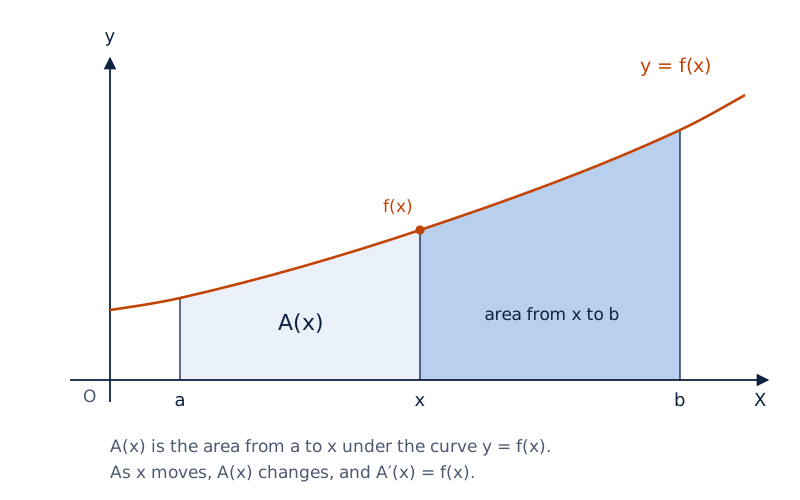
The curve y = f(x), where y denotes the vertical coordinate, lies above the horizontal axis. Vertical boundaries are marked at a, x and b. The lighter shaded region from a to x is labelled A(x); the region from x to b is darker.
Drawn by One Young India.
Theorem: Evaluating through an antiderivative
If F is an antiderivative of continuous f on [a, b], then . The bracket notation means substitute the upper limit and subtract the value at the lower limit. These theorem statements are used without proof.
Worked example 10. Evaluate .
Answer: An antiderivative is F(x) = x³/3. Therefore the integral is F(3) − F(2) = 27/3 − 8/3 = 19/3. Any constant added to F cancels in the subtraction.
In a definite integral, the arbitrary constant does not remain in the final value. Using F + C gives [F(b) + C] − [F(a) + C], which equals F(b) − F(a). Check the integrand's domain across the whole interval before evaluating endpoints.
How do substitutions and basic properties work with limits?
There are two consistent ways to use substitution in a definite integral. Either integrate in a new variable and return to x before using the original limits, or change the limits with the substitution and finish entirely in the new variable.
How should transformed limits be recorded?
- Choose t as a function of x and calculate dt.
- Find t at the original lower limit.
- Find t at the original upper limit and write the transformed integral.
- Evaluate using the new limits, keeping their order consistent with the differential.
Worked example 11. Evaluate .
Answer: Set t = tan⁻¹x, giving dt = dx/(1 + x²). The limits x = 0 and x = 1 become t = 0 and t = π/4. Hence the integral equals [t²/2] from 0 to π/4, or π²/32.
Property: Renaming, reversing and splitting
The variable inside a definite integral is a dummy variable: renaming it changes neither the limits nor the value. Thus . This is different from substituting a new function of x, which may change limits and differential factors.
Reversing the limits reverses the sign: . Equal limits give zero. If c lies between a and b, the splitting property is , with the same integrand and differential in each integral.
Splitting is useful for an absolute-value function, because its algebraic expression may change with sign. Locate the zeros, meaning inputs giving value zero, of the expression inside the absolute value, determine its sign on each resulting subinterval, and remove the absolute-value bars accordingly.
For |x³ − x| on [−1, 2], the expression x³ − x is non-negative on [−1, 0], non-positive on [0, 1], and non-negative on [1, 2]. Split at 0 and 1; the middle integral uses x − x³.
Do not carry the original x-limits into an integral written in t unless they produce the same new limits. Explicitly writing the endpoint substitutions prevents a correct antiderivative from being evaluated at the wrong values.
How can symmetry simplify a definite integral?
Reflection replaces x by a + b − x on [a, b], interchanging the endpoints. The resulting property is . On [0, a], this becomes replacement by a − x.
Property: Pairing a reflected integrand
Write the integral once in its original form and once in its reflected form. Adding the expressions may cancel variable terms or combine two numerators into their common denominator. The two sides then give twice the original integral.
Worked example 12. Evaluate .
Answer: The replacement x → π/2 − x, where → means “is replaced by”, interchanges sine and cosine, so I also equals the integral with numerator cos⁴x. Adding gives 2I = ∫ from 0 to π/2 of 1 dx = π/2. Thus I = π/4.
For a positive constant a and an integrable function, meaning one whose definite integral exists on [0, 2a], if f(2a − x) = f(x), then the integral over [0, 2a] is twice that over [0, a]. If f(2a − x) = −f(x), the full integral is zero.
Property: Even and odd functions
An even function satisfies f(−x) = f(x); an odd function satisfies f(−x) = −f(x). On symmetric limits [−a, a], an even function gives twice the integral from 0 to a, while an odd function gives zero, provided the integral exists.
Worked example 13. Evaluate .
Answer: Replacing x by −x changes the sign of sin⁵x but leaves cos⁴x unchanged. The product is therefore odd. Since it is continuous on [−1, 1], its integral over these symmetric limits is 0.
Test the whole integrand before using parity, meaning its even or odd character. A function's appearance or the presence of one odd factor is insufficient by itself. For example, sin²x is even, because the sign introduced by replacing x with −x disappears when sine is squared.
Symmetry often reduces the amount of integration needed, but its condition must match the interval. Reflection about the midpoint of [0, 2a] and parity about zero are related properties with different substitutions and different pairs of endpoints.
Glossary
- Antiderivative — A function whose derivative equals the specified function on the interval being considered.
- Indefinite integral — The family of antiderivatives represented by one antiderivative plus an arbitrary constant.
- Integrand — The function written inside the integral sign, which is to be integrated.
- Constant of integration — An arbitrary real constant added to describe the family of antiderivatives on an interval.
- Substitution — A change of variable that rewrites an integral in a more manageable form.
- Rational function — A ratio of two polynomials, defined where the denominator does not equal zero.
- Proper rational function — A rational function whose numerator has lower degree than its denominator.
- Partial fractions — Simpler rational expressions whose sum equals the given proper rational function.
- Integration by parts — A method derived from the product rule that replaces one product integral with another.
- Definite integral — An integral with specified lower and upper limits, giving a value when it exists.
- Area function — A function describing accumulated area as the upper endpoint of integration varies.
- Even function — A function whose value is unchanged when its input is replaced by its negative.
- Odd function — A function whose value changes sign when its input is replaced by its negative.
Common errors and misconceptions
- Misconception: One antiderivative is the complete indefinite integral. Correct: Add the arbitrary constant C to describe the family. A given function value can then determine that constant.
- Misconception: The power rule applies to 1/x. Correct: Its exponent is −1, the excluded case. The integral is log |x| + C on an interval excluding zero.
- Misconception: Integrating a product means multiplying the separate integrals. Correct: Linearity applies to sums and constant multiples. Products may require substitution, identities or integration by parts.
- Misconception: Repeated denominator factors need just one partial fraction. Correct: A squared linear factor requires terms with both its first and second powers in the denominator.
- Misconception: A substitution changes the expression but leaves dx untouched. Correct: Transform the differential too. In definite integrals, transform the limits or return to the original variable.
- Misconception: Endpoint evaluation means lower value minus upper value. Correct: Calculate F(b) − F(a). Reversing the original integration limits changes the sign of the value.
- Misconception: Symmetric limits make every integral zero. Correct: The zero rule requires an odd integrand and an existing integral. An even integrand generally gives twice the half-interval integral.
Exam-style questions with model answers
Q1. Find the antiderivative F satisfying F′(x) = 4x³ − 6 and F(0) = 3. [2 marks]
- Integrate the derivative term by term to obtain F(x) = x⁴ − 6x + C, where C is the arbitrary constant.
- The condition F(0) = 3 gives C = 3. Hence the required function is F(x) = x⁴ − 6x + 3.
Q2. Using substitution, find ∫ 2x sin(x² + 1) dx. [3 marks]
- Choose t = x² + 1 because its derivative supplies the factor 2x already present. Differentiation gives dt = 2x dx.
- The integral becomes ∫ sin t dt. Its antiderivative is −cos t + C, since the derivative of −cos t is sin t.
- Replace t by the original expression to obtain −cos(x² + 1) + C. The constant represents the full family of antiderivatives.
Q3. Evaluate the indefinite integral ∫ cos²x dx using a trigonometric identity. [3 marks]
- Use cos²x = (1 + cos 2x)/2 to replace the square by a constant term and a double-angle cosine term.
- Integrate the terms separately. The constant contributes x/2, and the cosine term contributes sin 2x/4 because the inner angle has derivative 2.
- Therefore the answer is x/2 + sin 2x/4 + C. Differentiating gives (1 + cos 2x)/2, confirming the original integrand.
Q4. Find ∫ dx/[(x + 1)(x + 2)] by partial fractions, on an interval excluding −1 and −2. [4 marks]
- Write the integrand as A/(x + 1) + B/(x + 2), where A and B are constant coefficients to determine.
- Multiply by the denominator to obtain 1 = A(x + 2) + B(x + 1). Comparing coefficients gives A + B = 0 and 2A + B = 1.
- Solving gives A = 1 and B = −1. The integral is therefore ∫ dx/(x + 1) − ∫ dx/(x + 2).
- The result is log |x + 1| − log |x + 2| + C, equivalently log |(x + 1)/(x + 2)| + C.
Q5. Use integration by parts to find ∫ x cos x dx. [4 marks]
- Choose u = x and dv = cos x dx, so differentiation simplifies the algebraic factor and integration of the trigonometric factor is immediate.
- Then du = dx and v = sin x. Apply the formula ∫ u dv = uv − ∫ v du.
- This gives ∫ x cos x dx = x sin x − ∫ sin x dx. Since ∫ sin x dx = −cos x, retain the resulting plus sign.
- Hence the answer is x sin x + cos x + C. Its derivative is sin x + x cos x − sin x = x cos x.
Q6. Evaluate ∫ from 0 to 1 of tan⁻¹x/(1 + x²) dx by substitution, showing the transformed limits. [5 marks]
- Set t = tan⁻¹x, where tan⁻¹ denotes the principal inverse tangent. This substitution matches the derivative factor present in the denominator of the integrand.
- Differentiate to obtain dt = dx/(1 + x²). Hence the whole expression tan⁻¹x dx/(1 + x²) becomes t dt.
- Transform both endpoints: when x = 0, t = 0; when x = 1, t = π/4. These are the limits for integration in t.
- The transformed integral is ∫ from 0 to π/4 of t dt. An antiderivative is t²/2, which must be evaluated at these new limits.
- Upper value minus lower value gives (π/4)²/2 − 0²/2 = π²/32. No arbitrary constant remains in the definite integral.
Q7. Using a property of definite integrals, evaluate I = ∫ from 0 to π/2 of sin⁴x/(sin⁴x + cos⁴x) dx. [5 marks]
- The denominator is positive throughout the interval because sine and cosine cannot both be zero. Thus the integrand is defined and continuous over the given limits.
- Use the reflection property on [0, π/2], replacing x in the integrand by π/2 − x. This interchange preserves the integral's value.
- Sine and cosine interchange under the reflection. Therefore I also equals the integral over the same limits with numerator cos⁴x and denominator sin⁴x + cos⁴x.
- Add the original and reflected expressions. Their numerators sum to their common denominator, so 2I equals the integral of 1 from 0 to π/2.
- The last integral is π/2 − 0 = π/2. Dividing the equality 2I = π/2 by 2 gives the required value I = π/4.
Q8. Evaluate ∫ from −1 to 1 of sin⁵x cos⁴x dx, stating the symmetry used. [2 marks]
- The integrand is odd: replacing x by −x changes the sign of sin⁵x and leaves cos⁴x unchanged.
- The integrand is continuous on [−1, 1]. Its integral over these symmetric limits is therefore zero by the odd-function property.
Key takeaways
- Integration finds antiderivatives; the arbitrary constant describes the family of functions having the same derivative on an interval.
- Choose a substitution whose differential matches a factor in the integrand, and replace the entire expression consistently.
- Reduce even trigonometric powers using identities; for cubic powers, retain a factor that supplies a useful differential.
- Complete the square to identify quadratic forms, then distinguish logarithmic results from inverse trigonometric results.
- Divide improper rational functions before using partial fractions, and include the required terms for repeated factors.
- Integration by parts reverses the product rule; choose the two functions so the remaining integral becomes useful.
- A definite integral is evaluated as upper antiderivative value minus lower value, with the arbitrary constant cancelling.
- Reflection and even or odd symmetry can simplify definite integrals, provided the integrand and interval satisfy the required conditions.
Test yourself
Why is C included in an indefinite integral?
A constant has derivative zero, so adding C produces the family of antiderivatives with the same derivative on the interval.
Which exponent is excluded from the power rule?
The exponent −1 is excluded. Its integrand is 1/x, whose integral is log |x| + C for x ≠ 0.
What substitution suits 2x sin(x² + 1)?
Use t = x² + 1 and dt = 2x dx. The transformed integral is ∫ sin t dt.
How does a squared linear factor affect partial fractions?
Include a term with the linear factor and another with its square, each having a separate constant numerator.
What is the by-parts choice for ∫ log x dx, where x > 0?
Take u = log x and dv = dx. Then du = dx/x and v = x, giving x log x − x + C.
When t = tan⁻¹x, what do x = 0 and x = 1 become?
The new limits are t = 0 and t = π/4. Use these limits when evaluating an antiderivative written in t.
What reflection applies to a definite integral on [a, b]?
Replace x by a + b − x inside the integrand. The value is unchanged when the integral exists.
What is the difference between the even and odd integral rules?
Over [−a, a], an even integrand gives twice its integral over [0, a]; an odd integrand gives zero, provided the integrals exist.
Write about it
Turn a question from this chapter into a paper.
The Writing Studio has a structure guide, a rubric and citation tools for 15 formats, from essays to research papers. Drafting is free with an account. Learnacy Essential adds feedback from an AI writing coach and submission to The OYI Review.
Learnacy Essential is ₹1,499 for the year. Publication depends on review and is not guaranteed.