
Three - dimensional Geometry | ISC Class 12 Maths Notes
On this page

This note covers coordinate axes and planes, direction cosines and direction ratios, equations of lines, angles between lines, coplanar and skew lines, shortest distances, equations of planes, line-plane intersections, and distances from points to lines and planes.
How are points, axes and vectors represented in space?
What does the notation mean?
A Cartesian coordinate system uses three mutually perpendicular axes, the x-axis, y-axis and z-axis, meeting at the origin O. A point P(x, y, z) has coordinates x, y and z measured along these respective directions.
A vector has magnitude and direction. The position vector r⃗ of P is the directed segment from O to P. Write r⃗ = xî + yĵ + zk̂, where î, ĵ and k̂ are unit vectors along the positive coordinate axes. A unit vector has length one.
A scalar is a quantity specified by a real number. Arrows distinguish vectors from scalars. For a vector u⃗ = uî + vĵ + wk̂, the scalars u, v and w are its components. Its magnitude, written |u⃗|, is √(u² + v² + w²). The symbol √ denotes the non-negative square root.
The zero vector, written 0⃗, has all three components zero. The symbol · denotes the scalar product: multiply corresponding components and add. The symbol × denotes the vector product, which is perpendicular to both non-parallel input vectors. Use the standard orientation î × ĵ = k̂. If u⃗ and v⃗ have components (u₁, u₂, u₃) and (v₁, v₂, v₃), then:
u⃗ · v⃗ = u₁v₁ + u₂v₂ + u₃v₃; u⃗ × v⃗ = (u₂v₃ − u₃v₂)î + (u₃v₁ − u₁v₃)ĵ + (u₁v₂ − u₂v₁)k̂.
Which coordinates stay fixed on an axis?
A plane is a flat surface extending indefinitely. The coordinate planes contain pairs of coordinate axes, as listed below.
| Object | Cartesian equations | Free coordinates |
|---|---|---|
| x-axis | y = 0, z = 0 | x is free |
| y-axis | x = 0, z = 0 | y is free |
| z-axis | x = 0, y = 0 | z is free |
| xy-plane | z = 0 | x and y are free |
| yz-plane | x = 0 | y and z are free |
| zx-plane | y = 0 | z and x are free |
An axis needs two fixed-coordinate equations, whereas a coordinate plane needs one. Thus x = 0 describes the whole yz-plane, rather than the y-axis alone.
What are direction cosines and direction ratios?
How does orientation affect the signs?
Definition: A directed line is a line with one of its two directions chosen. If it makes direction angles α, β and γ with the positive x, y and z directions, its direction cosines are l = cos α, m = cos β and n = cos γ.
The Greek letters α, β and γ name those three angles. A line not passing through O can be represented by a parallel directed line through O. Reversing the chosen direction reverses all three direction cosines together.
Direction ratios a, b and c are numbers proportional to l, m and n. They are not all zero. Multiplying all three ratios by the same non-zero number preserves the line's direction. There are infinitely many such triples for a line.
Result: Direction cosines have unit squared sum
l² + m² + n² = 1. If R = √(a² + b² + c²), where R is the positive length of the direction-ratio triple, then one set of direction cosines is (a/R, b/R, c/R). The opposite set is (−a/R, −b/R, −c/R).
Choose the signs together. Independent sign changes generally change the line. Ratios need not satisfy the unit squared-sum relation; dividing by R is the step that converts ratios into direction cosines.
Worked example 1. A directed line makes angles 90°, 60° and 30° with the positive x, y and z directions respectively. Find its direction cosines.
Answer: l = cos 90° = 0, m = cos 60° = 1/2 and n = cos 30° = √3/2. Their squared sum is 0 + 1/4 + 3/4 = 1.
Worked example 2. Find direction cosines for a line with direction ratios 2, −1 and −2.
Answer: R = √(4 + 1 + 4) = 3. One set is (2/3, −1/3, −2/3); reversing the direction gives (−2/3, 1/3, 2/3).
What the figure shows
Direction angles
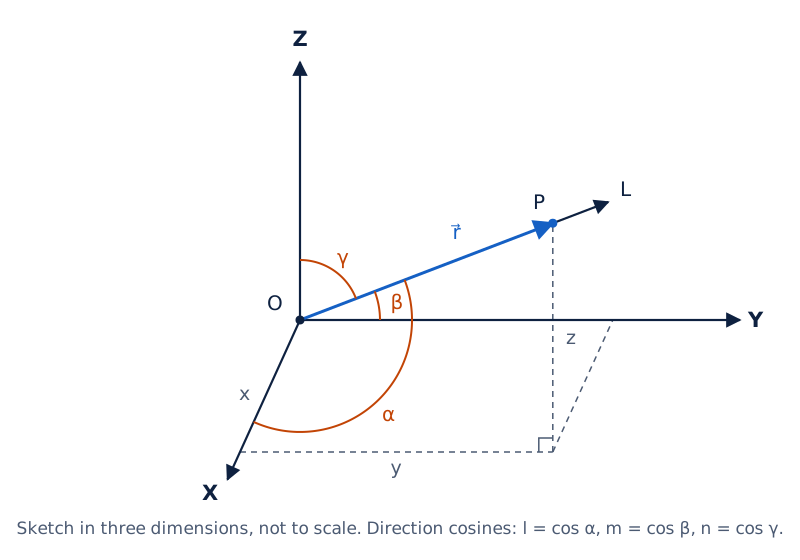
The axes X, Y and Z meet at O. The slanting directed line L passes through P. The angles α, β and γ are marked at O, and dotted lines show the coordinate construction around P.
Drawn by One Young India.
How do two points determine a line's direction?
Which subtraction gives the required direction?
Let P(x₁, y₁, z₁) and Q(x₂, y₂, z₂) be distinct points. Subscripts 1 and 2 identify the coordinates of P and Q. For the direction from P to Q, subtract the coordinates of P from the corresponding coordinates of Q.
The vector PQ⃗ has components x₂ − x₁, y₂ − y₁ and z₂ − z₁. These are direction ratios. The length PQ is √[(x₂ − x₁)² + (y₂ − y₁)² + (z₂ − z₁)²]. Divide each component by PQ to obtain direction cosines.
Collinear points lie on one straight line. To test three distinct points, compare the direction ratios of two segments sharing one point. Proportional triples give the same line because the segments have both a common point and a common direction.
Worked example 3. Find the direction cosines from P(−2, 4, −5) towards Q(1, 2, 3).
Answer: PQ⃗ = 3î − 2ĵ + 8k̂ and PQ = √(9 + 4 + 64) = √77. The required direction cosines are 3/√77, −2/√77 and 8/√77.
How is collinearity checked?
Worked example 4. Show that A(2, 3, −4), B(1, −2, 3) and C(3, 8, −11) are collinear.
Answer: AB⃗ = −î − 5ĵ + 7k̂ and BC⃗ = 2î + 10ĵ − 14k̂. Thus BC⃗ = −2AB⃗. The directions are proportional, and the two lines share B, so A, B and C lie on one straight line.
Maintain the same subtraction order in every coordinate. Reversing all differences gives the reverse direction and is consistent. Reversing just one difference can produce a different vector and an incorrect angle or equation.
How are vector and Cartesian equations of a line formed?
Result: A point and a direction determine a line
Let a⃗ be the position vector of a fixed point A and b⃗ a non-zero vector parallel to the line. Its vector equation is r⃗ = a⃗ + λb⃗. Here λ is a real parameter, meaning a number allowed to vary, and r⃗ locates a general point on the line.
For A(x₁, y₁, z₁) and b⃗ = aî + bĵ + ck̂, equating components gives the parametric equations x = x₁ + λa, y = y₁ + λb and z = z₁ + λc. The same parameter must satisfy all three equations.
When a, b and c are non-zero, elimination of λ gives the symmetric Cartesian form (x − x₁)/a = (y − y₁)/b = (z − z₁)/c. Each fraction equals the same number. The numerators identify a point; the denominators give direction ratios.
Note: A zero direction component is handled through the parametric equations. For a line parallel to the x-axis through A, write y = y₁ and z = z₁, with x free. Do not interpret a fraction with denominator zero as ordinary division.
Worked example 5. Find the line through (5, 2, −4) parallel to 3î + 2ĵ − 8k̂.
Answer: r⃗ = 5î + 2ĵ − 4k̂ + λ(3î + 2ĵ − 8k̂). Its Cartesian equation is (x − 5)/3 = (y − 2)/2 = (z + 4)/(−8).
For lines through A(x₁, y₁, z₁) parallel to the coordinate axes, the fixed-coordinate equations are:
| Parallel direction | Equations through A | Variable coordinate |
|---|---|---|
| x-axis | y = y₁, z = z₁ | x varies freely |
| y-axis | x = x₁, z = z₁ | y varies freely |
| z-axis | x = x₁, y = y₁ | z varies freely |
How is the two-point form obtained?
If a⃗ and q⃗ are the position vectors of two distinct given points, use q⃗ − a⃗ as the direction vector. Then r⃗ = a⃗ + λ(q⃗ − a⃗). At λ = 0 the point is the first endpoint; at λ = 1 it is the second.
In coordinates, the denominators are x₂ − x₁, y₂ − y₁ and z₂ − z₁. A zero difference fixes the corresponding coordinate. The full real range of λ describes the entire line, including points beyond the two given points.
What the figure shows
A line through a fixed point
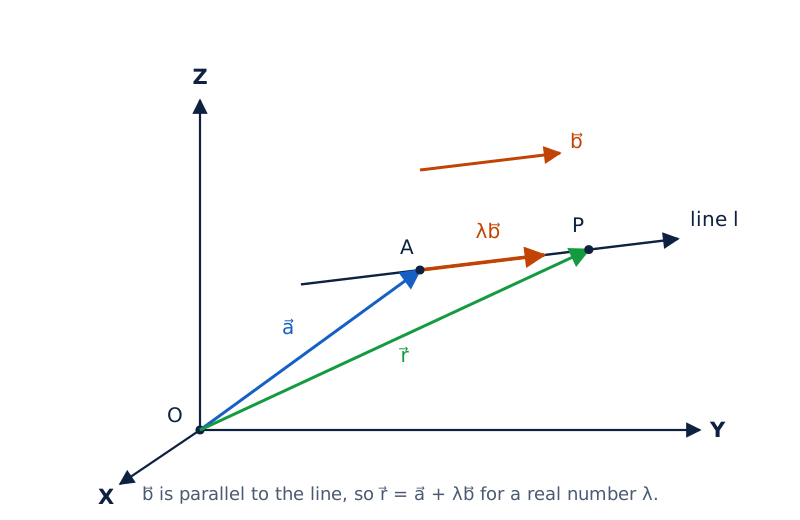
A and P lie on the line labelled l. Vectors from O reach A and P, while a separate arrow labelled b⃗ is parallel to the line.
Drawn by One Young India.
How is the angle between two lines calculated?
Result: Use the scalar product of direction vectors
Let b⃗₁ and b⃗₂ be non-zero direction vectors for the two lines. The smaller angle θ between their directions satisfies cos θ = |b⃗₁ · b⃗₂|/(|b⃗₁||b⃗₂|). Here θ names the angle, and vertical bars around a scalar mean its absolute value.
For direction ratios (a₁, b₁, c₁) and (a₂, b₂, c₂), the numerator becomes |a₁a₂ + b₁b₂ + c₁c₂|. The denominator is √(a₁² + b₁² + c₁²) √(a₂² + b₂² + c₂²).
With direction cosines (l₁, m₁, n₁) and (l₂, m₂, n₂), the denominator is one. Hence cos θ = |l₁l₂ + m₁m₂ + n₁n₂|. For specified directed vectors, omitting the absolute value gives their vector angle, which may be obtuse.
Which conditions identify special directions?
| Relationship | Condition | Meaning |
|---|---|---|
| Parallel directions | b⃗₁ × b⃗₂ = 0⃗ | The direction vectors are proportional |
| Perpendicular directions | b⃗₁ · b⃗₂ = 0 | The angle between directions is 90° |
| General smaller angle | cos θ = |b⃗₁ · b⃗₂|/(|b⃗₁||b⃗₂|) | Use non-zero direction vectors |
An angle calculation uses directions, not the position vectors of arbitrary points on the lines. It does not by itself prove that the lines meet.
Worked example 6. Find the angle between r⃗ = 3î + 2ĵ − 4k̂ + λ(î + 2ĵ + 2k̂) and r⃗ = 5î − 2ĵ + μ(3î + 2ĵ + 6k̂), where μ is an independent real parameter.
Answer: The direction vectors have scalar product 3 + 4 + 12 = 19 and magnitudes 3 and 7. Thus cos θ = 19/21, giving θ = cos⁻¹(19/21). Here cos⁻¹ denotes the inverse cosine function.
How can intersecting, parallel and skew lines be distinguished?
What does coplanar mean?
Coplanar lines lie in a common plane. Intersecting lines and parallel lines are coplanar. Skew lines are neither parallel nor intersecting; no single plane contains both. Non-parallel lines in space therefore need not meet.
Write the equations as r⃗ = a⃗₁ + λb⃗₁ and r⃗ = a⃗₂ + μb⃗₂. The vectors a⃗₁ and a⃗₂ locate fixed points on the first and second lines. The independent parameters λ and μ locate potentially different points.
To find an intersection, equate the three coordinates. Solve two independent equations for λ and μ, then test the remaining equation. A pair of values must satisfy all three. Failure of the third equation means the candidate points are different.
How does the coplanarity test work?
Define w⃗ = a⃗₂ − a⃗₁, a vector joining the chosen fixed points. The lines are coplanar when w⃗ · (b⃗₁ × b⃗₂) = 0. This expression is a scalar triple product: first form the vector product, then take its scalar product with w⃗.
- Check whether the direction vectors are proportional. If so, the lines have parallel directions.
- For parallel directions, test whether one fixed point also belongs to the other line to distinguish coincident from distinct parallel lines.
- For non-parallel directions, a zero scalar triple product gives coplanarity and hence an intersection.
- For non-parallel directions, a non-zero scalar triple product identifies skew lines.
Coincident lines are two descriptions of the same line. In the parallel case, the scalar triple product vanishes automatically because the vector product is zero. That result alone cannot distinguish coincident lines from separate parallel lines.
The angle between skew lines is defined using intersecting lines drawn parallel to them through a common point, preferably the origin. This makes the angle a relationship between their directions even though the original lines do not meet.
How is the shortest distance between two lines found?
Why does the vector product appear?
The shortest distance is the least length of a segment joining one point on each line. It is zero for intersecting lines. For skew lines, the shortest segment is perpendicular to both lines, so its direction is parallel to b⃗₁ × b⃗₂.
For the lines r⃗ = a⃗₁ + λb⃗₁ and r⃗ = a⃗₂ + μb⃗₂, with non-parallel directions, let d be the shortest distance. Then d = |(a⃗₂ − a⃗₁) · (b⃗₁ × b⃗₂)|/|b⃗₁ × b⃗₂|.
This takes the absolute scalar projection, the signed component along a chosen unit direction made non-negative, of the joining vector onto the common perpendicular. Moving the chosen points along their lines does not change this perpendicular separation.
Worked example 7. Find the shortest distance between r⃗ = î + ĵ + λ(2î − ĵ + k̂) and r⃗ = 2î + ĵ − k̂ + μ(3î − 5ĵ + 2k̂).
Answer: The joining vector is î − k̂. The vector product of the directions is 3î − ĵ − 7k̂, with magnitude √59. Its scalar product with the joining vector is 3 + 7 = 10. Hence d = 10/√59 units.
What changes for parallel lines?
For parallel lines use a common non-zero direction vector b⃗. Their distance is d = |(a⃗₂ − a⃗₁) × b⃗|/|b⃗|. This is the perpendicular distance from a point on either line to the other line.
Worked example 8. Find the distance between r⃗ = î + 2ĵ − 4k̂ + λ(2î + 3ĵ + 6k̂) and r⃗ = 3î + 3ĵ − 5k̂ + μ(2î + 3ĵ + 6k̂).
Answer: The joining vector has components (2, 1, −1). Taking b⃗ × (a⃗₂ − a⃗₁) gives −9î + 14ĵ − 4k̂, of magnitude √293. Since |b⃗| = 7, the distance is √293/7 units.
What the figure shows
A common perpendicular
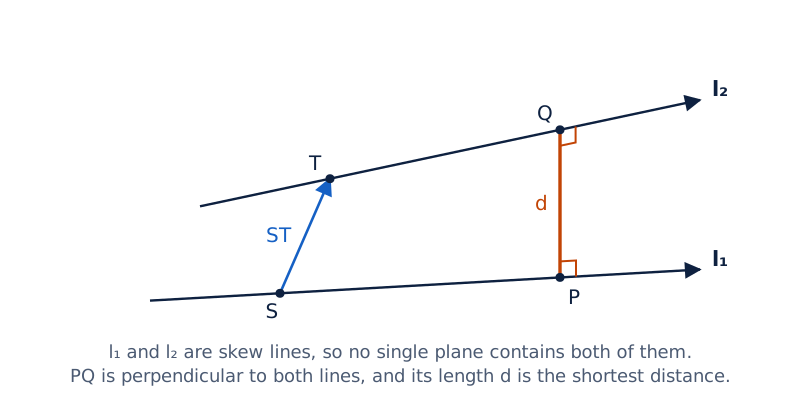
S and P lie on l₁, while T and Q lie on l₂. The segment PQ joins the lines, and a right-angle mark is shown at P. ST joins the chosen points S and T.
Drawn by One Young India.
How is the distance of a point from a line calculated?
How is the foot of the perpendicular located?
The foot of the perpendicular is the point where a perpendicular from a given point meets a line or plane. Let P have position vector p⃗, and let the given line be r⃗ = a⃗ + λb⃗. Write Q for the required foot on the line.
Since Q lies on the line, its position vector is a⃗ + λb⃗. Therefore PQ⃗ = a⃗ + λb⃗ − p⃗. The perpendicularity condition is (a⃗ + λb⃗ − p⃗) · b⃗ = 0. Solve this equation for λ.
Substitute that value into the line to obtain Q. The required distance is |PQ⃗|. Alternatively, the vector-product formula gives the distance directly as |(p⃗ − a⃗) × b⃗|/|b⃗|. Both expressions require b⃗ to be non-zero.
Worked example 9. Find the distance of P(−2, 4, −5) from (x + 3)/3 = (y − 4)/5 = (z + 8)/6.
Answer: A general point Q is (3λ − 3, 5λ + 4, 6λ − 8). Thus PQ⃗ has components (3λ − 1, 5λ, 6λ − 3).
Perpendicularity gives 3(3λ − 1) + 5(5λ) + 6(6λ − 3) = 0. Hence 70λ = 21 and λ = 3/10.
The perpendicular vector is (−1/10)î + (15/10)ĵ − (12/10)k̂. Its length is √370/10 = √(37/10) units.
This method finds an actual point on the line as well as a distance. A point chosen arbitrarily on the line will generally give a longer segment. The scalar-product equation is what ensures that the chosen joining segment is perpendicular.
How is the equation of a plane written using a normal?
What information fixes a plane?
A normal vector is a non-zero vector perpendicular to a plane. Let n⃗ = Aî + Bĵ + Ck̂ be a normal, where A, B and C are real constants not all zero. Let a⃗ locate a fixed point on the plane.
For any point with position vector r⃗ in the plane, r⃗ − a⃗ lies along the plane and is perpendicular to n⃗. Therefore the one-point vector form is (r⃗ − a⃗) · n⃗ = 0.
If the fixed point is (x₁, y₁, z₁), the corresponding Cartesian form is A(x − x₁) + B(y − y₁) + C(z − z₁) = 0. Expanding gives Ax + By + Cz + D = 0, where D = −Ax₁ − By₁ − Cz₁.
Which coefficients describe the normal?
The coefficients A, B and C are direction ratios of the normal. They do not describe a line lying in the plane. Multiplying the entire equation by the same non-zero number preserves the plane and changes the normal by that scalar factor.
An equivalent vector equation is r⃗ · n⃗ = k, where k is the scalar constant a⃗ · n⃗. The letter k without a hat denotes a scalar here; k̂ denotes the unit vector along the z-axis.
If three non-collinear points are given, form two vectors from one of them to the other two. Their vector product supplies a normal. Use that normal and any of the three points in the one-point equation.
Non-collinearity matters: collinear points do not determine a unique plane. Their two joining vectors are proportional, giving a zero vector product, which cannot serve as a plane's normal. A point and a specified non-zero normal avoid that ambiguity.
How do normal and intercept forms describe a plane?
What does normal form measure?
Let n̂ be a unit normal chosen towards the plane from the origin, and let p be the perpendicular distance from the origin. The normal form is r⃗ · n̂ = p. Since n̂ has magnitude one, the right-hand side directly measures distance.
If l, m and n are the direction cosines of this normal, the Cartesian normal form is lx + my + nz = p, with l² + m² + n² = 1. In this equation p is non-negative. If the plane contains the origin, p = 0 and either unit normal can be used.
For Ax + By + Cz + D = 0, divide by √(A² + B² + C²) to normalise the coefficients. Choose the overall sign so that the right-hand side is non-negative. The origin-to-plane distance is |D|/√(A² + B² + C²).
What do the intercepts represent?
An axis intercept is the signed coordinate where a plane meets an axis. If the plane meets the axes at (a, 0, 0), (0, b, 0) and (0, 0, c), its intercept form is x/a + y/b + z/c = 1.
Here a, b and c denote the three non-zero intercepts, rather than direction ratios. This form assumes finite, non-zero intercepts on all three axes. A coordinate plane or a plane parallel to an axis is better written in general Cartesian form.
Worked example 10. Find the plane through (2, 0, 0), (0, 3, 0) and (0, 0, 4).
Answer: Its intercepts are 2, 3 and 4. Therefore x/2 + y/3 + z/4 = 1. Multiplying throughout by 12 gives 6x + 4y + 3z = 12.
The intercept equation can be checked by substituting each intercept point. Two terms become zero and the remaining fraction becomes one. In general form, setting two coordinates to zero provides the corresponding intercept when that axis is met uniquely.
How are angles involving planes calculated?
Which vectors give the angle between two planes?
Let n⃗₁ and n⃗₂ be non-zero normals to two planes. The smaller angle θ between the planes satisfies cos θ = |n⃗₁ · n⃗₂|/(|n⃗₁||n⃗₂|). This is the angle between their normals, reduced to the smaller angle.
For equations A₁x + B₁y + C₁z + D₁ = 0 and A₂x + B₂y + C₂z + D₂ = 0, use normals (A₁, B₁, C₁) and (A₂, B₂, C₂). The constants D₁ and D₂ locate the planes but do not enter their angle.
Proportional normals give parallel or coincident planes. A zero scalar product of the normals gives perpendicular planes. These conditions concern the orientation of the planes, so the normal vectors must be extracted before any angle calculation.
Why does a line-plane angle use sine?
Let b⃗ be the direction vector of a line and n⃗ the normal to a plane. If φ denotes their line-plane angle, then sin φ = |b⃗ · n⃗|/(|b⃗||n⃗|). The angle with the plane is complementary to the smaller angle with its normal.
The Greek letter φ names an angle from 0° to 90°. A zero scalar product gives φ = 0°, meaning the line's direction is parallel to the plane. Proportional b⃗ and n⃗ give φ = 90°, meaning the line is perpendicular to the plane.
For direction ratios (a, b, c) and plane Ax + By + Cz + D = 0, the sine numerator is |aA + bB + cC|. Divide by √(a² + b² + c²) √(A² + B² + C²). Using cosine here instead would give the complementary angle.
How are line-plane intersections and point-plane distances found?
How is the intersection parameter determined?
For a line r⃗ = a⃗ + λb⃗ and plane r⃗ · n⃗ = k, substitution gives a⃗ · n⃗ + λ(b⃗ · n⃗) = k. If b⃗ · n⃗ is non-zero, the unique intersection parameter is λ = (k − a⃗ · n⃗)/(b⃗ · n⃗).
If b⃗ · n⃗ = 0, check a⃗ · n⃗. When it equals k, the line lies in the plane. Otherwise, the line is parallel to the plane without meeting it. Do this check before dividing by the scalar product.
Worked example 11. Find where the line through (3, −4, −5) and (2, −3, 1) meets the plane through (2, 2, 1), (3, 0, 1) and (4, −1, 0).
Answer: Two vectors in the plane have components (1, −2, 0) and (2, −3, −1). Their vector product is (2, 1, 1), giving the plane 2x + y + z = 7.
The line is x = 3 − λ, y = −4 + λ, z = −5 + 6λ. Substitution gives 5λ − 3 = 7, so λ = 2. The intersection is (1, −2, 7).
Why must the normal be normalised for a distance?
For P(x₀, y₀, z₀) and Ax + By + Cz + D = 0, the perpendicular distance d is |Ax₀ + By₀ + Cz₀ + D|/√(A² + B² + C²). The subscript 0 identifies the given point's coordinates.
Equivalently, for point position vector p⃗ and plane r⃗ · n⃗ = k, d = |p⃗ · n⃗ − k|/|n⃗|. The denominator accounts for the length of the normal. The absolute value ensures a non-negative distance on either side of the plane.
Worked example 12. Find the distance from the point with position vector 2î + ĵ − k̂ to the plane r⃗ · (î − 2ĵ + 4k̂) = 9.
Answer: The Cartesian point is (2, 1, −1), and the plane is x − 2y + 4z − 9 = 0. Thus d = |2 − 2 − 4 − 9|/√(1 + 4 + 16) = 13/√21 units.
Glossary
- Position vector — The vector from the origin to a point, specifying that point's location in the coordinate system.
- Direction angles — Angles made by a directed line with the positive directions of the three coordinate axes.
- Direction cosines — Cosines of the three direction angles, whose squares add to one for a directed line.
- Direction ratios — Three numbers, not all zero, proportional to the direction cosines of a line.
- Parameter — A variable real number that locates different points when substituted into the equations of a line.
- Collinear points — Points that lie on the same straight line in the coordinate space.
- Coplanar lines — Lines for which there exists a single plane containing both of them.
- Skew lines — Lines in space that are neither parallel nor intersecting and cannot lie in one common plane.
- Common perpendicular — A line perpendicular to both given skew lines, whose joining segment measures their shortest distance.
- Normal vector — A non-zero vector perpendicular to a plane, used to specify the plane's orientation.
- Unit normal — A normal vector of magnitude one, used in the normal form of a plane.
- Axis intercept — The signed coordinate at which a plane meets a specified coordinate axis.
- Foot of the perpendicular — The point where a perpendicular drawn from a given point meets the specified line or plane.
Common errors and misconceptions
- Misconception: Direction ratios must have squared sum one. Correct: Direction cosines have this property; direction ratios must be normalised before that test applies.
- Misconception: Each direction cosine may independently change sign. Correct: Reversing the same line's direction changes all three signs together.
- Misconception: x = 0 is the equation of the y-axis. Correct: It describes the yz-plane; the y-axis needs both x = 0 and z = 0.
- Misconception: Every pair of non-parallel lines intersects. Correct: Non-parallel lines in space can be skew; an intersection must satisfy all three coordinate equations.
- Misconception: The skew-line distance formula also works for parallel lines. Correct: Its denominator then vanishes. Use the parallel-line formula with a common direction vector.
- Misconception: Plane coefficients give a direction lying in the plane. Correct: The coefficients of x, y and z give a normal perpendicular to the plane.
- Misconception: The line-plane angle equals the smaller angle between the line and the plane's normal. Correct: These two angles are complementary. The sine of the line-plane angle equals the cosine of the smaller angle with the normal.
- Misconception: Substituting a point into a plane equation immediately gives distance. Correct: Take the absolute value and divide by the magnitude of the normal.
Exam-style questions with model answers
Q1. A line has direction ratios 2, −1 and −2. Find one set of direction cosines and state the set for the reverse direction. [2 marks]
- The normalising length is √[2² + (−1)² + (−2)²] = 3, so one set of direction cosines is (2/3, −1/3, −2/3).
- Reverse all three signs together to obtain the opposite direction: (−2/3, 1/3, 2/3).
Q2. Show that A(2, 3, −4), B(1, −2, 3) and C(3, 8, −11) are collinear. [3 marks]
- Subtract A's coordinates from B's coordinates to obtain the vector AB⃗ with components (−1, −5, 7). These give a direction for the line through A and B.
- Similarly, subtract B's coordinates from C's coordinates: BC⃗ has components (2, 10, −14), which equal −2 times the corresponding components of AB⃗.
- The lines therefore have proportional directions and share B. They coincide, so all three points are collinear.
Q3. Find vector and Cartesian equations of the line through (5, 2, −4) parallel to 3î + 2ĵ − 8k̂, where î, ĵ and k̂ are positive coordinate unit vectors. [4 marks]
- The fixed point has position vector a⃗ = 5î + 2ĵ − 4k̂, and the given non-zero direction vector is b⃗ = 3î + 2ĵ − 8k̂.
- Let r⃗ locate a general point and λ be real. The vector equation is r⃗ = 5î + 2ĵ − 4k̂ + λ(3î + 2ĵ − 8k̂).
- Equating components gives x = 5 + 3λ, y = 2 + 2λ and z = −4 − 8λ.
- Eliminating the common parameter gives the Cartesian equation (x − 5)/3 = (y − 2)/2 = (z + 4)/(−8).
Q4. Find the shortest distance between the lines r⃗ = î + ĵ + λ(2î − ĵ + k̂) and r⃗ = 2î + ĵ − k̂ + μ(3î − 5ĵ + 2k̂). Here r⃗ is a position vector, î, ĵ, k̂ are coordinate unit vectors, and λ, μ are independent real parameters. [5 marks]
- Choose the fixed points with position vectors a⃗₁ = î + ĵ and a⃗₂ = 2î + ĵ − k̂. Their joining vector is a⃗₂ − a⃗₁ = î − k̂.
- The direction vectors are b⃗₁ = 2î − ĵ + k̂ and b⃗₂ = 3î − 5ĵ + 2k̂. Their vector product is 3î − ĵ − 7k̂.
- This vector product is non-zero, so the directions are not parallel. Its magnitude is √(9 + 1 + 49) = √59.
- The scalar product of the joining vector with this vector product is 3 + 7 = 10. Since it is non-zero, the lines are skew.
- The shortest distance is the absolute scalar triple product divided by the vector-product magnitude: d = 10/√59 units.
Q5. Find where the line through (3, −4, −5) and (2, −3, 1) meets the plane through (2, 2, 1), (3, 0, 1) and (4, −1, 0). [5 marks]
- From the first plane point to the other two, form vectors with components (1, −2, 0) and (2, −3, −1). Their vector product has components (2, 1, 1), supplying a non-zero normal.
- Using the point (2, 2, 1), the plane equation is 2(x − 2) + (y − 2) + (z − 1) = 0, or 2x + y + z = 7.
- The line's direction is the difference between its given points, (−1, 1, 6). With real parameter λ, write x = 3 − λ, y = −4 + λ and z = −5 + 6λ.
- Substitute these into the plane equation: 2(3 − λ) + (−4 + λ) + (−5 + 6λ) = 7. Thus 5λ − 3 = 7 and λ = 2.
- Substitution in the line gives the intersection (1, −2, 7). It satisfies the plane because 2 − 2 + 7 = 7.
Q6. Calculate the perpendicular distance of P(2, 1, −1) from the plane x − 2y + 4z = 9. [4 marks]
- Put the plane in the form x − 2y + 4z − 9 = 0. A normal vector has components (1, −2, 4).
- The magnitude of that normal is √[1² + (−2)² + 4²] = √21, which is the denominator of the distance formula.
- Substituting the given point into the plane's left-hand side gives 2 − 2 − 4 − 9 = −13. Take its absolute value, 13.
- The perpendicular distance is therefore d = 13/√21 units. The negative substitution value indicates a side of the plane, not a negative distance.
Key takeaways
- Direction cosines have squared sum one; direction ratios are proportional triples that must be normalised to obtain direction cosines.
- A point and a non-zero direction vector determine a line, with one common parameter controlling all three coordinates.
- Use direction vectors for line angles and normal vectors for plane angles; positions do not determine these orientations.
- Non-parallel lines may be skew. An intersection requires a parameter pair satisfying all three coordinate equations.
- The shortest segment between skew lines is perpendicular to both; parallel lines require a different distance formula.
- A plane's Cartesian coefficients give its normal direction, and one point then fixes its position.
- The line-plane angle uses sine because it is complementary to the smaller angle between the line and the plane's normal.
- Point-plane distance requires an absolute numerator and division by the normal's magnitude, unless that normal is already a unit vector.
Test yourself
What equations describe the x-axis, and why is one equation insufficient?
The x-axis is y = 0 and z = 0, with x free. Either equation alone describes a whole coordinate plane.
How do direction cosines change when a directed line is reversed?
All three signs reverse together, giving the opposite orientation along the same geometric line.
How are direction ratios obtained from two distinct points?
Subtract corresponding coordinates in the same order throughout. The three differences form a non-zero direction vector.
Why must the third coordinate equation be checked when testing line intersection?
A parameter pair satisfying two coordinate equations may fail the third, so the candidate points need not coincide in space.
Why cannot the skew-line shortest-distance formula be used for parallel lines?
The vector product of parallel direction vectors is zero, so the denominator in that formula vanishes.
In Ax + By + Cz + D = 0, what do A, B and C represent?
The constants A, B and C are direction ratios of a normal to the plane, and are not all zero.
How is a line-plane angle related to the angle with the plane's normal?
It is complementary to the smaller direction-normal angle, which explains the sine in the line-plane angle formula.
When does a line whose direction is parallel to a plane lie in that plane?
It lies in the plane when a fixed point on the line also satisfies the plane's equation.
Write about it
Turn a question from this chapter into a paper.
The Writing Studio has a structure guide, a rubric and citation tools for 15 formats, from essays to research papers. Drafting is free with an account. Learnacy Essential adds feedback from an AI writing coach and submission to The OYI Review.
Learnacy Essential is ₹1,499 for the year. Publication depends on review and is not guaranteed.