
Measurement of Length and Motion | CBSE Class 6 Science Notes
On this page
Watch & explore
Start with a few high-quality watches, then dive into the notes below.
Try an idea before you read. Apply your knowledge of measurement rules and motion concepts to solve these real-world scenarios. Explore →
This note covers measurement using body parts, standard units of length, unit conversions, correct use of scales, measurement of curved lines, reference points, rest and motion, linear motion, circular motion, oscillatory motion and practical measurement activities.
How do we measure length using a unit?
Measurement of length involves comparing a length with a chosen unit. A unit is the length selected for this comparison. A measurement has two parts: a number and a unit. The number alone does not give the complete measurement.
What does a handspan measurement mean?
A handspan is the span of an outstretched hand used for measuring length. Deepa's mother calls it balisht. Deepa and her friends compare the length of their classroom table with their handspans and record how many handspans cover its length.
If a table measures 13 handspans, 13 is the number and handspan is the selected unit. The table's length is being expressed in terms of the handspan used. It is not enough to report its length simply as 13.
| Student | Number of handspans for the table |
|---|---|
| Anish | Slightly more than 13 |
| Padma | 13 |
| Tasneem | Slightly less than 13 |
| Deepa | Between 13 and 14 |
| Hardeep | 14 |
The friends obtain different numbers for the same table. On comparing their hands, they find that their handspans have different lengths. The difference is in the size of the chosen unit, rather than a change in the table they measured.
Which other body parts have been used?
Body-based measurements include the length of an arm, a foot or a stride, meaning a step taken while walking. A farmer may walk and count strides when dividing a field into beds. Fingers and fists have also been used as units.
Angula means finger width; char angula means four fingers width. Deepa's mother uses this expression when asking the tailor to increase the length of Deepa's uniform. Such units depend on body dimensions, which differ from person to person.
Why are standard units of length necessary?
Standard units provide agreed units for measurement. Handspans, feet, fists and fingers differ between people. There is therefore a need for a unit with which measurements of the same length made by different people do not differ because they used different-sized units.
How did a shared system become necessary?
Several systems of units developed in different parts of the world. As people travelled between places, these different systems caused confusion. Countries came together and adopted a set of standard units of measurement to provide a shared system.
Definition: SI stands for the International System of Units, the system of standard units adopted by countries. The SI unit of length is the metre, whose symbol is m.
Using a metre scale gives people a common unit for comparing lengths. Correct technique remains necessary: the scale must be placed properly and the reading taken correctly. A shared unit and a correct measurement method are both part of measuring length.
What is known about older Indian units?
India has a rich history of measurement systems dating back to ancient times. Angula, multiples of angula, dhanusa and yojana are units of measurement mentioned in ancient Indian literature. They were used in measuring artefacts, architecture and town planning.
Traditional craftspeople, such as carpenters and tailors, still use angula. Several objects with ruled markings which could be scales have been excavated from sites of the Harappan Civilisation.
These older practices explain why everyday conversations may use body-based units alongside standard units. In Deepa's uniform example, the shopkeeper measures a two-metre cloth piece using a metal rod, while her mother describes an alteration using finger widths.
How are metres, centimetres, millimetres and kilometres related?
A metre (m) is the SI unit of length. One metre is divided into 100 equal divisions, each called a centimetre (cm). Each centimetre is divided into ten equal parts, each called a millimetre (mm).
A kilometre (km) is a larger unit equal to 1000 metres. Kilometres are useful for larger lengths, while centimetres and millimetres are useful for smaller lengths. The unit should suit the length being measured.
| Relationship | Meaning |
|---|---|
| One kilometre equals one thousand metres. | |
| One metre equals one hundred centimetres. | |
| One centimetre equals ten millimetres. | |
| One millimetre equals one-tenth of a centimetre. |
What do the markings on a scale mean?
A typical 15 cm scale has centimetre markings from 0 to 15. The distance between consecutive big marks, such as 1 and 2 or 5 and 6, is 1 cm. Ten smaller equal divisions divide this distance.
On this scale, 1 mm is the smallest length that can be measured. This describes the scale with those divisions; when examining another measuring device, look at its markings to find the smallest value it can measure.
What the figure shows
A 15 cm scale
The picture shows a green scale with numbered centimetre marks and smaller divisions between them. The centimetre numbering runs from 0 to 15.
See Fig. 5.3 in your NCERT textbook
How can a distance be converted?
Worked example 1. The distance between home and school is 1.5 km. Express this distance in metres, using .
Answer: . The distance is unchanged; it has been expressed using metres instead of kilometres.
Some scales also carry inch markings. An inch is a unit of length equal to 2.54 cm: . Inch and foot were used in earlier days and are still used by some people.
How do we choose an instrument and record a measurement?
A measuring instrument, such as a scale or tape, must be suitable for the object. Consider both the length involved and whether the surface is straight or curved. A rigid scale and a flexible tape serve different measurement needs.
| Length to measure | Suitable instrument | Reason for the choice |
|---|---|---|
| Length of a pencil | A 15 cm scale | A small scale can be placed along the pencil. |
| Height of a room | A metre scale or measuring tape | The measurement requires a longer measuring instrument. |
| Girth of a tree | A flexible measuring tape | The tape can follow the distance around the trunk. |
| Size around the chest | A tailor's flexible tape | The tape can follow the body for the measurement. |
Girth means the measurement around an object, such as a tree trunk. It cannot be measured directly using a metre scale. A flexible tape is more suitable for this purpose because it can follow the curved surface.
Which units suit different lengths?
Distance between Delhi and Lucknow is conveniently expressed in kilometres. The thickness of a coin is suited to millimetres, the length of an eraser to centimetres, and the length of a school ground to metres.
The choice of unit and the choice of instrument are related but distinct decisions. One concerns how to express the result; the other concerns how to measure the actual object. For a curved measurement, the instrument must be able to follow the curve.
How should unit symbols be written?
- Write the symbols km, m, cm and mm in lowercase letters.
- Leave a space between the number and the unit, as in 1.5 km.
- Do not add “s” to a unit symbol to make it plural.
- Do not put a full stop after a symbol unless it ends a sentence.
- Write unit names in lowercase, except at the beginning of a sentence.
A record of measurements must include both the object and its measured length with a unit. Omitting the unit removes part of the information needed to understand the result, even when the numerical reading has been recorded correctly.
What is the correct way to measure with a scale?
Correct placement and correct eye position are essential when reading a scale. Put the scale in contact with the object along the length being measured. For a pencil, align it with the scale and look directly above its tip.
How should the measurement be taken?
- Select a scale suitable for the length of the object being measured.
- Place the scale in contact with the object and along its length.
- Align one end with the zero mark if that mark is clear and usable.
- Position the eye directly above the other end while reading the scale.
- Record the measured length as a number together with its unit.
What the figure shows
Placing a scale
The two pictures compare a scale placed along a rectangular object with a scale placed at a slant. They are labelled “Correct” and “Incorrect”, respectively.
See Fig. 5.4 in your NCERT textbook
What the figure shows
Correct eye position
A pencil lies along a scale. Three viewing positions are labelled A, B and C. B is directly above the pencil tip and is identified as the correct position.
See Fig. 5.5 in your NCERT textbook
What if the zero end is broken?
A scale with broken ends or an unclear zero mark can still be used. Begin at another full mark, such as 1.0 cm. Record the reading at each end of the object and subtract the starting reading from the other reading.
Worked example 2. An object placed beside a scale with a broken end begins at 1.0 cm and ends at 10.4 cm. Find its length.
Answer: . Here, “starting reading” and “final reading” mean the scale readings at the two ends of the object. Its length is .
Note: The final reading alone is not the length when the object begins at a mark other than zero. Both end readings are needed to calculate the length.
Visually challenged students use scales with raised markings that can be felt by touch. Such markings provide a way of reading the scale through touch rather than by looking at printed divisions.
How can the length of a curved line be measured?
A curved line bends instead of following a straight path. To measure its length, use a flexible measuring tape or a thread that follows the curve. A thread can then be straightened and measured using a metre scale.
How does the thread method work?
- Take a thread that can be placed along the curved line.
- Lay it along the curve, following the line from one end to the other.
- Identify the portion of thread that matches the complete curved line.
- Straighten this portion and measure its length using a metre scale.
- Record the result as a number together with the appropriate unit.
What the figure shows
Measuring a curved line
The drawing shows hands placing a thread along a blue curved line. The thread follows the bends of the line, providing a length that can subsequently be straightened for measurement.
See Fig. 5.8 in your NCERT textbook
Anish and his parents decorate the arches of their verandah with electric string lights for a celebration. Measuring along an arch is a practical use of the curved-line method. A flexible tape or thread can follow the shape where the lights will be fixed.
Where else can this method be used?
The curved part of the base of a tumbler or bottle can be measured and recorded. A similar use of string measures the outer boundary, meaning the edge all the way around, of a bicycle wheel.
The important distinction is between the curved path itself and a straight measurement. In the thread method, the flexible material first follows the shape being measured. Its length is then read against a straight scale after that portion is straightened.
These examples connect the choice of instrument with the shape of the object. The scale supplies the standard unit and reading, while the thread allows the measurement to follow a line that the rigid scale cannot directly follow.
How does a reference point help describe position?
Definition: A reference point is a fixed object or point with respect to which a distance is stated. It provides the starting reference for describing where an object or place is located.
Position describes where something is in relation to a reference point. Statements about a place being closer or farther need that reference. Different people can reach different conclusions if they compare distances from different starting places.
Why do the friends disagree about the garden?
Before an educational visit, Deepa and her friends compare the garden's distance with the school's distance. Tasneem and Padma say the garden is closer. Deepa and Anish say the school is closer. Hardeep thinks both are almost at an equal distance.
All of them are correct because each is comparing the distances from their own house. If everyone used the same object or point, such as the bus stand, their observations would be the same. Their different starting references explain the disagreement.
What the figure shows
Locations used to compare distances
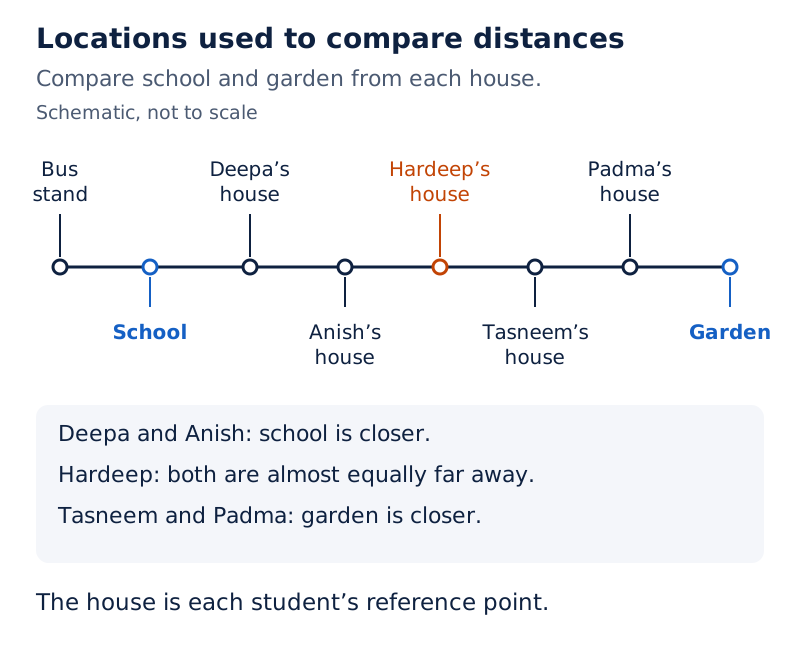
From left to right, the drawing labels the bus stand, school, Deepa's house, Anish's house, Hardeep's house, Tasneem's house, Padma's house and garden.
Drawn by One Young India. See Fig. 5.9 in your NCERT textbook
How is a reference point used in practice?
When drawing a Kabaddi court, the students first decide a point on the ground from which to measure distances. They use a longer measuring tape and draw lines with chuna powder, meaning limestone powder. The chosen point is their reference point.
On a bus journey to her grandparents in Delhi, Padma reads a kilometre stone marked Delhi 70 km. Farther along, another reads Delhi 60 km. A kilometre stone is a roadside marker indicating distance from the named place.
Delhi is the reference point in this example. Padma's position is first 70 km from Delhi and later 60 km from Delhi. These readings show that she is getting closer to her destination as her distance from it decreases.
How do we decide whether an object is at rest or in motion?
Definition: An object is in motion if its position changes with respect to a reference point with time. It is at rest if its position does not change with respect to that reference point with time.
The decision requires a reference point and an observation of position over time. Saying that something is moving or at rest involves comparing its position with that reference. The same situation can be described differently when the reference changes.
What happens to passengers in a moving bus?
Deepa looks at the seated passengers in a bus. After a minute, they still occupy their seats. Relative to Deepa or the bus, their positions have not changed, so they are at rest with respect to that reference.
When she looks outside, their positions change with respect to things outside the bus. Taking a building outside as the reference point, the passengers and the bus are in motion. Both descriptions depend on the stated reference point.
| Object being considered | Reference point | Conclusion |
|---|---|---|
| Passengers remaining in their seats | Deepa or the bus | At rest because their positions relative to this reference do not change. |
| The same passengers in the travelling bus | A building outside | In motion because their positions relative to the building change. |
| Padma travelling towards Delhi | Delhi | In motion because her position relative to Delhi changes with time. |
How can an observation be justified?
To investigate nearby objects, prepare a list of five objects in motion and five at rest. For each object, explain how its position behaves with time relative to the selected reference. The explanation is the justification, or reason, for the classification.
A useful observation identifies what is being watched, what it is compared with, and whether the position changes. Merely naming an object does not explain the decision. The bus example shows why the reference must be clear before drawing a conclusion.
How do linear motion and circular motion differ?
Moving objects can follow different paths. A path is the line along which an object moves. Two types can be distinguished by the shape of this line: a straight path gives linear motion, while a circular path gives circular motion.
What is linear motion?
Definition: Linear motion is the motion of an object along a straight line. The shape of its path, rather than the name of the object, identifies this type of motion.
Drop an eraser from a certain height and observe its path. Other examples include an orange dropping from a tree and students marching along a straight path during a march-past. A car moving on a straight road also shows linear motion.
When a heavy box is pushed, it may also move along a straight line. The qualification matters: the example concerns the straight-line movement of the box. It does not say that every pushed box must follow a straight path.
What is circular motion?
Definition: Circular motion is the motion of an object along a circular path. A merry-go-round and an eraser whirled on a thread illustrate this type of motion.
- Tie an eraser or a potato to one end of a thread.
- Hold the other end of the thread in your hand.
- Whirl the attached object and observe the path it follows.
- Compare its motion with the motion seen on a merry-go-round.
What the figure shows
Circular motion
The drawing shows a child whirling an object on a thread, with a dotted curved outline marking its path. Beside it is a merry-go-round carrying riders on horses.
See Fig. 5.15 in your NCERT textbook
The eraser is used in different activities to reveal different motions. Dropping it allows observation of a straight-line path; whirling it on a thread allows observation of a circular path. Classify the observed movement rather than assigning one permanent motion type to an object.
What are oscillatory motion and periodic motion?
Definition: Oscillatory motion is motion to and fro about some fixed position. “To and fro” means moving back and forth, as in the motion of a swing.
How can an eraser demonstrate oscillatory motion?
- Tie an eraser or a potato to one end of a thread.
- Hold the other end so that the object hangs down, keeping your hand steady.
- Using the other hand, take the object slightly to one side.
- Release it and observe its to-and-fro movement about a fixed position.
The hanging eraser moves like a swing. This differs from whirling the eraser around a circular path. In one activity it swings to and fro; in the other it moves around. The way the object moves determines its classification.
What the figure shows
Oscillatory motion
One drawing shows a hanging eraser at a central position and at positions on either side. Another shows a child on a swing, illustrating to-and-fro movement.
See Fig. 5.16 in your NCERT textbook
How does a metal strip demonstrate the same motion?
Take a thin metal strip about 50 cm long. Hold one end pressed to a table using a few books or a brick. Press the free end slightly and release it. Its up-and-down movement is also an example of oscillatory motion.
The free end changes position repeatedly while the other end is held in place. The activity provides another way to recognise oscillation, alongside the hanging eraser and the swing. All involve motion to and fro about a fixed position.
What does periodic mean?
Periodic motion is motion in which an object repeats its path after a fixed interval of time. “Fixed interval” means the same time gap between repetitions. The repetition and its time interval are part of the meaning.
In circular motion, an object goes along the circular path again and again. An object in oscillatory motion also repeats its motion as it moves to and fro. Both circular and oscillatory motion are periodic in nature.
How can measurement and motion be investigated through activities?
Observation, meaning carefully noting what happens, connects measurement with the study of motion. In measurement activities, record the actual lengths found. In motion activities, describe the path or change in position that supports the chosen classification.
How can measurements be recorded and compared?
Measure objects such as a comb, pen, pencil and eraser using a metre scale, recording each length with its unit. Compare readings for the same objects with those of friends. If the readings are slightly different, discuss possible reasons using the measurement precautions.
Collect fallen leaves from the same tree and identify the tree. Use a 15 cm scale to measure each leaf's length and breadth, meaning its width. Record the tree's name and both measurements, then compare how the leaves vary.
For a height record, stand against a wall and ask an adult to mark your height. Repeat the measurement every three months for yourself and your siblings. The record allows measurements made at different times to be compared.
How can a bicycle help measure distance?
A flexible metal strip can be attached to a spoke of the front bicycle wheel so that it hits the frame holding the wheel and makes a sound whenever it crosses that frame. A spoke is a rod joining the wheel's central part to its outer part.
- Arrange the flexible strip so that the sound marks each turn of the wheel.
- Ride the bicycle slowly and count the sounds to count the turns.
- Use a string to measure the length of the wheel's outer boundary.
- Multiply that boundary length by the number of turns to obtain the distance travelled.
. Here, “boundary length” is the measured length around the wheel, and “turns” is the number of complete wheel turns counted through the sounds.
Such methods are used to measure distances for road-running races. A Jones Counter is a device attached to a bicycle wheel and used for measuring distances. This application joins the measurement of a curved boundary with repeated wheel motion.
How can motion be classified in a park?
Observe motions in a children's park and classify them as linear, circular or oscillatory. The swing provides to-and-fro motion, while the merry-go-round provides circular motion. Give the observed feature that supports each classification instead of recording a label alone.
Glossary
- Measurement of length — Comparison of a length with a selected unit, expressed as a number together with that unit.
- Unit — A chosen length used as the basis for comparing and expressing another length.
- Handspan — The span of an outstretched hand, used as a body-based measure that differs between people.
- Angula — Finger width used as a measure of length, still used by traditional craftspeople such as tailors.
- SI units — Standard units belonging to the International System of Units, adopted by countries for measurement.
- Metre — The SI unit of length, represented by m and divided into one hundred centimetres.
- Centimetre — A unit equal to one-hundredth of a metre, represented by cm and divided into ten millimetres.
- Millimetre — A unit equal to one-tenth of a centimetre, represented by the lowercase symbol mm.
- Kilometre — A unit equal to one thousand metres, represented by km and useful for larger lengths.
- Reference point — A fixed object or point with respect to which a distance is stated.
- Motion — Change in an object's position with respect to a reference point as time passes.
- Rest — The condition in which an object's position does not change with time relative to a reference point.
- Linear motion — Motion along a straight line, such as that of a car moving on a straight road.
- Circular motion — Motion along a circular path, as seen when an eraser is whirled on a thread.
- Oscillatory motion — Motion to and fro about a fixed position, as illustrated by a moving swing.
Common errors and misconceptions
- Misconception: Everyone must obtain the same number of handspans for a table. Correct: Handspan sizes differ between people, so the same table can give different handspan counts.
- Misconception: A length is fully recorded by writing its number. Correct: Every measured length needs both a number and a unit, such as 13 handspans.
- Misconception: One kilometre equals 100 centimetres. Correct: One kilometre equals 1000 metres. It is one metre that equals 100 centimetres.
- Misconception: A rigid metre scale directly measures a tree's girth. Correct: A flexible measuring tape is more suitable because the measurement goes around the trunk.
- Misconception: A scale becomes unusable when its zero end breaks. Correct: Start at another full mark and subtract that reading from the reading at the other end.
- Misconception: The eye can be anywhere when reading the pencil's length. Correct: Position it directly above the pencil tip, with the scale correctly aligned along the pencil.
- Misconception: Seated passengers in a moving bus have the same state of motion relative to everything. Correct: They are at rest relative to the bus but moving relative to an outside building.
- Misconception: An eraser must always show one type of motion. Correct: A dropped eraser, an eraser whirled on a thread and a hanging eraser moving to and fro illustrate different motions.
Exam-style questions with model answers
Q1. A table measures 13 handspans. Identify the two parts of this measurement and explain why classmates may obtain different handspan counts for the same table. [2 marks]
- The number is 13 and the selected unit is the handspan; together they express the measured length.
- Classmates' handspans differ in size, so their counts can differ even when they measure the same table.
Q2. The distance between a student's home and school is 1.5 km. Using 1 km = 1000 m, express the distance in metres and state whether conversion changes the actual distance. [2 marks]
- The distance in metres is 1.5 × 1000 m = 1500 m.
- The actual distance does not change. The same home-to-school distance is being expressed in metres instead of kilometres.
Q3. Padma passes a kilometre stone reading “Delhi 70 km” and later one reading “Delhi 60 km”. Identify the reference point, describe her two positions, and explain what the change shows. [3 marks]
- Delhi is the reference point because both kilometre stones state the distance with respect to Delhi.
- At the first stone Padma is 70 km from Delhi; at the later stone she is 60 km from Delhi.
- Her distance from Delhi decreases with time, showing that she is moving closer to Delhi during this part of the journey.
Q4. Deepa and the other passengers remain in their seats while their bus travels past a building. Explain the passengers' state of rest or motion relative to the bus and relative to the building, and state the general rule used. [3 marks]
- Relative to the bus, the passengers are at rest because they continue to occupy their seats without changing position in the bus.
- Relative to the building outside, the passengers are in motion because their positions with respect to it change as the bus travels.
- Motion means a change of position with time relative to a reference point; rest means no such change.
Q5. A scale has a broken zero end. An object begins at its 1.0 cm mark and ends at its 10.4 cm mark. Explain how to obtain the object's length, calculate it, and explain why 10.4 cm alone is not the answer. [4 marks]
- A broken zero end does not prevent measurement; another clear full mark can be used as the starting mark.
- Subtract the reading at the starting end from the reading at the other end of the object.
- The length is 10.4 cm − 1.0 cm = 9.4 cm.
- The reading 10.4 cm is an end position on the scale, while the object begins at 1.0 cm rather than zero.
Q6. Anish wants to measure the curved arch along which string lights will be fixed. He has a thread and a metre scale. Describe the measurement method in five points, including how to record the result. [5 marks]
- Place the thread along the arch from one end to the other, following the entire curved path.
- Mark the two points on the thread that correspond to the two ends of the arch.
- Straighten the portion of thread between these marks without stretching it.
- Measure the straightened portion with the metre scale, placing the scale along the thread and reading directly above its end.
- Record the measured length with both its numerical value and its unit. This gives the length represented by the thread along the arch.
Q7. Define linear, circular and oscillatory motion. Give two examples of each, using a dropped eraser, a car on a straight road, a merry-go-round, an eraser whirled on a thread, a swing, and a hanging eraser moving to and fro. [6 marks]
- Linear motion is motion along a straight line. The straight shape of the path is the feature used to identify it.
- A dropped eraser and a car travelling on a straight road are examples of linear motion, because they move along straight paths.
- Circular motion is motion along a circular path. The object goes around instead of following a straight-line path.
- A merry-go-round and an eraser whirled on a thread illustrate circular motion because their movement follows a circular path.
- Oscillatory motion is motion to and fro about a fixed position. The back-and-forth movement is the feature used to identify it.
- A swing and a hanging eraser moving to and fro illustrate oscillatory motion, since both move back and forth about a fixed position.
Q8. A thin metal strip about 50 cm long is held at one end against a table by books. Its free end is pressed slightly and released. Explain the setup, describe the resulting motion, and identify its type with a reason. [3 marks]
- The books hold one end of the metal strip pressed against the table, leaving the other end free to move.
- After the free end is pressed slightly and released, it moves up and down rather than remaining at the released position.
- This is oscillatory motion because the free end moves to and fro about a fixed position.
Key takeaways
- A measured length has two parts: a number and a unit; both must appear in the recorded result.
- Handspans differ between people, so standard units provide a shared basis for measuring and comparing the same length.
- The metre is the SI unit of length; 1 km equals 1000 m, 1 m equals 100 cm, and 1 cm equals 10 mm.
- Choose the measuring instrument to suit the object, using flexible tape for measurements around curved surfaces such as a tree trunk.
- Place the scale along the object and read directly above its end; subtract the starting reading when it is not zero.
- A thread can follow a curved line and then be straightened so that its length can be measured with a scale.
- Rest and motion depend on position changing, or remaining unchanged, with time relative to the chosen reference point.
- Linear motion follows a straight line, circular motion follows a circle, and oscillatory motion goes to and fro about a fixed position.
Test yourself
What does “char angula” mean in the description of Deepa's uniform?
It means four fingers width. Deepa's mother asks the tailor to increase the uniform's length by this body-based measure.
Why can two students obtain different handspan counts for the same table?
Their handspans may have different lengths, so they are comparing the same table with different-sized units.
A centimetre on the illustrated scale has ten equal divisions. What is one division?
Each small division is one millimetre, equal to one-tenth of a centimetre or 0.1 cm.
How can visually challenged students read a length scale?
They can use a scale with raised markings, reading the divisions by feeling them through touch.
Where should the eye be when reading a pencil's length on a scale?
The eye should be directly above the pencil tip, with the scale placed in contact along the pencil's length.
What shared reference could the friends use to compare the school and garden?
They could use the bus stand as the same reference point instead of comparing distances from their different houses.
What makes a motion periodic?
The object repeats its path after a fixed interval of time. Both circular and oscillatory motion are periodic in nature.
How does the bicycle method calculate distance after counting wheel turns?
Measure the wheel's outer boundary using a string, then multiply that length by the number of wheel turns counted.
Try it
Measurement and Motion Scenarios
Apply your knowledge of measurement rules and motion concepts to solve these real-world scenarios.
1Priya is measuring a ribbon. The zero mark on her ruler is worn out, so she aligns one end of the ribbon with the 1.5 cm mark. The other end aligns with the 8.5 cm mark. What is the correct length of the ribbon?
Incorrect. You cannot just read the end mark unless the object starts at the zero mark. The length is the difference between the end and start points.
Correct! As shown in the text's worked reasoning, if an object doesn't start at zero, its length is the difference between the end and start points: 8.5 - 1.5 = 7.0 cm.
Incorrect. You must subtract the starting point from the ending point (8.5 - 1.5) to find the correct length.
2Amit is sitting next to his sister in a moving train. He looks at her, and then looks out the window at the trees passing by. How should Amit describe his sister's state of motion?
Incorrect. Motion depends on the reference point. Relative to Amit and the train seat, her position is not changing with time, so she is at rest.
Correct! The text explains that motion depends on the reference point. Just like a passenger in a bus, she is at rest relative to the seat but in motion relative to the outside.
Incorrect. While she is at rest relative to the train, she is in motion relative to the outside world. Motion means an object changes its position with time relative to a chosen reference point.
Great job! You successfully applied the rules for calculating length from a non-zero mark and identified how motion depends on a reference point.