
Diversity in the Living World | CBSE Class 6 Science Notes
On this page
Try an idea before you read. Apply your understanding of life processes and organism adaptations to analyze these two ecological observations. Explore →

These notes cover biodiversity, observing and grouping plants and animals, herbs, shrubs and trees, leaf venation, roots, seeds, animal movement, habitats, adaptations, habitat loss and the protection of living things.
What is biodiversity, and how are living things connected?
The natural world contains a great variety of plants and animals. Grasses, bushes and large trees differ in appearance. Birds, butterflies and monkeys also differ in their features and activities. This variety can be noticed in a park, a forest or the surroundings of a school.
Definition: The variety of plants and animals found in a particular region contributes to the biodiversity of that region.
Diversity means variety. It includes differences that can be seen, such as the shapes of leaves, and differences that can be heard, such as bird calls. Each bird has a unique chirp. Listening is therefore part of observing the variety of living things.
How do plants and animals depend on one another?
Each member of a region's biodiversity has a different role. Trees provide food and shelter to some birds and other animals. Animals help spread seeds after eating fruits. These examples show that plants and animals are dependent on each other.
To appreciate this variety, close your eyes for 30 seconds and think of one plant and one animal you have closely observed. Draw them and compare the drawings with those made by others. The collection may show many different living things.
The plants and animals remembered by a class are not the whole variety around it. Further observation can add more names. Recording these observations helps build a fuller picture of the plants and animals found in a particular region.
How can a nature walk reveal differences among plants and animals?
A nature walk is an opportunity to observe plants and animals in their surroundings. Carry a notebook, a pen and a water bottle. Notice the weather, including whether it is hot, cold or windy, as well as the living things around you.
How should observations be collected?
- Observe the plants, insects, birds and other animals in a park or nearby forest. Listen to different sounds and notice the variety of smells.
- Record plant features, including the stem, the shape and arrangement of leaves, and the colour, shape and scent of flowers.
- Record where animals live, the food they eat, the way they move and any other interesting features you observe.
- Collect fallen leaves or flowers for a scrapbook, sketch the plants and animals, and discuss the observations. Add newly observed plants and animals to the record later.
Note: Respect living creatures and observe them without disturbing them. Do not pluck leaves or flowers during the nature walk. Use fallen material for the scrapbook.
What do sample observations show?
| Plant | Observed stem | Other recorded feature |
|---|---|---|
| Common grass | Soft and thin | Green leaves; single leaves arise alternately from different points on the stem |
| Tulsi | Hard and thin | Pairs of leaves face opposite directions; flowers are pinkish purple |
| Neem | Hard and thick | Leaves have a smooth surface |
Animal observations reveal different kinds of information. A crow may be recorded carrying a twig in its beak; crows eat insects and move by flying and walking. Ants have six legs and eat leaves, seeds and insects. Cows eat grasses and leaves.
A useful record separates what was observed about each feature. Comparing stems with stems, or movements with movements, makes similarities and differences easier to recognise. Observations made while travelling to and from school can extend the same record.
Why do we group plants and animals?
Definition: Grouping is arranging things into groups on the basis of common features.
Plants and animals can be grouped using their similarities and differences. Grouping makes their diversity easier to understand and study. Just as grouping books and notebooks helps organise a school bag, grouping living things helps organise observations about them.
What features can form the basis of a group?
For plants, possible features include height, the hardness of stems, and the presence or absence of flowers. Leaves also vary in shape, colour, size and arrangement. The feature chosen determines which similarities are being considered.
For animals, possible features include their food, the places where they live, their colour and how they move. Shape, size and body structure can also be used. There can be different useful ways of grouping the same collection.
How can picture cards be grouped?
- Collect pictures of plants and animals from old magazines, newspapers or charts, and paste each picture onto a separate card.
- Work in groups of five to six students and pool the picture cards prepared by the members.
- Observe the features shown in the pictures and recall the features recorded during a nature walk.
- Arrange the cards according to common features, then share and discuss the chosen basis of grouping with other groups.
Different groups may produce different arrangements because they choose different features. One may use plant height, while another uses the presence of flowers. Explain the basis of grouping so that the arrangement can be understood.
How do herbs, shrubs and trees differ?
Plant height, the nature of the stem and the position of branches help distinguish herbs, shrubs and trees. Observe these features together when describing a plant. Stems can differ in colour, thickness and hardness.
Trees grow tall and have hard, thick, brown, woody stems. Their branches typically begin higher up on the stem, away from the ground. Mango is an example of a tree.
Shrubs are not as tall as trees. They often have many brown, woody stems that branch very close to the ground. Their stems are hard but not as thick as a tree's stem. Rose is a shrub.
Herbs are typically small plants with soft, green stems. Tomato is an example. These stem features help distinguish a herb from a shrub even when both plants are much shorter than a tall tree.
How do the example plants compare?
| Feature | Mango: tree | Rose: shrub | Tomato: herb |
|---|---|---|---|
| Height | Tall | Medium | Short |
| Stem colour | Brown | Brown | Green |
| Stem hardness | Hard | Hard | Tender |
| Stem thickness | Thick | Thin | Thin |
| Branch position | Higher up on the stem | Close to the ground | Close to the ground |
During observation, compare the plant's height with your own, notice whether the stem is brown or green, and gently feel its firmness. Take care that stems do not break. Also check where branches arise rather than judging the plant from height alone.
What are climbers and creepers?
Climbers are plants with weak stems that need support to climb and grow. Creepers are plants that creep along the ground. These descriptions draw attention to the way plants grow.
What is leaf venation, and what patterns can be recognised?
Leaves differ in shape and structure. Look closely at a leaf and you may see thin lines called veins. Venation means the pattern formed by these veins on the leaf. This pattern provides another feature for grouping plants.
How do the two patterns differ?
In reticulate venation, veins form a net-like pattern on both sides of a thick middle vein. A hibiscus leaf shows this pattern. The connected network is the feature to identify when observing this type of leaf.
In parallel venation, veins run parallel to one another. Banana leaves and grass leaves show this pattern. A leaf's vein pattern can therefore be described separately from its overall shape.
What the figure shows
Leaf venation
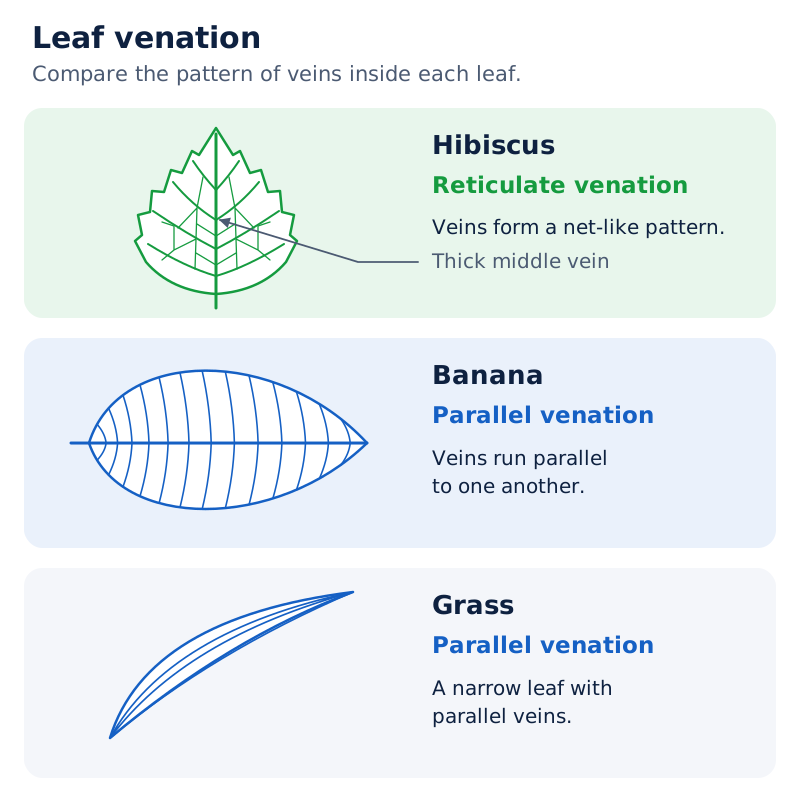
The illustrations show a hibiscus leaf with a net-like vein pattern, a banana leaf with parallel veins, and a narrow grass leaf with parallel venation. The three captions identify the plant and its venation.
Drawn by One Young India. See Fig. 2.4 in your NCERT textbook
How should collected leaves be compared?
Use the leaves collected during the nature walk. First compare their shapes and structures, then examine their veins. Decide whether the visible pattern is net-like or parallel. Record the plant's name beside its vein pattern so that different plants can be compared.
Banana and grass illustrate why the pattern matters: their leaves look different in overall shape, yet both show parallel venation. Hibiscus provides a contrasting example of reticulate venation. Grouping by venation focuses on this shared or differing feature.
How do taproots and fibrous roots differ?
The roots of different plants can have different arrangements. A mustard plant has one main root with small side roots arising from it. The main root is called a taproot. Hibiscus is another example of a plant with a taproot.
Common grass has a bunch of similar-sized, thin roots growing from the base of the stem. These are fibrous roots. Compare the arrangement of the whole root system: one main root with side roots differs from a bunch of similar-sized roots.
What the figure shows
Types of roots
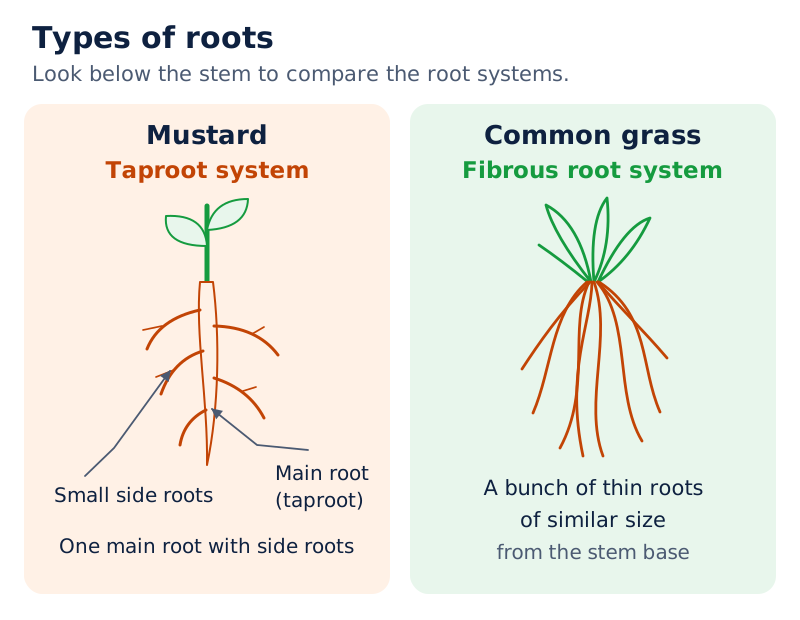
The mustard illustration shows a main root with smaller side roots below the stem. The common grass illustration shows a bunch of thin roots beneath the stem base. The captions identify taproot and fibrous root systems.
Drawn by One Young India. See Fig. 2.5 in your NCERT textbook
How can roots be observed carefully?
- Visit an open area with wild herbs and grasses. Choose small herbs for the observation.
- Wet and loosen the soil, then carefully dig out a few herbs with a khurpi, a trowel, without damaging their roots.
- Wash the roots with water and compare their arrangements, looking for a main root or a bunch of similar-sized roots.
- Replant the herbs after observing them so that they may continue to grow.
How are roots related to leaf venation?
Generally, plants with reticulate venation have taproots, while plants with parallel venation have fibrous roots. Sadabahar, also called periwinkle, has a taproot and reticulate venation. Lemongrass has fibrous roots and parallel venation.
Chickpea, also called chana, provides another example of taproots with reticulate venation. Wheat has fibrous roots and parallel venation. To investigate the relationship, observe both roots and leaves of nursery plants before planting them and record the two features together.
How do seeds help distinguish monocots and dicots?
Seeds provide another basis for grouping plants. A soaked chickpea seed can be split into two parts after its seed coat, the outer covering, is removed. Each of these parts is called a cotyledon.
Plants whose seeds have two cotyledons are called dicotyledons, or dicots. Chickpea is an example. Maize has a single thin cotyledon. Plants whose seeds have one cotyledon are called monocotyledons, or monocots.
How can chickpea and maize seeds be compared?
Soak chickpea and maize seeds in water for two or three days. Remove the chickpea seed coat and observe the structure of both kinds of seeds. Compare the two parts of the chickpea with the single thin cotyledon of maize.
What the figure shows
Dicot and monocot seeds
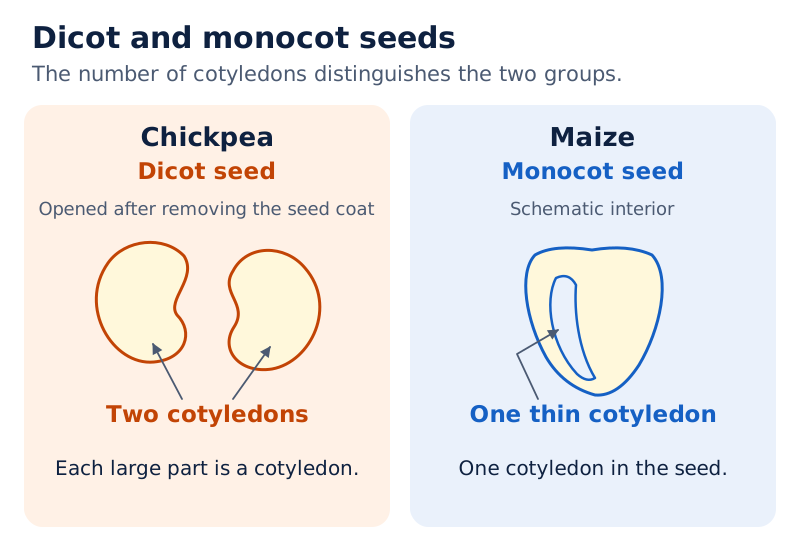
The chickpea drawing shows the seed opened into two large parts, with arrows labelled “Cotyledons”. The maize seed is drawn beside it and captioned as a monocot seed.
Drawn by One Young India. See Fig. 2.6 in your NCERT textbook
How do seed, leaf and root features compare?
| Feature | Dicots | Monocots |
|---|---|---|
| Full name | Dicotyledons | Monocotyledons |
| Cotyledons in a seed | Two | One |
| Usual leaf and root combination | Typically reticulate venation and taproots | Generally parallel venation and fibrous roots |
| Seed used for comparison | Chickpea | Maize |
The cotyledon count supplies the basis for naming these groups. Leaf venation and root type are related features that can be compared alongside the seeds. Keep all three observations distinct in a record: the seed parts, the vein pattern and the root arrangement.
Note: Monocots generally exhibit parallel venation and possess fibrous roots, while dicots typically exhibit reticulate venation and possess taproots. Keep these qualifications when describing the relationship.
How can animals be grouped by movement?
Animals show different kinds of movement. They may fly, run, crawl, walk, hop or jump. The kind of movement and the body parts used for it provide useful ways of grouping animals.
Observe an animal's movement and then identify the parts involved. Legs, wings and fins are examples of body parts used for moving from one place to another. Some animals show more than one kind of movement.
Which movements and body parts can be compared?
| Animal | Movement | Body parts used |
|---|---|---|
| Goat | Walks and jumps | Legs |
| Pigeon | Walks and flies | Legs and wings |
| Housefly | Walks and flies | Legs and wings |
| Fish | Swims in water | Fins |
Pigeons and houseflies share walking and flying as movements, although they are different animals. Goats use their legs to walk and jump. Ants also use legs for movement. A movement-based group therefore brings together animals through a chosen common feature.
How is movement connected with surroundings?
Fish live in water. Their streamlined bodies, bodies shaped to move easily through water, help them swim, and they use fins for movement. Goats live in grassy areas and move with the help of legs.
Photograph: Body parts used for movement (NCERT Class 6 Figure 2.8). A fish is shown with arrows pointing to its fins. A goat is shown with arrows identifying its legs. The captions connect the fish with swimming and the goat with walking on the ground.
Movement is one basis of grouping. Animals also differ in shape, size, structure and colour. Comparing these features, together with food and living places, helps reveal the variety among animals.
What is a habitat, and how are habitats grouped?
Definition: A habitat is the place where a plant or animal lives. It provides food, water, air, shelter and other needs for survival.
Sea turtles live in the sea or ocean. Camels live in hot or cold deserts. Rhododendrons, plants with bright flowers, live in mountain regions. Many types of plants and animals may share the same habitat.
What are terrestrial and aquatic habitats?
Terrestrial habitats are habitats on land. Forests, deserts, grasslands and mountains are examples. Aquatic habitats are habitats in water. Examples include ponds, lakes, rivers and oceans.
| Habitat group | Meaning | Examples |
|---|---|---|
| Terrestrial | On land | Forests, deserts, grasslands and mountains |
| Aquatic | In water | Ponds, lakes, rivers and oceans |
Some animals, such as frogs, can live in water as well as on land. These are called amphibians. Their example shows that a description of where an animal lives may need to include both land and water.
Why do different regions have different living things?
Regions have different environmental conditions. A desert, a mountain and an ocean provide different surroundings. Plants and animals found in one kind of region therefore differ from those found in another. Habitat helps shape the biodiversity of a region.
Compare a camel in a desert, a deodar tree on a mountain, a fish in the ocean and a lion in a forest. These examples connect living things with their surroundings. Studying a habitat includes considering the needs it provides for its inhabitants.
What adaptations help plants survive in different regions?
Definition: Adaptations are special features that enable plants and animals to survive in a particular region.
A plant's features can be connected with the conditions of its habitat. Deserts have very little available water. A hot desert is typically very hot during the day and very cold at night. Plants and animals there can tolerate these conditions.
How do cactus and deodar differ?
Cactus plants in the deserts of Rajasthan have thick, fleshy stems. The fleshy stems of desert plants can store water and help them tolerate hot conditions. Water storage is therefore connected with survival where water is scarce.
Deodar trees in the Himalayas of Himachal Pradesh have a conical shape, a cone-like form, and flexible, sloping branches. In extremely cold mountain regions, snowfall is frequent. Their shape and sloping branches allow snow to slide off easily.
These plants illustrate different connections between a feature and its usefulness. A fleshy stem helps with desert conditions, while the shape and branches of a deodar help with snowfall. Both examples relate a plant's features to its surroundings.
Can similar plants show different features in different regions?
Rhododendrons in the Shola forests of the Nilgiris are shorter and have smaller leaves to survive heavy winds on mountain tops. Rhododendrons observed in the mountains of Sikkim are taller.
Rhododendrons may therefore exhibit different features in different regions to survive those regions' conditions. The comparison links plant height and leaf size with surroundings. The shape of deodar and the height of rhododendron are examples of adaptations to mountainous regions.
How do camels survive in hot and cold deserts?
Camels from the hot desert of Rajasthan and the cold desert of Ladakh show different features. Comparing them helps connect body features with the conditions in which an animal lives. Both kinds face surroundings where food is not easily available.
How do their legs and humps differ?
The hot-desert camel has long legs and wide hooves, the hard parts at the ends of its feet. The long legs and wide hooves help it walk on sandy ground without sinking into the sand.
The cold-desert camel's height and legs are comparatively shorter. Its short legs allow it to walk easily in mountainous regions. This comparison is between camels of the two regions, rather than a statement that all camels have the same legs.
Camels store food in their humps, the raised parts on their backs. Hot-desert camels have one hump each, helping them survive food scarcity. Cold-desert camels have two humps each.
The two humps shrink in late winters when little food is available and the camels use stored food. Cold-desert camels also grow long hair from head to neck, helping them survive Ladakh's cold winters.
How does limited water loss help?
Camels lose little water from their bodies and can survive for many days without drinking water. Their dung is dry, and they excrete small amounts of urine. These features help connect their water needs with life in desert surroundings.
When comparing adaptations, state both the feature and its usefulness. Long legs and wide hooves help the hot-desert camel on sand; comparatively shorter legs help the cold-desert camel in mountainous areas. Humps help with food scarcity, while long hair helps with cold conditions.
Why must biodiversity be protected, and what examples show how?
Damage to habitats takes away the homes, food and other resources of plants and animals. This leads to a loss of biodiversity. Changes in the plants and animals commonly seen in a place often happen when habitats are damaged.
Conservation means protecting biodiversity and the places that support it. Protecting habitats helps living things survive and thrive. Information from parents, grandparents and neighbours can reveal plants and animals they saw frequently earlier but see less often now.
What happened in the Save Silent Valley movement?
Silent Valley is a moist evergreen forest in Kerala's Palakkad district. A proposal to build a hydroelectric dam, a dam used for generating electricity from water, across the Kunthipuzha river led to a movement to protect the forest and its rich biodiversity.
The struggle continued for 10 years. Common people, including people who did not live near the forest, led the movement. They used awareness programmes, letters to editors, newspaper articles, seminars, petitions and appeals in court. The movement succeeded in saving Silent Valley.
How did Janaki Ammal and Salim Ali contribute?
Janaki Ammal (1897 to 1984) was an Indian botanist, a scientist who studies plants. She helped document and preserve India's plant biodiversity and played a key role in the Save Silent Valley movement.
As head of the Botanical Survey of India, she initiated programmes to document India's plant diversity. Recording which plants occur in a region was an important part of her environmental work.
Salim Ali (1896 to 1987) travelled across India to observe birds. He listed birds, documented their travel routes and habitats, recorded areas with high bird diversity, and took measures to conserve those areas.
Regions he helped preserve include Keoladeo National Park in Bharatpur, Rajasthan, and Ranganathittu Bird Sanctuary in Mandya, Karnataka. Known as the Birdman of India, he wrote a series of 10 books on birds of the Indian Subcontinent and received the Padma Vibhushan in 1976.
Which projects and community efforts protect biodiversity?
Loss of natural habitats through human activities has reduced populations of the Bengal Tiger, Cheetah and Great Indian Bustard in India. Government projects and protection of habitats are examples of efforts to conserve them.
| Conservation effort | Purpose or protection |
|---|---|
| Project Tiger, initiated in 1973 | Protect the declining Bengal Tiger population |
| Cheetah Reintroduction Project, initiated in 2022 | Restore the Cheetah population |
| Protected areas for Great Indian Bustards | Habitats protected in Gujarat, Rajasthan and Maharashtra |
Sacred groves are undisturbed patches of forest protected by local communities. Found across India, they may range from quite small to very large. They contain different plants and animals, including numerous medicinal plants.
No one is allowed to harm animals, cut trees or disturb the area in these groves. Community protection makes sacred groves a treasure of biodiversity. Nature-walk records, a class biodiversity register and discussions about local protection can help develop awareness of this shared responsibility.
Glossary
- Biodiversity — The variety of plants and animals found in a particular region.
- Grouping — Arranging things into groups on the basis of their common features.
- Herbs — Plants that are typically small and have soft, green stems.
- Shrubs — Plants shorter than trees, often with many hard, woody stems branching near the ground.
- Trees — Tall plants with hard, thick, brown, woody stems and branches typically beginning higher above the ground.
- Venation — The pattern formed by the veins on a plant's leaf.
- Reticulate venation — A net-like arrangement of veins on both sides of a thick middle vein.
- Parallel venation — A leaf vein pattern in which the veins run parallel to one another.
- Taproot — The main root from which smaller side roots arise in plants such as mustard.
- Fibrous roots — A bunch of similar-sized thin roots arising from the base of a plant's stem.
- Cotyledon — A seed part; chickpea seeds have two cotyledons, while maize has one thin cotyledon.
- Habitat — The place where a plant or animal lives and obtains its needs for survival.
- Adaptations — Special features that enable plants and animals to survive in a particular region.
- Amphibians — Animals such as frogs that can live in water as well as on land.
- Sacred groves — Undisturbed forest patches protected by local communities, supporting many kinds of plants and animals.
Common errors and misconceptions
- Misconception: Plants and animals in a region live independently of one another. Correct: Trees provide food and shelter to some animals, while animals help spread seeds after eating fruits. Living things depend on one another.
- Misconception: There is just one possible way to group a collection of living things. Correct: Different features can provide different bases for grouping, such as plant height, flower presence, animal food or movement.
- Misconception: Every plant shorter than a tree is a herb. Correct: Shrubs are also shorter than trees. Herbs typically have soft, green stems, while shrubs often have several hard, woody stems branching close to the ground.
- Misconception: Reticulate venation means that veins run parallel. Correct: Reticulate venation forms a net-like pattern. Parallel venation has veins running parallel, as in banana and grass leaves.
- Misconception: The relationship between leaf venation and root type should be written as an unqualified rule. Correct: Generally, plants with reticulate venation have taproots, while those with parallel venation have fibrous roots.
- Misconception: Monocots have two cotyledons, and dicots have one. Correct: Monocots have one cotyledon, as in maize. Dicots have two, as in chickpea. The group names depend on the cotyledon count.
- Misconception: A habitat and an adaptation mean the same thing. Correct: A habitat is a living place. An adaptation is a special feature that enables survival in a region, such as the shape and sloping branches of deodar.
- Misconception: All camels have one hump and equally long legs. Correct: Hot-desert camels have one hump and long legs. Cold-desert camels have two humps, with comparatively shorter height and legs.
Exam-style questions with model answers
Q1. A mustard plant has one main root with smaller side roots. Common grass has a bunch of similar-sized thin roots arising from its stem base. Identify each root type and give its identifying feature. [2 marks]
- Mustard has a taproot system: one main root bears smaller side roots.
- Common grass has fibrous roots: similar-sized thin roots form a bunch at the stem base.
Q2. Mango is tall with a hard, thick, brown stem and branches higher up. Rose is medium-height with hard, thin, brown stems branching near the ground. Tomato is short with a tender, thin, green stem. Classify each plant and explain your choice. [3 marks]
- Mango is a tree. Its tall growth, thick and hard brown stem, and branches higher above the ground match the features used to identify trees.
- Rose is a shrub. Its medium height, hard but thin woody stems, and branching near the ground match the features used to identify shrubs.
- Tomato is a herb. It is short and has a tender green stem, matching the typically small size and soft, green stems of herbs.
Q3. Chickpea seeds have two cotyledons, and maize seeds have one thin cotyledon. Dicots typically have reticulate venation and taproots; monocots generally have parallel venation and fibrous roots. Classify each seed, then state the usual leaf and root combination for each group. [4 marks]
- Chickpea is a dicot, or dicotyledon, because its seed contains two cotyledons. The cotyledon count is the basis for this classification.
- Maize is a monocot, or monocotyledon, because its seed contains a single thin cotyledon rather than two cotyledons.
- Dicots typically show reticulate venation, a net-like vein pattern, and possess a taproot system with a main root and smaller side roots.
- Monocots generally show parallel venation and possess fibrous roots. These roots form a bunch of similar-sized thin roots arising from the stem base.
Q4. During a nature walk, a group records plant stems, leaves and flowers, and animal living places, foods and movements. It wants to prepare a shared record without harming living things. Describe five steps, from observation to extending the record. [5 marks]
- Observe the different plants and animals in the surroundings. Listen to animal sounds and record the weather conditions, including whether it is hot, cold or windy.
- Record plant features carefully: describe stems and the shape and arrangement of leaves, together with the colour, shape and scent of flowers.
- Record animal observations, including where each animal lives, what it eats, how it moves and any other interesting features seen during the walk.
- Respect living things while collecting material. Do not disturb plants or animals or pluck leaves and flowers; collect fallen leaves or flowers for a scrapbook.
- Compare and discuss the observations, add sketches or scrapbook material, and extend the shared record when plants or animals not previously listed are observed.
Q5. Hot-desert camels have long legs, wide hooves and one hump. Cold-desert camels have comparatively shorter legs, two humps that shrink in late winters, and long hair from head to neck. Long legs and wide hooves help movement on sand; shorter legs help mountain movement. Humps store food, and long hair helps in cold winters. Explain five connections between these features and survival. [5 marks]
- The hot-desert camel's long legs and wide hooves help it walk on sandy desert ground without sinking into the sand. These features suit movement in its surroundings.
- The cold-desert camel's comparatively shorter legs allow it to walk easily in mountainous regions. Its movement-related features differ from those of the hot-desert camel.
- The hot-desert camel's single hump stores food. This helps the animal survive when food is scarce in the desert, where food is not easily available.
- The cold-desert camel uses food stored in its two humps when little food is available in late winters. The use of this stored food makes the humps shrink.
- Long hair growing from head to neck helps the cold-desert camel survive cold winters. This is a connection between a body feature and cold conditions.
Q6. A fish lives in water and swims using fins; a goat lives in grassy areas and walks using legs; a frog can live both in water and on land. Use these observations to identify the habitat grouping of each animal. [3 marks]
- The fish belongs to the aquatic habitat group because it lives in water. Its fins are the body parts used for swimming in that setting.
- The goat belongs to the terrestrial habitat group because its grassy surroundings are on land. It uses its legs to walk there.
- The frog can live in both water and on land, so both surroundings belong in its description. Animals such as frogs are called amphibians.
Q7. Cactus has fleshy stems that store water where desert water is scarce. Deodar has a conical shape and sloping branches that let snow slide off. Nilgiris rhododendrons are shorter with smaller leaves to withstand heavy winds; those observed in Sikkim are taller. Explain three feature-condition relationships and the conclusion from the rhododendron comparison. [4 marks]
- The cactus's fleshy stems store water. This helps it tolerate hot desert conditions in a region where very little water is available.
- The deodar's conical shape and sloping branches allow snow to slide off easily. These features help it survive in mountain regions with frequent snowfall.
- Shorter height and smaller leaves help the Nilgiris rhododendrons survive the heavy winds found on mountain tops.
- Rhododendrons may exhibit different features in different regions. The taller plants observed in Sikkim contrast with the shorter plants of the Nilgiris.
Q8. Habitat damage removes homes, food and other resources. Project Tiger began in 1973 to protect Bengal Tigers; the Cheetah Reintroduction Project began in 2022 to restore Cheetahs. Great Indian Bustard habitats are protected in Gujarat, Rajasthan and Maharashtra. Sacred groves prohibit harming animals, cutting trees and disturbance. The successful Save Silent Valley movement opposed a proposed dam across the Kunthipuzha river for 10 years. Use these facts to explain one consequence of habitat damage and five conservation examples. [6 marks]
- Habitat damage leads to loss of biodiversity because plants and animals lose their homes, food and other resources needed for survival.
- Project Tiger was initiated in 1973 to protect the declining Bengal Tiger population. It is an example of a government conservation project.
- The Cheetah Reintroduction Project began in 2022 to restore the Cheetah population. Its stated purpose connects the project with protection of biodiversity.
- Great Indian Bustard habitats have been declared protected areas in Gujarat, Rajasthan and Maharashtra. This example focuses on protecting the places where the birds live.
- Sacred groves are protected by local communities. Prohibiting harm to animals, tree cutting and disturbance protects the plants and animals within these forest patches.
- The Save Silent Valley movement successfully protected the forest by opposing the proposed dam across the Kunthipuzha river. The struggle lasted 10 years.
Key takeaways
- Biodiversity includes the variety of plants and animals in a region; living things depend on one another in different ways.
- Grouping uses common features and makes diversity easier to study; different chosen features can produce different useful groups.
- Plant height, stem features and branching patterns help distinguish herbs, shrubs and trees; tomato, rose and mango illustrate these groups.
- Generally, reticulate leaf venation is associated with taproots, while parallel venation is associated with fibrous roots.
- Dicot seeds have two cotyledons, while monocot seeds have one; chickpea and maize illustrate this seed-based distinction.
- Animals can be grouped by their movements, the body parts involved, their food or the places where they live.
- A habitat provides survival needs; adaptations are special features that enable plants and animals to survive in particular regions.
- Habitat damage leads to biodiversity loss; conservation projects, successful public movements and community-protected sacred groves help protect living things.
Test yourself
How do trees and fruit-eating animals illustrate interdependence?
Trees provide food and shelter to some animals. Animals help spread seeds after eating fruits, showing that plants and animals depend on each other.
Which features distinguish a shrub from a herb?
Shrubs often have hard, brown, woody stems branching near the ground. Herbs are typically small plants with soft, green stems.
What venation patterns occur in hibiscus, banana and grass leaves?
Hibiscus leaves show reticulate venation. Banana and grass leaves show parallel venation.
What root and leaf combination occurs in lemongrass?
Lemongrass has fibrous roots, and its leaves show parallel venation.
How many cotyledons occur in chickpea and maize seeds?
Chickpea seeds have two cotyledons and are dicot seeds. Maize has one thin cotyledon and is a monocot.
Why can snow slide off a deodar tree easily?
The deodar's conical shape and sloping branches enable snow to slide off easily.
Which two dated projects concern Bengal Tigers and Cheetahs?
Project Tiger began in 1973 to protect Bengal Tigers. The Cheetah Reintroduction Project began in 2022 to restore the Cheetah population.
How do local communities protect sacred groves?
They protect these forest patches by prohibiting harm to animals, cutting of trees and disturbance of the area.
Try it
Diversity in the Living World: Habitats and Adaptations Scenario
Apply your understanding of life processes and organism adaptations to analyze these two ecological observations.
1An observer notices that a cloud in the sky moves across the horizon and gradually increases in size. Based on the real checklist for identifying living things, how should this cloud be classified?
Non-living things may show one or two features such as growing or moving, but something is only alive if it shows the complete set of essential life processes together.
A cloud can grow bigger and move, but because it does not eat, respire, excrete, or reproduce, it does not meet the requirement of showing all essential life processes together.
The checklist for life relies on whether an entity performs all essential life processes together—nutrition, respiration, excretion, growth, movement, response to stimuli, and reproduction—which a cloud does not.
2You are studying a plant that features leaves reduced to spines, a thick fleshy green stem, and deep roots. What does this specific combination of adaptations indicate about its natural habitat?
These inherited features are characteristic of desert plants: spines reduce water loss, the thick fleshy stem stores water while performing photosynthesis, and deep roots absorb water from deep underground.
Aquatic plants have short roots because water is readily available, and broad floating leaves or stems with air spaces to stay afloat, unlike desert plants with fleshy water-storing stems and spines.
Mountain plants typically have a conical shape so snow slides off and needle-like leaves to resist cold and reduce water loss, whereas fleshy stems and spines are adaptations for hot, dry deserts.
Great job! You have demonstrated how to apply the checklist of essential life processes to distinguish living things from non-living things, as well as how specific plant adaptations correspond to survival in challenging habitats.