
Mensuration | ICSE Class 8 Maths Notes
On this page
This note covers area of trapeziums, polygons and semicircles, nets of solids, total and lateral surface areas of cubes and cuboids, curved surface area of cylinders, volume, capacity and measurement units.
How do perimeter, area, surface area and volume differ?
Mensuration concerns the measurement of shapes. A plane figure lies on a flat surface. Its perimeter is the distance around its boundary, while its area measures the region enclosed by that boundary. These answer different questions about the same figure.
A solid occupies space and has three dimensions. Its surface area measures its outer surfaces; its volume measures the space it occupies. Covering a box requires surface area, whereas measuring the space inside a container concerns its capacity.
Capacity is the quantity a container can hold. For a vessel, use its internal measurements to find the volume available inside. External measurements describe its outside size and are used when calculating the area of paper needed to cover its outer surfaces.
Which units belong to each measurement?
The symbols m, cm and mm mean metre, centimetre and millimetre. A square has four equal sides and four right angles, each measuring 90 degrees. A square centimetre, written cm², is its area when each side is 1 cm. A cube has six identical square faces, meaning flat surfaces. An edge is where two faces meet. A cubic centimetre, written cm³, is its volume when each edge is 1 cm.
| Measurement | What it measures | Suitable units |
|---|---|---|
| Perimeter | Length of a boundary | cm or m |
| Area and surface area | Extent of a region or surface | cm² or m² |
| Volume | Space occupied by a solid | cm³ or m³ |
| Capacity | Quantity held by a container | cm³, millilitres or litres |
A unit square is a square whose side is one chosen length unit. Counting such squares measures area. A unit cube has every edge equal to one chosen length unit. Counting these cubes measures volume.
On a square grid, count the squares inside a plane figure and account for partly covered squares. Formulae provide another way to measure the same region. For solids, counting cubes in rows and layers leads to volume formulae.
Note: The required quantity decides the method. Plastering a tank concerns surface area; finding how much it holds concerns capacity. A numerical answer without the appropriate unit does not identify the measurement completely.
How is the area of a trapezium calculated?
A trapezium is a quadrilateral with a pair of parallel opposite sides. A quadrilateral is a closed figure with four straight sides. Parallel sides lie along lines that do not meet. The height is the perpendicular distance between the parallel sides.
A perpendicular meets a line at a right angle, an angle of 90 degrees. Thus the height is measured straight across the gap between the parallel sides, not along a sloping side. Identifying this distance is essential before substituting measurements into the area formula.
Result: Area of a trapezium
Let A mean area, a and b the lengths of the two parallel sides, and h the perpendicular height. Then A = ½(a + b)h. All three lengths must be expressed in the same unit.
The factor ½ means one-half. The formula takes half the sum of the parallel sides and multiplies it by their separation. It uses both parallel sides, so choosing just one of them as a base and multiplying by height is insufficient.
How does splitting the shape explain the formula?
A diagonal joins two non-adjacent corners of a polygon. A polygon is a closed plane figure bounded by straight line segments. A diagonal of a trapezium divides it into two triangles, each having the same perpendicular height as the trapezium.
A triangle is a closed figure with three straight sides. Its area is half its base times its perpendicular height. Using the parallel sides as the two bases gives areas ½ah and ½bh. Adding them gives ½ah + ½bh = ½(a + b)h. The triangles together cover the trapezium.
Worked example 1. A trapezium-shaped field has area 480 m², height 15 m and one parallel side 20 m. Find the other parallel side.
Answer: Let b be the unknown side in metres. Substitution gives 480 = ½ × (20 + b) × 15. Therefore 20 + b = 960 ÷ 15 = 64, so b = 44 m. Checking gives ½ × (20 + 44) × 15 = 480 m².
A rectangle is a quadrilateral with four right angles. A parallelogram has both pairs of opposite sides parallel. Cutting off a triangular end and moving it to the other end produces a rectangle of the same area. Thus its area is base multiplied by perpendicular height. This illustrates how rearranging familiar shapes can explain an area formula.
This calculation reverses the area formula: first obtain the sum of the parallel sides, then subtract the known side. The intermediate value 64 m is the sum, not the missing side. Keep this distinction when interpreting an algebraic result.
How can quadrilaterals and other polygons be split into simpler shapes?
Decomposition means splitting a shape into simpler parts whose areas can be calculated. The parts must cover the required region without overlapping. Add their areas to obtain the area of the whole polygon. Different valid divisions can give the same total.
An internal diagonal that divides a quadrilateral into two triangles provides a common base for their areas. If their common base has length d, and their perpendicular heights are h₁ and h₂, their combined area is A = ½d(h₁ + h₂). The small numerals distinguish the two heights.
Result: Area of a rhombus
A rhombus is a quadrilateral with all four sides equal. Its diagonals meet at right angles. Let d₁ and d₂ be their lengths. Splitting the rhombus into triangles gives A = ½d₁d₂, half the product of its diagonals.
Worked example 2. A rhombus has area 240 cm² and one diagonal 16 cm. Find its other diagonal.
Answer: Let d₂ be the unknown length in centimetres. Then 240 = ½ × 16 × d₂ = 8d₂. Dividing by 8 gives d₂ = 30 cm. The check is ½ × 16 × 30 = 240 cm².
How can two decompositions check one answer?
A hexagon is a polygon with six sides. A rectangle has four right angles, and its area is length multiplied by breadth. Two shapes are congruent when they have the same shape and size.
What the figure shows
Two divisions of a hexagon
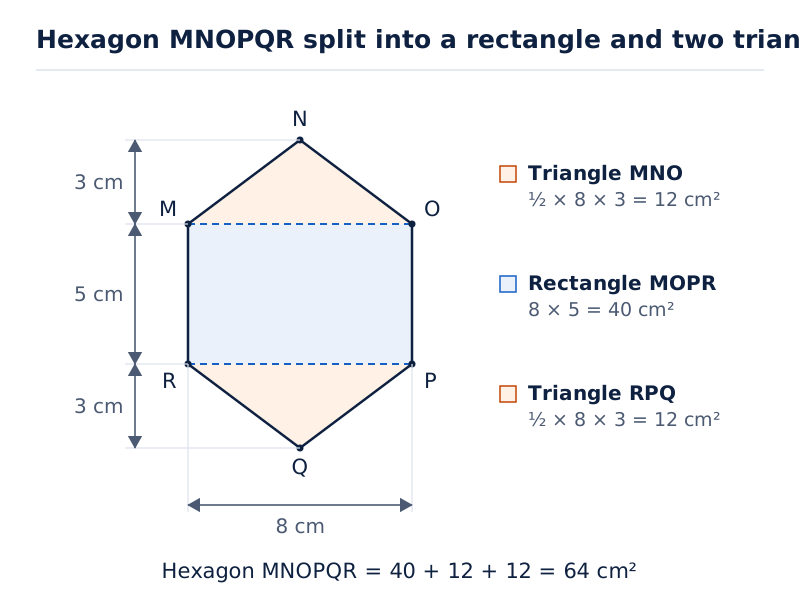
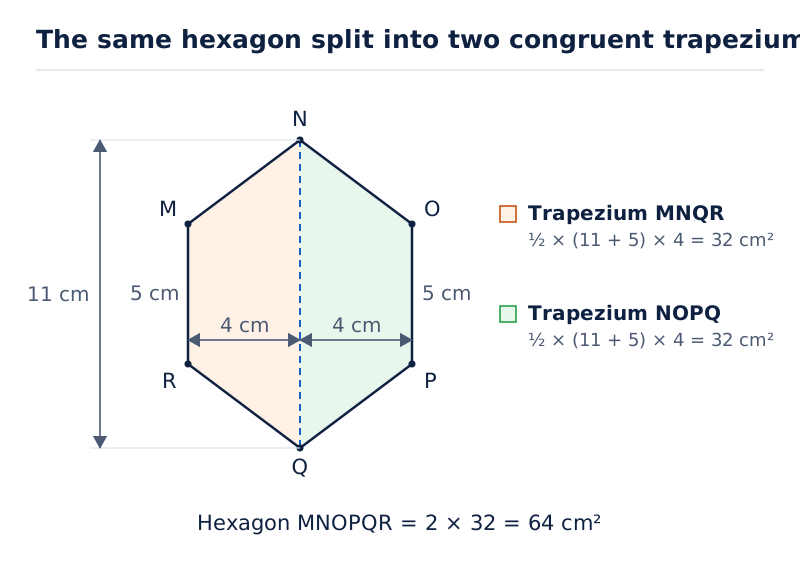
The hexagon MNOPQR has a central rectangle MOPR with a triangle above and another below. The width is labelled 8 cm, the rectangle's height 5 cm, and each triangle's height 3 cm. Another division joins N to Q to form two congruent trapeziums.
Drawn by One Young India.
Worked example 3. A hexagon consists of a rectangle 8 cm by 5 cm and two congruent triangles, each with base 8 cm and height 3 cm. Alternatively, it consists of two congruent trapeziums, each with parallel sides 11 cm and 5 cm and height 4 cm. Find its area both ways.
Answer: The rectangle has area 8 × 5 = 40 cm². Each triangle has area ½ × 8 × 3 = 12 cm², giving 40 + 12 + 12 = 64 cm². Each trapezium has area ½ × (11 + 5) × 4 = 32 cm², giving 2 × 32 = 64 cm².
The example requires the stated dimensions and divisions. Knowing only that a shape is a hexagon does not establish that a particular diagonal creates congruent trapeziums. Choose a division justified by the information supplied, then calculate each part separately.
How is the area of a semicircle found?
A circle has a boundary whose points are equally distant from its centre. Its radius is the distance from the centre to the boundary. Its diameter is a straight segment passing through the centre and joining two points on the boundary.
A semicircle is half a circle, formed by dividing the circular region along a diameter. The diameter separates the circle into two equal regions. Consequently, the area of either semicircular region is half the area of the complete circle.
Result: Area of a semicircle
Let r denote the radius. The symbol π, read as pi, is the ratio of a circle's circumference to its diameter. Circumference means the length of the circle's boundary. The area of a circle is πr².
The notation r² means r × r. Hence A = ½πr² for a semicircle. If the diameter is given, halve it to obtain r before squaring. Squaring the diameter would use the wrong length in the circle-area formula.
Use the value of π stated in a question. In the worked cylinder calculations here, take π as 22/7 unless otherwise stated. This is a value used for calculation, not an assertion that π is exactly equal to that fraction.
How does a semicircle fit into a combined figure?
First identify the semicircular part and its diameter. If it is attached to a polygon without overlapping, add the two areas. If the semicircular region has been removed from a larger region, subtract its area from the original area.
Do not add a boundary length to an area. Although both depend on the radius, circumference measures distance and area measures a region. The curved edge of a semicircle is part of its boundary; the semicircular area is the whole region inside it.
The distinction also explains why a square unit is needed in the answer. Halving a circular area changes the amount of area, not the type of measurement. A circle measured in square centimetres gives a semicircle measured in square centimetres too.
How do nets explain the surface area of a cuboid?
A cuboid has six rectangular faces, arranged in three pairs of identical opposite faces. A face is a flat surface of a solid. An edge is a line segment where two faces meet.
A net shows the surfaces of a solid opened out on a plane. It helps identify every face that contributes to surface area. Opening a box changes the arrangement of its faces, while preserving their areas.
Let l denote length, b breadth and h height. Breadth means width. In these cuboid formulae, b represents breadth, rather than the parallel side used in the trapezium formula. The meaning of a symbol depends on its stated definition.
What the figure shows
A cuboid opened into a net
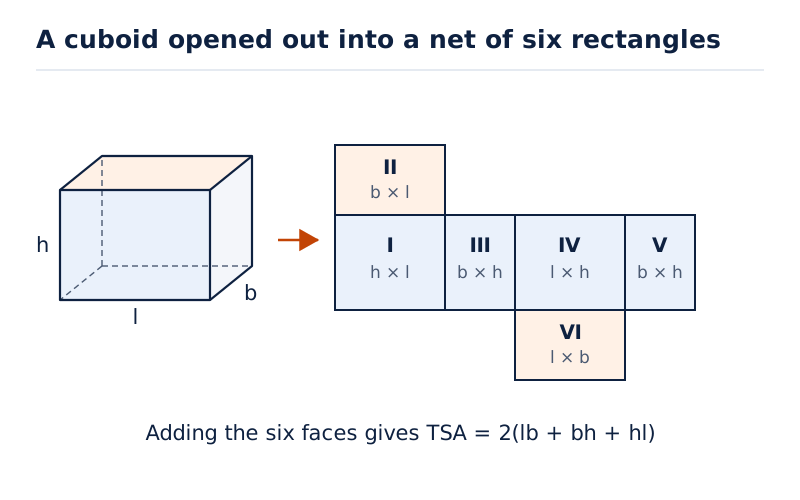
A box is shown beside six connected rectangles labelled I to VI. Four side rectangles form a strip, with another rectangle above and one below. The measurements l, b and h mark the face dimensions.
Drawn by One Young India.
Result: Total surface area of a cuboid
Total surface area, abbreviated TSA, includes every outer face of the closed cuboid. The top and bottom each have area lb, the front and back each have area lh, and the other pair each have area bh.
Adding all six faces gives TSA = 2(lb + bh + hl). Here lb means l × b, and similarly for the other products. This formula counts each pair of opposite rectangular faces exactly once.
| Faces | Area of each face | Combined area |
|---|---|---|
| Top and bottom | lb | 2lb |
| Front and back | lh | 2lh |
| Remaining opposite sides | bh | 2bh |
Worked example 4. A cuboidal aquarium has external length 80 cm, breadth 30 cm and height 40 cm. Paper covers its base, back and two side faces. Find the required paper area.
Answer: Base area = 80 × 30 = 2400 cm². Back area = 80 × 40 = 3200 cm². Each side area = 30 × 40 = 1200 cm². Required area = 2400 + 3200 + 2 × 1200 = 8000 cm².
This example counts selected faces rather than every face. Read the covering instructions before choosing a formula. A complete cuboid formula would include the top and front, which are not among the surfaces specified here.
How are lateral surface area and room-painting problems solved?
The lateral surface area, abbreviated LSA, of a cuboid is the area of its four side faces, excluding the top and bottom. With the length and breadth forming the base, the remaining vertical dimension is the height.
Two side faces each have area lh, and the other two each have area bh. Thus LSA = 2h(l + b). The expression 2(l + b) is the perimeter of the rectangular base. Multiplying it by height gives the area of the surrounding walls.
Which surfaces does the question include?
For the four walls of a cuboidal room, use its lateral surface area. If the ceiling is also included, add the ceiling's rectangular area lb. The floor has the same area as the ceiling, but it should not be included in a walls-and-ceiling calculation.
Once the area is known, multiply it by the rate, meaning the cost for each unit of area. The area unit must match the unit used in the rate. The symbol ₹ denotes rupees.
Worked example 5. A room has internal length 12 m, breadth 8 m and height 4 m. Whitewashing costs ₹5 per m². Ignoring openings, find the cost for all four walls and then for the walls together with the ceiling.
Answer: Wall area = 2 × (12 + 8) × 4 = 160 m². Wall cost = 160 × 5 = ₹800. Ceiling area = 12 × 8 = 96 m², costing 96 × 5 = ₹480. Combined cost = 800 + 480 = ₹1280.
The dimensions here are internal because the inner surfaces are being whitewashed. The stated instruction to ignore openings makes clear which wall area is included. No floor area is required, because the question specifies walls and ceiling.
How should a surface-area solution be organised?
- Identify the solid and list the surfaces included in the work.
- Write the dimensions in one length unit and identify the area of each required face.
- Add the areas, using a total or lateral surface-area formula when it matches the selected surfaces.
- Multiply by the given rate if a cost is required, then state the result in rupees.
Keeping area and cost as separate stages makes the calculation easier to check. An area is measured in square units, while a cost is money. The rate links them, but it does not change which faces belong in the area calculation.
How are the surface area and volume of a cube found?
A cube has six identical square faces, meaning flat surfaces. An edge is where two faces meet. It is a special cuboid whose length, breadth and height are equal. Let s represent its edge length. A square has four equal sides and four right angles, each measuring 90 degrees.
Each face has area s². Adding the six faces gives TSA = 6s². The four side faces have combined area LSA = 4s². The remaining two faces are the top and bottom, each also of area s².
How does the net help?
What the figure shows
A cube and its net
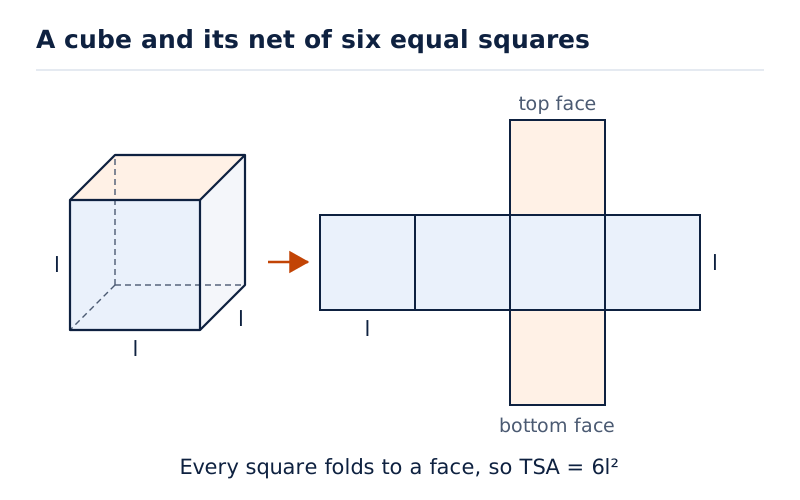
A cube is shown with its edges labelled l. Beside it is a connected arrangement of six equal squares. Four squares lie in a row, with one above and one below the third square from the left. The letter l in this figure denotes the cube's edge length.
Drawn by One Young India.
Every square in the net becomes a face when folded. Count all six faces for the total surface area. Counting only the squares visible in a drawing of the folded cube would omit hidden faces and give an incomplete total.
Worked example 6. Find the edge length of a cube whose total surface area is 600 cm².
Answer: With s as its edge in centimetres, 6s² = 600. Dividing by 6 gives s² = 100. Since an edge length is positive and 10 × 10 = 100, s = 10 cm.
Why is cube volume a third power?
Write V for volume. A cube's base contains s × s unit squares, and its height supplies the third dimension. Its volume is V = s³, where s³ means s × s × s.
Worked example 7. Find the volume of a cube with edge 4 cm.
Answer: V = s³ = 4 × 4 × 4 = 64 cm³. The unit is cubic centimetres because three length measurements have been multiplied.
Surface area and volume therefore depend differently on the same edge. When every edge is doubled, each face area becomes four times as large, while the volume becomes eight times as large. These follow from multiplying two length factors for area and three for volume.
How does a cylinder's net give its curved and total surface areas?
A right circular cylinder has two congruent, parallel circular faces. The line joining their centres is perpendicular to the base. Its height is the perpendicular distance between these faces. The cylinder formulae here refer to this type of cylinder.
Most of the cylinders we observe are right circular cylinders. A cylinder has a curved side surface as well as its two circular faces. Cutting the curved surface along its height and opening it flat produces a rectangle.
How do the rectangle and circles fit together?
The rectangle's length equals the circumference of the circular base, 2πr. Its width equals the cylinder's height h. Multiplying these measurements gives the curved surface area, abbreviated CSA: CSA = 2πrh.
What the figure shows
Opening a cylinder
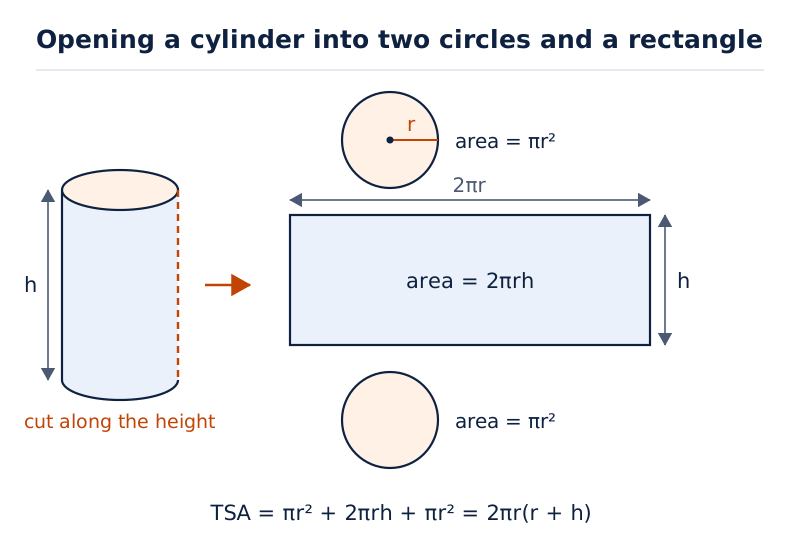
The drawing separates the circular ends from the curved side, then opens that side into a rectangle. The rectangle is labelled 2πr along its length and h along its height. Each circular end is labelled with area πr².
Drawn by One Young India.
For a cylinder, lateral surface area means the same as curved surface area. A closed cylinder includes both circular ends as well. Therefore TSA = 2πrh + 2πr² = 2πr(r + h).
| Surface included | Reason | Area |
|---|---|---|
| Curved side | Rectangle with length 2πr and height h | 2πrh |
| Two circular ends | Two circles of radius r | 2πr² |
| Complete closed surface | Curved side plus both ends | 2πr(r + h) |
Worked example 8. A closed cylinder has radius 7 cm and total surface area 968 cm². Find its height, taking π = 22/7.
Answer: Substitute into the total-area formula: 968 = 2 × (22/7) × 7 × (7 + h). Hence 968 = 44(7 + h), so 7 + h = 22. Subtracting 7 gives h = 15 cm.
This solution uses the given total surface area. Substituting 968 into the curved-area formula would exclude the two circular ends. When a question describes covering, painting or making a container, identify whether the ends are part of the required surface.
If diameter is supplied, calculate the radius before substitution. Radius and height must be in the same length unit. The final area is in the corresponding square unit, just as it is for the rectangle obtained by opening the curved surface.
How are the volumes of cuboids and cylinders calculated?
Volume measures occupied space using cubic units. A cuboid can be built by arranging unit cubes in rows, placing rows beside one another to form a layer, and stacking layers. This links its length, breadth and height to its volume.
Result: Volume equals base area multiplied by height
For a cuboid of length l, breadth b and height h, the base area is lb. Multiplying this by height gives V = lbh. All three dimensions must use the same length unit before multiplication.
Let B denote the area of the base. The same relationship can be written V = Bh. In this expression, B is an area measured in square units, whereas h is a length. Their product is measured in cubic units.
Worked example 9. A cuboid has volume 275 cm³ and base area 25 cm². Find its height.
Answer: From V = Bh, height h = V ÷ B = 275 ÷ 25 = 11 cm. Checking gives 25 cm² × 11 cm = 275 cm³.
How does this apply to a right circular cylinder?
A right circular cylinder has congruent parallel circular ends and a constant circular cross-section along its height. A cross-section is the shape made by a flat cut through a solid. Its base area is πr², giving V = πr²h.
Worked example 10. A rectangular paper of width 14 cm is rolled so that this width becomes the height of a cylinder of radius 20 cm. Find its volume using π = 22/7.
Answer: Here h = 14 cm and r = 20 cm. Therefore V = πr²h = (22/7) × 20 × 20 × 14 = 17600 cm³.
Rolling paper changes the interpretation of its dimensions. The measurement that goes around the cylinder becomes the circumference, while the perpendicular measurement becomes its height. Read the stated rolling direction carefully instead of treating the paper's length as a radius.
Worked example 11. Paper measuring 11 cm by 4 cm is rolled without overlap into a cylinder of height 4 cm. Find its volume, taking π = 22/7.
Answer: The circumference is 11 cm. Thus 2 × (22/7) × r = 11, giving r = 7/4 cm. Then V = (22/7) × (7/4) × (7/4) × 4 = 38.5 cm³.
The two paper examples use the same cylinder-volume formula, but the available information differs. One directly supplies the radius; the other supplies the circumference, so the radius must first be calculated. State this extra step explicitly.
How are volume, capacity and unit conversions used together?
Volume refers to the space an object occupies, while capacity refers to the quantity a container holds. Capacity can be expressed in cubic units or liquid-measure units. The symbols mL and L mean millilitre and litre respectively.
The relationships are 1 mL = 1 cm³ and 1 L = 1000 cm³. Also, 1 m³ = 1000000 cm³ = 1000 L. Use these equalities after calculating the volume from the vessel's dimensions.
Why must volume conversions be cubed?
Since 1 m = 100 cm, a cube of side 1 m has dimensions 100 cm by 100 cm by 100 cm. Its volume is therefore 100 × 100 × 100 = 1000000 cm³. The length conversion applies to each dimension.
Likewise, 1 cm³ = 1000 mm³ because 1 cm = 10 mm. An area conversion uses two length factors, while a volume conversion uses three. Converting only one factor would change just one dimension of the measurement.
| Conversion | Operation | Reason |
|---|---|---|
| cm³ to L | Divide by 1000 | 1000 cm³ fill one litre |
| m³ to L | Multiply by 1000 | Each cubic metre equals 1000 litres |
| L to cm³ | Multiply by 1000 | Each litre equals 1000 cubic centimetres |
Worked example 12. A cylindrical milk tank has internal radius 1.5 m and internal length 7 m. Find its capacity in litres, taking π = 22/7.
Answer: The tank's length is the distance between its circular ends. V = (22/7) × 1.5 × 1.5 × 7 = 49.5 m³. Capacity = 49.5 × 1000 = 49500 L.
How is filling time calculated?
A filling rate is the volume entering a container per unit time. Divide the required volume by the rate, using compatible units. If the rate is in litres per minute, express the capacity in litres to obtain time in minutes.
Worked example 13. Water enters an initially empty cuboidal reservoir of capacity 108 m³ at a constant rate of 60 litres per minute. How many hours will filling take, with no water leaving?
Answer: Capacity = 108 × 1000 = 108000 L. Time = 108000 ÷ 60 = 1800 minutes. Since an hour contains 60 minutes, the required time is 1800 ÷ 60 = 30 hours.
The conversion to litres must come before dividing by the stated rate. The final conversion to hours is a time conversion, separate from the capacity conversion. Keeping these steps distinct preserves the meaning of each intermediate result.
Glossary
- Perimeter — The total distance around the boundary of a closed plane figure, measured in length units.
- Area — The measure of the region occupied by a plane shape, expressed in square units.
- Trapezium — A quadrilateral with a pair of parallel opposite sides, whose perpendicular separation is its height.
- Polygon — A closed plane figure bounded by straight line segments joined at their endpoints.
- Diagonal — A line segment joining two non-adjacent vertices, or corners, of a polygon.
- Semicircle — Half of a circular region, obtained when a diameter divides the circle into two equal parts.
- Radius — The distance from the centre of a circle to any point on its boundary.
- Net — A flat arrangement of the surfaces that can be folded to form a solid.
- Total surface area — The sum of the areas of all the outer surfaces of a solid.
- Lateral surface area — The area of the side surfaces of a solid, excluding its top and bottom.
- Right circular cylinder — A cylinder with congruent parallel circular ends whose centres are joined by a line perpendicular to the base.
- Volume — The amount of space occupied by a three-dimensional object, measured using cubic units.
- Capacity — The quantity a container holds, which may be expressed in cubic units, millilitres or litres.
- Unit cube — A cube with each edge equal to one chosen length unit, used for measuring volume.
Common errors and misconceptions
- Misconception: Any side of a trapezium can be used as its height. Correct: The height is the perpendicular distance between the parallel sides. A sloping side is not that distance.
- Misconception: The area of a rhombus is the product of its diagonals. Correct: It is half that product. Include the factor ½ when substituting the two diagonal lengths.
- Misconception: A circle's diameter can replace its radius in the area formula. Correct: Halve the diameter first. A semicircle then has half the area calculated using this radius.
- Misconception: Every covering problem uses total surface area. Correct: Count the surfaces specified. An aquarium's base, back and side faces exclude its front and top.
- Misconception: Curved surface area includes a cylinder's circular ends. Correct: Curved surface area is 2πrh. A closed cylinder's total surface area includes two additional circular areas.
- Misconception: Surface area and volume use the same units. Correct: Surface area uses square units and volume uses cubic units, because they measure surfaces and space respectively.
- Misconception: A cubic metre equals 100 cubic centimetres. Correct: Convert all three length factors. One cubic metre equals 100 × 100 × 100 = 1000000 cm³.
- Misconception: The outside measurements of a thick-walled vessel give its capacity. Correct: Capacity concerns the available interior. Use the internal measurements when calculating the volume it can hold.
Exam-style questions with model answers
Q1. A trapezium-shaped tabletop has parallel sides 1 m and 1.2 m, separated by a perpendicular distance of 0.8 m. Find its area. [2 marks]
- The area is half the sum of the parallel sides multiplied by their perpendicular separation: ½ × (1 + 1.2) × 0.8.
- This equals ½ × 2.2 × 0.8 = 0.88 m². Square metres are required because the result measures the tabletop's area.
Q2. A rhombus has area 240 cm² and one diagonal of length 16 cm. Find the other diagonal and check your answer. [3 marks]
- Let d₂ represent the unknown diagonal in centimetres. The area of a rhombus is half the product of its diagonals, so 240 = ½ × 16 × d₂.
- Simplify to obtain 240 = 8d₂. Dividing both sides by 8 gives the missing diagonal as d₂ = 30 cm.
- Substitute both diagonal lengths to check: ½ × 16 × 30 = 240 cm², which agrees with the given area.
Q3. A diagonal of length 24 m divides a quadrilateral field into two triangles. Their perpendicular heights to this diagonal are 8 m and 13 m. Find the area of each triangle and the whole field. [4 marks]
- The two triangles have the diagonal as their common base. Their areas can be added because the diagonal divides the field into these two parts.
- The triangle with height 8 m has area ½ × 24 × 8 = 96 m², using half the base multiplied by the perpendicular height.
- The other triangle has height 13 m, so its area is ½ × 24 × 13 = 156 m².
- The whole field has area 96 + 156 = 252 m². Both component areas use the same square unit before addition.
Q4. A cube has total surface area 600 cm². Find the area of one face and hence its edge length. [3 marks]
- A cube has six congruent square faces. Dividing the given total surface area by six gives the area of one face: 600 ÷ 6 = 100 cm².
- Let s denote the edge length in centimetres. The area of one square face is s², so s² = 100.
- Since 10 × 10 = 100 and an edge length is positive, the cube's edge is 10 cm. This gives total surface area 6 × 100 = 600 cm².
Q5. A cuboidal room has internal length 12 m, breadth 8 m and height 4 m. Whitewashing costs ₹5 per m². Ignoring doors and windows, calculate the cost of whitewashing all four walls and the ceiling. [5 marks]
- The four walls form the lateral surface. Their area is the perimeter of the rectangular floor multiplied by the room's height: 2 × (12 + 8) × 4.
- Evaluating this gives 2 × 20 × 4 = 160 m². At ₹5 per square metre, whitewashing the walls costs 160 × 5 = ₹800.
- The ceiling is a rectangle with the room's length and breadth. Its area is therefore 12 × 8 = 96 m².
- Using the same rate, whitewashing the ceiling costs 96 × 5 = ₹480. The floor is excluded from the required work.
- Add the costs of the specified surfaces: ₹800 + ₹480 = ₹1280. This is the total cost of whitewashing the walls and ceiling.
Q6. A cuboidal aquarium has external length 80 cm, breadth 30 cm and height 40 cm. Coloured paper covers its base, back and both side faces, leaving its front and top uncovered. Calculate the area of paper required. [5 marks]
- The required paper covers four specified faces. The base uses length and breadth, the back uses length and height, and each side uses breadth and height.
- The base area is 80 × 30 = 2400 cm². It is counted once because only one base is being covered.
- The back area is 80 × 40 = 3200 cm². The equally sized front is not included because the question leaves it uncovered.
- Each side face has area 30 × 40 = 1200 cm². Both sides together therefore require 2 × 1200 = 2400 cm².
- The total paper area is 2400 + 3200 + 2400 = 8000 cm². No top or front area is added.
Q7. A closed right circular cylinder has radius 7 cm and total surface area 968 cm². Find its height, using π = 22/7. [4 marks]
- Let h be the height in centimetres. Total surface area includes the curved side and both circular ends, so the appropriate formula is 2πr(r + h).
- Substituting the radius and given area gives 968 = 2 × (22/7) × 7 × (7 + h), which simplifies to 968 = 44(7 + h).
- Divide both sides by 44 to obtain 7 + h = 22. This value includes the radius as well as the height.
- Subtract the radius: h = 22 − 7 = 15 cm. The answer is a length, so its unit is centimetres.
Q8. A rectangular sheet measuring 11 cm by 4 cm is rolled without overlap into a right circular cylinder of height 4 cm. Find its radius and volume, using π = 22/7. [5 marks]
- The 4 cm width becomes the cylinder's height. The 11 cm length goes around its circular base, so the base circumference is 11 cm.
- Let r represent the radius in centimetres. Circumference equals 2πr, giving 2 × (22/7) × r = 11.
- Rearranging the circumference equation gives r = 11 × 7 ÷ 44 = 7/4 cm. This is the radius used in the volume calculation.
- The volume of the right circular cylinder is its circular base area multiplied by height: V = πr²h, where V denotes volume.
- Substitution gives V = (22/7) × (7/4) × (7/4) × 4 = 38.5 cm³. The cubic unit records the space enclosed by the cylinder.
Q9. An initially empty reservoir has capacity 108 m³. Water flows in at a constant rate of 60 litres per minute, with no water leaving. Find the time needed to fill it in hours. Use 1 m³ = 1000 L and 1 hour = 60 minutes. [5 marks]
- The capacity is given in cubic metres, but the filling rate uses litres per minute. Convert the capacity into litres before dividing by the rate.
- Using the stated conversion, the reservoir holds 108 × 1000 = 108000 L. This is the volume that must enter the initially empty reservoir.
- At a constant filling rate, time equals the required volume divided by volume entering per minute. Thus the time is 108000 ÷ 60 minutes.
- This division gives 1800 minutes. The result is in minutes because the rate states how much water enters during each minute.
- Convert minutes into hours using the given relationship: 1800 ÷ 60 = 30 hours. With no water leaving, this is the required filling time.
Key takeaways
- Identify whether a problem asks for boundary length, covered area, occupied space or capacity before selecting its formula and units.
- A trapezium's area uses both parallel sides and their perpendicular separation; a sloping side does not automatically supply the height.
- Split polygons into triangles, rectangles or trapeziums with known measurements, then add the areas without counting any region twice.
- A semicircle has half the area of a circle of the same radius; halve a given diameter before substitution.
- A cuboid's net reveals three pairs of rectangular faces, while a cube's net contains six identical squares.
- A cylinder's curved surface opens into a rectangle; adding its two circular ends gives the total surface area.
- Multiply base area by height for cuboids and right circular cylinders, and use cubic units for the resulting volume.
- Capacity conversions must match the calculation: one litre equals 1000 cubic centimetres, while one cubic metre equals 1000 litres.
Test yourself
What distance supplies the height in a trapezium-area calculation?
The height is the perpendicular distance between the parallel sides, rather than the length of a sloping side.
Why can a polygon's area be found by splitting it into triangles?
When the triangles cover the polygon without overlapping, adding their individual areas gives the area of the entire polygon.
What is the area of a semicircle of radius r?
Its area is ½πr², because a diameter divides the circular region into two equal parts.
Which cuboid surfaces are excluded from lateral surface area?
The top and bottom are excluded; lateral surface area counts the four side faces of the cuboid.
What rectangle is obtained by opening a right circular cylinder's curved side?
Its length is the base circumference, 2πr, and its width is the cylinder's height, h.
How does doubling a cube's edge affect its volume?
Its volume becomes eight times as large, because each of the three multiplied edge lengths doubles.
How do you find a cuboid's height when its volume and base area are known?
Divide its volume by its base area, keeping the units compatible so the resulting height is a length.
Why is one cubic metre equal to 1000000 cubic centimetres?
Each metre contributes a factor of 100 centimetres, so the three dimensions give 100 × 100 × 100 cubic centimetres.
Write about it
Turn a question from this chapter into a paper.
The Writing Studio has a structure guide, a rubric and citation tools for 15 formats, from essays to research papers. Drafting is free with an account. Learnacy Essential adds feedback from an AI writing coach and submission to The OYI Review.
Learnacy Essential is ₹1,499 for the year. Publication depends on review and is not guaranteed.