
Math of Space: Surface Area and Volume | CBSE Class 9 Maths Notes
On this page
This note covers surface area and volume, cuboids and cubes, right circular cylinders, cones, pyramidal shapes, spheres and hemispheres, comparisons between solids, and estimates involving containers, golgappas and packed tennis balls.
How do we measure the surface area and volume of a cuboid?
A solid is a three-dimensional object: it extends in length, width and height. Its surface area measures its boundary, while its volume measures the amount of three-dimensional space it occupies. Covering an object and measuring the space it occupies therefore require different calculations.
A cuboid has six rectangular faces. A face is a flat surface of the solid. Write its length as l, its width as w, and its height as h. These letters represent measurements, not additional faces or edges.
Result: Add the areas of the six faces
Total surface area, abbreviated to TSA, includes every face. The three pairs of rectangular faces have areas lw, lh and wh. Each pair contributes twice its individual face area, so TSA = 2(lw + lh + wh).
A net is a flat arrangement of surfaces that can be folded to form a solid. The cuboid's net helps identify which rectangles contribute to its surface area. Count all six faces, including surfaces hidden in a drawing of the assembled object.
What the figure shows
Cuboid and its net
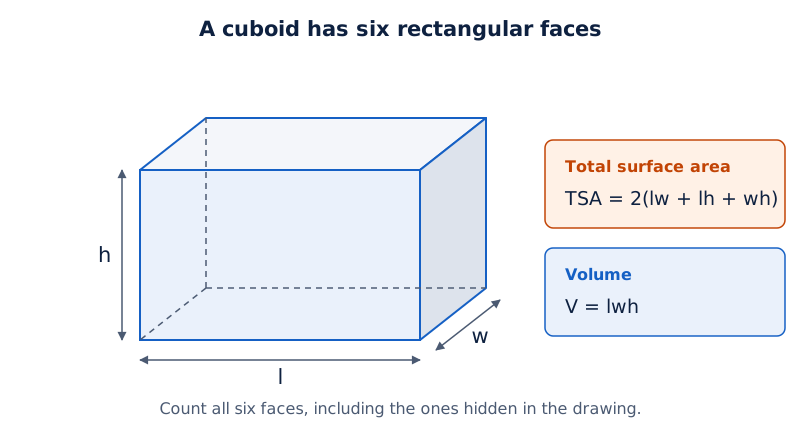
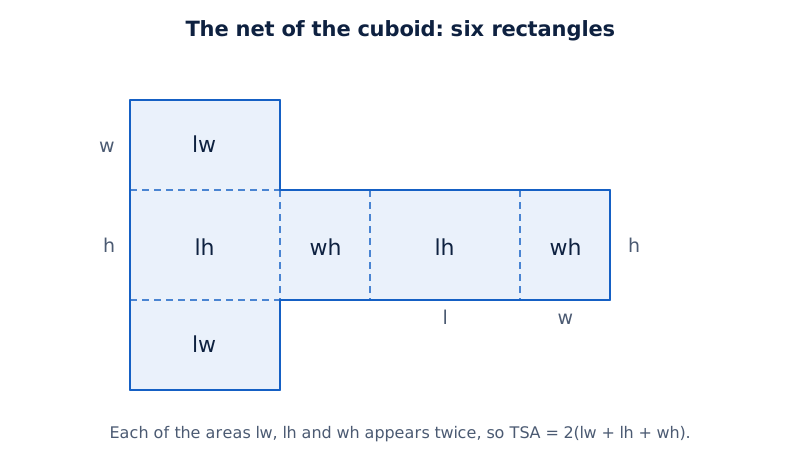
The cuboid drawing labels its dimensions l, w and h. The blue net lays out six rectangles, with matching lengths marked on their edges.
Drawn by One Young India. See Figs. 14.1C and 14.2 in your NCERT textbook
Why does multiplying three lengths give volume?
Write V for volume. A unit cube measures one unit in each direction and occupies one cubic unit. Counting the unit cubes that fit into a cuboid gives V = lwh, or base area multiplied by height.
The base is the face used as the bottom when describing the solid. Imagine thin rectangular layers stacked to form the cuboid. Each layer has the same base area; stacking through the full height explains the extra multiplication by h.
Here cm means centimetre and m means metre. Square centimetres, written cm², measure area; cubic centimetres, written cm³, measure volume. Similarly, m² and m³ mean square metres and cubic metres. Use matching length units before multiplying measurements.
How is a cube related to a cuboid, and can equal volumes have different areas?
A cube is a cuboid whose length, width and height are equal. Let a denote this common side length. Substituting a for each cuboid dimension gives the cube formulas directly, so there is no need to treat them as unrelated rules.
Result: Cube formulas are special cases
The six faces are equal squares, each of area a². Thus TSA = 6a². Multiplying the three equal dimensions gives V = a³. The superscripts ² and ³ indicate products of two and three equal factors respectively: a² = a × a and a³ = a × a × a.
Cube numbers include 1, 8, 27 and 64. They are the volumes, in cubic units, of cubes with sides 1, 2, 3 and 4 units respectively. Finding a side from a cube's volume reverses the operation of cubing.
Worked example 1. Cube A has side 6 cm. Cuboid B, made from the same material, measures 9 cm × 6 cm × 4 cm. Compare their volumes and total surface areas.
Answer: Cube A has volume 6³ = 216 cm³ and total surface area 6 × 6² = 216 cm². Cuboid B has volume 9 × 6 × 4 = 216 cm³ and total surface area 2[(9 × 6) + (6 × 4) + (9 × 4)] = 228 cm².
The two objects have equal volumes but different surface areas. For this comparison, the cube requires less covering material, while the cuboid exposes more area to its surroundings. This distinction matters in packaging, heat transfer and engineering.
How can volume determine surface area?
Worked example 2. A cube has volume 64 cm³. Find its total surface area.
Answer: Since 4 × 4 × 4 = 64, its side is 4 cm. Its total surface area is 6 × 4² = 96 cm². Finding the side first connects the volume information to the area formula.
Equal volume does not determine a unique surface area across different shapes. Likewise, cutting a cube into smaller cubes can increase their combined exposed surface area without changing their combined volume. The newly exposed faces must be counted when considering the separate pieces.
How do the surface area and volume formulas for a cylinder work?
A cross-section is the shape obtained by taking an extremely thin slice through a solid. A cylinder sliced parallel to its circular base has a circular cross-section. A slice parallel to its axis, the line through the centres of its circular ends, gives a rectangular cross-section.
In a right circular cylinder, the axis is perpendicular to the base, meaning it meets the base at a right angle. An oblique circular cylinder has an inclined axis. The formulas here concern right circular cylinders.
Let r denote the radius of the circular base, the distance from its centre to its boundary. The diameter passes through the centre and equals 2r. Let h denote the cylinder's height, the perpendicular distance between its bases.
The circumference is the length around a circle. A ratio compares quantities by division. The constant π, pronounced pi, is the ratio of circumference to diameter. Thus circumference is 2πr and circular area is πr². The symbol ≈ means approximately equal; 22/7 and 3.14 are approximations to π.
Result: Unrolling the curved surface gives a rectangle
Curved surface area, abbreviated to CSA, counts the curved part without the flat ends. Unrolling the cylinder gives a rectangle with length 2πr and height h. Therefore CSA = 2πrh.
What the figure shows
Unrolling a cylinder
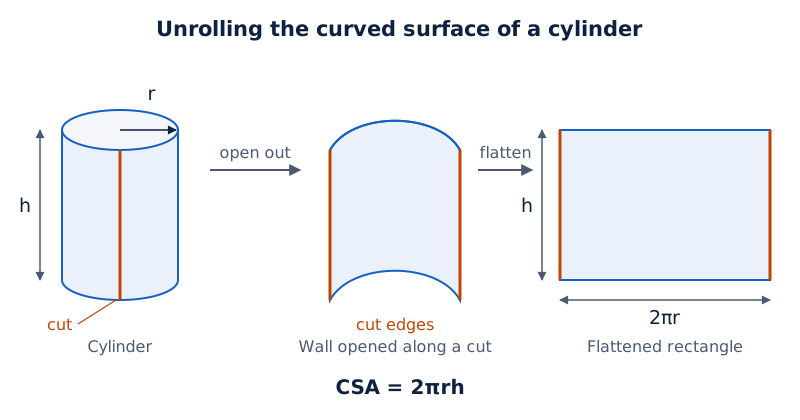
Three drawings show an intact cylinder, its curved wall opened along a cut, and the wall flattened into a rectangle.
Drawn by One Young India. See Fig. 14.5A in your NCERT textbook
| Surface being measured | Area |
|---|---|
| Curved wall | 2πrh |
| Curved wall and one circular end | 2πrh + πr² = πr(2h + r) |
| Curved wall and both circular ends | 2πrh + 2πr² = 2πr(h + r) |
A tumbler has one closed end, while a closed biscuit tin has two. The object and the task determine which circular areas to include. Adding end areas changes the amount of surface counted, rather than the cylinder's volume formula.
How do layers explain cylindrical volume?
Imagine thin circular layers stacked through height h. Each layer has base area πr², giving V = πr²h. This is the same base-area-times-height idea used for a cuboid, with a circle replacing a rectangle.
Worked example 3. Savitri needs chart paper for the curved surface of a cylindrical kaleidoscope of length 25 cm and radius 3.5 cm. Use π ≈ 22/7.
Answer: The required area is 2πrh = 2 × (22/7) × 3.5 × 25 = 550 cm². The length of the kaleidoscope acts as its cylindrical height; the task asks for its curved wall.
The notation A:B states the comparison in the order A to B; equal quantities have ratio 1:1.
Worked example 4. Cylinder B has twice the radius and half the height of cylinder A. Compare their curved surface areas and volumes.
Answer: Let A have radius r and height h. For B, CSA = 2π(2r)(h/2) = 2πrh, while V = π(2r)²(h/2) = 2πr²h. The ratios A:B are 1:1 for curved surface area and 1:2 for volume.
How do we find the curved and total surface areas of a cone?
A right circular cone can be formed by rotating a right-angled triangle about one of its perpendicular sides. A right-angled triangle contains a right angle. Its hypotenuse is the side opposite that angle; its other two sides are its legs.
The rotating triangle's fixed leg becomes the cone's height h, and the other leg becomes its base radius r. Its hypotenuse becomes the slant height, the distance along the cone from its tip to the circular rim. Here l denotes slant height, rather than cuboid length.
Result: Distinguish slant height from perpendicular height
The Baudhāyana-Pythagoras theorem relates the three sides of a right-angled triangle: the square of the hypotenuse equals the sum of the squares of the legs. Applied inside a right circular cone, it gives l² = h² + r².
A sector is a region of a circle bounded by two radii and the arc between them. An arc is part of a circle's boundary. Cutting a cone along a slant edge and opening its curved surface produces a sector of radius l.
What the figure shows
Cone and unrolled sector
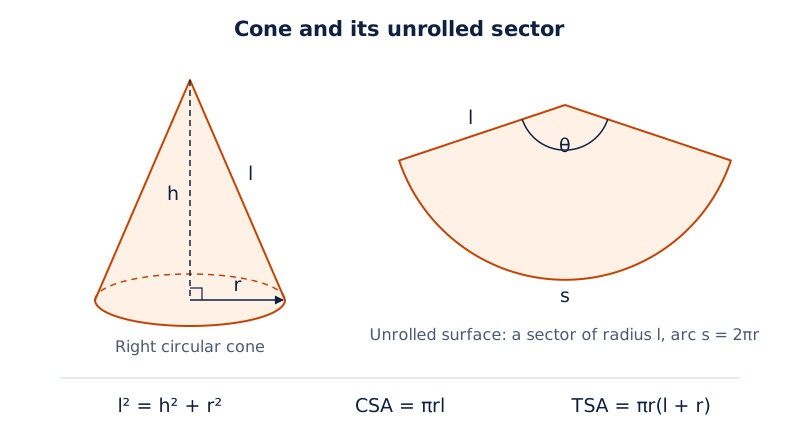
The cone shows perpendicular height h, base radius r and slant height l. The orange sector labels radius l, central angle θ and curved boundary s. Here θ denotes the sector's angle and s its arc length.
Drawn by One Young India. See Fig. 14.8 in your NCERT textbook
Why is the curved area πrl?
- The sector's arc becomes the base circumference when the cone is assembled, so its length is 2πr.
- Divide the sector into many very thin sectors, each of which can be regarded as a narrow isosceles triangle of height l. An isosceles triangle has two equal sides.
- The narrow base lengths together make the base circumference. Their combined area is half the total base length multiplied by l.
- Therefore CSA = ½ × 2πr × l = πrl. Adding the circular base gives TSA = πrl + πr² = πr(l + r).
Worked example 5. Each of 10 conical joker's caps has radius 7 cm and perpendicular height 24 cm. Find the sheet area required, using π ≈ 22/7.
Answer: The slant height satisfies l² = 24² + 7² = 625, so l = 25 cm. One cap needs curved area πrl = (22/7) × 7 × 25 = 550 cm². Ten caps need 5500 cm².
Note: A cap's covering follows the sloping surface. Find slant height before calculating that area. Perpendicular height is the measurement used in the cone's volume formula.
Why is a cone's volume one third of a matching cylinder's volume?
For a right circular cone with base radius r and perpendicular height h, V = ⅓πr²h. In words, its volume is one third of its base area multiplied by its height. The slant height does not replace h in this expression.
The comparison is with a cylinder having the same base radius and the same height. These conditions are essential: the one-third relationship does not compare arbitrary cones and cylinders. Their matching base areas and heights make their formulas directly comparable.
How can the relationship be verified experimentally?
- Prepare a cylindrical tin and a paper cone with equal base radii and equal heights.
- Fill the cone to the brim with clean, fine-grained salt and empty it into the cylinder.
- Repeat with a second full cone. The cylinder is still not full.
- Pour in a third full cone. The cylinder becomes full to the brim, experimentally verifying the volume relationship.
Another activity uses modelling clay. Form a solid cylinder, then reshape the same clay into identical cones, each with that cylinder's base radius and height. The clay makes three such cones. The amount of material connects the original volume with the combined cone volumes.
What happens when a triangle rotates?
The symbol ° denotes degrees of angle; 360° is one complete turn.
Worked example 6. A right-angled triangle with sides 5 cm, 12 cm and 13 cm is rotated through 360° about its 12 cm side. Find the volume of the solid formed, leaving π in the answer.
Answer: Since 5² + 12² = 13², the perpendicular sides are 5 cm and 12 cm. Rotation forms a cone with h = 12 cm and r = 5 cm. Its volume is ⅓ × π × 5² × 12 = 100π cm³.
Identify the fixed side before assigning the cone's dimensions. In this example, the 13 cm side describes the sloping boundary, while the 12 cm side determines the perpendicular height.
How are pyramidal shapes measured?
A pyramidal shape connects all points of a flat base to a single point outside the base's plane. That point is the apex. A plane is a flat surface extending in two dimensions. The base may be triangular, square or another closed shape.
For a pyramid with a polygonal base, its side faces are triangles meeting at the apex. A polygon is a closed plane shape bounded by straight sides. The base and triangular faces together form the surfaces whose areas must be counted.
Result: Volume depends on base area and perpendicular height
The rule is V = ⅓ × area of base × height. The height means the perpendicular distance from the apex to the base's plane. Find the area of the given base first, then multiply by the height and divide by three.
This volume rule applies whether the base is triangular, square or another shaped flat surface. The cone follows the same rule with a circular base. We may therefore think of a cone as a pyramid with a circular base.
How is surface area different from volume here?
For a polygonal pyramid, calculate the area of each face and add the results. Include the base when finding total surface area. A separate universal surface-area formula is unnecessary when the individual polygonal face areas can be found.
Do not assume that the height of a triangular side face equals the perpendicular height of the whole pyramid. Each area calculation requires the measurements belonging to that face. The volume calculation instead uses the base area and the solid's perpendicular height.
The pyramids in Egypt have square bases. Some mountains have pyramidal peaks, including Shivling Peak in Uttarakhand and the Matterhorn in the Alps. Recognising a resemblance to a geometric solid helps organise measurements without treating every natural object as an exact mathematical shape.
How do we calculate and understand a sphere's area and volume?
A sphere consists of points in three-dimensional space at a fixed distance r from a fixed point, its centre. Here r is the sphere's radius. The letter O, when used in a sphere diagram, labels its centre. A ball provides a familiar spherical form.
A circle instead consists of points in a plane at a fixed distance from its centre. Rotating a circle about a diameter produces a hollow sphere. The distinction between a plane shape and a three-dimensional surface matters when choosing an area formula.
Result: A sphere has area equal to four matching circles
Let A denote the sphere's surface area. Then A = 4πr². A cylinder fitting tightly around the sphere has radius r and height 2r. Its curved surface area is 2πr × 2r = 4πr², equal to the sphere's surface area.
What the figure shows
Sphere inside a cylinder
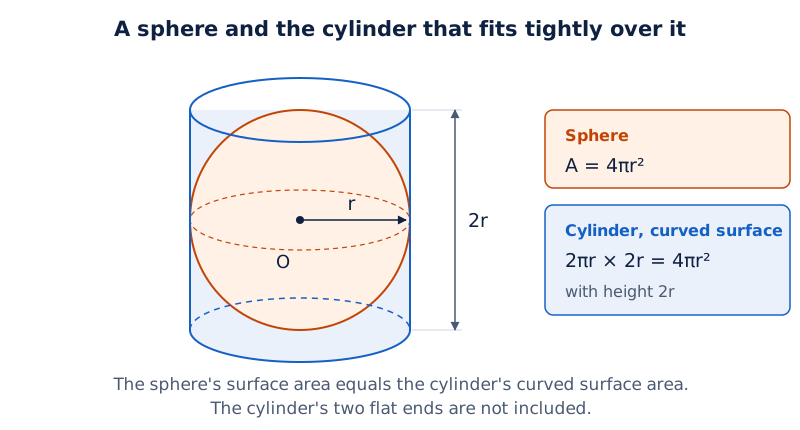
An orange sphere is enclosed by a blue cylinder. The horizontal radius is marked r and the cylinder's vertical height is marked 2r.
Drawn by One Young India. See Fig. 14.12 in your NCERT textbook
The comparison uses the cylinder's curved surface. Its two flat ends are excluded. Including those ends would change the cylinder area being compared and would no longer give the stated equality with the sphere.
How do activities connect the formulas?
In the string activity, a ball is completely covered by tightly wound string. The string is unwound and used to fill four circles, each with the ball's radius. This experimentally verifies that the sphere's area is four times the corresponding circle's area.
The volume enclosed by a sphere is V = ⁴⁄₃πr³. Another way to write it is V = ⅓ × surface area × radius. Substituting 4πr² for surface area produces the same volume formula.
To visualise this link, imagine dividing the spherical surface into very tiny regions and connecting them to the centre. The resulting thin cone-like pieces have height r. Adding their volumes links one third of their combined base areas, which form the spherical surface, to radius r.
This visualisation helps connect the formulas. The surface-area formula uses the square of the radius, while the volume formula uses its cube. Consequently, a change in radius affects area and volume by different factors.
How does a hemisphere differ from half a sphere's surface area?
A hemisphere is formed by cutting a sphere into two equal halves with a plane through its centre. Each half has a curved surface and a flat circular base. The circle exposed by the cut has the same radius as the original sphere.
Which surfaces belong in the calculation?
The curved surface is half the sphere's surface, giving CSA = 2πr². Total surface area also includes the circular base of area πr². Therefore TSA = 3πr². Half of the sphere's area accounts for the curved part alone.
Volume behaves differently: the two hemispheres divide the space inside the sphere equally. Hence V = ⅔πr³. Adding a flat base area in a surface calculation does not add an extra volume term.
| Measurement | Sphere | Hemisphere |
|---|---|---|
| Curved surface area | 4πr² | 2πr² |
| Total surface area | 4πr² | 3πr² |
| Volume | ⁴⁄₃πr³ | ⅔πr³ |
How does a bowl's shape determine its capacity?
Capacity is the volume a container can hold. Bowls, serving dishes and dome-shaped covers provide hemispherical examples. Decide whether a question asks for curved covering, total surface area of the solid, or the volume held inside it.
Worked example 7. A hemispherical bowl has radius 3.5 cm. Find the volume of water it can contain, using π ≈ 22/7.
Answer: V = ⅔πr³ = ⅔ × (22/7) × 3.5 × 3.5 × 3.5 ≈ 89.8 cm³. The calculation treats the stated radius as the radius of the water-containing hemisphere.
Note: A hemispherical dome's curved exterior and a solid hemisphere's total boundary are different surfaces. Read which part is being covered before selecting between 2πr² and 3πr².
How can we choose formulas and units for practical problems?
First identify the geometric model, the mathematical shape used to represent the object. Then decide whether the required quantity describes a surface, the space occupied, or the capacity of a container. Similar-looking questions can require different formulas because they measure different things.
Which information belongs to each solid?
| Solid | Measurements required for volume | Volume |
|---|---|---|
| Cuboid | Length l, width w, height h | lwh |
| Cube | Side a | a³ |
| Right circular cylinder | Base radius r, height h | πr²h |
| Right circular cone | Base radius r, perpendicular height h | ⅓πr²h |
| Pyramidal shape | Base area and perpendicular height | ⅓ × base area × height |
| Sphere | Radius r | ⁴⁄₃πr³ |
| Hemisphere | Radius r | ⅔πr³ |
A litre is a unit of capacity: 1000 cm³ = 1 litre. Calculate a volume in cubic centimetres before dividing by 1000 to express it in litres. A diameter must also be halved before it is substituted into a formula requiring radius.
Worked example 8. A school serves 1600 students milk in cylindrical glasses of diameter 7 cm, filled to a height of 12 cm. Find the milk required in litres. Use π ≈ 22/7 and 1000 cm³ = 1 litre.
Answer: Radius = 7/2 = 3.5 cm. Each glass contains (22/7) × 3.5² × 12 = 462 cm³. The total is 1600 × 462 = 739200 cm³, or 739.2 litres.
How should a solution be organised?
- List the given dimensions and identify whether each describes a radius, diameter, perpendicular height or slant height.
- Choose the surfaces or volume actually required. For a cylinder, count the circular ends included in the task.
- Write the formula before substituting values. Convert dimensions into compatible units and use the stated approximation to π.
- Calculate, attach the correct units, and interpret the result in the context of covering, filling or comparing objects.
When an object is melted and recast, its original volume supplies the material for the new shapes. When separate objects are packed into a container, their arrangement also matters. A volume quotient alone cannot account for gaps between objects.
How do assumptions change a guesstimate?
A guesstimate is a reasonable estimate made when exact data are unavailable. It combines assumptions, approximations, logic and everyday knowledge. An assumption is a condition adopted for the model, while an approximation replaces a measurement or value with a nearby manageable value.
Start with an intuitive guess. Identify the relevant quantities, choose a shape model and state assumptions. Calculate using suitable approximations, then compare the result with the initial guess. Different answers can arise from different assumptions; explaining the reasoning is central to the task.
How does the golgappa example use volume?
Lallan's cylindrical vessel contains pani, or spiced water, up to a height of 50 cm and has radius 10 cm. A golgappa is a small hollow ball made of wheat. Model each golgappa as a sphere and neglect its thickness.
Worked example 9. Estimate how many golgappas the vessel can serve using the two sets of assumptions in the table below.
Answer: The available pani has volume π × 10 × 10 × 50 = 5000π cm³. Divide this by the estimated pani in each golgappa. The two calculations lead to about 1850 and about 870 golgappas respectively.
The symbol % means per hundred, so 60% and 80% correspond to 0.6 and 0.8 of the estimated capacity.
| Quantity or assumption | Student 1 | Student 2 |
|---|---|---|
| Estimated average radius | 1.5 cm | 1.75 cm |
| Estimated spherical volume, neglecting thickness | ⁴⁄₃ × π × (1.5)³ ≈ 14.14 cm³ | ⁴⁄₃ × π × (1.75)³ ≈ 22.43 cm³ |
| Average proportion filled with pani | 60% | 80% |
| Pani volume in one golgappa | 14.14 × 0.6 ≈ 8.5 cm³ | 22.43 × 0.8 ≈ 18 cm³ |
| Calculated number served | 5000π/8.5 ≈ 1848 | 5000π/18 ≈ 873 |
| Final estimate | About 1850 golgappas | About 870 golgappas |
Why are the two answers different?
The students assume different average radii and different proportions filled with pani. Both choices affect the volume used in one serving.
The vessel's pani volume stays the same in both calculations. The estimated volume per serving changes, so the number of servings changes. The final numbers are estimates, not exact counts guaranteed independently of golgappa size or filling.
Keep intermediate approximations visible. The approximate sphere volume is followed by an approximate amount of pani and then an approximate serving count. Hiding these assumptions would make the final result appear more precise than the model supports.
Why does packing tennis balls require more than dividing volumes?
Anirban considers an empty classroom measuring 30 ft × 30 ft × 15 ft and tennis balls of radius 3 cm. The abbreviation ft means foot, a length unit; ft³ means cubic feet. One foot equals 30.48 cm; a rough length conversion is 1 ft ≈ 30 cm.
What does dividing the two volumes tell us?
A ball's volume is ⁴⁄₃ × π × 3³ ≈ 113 cm³. The classroom volume is 30 × 30 × 15 = 13,500 ft³. Using the volume approximation 1 ft³ ≈ 28000 cm³ gives approximately 37,80,00,000 cm³.
Dividing 37,80,00,000 by 113 gives approximately 33,45,132. This is an upper bound, a ceiling supplied by the available volume in this approximate model. It is not an achievable packing count: balls leave gaps, so their combined volume does not fill every part of the room.
How does an arrangement give a better estimate?
Worked example 10. Estimate the number of radius-3 cm tennis balls arranged in straight rows and layers inside the 30 ft × 30 ft × 15 ft room. Use 1 ft ≈ 30 cm for the lengths.
Answer: Each diameter is 6 cm. Along the length, approximately 900/6 = 150 balls fit; the width also holds 150. Along the height, 450/6 = 75 balls fit. The estimated count is 150 × 150 × 75 = 16,87,500 balls.
Packing efficiency describes how effectively an arrangement uses the available space. Using other configurations, we might be able to fit more balls because of higher packing efficiency. The straight-row arrangement is therefore an estimate for a particular packing method.
What the figure shows
Ordered sphere packings
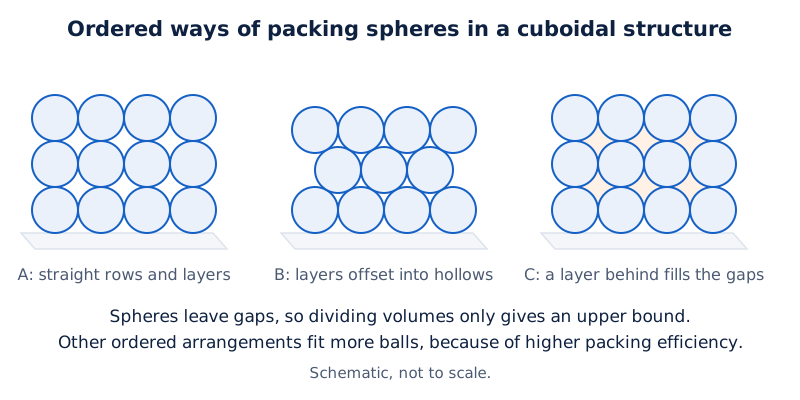
Three drawings, labelled A, B and C, show groups of blue spheres arranged in different layers above rectangular bases. The spheres leave visible spaces between them.
Drawn by One Young India. See Fig. 14.17 in your NCERT textbook
This explains why cubes, rather than spheres, are used as basic units of volume: spheres leave gaps. Distinguish the volume occupied by the balls from the larger region containing both balls and gaps when interpreting any packing calculation.
Glossary
- Surface area — The measure of the boundary surfaces of a solid, expressed in square units.
- Volume — The amount of three-dimensional space occupied by an object or container, measured in cubic units.
- Cuboid — A solid with six rectangular faces, described by its length, width and height.
- Cube — A special cuboid whose length, width and height are all equal.
- Net — A flat arrangement of surfaces that can be folded to form a solid.
- Cross-section — The shape obtained by taking an extremely thin slice through a three-dimensional object.
- Right circular cylinder — A cylinder with circular bases and an axis perpendicular to its base.
- Curved surface area — The area of a solid's curved surface, excluding its flat base or ends.
- Slant height — The distance along a right circular cone from its apex to its circular rim.
- Apex — The point outside a pyramid's base plane to which its base points are connected.
- Sphere — The set of points in three-dimensional space at a fixed distance from a fixed centre.
- Hemisphere — Half a sphere formed by cutting it with a plane passing through its centre.
- Capacity — The volume that a container can hold, often expressed in litres or cubic centimetres.
- Guesstimate — A reasonable estimate using assumptions, approximations and reasoning when exact data are unavailable.
- Upper bound — A ceiling for a quantity under the stated conditions or assumptions of a model.
Common errors and misconceptions
- Misconception: Equal volumes imply equal surface areas. Correct: The 6 cm cube and the 9 cm × 6 cm × 4 cm cuboid both have volume 216 cm³, but their areas are 216 cm² and 228 cm².
- Misconception: Every cylinder surface calculation includes two circular ends. Correct: Include no ends for curved area, one for a one-ended container, and both for a fully closed cylinder.
- Misconception: A cone's slant height and perpendicular height can be exchanged. Correct: Curved area uses πrl, volume uses ⅓πr²h, and l² = h² + r² relates the measurements.
- Misconception: A hemisphere's total surface area is half a sphere's area. Correct: Its curved area is 2πr², but adding the circular base gives total area 3πr².
- Misconception: A diameter can be substituted directly for radius. Correct: The radius is half the diameter; identify which measurement the problem supplies before using a formula.
- Misconception: Dividing room volume by ball volume gives the number of balls that fit. Correct: This ignores gaps and supplies an upper bound in the model; an arrangement is needed for a packing estimate.
- Misconception: A guesstimate has one exact answer independent of assumptions. Correct: Estimated sizes, filling proportions and packing choices can change the result, so state them clearly.
Exam-style questions with model answers
Q1. A cube has volume 64 cm³. Find its side and total surface area. [2 marks]
- The side is 4 cm because 4³ = 64; cubing the side gives the cube's volume.
- Total surface area = 6 × 4² = 96 cm², obtained by adding the areas of its six square faces.
Q2. Find the chart-paper area for the curved surface of a cylindrical kaleidoscope of radius 3.5 cm and length 25 cm. Use π ≈ 22/7 and explain the choice of surface. [3 marks]
- The chart paper covers the curved wall, so use curved surface area. Circular end areas are not part of the requested covering.
- The cylinder's radius is 3.5 cm and its height is the stated length, 25 cm. The formula is CSA = 2πrh.
- Substituting gives 2 × (22/7) × 3.5 × 25 = 550 cm². The unit is square centimetres because the quantity being measured is area.
Q3. Ten conical joker's caps each have base radius 7 cm and perpendicular height 24 cm. Find the slant height, sheet area per cap and total sheet area. Use π ≈ 22/7. [4 marks]
- The slant height satisfies l² = h² + r² = 24² + 7² = 625, so l = 25 cm.
- The sheet forms the curved surface of each cap. Its area is πrl; a circular base is not included.
- Substitution gives the sheet area per cap as (22/7) × 7 × 25 = 550 cm².
- For ten identical caps, multiply this area by 10. The total sheet area required is 5500 cm².
Q4. Cube A has side 6 cm. Cuboid B measures 9 cm × 6 cm × 4 cm. Calculate both volumes and total surface areas, then compare the covering material required. [5 marks]
- Cube A has volume a³, where a is its side. Substituting a = 6 cm gives 6³ = 216 cm³.
- Its six equal square faces give total surface area 6a² = 6 × 6² = 216 cm². This measures its complete covering.
- Cuboid B has volume equal to length multiplied by width multiplied by height, giving 9 × 6 × 4 = 216 cm³.
- Its total surface area is 2[(9 × 6) + (6 × 4) + (9 × 4)] = 228 cm², counting all six faces.
- The objects have equal volumes, but Cube A has the smaller total surface area. It therefore requires less covering material in this comparison.
Q5. A right-angled triangle has sides 5 cm, 12 cm and 13 cm. It rotates through 360° about its 12 cm side. Identify the solid and calculate its volume in terms of π. [3 marks]
- The perpendicular sides are 5 cm and 12 cm, since 5² + 12² = 13². The 13 cm side is the hypotenuse.
- Rotating about the 12 cm side produces a right circular cone. Its perpendicular height is 12 cm and its base radius is 5 cm.
- The volume is ⅓πr²h = ⅓ × π × 5² × 12 = 100π cm³. The hypotenuse is not used as the perpendicular height.
Q6. A hemispherical bowl has internal radius 3.5 cm. Explain and calculate the volume of water it can hold when full, using π ≈ 22/7. Give the volume to one decimal place. [3 marks]
- The water occupies a hemisphere. A hemisphere contains half the volume of a sphere with the same radius, so use V = ⅔πr³.
- The internal radius is 3.5 cm. Substitution gives V = ⅔ × (22/7) × 3.5 × 3.5 × 3.5 cubic centimetres.
- Evaluating and rounding to one decimal place gives 89.8 cm³. This is the bowl's water capacity; surface area would measure a different quantity.
Q7. An empty classroom measures 30 ft × 30 ft × 15 ft. Tennis balls of radius 3 cm are arranged in straight rows and layers. Using 1 ft ≈ 30 cm, estimate their number and explain why dividing room volume by ball volume ignores an important feature. [5 marks]
- Convert the room dimensions with the given approximation: the length and width are each approximately 900 cm, and the height is approximately 450 cm.
- Each ball's diameter is twice its radius, so it is 6 cm. Adjacent balls in a straight row therefore occupy 6 cm each along that direction.
- The number along the length is 900/6 = 150; the width also holds 150. Along the height, the number of layers is 450/6 = 75.
- The estimated count for this arrangement is 150 × 150 × 75 = 16,87,500 balls. It depends on the stated length approximation and packing method.
- Balls leave gaps between them. Dividing room volume by individual ball volume ignores those gaps and gives an upper bound in the volume model, rather than this arrangement's count.
Q8. Cylinder A has radius r and height h. Cylinder B has radius 2r and height h/2. Find the ratios A:B of curved surface area and volume. [4 marks]
- Cylinder A has curved surface area 2πrh. For Cylinder B, substituting its radius and height gives 2π(2r)(h/2) = 2πrh.
- The curved surface areas are equal, so their ratio A:B is 1:1. Doubling the radius compensates for halving the height here.
- Cylinder A has volume πr²h. Cylinder B has volume π(2r)²(h/2) = 2πr²h because the radius is squared.
- The volume ratio A:B is therefore 1:2. Equal curved surface areas in this pair do not imply equal volumes.
Key takeaways
- Surface area measures a solid's boundary in square units; volume measures occupied three-dimensional space in cubic units.
- A cube is a special cuboid with equal dimensions, giving total surface area 6a² and volume a³.
- A cylinder's curved area comes from an unrolled rectangle; add circular ends according to the surfaces required.
- A cone's curved area uses slant height, while its volume uses perpendicular height and one third of the base-area product.
- A pyramidal shape has volume equal to one third of base area multiplied by perpendicular height.
- A sphere's surface area is 4πr², equal to the curved area of its tightly enclosing cylinder.
- A hemisphere's total surface area includes its circular base, so it differs from half the original sphere's surface area.
- Guesstimates require explicit assumptions, and sphere-packing estimates must account for gaps rather than rely solely on volume division.
Test yourself
Why does a cuboid's total surface area contain a factor of two?
Its rectangular faces occur in three equal-area pairs, so each of the areas lw, lh and wh is counted twice.
What makes a circular cylinder a right circular cylinder?
Its axis is perpendicular to its circular base, rather than being inclined to that base.
What surface area belongs to a cylinder closed at one end?
Add the curved wall and one circular base: 2πrh + πr², where r is radius and h is height.
Which cone measurement is used in πrl, and how is it related to r and h?
The letter l denotes slant height. For base radius r and perpendicular height h, it satisfies l² = h² + r².
When is a cone's volume one third of a cylinder's volume?
The right circular cone and cylinder must have the same base radius and the same perpendicular height.
Why is a hemisphere's total surface area 3πr²?
Its curved surface contributes 2πr², and its circular base contributes another πr², giving 3πr² altogether.
Why do the two golgappa estimates differ?
The students assume different average radii and different filling percentages, changing the estimated amount of pani used per serving.
Why does room volume divided by tennis-ball volume not give a packing arrangement's count?
The division ignores spaces between balls. An arrangement leaves gaps, so a packing calculation must account for them.
Write about it
Turn a question from this chapter into a paper.
The Writing Studio has a structure guide, a rubric and citation tools for 15 formats, from essays to research papers. Drafting is free with an account. Learnacy Essential adds feedback from an AI writing coach and submission to The OYI Review.
Learnacy Essential is ₹1,499 for the year. Publication depends on review and is not guaranteed.