
Quadrilaterals | CBSE Class 9 Maths Notes
On this page

This note covers precise definitions of quadrilaterals, convexity, parallelogram properties and tests, the Midpoint Theorem and its converse, congruent triangles, medians and centroids, Varignon parallelograms, applications of midpoint reasoning, and tiling the plane.
What exactly is a quadrilateral?
A quadrilateral, also called a 4-gon, has four straight sides. A precise definition must distinguish it from an open figure, a figure with overlapping sides, and a figure whose sides cross. Four labelled points alone do not settle these issues.
Definition: Take four distinct points A, B, C and D in a plane, with no three collinear. Quadrilateral ABCD consists of the points on segments AB, BC, CD and DA, provided every point other than these vertices belongs to exactly one of those segments.
A plane is a flat surface extending in all directions. Collinear points lie on one straight line. A line segment joins two endpoints; AB names the segment joining points A and B, and also denotes its length when used in a length equality.
How are its parts named?
The four points are vertices, meaning corners, and AB, BC, CD and DA are the sides or edges. A diagonal joins opposite vertices: the diagonals here are AC and BD. Adjacent vertices are the endpoints of one side.
Adjacent sides share an endpoint; opposite sides share none. An internal angle is the angle inside the figure between the sides meeting at a vertex. Adjacent angles occur at adjacent vertices, while opposite angles occur at vertices not joined by a side.
The symbol ∠ means angle. Thus ∠A names the internal angle at A, and ∠DAB names the angle between AD and AB, with the middle letter identifying its vertex. The symbol ° means degrees, the unit used to measure angles.
Worked example 1. In quadrilateral ABCD, list the sides adjacent and opposite to AB, and the angles adjacent and opposite to ∠A.
Answer: The 2 adjacent sides are AD and BC; the opposite side is CD. The 2 adjacent angles are ∠B and ∠D; the opposite angle is ∠C. Sharing an endpoint determines adjacency of sides; sharing a side determines adjacency of angles.
How do we distinguish convex and other four-sided figures?
Unless stated otherwise, a quadrilateral here is planar, meaning its vertices lie in one plane, and non-self-intersecting, meaning its sides do not cross away from their shared endpoints. Non-planar and self-intersecting four-sided figures require explicit qualification.
What does convex mean?
A convex quadrilateral has every internal angle less than 180°. A non-convex quadrilateral has a dent, where the internal angle exceeds 180°. The dent does not prevent the figure from being a quadrilateral under the definition.
The diagonals give another test. The diagonal segments of a convex quadrilateral intersect, whereas those of a non-convex quadrilateral do not. Here intersect means meet at a common point. The test concerns the segments themselves, not lines obtained by extending them indefinitely.
What the figure shows
Convexity and diagonals
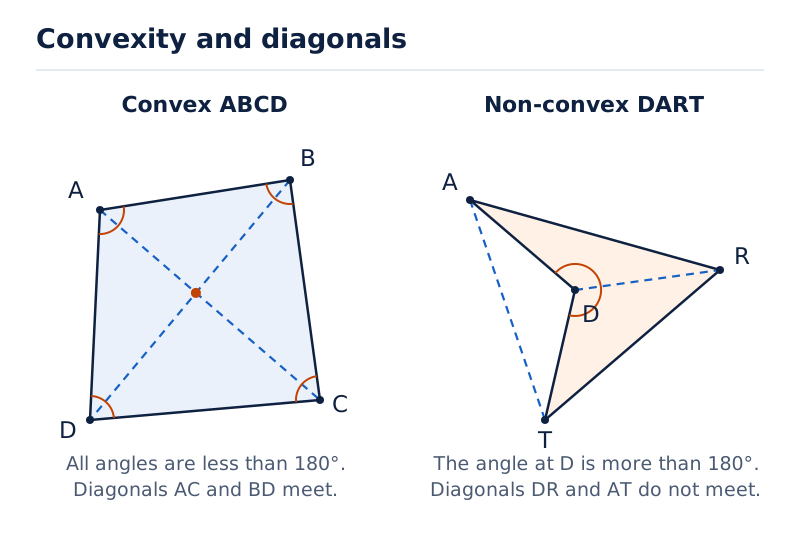
ABCD is shown with all internal angles below 180° and with intersecting dashed diagonals. DART has a dent at D, an internal angle above 180°, and diagonal segments that do not intersect.
Drawn by One Young India. See Figs. 12.4 and 12.5 in your NCERT textbook
Why does the order of letters matter?
The name follows the boundary. ABCD, BCDA, CDAB and DABC start at different vertices but travel in the same direction. DCBA, ADCB, BADC and CBAD travel in the reverse direction. Other orders do not name the same sequence of sides.
A parallelogram has both pairs of opposite sides parallel. Parallel lines lie in one plane and do not meet; the symbol ∥ means “is parallel to”. Rectangles, rhombuses and squares are included among parallelograms.
| Special parallelogram | Defining extra property |
|---|---|
| Rectangle | All four angles are right angles, each measuring 90°. |
| Rhombus | All four sides have equal length. |
| Square | All four sides are equal and all four angles are right angles. |
What properties follow from the definition of a parallelogram?
Theorem: Opposite sides and opposite angles are equal
For parallelogram ABCD, AB ∥ DC and AD ∥ BC. It follows that AB = DC and AD = BC, where = means equality. Its opposite angles are also equal: ∠A = ∠C and ∠B = ∠D.
Join AC. A transversal is a line crossing two other lines. AC acts as a transversal for each pair of parallel sides. The alternate interior angles, lying between the parallel lines on opposite sides of the transversal, are equal.
The symbol ∆ means triangle, and ≅ means congruent. Congruent triangles have matching sides and angles equal. Thus ∆ACD ≅ ∆CAB by the angle-side-angle test, using the shared side AC and the equal angles at its ends.
| Congruence test | Required matching data |
|---|---|
| ASA: angle-side-angle | Two angles and the side between them. |
| AAS: angle-angle-side | Two angles and a corresponding side not between them. |
| SSS: side-side-side | All three corresponding sides. |
| SAS: side-angle-side | Two sides and the angle between them. |
Corresponding parts are those that match in the stated vertex order. From the congruence above, AB matches CD, and AD matches CB. These give the two equalities of opposite sides.
Interior angles on the same side of a transversal between parallel lines total 180°. Such angles are supplementary. Hence ∠A + ∠B = 180° and ∠B + ∠C = 180°. Subtracting the common angle gives ∠A = ∠C. Similarly, ∠B = ∠D.
Theorem: The diagonals bisect each other
To bisect a segment means to divide it into two equal parts. Let E be the intersection of diagonals AC and BD. In triangles AED and CEB, AD = CB, and the parallel sides provide two equal pairs of angles.
The triangles are congruent by ASA or AAS. Therefore EA = EC and ED = EB. A midpoint is a point dividing a segment into equal parts, so E is the midpoint of both diagonals.
What the figure shows
Three parallelogram properties
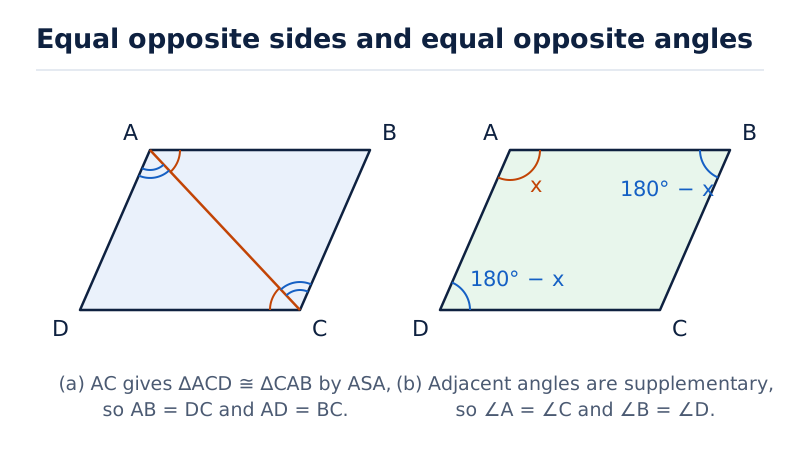
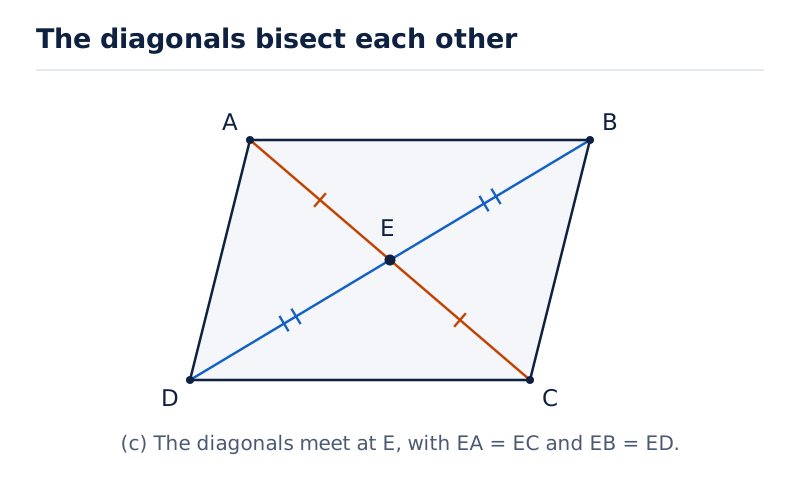
The three drawings show diagonal AC with angle markings, adjacent angles labelled x and 180° − x, and diagonals meeting at E. Here x denotes an angle measure, and − means subtraction.
Drawn by One Young India. See Fig. 12.6 in your NCERT textbook
Which conditions prove that a quadrilateral is a parallelogram?
A converse interchanges the assumption and conclusion of an “if…then…” statement. A true statement need not have a true converse. For parallelograms, however, the converses of the three properties just proved are all true.
Theorem: Both pairs of opposite sides are equal
Suppose quadrilateral ABCD has AB = CD and AD = BC. Draw AC. Triangles ACD and CAB have all three corresponding sides equal, including their common side AC. They are congruent by SSS.
The matching angles are therefore equal. The converse of the alternate-interior-angle result gives AB ∥ DC and AD ∥ BC. Both pairs of opposite sides are parallel, so ABCD is a parallelogram.
Theorem: Both pairs of opposite angles are equal
Suppose ∠A = ∠C and ∠B = ∠D. The internal angles of a quadrilateral total 360°. Substituting the equal opposite angles gives 2(∠A + ∠B) = 360°. Thus ∠A + ∠B = 180°, and similarly ∠B + ∠C = 180°.
These supplementary adjacent angles give AD ∥ BC and AB ∥ DC. An equivalent test is that each pair of adjacent angles is supplementary. One angle equality alone is not the full opposite-angle test.
Theorem: The diagonals bisect each other
Let AC and BD meet at E, with EA = EC and EB = ED. The angles AED and CEB are vertically opposite angles, meaning the facing angles made by two intersecting lines. These angles are equal.
Triangles AED and CEB are congruent by SAS. Matching angles show AD ∥ BC. Applying the same reasoning to triangles EAB and ECD gives AB ∥ DC, completing the test.
Theorem: One pair of opposite sides is equal and parallel
Suppose AB ∥ DC and AB = DC. Let E be the intersection of AC and BD. Equal alternate interior angles and AB = DC give ∆EAB ≅ ∆ECD by ASA. Hence the diagonals bisect each other, proving that ABCD is a parallelogram.
Worked example 2. In parallelogram ABCD, distinct points P and Q lie on diagonal BD and DP = BQ. Show that APCQ is a parallelogram.
Answer: Let E be the midpoint of BD. It is also the midpoint of AC. Equal distances DP and BQ from opposite ends of BD place P and Q equally far from E, on opposite sides. Thus EP = EQ. The 2 diagonals AC and PQ of APCQ bisect each other at E, so APCQ is a parallelogram.
Note: In the equal parallel sides test, equality and parallelism must refer to the same pair of opposite sides. Each test supplies sufficient conditions; a drawing that merely looks like a parallelogram supplies no proof.
How does the Midpoint Theorem connect triangles and parallelograms?
Theorem: A segment joining two side midpoints
The Midpoint Theorem says that the segment joining the midpoints of two sides of a triangle is parallel to the third side and has half its length. It gives a direction conclusion and a length conclusion together.
In ∆ABC, let P be the midpoint of AB and Q the midpoint of AC. Then PQ ∥ BC and PQ = BC/2. The slash means division, so BC/2 is half the length of BC. The midpoint assumptions give AP = PB and AQ = QC.
How does an extra line produce the proof?
An auxiliary construction is an added line or point used to help a proof. Draw a line through C parallel to BA, meeting the extended line PQ at R. This creates two triangles that can be compared and a quadrilateral that can become a parallelogram.
- AQ = CQ because Q is the midpoint of AC. The angles AQP and CQR are equal vertically opposite angles.
- AP ∥ RC, so ∠APQ = ∠CRQ. Therefore ∆APQ ≅ ∆CRQ by AAS.
- Congruence gives PQ = QR and CR = AP. Since AP = BP, we obtain CR = BP.
- CR and BP are also parallel. The equal parallel sides test makes BCRP a parallelogram.
- Consequently PR ∥ BC and PR = BC. Since PQ = QR, PQ = PR/2 = BC/2, with PQ ∥ BC.
What the figure shows
Midpoint construction
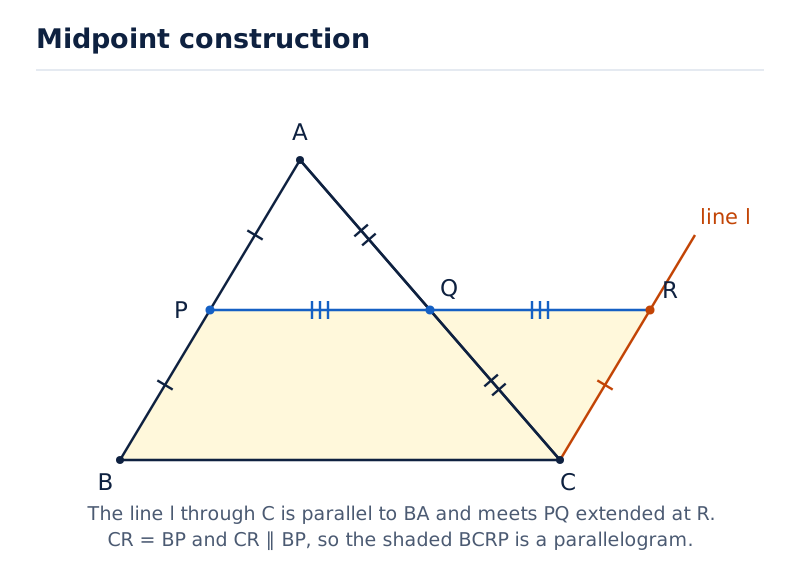
P lies on AB and Q lies on AC. The line through C, labelled l, is parallel to AB and meets the extended PQ at R. Equal-length marks identify the halves of AB and AC; l is the name of the added line.
Drawn by One Young India. See Fig. 12.14 in your NCERT textbook
Worked example 3. In ∆ABC, P and Q are the midpoints of AB and AC. Find the direction and length of PQ relative to BC.
Answer: The two midpoint assumptions satisfy the Midpoint Theorem. Therefore PQ ∥ BC and PQ = BC/2. No numerical length of BC is required: the answer expresses PQ as half the given third side.
What does the converse of the Midpoint Theorem establish?
Theorem: A parallel through one midpoint bisects another side
In ∆ABC, suppose P is the midpoint of AB. Draw the line through P parallel to BC, and let it meet AC at Q. The converse of the Midpoint Theorem gives AQ = QC. It also gives PQ = BC/2.
The distinction is in the information supplied. The original theorem starts with two midpoints and proves parallelism. This converse starts with one midpoint and parallelism, and proves that the point on the other side is its midpoint.
Why is the short proof valid?
- Let M be the midpoint of AC. This point is introduced independently of the given point Q.
- P and M are midpoints of AB and AC, so the Midpoint Theorem gives PM ∥ BC.
- There is a unique line through P parallel to BC. Therefore PM and PQ are the same line.
- That line meets AC at the same point, so M = Q. Hence Q is the midpoint, and the original theorem also gives PQ = BC/2.
The new ingredient is uniqueness of the parallel: exactly one parallel to a given line passes through a given point outside it. The proof does not assume that a theorem automatically makes its converse true.
| Statement | Given information | Conclusion |
|---|---|---|
| Midpoint Theorem | P and Q are side midpoints. | PQ is parallel to and half the third side. |
| This converse | P is a side midpoint and PQ is parallel to the third side. | Q is the other midpoint; PQ is half the third side. |
A statement with several assumptions and conclusions can suggest more than one converse. Keeping one midpoint assumption fixed while exchanging the other midpoint condition and parallelism gives this particularly useful converse.
Why do three side midpoints create four congruent triangles?
Cutting a triangle along the segments joining its side midpoints suggests a pattern: it appears that all four smaller triangles are congruent, and each seems to be a smaller copy of the original triangle. The Midpoint Theorem turns this observation into a proof.
How are all three midpoint segments used?
In ∆ABC, let P, Q and R be the midpoints of AB, AC and BC respectively. Applying the Midpoint Theorem to the three possible pairs gives PQ = BC/2, PR = AC/2 and QR = AB/2.
The midpoint definitions also give AP = PB = AB/2, AQ = QC = AC/2 and BR = RC = BC/2. Thus each of the four smaller triangles has the same three side lengths, even though its orientation may differ.
Worked example 4. For these midpoints P, Q and R, show that ∆PQR is congruent to ∆QPA and identify the other two matching triangles.
Answer: The 3 side lengths of each small triangle are AB/2, AC/2 and BC/2. For example, PQ = QP, QR = PA and PR = QA, so ∆PQR ≅ ∆QPA by SSS. Keeping the corresponding vertices in order gives ∆PQR ≅ ∆RBP and ∆PQR ≅ ∆CRQ. Hence all 4 small triangles are congruent.
Vertex correspondence matters when writing a congruence statement. In ∆PQR ≅ ∆RBP, P matches R, Q matches B and R matches P. Check the three side pairings before writing the letters.
This reasoning also explains why trying a congruence test immediately after cutting can fail: the required side equalities have not yet been established. The midpoint results supply the missing information rather than relying on measurement alone.
Why do the medians meet at a centroid in the ratio 2:1?
A median joins a triangle’s vertex to the midpoint of the opposite side. Lines or segments are concurrent if they pass through one common point. The Centroid Theorem establishes concurrency of the three medians and specifies how that point divides each one.
Theorem: The centroid divides every median in a fixed ratio
Let P, Q and R be the midpoints of AB, AC and BC in ∆ABC. Its medians are CP, BQ and AR. Their common point M is the centroid. Then CM:MP = BM:MQ = AM:MR = 2:1.
The colon denotes a ratio, comparing lengths in the stated order. A ratio of 2:1 means the first length is twice the second. The longer part connects the vertex to M; the shorter part connects M to the side midpoint.
How do midpoints prove the division and concurrency?
- Start with only CP and BQ, meeting at M. Let X be the midpoint of BM and Y the midpoint of CM.
- Apply the Midpoint Theorem in triangles ABC and MBC. Both PQ and XY are parallel to BC, and PQ = XY = BC/2.
- These parallel segments give equal alternate interior angles in triangles MPQ and MYX. With PQ = YX, ASA gives ∆MPQ ≅ ∆MYX.
- Thus MP = MY = YC and MQ = MX = XB. Consequently CM = 2MP and BM = 2MQ.
- Repeat with medians AR and BQ, meeting at N. The same reasoning gives BN:NQ = 2:1 and AN:NR = 2:1.
- Only one point divides BQ in that ratio. Therefore N = M, so the third median also passes through M.
Worked example 5. In ∆ABC, CP is a median and M is the centroid. Express CM and MP as fractions of CP.
Answer: CM:MP = 2:1, with CM the longer part because it touches vertex C. The complete median contains 3 equal parts. Therefore CM = 2CP/3 and MP = CP/3. Reversing the order gives MP:CM = 1:2.
The proof establishes both parts of the theorem. Showing the ratio on two medians alone would not yet prove that the third passes through their intersection. The final uniqueness argument supplies that missing step.
What is the Varignon parallelogram of a quadrilateral?
Take a quadrilateral ABCD and mark P, Q, R and S as the midpoints of AB, BC, CD and DA respectively. Joining these points in boundary order creates the Varignon parallelogram of ABCD.
Theorem: The side midpoints are vertices of a parallelogram
Draw diagonals AC and BD. In triangle ABC, the Midpoint Theorem gives PQ ∥ AC and PQ = AC/2. In triangle ADC, it gives SR ∥ AC and SR = AC/2. Hence PQ ∥ SR.
Similarly, in triangles BCD and BAD, QR and PS are both parallel to BD and have length BD/2. Therefore QR ∥ PS. Both pairs of opposite sides of PQRS are parallel, proving Varignon’s theorem.
What the figure shows
Midpoint parallelogram
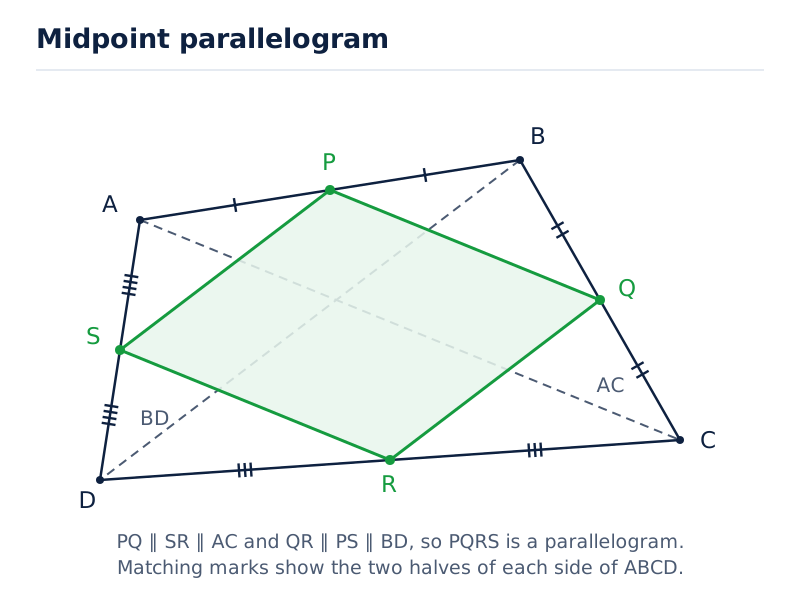
P, Q, R and S are marked successively on AB, BC, CD and DA. The inner quadrilateral PQRS is drawn with the original diagonals shown as dashed segments. Matching marks indicate the two halves of each outer side.
Drawn by One Young India. See Fig. 12.21 in your NCERT textbook
What information comes from the original diagonals?
The sides of the midpoint parallelogram have lengths AC/2 and BD/2. Thus information about the original diagonals becomes information about the new sides. The diagonals of PQRS itself are PR and QS, a different pair of segments.
Worked example 6. If P, Q, R and S are the successive side midpoints of quadrilateral ABCD, show that PR and QS bisect each other.
Answer: By the Midpoint Theorem, PQ = SR = AC/2 and QR = PS = BD/2, with opposite sides parallel. Thus PQRS is a parallelogram. Its 2 diagonals are PR and QS. The diagonal property of a parallelogram says that their intersection divides each into equal halves.
The midpoint construction is useful even when the original quadrilateral has no pairs of parallel sides. The proof works through triangles formed by the original diagonals, allowing a known triangle theorem to establish a new quadrilateral result.
How can midpoint reasoning solve a problem with an arbitrary point?
A midpoint segment can control other segments drawn inside the same triangle. The key is to choose the triangle containing the segment to be bisected and identify a parallel line through one of its side midpoints.
How do we choose the smaller triangle?
Worked example 7. In ∆ABC, M and N are the midpoints of AB and AC respectively. Let D be any point on BC. Show that MN bisects AD.
Answer: The Midpoint Theorem in ∆ABC gives MN ∥ BC. Let T be the intersection of MN and AD. For D inside BC, consider ∆ABD: M is the midpoint of AB, and MT ∥ BD because BD lies along BC. The converse of the Midpoint Theorem gives AT = TD, or AT = AD/2. Thus MN divides AD into 2 equal parts.
If D is B, AD is AB and the intersection is its midpoint M. If D is C, AD is AC and the intersection is its midpoint N. These endpoint cases also satisfy the conclusion without requiring a triangle with repeated vertices.
Any point on BC does not mean that D must be its midpoint. The given midpoint information concerns M and N. Parallelism allows that information to be transferred to AD through triangle ABD.
What is the general reasoning pattern?
- Use a midpoint theorem in the larger triangle to establish a parallel direction.
- Name the intersection whose midpoint status must be proved.
- Find a smaller triangle containing the segment in question.
- Use the converse theorem with the known midpoint and the established parallel.
This method separates two roles: the original theorem supplies parallelism, and its converse supplies the new midpoint. Keeping those roles distinct prevents the desired conclusion from being used as an unproved assumption.
How does midpoint reasoning extend to a trapezium?
A trapezium is a quadrilateral with a pair of opposite sides parallel. Let ABCD have AB ∥ DC, and let E and F be the midpoints of AD and BC. Their joining segment is parallel to the two parallel sides.
How is the average-length relation obtained?
Let M be the midpoint of diagonal BD. In triangle DAB, EM ∥ AB and EM = AB/2. In triangle DCB, MF ∥ DC and MF = DC/2. Since AB ∥ DC, the lines EM and MF coincide.
Thus E, M and F lie on one line parallel to AB and DC. Adding the two lengths gives EF = (AB + DC)/2. The midpoint segment has the average of the lengths of the parallel sides.
How can this find an area ratio? (optional enrichment, not assessed)
Worked example 8. In trapezium ABCD, the parallel sides are AD = 3 cm and BC = 5 cm. E and F are the midpoints of the non-parallel sides AB and CD. Find the ratio of the areas of AEFD and EBCF. Here cm means centimetres.
Answer: EF = (3 + 5)/2 = 4 cm. The two smaller trapeziums have equal perpendicular heights because E and F are side midpoints. The area of a trapezium is half the sum of its parallel sides multiplied by its perpendicular height. Cancelling the equal height factors gives area(AEFD):area(EBCF) = (3 + 4):(4 + 5) = 7:9. Here area names the size of the enclosed region.
Perpendicular lines meet at 90°. A perpendicular height is the distance between the parallel sides measured at right angles to them. Equal heights do not make the areas equal: the sums of the parallel side lengths also enter the calculation.
Notice the changed labelling in this example. Its parallel sides are AD and BC, whereas the preceding proof used AB and DC. Match the midpoint formula to the given parallel sides before substituting lengths.
Optional enrichment (not assessed)
Trapezium ABCD has parallel sides AD = 3 cm and BC = 5 cm. E and F are the midpoints of AB and CD. Find area(AEFD):area(EBCF). You may use the trapezium area formula: half the sum of the parallel sides multiplied by the perpendicular height.
- The midpoint segment is parallel to AD and BC. Its length is EF = (AD + BC)/2 = (3 + 5)/2 = 4 cm.
- Because E and F are midpoints, the two smaller trapeziums have equal perpendicular heights. Denote this common height by h.
- The given area formula gives area(AEFD) = (3 + 4)h/2 and area(EBCF) = (4 + 5)h/2.
- Cancel the common positive factor h/2 in the ratio. Therefore area(AEFD):area(EBCF) = 7:9.
How can any quadrilateral be used to tile the plane?
Tiling the plane means covering it with copies of a shape or shapes without gaps or overlaps. Rectangular tiles give a familiar pattern. A grid made of two sets of parallel lines also gives a tiling by copies of a fixed parallelogram.
The result extends to any given quadrilateral. To explore it, take the irregular quadrilateral named SOME and make identical cutouts. Its four internal angles total 360°, which is the angle needed to fit all the way around a point.
How does rotating around side midpoints help?
A rotation turns a figure about a fixed point. A rotation of 180° is a half-turn. Start with two copies of SOME directly on top of each other, and rotate the top copy by 180° about the midpoint of side OM.
The rotated copy aligns with the first along OM. Repeat this procedure at the edges of added copies. The cutouts allow experimental verification of the pattern. A proof must additionally justify that different routes place a new copy consistently and that copies fit without gaps or overlaps.
What the figure shows
Half-turn tiling
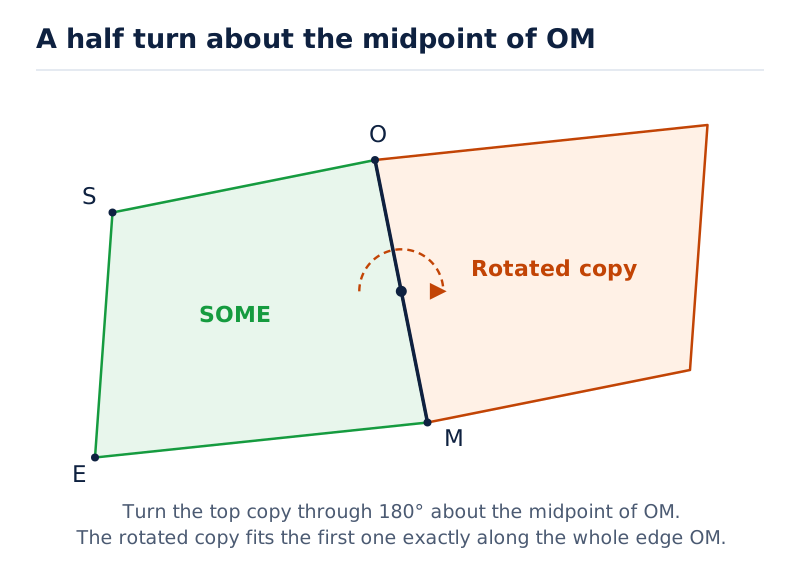
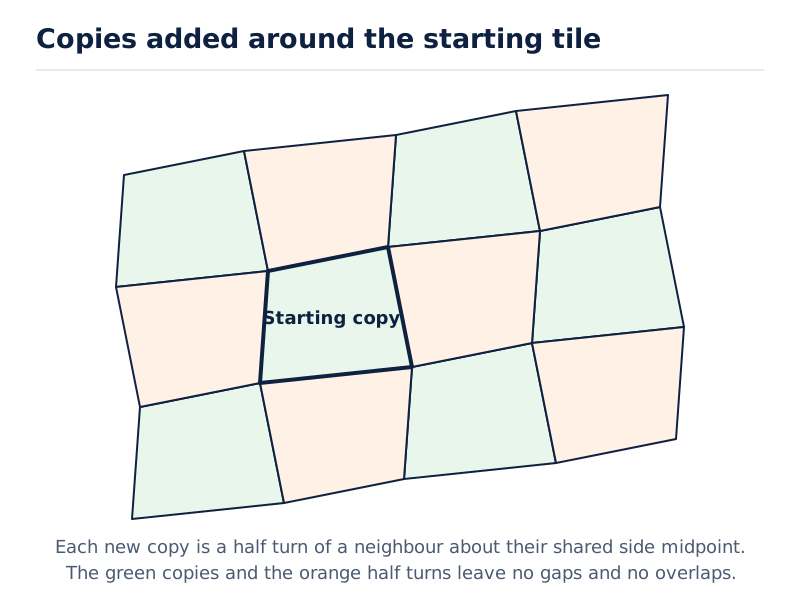
A green copy of SOME is joined along OM to an orange rotated copy. The following drawings add copies around the starting tile, producing larger green and orange patches.
Drawn by One Young India. See Figs. 12.29 and 12.30 in your NCERT textbook
How do Varignon parallelograms give a second method?
Draw the Varignon parallelogram inside each tile. It appears that the Varignon parallelograms form a grid. This suggests starting with a grid of the midpoint parallelogram and reconstructing copies of the original quadrilateral around selected grid cells.
Place the selected copies carefully so that they meet at vertices. Further copies fit in the gaps, and the construction continues. The procedure needs justification to assure us that it will always work; a finite arrangement of cutouts is experimental evidence rather than a complete proof.
What the figure shows
Varignon grid inside a tiling
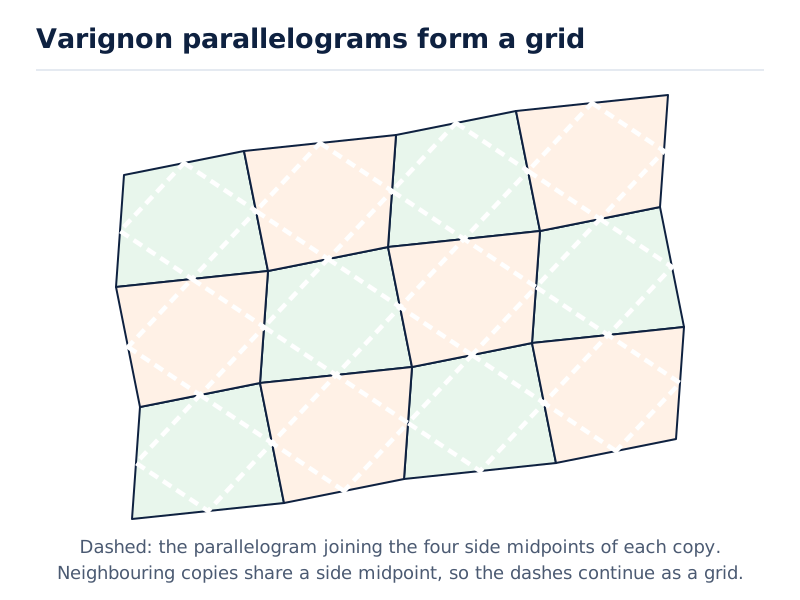
Green and orange quadrilaterals cover a patch of the plane. White dashed segments join their side midpoints and continue across the patch as a grid of parallelograms.
Drawn by One Young India. See Fig. 12.31 in your NCERT textbook
What should a complete tiling argument establish?
A local angle total of 360° explains how copies can fit around a vertex, but the whole construction must also cover the plane. It must be possible to continue consistently, with no overlaps and no gaps left between tiles.
Tiling brings together precise quadrilateral definitions, midpoint constructions, parallelograms and reasoning that distinguishes an observed pattern from a proved statement. The same tiling question also applies to non-convex quadrilaterals.
Glossary
- Quadrilateral — A planar figure with four straight sides, with no crossings or overlapping sides under the usual definition.
- Vertex — A corner point at which two adjacent sides of a polygon meet.
- Diagonal — A segment joining two vertices of a polygon that are not adjacent.
- Convex quadrilateral — A quadrilateral in which every internal angle is less than 180°.
- Parallelogram — A quadrilateral in which both pairs of opposite sides are parallel.
- Converse — A statement obtained by exchanging the assumption and conclusion of an if-then statement.
- Congruent triangles — Triangles whose corresponding sides and corresponding angles are equal to one another.
- Transversal — A line that intersects two other lines at distinct points.
- Midpoint — The point on a segment that divides it into two equal lengths.
- Median — A segment joining a triangle’s vertex to the midpoint of its opposite side.
- Concurrent — Describes lines or segments that pass through one common point.
- Centroid — The common point of a triangle’s medians, dividing each in a 2:1 ratio from the vertex.
- Varignon parallelogram — The parallelogram formed by joining the successive side midpoints of a quadrilateral.
- Trapezium — A quadrilateral that has a pair of opposite sides parallel to one another.
- Tiling — Covering the plane with copies of shapes without leaving gaps or producing overlaps.
Common errors and misconceptions
- Misconception: A quadrilateral must have no dent. Correct: A non-convex quadrilateral is allowed; it has an internal angle exceeding 180°. Convexity is an additional condition.
- Misconception: Any order of four vertex letters names the same quadrilateral. Correct: The order must follow consecutive sides around the boundary, in either direction.
- Misconception: A true theorem automatically has a true converse. Correct: The converse needs its own proof, even when that proof uses the original theorem.
- Misconception: One pair of equal opposite sides proves a parallelogram. Correct: Use both equal opposite pairs, or prove that the same single pair is also parallel.
- Misconception: Equal diagonals alone prove that a quadrilateral is a rectangle. Correct: Equal diagonals give this conclusion when the quadrilateral is also known to be a parallelogram.
- Misconception: One midpoint alone guarantees that a segment to the other side bisects it. Correct: The converse also requires parallelism to the third side.
- Misconception: The centroid is halfway along each median. Correct: It divides each median in a 2:1 ratio, with the longer part adjoining the vertex.
- Misconception: Fitting four tiles around one point proves an entire tiling. Correct: Consistent continuation and coverage without gaps or overlaps must also be justified.
Exam-style questions with model answers
Q1. In quadrilateral ABCD, name the sides adjacent to AB and the angle opposite ∠A. [2 marks]
- The sides adjacent to AB are AD and BC, because each shares exactly one endpoint with AB.
- The angle opposite ∠A is ∠C, because A and C are not adjacent vertices.
Q2. Quadrilateral ABCD has AB = CD and AD = BC. Prove that it is a parallelogram. [3 marks]
- Draw AC. Triangles ACD and CAB have AC = CA as a common side, CD = AB and AD = CB. Thus they are congruent by the SSS test.
- Corresponding angles give ∠DCA = ∠BAC and ∠DAC = ∠BCA. These are equal alternate interior angles for the respective pairs of opposite sides.
- Consequently DC ∥ AB and AD ∥ BC. Both pairs of opposite sides are parallel, so ABCD is a parallelogram.
Q3. In ∆ABC, P and Q are the midpoints of AB and AC respectively. Prove that PQ ∥ BC and PQ = BC/2. [5 marks]
- Draw through C a line parallel to BA, meeting the extended line PQ at R. The midpoint assumptions give AP = PB and AQ = QC.
- In triangles APQ and CRQ, AQ = CQ. Also ∠AQP = ∠CQR by vertically opposite angles, and ∠APQ = ∠CRQ because AP ∥ RC.
- Therefore ∆APQ ≅ ∆CRQ by AAS. Corresponding sides give PQ = QR and CR = AP.
- Since AP = BP, CR = BP. Also CR ∥ BP, so BCRP is a parallelogram by the equal parallel sides test.
- Opposite sides give PR ∥ BC and PR = BC. As PQ = QR, PQ = PR/2 = BC/2, and PQ ∥ BC.
Q4. In ∆ABC, P is the midpoint of AB. The line through P parallel to BC meets AC at Q. Prove that Q is the midpoint of AC using uniqueness of a parallel line. [3 marks]
- Let M be the midpoint of AC. Since P and M are the midpoints of AB and AC, the Midpoint Theorem gives PM ∥ BC.
- The given line PQ is also parallel to BC and passes through P. There is a unique parallel to BC through P, so PM and PQ are the same line.
- The same line meets AC at the same point, giving M = Q. Therefore AQ = QC, as required.
Q5. In ∆ABC, CP is a median, P is the midpoint of AB, and M is the centroid. Find CM:MP and express MP as a fraction of CP. [2 marks]
- The Centroid Theorem gives CM:MP = 2:1, with CM longer because it connects the centroid to vertex C.
- The complete median contains three equal parts, of which MP is one. Therefore MP = CP/3.
Q6. In ∆ABC, let P, Q and R be the midpoints of AB, AC and BC. Prove that medians CP, BQ and AR meet at one point and are each divided there in the ratio 2:1 from the vertex. [6 marks]
- Let CP and BQ intersect at M. Introduce X as the midpoint of BM and Y as the midpoint of CM.
- The Midpoint Theorem in triangles ABC and MBC gives PQ ∥ BC, XY ∥ BC and PQ = XY = BC/2.
- Therefore PQ ∥ XY. The alternate interior angles in triangles MPQ and MYX are equal, and PQ = YX, so these triangles are congruent by ASA.
- Congruence gives MP = MY and MQ = MX. Using MY = YC and MX = XB gives CM:MP = BM:MQ = 2:1.
- Let AR meet BQ at N. Repeating the argument with these two medians gives BN:NQ = AN:NR = 2:1.
- Both M and N divide BQ in the same ratio, so M = N. All three medians are concurrent, with the longer part of each adjoining its vertex.
Q7. P, Q, R and S are the midpoints of AB, BC, CD and DA in quadrilateral ABCD. Prove that PQRS is a parallelogram and that PR and QS bisect each other. [4 marks]
- Draw AC and BD. The Midpoint Theorem in triangles ABC and ADC gives PQ ∥ AC and SR ∥ AC, hence PQ ∥ SR.
- Applying the theorem in triangles BCD and BAD gives QR ∥ BD and PS ∥ BD, hence QR ∥ PS.
- Both pairs of opposite sides of PQRS are parallel, so PQRS is a parallelogram.
- PR and QS are its diagonals. The diagonals of a parallelogram bisect each other, which proves the required conclusion.
Key takeaways
- A quadrilateral’s precise definition includes planar vertices, the boundary order, and conditions excluding crossings or overlapping sides.
- A convex quadrilateral has all internal angles below 180°, and its diagonal segments intersect.
- Parallelograms have equal opposite sides, equal opposite angles and diagonals that bisect each other.
- Each converse of those three parallelogram properties is true and supplies a useful recognition test.
- The Midpoint Theorem gives both parallelism to the third side and a length equal to half that side.
- A line through one side midpoint parallel to a second side bisects the third side; its proof needs more than merely reversing a statement.
- The centroid is the common point of three medians, dividing each in the ratio 2:1 from its vertex.
- Joining a quadrilateral’s successive side midpoints gives a Varignon parallelogram, linking triangle midpoint reasoning to quadrilateral geometry.
- Any quadrilateral can tile the plane; proposed procedures require consistent continuation without gaps or overlaps.
Test yourself
What makes a quadrilateral non-convex?
It has a dent with an internal angle greater than 180°. It still qualifies as a quadrilateral under the usual non-self-intersecting definition.
What is required in the equal parallel sides test?
The same pair of opposite sides must be both equal in length and parallel. These conditions prove that the quadrilateral is a parallelogram.
Why is the SSS test used in the opposite-sides converse?
The two given equal opposite-side pairs and a shared diagonal provide all three corresponding side equalities for the two triangles.
In ∆ABC, P and Q are midpoints of AB and AC. What does the Midpoint Theorem conclude?
It concludes that PQ is parallel to BC and PQ = BC/2. Both midpoint assumptions are supplied.
In the same triangle, if P is the midpoint of AB and PQ ∥ BC with Q on AC, what follows?
The converse gives AQ = QC, so Q is the midpoint of AC. It also follows that PQ = BC/2.
Which part of a median is longer at the centroid?
The part joining the vertex to the centroid is twice the part joining the centroid to the opposite side midpoint.
In the Varignon parallelogram PQRS of ABCD, which original segment controls the length of PQ?
The original diagonal AC controls it: PQ is parallel to AC and has length AC/2 by the Midpoint Theorem.
Why is fitting tiles around one vertex insufficient as a complete tiling proof?
A complete argument must justify that the construction continues consistently over the plane and covers it without gaps or overlaps.
Write about it
Turn a question from this chapter into a paper.
The Writing Studio has a structure guide, a rubric and citation tools for 15 formats, from essays to research papers. Drafting is free with an account. Learnacy Essential adds feedback from an AI writing coach and submission to The OYI Review.
Learnacy Essential is ₹1,499 for the year. Publication depends on review and is not guaranteed.