
Two Variables, One Line | CBSE Class 9 Maths Notes
On this page
This note covers equations involving two changing quantities, their solutions and straight-line graphs, slope, equations for two related conditions, substitution, elimination, graphical solutions and the classification of pairs of lines.
What is a linear equation in two variables?
A variable is a symbol representing a quantity whose value can vary. An equation states that two expressions are equal. Two unknown quantities can be connected by one equation, even when their individual values are not yet known.
How can a purchase become an equation?
Radha buys mangoes costing ₹60 per kilogram and bananas costing ₹50 per kilogram, paying ₹280 altogether. Here ₹ denotes rupees. Let x be the number of kilograms of mangoes and y the number of kilograms of bananas.
The mangoes cost ₹60x and the bananas cost ₹50y. Adding these costs gives 60x + 50y = 280. The left-hand side, abbreviated LHS, and the right-hand side, abbreviated RHS, both represent the total cost in rupees.
Definition: A linear equation in two variables can be written as ax + by + c = 0. Here x and y are variables; a, b and c are real numbers, and a and b are not both zero.
Real numbers include rational and irrational numbers. Rational numbers can be expressed as fractions of integers with non-zero denominators; irrational numbers cannot. An integer is a whole number, its negative, or zero.
In the standard form ax + by + c = 0, a and b are coefficients, meaning the numbers multiplying x and y. The constant c is the fixed term without a variable. The restriction on a and b prevents both variable terms from disappearing.
One coefficient may be zero. For instance, 7 + 4x = 0 can be written as 4x + 0×y + 7 = 0. It therefore fits the definition, with a = 4, b = 0 and c = 7.
How do you write an equation in standard form?
To identify the coefficients and constant, first arrange the equation so that one side is zero. Keep each sign attached to its term. A negative coefficient includes the minus sign; the constant is also read with its sign.
Worked example 1. Write 5x + 2y = 2.7 in standard form and identify its coefficients and constant.
Answer: Subtracting 2.7 from both sides gives 5x + 2y − 2.7 = 0. Thus a = 5, b = 2 and c = −2.7. Equivalently, −5x − 2y + 2.7 = 0 has a = −5, b = −2 and c = 2.7.
The two forms above describe the same equation. The particular coefficient values depend on which equivalent form is written. Read them from that form consistently instead of mixing signs from different arrangements.
How are fractions and missing variables handled?
For x/2 − 4 = 3y/2, standard form is x/2 − 3y/2 − 4 = 0. Here a = 1/2, b = −3/2 and c = −4. The slash denotes division, so x/2 means x divided by 2.
For convenience, we often multiply an equation containing fractions by a suitable number to obtain integer coefficients. Multiplying x/4 + 3y/5 − 1/2 = 0 by 20 gives 5x + 12y − 10 = 0.
Every term must be multiplied, including the constant. This operation changes the written coefficients while preserving the equation's solutions. A solution is a choice of values that makes its two sides equal.
Worked example 2. Express 3y = 5 in standard form.
Answer: Write 0×x + 3y − 5 = 0. Therefore a = 0, b = 3 and c = −5. The absent x-term has coefficient zero; the equation remains linear in two variables because b is non-zero.
Result: Non-zero multiplication preserves solutions
The equations ax + by = c and kax + kby = kc have the same solutions when k is a non-zero number. Multiplying by k takes the first equation to the second; dividing by k reverses the operation.
What does a solution mean algebraically and geometrically?
A solution of a linear equation in two variables is a pair of values that satisfies it. Write the values as an ordered pair (x, y): the first entry gives x and the second gives y. Their positions matter.
Worked example 3. Test whether (2, 3), (4, 0) and (1, 3) solve 3x + 2y = 12.
Answer: For (2, 3), substitution gives 3 × 2 + 2 × 3 = 12. For (4, 0), it gives 3 × 4 + 2 × 0 = 12. Both solve the equation. For (1, 3), the result is 9 ≠ 12, so it does not.
Substitution means replacing a symbol by its specified value or an equal expression. The sign ≠ means “is not equal to”. Testing an ordered pair requires substituting both entries, not checking either variable in isolation.
A graph represents the equation's solutions as points. The coordinate plane has a horizontal x-axis and a vertical y-axis. The axes meet at the origin, (0, 0). A point's coordinates are its ordered x-value and y-value.
Result: Solutions form a straight line
Every solution of a linear equation in two variables is a point on its graph, and every point on that graph is a solution. The graph is a straight line. Thus algebraic substitution and plotting describe the same relationship in different ways.
A linear equation in two variables has infinitely many solutions when the variables range over real numbers. For 3x + 2y = 12, choose an x-value and solve for y. Repeating this gives further ordered pairs on the line.
Worked example 4. The pair (−3, 4) satisfies 3ax + 4y = −2 and 2x + by = 14. Find the unknown numbers a and b.
Answer: Substituting in the first equation gives −9a + 16 = −2, so −9a = −18 and a = 2. The second gives −6 + 4b = 14, so 4b = 20 and b = 5.
How do you draw the graph of a linear equation?
Find two distinct solutions, plot their points, and draw the straight line through them. “Distinct” means different: writing the same solution twice does not provide two points. Further solutions can be read from the line and checked by substitution.
How can the axes help?
Setting x = 0 can locate where a line meets the y-axis. Setting y = 0 can locate where it meets the x-axis. An intercept records where a line meets an axis. These substitutions are an easy way to obtain points in many examples.
Worked example 5. Find two solutions of 2x + y = 7, draw its graph and identify four more solutions.
Answer: Setting x = 0 gives y = 7; setting y = 0 gives x = 7/2. Plot (0, 7) and (7/2, 0), then join them. Other solutions are (1, 5), (2, 3), (3, 1) and (3/2, 4).
| Variable | First solution | Second solution |
|---|---|---|
| x | 0 | 7/2 |
| y | 7 | 0 |
What the figure shows
Graph of 2x + y = 7
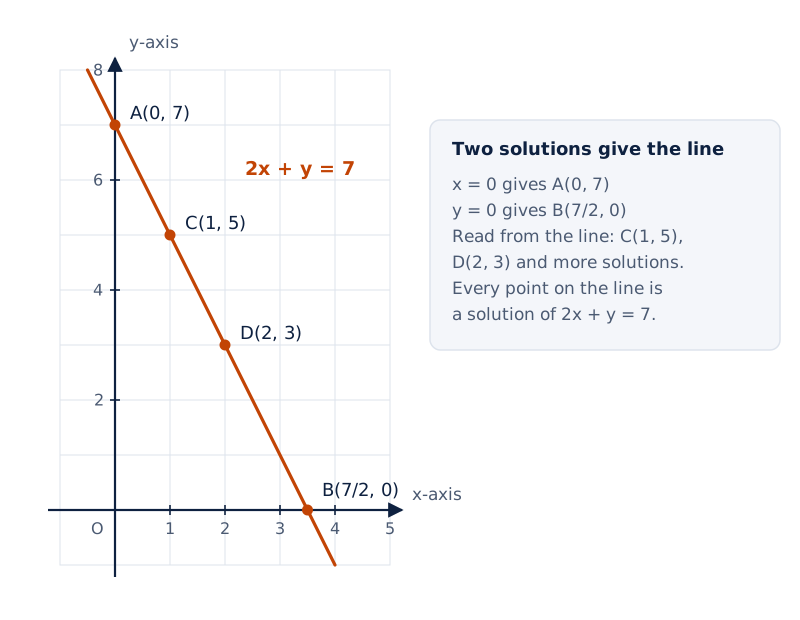
A descending line passes through A(0, 7), C(1, 5), D(2, 3) and B(7/2, 0). The horizontal x-axis and vertical y-axis are labelled.
Drawn by One Young India. See Fig. 13.2 in your NCERT textbook
Result: A zero constant gives a line through the origin
When c = 0 in ax + by + c = 0, substituting x = 0 and y = 0 satisfies the equation. Hence the line passes through the origin, with the usual condition that a and b are not both zero.
For 2x + 5y = 0, either axis substitution gives (0, 0). A second point requires another choice: x = 1 gives y = −2/5, while x = 5 gives y = −2. These are distinct points on the same line.
The special equations x = 0 and y = 0 also pass through the origin. The first represents the y-axis; the second represents the x-axis. Their graphs illustrate why one coefficient may vanish without invalidating the equation.
How does slope measure a line's steepness?
The slope, also called the gradient, measures a line's steepness. A positive slope rises from left to right; a negative slope falls from left to right. To calculate it, compare vertical change with horizontal change between two points.
Let A(x₁, y₁) and B(x₂, y₂) be two points. A and B label the points; the small subscripts 1 and 2 identify their respective coordinates. The horizontal change x₂ − x₁ is the run, and the vertical change y₂ − y₁ is the rise.
Moving right gives a positive run, while moving left gives a negative run. Moving up gives a positive rise, while moving down gives a negative rise. The horizontal and vertical changes are often referred to as run and rise respectively.
Definition: Slope = rise/run = (y₂ − y₁)/(x₂ − x₁), provided x₂ − x₁ is non-zero. Use the same point order in the numerator, above the division bar, and the denominator, below it.
What the figure shows
Rise and run
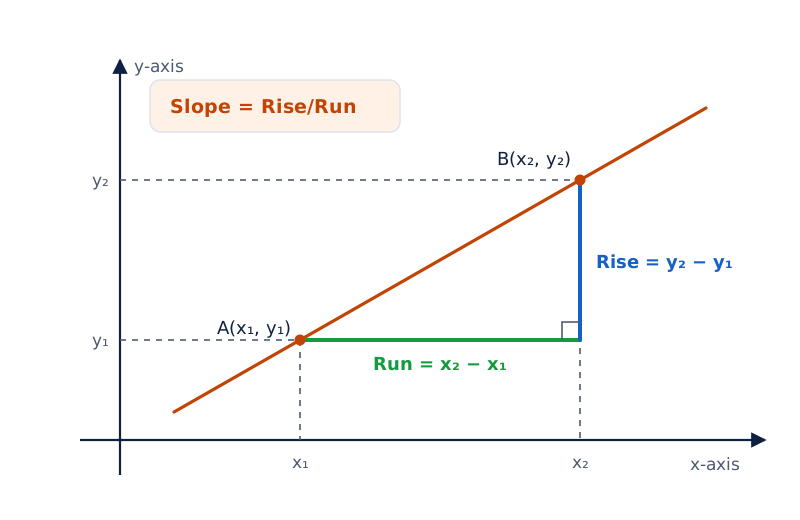
A rising line joins A(x₁, y₁) and B(x₂, y₂). A horizontal segment is labelled Run = x₂ − x₁, and a vertical segment is labelled Rise = y₂ − y₁.
Drawn by One Young India. See Fig. 13.6 in your NCERT textbook
Worked example 6. Find the slope through A(−4, 5) and B(−1, 2).
Answer: Taking changes from A to B gives (2 − 5)/(−1 − (−4)) = −3/3 = −1. Reversing both differences gives (5 − 2)/(−4 − (−1)) = 3/(−3) = −1. The slope is unchanged.
For the points (2, 0) and (4, 3), the run is 2 units and the rise is 3 units, giving slope 3/2. The slope remains the same wherever it is measured on a straight line with defined slope.
What does the slope-intercept form tell you?
The slope-intercept form is y = mx + d. Here m is the slope, and d is the y-intercept: the line meets the y-axis at (0, d). The constant d is read together with its sign.
Why is the slope equal to m?
Take two distinct points (x₁, y₁) and (x₂, y₂) on the line. They satisfy y₁ = mx₁ + d and y₂ = mx₂ + d. Subtracting gives y₂ − y₁ = m(x₂ − x₁).
Dividing by the non-zero change x₂ − x₁ gives (y₂ − y₁)/(x₂ − x₁) = m. The constant d cancels. This explains why the slope is independent of the particular points chosen on this line.
From ax + by + c = 0, rearrange to by = −ax − c. Provided b ≠ 0, divide by b to obtain y = (−a/b)x − c/b. Therefore m = −a/b and d = −c/b.
Worked example 7. Find the slope and y-intercept of 5x + y = 3.
Answer: Rearranging gives y = −5x + 3. Hence m = −5 and d = 3. For each increase of 1 unit in x, y decreases by 5 units. The line meets the y-axis at (0, 3).
| Variable | First point | Second point | Third point |
|---|---|---|---|
| x | 0 | 1 | −1 |
| y | 3 | −2 | 8 |
How do zero and undefined slopes differ?
A horizontal line runs in the direction of the x-axis. For y = 5, y stays constant as x changes, so the slope is zero. A vertical line runs in the direction of the y-axis.
For x = 2, x stays constant as y changes. Its run is zero, so the slope calculation would divide by zero. Its slope is undefined, meaning no value is assigned by this calculation. It cannot be written as y = mx + d.
How do two conditions produce a pair of equations?
A pair of linear equations expresses two conditions involving the same two variables. A solution must satisfy both conditions simultaneously, meaning at the same time. Satisfying just one equation is insufficient.
How should the variables be chosen?
Define what each variable measures before translating the conditions. Keep those meanings fixed throughout the problem. For a cost problem, distinguish a price per item from a number of items; for a number puzzle, keep track of the stated order of subtraction.
In Rakesh's puzzle, two numbers have sum 25 and difference 11. Let x be the first number and y the second. The equations are x + y = 25 and x − y = 11.
| First number | Second number | Sum | Difference |
|---|---|---|---|
| 10 | 15 | 25 | −5 |
| 20 | 5 | 25 | 15 |
| 18 | 7 | 25 | 11 |
The first two rows satisfy the sum condition but fail the difference condition. The pair (18, 7) satisfies both. This shows why two separate checks are needed even when several candidates satisfy one equation.
At a science exhibition, two adult tickets and three child tickets cost ₹600, while three adult tickets and two child tickets cost ₹700. Let ₹x and ₹y be the respective prices of one adult ticket and one child ticket.
The equations are 2x + 3y = 600 and 3x + 2y = 700. Each coefficient counts tickets of the relevant type. Both equations refer to the same individual ticket prices.
Generally, write a pair as a₁x + b₁y + c₁ = 0 and a₂x + b₂y + c₂ = 0. The subscripted letters are real coefficients and constants for the first and second equations. The coefficients a₁ and b₁ must not both be zero; neither may a₂ and b₂ both be zero.
How does substitution solve a pair of equations?
The substitution method reduces two equations to one equation in one variable. Express one variable using the other, then replace that variable in the second equation. Once one value is known, substitute back to obtain the other.
- Select an equation and express one variable in terms of the other.
- Substitute that expression into the other equation, retaining brackets where necessary.
- Solve the resulting equation in a single variable.
- Substitute the value back, find the other variable, and verify both original equations.
Worked example 8. Solve 7x − 15y = 2 and x + 2y = 3 by substitution.
Answer: The second equation gives x = 3 − 2y. Substituting into the first gives 7(3 − 2y) − 15y = 2. Expanding gives 21 − 14y − 15y = 2, so −29y = −19 and y = 19/29.
Now x = 3 − 2(19/29) = 49/29. Thus the solution is (49/29, 19/29). Check by replacing x and y in both original equations.
The replacement x = 3 − 2y expresses the same condition as x + 2y = 3. Every common solution must obey it. Substituting into the other equation combines the two conditions without requiring guesses for either variable.
How can an angle problem use substitution?
The angle sum property of a triangle states that its three interior angles add to 180°. The symbol ° denotes degrees, the angle unit. Use this relationship alongside the given relation between the unknown angles.
Worked example 9. Two angles of a triangle have degree measures x and y, where y = 4x. The third angle is 50°. Find all three angles.
Answer: The angle sum gives x + y + 50 = 180. Replace y by 4x: x + 4x + 50 = 180. Thus 5x = 130 and x = 26. Then y = 104. The angles are 26°, 104° and 50°.
Report all three angles when the question asks for the triangle's angles. The known third angle remains part of the answer even though it did not require solving.
How does elimination remove a variable?
The elimination method combines equations to cancel a variable. It is sometimes more convenient than substitution. Multiplying equations by suitable numbers can make the coefficients of a chosen variable equal, after which subtraction removes that variable.
How are ratios translated into equations?
A ratio compares quantities by their relative parts. The notation 9:7 means nine parts to seven equal-sized parts. If x is the value of one income part, the two incomes are 9x and 7x.
Worked example 10. Two people have monthly incomes in the ratio 9:7 and expenditures in the ratio 4:3. Each saves ₹2000 per month. Find their monthly incomes.
Answer: Let ₹x be one income part and ₹y one expenditure part. Their incomes are ₹9x and ₹7x; their expenditures are ₹4y and ₹3y. Savings equal income minus expenditure, giving 9x − 4y = 2000 and 7x − 3y = 2000.
- Multiply the first equation by 3 to obtain 27x − 12y = 6000.
- Multiply the second equation by 4 to obtain 28x − 12y = 8000.
- Subtract the first transformed equation from the second. The y-terms cancel, leaving x = 2000.
- Substitute into 9x − 4y = 2000. This gives y = 4000.
The monthly incomes are ₹18,000 and ₹14,000. Their expenditures are ₹16,000 and ₹12,000, leaving savings of ₹2000 each. The income ratio is 9:7 and the expenditure ratio is 4:3.
Here x and y are values of parts, rather than the final incomes. The answer requires multiplying x by the income-ratio numbers. Interpreting the variables after solving is as necessary as forming the equations correctly.
Elimination works by performing equal operations on equal quantities. Multiplication applies to every term on both sides. Subtraction also applies to each term, so signs must be retained until the cancellation is completed.
How can a pair have one, no or infinitely many solutions?
A unique solution means exactly one common ordered pair. A pair may instead have no common solution or infinitely many. Elimination reveals the distinction by showing whether a variable remains or whether both disappear.
What happens when both variables cancel?
Consider x − y = 10 and 10x − 10y = 100. Multiplying the first equation by 10 produces the second. Both equations impose the same condition, so every solution of either also solves the pair.
Now replace the second equation by 10x − 10y = 101. The first still requires 10x − 10y = 100. The same expression cannot equal both 100 and 101, so this pair has no solution.
For the standard-form pair a₁x + b₁y + c₁ = 0 and a₂x + b₂y + c₂ = 0, compare corresponding coefficients and constants. The following ratio statements use the condition a₂, b₂ and c₂ are each non-zero.
| Ratio condition | Number of solutions | Graphical meaning |
|---|---|---|
| a₁/a₂ ≠ b₁/b₂ | Exactly one | Lines intersect at one point |
| a₁/a₂ = b₁/b₂ = c₁/c₂ | Infinitely many | Lines coincide |
| a₁/a₂ = b₁/b₂ ≠ c₁/c₂ | None | Distinct parallel lines |
Intersecting lines meet. Coincident lines occupy the same line. Distinct parallel lines never meet. A common solution must be a point belonging to both graphs, which connects each ratio condition to its geometric interpretation.
If every coefficient and constant in one equation is the same non-zero multiple of its counterpart in the other, the equations have identical solutions. The multiplier need not be an integer. If the variable terms scale alike but the constants do not, there is no common solution.
Note: A ratio with zero denominator is undefined. When a denominator in the displayed test is zero, examine the equations through elimination or their graphs instead of dividing by zero.
How do graphs solve and classify a pair of equations?
The graphical method draws both equations on the same coordinate plane and looks for points shared by the lines. Prepare a table of solutions for each equation, plot at least two distinct points per line, and draw the lines through them.
Worked example 11. Solve x + 3y = 6 and 2x − 3y = 12 graphically.
Answer: For the first equation, use (0, 2) and (6, 0). For the second, use (0, −4) and (3, −2). Drawing the two lines gives the common point (6, 0), so x = 6 and y = 0 form the unique solution.
| Equation | First plotted point | Second plotted point |
|---|---|---|
| x + 3y = 6 | (0, 2) | (6, 0) |
| 2x − 3y = 12 | (0, −4) | (3, −2) |
What the figure shows
Intersecting lines
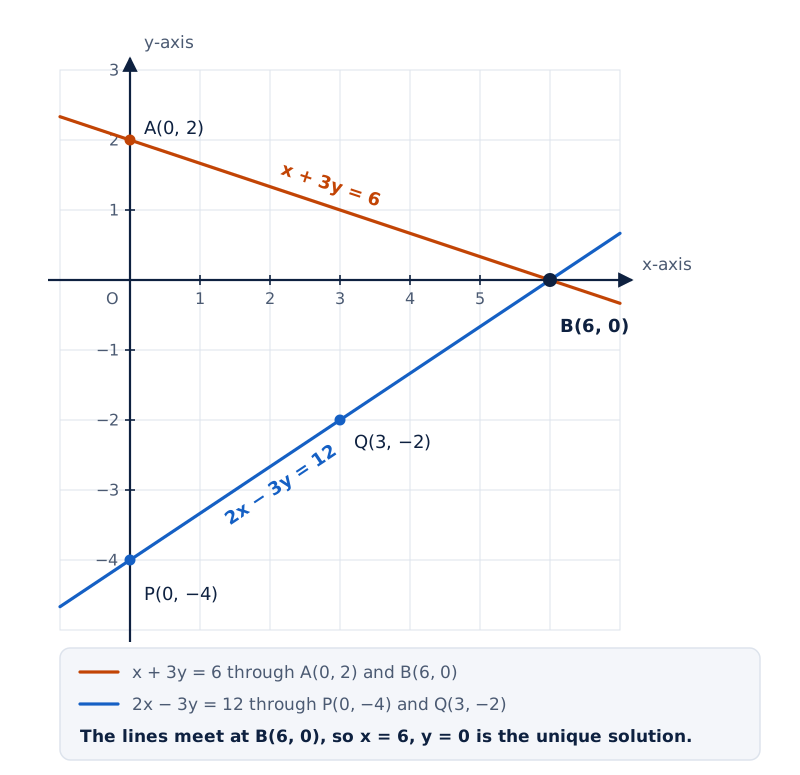
The line through A(0, 2) and B(6, 0) descends. The line through P(0, −4) and Q(3, −2) rises. They meet at B(6, 0).
Drawn by One Young India. See Fig. 13.14 in your NCERT textbook
How are parallel and coincident lines recognised?
Worked example 12. Classify x + 2y − 4 = 0 and 2x + 4y − 12 = 0.
Answer: Their coefficient ratios are 1/2 and 2/4 = 1/2, but their constant ratio is (−4)/(−12) = 1/3. The lines are parallel and the pair has no solution. Plotting (0, 2), (4, 0) and (0, 3), (6, 0) confirms this.
What the figure shows
Parallel lines
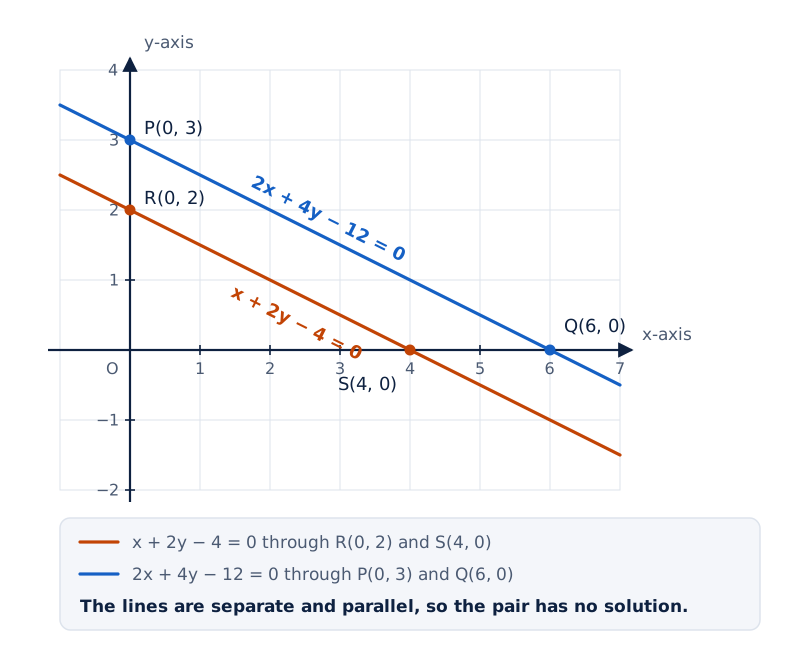
One descending line passes through R(0, 2) and S(4, 0). The other passes through P(0, 3) and Q(6, 0). They are separate and parallel.
Drawn by One Young India. See Fig. 13.15 in your NCERT textbook
For a coincident pair, Romila buys two erasers and three A4 sheets for ₹9; Sonali buys four erasers and six A4 sheets of the same kind for ₹18. A4 identifies the paper size. Let ₹x and ₹y be the individual eraser and sheet prices.
The equations are 2x + 3y = 9 and 4x + 6y = 18. The second is twice the first. The equations therefore represent one line, and the pair has infinitely many solutions rather than a unique pair of prices.
What the figure shows
Coincident lines
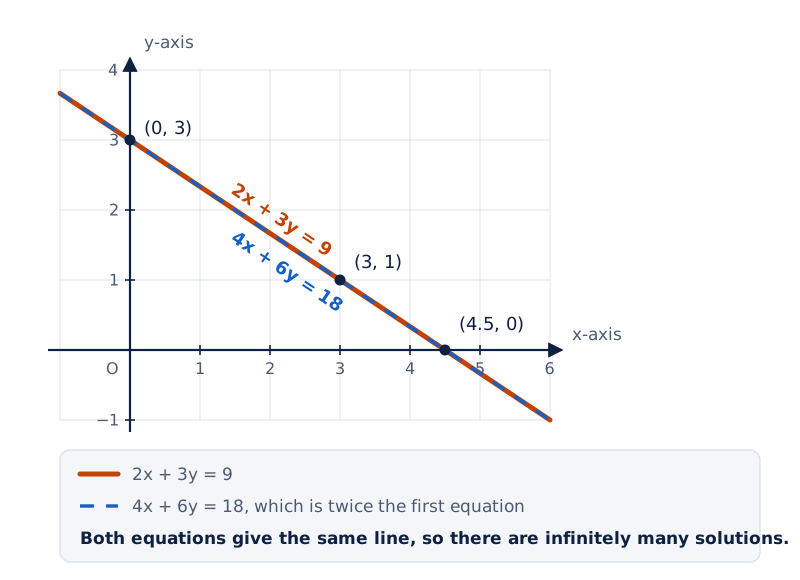
A single descending line carries both equation labels, 2x + 3y = 9 and 4x + 6y = 18. Points labelled on it include (0, 3), (3, 1) and (4.5, 0).
Drawn by One Young India. See Fig. 13.16 in your NCERT textbook
Glossary
- Variable — A symbol representing a quantity whose value may vary in an equation or mathematical relationship.
- Coefficient — The number multiplying a variable, including the sign attached to that number.
- Constant — A fixed term that does not contain a variable in the equation.
- Standard form — The arrangement ax + by + c = 0, with real coefficients and a and b not both zero.
- Ordered pair — Two numbers written in a fixed order, giving the x-value first and the y-value second.
- Solution — An ordered pair that makes the two sides of the given equation equal.
- Origin — The point (0, 0), where the horizontal and vertical coordinate axes meet.
- Slope — The ratio of vertical change to non-zero horizontal change between two points on a line.
- Y-intercept — The value d in y = mx + d, giving the intersection point (0, d) on the y-axis.
- Substitution method — Solving a pair by expressing one variable through the other and replacing it in the remaining equation.
- Elimination method — Solving a pair by combining equations to cancel one variable and obtain an equation in the other.
- Unique solution — Exactly one ordered pair satisfying both equations, represented by their lines' single intersection point.
- Coincident lines — Lines that occupy the same position and share every point on that line.
Common errors and misconceptions
- Misconception: Both variable coefficients must be non-zero. Correct: They must not both be zero; 3y = 5 is a valid example with zero coefficient of x.
- Misconception: Any two numbers from a solution can be written in either order. Correct: The first entry gives x and the second gives y, so substitution must respect their order.
- Misconception: Every linear equation passes through the origin. Correct: Substituting (0, 0) into standard form gives c = 0; lines with a non-zero constant do not pass through it.
- Misconception: A vertical line has zero slope. Correct: Its slope is undefined because its run is zero. A horizontal line has zero slope.
- Misconception: A pair is solved when one equation is satisfied. Correct: The same ordered pair must satisfy both equations, so check each original condition.
- Misconception: Equal variable-coefficient ratios guarantee infinitely many solutions. Correct: Compare the constant ratio too, where defined; a different constant ratio gives no solution.
- Misconception: The ratio test permits division by a zero coefficient. Correct: Ratios with zero denominators are undefined; use elimination or graphs in such cases.
Exam-style questions with model answers
Q1. Write 3y = 5 in the standard form ax + by + c = 0, where a and b are variable coefficients and c is the constant. Explain why it is linear in two variables. [2 marks]
- The standard form is 0×x + 3y − 5 = 0, giving a = 0, b = 3 and c = −5.
- It qualifies because a and b are not both zero. One coefficient may vanish while the other remains non-zero.
Q2. In an ordered pair (x, y), the first entry gives x and the second gives y. Test whether (2, 3) and (1, 3) solve 3x + 2y = 12. [2 marks]
- For (2, 3), substituting gives 3 × 2 + 2 × 3 = 12. This equals the right-hand side, so the pair is a solution.
- For (1, 3), substituting gives 3 × 1 + 2 × 3 = 9, which is not 12. This pair is not a solution.
Q3. Find the slope through A(−4, 5) and B(−1, 2), using slope = vertical change/horizontal change. Explain its sign and verify that reversing the point order leaves it unchanged. [3 marks]
- From A to B, the vertical change is 2 − 5 = −3 and the horizontal change is −1 − (−4) = 3. Thus the slope is −3/3 = −1.
- The negative sign means the line goes downward as we move from left to right.
- Reversing the order gives (5 − 2)/(−4 − (−1)) = 3/(−3) = −1. Both differences change sign, so their ratio remains unchanged.
Q4. Solve 7x − 15y = 2 and x + 2y = 3 by substitution, then check both equations. [4 marks]
- From the second equation, x = 3 − 2y. Substitute this expression into the first equation to combine the two conditions.
- Then 7(3 − 2y) − 15y = 2 gives 21 − 29y = 2. Hence y = 19/29.
- Substitute back: x = 3 − 2(19/29) = 49/29. The solution is the ordered pair (49/29, 19/29).
- Checking gives 7(49/29) − 15(19/29) = 58/29 = 2, and 49/29 + 2(19/29) = 87/29 = 3. Both equations hold.
Q5. Two people's monthly incomes are in the ratio 9:7 and their expenditures are in the ratio 4:3. Each saves ₹2000 monthly. Taking savings as income minus expenditure, find their incomes by elimination and verify the result. [5 marks]
- Let ₹x be the value of one income part and ₹y one expenditure part. The incomes are ₹9x and ₹7x; expenditures are ₹4y and ₹3y.
- Subtracting expenditure from income gives 9x − 4y = 2000 and 7x − 3y = 2000.
- Multiply the first equation by 3 and the second by 4: 27x − 12y = 6000 and 28x − 12y = 8000. Subtract to obtain x = 2000.
- Substitute into the first original equation: 9(2000) − 4y = 2000, giving y = 4000. Therefore the incomes are ₹18,000 and ₹14,000.
- The expenditures are ₹16,000 and ₹12,000. Each person saves ₹2000, while the income and expenditure ratios simplify to 9:7 and 4:3 respectively.
Q6. Solve x + 3y = 6 and 2x − 3y = 12 graphically. Give two plotting points for each line, identify the common solution, verify it and state the number of solutions. [5 marks]
- For x + 3y = 6, setting x = 0 gives y = 2, and setting y = 0 gives x = 6. Plot (0, 2) and (6, 0).
- For 2x − 3y = 12, setting x = 0 gives y = −4. Setting x = 3 gives y = −2. Plot (0, −4) and (3, −2).
- Draw the straight line through each pair of points on the same coordinate plane. The lines meet at the point (6, 0).
- Substitution checks the common point: 6 + 3 × 0 = 6, and 2 × 6 − 3 × 0 = 12.
- The solution is x = 6, y = 0. It is unique because the two lines intersect at one point.
Q7. Classify x + 2y − 4 = 0 and 2x + 4y − 12 = 0 using corresponding coefficient and constant ratios. State the graphical relationship and the number of solutions. [3 marks]
- The ratios of the x-coefficients and y-coefficients are 1/2 and 2/4 = 1/2 respectively, so they are equal.
- The constant ratio is (−4)/(−12) = 1/3, different from 1/2. All denominators are non-zero, so these ratios are defined.
- Equal variable-coefficient ratios but a different constant ratio mean distinct parallel lines. They share no point, so the pair has no solution.
Key takeaways
- Standard form is ax + by + c = 0, where the two variable coefficients must not both be zero.
- An ordered pair solves an equation precisely when substitution makes its left-hand and right-hand sides equal.
- A single linear equation has infinitely many real solutions, represented by the points on its straight-line graph.
- Slope is vertical change divided by non-zero horizontal change; preserve the point order in both differences.
- In y = mx + d, m gives the slope and the line meets the y-axis at (0, d).
- Substitution replaces one variable by an equal expression; elimination combines equations to cancel a variable.
- A pair of equations requires common solutions, so verify the same ordered pair in both original equations.
- Intersecting, distinct parallel and coincident lines correspond respectively to one, no and infinitely many common solutions.
Test yourself
Why is 7 + 4x = 0 a linear equation in two variables?
It can be written as 4x + 0×y + 7 = 0. Its variable coefficients are not both zero.
Does (4, 0) solve 3x + 2y = 12?
Yes. Substituting x = 4 and y = 0 gives 3 × 4 + 2 × 0 = 12.
Why does ax + by = 0, with a and b not both zero, pass through the origin?
Substituting x = 0 and y = 0 makes both sides zero, so the origin is a solution.
What are the slope and y-intercept of y = −5x + 3?
The slope is −5 and the y-intercept is 3. The line crosses the y-axis at (0, 3).
How do the slopes of y = 5 and x = 2 differ?
The horizontal line y = 5 has zero slope. The vertical line x = 2 has undefined slope because its run is zero.
Why do x − y = 10 and 10x − 10y = 100 have infinitely many solutions?
The second equation is ten times the first, so both impose the same condition and share all their solutions.
Why do x − y = 10 and 10x − 10y = 101 have no common solution?
The first equation requires 10x − 10y = 100. That expression cannot simultaneously equal 101, so no ordered pair satisfies both.
Write about it
Turn a question from this chapter into a paper.
The Writing Studio has a structure guide, a rubric and citation tools for 15 formats, from essays to research papers. Drafting is free with an account. Learnacy Essential adds feedback from an AI writing coach and submission to The OYI Review.
Learnacy Essential is ₹1,499 for the year. Publication depends on review and is not guaranteed.