
Predicting What Comes Next: Exploring Sequences and Progressions | CBSE Class 9 Maths Notes
On this page

This note covers number sequences, term notation, explicit and recursive rules, triangular and square numbers, arithmetic progressions, sums of natural numbers, geometric progressions, graphs of progressions, bouncing heights, and patterns in the Sierpiński triangle and square carpet.
What is a sequence, and how do we describe its terms?
Definition: A sequence is an ordered list of numbers. Each number in the list is called a term. The position of a term tells us where it occurs in that ordered list.
How does position differ from value?
The natural numbers are the counting numbers 1, 2, 3, 4, 5, 6, … . The symbol … indicates that the sequence continues indefinitely. A square number is a natural number multiplied by itself. The square-number sequence is 1, 4, 9, 16, 25, 36, … . Its fifth term is 25, although its fifth position is numbered 5.
Write tₙ for the term at position n. The small lowered number or letter is a subscript, which identifies position. Thus t₁ means the first term and t₄ means the fourth term. The odd numbers are natural numbers not divisible by 2: 1, 3, 5, 7, … . For this sequence, t₄ = 7.
For lists starting with the first term, n takes the values 1, 2, 3, … . Later, a pattern whose starting stage is labelled 0 uses stage numbers beginning at 0. State which numbering convention is being used before applying a formula.
Must sequences grow or continue forever?
A finite sequence has a limited number of terms: 6, 12, 24, 48, 96 has five. An infinite sequence continues indefinitely, as the sequence of natural numbers does. A sequence need not increase: 1, 1/2, 1/3, 1/4, … decreases.
A unit fraction has numerator 1; the numerator is the number above the fraction bar. Terms can also be negative, as in −7, −3, 1, 5, 9, … . Different letters can distinguish different sequences: sₙ and uₙ, like tₙ, denote terms at position n. The letter changes the name of the sequence, not the meaning of the subscript.
How do triangular and square numbers reveal patterns?
How are triangular numbers built?
Consecutive terms are terms next to one another in a sequence. The triangular numbers begin 1, 3, 6, 10, 15, 21, … . The differences between the first six consecutive terms are 2, 3, 4, 5 and 6. The amount added therefore changes.
A triangular number counts dots arranged in a triangle. Each term is also a sum of natural numbers: 1 = 1, 3 = 1 + 2, 6 = 1 + 2 + 3, and 10 = 1 + 2 + 3 + 4.
The fifth triangular number is 15 because 1 + 2 + 3 + 4 + 5 = 15. The position tells us how many natural numbers to add. It does not tell us to add every number up to the value 15.
What the figure shows
Triangular dot arrangements
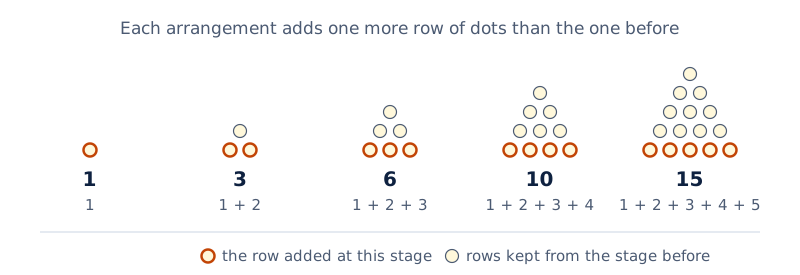
Five triangular groups of yellow dots are labelled 1, 3, 6, 10 and 15. Each successive group contains an additional row, illustrating the sums of consecutive natural numbers.
Drawn by One Young India. See Fig. 8.1 in your NCERT textbook
How are square numbers related to odd numbers?
A square number is obtained by multiplying a natural number by itself. The squares 1, 4, 9, 16, 25, 36, … have consecutive differences 3, 5, 7, 9 and 11 among these first six terms.
Their sums reveal another pattern: 4 = 1 + 3, 9 = 1 + 3 + 5, and 16 = 1 + 3 + 5 + 7. Thus a square number at a given position is the sum of that many initial odd numbers.
What the figure shows
Odd-number layers making squares
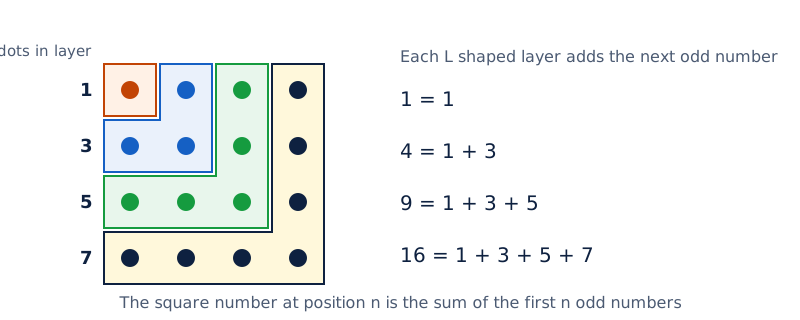
Coloured dots and nested L-shaped boundaries form successive square arrangements. Adding an outer layer connects the next odd number with the increase from one square number to the next.
Drawn by One Young India. See Fig. 8.2 in your NCERT textbook
These patterns distinguish a changing difference from a fixed one. Natural numbers increase by 1 and odd numbers by 2, but triangular and square numbers do not have a constant difference between consecutive terms.
How does an explicit rule find a term directly?
Definition: An explicit rule calculates a term from its position number. It allows a specified term to be found without first calculating the earlier terms.
How do we substitute a position?
For the odd-number sequence, let uₙ denote the term at position n. Its explicit rule is uₙ = 2n − 1. Here 2n means 2 multiplied by n. The expression instructs us to double the position number and subtract 1.
Worked example 1. Use uₙ = 2n − 1 to generate the first three odd numbers.
Answer: At n = 1, u₁ = 2 × 1 − 1 = 1. At n = 2, u₂ = 2 × 2 − 1 = 3. At n = 3, u₃ = 2 × 3 − 1 = 5.
The same rule applies to a distant position. Finding a term and locating a given value are different operations: for the first, substitute the position; for the second, equate the formula to the value and solve for the position.
Worked example 2. Which term of the odd-number sequence is 137?
Answer: Set uₙ = 137. Then 2n − 1 = 137, so 2n = 138 and n = 69. Therefore 137 occupies the 69th position in the sequence.
How does a formula test membership?
For sₙ = 5n − 2, sₙ denotes the term at positive integer position n. To test whether a value belongs to this sequence, solve the equation and check the resulting position. The whole numbers are 0, 1, 2, 3, … . An integer is a whole number or the negative of a whole number.
Worked example 3. Is 308 a term of the sequence sₙ = 5n − 2, with positions starting at 1?
Answer: Solve 5n − 2 = 308. This gives 5n = 310 and n = 62. Since 62 is a natural number, 308 is the 62nd term.
The position must fit the permitted numbering. A non-integer answer cannot identify a term in a list indexed by natural numbers. Solving the equation is therefore followed by an interpretation, not merely by recording the calculated value of n.
How does a recursive rule use earlier terms?
Definition: A recursive rule gives a term using one or more earlier terms. Starting values are required so that the rule can generate the sequence.
What information starts a recurrence?
For 1, 4, 7, 10, 13, …, the explicit rule is tₙ = 3n − 2. The recursive description is t₁ = 1, tₙ = tₙ₋₁ + 3 for n ≥ 2. Here tₙ₋₁ means the previous term, and ≥ means greater than or equal to.
The starting value supplies the first term. The rule then supplies each following term by adding 3 to the preceding value. A recursive formula must use the earlier term's value, not simply the earlier term's position number.
Worked example 4. Find the first four terms when u₁ = 1 and uₙ = 2uₙ₋₁ + 3 for n ≥ 2.
Answer: The first term is 1. Next, u₂ = 2 × 1 + 3 = 5, u₃ = 2 × 5 + 3 = 13, and u₄ = 2 × 13 + 3 = 29. The terms are 1, 5, 13, 29.
Worked example 5. Find the first four terms when s₁ = 3 and sₙ = sₙ₋₁(sₙ₋₁ − 1) for n ≥ 2.
Answer: Start with s₁ = 3. Then s₂ = 3 × 2 = 6, s₃ = 6 × 5 = 30, and s₄ = 30 × 29 = 870. The sequence begins 3, 6, 30, 870.
Can a rule use two previous terms?
The Virahānka-Fibonacci sequence begins 1, 2, 3, 5, 8, 13, 21, 34, … . Let Vₙ denote its term at position n. It is defined by V₁ = 1, V₂ = 2 and Vₙ = Vₙ₋₁ + Vₙ₋₂ for n ≥ 3.
Here Vₙ₋₂ means the term two positions earlier. Two starting values are needed because the rule adds the previous two terms. For example, V₃ = 2 + 1 = 3, V₄ = 3 + 2 = 5 and V₅ = 5 + 3 = 8.
This sequence arose in Virahānka's study of Prakrit metre and poetry. Its rule illustrates why recursion is broader than repeatedly adding one fixed number: what is added may itself be an earlier, changing term.
What makes a sequence an arithmetic progression?
Definition: An arithmetic progression, abbreviated AP, is a sequence with a constant difference between consecutive terms. This fixed amount is the common difference.
Result: The nth term of an AP
Let a be the first term and d the common difference. Then the sequence is a, a + d, a + 2d, a + 3d, … . The letter tₙ continues to denote the term at position n.
- The first term is a, before any common difference has been added.
- The second term is a + d, after one addition of d.
- The third term is a + 2d, after two additions of d.
- The nth term follows n − 1 additions of d, giving tₙ = a + (n − 1)d.
tₙ = a + (n − 1)d is the explicit rule. The recursive rule is t₁ = a and tₙ = tₙ₋₁ + d for n ≥ 2. Both descriptions use the same first term and common difference.
Can the common difference be negative?
Yes. The sequence 11, 7, 3, −1, −5, … decreases by 4 at each step. Its common difference is −4, because the later term minus the earlier term is −4. Decreasing terms do not prevent a sequence from being an AP.
Worked example 6. Find an explicit rule for the AP 11, 7, 3, −1, −5, … .
Answer: Here a = 11 and d = −4. Substitution gives tₙ = 11 + (n − 1)(−4). This uses n − 1 decreases of 4 after the first term.
In contrast, the triangular numbers have changing differences. Identifying an AP requires the difference to remain fixed, not merely to be positive or to follow some recognisable pattern. The fixed difference is the defining feature.
Note: Subtract an earlier term from the next term when finding d. Reversing that subtraction changes the sign and produces a rule for the wrong direction of change.
How can squares, graphs and taxi fares represent an AP?
How does the growing square pattern work?
The square pattern with counts 1, 5, 9, 13, … adds four tiny squares at every stage. Its first term is 1 and its common difference is 4, so tₙ = 1 + (n − 1) × 4 = 4n − 3.
What the figure shows
Four growing arms of squares
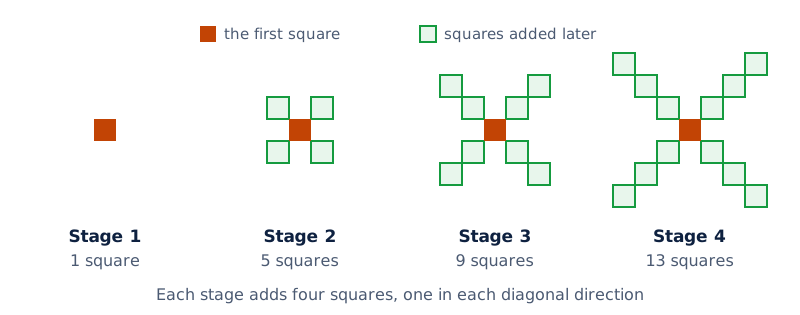
Stage 1 contains a red square. Later stages retain the central red square and extend green squares in four diagonal directions. The first four stages contain 1, 5, 9 and 13 squares.
Drawn by One Young India. See Fig. 8.3 in your NCERT textbook
| Stage number | Number of squares |
|---|---|
| 1 | 1 |
| 2 | 5 |
| 3 | 9 |
| 4 | 13 |
| 5 | 17 |
| … | … |
| n | 4n − 3 |
An ordered pair (x, y) records two values in a specified order. Here x is the stage number and y is its square count. On a graph, the x-axis is horizontal and the y-axis is vertical.
What the figure shows
A linear pattern from an AP
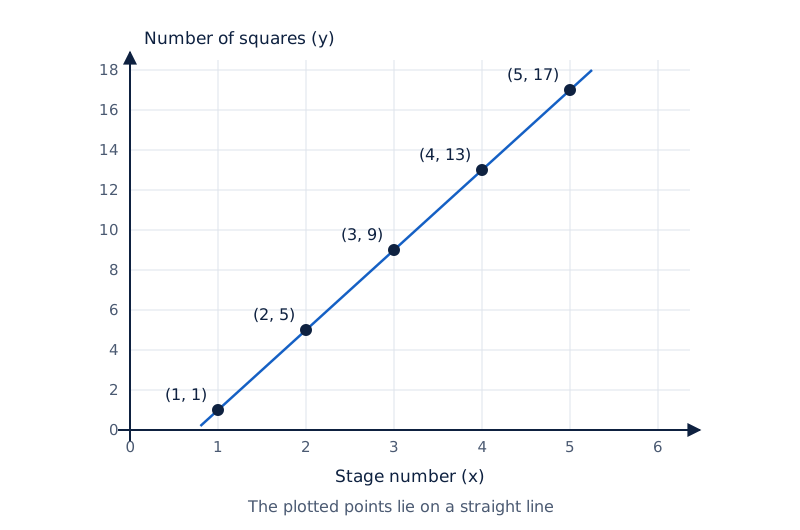
The labelled points (1, 1), (2, 5), (3, 9), (4, 13) and (5, 17) lie on a straight line. The horizontal coordinate gives the stage and the vertical coordinate gives the number of squares.
Drawn by One Young India. See Fig. 8.4 in your NCERT textbook
A linear pattern here means that the plotted points lie on a straight line. The numerical table, the growing squares and the graph show the same fixed increase in three representations.
How does a fixed fee affect the first term?
Worked example 7. A taxi charges a booking fee of ₹200 plus ₹40 per kilometre. Find the fares after 1, 2 and 3 kilometres, and after 10 kilometres.
Answer: The first fares are ₹240, ₹280 and ₹320. They form an AP with a = 240 and d = 40. For n kilometres, the fare is 240 + (n − 1) × 40 = 200 + 40n. At 10 kilometres it is ₹600.
The first term represents the fare after one kilometre. It includes the booking fee and that kilometre's charge. Identifying what the first position represents prevents a mismatch between the context and the formula.
How do we find sums of consecutive natural numbers?
Result: The sum of the first n natural numbers
Let S denote the sum 1 + 2 + … + n, where n is the number of terms. Writing the same sum in reverse pairs small and large values. Each corresponding pair has the same total.
- Write the sum in increasing order: S = 1 + 2 + … + n.
- Write the same sum in decreasing order: S = n + (n − 1) + … + 1.
- Add corresponding terms. Each pair totals n + 1, and there are n pairs.
- Therefore 2S = n(n + 1). Divide by 2 because two copies of the original sum were added.
S = n(n + 1)/2. We can also write Sₙ = n(n + 1)/2, where Sₙ means the sum of the first n natural numbers. A capital S denotes a sum here, while tₙ denotes one term.
Worked example 8. Find 1 + 2 + 3 + … + 10 by pairing two copies.
Answer: Reverse the second copy. Every corresponding pair totals 11, and there are 10 pairs. Therefore 2S = 110 and S = 55.
What the figure shows
Two triangular groups form a rectangle
Pink and green circles occupy opposite sides of a zigzag partition. Together they form a 7 × 6 rectangular array, representing 2 × (1 + 2 + 3 + 4 + 5 + 6) = 7 × 6.
See Fig. 8.5 in your NCERT textbook
How do we handle a sum starting after 1?
Worked example 9. Find 25 + 26 + 27 + … + 58.
Answer: Subtract the unwanted initial terms: S₅₈ − S₂₄ = (58 × 59)/2 − (24 × 25)/2 = 1711 − 300 = 1411.
The subtraction stops at 24 because 25 must remain in the required sum. Subtracting the sum through 25 would remove the first required term. This method reuses the formula for sums starting at 1.
The same formula gives the nth triangular number: tₙ = n(n + 1)/2. A triangular number is one entry in a sequence, but its value is the sum of the first n natural numbers.
What makes a sequence a geometric progression?
Definition: A geometric progression, abbreviated GP, is a sequence in which each term after the first is obtained by multiplying the previous term by a fixed number. This multiplier is the common ratio.
Result: The nth term of a GP
Let a denote the first term and r the common ratio. The general sequence is a, ar, ar², ar³, … . The exponent, or power, tells us how many times the base is used as a factor: r² means r × r.
There are n − 1 multiplications after the first term, so tₙ = arⁿ⁻¹. Here rⁿ⁻¹ means r raised to the power n − 1. The recursive description is t₁ = a and tₙ = rtₙ₋₁ for n ≥ 2.
What the figure shows
Doubling arrays of green squares
Four pink-bordered rectangular arrays contain 3, 6, 12 and 24 green squares. The arrays grow from one row to two, four and eight rows, each containing three squares.
See Fig. 8.6 in your NCERT textbook
This pattern has a = 3 and r = 2. Its rule is tₙ = 3 × 2ⁿ⁻¹, giving 3, 6, 12, 24, 48, 96, … . Equal multiplication replaces the equal addition used in an AP.
How do fractions and negative ratios work?
To test a ratio, divide a term by its preceding term. For 1, 2, 4, 8, 16, … the common ratio is 2. For 1, 3, 9, 27, 81, … it is 3. For 1, −1, 1, −1, 1, … it is −1.
Worked example 10. Check whether 5, 15/4, 45/16, 135/64, … is a GP, and find its nth term.
Answer: The consecutive ratios are (15/4) ÷ 5 = 3/4, (45/16) ÷ (15/4) = 3/4, and (135/64) ÷ (45/16) = 3/4. Therefore a = 5, r = 3/4 and tₙ = 5(3/4)ⁿ⁻¹.
A GP can therefore decrease or alternate in sign. Increasing size is not its definition. Check the fixed multiplier, just as you check the fixed difference for an AP, and retain the sign when dividing consecutive terms.
How do graphs and bouncing heights illustrate a GP?
What does the doubling graph show?
For the square-count GP, let x represent stage number and y represent the corresponding number of squares. The following values give the ordered pairs to plot. Both quantities must retain the same meaning throughout the graph.
| Stage number | Number of squares |
|---|---|
| 1 | 3 |
| 2 | 6 |
| 3 | 12 |
| 4 | 24 |
| 5 | 48 |
| … | … |
| n | 3 × 2ⁿ⁻¹ |
What the figure shows
Doubling square counts
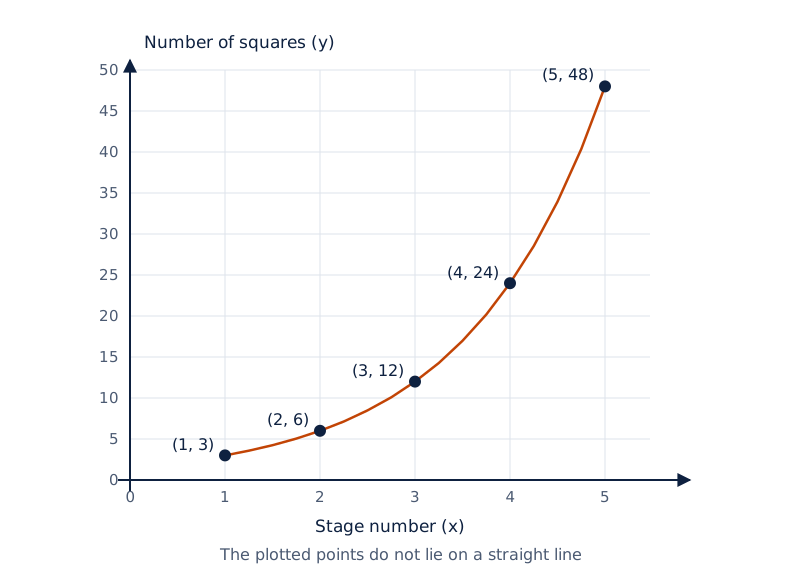
The points (1, 3), (2, 6), (3, 12), (4, 24) and (5, 48) appear on an upward-curving red line. These plotted points do not lie on a straight line.
Drawn by One Young India. See Fig. 8.9 in your NCERT textbook
The common ratio is fixed, but the amount added between successive counts changes. The graph therefore differs from the straight-line pattern of 1, 5, 9, 13, 17. The visual comparison reflects multiplication in one sequence and fixed addition in the other.
How do repeated fractional heights form a GP?
Worked example 11. A ball is dropped from 24 feet and rebounds to 3/4 of its previous height each time. Find the maximum heights after the first three bounces.
Answer: The first height is 24 × 3/4 = 18 feet. The second is 18 × 3/4 = 13.5 feet. The third is 13.5 × 3/4 = 10.125 feet. The bounce-height sequence has a = 18 and r = 3/4.
The initial dropping height and the first bounce height occupy different positions. If the sequence starts with the first bounce, its first term is 18 feet. Each later bounce uses the preceding maximum height, so the fixed fraction is applied repeatedly.
The heights decrease because each new height is three quarters of the preceding one. This context connects a physical pattern to the same multiplication rule used for a decreasing numerical GP.
How does the Sierpiński triangle connect growth and shrinking area?
A fractal is a shape or pattern that repeats at different scales: a small part looks similar to the whole. The Sierpiński triangle is constructed by repeatedly removing central triangles. An equilateral triangle has three equal sides, and a side's midpoint divides it into two equal lengths.
How is each stage constructed?
- Begin at Stage 0 with a black equilateral triangle.
- Join the midpoints of its sides, forming four smaller equilateral triangles.
- Remove the central triangle, leaving three black triangles at Stage 1.
- Repeat the same process on every remaining black triangle to obtain the next stage.
What the figure shows
Repeated triangular holes
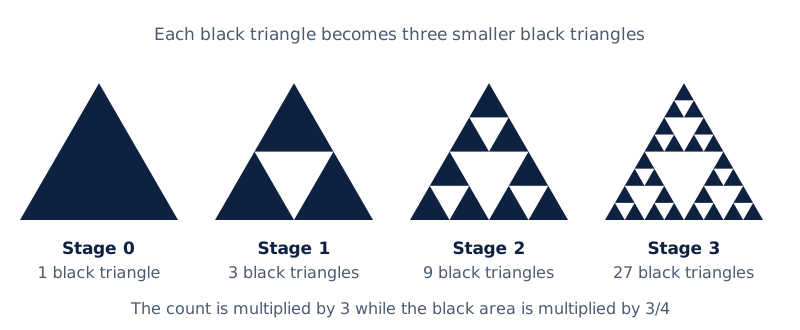
Stage 0 is a solid black triangle. Stage 1 has a central white triangular hole. Stages 2 and 3 contain further smaller white holes within the remaining black triangles.
Drawn by One Young India. See Fig. 8.7 in your NCERT textbook
Let tₙ now count the black triangles at stage n, starting with n = 0. Let sₙ be the total black area at that stage when Stage 0 has area 1 square unit. These symbols refer to stage numbers in this section.
Why do the count and area move in opposite directions?
Every black triangle becomes three smaller black triangles. The count is multiplied by 3, giving tₙ = 3ⁿ. Meanwhile, three of four equal parts remain from each triangle, so the total area is multiplied by 3/4, giving sₙ = (3/4)ⁿ.
| Stage n | Number of black triangles tₙ | Shaded area sₙ |
|---|---|---|
| 0 | 1 = 3⁰ | 1 |
| 1 | 3 = 3¹ | 3/4 |
| 2 | 9 = 3² | (3/4)² |
| 3 | 27 = 3³ | (3/4)³ |
| 4 | 81 = 3⁴ | (3/4)⁴ |
| 5 | 243 = 3⁵ | (3/4)⁵ |
| … | … | … |
| n | 3ⁿ | (3/4)ⁿ |
The table's area values are in square units. Its count increases rapidly while its total shaded area decreases, getting closer and closer to 0. Having more separate triangles does not mean having more shaded area, because the individual triangles become smaller.
Note: Stage numbering begins at 0 here. With this convention, the recursive rules are t₀ = 1, tₙ = 3tₙ₋₁ and s₀ = 1, sₙ = (3/4)sₙ₋₁ for n ≥ 1. Keep the initial stage consistent with the explicit formulas.
How can the same reasoning analyse the Sierpiński square carpet?
What changes when the starting shape is a square?
The Sierpiński square carpet begins with a square sheet at Stage 0. Trisect each side, meaning divide it into three equal parts, and join opposite division points. This forms nine equal smaller squares. Remove the central square and retain the other eight.
Repeat the same operation on each retained square to obtain the next stage. The construction rule is applied throughout the remaining shape. This is the square counterpart of repeatedly removing central triangles.
What the figure shows
Square holes at successive scales
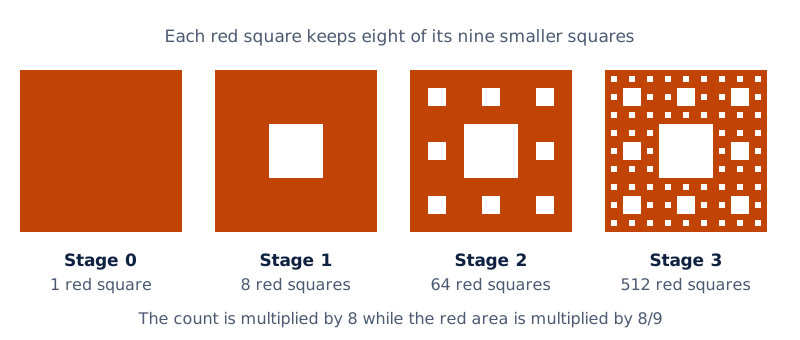
The four stages begin with a solid red square. Stage 1 has a white central square hole. Stages 2 and 3 show smaller square holes repeated within the retained red parts.
Drawn by One Young India. See Fig. 8.12 in your NCERT textbook
How do we write rules from the construction?
Let Cₙ count the retained small red squares at stage n, and let Aₙ denote their total area when the initial square has area 1 square unit. The stage number n begins at 0, so C₀ = 1 and A₀ = 1.
Each retained square produces eight smaller retained squares. Therefore Cₙ = 8ⁿ, or recursively Cₙ = 8Cₙ₋₁ for n ≥ 1. The counts at Stages 0 to 3 are 1, 8, 64 and 512.
Eight ninths of each square's area remains at each step. Consequently, Aₙ = (8/9)ⁿ, or recursively Aₙ = (8/9)Aₙ₋₁ for n ≥ 1. Count and area follow different GPs because their multipliers describe different quantities.
The triangle and carpet can be analysed by the same method: identify the initial stage, determine the multiplier for the quantity being studied, and write the corresponding power. Distinguish a count of pieces from their combined area throughout the calculation.
Glossary
- Sequence — An ordered list of numbers, with each entry occupying a particular position in the list.
- Term — An individual number in a sequence, identified by its position in the ordered list.
- Subscript — A lowered number or letter identifying a term's position, or an explicitly defined stage number.
- Finite sequence — A sequence containing a limited number of terms rather than continuing indefinitely.
- Infinite sequence — A sequence whose list of terms continues indefinitely without a final term.
- Explicit rule — A formula calculating a term directly from its position number without requiring previous term values.
- Recursive rule — A rule calculating a term from earlier terms, together with the starting values needed.
- Triangular number — A number represented by a triangular dot arrangement and by a sum of initial natural numbers.
- Arithmetic progression — A sequence in which each term after the first is obtained by adding a fixed number.
- Common difference — The fixed number added to each term of an arithmetic progression to obtain the next.
- Geometric progression — A sequence in which each term after the first is obtained by multiplying by a fixed number.
- Common ratio — The fixed multiplier taking each term of a geometric progression to the following term.
- Ordered pair — Two values written in a specified order, such as stage number followed by square count.
- Fractal — A shape or pattern repeating at different scales, with small parts looking similar to the whole.
Common errors and misconceptions
- Misconception: The position of a term equals its value. Correct: Position and value differ. In 1, 3, 5, 7, …, the fourth term is 7, so t₄ = 7.
- Misconception: Any increasing sequence is an AP. Correct: Consecutive differences must be constant. Triangular and square numbers increase but their consecutive differences change.
- Misconception: An AP cannot decrease. Correct: A negative common difference gives decreasing terms, as in 11, 7, 3, −1, −5, … .
- Misconception: The nth term of an AP is a + nd. Correct: There are n − 1 additions after the first term, giving a + (n − 1)d.
- Misconception: A recursive rule needs no starting value. Correct: Earlier values must be known. The Virahānka-Fibonacci rule needs its first two terms to generate later terms.
- Misconception: The taxi booking fee is the first term of the fare sequence after 1, 2, 3, … kilometres. Correct: The first term includes both the booking fee and the first kilometre's charge.
- Misconception: Increasing numbers of black triangles mean increasing black area. Correct: In the Sierpiński triangle, the count triples while the total black area is multiplied by 3/4.
- Misconception: Stage 0 can be treated as position 1 without changing a formula. Correct: Match the exponent and initial value to the stated numbering convention before substituting.
Exam-style questions with model answers
Q1. Define a sequence and identify the fourth term of 1, 3, 5, 7, 9, … . [2 marks]
- A sequence is an ordered list of numbers, each of which is called a term.
- The fourth term is 7 because 7 occupies the fourth position in the given list.
Q2. The term at position n in the odd-number sequence is uₙ = 2n − 1, where n is a natural number. Show which term is 137. [3 marks]
- To find the position of the value 137, equate the explicit expression to that value: 2n − 1 = 137.
- Add 1 to both sides to obtain 2n = 138. Dividing by 2 gives the position number n = 69.
- Since 69 is a natural number, it is an allowed position. Therefore 137 is the 69th term of this sequence.
Q3. A sequence has first term u₁ = 1 and recursive rule uₙ = 2uₙ₋₁ + 3 for n ≥ 2, where uₙ₋₁ is the preceding term. Find its first four terms. [4 marks]
- The given starting value is u₁ = 1. Record this before applying the recurrence, which begins at the second term.
- Using the first term, u₂ = 2 × 1 + 3 = 5. This is the second term.
- Use the newly obtained second term: u₃ = 2 × 5 + 3 = 13.
- Use the third term: u₄ = 2 × 13 + 3 = 29. Hence the terms are 1, 5, 13, 29.
Q4. A taxi charges ₹200 as a fixed booking fee and ₹40 per kilometre. For journeys of 1, 2, 3, … kilometres, find the first three fares, identify the AP, obtain its nth-term rule and calculate the fare for 10 kilometres. [5 marks]
- The fare after one kilometre includes both charges: ₹200 + ₹40 = ₹240. This is the first term of the requested sequence.
- After two and three kilometres the fares are ₹200 + ₹80 = ₹280 and ₹200 + ₹120 = ₹320 respectively.
- Each additional kilometre adds ₹40. Hence the fares form an AP with first term a = 240 and common difference d = 40.
- Let n be the positive whole-number distance in kilometres and tₙ the fare in rupees. Then tₙ = 240 + (n − 1) × 40 = 200 + 40n.
- Substitute n = 10 into this rule. The total fare is ₹(200 + 400) = ₹600 for the ten-kilometre journey.
Q5. Derive a formula for the sum of the first n natural numbers, where n is a positive integer. Use it to evaluate 25 + 26 + … + 58. [5 marks]
- Let S denote the required general sum from 1 to n. Write S = 1 + 2 + … + n.
- Write the same terms in reverse order beneath the first expression: S = n + (n − 1) + … + 1.
- Add the two expressions term by term. Each pair totals n + 1 and there are n pairs, so 2S = n(n + 1).
- Dividing by 2 gives S = n(n + 1)/2. Write Sₙ for this sum when specifying the number of terms with a subscript.
- The required interval excludes 1 through 24. Therefore S₅₈ − S₂₄ = (58 × 59)/2 − (24 × 25)/2 = 1711 − 300 = 1411.
Q6. For 5, 15/4, 45/16, 135/64, …, verify the common ratio and write the nth-term rule, assuming the displayed pattern continues. [4 marks]
- Divide the second term by the first: (15/4) ÷ 5 = 3/4. This gives the candidate common ratio.
- Divide the third term by the second: (45/16) ÷ (15/4) = 3/4, the same ratio.
- Divide the fourth term by the third: (135/64) ÷ (45/16) = 3/4. The repeated multiplier identifies the GP.
- With first term a = 5 and common ratio r = 3/4, the term at position n is tₙ = arⁿ⁻¹ = 5(3/4)ⁿ⁻¹.
Q7. A Sierpiński triangle starts at Stage 0 with one black equilateral triangle of area 1 square unit. At each step every black triangle is divided into four equal smaller triangles and its central triangle is removed. Find rules for the number of remaining triangles and total black area at Stage n, and explain their trends. [5 marks]
- Let tₙ be the count of black triangles at stage n and sₙ their total area. The initial values are t₀ = 1 and s₀ = 1.
- Every black triangle leaves three smaller black triangles. The count is therefore multiplied by 3 at each stage, giving tₙ = 3ⁿ.
- Removing one of four equal parts retains three quarters of each triangle's area. The combined black area is consequently multiplied by 3/4 at every step.
- Since the initial area is 1 square unit, sₙ = (3/4)ⁿ square units. The same multiplier applies to the total area at successive stages.
- The number of black triangles increases rapidly, while their combined area decreases towards 0. There are more pieces, but each piece is smaller.
Key takeaways
- A sequence is an ordered list; a term's position and its numerical value are different pieces of information.
- An explicit rule calculates a term from its position; a recursive rule uses earlier terms and requires starting values.
- An AP has a fixed common difference d, with nth term tₙ = a + (n − 1)d.
- The sum of the first n natural numbers is n(n + 1)/2, which also gives the nth triangular number.
- A GP has a fixed common ratio r, with nth term tₙ = arⁿ⁻¹ when the first term is a.
- The growing square AP produces points on a straight line; the doubling-square GP produces points that do not.
- In the Sierpiński triangle, the black-triangle count is multiplied by 3 while the combined black area is multiplied by 3/4.
- Identify whether numbering begins at term 1 or stage 0 before choosing an exponent or an initial value.
Test yourself
How many terms are in the finite sequence 6, 12, 24, 48, 96?
There are five terms, ending with 96 as the fifth term.
Why is 1, 3, 6, 10, 15, 21, … not an AP?
The consecutive differences are 2, 3, 4, 5 and 6, so they are not constant.
What starting values accompany the Virahānka-Fibonacci rule Vₙ = Vₙ₋₁ + Vₙ₋₂ for n ≥ 3?
The starting values are V₁ = 1 and V₂ = 2; later terms add the preceding two values.
What is the common difference of 11, 7, 3, −1, −5, …?
The common difference is −4, obtained by subtracting each term from the following term.
Why does the AP formula use n − 1 additions of the common difference?
The first term is already present, so reaching position n requires n − 1 further steps.
What is the common ratio of 1, −1, 1, −1, 1, …?
The common ratio is −1, because multiplying each term by −1 gives the next.
Why does 25 + 26 + … + 58 equal S₅₈ − S₂₄, where Sₙ sums the first n natural numbers?
Subtracting S₂₄ removes exactly the unwanted terms from 1 through 24, leaving the required terms.
In a Sierpiński triangle, each stage retains three quarters of the previous black area. Does tripling the triangle count make the black area grow?
No. The count triples, but the combined area decreases because only three quarters of the previous black area remains.
Write about it
Turn a question from this chapter into a paper.
The Writing Studio has a structure guide, a rubric and citation tools for 15 formats, from essays to research papers. Drafting is free with an account. Learnacy Essential adds feedback from an AI writing coach and submission to The OYI Review.
Learnacy Essential is ₹1,499 for the year. Publication depends on review and is not guaranteed.