
Propositions and their Converses | CBSE Class 9 Maths Notes
On this page
This note covers propositions, if-then statements, converses, counterexamples, factor pairs, perfect squares, geometric implications, the Baudhāyana-Pythagoras theorem and its converse, equality, divisibility, prime-number claims and constructions using diagonals.
What is a proposition, and how do we read it?
Definition: A proposition is a statement that is either true or false.
A proposition makes a claim whose truth can be considered. Being called a proposition does not mean that a statement has already been proved true. False statements also qualify. The mathematical task is to understand precisely what is claimed and then justify or disprove it.
Many propositions have the form “if X, then Y”. Here X and Y stand for statements or conditions. X is the starting condition, also called the hypothesis; Y is the conclusion claimed to follow from it. These letters do not represent numbers in this usage.
How do different wordings express the same implication?
The wording “X implies Y” expresses the same direction as “if X, then Y”. The wording “Y when X” also expresses this relationship. The word “when” identifies the condition under which the other statement follows.
| Wording | Starting condition | Conclusion |
|---|---|---|
| If X, then Y | X | Y |
| X implies Y | X | Y |
| Y when X | X | Y |
For example, equal sides of a triangle lead to equal angles opposite those sides. A triangle is a figure with three straight sides. An angle opposite a side is the angle at the corner not belonging to that side. The given information concerns sides; the conclusion concerns angles.
Reading the direction carefully is essential. A claim beginning with information about sides is a different proposition from one beginning with information about angles, even when the two claims concern the same triangle. A proof must establish the direction actually requested.
How is the converse of a proposition formed?
Definition: The converse of “if X, then Y” is “if Y, then X”. The condition and conclusion exchange roles.
To form a converse, first identify the complete starting condition and the complete conclusion. Exchange these two parts while keeping the setting unchanged. If a statement concerns a triangle, its converse still concerns a triangle. Restrictions on numbers or figures also remain in force.
What happens in the triangle example?
The original proposition begins with two equal sides and concludes that the angles opposite them are equal. Its converse begins with two equal angles and concludes that their opposite sides have equal lengths. Both are true, but they are separate results.
Result: Equal sides and equal opposite angles
In a triangle, equal sides have equal opposite angles. Conversely, equal angles have equal opposite sides. A triangle with two equal sides is called an isosceles triangle. Recognising the converse tells us which information is given and which information must be established.
- Identify the objects being discussed, such as a triangle or positive integers, meaning whole numbers greater than zero.
- Find the condition following “if”, including every restriction attached to it.
- Find the conclusion following “then”, without weakening or enlarging it.
- Swap the condition and conclusion, retain the setting, and investigate the new statement independently.
A proof is a logical argument establishing a claim from the given information and accepted results. To investigate the equal-angle converse, draw the altitude from the remaining vertex. An altitude is a perpendicular from a vertex to the line containing the opposite side.
The drawing is a starting point for an argument. The important logical distinction is that a proof beginning with equal sides establishes the original proposition. A proof of the converse must begin with equal angles. Knowing that the first proposition is true does not by itself settle the second.
How does a counterexample show that a converse can fail?
Definition: A counterexample is an instance that contradicts a proposed statement, showing that the statement is not true in general.
For an if-then claim, a useful counterexample satisfies the starting condition but fails the claimed conclusion. An instance that does not satisfy the starting condition cannot show that the proposed consequence fails under that condition. Both parts must be checked.
What does the wet-road example establish?
Consider the proposition that if it rains, the road is wet. Its converse says that if the road is wet, it has rained. The converse may not be true: a tanker may have spilled water on the road. Wetness alone does not establish rainfall.
This example does not claim that a wet road could never result from rain. It shows that the observed result can have another explanation. The strength of the conclusion is that the converse is not guaranteed, rather than that rain and wet roads are unrelated.
What happens with multiples of 6 and 3?
A multiple of a positive integer is obtained by multiplying it by an integer; an integer is a whole number, its negative, or zero. Saying a positive integer is divisible by another means that division leaves no remainder.
Worked example 1. Examine the claim that a multiple of 6 is a multiple of 3, and its converse.
Answer: Since 6 = 3 × 2, multiplying 6 by an integer produces a multiple of 3. Here × means multiplication and = means equality. The converse fails: 3 is a multiple of 3 but is not a multiple of 6.
The successful forward argument and the failed converse concern different directions. A single valid counterexample settles the false claim, whereas a list of successful cases does not establish a claim about every number. The reason must cover all numbers allowed by the condition.
Why does an odd number of factors imply a perfect square?
Let n represent a positive integer, meaning one of 1, 2, 3 and so on. A factor, or divisor, of n is a positive integer that divides n exactly. A perfect square is a number obtained by multiplying an integer by itself.
A factor has a partner factor: the other factor needed to make the product n. For 35, the factors 5 and 7 are partners because 5 × 7 = 35. For 25, the factor 5 is its own partner.
An even number is divisible by 2; an odd number is not.
How does pairing help us count?
Worked example 2. Use the factor-partner pairs (1, 12), (2, 6) and (3, 4) to explain the factor count of 12. Parentheses here group the two partners.
Answer: Each of the 3 pairs contains two different factors. Together they give the six factors 1, 2, 3, 4, 6 and 12. There is no self-partner factor, so the factors occur in an even number.
If every factor has a different partner, the factors can all be grouped in twos. Consequently, an odd count requires a factor that is its own partner.
- Begin with the assumption that n has an odd number of positive factors.
- Pair each factor with the factor that multiplies with it to produce n.
- Since distinct partners would give an even count, a self-partner factor must occur.
- Call this factor f. Then n = f × f, so n is a perfect square.
This argument proves the direction odd factor count implies perfect square. It starts from the count and arrives at the form of the number. It does not yet prove that starting with a perfect square must give an odd factor count.
Why does a perfect square have an odd number of factors?
Result: Perfect squares and odd factor counts
For a positive integer, being a perfect square and having an odd number of positive factors imply each other. The forward argument needs one additional detail: a positive integer cannot have more than one factor pair whose two entries are equal.
Start with a perfect square n. Write n = f × f, where f is its positive square root, the positive number whose square is n. This gives a self-partner factor. Every other positive factor pairs with a different factor.
Why must the self-partner be unique?
It is not enough simply to say that a repeating pair exists. If there were two different self-partner factors, their contributions would have to be counted separately. The required fact is that exactly one positive factor can be its own partner for this number.
The unequal pairs each contribute two factors. The single self-partner contributes one factor, counted once rather than twice. Thus the total is an even count with one additional factor, giving an odd number of factors.
Worked example 3. Explain how the self-partner factor works for 25.
Answer: The pairs are (1, 25) and (5, 5). The distinct positive factors are 1, 5 and 25, so there are 3 factors. The repeated 5 contributes just one factor to the count, and 25 = 5 × 5.
Note: A chain of implications must be checked again before being read backwards. The existence of a repeating factor pair alone does not explain the count; its uniqueness is essential.
The two proofs now complement each other. One begins with an odd count and forces a self-partner. The other begins with a square, identifies exactly one self-partner, and obtains an odd count. Their conclusions agree, but their starting assumptions are different.
How do geometric examples distinguish a proposition from its converse?
Congruent triangles have the same shape and size, with matching sides and angles. Their area, the amount of plane surface enclosed, is therefore equal. However, equal areas alone do not require triangles to have the same shape and size.
Consider the proposition that equal-area triangles are congruent. Its converse says that congruent triangles have equal areas. Here the original proposition is false and the converse is true. The order in which we name the statements does not decide their truth.
What happens with squares and equal angles?
A quadrilateral is a figure with four straight sides. A square has four equal sides and four right angles. A right angle is a quarter-turn angle, measuring 90 degrees; the symbol ° denotes degrees.
If a quadrilateral is a square, all its angles are equal. The converse claims that equal angles make a quadrilateral a square. A rectangle, a quadrilateral with four right angles, can have unequal adjacent sides. Such a rectangle contradicts this converse.
| Proposition | Converse | Truth of the two directions |
|---|---|---|
| Equal sides of a triangle give equal opposite angles | Equal angles give equal opposite sides | Both true |
| Equal-area triangles are congruent | Congruent triangles have equal areas | Original false; converse true |
| A square has equal angles | A quadrilateral with equal angles is a square | Original true; converse false |
Parallel lines are lines in a plane that do not meet. A transversal crosses two lines at distinct points. Corresponding angles occupy matching positions at the intersections. Parallel lines give equal corresponding angles, and equal corresponding angles establish that the lines are parallel.
These examples show why a familiar-looking statement still needs careful analysis. Some geometric conditions determine the required figure, while others provide only one property of it. A proof must connect the actual condition to the actual conclusion.
How is the converse of the Baudhāyana-Pythagoras theorem proved?
Theorem: Right angles and the side-length equation
In a right-angled triangle, let a and b be the lengths of the perpendicular sides and c the length of the hypotenuse, the side opposite the right angle. Perpendicular sides meet at a right angle. The theorem gives a² + b² = c².
The notation a² means a × a, and similarly for b² and c²; + denotes addition. For the converse, retain the setting of a triangle with side lengths a, b and c. Assume the equation and prove that the angle opposite side c is a right angle.
How does a second triangle establish the converse?
Let A, B and C name the vertices, or corners, of the given triangle. The notation ΔABC means triangle ABC; AB denotes its side joining A and B, or that side's length when used in an equation. Take BC = a, CA = b and AB = c.
- Begin with ΔABC satisfying a² + b² = c², without assuming that its angle at C is right.
- Construct ΔXYZ, whose vertices are X, Y and Z, with a right angle at Z and perpendicular sides YZ = a and XZ = b.
- Apply the forward theorem to this constructed right triangle. It gives XY² = a² + b² = c².
- Side lengths are positive, so XY = c. Thus all three side lengths match those of ΔABC.
- Use SSS congruence, the side-side-side condition: triangles with three corresponding sides equal are congruent. The angle at C equals the right angle at Z.
What the figure shows
Comparing two triangles
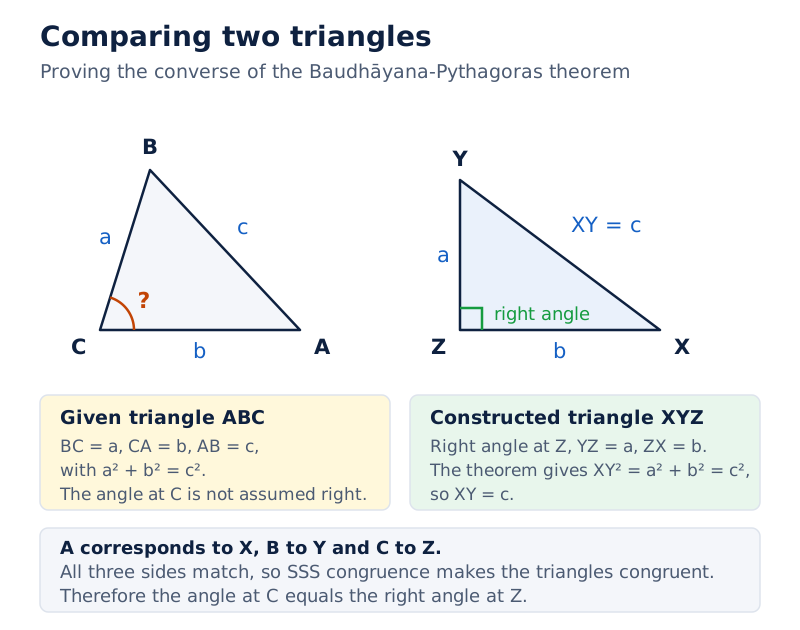
The first drawing labels BC as a, CA as b and BA as c. The second labels YZ as a and ZX as b, with a right-angle mark at Z. X corresponds to A, Y to B and Z to C.
Drawn by One Young India. Reference: NCERT Class 9, unnumbered diagrams on page 4
The right-angle mark belongs to the constructed triangle at the start. Transferring that property to the original triangle requires the congruence argument. Assuming the first triangle is right-angled before proving congruence would assume the very conclusion being investigated.
When do equality statements remain true in reverse?
For this section, x, y, a and b represent numbers. Real numbers are numbers represented on the number line. The expression a + x means the sum of a and x. When multiplication is written without a sign, as in ab, it means a × b.
Property: Adding the same number preserves equality
If x = y, then a + x = a + y. The converse also holds: if a + x = a + y, subtracting a from both sides gives x = y. The same number must be added or subtracted on both sides.
The forward direction adds a to equal numbers. The converse subtracts a from equal sums. Each step preserves equality, so the implication works in both directions. This explains why these operations can be used when solving equations.
Why do squares and cubes behave differently?
If x = y, then x² = y². The converse can fail because a number and its negative have equal squares. The sign − denotes a negative number or subtraction.
Worked example 4. For real numbers x and y, test the converse of “If x = y, then x² = y²”.
Answer: The converse claims that equal squares imply equal numbers. Take x = 3 and y = −3. Then x² = y² = 9, but x and y are unequal. Thus the converse is false.
A cube multiplies a number by itself three times: x³ means x × x × x. For real numbers, x = y gives x³ = y³, and x³ = y³ also gives x = y. Unlike squaring, cubing distinguishes a positive number from its negative.
For positive integers a and b, if each is a perfect square, their product ab is a perfect square. But a square product need not have two square factors. The factorisation 25 = 5 × 5 illustrates this: the product is square, while neither factor 5 is square.
The common method is to identify what information survives each operation. Adding a fixed number can be reversed by subtracting it. Squaring loses the distinction between opposite signs, so equality of squares is weaker than equality of the original real numbers.
How should divisibility propositions and their converses be tested?
Throughout these divisibility statements, n is a positive integer. A forward implication may follow because the proposed divisors are factors of a larger divisor. The converse asks whether satisfying the smaller divisibility conditions is enough to recover the larger one.
Worked example 5. Test the proposition that divisibility by 24 implies divisibility by both 4 and 6, and test its converse.
Answer: Because 24 = 4 × 6, every multiple of 24 is divisible by 4 and by 6. The converse is false. The number 12 is divisible by both 4 and 6 but is not divisible by 24.
Both smaller conditions hold in the counterexample. A number divisible by just one of 4 and 6 would not test the full converse. The word “both” is part of the condition and must not disappear when the proposition is reversed.
Worked example 6. Compare divisibility by 60 with divisibility by both 5 and 12.
Answer: A multiple of 60 is divisible by 5 and 12 because 60 = 5 × 12. The converse is also true: 5 and 12 have no common positive factor other than 1, so a number divisible by both is divisible by their product, 60.
How does this affect divisibility shortcuts?
Divisibility by 8 implies divisibility by 2 and by 4. The converse fails: 4 is divisible by both 2 and 4 but not by 8. Therefore, these two checks do not together establish divisibility by 8.
The digit-sum test for 3 works in both directions. If a positive integer is divisible by 3, the sum of its digits is a multiple of 3. Conversely, if that sum is a multiple of 3, the integer is divisible by 3.
For n and n + 3, the phrase “no factors in common” means no common positive factor other than 1. Every pair of positive integers shares 1. Any common factor of these two numbers divides their difference, 3. Therefore they share no factor greater than 1 precisely when n is not a multiple of 3.
What do prime numbers reveal about factor-count converses?
A prime number is a positive integer greater than 1 with exactly two positive factors, 1 and itself. A composite number is a positive integer greater than 1 that has additional positive factors. The number 1 is neither prime nor composite.
What happens to the square of a prime?
The square of a prime has exactly three positive factors: 1, the prime, and its square. Conversely, a positive integer with exactly three positive factors must be the square of a prime. The odd factor count first tells us that the number is a square.
Worked example 7. Illustrate the proposition about a prime square with 25 = 5 × 5.
Answer: The number 5 is prime. The positive factors of 25 are exactly 1, 5 and 25, giving 3 factors. The factor 5 is the self-partner, while 1 and 25 form the unequal pair.
For the converse, the positive square root must be prime. If it had a factor strictly between 1 and itself, that factor would also divide its square, adding a factor beyond the proposed three. Thus the count restricts the form of the square root.
Does a count of four divisors work the same way?
The product of two unequal primes has four positive divisors: 1, each prime, and their product. However, four divisors do not force this form. The cube of a prime can also have exactly four positive divisors.
Worked example 8. Test the converse “If a positive integer has exactly 4 divisors, it is a product of two unequal primes.”
Answer: The divisors of 8 are 1, 2, 4 and 8. Yet 8 = 2 × 2 × 2 is not a product of two unequal primes. It therefore contradicts the converse while leaving the forward proposition intact.
Both exercises concern factor counts, but their converses have different outcomes. The three-factor condition determines a prime square. The four-factor condition allows more than one form. An argument valid for the first count cannot simply be transferred to the second.
How can counterexamples test claims about prime-producing expressions?
A formula can produce primes for several inputs without producing primes for every allowed input. To disprove a universal prime claim, find one permitted value that gives a composite number, and exhibit a factorisation that demonstrates compositeness.
In the following expressions, n denotes the chosen integer input. An exponent specifies a power: 2ⁿ means multiplying 2 by itself n times for positive n, and similarly for 4ⁿ. The convention for a non-zero number to the power zero gives 1.
What does the Fermat example show?
Fermat claimed that all numbers of the form 2^(2ⁿ) + 1 were prime for n = 0, 1, 2, 3 and so on. Here the caret and parentheses mean that 2ⁿ is the exponent of the outer 2. For n = 3, this gives 257.
Euler disproved the claim by showing that the value for n = 5 is composite. This is a counterexample to the universal statement. It does not imply that every other value is composite, and it does not deny the successful prime example.
How can the exercise claims be checked?
| Claimed prime expression | Permitted input | Composite output |
|---|---|---|
| 4n² + 1 | n = 4 | 65 = 5 × 13 |
| n² + n + 11 | n = 11 | 143 = 11 × 13 |
| 4ⁿ + 3 | n = 4 | 259 = 7 × 37 |
| 2ⁿ − 1 when n is prime | n = 11 | 2047 = 23 × 89 |
| 2ⁿ + 1 when n is even | n = 6 | 65 = 5 × 13 |
In each successful counterexample the input satisfies the required condition and the output has factors other than 1 and itself. Checking the input restriction is especially important for the last two claims: a composite input would not challenge the prime-input claim.
Note: There are no known ‘neat’ expressions that generate only primes. The qualifications “known” and “‘neat’” matter; this is not a claim that such an expression has been proved impossible.
How does the direction of a proposition affect a construction?
A diagonal of a quadrilateral joins two non-adjacent vertices. Imagine two thin sticks used as diagonals, with their endpoints joined to form a quadrilateral. Let Q name a category of quadrilaterals. Here Q labels a category, rather than a proposition or a number.
What if every quadrilateral of type Q has equal diagonals?
Under the condition “if a quadrilateral is of type Q, it has equal-length diagonals”, equal stick lengths are required for a successful construction of type Q. Unequal sticks would give unequal diagonals, so the resulting figure could not meet the stated requirement.
However, equal sticks alone do not guarantee membership of Q. Their arrangement may still matter. The proposition supplies one property of figures already known to be of type Q; it does not say that every quadrilateral possessing that property belongs to Q.
What changes when equal diagonals imply type Q?
Now suppose the given proposition is “if a quadrilateral has equal diagonals, it is of type Q”. Equal sticks guarantee type Q whenever their endpoints form a quadrilateral. No additional arrangement condition is supplied by this implication beyond forming such a quadrilateral.
This second statement does not establish that every quadrilateral of type Q must have equal diagonals. It gives a way to ensure membership, without excluding the possibility of other members. Reversing that conclusion would again assume an unproved converse.
What the figure shows
Sticks used as diagonals
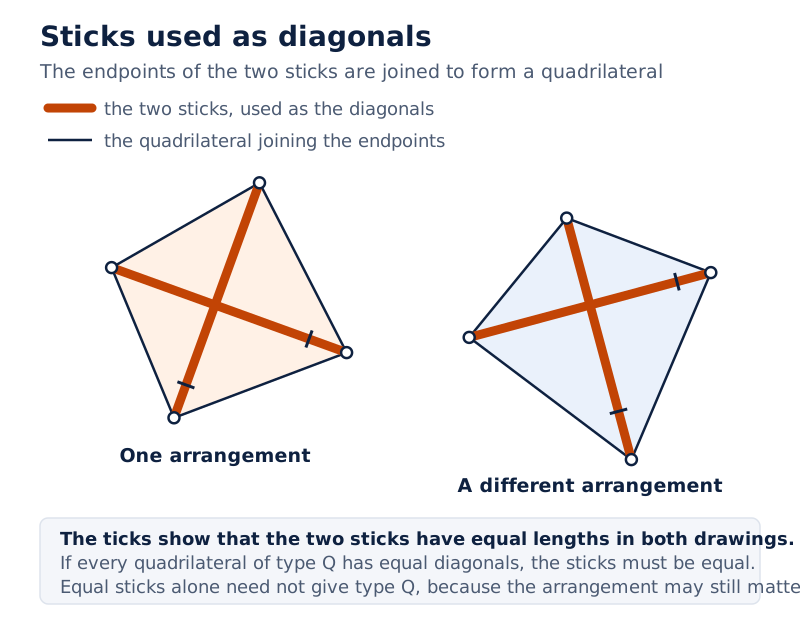
Two shaded sticks cross inside a four-sided outline. The outline joins the four stick endpoints, showing the sticks as the diagonals of the resulting quadrilateral.
Drawn by One Young India. See Fig. 9.2 in your NCERT textbook
The same picture supports two different logical questions. One asks what must be true of a desired figure; the other asks what condition guarantees the desired figure. Keeping the direction visible prevents a construction from being justified by a property that is too weak.
Glossary
- Proposition — A statement that is either true or false, whether or not its truth has yet been established.
- Hypothesis — The starting condition assumed in an if-then statement before its claimed conclusion is considered.
- Conclusion — The statement claimed to follow from the starting condition of a proposition.
- Converse — The proposition obtained by exchanging the condition and conclusion while retaining the original setting.
- Counterexample — An instance satisfying a claim's condition but contradicting its conclusion, showing that the claim fails.
- Factor — A positive integer that divides the given positive integer exactly, leaving no remainder.
- Partner factor — The factor that multiplies with a given factor to produce the number under consideration.
- Perfect square — A number expressible as the product of an integer with itself.
- Prime number — A positive integer greater than one having exactly two positive factors, one and itself.
- Composite number — A positive integer greater than one with a positive factor besides one and itself.
- Congruent triangles — Triangles having the same shape and size, with their corresponding sides and angles equal.
- Hypotenuse — The side opposite the right angle in a right-angled triangle.
- SSS congruence — The condition establishing triangle congruence when all three pairs of corresponding sides are equal.
- Diagonal — A line segment joining two vertices of a quadrilateral that are not adjacent.
Common errors and misconceptions
- Misconception: A true proposition automatically has a true converse. Correct: Test each direction independently; multiples of 3 need not be multiples of 6.
- Misconception: Forming a converse changes the objects or number restrictions. Correct: Preserve the setting and exchange only the condition and conclusion.
- Misconception: Any unsuccessful example disproves an if-then statement. Correct: A counterexample must satisfy the full condition and fail the conclusion.
- Misconception: Proving that an odd factor count implies a square proves both directions. Correct: The reverse proof must establish exactly one self-partner factor.
- Misconception: The pair (5, 5) contributes two different factors of 25. Correct: The factor 5 occurs once in the list of distinct factors.
- Misconception: Equality of squares gives equality of real numbers. Correct: A number and its negative have the same square.
- Misconception: Divisibility by both 2 and 4 guarantees divisibility by 8. Correct: The number 4 satisfies both checks but is not divisible by 8.
- Misconception: In proving the Pythagoras converse, the original triangle may be assumed right-angled. Correct: Construct a right triangle and use congruence to establish the original angle.
Exam-style questions with model answers
Q1. Define a proposition and write the converse of “If two sides of a triangle are equal, the angles opposite those sides are equal.” [2 marks]
- A proposition is a statement that is either true or false.
- The converse is: if two angles of a triangle are equal, the sides opposite those angles have equal lengths.
Q2. Examine “If a positive integer is a multiple of 6, it is a multiple of 3.” Justify it, state its converse, and disprove the converse. [3 marks]
- The original statement is true because 6 = 3 × 2. Every integer multiple of 6 is therefore also an integer multiple of 3.
- The converse is: if a positive integer is a multiple of 3, then it is a multiple of 6.
- The number 3 is a counterexample. It satisfies the converse's starting condition but is not a multiple of 6, so the converse is false.
Q3. Prove that a positive integer with an odd number of positive factors is a perfect square. State whether this proof alone establishes the converse. [4 marks]
- Let n denote the given positive integer. Pair each positive factor with the partner that multiplies with it to give n.
- If every factor had a different partner, all factors would occur in pairs, giving an even total. This contradicts the assumed odd count.
- A factor must therefore be its own partner. Calling it f gives n = f × f, so n is a perfect square.
- This proves only the stated direction. The converse starts with a square and requires a separate argument for an odd factor count.
Q4. A triangle ABC has side lengths BC = a, CA = b and AB = c, satisfying a² + b² = c². Prove that its angle at C is right, using the Baudhāyana-Pythagoras theorem and SSS congruence. [5 marks]
- Construct a second triangle XYZ with a right angle at Z and perpendicular side lengths YZ = a and XZ = b. This right angle belongs to the constructed triangle.
- Apply the Baudhāyana-Pythagoras theorem to XYZ. Its hypotenuse satisfies XY² = a² + b².
- The given relation a² + b² = c² therefore gives XY² = c². Since side lengths are positive, XY = c.
- The side pairs BC and YZ, CA and ZX, and AB and YX are equal. Thus ABC and XYZ are congruent by the side-side-side condition.
- Corresponding angles in congruent triangles are equal. The angle at C corresponds to the angle at Z, so the angle at C is a right angle.
Q5. For a positive integer n, compare these claims and their converses: “If n is divisible by 24, it is divisible by both 4 and 6”; “If n is divisible by 60, it is divisible by both 5 and 12.” Explain all four truth judgements. [5 marks]
- The first forward claim is true: 24 is divisible by both 4 and 6, so every multiple of 24 is divisible by each of them.
- Its converse says that divisibility by both 4 and 6 gives divisibility by 24. This is false because 12 satisfies both smaller divisibility conditions but not the larger one.
- The second forward claim is true because 60 = 5 × 12. A multiple of 60 is therefore divisible by both 5 and 12.
- The second converse says that divisibility by both 5 and 12 gives divisibility by 60. This converse is true.
- The reason is that 5 and 12 share no positive factor except 1. Divisibility by both therefore gives divisibility by their product, 60.
Q6. For real numbers x and y, state “If x = y, then x² = y²” and its converse in words. Determine their truth, using a counterexample where needed. [3 marks]
- The original statement says that equal real numbers have equal squares. This is true because multiplying equal numbers by themselves produces equal results.
- The converse says that real numbers with equal squares must themselves be equal. This does not hold for all real numbers.
- Take x = 3 and y = −3. Both squares equal 9, but the original numbers are different. This disproves the converse.
Q7. Let Q be a category of quadrilaterals. Assume that every quadrilateral of type Q has equal-length diagonals. Two sticks will form the diagonals of a quadrilateral of type Q. Must they be equal, and does equality alone guarantee success? Explain also what changes if equal diagonals are instead given to imply type Q. [4 marks]
- Under the first assumption, the sticks must be equal because they represent the diagonals of the desired quadrilateral of type Q.
- Equality alone does not guarantee success. The given statement describes a property of type Q but does not establish its converse.
- The arrangement may therefore matter: forming a quadrilateral with equal diagonals does not, from this assumption alone, prove that it belongs to Q.
- Under the alternative assumption, equal sticks guarantee type Q whenever they form the diagonals of a quadrilateral, with no further arrangement condition. However, equal lengths are not established as necessary: the assumption does not rule out quadrilaterals of type Q with unequal diagonals.
Key takeaways
- A proposition makes a claim that is true or false; calling it a proposition does not establish its truth.
- Form a converse by exchanging condition and conclusion while retaining the objects and restrictions of the original statement.
- A true proposition can have a false converse, and proving one direction does not automatically prove the other.
- A counterexample must satisfy the proposed starting condition and contradict the conclusion that is supposed to follow.
- A positive integer is a perfect square exactly when its positive factors have an odd total.
- The Pythagoras converse follows by constructing a right triangle and proving congruence through three matching side lengths.
- Equality and divisibility exercises require attention to direction: some operations and tests support a converse, while others do not.
- A construction needs a condition that guarantees the required figure; a property of that figure may not be enough.
Test yourself
How can “Y when X” be written as an if-then statement?
It means “if X, then Y”: X remains the starting condition and Y the conclusion.
Why may a wet road fail to establish that it has rained?
A tanker may have spilled water on the road, so wetness alone does not guarantee rainfall.
Which direction does the argument “odd factor count, then a self-partner factor, then a square” prove?
It proves that an odd number of positive factors implies a perfect square, not the converse.
Why is 5 counted only once among the positive factors of 25?
It is its own partner, so the pair (5, 5) contains only one distinct factor.
What is the converse of “Congruent triangles have equal areas”?
The converse says equal-area triangles are congruent. It is false because equal area does not determine shape and size.
Why does checking divisibility by both 2 and 4 fail as a test for divisibility by 8?
The number 4 passes both checks but is not divisible by 8, disproving the proposed converse.
Can a proposition and its converse both be false?
Yes. The truth of a proposition does not decide its converse; both statements can be false.
What makes one composite output enough to refute an expression claimed always to give primes?
The universal claim includes that permitted input, so its composite output directly contradicts the claim.
Write about it
Turn a question from this chapter into a paper.
The Writing Studio has a structure guide, a rubric and citation tools for 15 formats, from essays to research papers. Drafting is free with an account. Learnacy Essential adds feedback from an AI writing coach and submission to The OYI Review.
Learnacy Essential is ₹1,499 for the year. Publication depends on review and is not guaranteed.