
Orienting Yourself: The Use of Coordinates | CBSE Class 9 Maths Notes
On this page

Learnacy Labs Try it hands-on: open the Lines & Coordinates lab
This Mathematics note covers coordinate systems, the Cartesian plane, axes and quadrants, ordered pairs, room plans, distances between points, reflections, collinearity, midpoints, trisection, circles, screen coordinates and the identification of a square.
How does a coordinate system describe a position?
A coordinate system is a structured framework that uses numbers to describe the exact locations of points or objects. Grid lines on a map or graph paper provide such a framework. A position becomes precise when the reference lines and the meaning of each number are fixed.
A number line describes positions in one dimension. To describe a point in a plane, we use two perpendicular number lines. One number records the horizontal position and another records the vertical position. Together, these numbers locate the point relative to the chosen reference lines.
Why does the order of the information matter?
The coordinates form an ordered pair, written as . The first entry is the horizontal coordinate and the second is the vertical coordinate. Reading them in the opposite order can change the point, even though the same two numbers appear.
Definition: The Cartesian coordinate system locates a point in a plane using its coordinates relative to two perpendicular axes.
Reiaan and Shalini use a rectangular grid to represent the floor of a room. Pins mark key positions, while thick wool joins points representing the corners of objects. The grid turns the layout into positions that can be read by touch.
The room sketch uses the scale . A scale connects distances on the drawing to distances in the room. It must be read before interpreting a length measured on the drawing.
What does a floor plan leave out?
A floor plan represents positions in the horizontal plane. It does not supply the height of the table or the height of a window above the floor. Two coordinates describe the floor position; they do not provide every feature of a three-dimensional object.
When interpreting a plan, first identify what surface it represents. Then identify the reference point, directions and scale. These choices give meaning to the coordinate labels and prevent a distance on paper from being confused with the corresponding distance in the room.
What are the coordinate axes and the origin?
The horizontal reference line is the -axis, and the vertical reference line is the -axis. Their point of intersection is the origin, denoted by . The coordinates of the origin are .
Equal units are marked from the origin along both axes. Movement to the right or upwards gives a positive coordinate. Movement to the left or downwards gives a negative coordinate. A negative coordinate tells us a direction; it does not mean that an ordinary length is negative.
Result: Coordinates of points on an axis
A point on the horizontal axis has no vertical displacement, so its form is . A point on the vertical axis has no horizontal displacement, so its form is . At the origin, both coordinates are zero.
| Point | Position relative to the origin | Axis |
|---|---|---|
| units to the right | -axis | |
| units to the left | -axis | |
| units below | -axis | |
| units above | -axis |
What the figure shows
Points on the axes
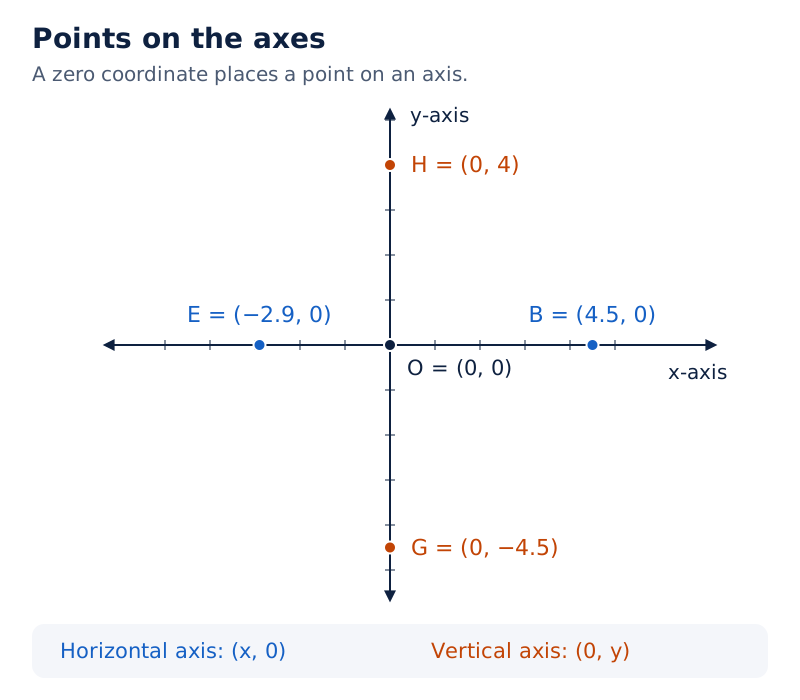
Two perpendicular axes meet at the origin. Points and lie on opposite sides of the origin along the horizontal axis, while and lie above and below the origin on the vertical axis.
Drawn by One Young India. See Fig. 1.2 in your NCERT textbook
How can a zero coordinate help?
Worked example 1. Interpret the coordinates .
- The first coordinate is , so there is no horizontal movement from the origin.
- The second coordinate is , so move units downwards.
- The point therefore lies on the negative part of the vertical axis.
Answer: is on the -axis, units below the origin.
Use both entries when identifying an axis. A positive first coordinate does not by itself put a point on the horizontal axis: the second coordinate must also be zero. Similarly, a point is on the vertical axis only when its first coordinate is zero.
How do ordered pairs identify the four quadrants?
The Cartesian plane, also called the coordinate plane or -plane, is divided by the axes into four regions called quadrants. The signs of the coordinates identify the region containing a point that does not lie on an axis.
| Quadrant | Coordinate signs | Position from the origin |
|---|---|---|
| I | Right and above | |
| II | Left and above | |
| III | Left and below | |
| IV | Right and below |
The first coordinate measures the signed horizontal displacement from the -axis. The second measures the signed vertical displacement from the -axis. For ordinary perpendicular distances, use the magnitudes of these coordinates and state the side separately.
Result: Reversing an ordered pair
The pairs and represent the same point exactly when . If , reversing the coordinates gives a different point. Matching only the numbers is insufficient; their positions within the pair also matter.
Worked example 2. Locate and .
- For , read and move units right.
- Read and move units down. Thus lies in Quadrant IV.
- For , read and move units left.
- Read and move units up. Thus lies in Quadrant II.
Answer: and are different points in Quadrants IV and II respectively.
What the figure shows
The four quadrants
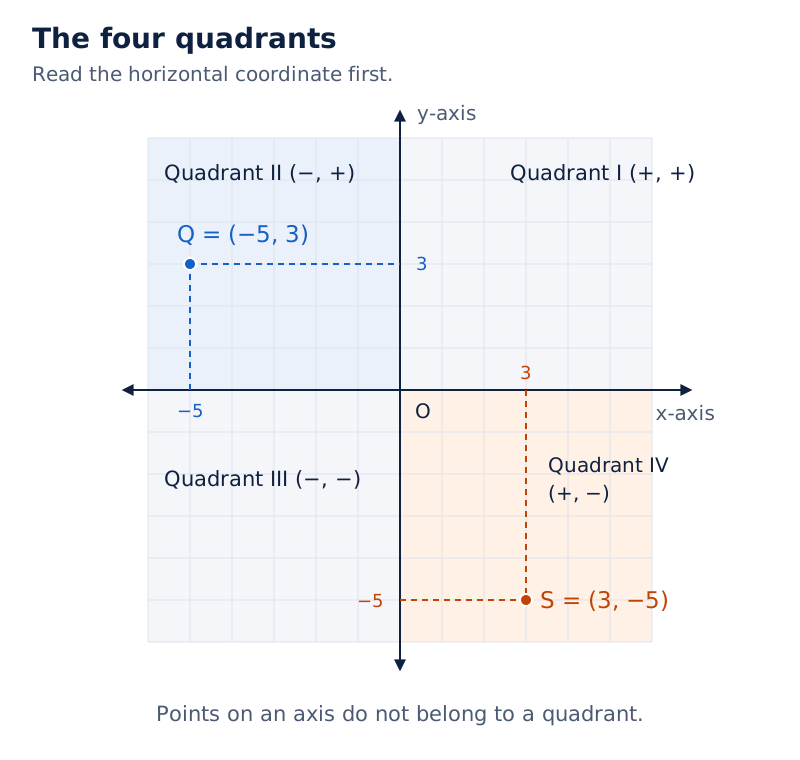
Quadrants I and II are above the horizontal axis, while III and IV are below it. The marked points are and .
Drawn by One Young India. See Fig. 1.4 in your NCERT textbook
Points on the axes form the boundaries of the quadrants. Classify a point with a zero coordinate as an axis point, rather than assigning it a quadrant. The origin is the common point of the two axes.
How can coordinates be used to read a room plan?
In Reiaan's room plan, the origin is one corner of the bedroom. The lower wall follows the -axis and the left wall follows the -axis. The bedroom corners are , , and .
A room plan allows us to compare positions, widths and lengths. Points sharing a vertical coordinate lie on the same horizontal line. Points sharing a horizontal coordinate lie on the same vertical line. These relationships are useful when identifying the missing corner of a rectangle.
How are door widths calculated?
Worked example 3. Compare the room door from to with the bathroom door from to .
- The room door lies along the horizontal axis. Its width is .
- The bathroom door lies along the vertical axis. Its width is .
- Compare the widths: .
Answer: The room door is wide. The bathroom door is wide, so it is narrower.
The room door is on the horizontal axis, so its perpendicular distance from that axis is zero. Its nearer endpoint is from the left wall. Distinguish the door's location from its width: these answer different questions.
How is a missing table foot located?
Worked example 4. A rectangular study table has feet at , and . Find the fourth foot and the side lengths.
- The top pair shares , and the right pair shares .
- The missing corner uses the other horizontal and vertical positions, giving .
- The horizontal side measures .
- The vertical side measures .
Answer: The fourth foot is ; the table measures by . Its height cannot be obtained from these floor coordinates.
Practical interpretation also involves the positions of doors and furniture. For the bathroom door, consider its hinge at , its opening direction into the bedroom and the wardrobe nearby. These features connect coordinate positions with questions about arranging the room.
How is the distance formula derived?
For a segment parallel to an axis, one coordinate remains unchanged. Its length is the absolute difference between the other coordinates. The absolute value ensures that the answer is a non-negative distance, whichever endpoint is considered first.
Result: Distances parallel to the axes
For points and , the horizontal distance is . For points and , the vertical distance is . These are special cases of the general distance formula.
When both coordinates change, the joining segment is slanting. Construct horizontal and vertical segments to form a right-angled triangle. The required segment is its hypotenuse; the other two sides measure the separate horizontal and vertical changes.
Derivation: Distance between two points
- Take endpoints and . Complete the right triangle with .
- The horizontal side has length , and the vertical side has length .
- Apply the Baudhāyana-Pythagoras theorem:
- Substitute the two side lengths:
- Take the non-negative square root to obtain
Distance formula: Subtract corresponding coordinates, square each difference, add the squares and then take the square root.
Use one consistent endpoint order for the subtractions. A negative difference records a direction and is handled by squaring. Reversing both differences gives the same result, because a number and its negative have equal squares.
Note: Adding the absolute values of the horizontal and vertical coordinate changes gives the length of a route consisting of one horizontal segment and one vertical segment. The straight-line distance is found from the sum of their squares followed by a square root.
Keep the units consistent with the coordinate scale. A graph measured in units gives a distance in units; a room plan whose coordinate unit represents a foot gives its real lengths in feet.
How are the three sides of a triangle calculated?
Consider the points , and . All three lie in the first quadrant, but none of the three joining sides is horizontal or vertical. Calculate each side using the coordinates of its own endpoints.
What the figure shows
A right triangle for measuring a slanting side
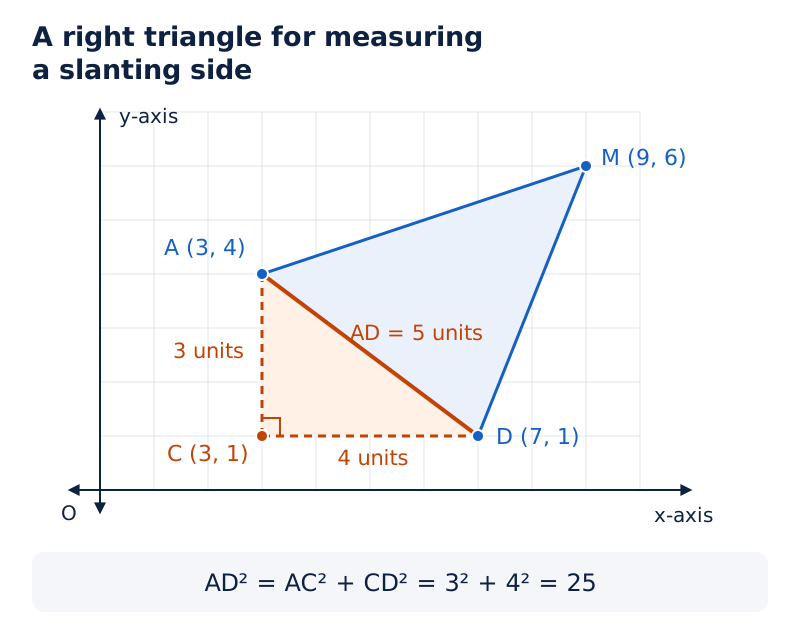
The triangle joins , and . Dashed vertical and horizontal segments meet at , creating a right triangle with hypotenuse .
Drawn by One Young India. See Fig. 1.7 in your NCERT textbook
How is the first side calculated?
Worked example 5. Find .
- Calculate the horizontal change: .
- Calculate the vertical change: .
- Square and add: .
- Take the positive square root: .
Answer: .
How are the other two sides calculated?
Worked example 6. Find and .
- For , the horizontal change is , and the vertical change is .
- Square and add: .
- Take the square root: .
- For , the horizontal change is , and the vertical change is .
- Square and add: .
- Take the square root: .
Answer: and .
These answers illustrate why the square root is essential. The sum of the squares is the square of the distance, not the distance itself. Also, a distance need not be a whole number merely because all the coordinates are whole numbers.
Leaving a non-perfect square under a radical gives an exact answer. A decimal approximation is unnecessary here. Check each calculation by matching its differences to the endpoints before comparing the three side lengths.
What changes when a figure is reflected in an axis?
A reflection in the -axis places each image point equally far on the opposite side of that axis. The horizontal coordinate changes sign and the vertical coordinate stays the same. Thus the coordinate rule is .
For the triangle already considered, the image points are , and . The original triangle lies to the right of the vertical axis, while its image lies to the left.
What the figure shows
Reflection in the vertical axis
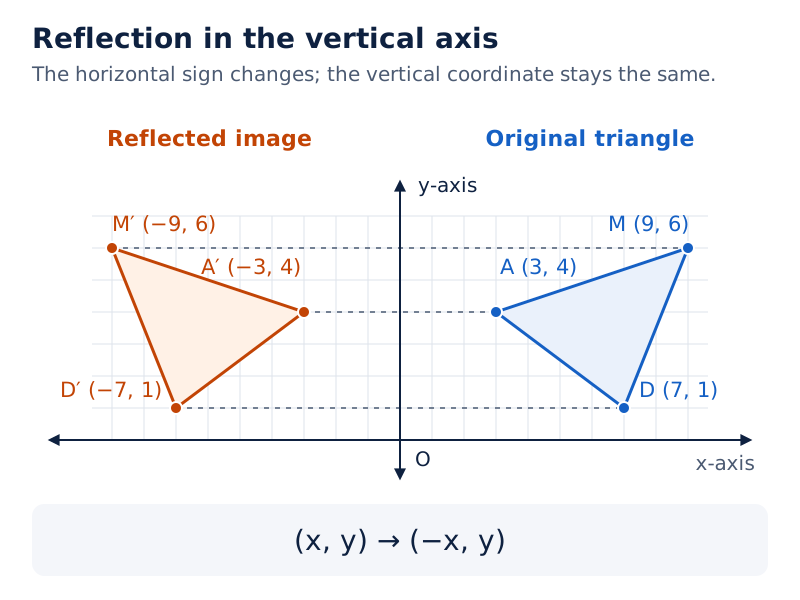
The original triangle and its reflected image appear on opposite sides of the -axis. Corresponding points have equal vertical coordinates and opposite horizontal coordinates.
Drawn by One Young India. See Fig. 1.9 in your NCERT textbook
Why do corresponding lengths remain equal?
Worked example 7. Recalculate the side lengths of the reflected triangle.
- For , the differences are and . Hence .
- For , the differences are and . Hence .
- For , the differences are and . Hence .
- Compare with the original triangle: , and .
Answer: The reflected lengths are , and units, so reflection preserves all three side lengths.
Reflection in the horizontal axis works similarly: . Here the horizontal position is unchanged and the vertical coordinate changes sign. In the distance formula, sign changes disappear when the coordinate differences are squared.
Do not confuse reflection with reversing an ordered pair. Interchanging the two entries and changing the sign of one entry are different operations. State the axis of reflection before changing coordinates so that the rule is unambiguous.
How can distances test whether points lie on one straight line?
Three collinear points lie on the same straight line. To test this using distances, calculate all three pairwise lengths. If the longest distance equals the sum of the other two, the three points lie in order along one straight segment.
This approach uses coordinate calculations without requiring a drawing. A graph can then provide a visual check. Keep exact lengths during the comparison, since rounded decimal values can make unequal distances appear equal.
How does the test work for the first set of points?
Worked example 8. Check , and .
- Find .
- Find .
- Find .
- Compare: .
Answer: The three points are collinear, with between and .
How can a second set fail the test?
Worked example 9. Check , and .
- Calculate the differences and . Hence .
- Calculate the differences and . Hence .
- Calculate the differences and . Hence , the longest distance.
- If , squaring gives , so .
- Squaring again would require . But , so this equality is false.
Answer: ; the three points are not collinear.
The comparison must involve the longest distance. A failed comparison using the wrong proposed middle point does not, by itself, rule out a different order. Finding all three distances first makes the test complete.
How are midpoints and points of trisection found?
The midpoint of a segment lies on the segment and divides it into two equal lengths. Its horizontal coordinate lies halfway between the endpoint horizontal coordinates, and its vertical coordinate lies halfway between their vertical coordinates.
Result: The midpoint connection
For endpoints and , the midpoint is Average the corresponding coordinates separately. Do not average a horizontal coordinate with a vertical coordinate.
| Endpoints | Candidate midpoint | Check |
|---|---|---|
| , | Yes: the averages are . | |
| , | Yes: the averages are . | |
| , | No: the midpoint is . | |
| , | No: the midpoint is . |
Worked example 10. Find when is the midpoint of and .
- Use the horizontal average: .
- Multiply by two and rearrange: , so .
- Use the vertical average: .
- Multiply by two and rearrange: , so .
- Check both averages: and .
Answer: .
How can midpoint reasoning give trisection points?
Worked example 11. Trisect the segment from to , with nearer and nearer .
- Let and be the horizontal and vertical coordinates of , and let and be those of . The equal segments make the midpoint of , and the midpoint of . Thus and .
- Substitute : . Therefore , and .
- For the vertical coordinates, and .
- Substitute : . Therefore , and .
- The three successive coordinate changes are each , confirming equal steps along the segment.
Answer: and .
How does distance locate points relative to a circle?
A circle consists of points at a fixed distance from its centre. This fixed distance is its radius. When the centre is the origin, the distance formula becomes for a point .
Compare the distance from the centre with the radius. Equality places the point on the circle. A smaller distance places it inside, and a larger distance places it outside. Squared distances can be compared directly because distances and the radius are non-negative.
How can a common radius be established?
Worked example 12. Show that , and lie on a circle centred at .
- Calculate .
- Calculate .
- Calculate .
- All three distances are equal: .
Answer: The three points lie on the same circle centred at the origin, with radius .
How are inside and outside points distinguished?
Worked example 13. Locate and relative to this circle.
- Calculate .
- Compare with the squared radius: , so .
- Calculate .
- Compare with the squared radius: , so .
Answer: lies inside the circle and lies outside it.
The point's quadrant does not determine whether it is inside or outside a circle. The deciding quantity is its distance from the centre. In particular, a negative coordinate is squared in exactly the same way as a positive coordinate of equal magnitude.
How can coordinates test the positions of screen icons?
A graphics screen can use its bottom-left corner as the origin. Horizontal coordinates then increase to the right and vertical coordinates increase upwards. For a screen pixels wide and pixels high, its coordinate boundaries are and .
A circular icon must be checked using its radius as well as its centre. The leftmost and rightmost positions are the centre's horizontal coordinate minus and plus the radius. The lowest and highest positions similarly use its vertical coordinate.
How can the screen boundaries be checked?
Worked example 14. Check an icon of radius pixels centred at , and one of radius pixels centred at .
- For the first icon, horizontal extremes are and .
- Its vertical extremes are and .
- For the second icon, horizontal extremes are and .
- Its vertical extremes are and .
- Every horizontal extreme lies between and ; every vertical extreme lies between and .
Answer: Both circular icons lie entirely within the screen.
Do the circles intersect?
- Calculate the centre separation:
- The sum of the radii is , and their difference is .
- Compare: . The separation is greater than the radius difference and less than the radius sum.
- The two circle boundaries therefore intersect at two points.
Answer: The circles intersect. Checking only that both centres are on the screen would not establish that the entire icons fit. Similarly, testing intersection requires both radii and the distance between the centres.
How can coordinates show that a quadrilateral is a square?
A drawing suggests a shape, but coordinate calculations provide evidence about its sides and angles. For a square, establish equal side lengths and right angles. Merely finding equal sides is insufficient, because that alone does not rule out a non-square rhombus.
Use the vertices in their given order when finding the sides. Joining a different order can replace a side with a diagonal. Label each calculation clearly so that the evidence refers to the intended quadrilateral.
How are its sides and a right angle checked?
Worked example 15. Test , , and , and find the area.
- Calculate .
- Calculate .
- Calculate .
- Calculate . Thus all four sides have length .
- Find the diagonal: .
- Since , the converse of the Baudhāyana-Pythagoras theorem gives .
- The quadrilateral has four equal sides and a right angle, so it is a square. Its area is .
Answer: is a square of side and area .
The squared-distance method keeps this proof short without omitting the reason for the right angle. It also avoids unnecessary approximations. Once the side length is established exactly, squaring it gives the area directly.
Separate the conclusion from its evidence: equal sides establish one requirement, and the diagonal calculation establishes the angle requirement. Together they justify the classification, rather than relying on how the plotted figure looks.
Glossary
- Coordinate system — A framework using numbers and reference lines to describe the positions of points or objects.
- Cartesian plane — The plane containing two perpendicular coordinate axes used to locate points.
- Origin — The intersection of the coordinate axes, with both coordinates equal to zero.
- Horizontal axis — The reference line along which horizontal positions are measured from the origin.
- Vertical axis — The reference line along which vertical positions are measured from the origin.
- Ordered pair — Two coordinates written in a fixed order, with the horizontal coordinate first.
- Quadrant — One of the four regions into which the coordinate axes divide the plane.
- Scale — The relationship between a distance on a drawing and the distance it represents.
- Distance formula — The rule finding straight-line distance from the squares of the two coordinate differences.
- Reflection — A mirror transformation placing corresponding points equally far on opposite sides of an axis.
- Collinear points — Points that all lie on one and the same straight line.
- Midpoint — The point on a segment that divides it into two equal lengths.
- Trisection points — Two points on a segment dividing its length into three equal parts.
- Radius — The fixed distance from a circle's centre to any point on the circle.
Common errors and misconceptions
- Misconception: The same two numbers identify the same point in either order. Correct: only when ; coordinate order matters.
- Misconception: The first coordinate measures distance from the horizontal axis. Correct: It gives horizontal displacement from the vertical axis; the second coordinate gives vertical displacement.
- Misconception: A point on an axis must belong to a quadrant. Correct: Axis points lie on quadrant boundaries and have at least one zero coordinate.
- Misconception: A negative coordinate means a negative length. Correct: Its sign gives direction. Ordinary distance is non-negative.
- Misconception: Add coordinate differences to find a slanting distance. Correct: Square the corresponding differences, add the squares and take the square root.
- Misconception: Reflection in the vertical axis changes both signs. Correct: It changes only the horizontal sign: .
- Misconception: Any point equally far from two endpoints is their midpoint. Correct: The midpoint must also lie on the segment joining those endpoints.
- Misconception: Four equal sides are enough to prove a square. Correct: A right-angle condition must also be established.
Exam-style questions with model answers
Q1. Define the origin and give the coordinate forms of points on the two axes. [2 marks]
- The origin is the intersection of the perpendicular coordinate axes, with coordinates .
- Points on the horizontal axis have form , while points on the vertical axis have form .
Q2. Locate and , explaining why reversing coordinates changes the point. [3 marks]
- For , move three units right from the origin and five units down. The positive horizontal and negative vertical coordinates place it in Quadrant IV.
- For , move five units left and three units up. It lies in Quadrant II.
- Although the entries are reversed, their positions have different meanings. Ordered pairs coincide after reversal only when their two entries are equal, which is not the case here.
Q3. Derive the distance formula for two points in the coordinate plane. [5 marks]
- Let the points be and . Draw a vertical segment from the first point and a horizontal segment from the second so that they meet at .
- The perpendicular side lengths are and . These lengths measure the separate changes in vertical and horizontal position.
- The joining segment is the hypotenuse, so the Baudhāyana-Pythagoras theorem gives .
- Substitution gives . Squaring removes any negative signs caused by the order of subtraction.
- Distance is non-negative, so take the non-negative root: . This also gives the axis-parallel cases when one difference is zero.
Q4. Find for , , and verify that reflection in the vertical axis preserves it. [4 marks]
- The original horizontal change is , and the vertical change is . Hence .
- Reflection changes the horizontal signs, giving and , while leaving the vertical coordinates unchanged.
- The reflected differences are and . Therefore . The equal answers confirm preservation of this length.
Q5. Find the unknown endpoint when is the midpoint of and . [3 marks]
- Use the horizontal midpoint relation: . Multiplying by two gives , hence .
- Use the vertical midpoint relation: . Multiplying by two gives , hence .
- The required endpoint is . Check it by averaging the coordinates: and , reproducing both coordinates of the given midpoint. Each coordinate must be checked separately to verify the endpoint.
Q6. Show that , , lie on a circle centred at the origin, and classify , . [5 marks]
- A point lies on a circle when its distance from the centre equals the radius. Since the centre is the origin, calculate each squared distance by adding the squares of its coordinates.
- For the three proposed circle points, , , and . Their equal distances establish a common radius of .
- For the next point, . Its distance from the centre is smaller than the radius, so it lies inside the circle.
- Finally, . Its distance exceeds the radius, so it lies outside. Comparing squared distances avoids unnecessary decimal approximations.
Key takeaways
- Two perpendicular axes provide a reference framework for locating points in the Cartesian plane.
- Read an ordered pair with the horizontal coordinate first and the vertical coordinate second.
- Coordinate signs identify directions from the origin and distinguish the four quadrants of the plane.
- A zero vertical coordinate identifies a point on the horizontal axis, and conversely for the other axis.
- The distance formula combines horizontal and vertical changes through the Baudhāyana-Pythagoras theorem for a right triangle.
- Reflection in an axis changes the appropriate coordinate sign while preserving distances between corresponding points.
- Midpoints average corresponding endpoint coordinates; trisection points divide the same segment into three equal lengths.
- Compare distances with radii and check side lengths and angles when using coordinates to investigate shapes.
Test yourself
Which coordinate is zero for every point on the vertical axis?
The horizontal coordinate is zero, so each such point has the form .
Where does lie?
It lies on the vertical axis, units below the origin.
When do and represent the same point?
They represent the same point exactly when their two coordinates are equal, so .
What does a floor plan fail to reveal about a table?
It does not reveal the table's height, because it represents positions on the floor.
How does reflection in the vertical axis change a point?
It reverses the horizontal coordinate's sign while preserving the vertical coordinate: .
Why is the square root needed in the distance formula?
The sum of the squared coordinate differences gives squared distance; its non-negative square root gives distance.
How can three pairwise distances establish collinearity?
The longest distance must equal the sum of the other two, placing one point between the others.
Why is checking equal side lengths insufficient to prove a square?
A rhombus also has equal sides, so a right-angle condition must be established as well.