
Polynomials | CBSE Class 10 Maths Notes
On this page
Watch & explore
Start with a few high-quality watches, then dive into the notes below.

Learnacy Labs Try it hands-on: open the Algebra lab
This Mathematics note covers polynomial degrees, values and zeroes, the geometrical meaning of zeroes, linear and quadratic graphs, factorisation, relationships between zeroes and coefficients, the construction of quadratic polynomials, and corresponding relationships for cubic polynomials.
What are polynomials and how does degree classify them?
A polynomial in one variable is a finite sum of terms consisting of real coefficients multiplied by non-negative integer powers of that variable. Its degree is the highest power of the variable appearing in it. Identify this power before deciding whether the polynomial is linear, quadratic or cubic.
For instance, has degree , while has degree . The polynomial has degree . The variable's name does not determine its degree: inspect its powers instead.
How do the three main types differ?
| Type | Degree | General form | Required condition |
|---|---|---|---|
| Linear polynomial | |||
| Quadratic polynomial | |||
| Cubic polynomial |
The letters representing the coefficients in these forms are real numbers. The condition on the leading coefficient matters because the highest-degree term must be present. Without it, the expression does not have the degree indicated by that general form.
A quadratic need not already be arranged in descending powers. For example, is quadratic, although its squared term comes last. Similarly, is cubic. Read every term before classifying an expression.
Which expressions should be excluded?
The expressions , and are not polynomials. In contrast, is a linear polynomial: here the square root belongs to a constant coefficient rather than to the variable.
Definition: A linear polynomial has degree , a quadratic polynomial has degree , and a cubic polynomial has degree . These names describe the highest power, rather than the number of terms.
How do you evaluate a polynomial and identify its zeroes?
The value of a polynomial at a given number is obtained by replacing its variable with that number. For a polynomial , the notation means the value after substituting for every occurrence of .
Definition: A real number is a zero of a polynomial when . The input is the zero; the resulting value is zero.
Evaluation and finding zeroes are therefore related but different tasks. Evaluation starts with an input and calculates its output. Finding a zero asks which input produces a zero output. A negative input needs brackets, especially when it is raised to a power.
How does substitution establish whether a number is a zero?
Worked example 1. Evaluate at , , and , and identify which of these inputs are zeroes.
- Substitute the first input into every term:
- Substitute zero; the terms containing the variable vanish:
- Bracket the negative input before squaring or multiplying:
- Check the remaining input in the same way:
Answer: and are zeroes. The inputs and are not zeroes because their corresponding polynomial values are and .
Notice that the constant term gives the value at the input zero in this example. That value is not automatically zero. Distinguishing the input from the output prevents the mistaken claim that every polynomial has zero as a zero.
The calculations also give coordinates on the corresponding graph. Each ordered pair contains the input first and its polynomial value second. When the second coordinate vanishes, the point lies on the horizontal axis, connecting substitution with the graphical interpretation.
Why does a linear polynomial have exactly one zero?
Result: The zero of a linear polynomial
For the linear polynomial , with , the zero is . The constant term changes sign before division by the coefficient of the variable. This relationship follows directly from the definition of a zero.
- Let be a zero and set the polynomial value to zero:
- Subtract the constant term from both sides:
- Divide by the non-zero coefficient:
In , is the input and is the polynomial value plotted vertically. The graph is a straight line. It meets the -axis at exactly one point, whose coordinates are . Its horizontal coordinate is therefore the polynomial's only zero.
How do algebra and the graph agree?
Worked example 2. Find the zero of .
- Apply the definition of a zero:
- Subtract the constant term:
- Divide by the coefficient of the variable:
- Substitute this answer back to check it:
Answer: the zero is , so the horizontal-axis intersection is .
What the figure shows
A linear graph
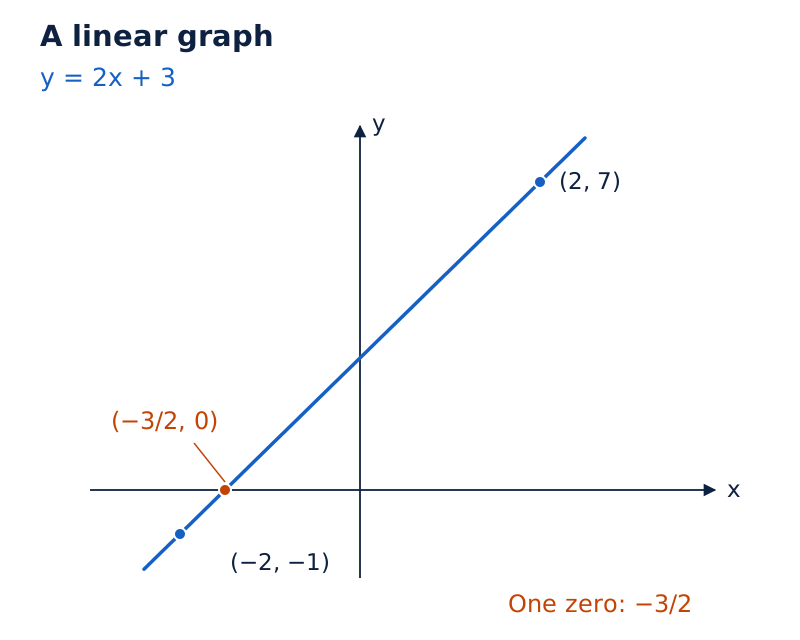
The rising straight line passes through the labelled points and . Its intersection with the -axis is labelled .
Drawn by One Young India. See Fig. 2.1 in your NCERT textbook
Do not report the whole coordinate pair when asked for the zero alone. The zero is a number. The pair describes the point on the graph associated with that number.
How do quadratic graphs show two, one or no zeroes?
The graph of , where , is a parabola. It opens upwards when and downwards when . Its zeroes are the horizontal coordinates of the points where the graph meets the -axis.
How does a table of values connect with a graph?
For , the following input-output pairs show where the graph is above, below or on the horizontal axis. The entries with zero output identify the zeroes; the other entries help describe the curve.
| Input | Output |
|---|---|
What the figure shows
Quadratic zeroes on a parabola
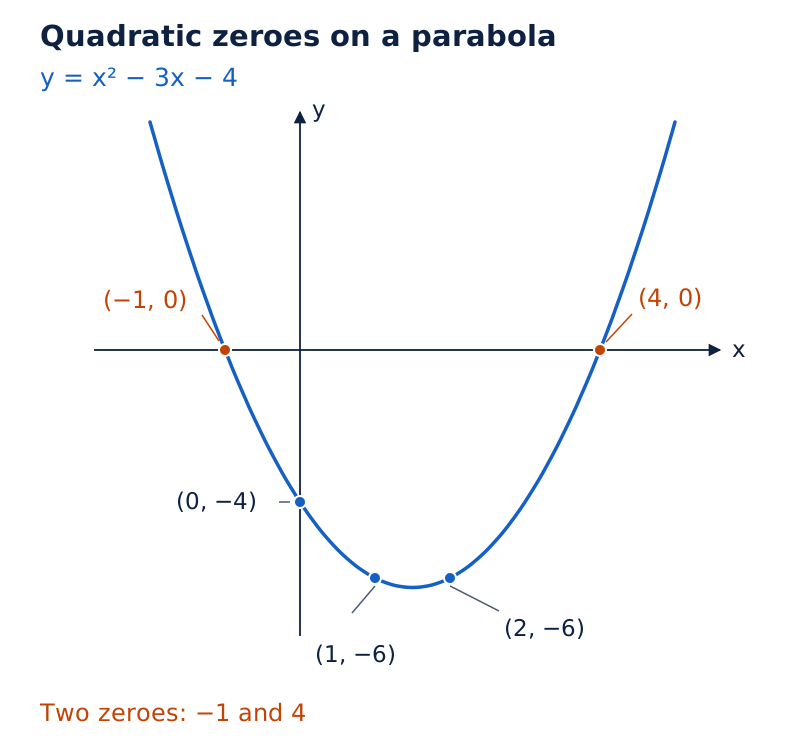
The upward-opening curve meets the horizontal axis at the labelled points and . Other labelled points include , and .
Drawn by One Young India. See Fig. 2.2 in your NCERT textbook
Result: A quadratic has at most two zeroes
A parabola can meet the horizontal axis at two distinct points, meet it at one point, or miss it altogether. Accordingly, a quadratic polynomial can have two distinct zeroes, two equal zeroes representing one distinct value, or no real zero.
| Position relative to the axis | Distinct zeroes | Interpretation |
|---|---|---|
| Meets the axis at two distinct points | Two different horizontal coordinates give zero output. | |
| Meets the axis at one point | The two zeroes coincide at the same value. | |
| Lies entirely above or below the axis | No point on the curve has zero output. |
What the figure shows
Three quadratic cases
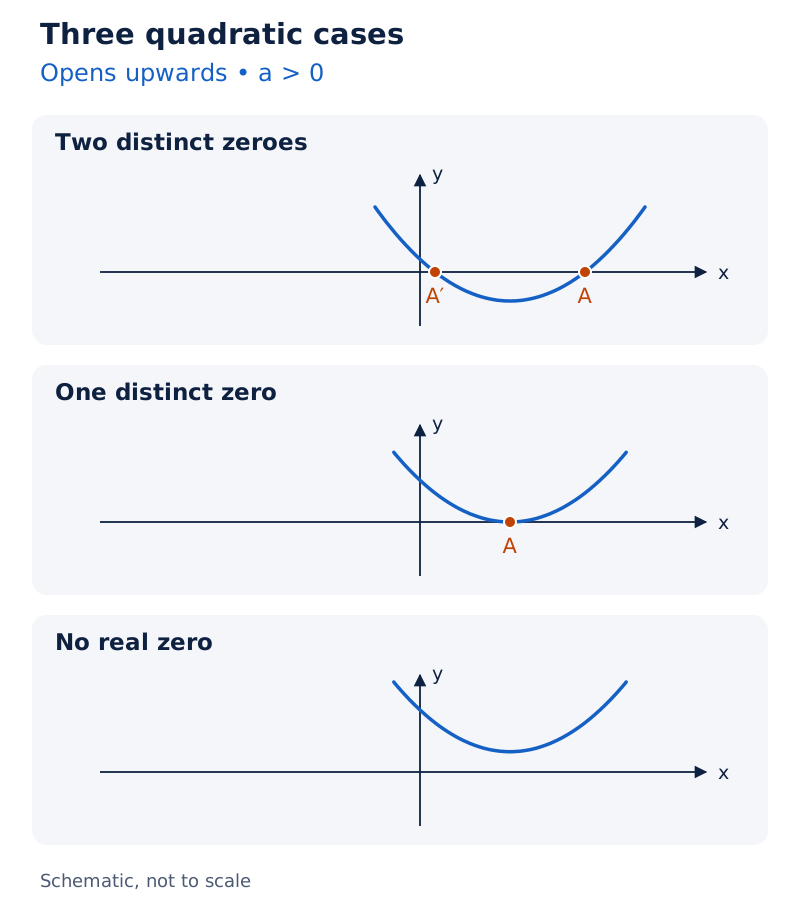
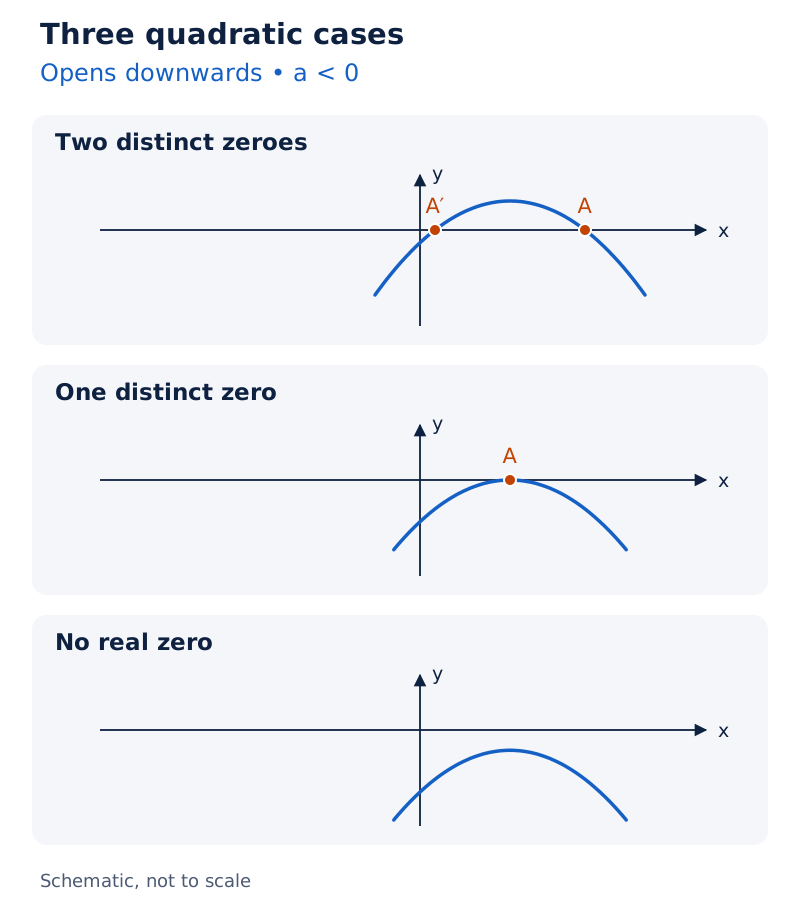
The first pair of graphs meets the horizontal axis at points labelled and . The next pair touches it at . The final pair lies entirely above or below it.
Drawn by One Young India. See Figs. 2.3, 2.4 and 2.5 in your NCERT textbook
Opening direction alone does not tell you how many zeroes exist. Look at the position of the curve relative to the horizontal axis. A touching point counts because its vertical coordinate is zero, even though the curve does not pass through the axis there.
What do cubic graphs reveal about the number of zeroes?
A cubic polynomial can have at most three zeroes. Its degree gives an upper bound, not a guarantee of three different real values. The graphs of , and illustrate different numbers of distinct zeroes.
How can three zeroes be checked directly?
Worked example 3. Check the zeroes of shown by its graph.
- Substitute the negative input and evaluate its cube first:
- Evaluate the polynomial at the origin's horizontal coordinate:
- Check the positive input:
- Compare the number of different values found with the degree: A cubic has at most three zeroes, so these three distinct values exhaust its zeroes.
Answer: the zeroes are , and .
What the figure shows
Three cubic zeroes
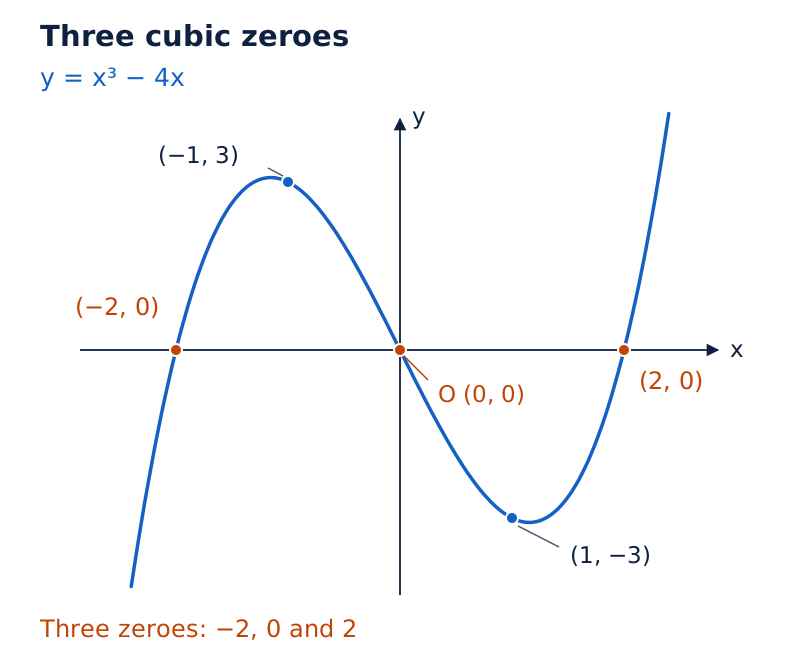
The curve meets the horizontal axis at , the origin and . The off-axis points and are also labelled.
Drawn by One Young India. See Fig. 2.6 in your NCERT textbook
How can a cubic have fewer distinct zeroes?
The polynomial has only the zero . The polynomial has two distinct zeroes, and . Factorisation explains the second statement without treating repeated factors as different horizontal coordinates.
- Take out the common squared factor:
- Set each factor equal to zero:
- Read the distinct resulting values:
What the figure shows
Cubics with fewer distinct zeroes
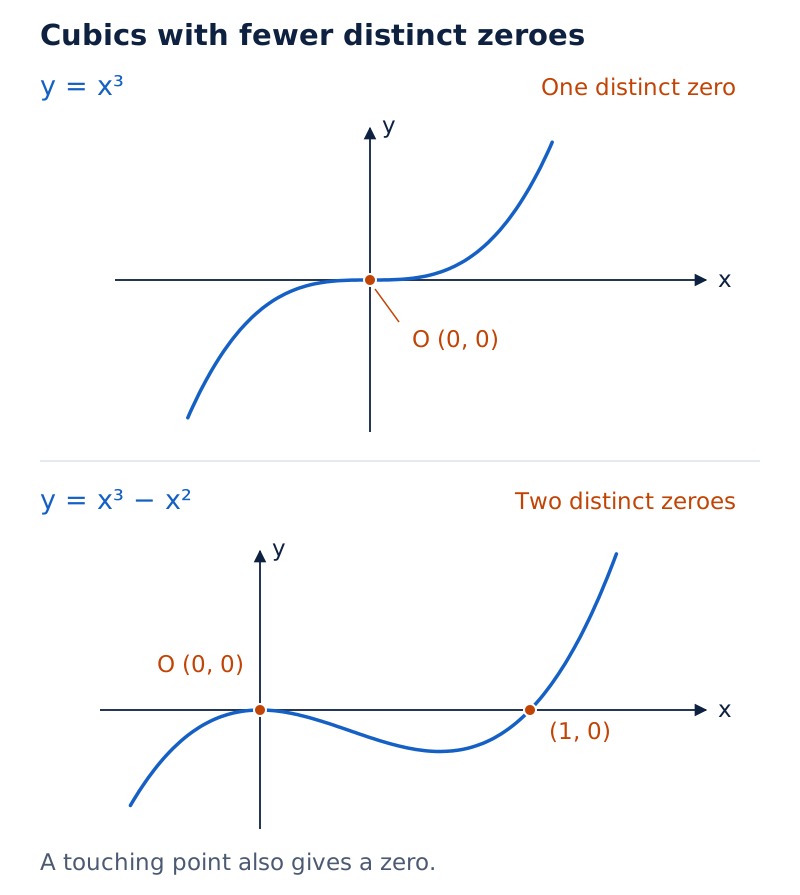
The graph of meets the horizontal axis at the origin. The graph of meets it at the origin and at .
Drawn by One Young India. See Figs. 2.7 and 2.8 in your NCERT textbook
More generally, a polynomial of degree has at most zeroes. When reading a supplied graph, count its distinct meetings with the horizontal axis rather than its bends or its intersections with the vertical axis.
How does splitting the middle term help find quadratic zeroes?
Factorisation rewrites a quadratic as a product of simpler expressions. Once the product is obtained, setting its factors equal to zero gives the zeroes. A non-zero constant multiplying the product does not create an additional zero.
When splitting the middle term of , choose two terms whose sum is and whose product is . Grouping the resulting four terms should then expose a shared factor. Retain the signs throughout.
How do you factor a quadratic with a negative middle term?
Worked example 4. Find the zeroes of .
- Identify the required split using the sum and product:
- Replace the middle term by these two terms:
- Take common factors from the two groups:
- Take out the common binomial:
- Set the variable factors equal to zero: Hence or .
- Check both values by substitution:
Answer: the zeroes are and .
How do you handle a negative constant term?
Worked example 5. Find the zeroes of .
- Choose a split with the correct sum and product:
- Split and group the middle terms:
- Factor each group, including the negative sign:
- Collect the shared binomial:
- Solve each linear condition:
- Verify the first zero:
- Verify the second zero:
Answer: the zeroes are and .
The factor does not give the zero : its coefficient must be included when solving. Factorisation produces linear equations, and these still need to be solved. Substitution then provides a direct check on the answer and on any sign changes.
Why are quadratic zeroes related to their coefficients?
Result: Sum and product of quadratic zeroes
If and are the zeroes of , where , their sum is and their product is . The letters are pronounced alpha and beta.
The two expressions have different sign conventions. The sum uses the negative of the coefficient of the linear term. The product uses the constant term with its own sign. Both are divided by the leading coefficient.
Derivation: Comparing coefficients after factorisation
- Use the factors corresponding to the two zeroes, allowing a constant multiplier:
- Multiply the two factors inside the brackets:
- Distribute the constant multiplier:
- Compare coefficients of corresponding powers and the constant terms:
- Replace the multiplier by the leading coefficient:
- Divide by the non-zero leading coefficient and rearrange:
The resulting relationships connect the factorised form to the expanded form. They allow a calculation with the zeroes to be compared with a calculation using coefficients, without confusing the roles of the different terms.
How should coefficients be identified?
First write the expression in descending powers. Include a zero coefficient when a power is absent. For , the linear coefficient is , while the constant term is . The leading coefficient is .
Note: Keep the sign attached to each coefficient. In , the linear coefficient is . Negating that coefficient in the sum formula produces a positive numerator.
These formulas describe both zeroes together. They do not identify which zero should be called alpha or beta, and exchanging those names leaves their sum and product unchanged.
How do you verify the quadratic relationships in worked examples?
A complete verification has two parts. First find the zeroes. Then calculate their sum and product and compare these with the coefficient ratios. State both comparisons so that a correct factorisation is supported by an independent coefficient check.
How does verification work with two negative zeroes?
Worked example 6. Find the zeroes of and verify both coefficient relationships.
- Identify the coefficients:
- Split the middle term and group:
- Factorise and solve the two linear conditions: Thus and .
- Check the values directly:
- Calculate the sum and compare it with the coefficient ratio:
- Calculate the product and compare it with the coefficient ratio:
Answer: the zeroes are and ; their sum is and product is . Both relationships are verified.
Two negative zeroes have a negative sum and a positive product in this example. Keep the brackets in the product until the signs have been evaluated. Merely copying the coefficient ratios would not demonstrate that the zeroes satisfy them.
Identity: Difference of two squares
The identity helps factorise a quadratic with no linear term when it is written as a difference of squares. Here the letters in the identity represent the quantities being squared.
Worked example 7. Find the zeroes of and verify the relationships.
- Express the constant as a square:
- Apply the difference-of-squares identity:
- Set each factor equal to zero: Hence and .
- Verify that both values give zero:
- Identify the coefficients, including the missing linear term:
- Check the sum:
- Check the product:
Answer: the zeroes are and . Their sum is , their product is , and both relationships hold.
How can you construct a quadratic from its zeroes' sum and product?
Finding a polynomial reverses the earlier process: instead of starting with coefficients and finding zeroes, start with the required sum and product. Choose the coefficient of the squared term, then use the two relationships to determine the remaining coefficients.
A convenient choice is a leading coefficient of . This gives one suitable polynomial. A non-zero constant multiple has the same zeroes, so the sum and product do not determine a unique quadratic unless an additional coefficient condition is imposed.
How is the coefficient method applied?
Worked example 8. Find a quadratic polynomial whose zeroes have sum and product .
- Write the required coefficient relationships:
- Choose the leading coefficient:
- Find the remaining coefficients:
- Substitute into the general quadratic form:
- Check its coefficient ratios against the required numbers:
Answer: one suitable polynomial is .
Why is the answer not unique?
The family , with real , meets the same conditions. The restriction keeps the expression quadratic. Multiplying all the coefficients by the same non-zero number leaves the relevant ratios unchanged.
- Read the coefficients after multiplying:
- Calculate the sum ratio and cancel the non-zero multiplier:
- Calculate the product ratio in the same way:
The phrase one quadratic polynomial is therefore precise. Choosing the simplest leading coefficient makes the construction shorter while preserving the required relationships.
What relationships connect cubic zeroes with their coefficients?
Result: The three cubic relationships
For a cubic polynomial , where , let the zeroes be , and . The third letter is pronounced gamma. Three coefficient relationships connect these zeroes to the expanded polynomial.
| Combination of zeroes | Coefficient relationship |
|---|---|
| Sum of the three zeroes | |
| Sum of products taken two at a time | |
| Product of the three zeroes |
The pairwise products contain each pair once. This middle relationship is different from the product of all three zeroes. Also notice the negative sign in the cubic product formula, which differs from the quadratic product formula.
How can all three relationships be verified?
Worked example 9. Verify that , and are zeroes of , then check the coefficient relationships.
- Identify the coefficients in descending powers:
- Substitute the first proposed zero:
- Substitute the negative integer, keeping its powers in brackets:
- Substitute the fractional value:
- Use a common denominator to finish this evaluation:
- Calculate the sum and its matching ratio:
- Calculate all three pairwise products before adding: Compare this with .
- Calculate the product and compare the constant-term ratio:
Answer: all three proposed values give zero, and the sum , pairwise-product sum , and product agree with the coefficients.
The substitution stage establishes that the proposed values really are zeroes. The later calculations verify the relationships. Keeping these stages separate makes the argument complete and helps locate arithmetic mistakes, particularly when a zero is a negative fraction.
Glossary
- Polynomial in one variable — A finite sum of terms consisting of real coefficients multiplied by non-negative integer powers of a single variable.
- Degree — The highest power of the variable appearing in a polynomial, used to classify its type.
- Linear polynomial — A polynomial of degree , with general form and non-zero leading coefficient.
- Quadratic polynomial — A polynomial of degree , expressed as , where the leading coefficient is non-zero.
- Cubic polynomial — A polynomial of degree , expressed as , with a non-zero leading coefficient.
- Value of a polynomial — The result obtained by replacing the variable with a particular number and evaluating the expression.
- Zero of a polynomial — A real number which, when substituted for the variable, makes the polynomial's value equal to zero.
- Coefficient — A numerical multiplier of a power of the variable, retaining its sign when identified.
- Leading coefficient — The coefficient of the highest-power term, represented by in the general linear, quadratic and cubic forms.
- Constant term — The term independent of the variable, used in the product relationships for quadratic and cubic zeroes.
- Parabola — The curve representing a quadratic polynomial, opening upwards or downwards according to its leading coefficient's sign.
- Factorisation — Rewriting a polynomial as a product of factors, which can help determine its zeroes.
- Equal zeroes — Two quadratic zeroes that coincide, corresponding to one distinct meeting point with the horizontal axis.
- Pairwise products — Products of cubic zeroes taken two at a time, whose sum is related to the linear coefficient.
Common errors and misconceptions
- Misconception: A quadratic must have two different real zeroes. Correct: It has at most two. Its graph may meet the horizontal axis at two points, touch it at one point, or have no meeting point.
- Misconception: A zero is the vertical coordinate of an intersection. Correct: The zero is the horizontal coordinate of a point where the graph meets the -axis; the vertical coordinate there is zero.
- Misconception: Touching the horizontal axis does not count. Correct: A touching point also has zero vertical coordinate. It therefore identifies a zero, even when the curve does not cross the axis.
- Misconception: The quadratic sum is . Correct: It is . Keep the coefficient's own sign before applying the extra negative sign required by the formula.
- Misconception: Both quadratic relationships use a negative sign before the ratio. Correct: The product is , while the sum is . A negative constant retains its own sign.
- Misconception: In , the linear coefficient is . Correct: The linear term is absent, so . The constant is , and the leading coefficient is .
- Misconception: A given sum and product determine exactly one quadratic polynomial. Correct: Non-zero constant multiples preserve the zeroes. For sum and product , the family is , with .
- Misconception: A cubic's pairwise-product sum equals its three-zero product. Correct: They are separate expressions: , whereas .
Exam-style questions with model answers
Q1. Define a zero of a polynomial and state its geometrical meaning. [2 marks]
- A real number is a zero of if .
- Geometrically, it is the horizontal coordinate of a point where the graph of meets the -axis. That point has vertical coordinate zero.
Q2. Find the zero of and check your answer. [2 marks]
- Set the polynomial equal to zero: .
- Subtract the constant and divide: , so .
- Check by substitution: . Hence the zero is , which is the horizontal coordinate of its axis intersection.
Q3. Explain the possible numbers of real zeroes of a quadratic polynomial using its graph. [3 marks]
- The graph of , with , is a parabola. The zeroes are the horizontal coordinates of its meetings with the horizontal axis.
- Two distinct meeting points give two different zeroes. If the parabola touches the axis at one point, the zeroes coincide, giving one distinct zero.
- If the graph lies entirely above or below the axis, there is no real zero. Thus a quadratic has at most two zeroes, rather than necessarily two distinct zeroes.
Q4. Find the zeroes of and verify their sum and product. [3 marks]
- Write the expression as a difference of squares: .
- Set the factors equal to zero: or . The zeroes are therefore and .
- Identify the coefficients carefully: , , . The missing linear term has zero coefficient.
- The sum is , agreeing with . The product is , agreeing with . Both required relationships are verified.
Q5. Derive the relationships between the zeroes and coefficients of a quadratic polynomial. [5 marks]
- Let and be the zeroes of , where . Their corresponding linear factors are and .
- Include a constant multiplier to account for the leading coefficient:
- Expand the factors and distribute the multiplier:
- Compare matching coefficients on both sides: This links the expanded polynomial with its factorised form.
- Replace by and divide by the non-zero leading coefficient: Thus the sum uses the negative linear coefficient, while the product uses the constant term; both are divided by the quadratic coefficient.
Q6. Find the zeroes of and verify the relationships with its coefficients. [5 marks]
- Compare with the general quadratic form to identify , , and . These coefficients will be used after finding the zeroes.
- Split the middle term and group:
- Set each factor equal to zero: or . Hence the zeroes are and .
- Calculate the sum directly: . Independently, the coefficient ratio is , so the sum relationship holds.
- Calculate the product directly: . The coefficient ratio is , so the product relationship holds as well. Both comparisons agree with the zeroes obtained by factorisation, completing the required verification.
Q7. Find a quadratic polynomial whose zeroes have sum and product . Explain whether the answer is unique. [3 marks]
- For , use and . Choose to obtain a simple polynomial.
- The first relation gives , so . The second gives . One suitable polynomial is therefore .
- The answer is not unique: , for real , has the same coefficient ratios and zeroes. The non-zero condition ensures that the resulting expression remains a quadratic polynomial.
Key takeaways
- The degree is the highest power of the variable; linear, quadratic and cubic polynomials have degrees , and , respectively.
- A zero is an input giving zero output; geometrically, it is a horizontal coordinate where the polynomial graph meets the horizontal axis.
- A linear polynomial with a non-zero leading coefficient has exactly one zero, found by setting its value equal to zero.
- A quadratic can have two distinct zeroes, one distinct zero from equal zeroes, or no real zero, as its graph illustrates.
- Factorisation turns the search for quadratic zeroes into solving linear conditions; preserve coefficients and signs when solving each factor.
- For quadratic zeroes, the sum is and the product is ; check both against values found by factorisation.
- A prescribed sum and product determine a suitable quadratic after choosing its leading coefficient; non-zero constant multiples preserve the zeroes.
- Cubic coefficient relationships involve the sum, the sum of pairwise products, and the product of three zeroes as separate expressions.
Test yourself
What distinguishes a quadratic polynomial from a linear polynomial?
A quadratic has degree , while a linear polynomial has degree . Classify by the highest power, not the number of terms.
Does the input zero have to be a zero of every polynomial?
No. A number is a zero only if its polynomial value vanishes. For , the value does not vanish.
Which coordinate of a horizontal-axis intersection gives a zero?
The horizontal coordinate gives the zero of the polynomial. The vertical coordinate of that intersection is zero.
How many distinct zeroes does a parabola touching the horizontal axis at one point have?
It has one distinct zero. The two equal zeroes correspond to the same horizontal coordinate at the touching point.
What is the linear coefficient in ?
The linear coefficient is , because the expression contains no linear term. Its constant term is , and its leading coefficient is .
Can a cubic polynomial have only one distinct zero?
Yes. The polynomial has only the zero ; degree gives an upper limit on the number of zeroes.
Which sign appears before the cubic constant-term ratio in the product relationship?
The relationship has a negative sign: . This differs from the quadratic product relationship, which is .
Why can more than one quadratic have the same zeroes?
Multiplying a quadratic by a non-zero constant preserves its zeroes, so different coefficient sets can describe polynomials with the same zeroes.
Try it yourself
Try this chapter in the Algebra lab.
Open the Algebra lab, change the inputs and watch what happens. The 2D version is free with a Learnacy account.
Learnacy Essential adds feedback from an AI writing coach and submission to The OYI Review, editorial review and publication of one accepted paper, the Model NITI Aayog self-paced course, World 101’s member tools and Learnacy Labs in 3D. Publication is not guaranteed. ₹1,499 for the year.
Or create a free account to draft in the Writing Studio, explore World 101’s map and open the 2D version of every lab. Create a free account