
Patterns in Mathematics | CBSE Class 6 Maths Notes
On this page
This note covers mathematical patterns, rules for lists of numbers, pictures made with dots and cubes, connections formed by adding numbers, sequences of shapes, and counting sides, corners, connecting lines and smaller shapes.
What does it mean to look for patterns in mathematics?
Mathematics is, in large part, a search for patterns and explanations of why those patterns exist. A pattern is a recognisable regularity, such as a repeated arrangement or a rule connecting successive numbers or shapes.
Patterns occur in nature, homes and schools, and in the motion of the sun, moon and stars. Shopping, cooking, throwing a ball and playing games also involve patterns. Understanding weather and using technology provide further settings in which mathematical ideas matter.
Why does the explanation matter?
Finding a pattern answers the question, “What happens?” Explaining it answers the question, “Why does it happen?” Both belong to mathematical work. An explanation can often be used in applications well beyond the setting in which the pattern was discovered.
The search can involve imagination and creativity as well as careful reasoning. This is why mathematics can be considered both an art and a science. Drawing, arranging objects and comparing results can help turn a noticed regularity into something that can be understood.
Number theory studies patterns in whole numbers. Whole numbers are 0, 1, 2, 3, 4, and so on. Geometry studies patterns in shapes. These two areas connect when a drawing helps explain a numerical pattern.
How should a pattern be investigated?
- Observe the numbers or shapes carefully and identify what is repeated or changed.
- Describe the rule in words so that another person can follow it.
- Use that rule to continue the sequence, which is an ordered list of numbers or shapes.
- Look for an explanation using a picture, a calculation or a comparison with another sequence.
A term is an entry in a sequence. When studying terms, pay attention to both their values and their positions. The task is to understand how the arrangement develops, rather than merely remember the first few entries.
How are the basic number sequences recognised?
A number sequence is an ordered list of numbers. Its rule describes how its terms are formed. Some sequences keep the same value throughout, some increase by adding, and others increase by multiplying or combining earlier terms.
In the lists below, the symbol ..., called an ellipsis, means that the sequence continues. A comma separates one term from the next. Read each list from left to right and compare neighbouring entries before deciding on its rule.
All 1’s repeats 1. Counting numbers begin with 1 and increase by 1. The positive odd numbers begin with 1 and increase by 2; the positive even numbers begin with 2 and increase by 2.
Triangular numbers count dots arranged in triangular rows. Squares count dots arranged in square grids. Cubes count small cubes forming larger cubes. These names connect numbers with arrangements, which will be examined more closely below.
Virahānka numbers begin with 1 and 2, with each later term found by adding the previous two. Powers of 2 begin with 1 and repeatedly double. Powers of 3 begin with 1 and repeatedly triple.
Which sequences should be familiar?
| Sequence | Terms |
|---|---|
| All 1’s | 1, 1, 1, 1, 1, 1, 1, ... |
| Counting numbers | 1, 2, 3, 4, 5, 6, 7, ... |
| Odd numbers | 1, 3, 5, 7, 9, 11, 13, ... |
| Even numbers | 2, 4, 6, 8, 10, 12, 14, ... |
| Triangular numbers | 1, 3, 6, 10, 15, 21, 28, ... |
| Squares | 1, 4, 9, 16, 25, 36, 49, ... |
| Cubes | 1, 8, 27, 64, 125, 216, ... |
| Virahānka numbers | 1, 2, 3, 5, 8, 13, 21, ... |
| Powers of 2 | 1, 2, 4, 8, 16, 32, 64, ... |
| Powers of 3 | 1, 3, 9, 27, 81, 243, 729, ... |
How is a rule used?
The symbol + means addition, and = means that the expressions on its two sides have equal values. A sum is the result of addition. These symbols let a rule be written as a calculation.
Worked example 1. Continue the odd-number sequence 1, 3, 5, 7, 9 by one term.
Answer: Add 2 to the last given term: 9 + 2 = 11. The next term is 11, because the same increase of 2 links the earlier neighbouring terms.
Worked example 2. Find the term after 13 in the Virahānka sequence 1, 2, 3, 5, 8, 13.
Answer: Add the previous two terms, 8 and 13. Since 8 + 13 = 21, the next term is 21. This rule uses two earlier terms rather than one fixed increase.
How do pictures explain triangular numbers, squares and cubes?
Visualising means using a picture or diagram to understand an idea. A number can be represented by that many dots, and the arrangement of the dots may reveal a rule that is less obvious in a written list.
What the figure shows
Pictures of number sequences
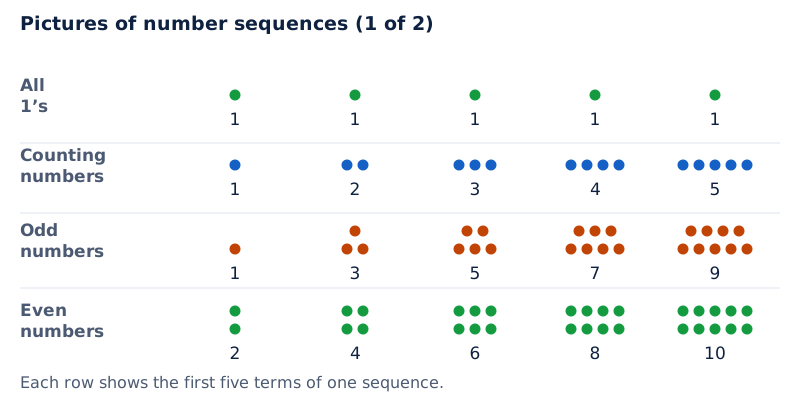
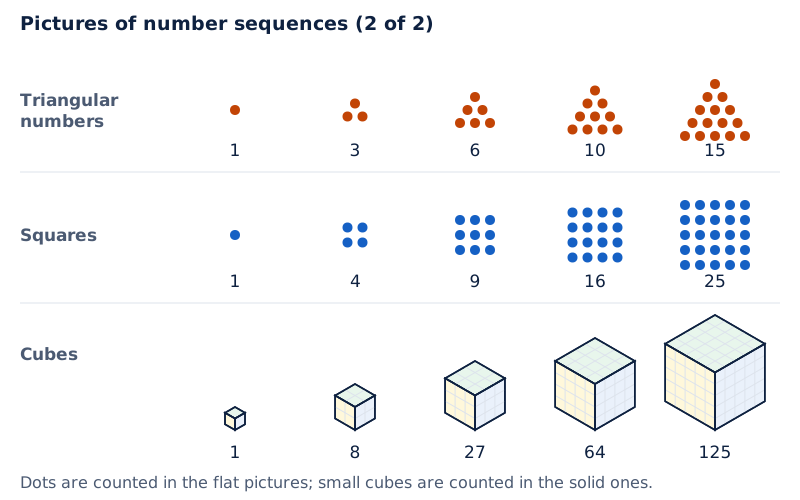
The first rows show single dots, growing rows of dots, and arrangements for odd and even numbers. Later rows show triangular dot arrangements, square dot grids and larger cubes built from smaller cubes.
Drawn by One Young India. Reference: NCERT Class 6 Table 2, page 4
What does each arrangement count?
A triangle is a closed shape with three straight sides. A triangular arrangement has successive rows containing 1, 2, 3 and further counting numbers of dots. Adding these rows gives 1, 3, 6, 10 and 15. These are the first triangular numbers shown in the pictures.
A square grid has the same number of dots in each row and the same number of rows. The displayed square pictures contain 1, 4, 9, 16 and 25 dots. A row is a line of dots across the arrangement.
The symbol × means multiplication. For example, 3 × 3 counts three rows of three dots. The notation 3², read “three squared”, means 3 × 3. The raised 2 indicates that two equal factors are multiplied; factors are the numbers being multiplied.
In a cube arrangement, count equal numbers of small cubes along its length, width and height. The notation 3³, read “three cubed”, means 3 × 3 × 3. The raised 3 indicates three equal factors.
Worked example 3. Explain the square number 9 and the cube number 27 using arrangements with 3 along each direction.
Answer: A square grid with 3 rows of 3 dots contains 3 × 3 = 9 dots. A cube with 3 small cubes along each of its three directions contains 3 × 3 × 3 = 27 small cubes.
Can one number have two different arrangements?
Yes. 36 is both triangular and square. Its dots can be arranged as a triangle or as a square. The same number can therefore have different representations and play different roles, depending on the context.
To compare the two pictures, keep the total number of dots unchanged and alter their arrangement. Calling a number triangular does not prevent it from also being a square number. The names describe possible arrangements rather than exclusive categories.
How do powers and hexagonal numbers appear in pictures?
A power expresses repeated multiplication by the same number. In the powers-of-2 sequence, each term after the first is twice the preceding term. In the powers-of-3 sequence, each term after the first is three times the preceding term.
The two sequences share a starting value of 1, but their repeated multiplications differ. Follow the multiplier, meaning the number by which a term is multiplied, rather than assume that every increasing sequence is formed by adding a fixed amount.
What does the powers-of-2 picture show?
What the figure shows
One possible picture for powers of 2
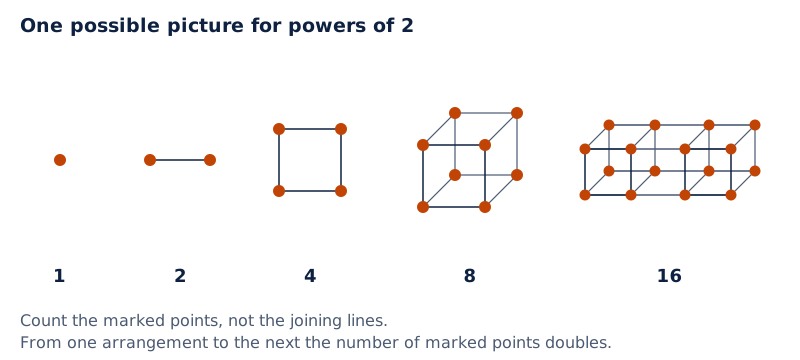
The drawing shows arrangements labelled 1, 2, 4, 8 and 16. A single point is followed by two joined points, four corners of a square, eight corners of a cube, and two connected cube drawings.
Drawn by One Young India. Reference: NCERT Class 6, page 6
This is one possible way to picture powers of 2. Count the marked points rather than the joining lines. From one arrangement to the next, the number of marked points doubles, connecting the drawings with 1, 2, 4, 8 and 16.
What are the hexagonal numbers used here?
Hexagonal numbers here are the counts 1, 7, 19, 37 and so on, shown by dots arranged around a centre in a six-sided pattern. A six-sided polygon, or closed shape made of straight sides, is called a hexagon.
What the figure shows
Hexagonal dot arrangements
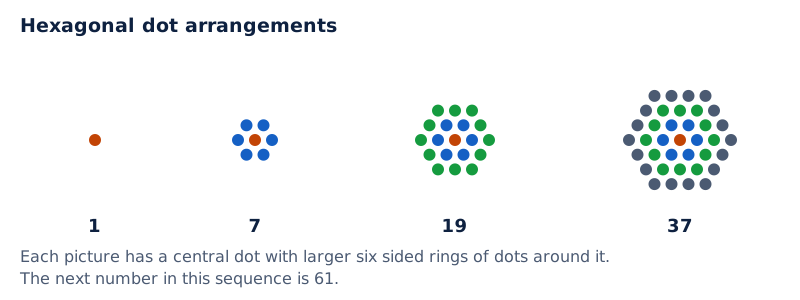
Four red-dot pictures are labelled 1, 7, 19 and 37. The first is a single dot. The later pictures have a central dot surrounded by successively larger six-sided arrangements of dots.
Drawn by One Young India. Reference: NCERT Class 6, page 5
The next number in this sequence is 61. The connection with triangular numbers gives another way to understand these counts, developed below. A useful drawing records both the total and the organisation of the dots, because the organisation helps explain how the sequence grows.
Pictures need a clear choice of what is being counted. A dot arrangement counts dots, a cube construction counts small cubes, and a line drawing may invite a count of corners or lines. These quantities should not be mixed within the same sequence.
Why does adding odd numbers give square numbers?
Result: Odd-number sums form squares
Adding the odd numbers starting with 1 gives the square numbers. The starting point and the order matter: this result concerns the first odd numbers taken consecutively, meaning one after another without skipping an entry.
| Odd numbers added | Sum |
|---|---|
| 1 | 1 |
| 1 + 3 | 4 |
| 1 + 3 + 5 | 9 |
| 1 + 3 + 5 + 7 | 16 |
| 1 + 3 + 5 + 7 + 9 | 25 |
| 1 + 3 + 5 + 7 + 9 + 11 | 36 |
The sums form 1, 4, 9, 16, 25 and 36. The pattern continues beyond these cases. A picture explains why: a square grid can be divided into groups containing successive odd numbers of dots.
What the figure shows
Odd-number groups inside a square
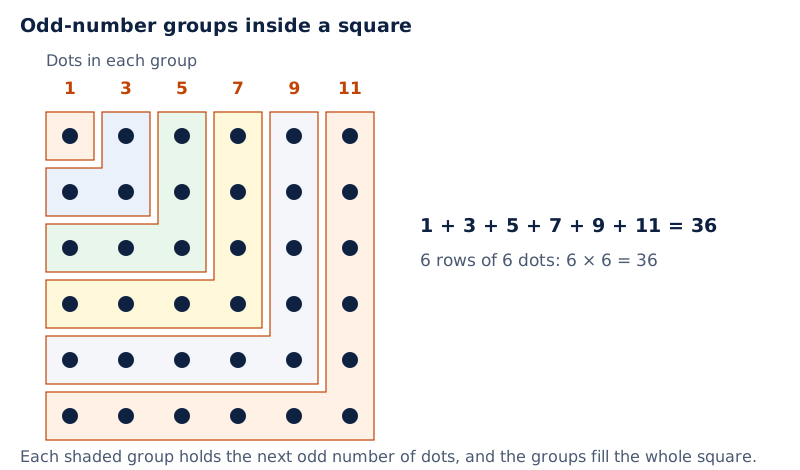
A square grid contains six rows of six black dots. Red dividing lines separate successive groups of 1, 3, 5, 7, 9 and 11 dots, showing that their sum is 36.
Drawn by One Young India. Reference: NCERT Class 6, page 7
Why does the picture explain more than one example?
The same grouping can be made in a square of any size. Starting from a single dot, each new outer group extends the smaller square to the next square. Counting the added groups and counting the complete square therefore give the same total.
The key is that the drawing shows a repeatable construction. It is not merely a check of a single addition. This explains why continuing the odd-number sums continues to produce square numbers.
Worked example 4. Find the sum of the first 10 odd numbers and the sum of the first 100 odd numbers, both starting with 1.
Answer: The first 10 odd-number groups make a square with 10 dots in each row and 10 rows, giving 10 × 10 = 100. The first 100 groups make a square with 100 rows of 100 dots, giving 100 × 100 = 10,000.
These larger sums can be understood by imagining the same construction. Drawing every dot is unnecessary once the reason for the grouping is clear. The size of the square is determined by how many odd-number groups have been included.
What happens when counting numbers are added up and down?
Adding up and down means increasing through the counting numbers to a chosen highest number and then decreasing back to 1. The highest number appears once. The sequence of sums starts with the single number 1.
| Addition up and down | Sum |
|---|---|
| 1 | 1 |
| 1 + 2 + 1 | 4 |
| 1 + 2 + 3 + 2 + 1 | 9 |
| 1 + 2 + 3 + 4 + 3 + 2 + 1 | 16 |
| 1 + 2 + 3 + 4 + 5 + 4 + 3 + 2 + 1 | 25 |
| 1 + 2 + 3 + 4 + 5 + 6 + 5 + 4 + 3 + 2 + 1 | 36 |
This seems to be another way of obtaining square numbers. To understand why, a square dot arrangement can be viewed from a corner. Its successive diagonal groups increase to the longest group and then decrease.
How can a turned square help?
Diagram
A square viewed from a corner
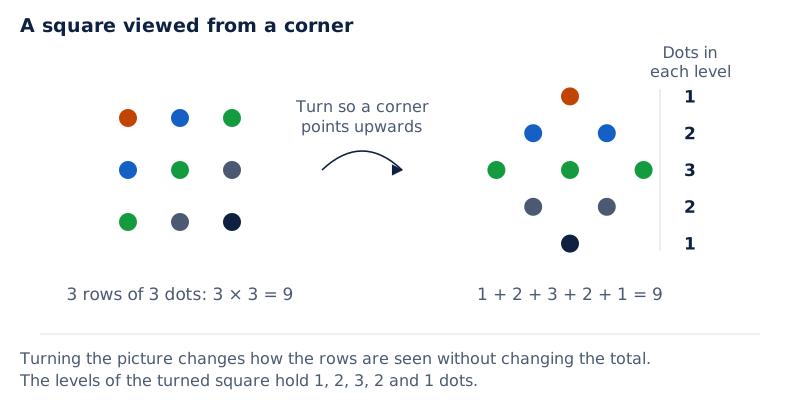
Draw nine dots in a three-by-three square grid, then turn the page so that a corner points upwards. The horizontal levels of dots now contain 1, 2, 3, 2 and 1 dots.
Drawn by One Young India.
Turning the picture changes how its rows are seen without changing its total. The diagonal groups, which run obliquely across the original grid, give the up-and-down addition. Counting the original square gives the same total by multiplication.
Worked example 5. Evaluate 1 + 2 + 3 + ... + 99 + 100 + 99 + ... + 3 + 2 + 1, where the numbers rise by 1 to 100 and then fall by 1 to 1.
Answer: Imagine the diagonal groups of a square with 100 rows of 100 dots. Their lengths rise to 100 and fall to 1, matching the given addition. The total is therefore 100 × 100 = 10,000.
What is different about adding All 1’s?
Adding successively more entries from All 1’s gives the counting numbers. Adding its entries up and down around a single middle entry gives the odd numbers: the arrangements contain one entry, then three entries, then five entries, and continue in this way.
Keep the operation separate from the starting sequence. The same instruction, “add up”, produces different results when applied to All 1’s, counting numbers or odd numbers, because the entries being added are different.
How are triangular numbers connected with squares?
Adding the counting numbers successively gives triangular numbers. The additions begin with 1, then 1 + 2, then 1 + 2 + 3, and continue by including the next counting number. Each new row extends the triangular arrangement.
How does the triangular arrangement grow?
- Begin with one dot, giving the first triangular number, 1.
- Add a row containing two dots. The total becomes 3.
- Add a row containing three dots. The total becomes 6.
- Continue with a row of four dots and then a row of five dots, producing totals of 10 and 15.
The row added at each stage is longer than the preceding row. This explains why triangular numbers do not increase by a fixed amount, even though their construction follows a regular rule.
Result: Consecutive triangular numbers add to squares
Adding consecutive triangular numbers, meaning neighbouring entries of their sequence, gives square numbers. The pairs 1 and 3, 3 and 6, 6 and 10, and 10 and 15 show this connection.
| Consecutive triangular numbers | Square total |
|---|---|
| 1 + 3 | 4 |
| 3 + 6 | 9 |
| 6 + 10 | 16 |
| 10 + 15 | 25 |
Worked example 6. Use the consecutive triangular numbers 10 and 15 to find a square number.
Answer: Add the two given numbers: 10 + 15 = 25. The total is a square number because 25 dots can be arranged in a square with five rows of five dots.
Why can the two triangles fit a square?
A square dot grid can be separated into two triangular groups, with its main diagonal included in one group. That diagonal joins opposite corners of the square. One triangular group therefore has an additional row compared with the other.
For the square with 25 dots, the groups contain 15 and 10 dots. Rearranging the groups as two triangles or combining them as one square preserves their total. This supplies a pictorial explanation of the addition.
The relation is about neighbouring triangular numbers. Identifying the two terms and checking that they are consecutive is part of applying it correctly. Simply choosing any two triangular numbers does not describe this construction.
What other connections link the number sequences?
Sometimes, number sequences can be related to one another in surprising ways. A useful approach is to apply one operation repeatedly, record its results in order, and check whether those results belong to a sequence already recognised.
What happens when powers of 2 are added?
Begin with 1 and successively include the next power of 2. The sums are 1, 3, 7, 15 and 31. Adding 1 to each sum gives 2, 4, 8, 16 and 32, which are powers of 2.
Worked example 7. Add the powers of 2 given by 1, 2, 4 and 8. Then increase the sum by 1.
Answer: First, 1 + 2 + 4 + 8 = 15. Then 15 + 1 = 16. The result is the next power of 2 after 8, illustrating that these successive sums are one less than a power of 2.
The relationship continues as the next power is included. A sum that is one less than the next power becomes one less than twice that power after the power is added. This explains why the extra 1 restores a power of 2.
How do triangular numbers produce hexagonal numbers?
Multiply each triangular number by 6 and then add 1. Starting from 1, 3, 6, 10 and 15 gives 7, 19, 37, 61 and 91. These are hexagonal numbers following the initial single-dot arrangement.
Brackets group parts of a calculation. In the following calculations, the multiplication inside the brackets is completed before 1 is added.
Worked example 8. Apply “multiply by 6, then add 1” to the triangular numbers 1, 3, 6 and 10.
Answer: The calculations are (1 × 6) + 1 = 7, (3 × 6) + 1 = 19, (6 × 6) + 1 = 37 and (10 × 6) + 1 = 61.
Result: Hexagonal-number sums form cubes
Successively adding the hexagonal numbers gives cube numbers: 1 is followed by 1 + 7 = 8, then 1 + 7 + 19 = 27, then 1 + 7 + 19 + 37 = 64.
What the figure shows
A cube and a hexagonal dot arrangement
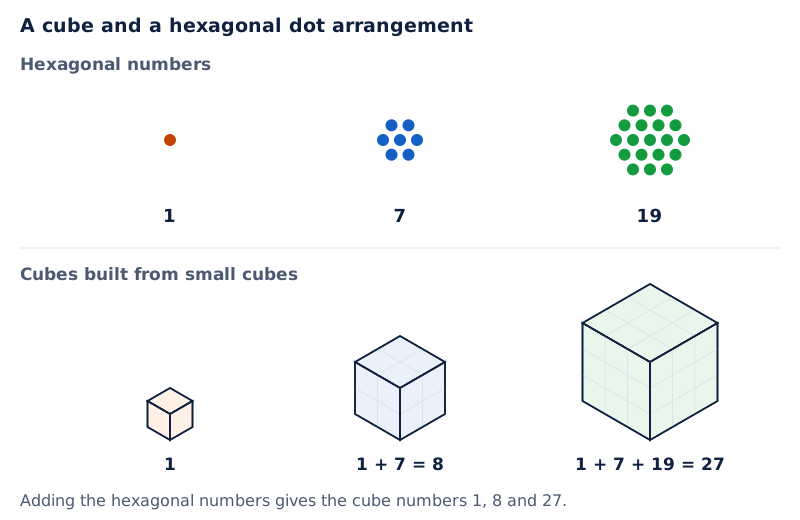
The illustration places a subdivided cube beside a hexagonal arrangement of dots. Both use blue, red and yellow parts, inviting a comparison between the cube construction and the dot pattern.
Drawn by One Young India. Reference: NCERT Class 6, page 9
The connection is between the running totals, meaning totals formed as successive entries are included, and cube numbers. The individual hexagonal numbers are the amounts added, while the resulting totals belong to a different sequence.
How do regular polygons connect shapes with counting numbers?
A shape sequence is an ordered series of shapes following a pattern. Shapes may have one, two or three dimensions, or even more. Dimensions describe the independent directions of extent: length, width and height are familiar examples.
The abbreviations 1D, 2D and 3D mean one-dimensional, two-dimensional and three-dimensional. Studying shape sequences often reveals relationships with number sequences, helping to explain both the shapes and the associated counts.
What makes a polygon regular?
A regular polygon is a closed shape made of straight sides with equal side lengths and equal angles. An angle describes the opening between two sides that meet. A corner, also called a vertex, is their meeting point.
Both requirements for regularity matter. The sides must have equal lengths, and the corners must have equal angles. In the regular polygon sequence, a triangle is followed by a square, then polygons with successively more sides.
| Regular polygon | Number of sides | Number of corners |
|---|---|---|
| Triangle | 3 | 3 |
| Quadrilateral, here a square | 4 | 4 |
| Pentagon | 5 | 5 |
| Hexagon | 6 | 6 |
| Heptagon | 7 | 7 |
| Octagon | 8 | 8 |
| Nonagon | 9 | 9 |
| Decagon | 10 | 10 |
Why do sides and corners give the same sequence?
Counting sides gives 3, 4, 5, 6, 7, 8, 9 and 10. Counting corners gives the same sequence. Moving once around any of these polygons, each side leads to the next corner, so the two counts match.
Quadrilateral means a four-sided polygon; the regular quadrilateral displayed here is a square. Pentagon, heptagon, octagon, nonagon and decagon name polygons with five, seven, eight, nine and ten sides respectively. The table connects each name directly to its count.
This example shows how a property of a shape supplies a numerical rule. To continue the displayed sequence, increase the number of sides and corners together, while preserving equal sides and equal angles.
What can be counted in complete graphs and stacked shapes?
A complete graph is a drawing of chosen points in which every pair of points is joined by a line. Here a graph means a network of points and connecting lines. It does not mean a plot of measured data.
The notation K₂ names the complete graph with two chosen points. Similarly, K₃, K₄, K₅ and K₆ have three, four, five and six chosen points. The small numeral records the number of points, not the number of joining lines.
What the figure shows
Shape sequences to count
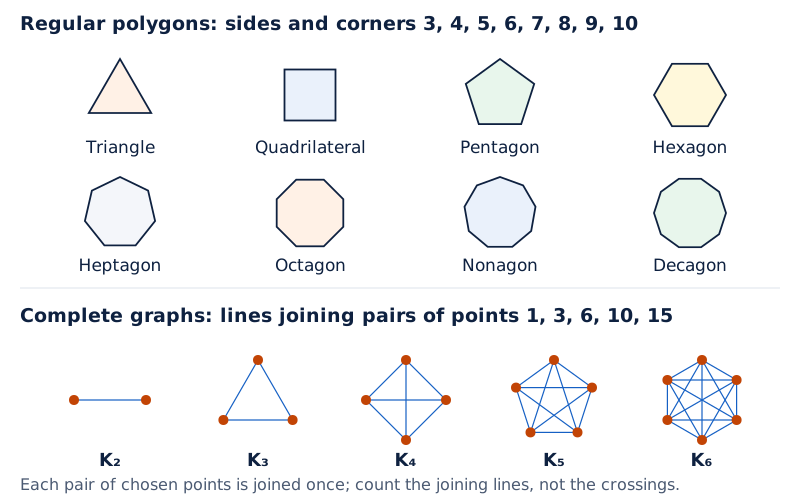
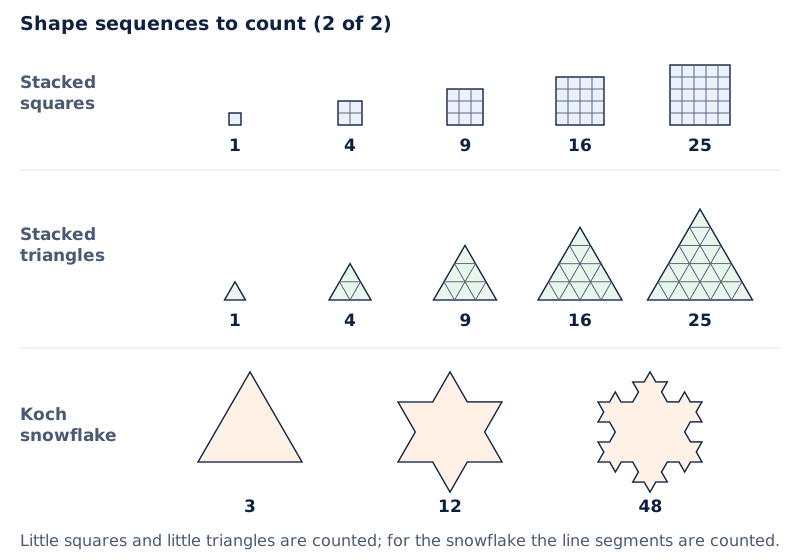
Rows show regular polygons, complete graphs labelled K₂ to K₆, stacked squares, stacked triangles and successive Koch snowflake shapes. The square and triangle constructions contain increasing numbers of little shapes.
Drawn by One Young India. Reference: NCERT Class 6 Table 3, page 10
Why do complete graphs give triangular numbers?
The complete graphs with two through six chosen points have 1, 3, 6, 10 and 15 connecting lines. Each new point must be connected to all earlier points, so the numbers of new lines follow the counting numbers.
Worked example 9. A complete graph on four chosen points has 6 joining lines. Add a fifth point and join it to each of the four existing points. How many lines are there now?
Answer: The fifth point requires 4 new lines. Keeping the original 6 gives 6 + 4 = 10 lines. This explains the move from 6 to 10 in the triangular-number sequence.
Count each line joining a chosen pair once. A crossing of drawn lines is not an additional chosen point in this construction. Keeping track of the original points prevents the picture from becoming a misleading counting exercise.
Why do both stacked sequences give squares?
The stacked squares are square arrangements of little squares. Their counts are 1, 4, 9, 16 and 25. Counting the little squares in each row and the number of rows explains these square-number totals.
The stacked triangles are larger triangular arrangements made from little triangles. Their totals are also 1, 4, 9, 16 and 25. The rows contain successive odd numbers of little triangles, linking their totals to the odd-number addition pattern.
A triangular outline therefore need not give triangular-number totals. The answer depends on what is being counted and how those pieces are arranged. Here the little triangles fill rows with odd-number counts, producing squares.
How does the Koch snowflake produce a number sequence?
The Koch snowflake is a sequence of shapes built by repeatedly replacing each straight line segment with a small outward “speed bump”. A line segment is a straight part between two endpoints. Each replacement consists of four shorter segments.
An iteration is one repetition of this replacement step across the shape. The sequence begins with a triangle. Repeating the operation makes the changes tinier and tinier, with very small line segments appearing in later shapes.
How does the segment count change?
- Begin with the triangle, which has 3 line segments.
- Replace every original segment with the four-segment bump, producing 12 segments.
- Apply the replacement to every segment again, producing 48 segments.
- Continue the same rule; the next displayed counts are 192 and 768 segments.
The count is multiplied by 4 at every step because each segment is replaced by four. The sequence is therefore 3 times powers of 4. Powers of 4 follow the same repeated-multiplication idea already used for powers of 2 and 3.
Worked example 10. A Koch snowflake stage has 12 line segments. Each is replaced by four smaller segments. Find the next count and compare it with the starting triangle’s count of 3.
Answer: The next stage has 12 × 4 = 48 segments. Compared with the starting triangle’s 3 segments, 48 is 16 times as many, or 45 more segments. Beginning with 3, the successive counts are 3, 12 and 48. Each replacement step multiplies the previous count by 4.
What should be recorded when studying a shape sequence?
State the starting shape, explain the change from one shape to the next, and identify the object counted. For the Koch snowflake, count line segments. For complete graphs, count joining lines; for stacked constructions, count the specified little shapes.
Note: An increasing number of line segments does not mean that each segment is getting longer. In this construction, repeated replacements create more segments while the individual segments become smaller. The count and the appearance must be described separately.
Across these examples, shapes make number patterns visible, while numerical counts help organise the shapes. A complete explanation connects the construction rule with the resulting sequence, showing why the same operation produces the next count.
Glossary
- Pattern — A recognisable regularity in numbers, shapes or arrangements that can be investigated and explained.
- Number sequence — An ordered list of numbers whose entries can be examined for a formation rule.
- Term — One entry in a sequence, considered together with its position in that sequence.
- Number theory — The branch of mathematics concerned with studying patterns in whole numbers.
- Geometry — The branch of mathematics concerned with studying patterns in shapes and their arrangements.
- Triangular numbers — Numbers counting triangular dot arrangements, obtained by adding successive counting numbers starting with one.
- Square numbers — Numbers counting square grids with equal numbers of rows and dots in each row.
- Cube numbers — Numbers counting small cubes in larger cubes with equal counts along three directions.
- Virahānka numbers — A sequence beginning with one and two, each later term adding the previous two.
- Consecutive terms — Entries that follow one another in a sequence without any intervening entry being skipped.
- Regular polygon — A closed straight-sided shape having both equal side lengths and equal angles.
- Complete graph — A network of chosen points with one joining line connecting each pair of points.
- Iteration — One repetition of a construction step, such as replacing every Koch snowflake segment.
Common errors and misconceptions
- Misconception: Whole numbers and counting numbers begin at the same number. Correct: Whole numbers include 0; the counting-number sequence shown here begins with 1.
- Misconception: Every sequence increases by adding a fixed number. Correct: Powers of 2 double, while Virahānka numbers use the sum of the previous two terms.
- Misconception: A triangular number cannot also be square. Correct: The number 36 permits both a triangular dot arrangement and a square dot arrangement.
- Misconception: Adding any collection of odd numbers gives the stated square pattern. Correct: The result uses consecutive odd numbers starting with 1.
- Misconception: Adding up and down repeats the highest number. Correct: The highest number appears once, as in 1 + 2 + 3 + 2 + 1.
- Misconception: Equal sides alone describe a regular polygon. Correct: Regular polygons have equal side lengths and equal angles; both conditions belong to the definition.
- Misconception: Stacked triangles must give triangular-number totals. Correct: Counting their little triangles gives square numbers because the rows contain successive odd numbers.
- Misconception: K₅ means five joining lines. Correct: It names five chosen points; joining every pair gives 10 lines.
Exam-style questions with model answers
Q1. Whole numbers are 0, 1, 2, 3, ... and counting numbers are 1, 2, 3, ... . State their different starting numbers and name the branch of mathematics that studies patterns in whole numbers. [2 marks]
- Whole numbers begin with 0, whereas the counting-number sequence begins with 1.
- The branch of mathematics that studies patterns in whole numbers is called number theory.
Q2. The Virahānka sequence begins 1, 2, 3, 5, 8, 13, 21. State its rule and use the given terms to show how 13 and 21 are obtained. [3 marks]
- The sequence starts with 1 and 2. Each later number is obtained by adding the two terms immediately before it.
- The two terms before 13 are 5 and 8. Adding these gives 5 + 8 = 13, explaining that entry.
- The two terms before 21 are 8 and 13. Their sum is 8 + 13 = 21, following the same rule.
Q3. A square dot grid has six rows of six dots. It is divided into groups of 1, 3, 5, 7, 9 and 11 dots. Explain the total, identify the two related sequences, and explain why the construction extends to larger squares. [4 marks]
- The complete square contains 6 × 6 = 36 dots, obtained by multiplying the number of rows by the dots in each row.
- The groups contain consecutive odd numbers beginning with 1. Their sum is 1 + 3 + 5 + 7 + 9 + 11 = 36.
- The groups connect the odd-number sequence with square numbers, since their running totals form successively larger square grids.
- The same grouping can be made for a square of any size. Each new outer group extends the preceding square, explaining the continuing pattern.
Q4. Add the counting numbers from 1 to 100 and then back down from 99 to 1: 1 + 2 + ... + 99 + 100 + 99 + ... + 2 + 1. Explain the counting rule, a square picture and the total in five points. [5 marks]
- The addition begins at 1 and increases by 1 at each step until it reaches 100. These are the increasing group sizes.
- After 100, the entries decrease from 99 back to 1. The largest entry, 100, is included once rather than repeated.
- Imagine a square dot grid with 100 rows and 100 dots in each row. Its diagonal groups can be counted from a corner.
- The diagonal group sizes increase from 1 to 100 and then decrease to 1. They match the entries of the given addition.
- Counting the complete square gives 100 × 100 = 10,000 dots. Therefore the required up-and-down sum is 10,000.
Q5. The consecutive triangular numbers 1, 3, 6, 10 and 15 are given. Add the neighbouring pairs 1 + 3, 3 + 6, 6 + 10 and 10 + 15, and identify the resulting sequence. [4 marks]
- The first pair gives 1 + 3 = 4, which is a square number represented by two rows of two dots.
- The next pair gives 3 + 6 = 9, represented by three rows of three dots in a square grid.
- The third pair gives 6 + 10 = 16, represented by four rows of four dots in a square grid.
- The final pair gives 10 + 15 = 25. The totals 4, 9, 16 and 25 are consecutive square numbers.
Q6. The powers of 2 begin 1, 2, 4, 8. Find their successive running totals, add 1 to each total, and identify the resulting sequence. [3 marks]
- The running totals are 1, 1 + 2 = 3, 1 + 2 + 4 = 7 and 1 + 2 + 4 + 8 = 15.
- Adding 1 to these totals gives 2, 4, 8 and 16 respectively. Each running total was one less than its corresponding result.
- The resulting numbers are powers of 2. Each is obtained by doubling the preceding number, linking the sums with the original type of sequence.
Q7. A complete graph joins each pair of chosen points once. A graph on four points has 6 lines. A fifth point is added and joined to each of the four existing points. Find the new lines and the total. [2 marks]
- The fifth point requires 4 new lines, one joining it to each existing point.
- The total becomes 6 + 4 = 10 lines, including the original connections.
Q8. A Koch snowflake begins with a triangle of 3 line segments. At each step every segment is replaced by four shorter segments forming a small outward bump. Explain the first two replacement steps and the resulting number pattern in five points. [5 marks]
- The starting triangle has 3 line segments. This is the initial count before any of the segments has been replaced.
- In the first step, each of the 3 segments produces four shorter segments. The new total is 3 × 4 = 12.
- In the second step, all 12 segments undergo the same replacement. The next total is therefore 12 × 4 = 48.
- The first three counts are 3, 12 and 48. Each count is multiplied by 4, giving the sequence described as 3 times powers of 4.
- Repeated replacements create tinier changes and very small line segments. The number of segments increases even though the individual segments become shorter.
Key takeaways
- Mathematics is, in large part, the search for patterns and explanations of why those patterns exist.
- State a sequence’s formation rule clearly, distinguishing repeated addition, repeated multiplication and addition of two previous terms.
- Pictures of dots and small cubes explain the names triangular numbers, square numbers and cube numbers.
- Adding consecutive odd numbers from 1 produces square numbers because the groups can form successive square grids.
- Counting numbers added upwards and downwards connect with square grids viewed through their increasing and decreasing diagonal groups.
- Consecutive triangular numbers combine to make squares, while successive sums of the hexagonal numbers give cube numbers.
- Regular polygons have equal sides and equal angles; their side and corner counts follow counting numbers starting at 3.
- Complete graphs give triangular counts of lines, while both stacked-square and stacked-triangle constructions give square counts of little shapes.
- Koch snowflake segment counts begin 3, 12 and 48, with every replacement step multiplying the previous count by 4.
Test yourself
What are the next terms after 9 and 10 in the positive odd and even sequences respectively?
The next odd number is 11, and the next even number is 12. Each sequence increases by 2.
Why can 36 be described as both triangular and square?
The same 36 dots can be arranged in a triangle or in a square. The names describe different possible arrangements.
What is the sum of the first 10 odd numbers starting with 1?
The sum is 100. The odd-number groups form a square with 10 rows of 10 dots.
What is 1 + 2 + 3 + 2 + 1, and which sequence contains the result?
The sum is 9, a square number. It matches a square grid with three rows of three dots.
Using triangular number 6, what does multiplying by 6 and then adding 1 produce?
The calculation (6 × 6) + 1 gives 37, which belongs to the hexagonal-number sequence used here.
What cube number is obtained from the hexagonal numbers 1, 7 and 19?
The sum 1 + 7 + 19 is 27, the cube formed with three small cubes along each direction.
How many sides and corners does a regular nonagon have?
A regular nonagon has nine sides and nine corners. Its side lengths are equal, and its angles are equal.
If a Koch snowflake stage has 12 segments and every segment is replaced by four, what is the next count?
The next count is 48 line segments, since 12 × 4 = 48 under the stated replacement rule.
Write about it
Turn a question from this chapter into a paper.
The Writing Studio has a structure guide, a rubric and citation tools for 15 formats, from essays to research papers. Drafting is free with an account. Learnacy Essential adds feedback from an AI writing coach and submission to The OYI Review.
Learnacy Essential is ₹1,499 for the year. Publication depends on review and is not guaranteed.