
Poverty | ICSE Class 9 Economics Notes
On this page

This note covers what poverty means, the poverty line and its basis in calorie intake, how the extent of poverty is measured, absolute and relative poverty, seven causes of poverty in India, the vicious circle that links the causes, and the effects of poverty.
What is poverty?
Every person needs food, water and shelter to live. These are examples of needs. Education and health care are also part of the basic requirements of a decent life. Poverty is the condition in which a person or household cannot afford such basic needs.
Definition: Poverty is the condition in which a person or household cannot meet its basic needs, such as food, shelter, education and health care.
Every Indian should be able to meet his or her basic needs such as food, a decent house, education and health care. Poverty is the failure to reach this standard.
What does poverty look like?
Before independence, a large section of India's population did not have basic needs such as housing. In the absence of reliable data, it is difficult to specify the extent of poverty at that time, but there is no doubt that extensive poverty prevailed in India during the colonial period.
What the figure shows
Makeshift huts in a crowded settlement
A black-and-white photograph shows many makeshift huts with rough roofs packed closely together, with a few people standing among them.
The caption reads: A large section of India's population did not have basic needs such as housing.
Where do the poor live today?
The majority of the poor live in rural areas, where they do not have access to the basic necessities of life. Agriculture is the major source of livelihood there.
More than two-thirds of India's population depends on agriculture that is yet to become productive enough to provide for them, and one-fourth of rural India still lives in abject poverty. Poor households are also found in urban areas.
Is poverty falling?
In recent decades India has made significant progress through improvements in infrastructure, expansion of education and technology, reduction in poverty and rising life expectancy. Yet important challenges remain, particularly in increasing incomes and ensuring that the benefits of growth reach all sections of society.
What is the poverty line?
Poverty comes in many degrees, so a dividing line is needed to count how many people are poor. The poverty line is the minimum level of spending per person that is needed to meet basic needs.
A person whose spending is below this level is counted as poor, or as living below the poverty line.
Definition: The poverty line is the minimum level of spending per person, worked out from the cost of meeting basic needs, below which a person is counted as poor.
What are the main features of the poverty line?
- It is fixed per capita, that is, for each person (capita means head), not for a whole household or country.
- It is stated as an amount of money, usually for one month, and is worked out separately for rural and urban areas.
- It is revised from time to time, because prices change.
- It rests on a standard of consumption, and in India that standard has been food energy, measured in calories.
Why is a poverty line needed?
Without a line, the poor cannot be counted, compared between areas or years, or identified for help.
Diagram
The poverty line
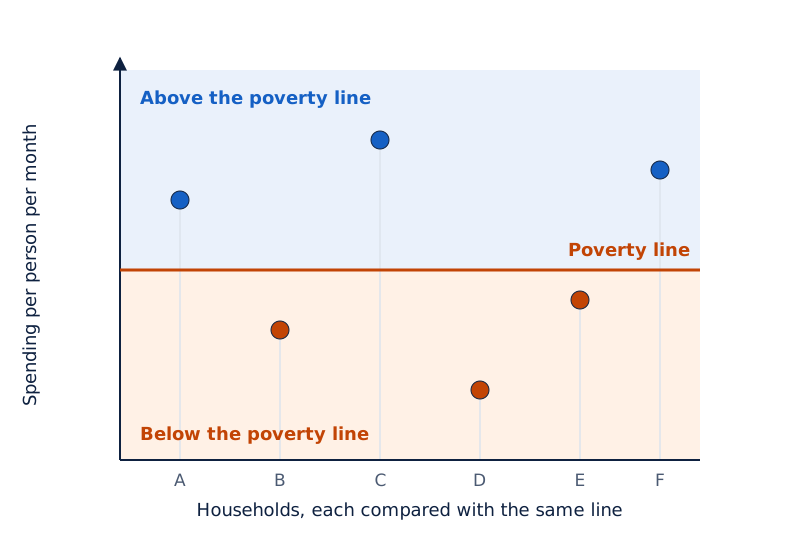
Draw a vertical scale labelled Spending per person per month. Draw a horizontal line across it and label it Poverty line.
Mark the region under the line Below the poverty line and the region above it Above the poverty line.
Plot a few households as dots to show that the spending per person of each household is compared with the same line.
Drawn by One Young India.
How is the poverty line based on calorie intake?
Food is one of the basic needs, so the poverty line starts from food. People need energy from food to live and work. Food energy is measured in calories. In food, a calorie means a kilocalorie, written kcal.
In India the poverty line has been built on a calorie norm, which is the minimum food energy fixed for one person for one day. The norm is 2,400 kcal per person per day for rural areas and 2,100 kcal per person per day for urban areas.
Why is the rural norm higher?
People in rural areas usually do more physical work, so they need more food energy. This is why the rural norm is higher than the urban norm.
| Area | Calorie norm (kcal per person per day) | Comparison |
|---|---|---|
| Rural | 2,400 | Higher, because rural work usually involves more physical effort |
| Urban | 2,100 | Lower than the rural norm |
Diagram
Daily calorie norm per person, rural and urban
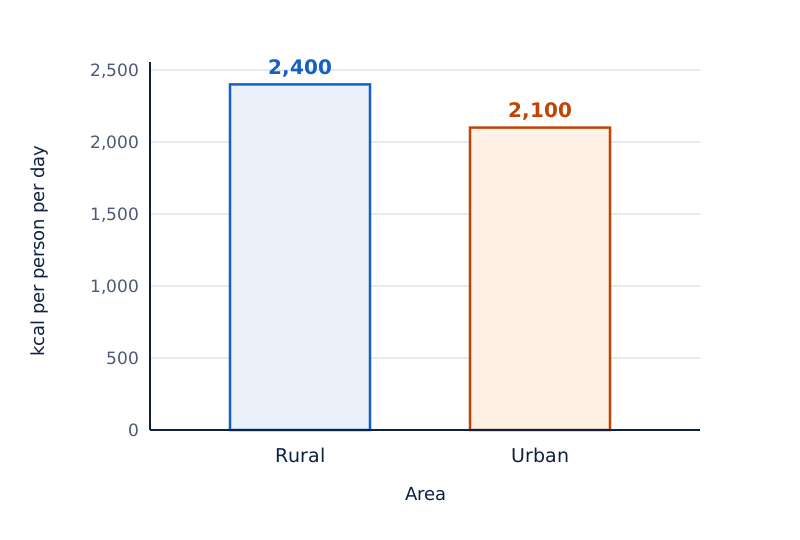
Draw a bar graph. Label the horizontal axis Area, with two bars named Rural and Urban.
Label the vertical axis kcal per person per day, marked from 0 to 2,500 in steps of 500. Make the Rural bar reach 2,400 and the Urban bar reach 2,100.
Drawn by One Young India.
How is the calorie norm turned into a poverty line?
The calorie norm is converted into money in the following steps.
- Fix the calorie norm for one person for one day: 2,400 kcal in rural areas and 2,100 kcal in urban areas.
- List the food items, such as cereals, pulses and vegetables, that together give these calories.
- Find the money cost of buying this food at current prices, and add the cost of essential non-food items such as clothing, fuel and light, education and medical needs.
- State the total as spending per person, usually for one month, separately for rural and urban areas.
- Compare this line with household spending found from large sample surveys, which ask a selected group of households about their spending, such as the National Sample Survey (NSS).
- Revise the line from time to time as prices rise.
Note: The rupee value of the line changes with prices and with revisions in the method of estimation. Any rupee figure used in a question is therefore given in the question itself.
How is the extent of poverty measured?
Once the line is fixed, the next question is how many people fall below it. The poverty ratio, also called the head-count ratio (it counts heads, that is, people), is the percentage of the population living below the poverty line.
In the formulas below, the sign ÷ means divided by, the sign × means multiplied by and the sign − means minus.
Poverty ratio (per cent) = (Number of people below the poverty line ÷ Total population) × 100
The number of people above the line is found by subtraction.
Number above the line = Total population − Number below the poverty line
Worked example 1. Practice figures: a town has a total population of 40,000, and 10,000 of its people live below the poverty line. Find the poverty ratio and the number of people above the line.
Answer: Poverty ratio = (10,000 ÷ 40,000) × 100 = 25 per cent. Number above the line = 40,000 − 10,000 = 30,000 people, which is 75 per cent of the population.
How is a household placed above or below the line?
Surveys record a household's total spending in a month and its number of members. Dividing the first by the second gives the per capita expenditure, which is spending per person.
Per capita expenditure = Total household expenditure ÷ Number of members
A household is below the poverty line if its per capita expenditure is lower than the poverty line.
Worked example 2. Practice figures: the poverty line is taken as ₹1,000 per person per month (₹ is the symbol for the rupee). A household of 4 members spends ₹3,600 in a month. Is it below the poverty line?
Answer: Per capita expenditure = 3,600 ÷ 4 = ₹900 per person per month. Since ₹900 is lower than ₹1,000, the household is below the poverty line. Its spending is ₹100 per person per month short of the line.
Note: The poverty ratio counts how many people are below the line. It does not show how far below the line they are.
What is absolute poverty?
Absolute poverty is the condition in which a person or household cannot afford the minimum basic needs of life, judged against a fixed standard such as the poverty line. The standard stays the same whatever other people earn.
A household whose spending per person is below the line is in absolute poverty.
What are examples of absolute poverty?
- A household that cannot afford enough food to reach the calorie norm of 2,400 kcal (rural) or 2,100 kcal (urban) per person per day.
- A family without proper housing, as in the photograph of makeshift huts shown earlier.
- A household whose per capita expenditure is lower than the poverty line, as in Worked example 2.
- A family that cannot afford basic education and health care.
How is absolute poverty measured?
Absolute poverty is measured with the poverty line and the poverty ratio. Because every household in an area is compared with the same line, absolute poverty can be counted and compared between areas and years.
What is relative poverty?
Relative poverty is poverty judged by comparison. A person or group is relatively poor when income or living standard is much lower than that of others in the same society, such as the average income or the richest group.
It is closely linked to inequality, the unequal distribution of income among people.
Why do averages hide relative poverty?
The average income of a country is its per capita income. It is the total income of the country divided by its total population.
Per capita income = Total income of the country ÷ Total population
While averages are useful for comparison, they also hide disparities (differences between people). An average does not tell how income is distributed among people. Consider two countries, A and B, with five citizens each.
| Monthly incomes of citizens (in rupees) | I | II | III | IV | V |
|---|---|---|---|---|---|
| Country A | 9500 | 10500 | 9800 | 10000 | 10200 |
| Country B | 500 | 500 | 500 | 500 | 48000 |
Worked example 3. Use the table above to find the average monthly income of Country A and of Country B.
Answer: Country A: (9500 + 10500 + 9800 + 10000 + 10200) ÷ 5 = 50000 ÷ 5 = ₹10000. Country B: (500 + 500 + 500 + 500 + 48000) ÷ 5 = 50000 ÷ 5 = ₹10000. The two countries have identical average income.
Even though both countries have identical average income, Country A is preferred because it has a more equitable, that is fairer, distribution. In Country A people are neither very rich nor extremely poor. In Country B most citizens are poor and one person is extremely rich.
What the figure shows
Cartoon of two countries
The cartoon has two panels.
In the panel headed Country with no rich and no poor, five people in white clothes sit in a row on chairs, and a speech bubble says: We made the chairs and we use them.
In the panel headed Country with rich and poor, one person lies stretched out along a row of chairs while four others are squeezed together at the other end, and a speech bubble says: We made the chairs and he took them.
What are examples of relative poverty?
- The four citizens of Country B who earn ₹500 a month each are poor relative to the fifth citizen, who earns ₹48000, and relative to the average of ₹10000.
- A household that can meet its basic needs, and so is above the poverty line, is still relatively poor if its income is far below the average income or the income of the richest group.
How do absolute and relative poverty differ?
Both ideas deal with people who have too little. They differ in the standard used to judge "too little". The table compares them point by point.
| Basis | Absolute poverty | Relative poverty |
|---|---|---|
| Meaning | Inability to afford the minimum basic needs of life | Low income or living standard compared with other people in the same society |
| Standard used | A fixed standard such as the poverty line | The income of other people, such as the average income or the richest group |
| Question it answers | Can the household meet its basic needs? | How far behind others is the household? |
| Link with other people's income | Does not depend on what others earn | Depends on what others earn |
| Example | A household that cannot afford enough food to reach the calorie norm | Four citizens of Country B who earn ₹500 a month each while a fifth earns ₹48000 |
What are the historical and demographic causes of poverty in India?
Poverty in India has several causes, and they work together. This note discusses seven. The first two are the colonial legacy and rapid population growth.
Cause 1: What is the colonial legacy?
India had an independent economy before British rule and was particularly well known for its handicraft industries. Colonial rule disrupted this progress, resulting in widespread poverty, recurrent famines and the decline of traditional industries.
- Slow growth. Most studies did find that the growth of aggregate real output (total output measured at constant prices) in the first half of the twentieth century was less than two per cent, coupled with a meagre half per cent growth in per capita output (output per person) per year.
- Stagnant agriculture. Low levels of technology, lack of irrigation facilities (supply of water to farmland) and negligible use of fertilisers added up to a dismal level of agricultural productivity. Under the zamindari system, implemented in the then Bengal Presidency, the profit from agriculture went to the zamindars instead of the cultivators.
- Decline of handicrafts. The decline of indigenous handicraft industries created massive unemployment, and no corresponding modern industrial base was allowed to come up.
- Weak social indicators. The overall literacy level was less than 16 per cent, and female literacy was about seven per cent.
Extensive poverty therefore prevailed during the colonial period, although in the absence of reliable data it is difficult to specify its extent.
Cause 2: How does rapid population growth add to poverty?
When population grows faster than total income, per capita income falls, because the total income is shared among more people. More people also need to be fed, housed, educated and employed from the same resources.
How do unemployment, low productivity and unequal assets cause poverty?
The next three causes concern work, farming and the ownership of land. All three reduce the incomes of the poor.
Cause 3: How do unemployment and underemployment cause poverty?
People without work, or with too little work, earn too little to buy what they need. Underemployment is common in agriculture.
Take Laxmi, a small farmer who owns about two hectares (a hectare is a unit of land area) of unirrigated land, dependent only on rain, where she grows crops such as jowar (a cereal crop) and arhar (a pulse crop).
All five members of her family work in the plot throughout the year, because they have nowhere else to go. None remains idle, but their labour effort gets divided. Each one is doing some work but no one is fully employed.
Definition: Underemployment, also called disguised unemployment, is the situation in which people are apparently working but all of them work less than their potential. It is hidden, in contrast to someone who has no job and is clearly visible as unemployed.
There are more people in agriculture than is necessary, so even if a few people moved out, production would not be affected.
Some 65 per cent of the population was still employed in agriculture as late as 1990, because the industrial and service sectors did not absorb them.
Many economists call this an important failure of the policies followed during 1950 to 1990.
Cause 4: How does low productivity in agriculture cause poverty?
At independence, about 75 per cent of the country's population was dependent on agriculture. Productivity was very low because of the use of old technology and the absence of the required infrastructure for the vast majority of farmers.
India's agriculture vitally depends on the monsoon. If the monsoon fell short, farmers were in trouble unless they had access to irrigation facilities, which very few had.
Being a poor farmer, Laxmi cannot afford many of the seeds, fertilisers, agricultural equipment and pumpsets she needs. Low output means low income, and low income leaves little to buy better inputs.
Cause 5: How does unequal distribution of land and income cause poverty?
At independence, the land tenure system was characterised by intermediaries, called zamindars, jagirdars and so on, who merely collected rent from the actual tillers of the soil (the people who cultivate the land).
Soon after independence, steps were taken to abolish intermediaries and to make the tillers the owners of land. Such changes in the ownership of landholdings are called land reforms.
The goal of equity, that is fairness in the sharing of benefits, was not fully served. In some areas the former zamindars continued to own large areas of land by making use of loopholes.
Even when the tillers got ownership of land, the poorest agricultural labourers, such as sharecroppers (tillers who give the landowner a share of the crop) and landless labourers, did not benefit.
Land reforms were successful in Kerala and West Bengal, whose governments were committed to the policy of land to the tiller. Other states did not have the same level of commitment, and vast inequality in landholding continues to this day.
A country can have high growth and the most modern technology, and also have most of its people living in poverty. It is important to ensure that the benefits of economic prosperity reach the poor sections as well, instead of being enjoyed only by the rich.
How do lack of cheap credit and low human capital cause poverty?
The last two causes concern money borrowed to farm or to live, and the skills and health of workers.
Cause 6: How does lack of cheap credit cause poverty?
Credit means borrowed money. Interest is what the borrower pays the lender in addition to repaying the amount borrowed (the principal).
Farmers borrow to meet the cost of seeds, fertilisers and implements, and family expenses such as marriage, death and religious ceremonies, because a long time passes between sowing and income.
Agricultural labourers may borrow to meet daily expenses when there is no work, as Rama does below.
Formal lenders are banks and cooperatives (societies whose members pool their resources), and the Reserve Bank of India (RBI) supervises them. Informal lenders include moneylenders, traders, employers, relatives and friends. Compared with formal lenders, most informal lenders charge a much higher interest on loans.
Definition: Collateral is an asset that the borrower owns, such as land, a building, a vehicle, livestock or deposits with banks, and uses as a guarantee to a lender until the loan is repaid.
Absence of collateral is one of the major reasons which prevents the poor from getting bank loans. Banks are also not present everywhere in rural India. Poor households therefore depend on informal sources.
| Urban households | Per cent of loans from the formal sector | Per cent of loans from the informal sector |
|---|---|---|
| Poor households | 46 | 54 |
| Households with a few assets | 62 | 38 |
| Well-off households | 73 | 27 |
| Rich households | 83 | 17 |
What the figure shows
Formal and informal loans of urban households
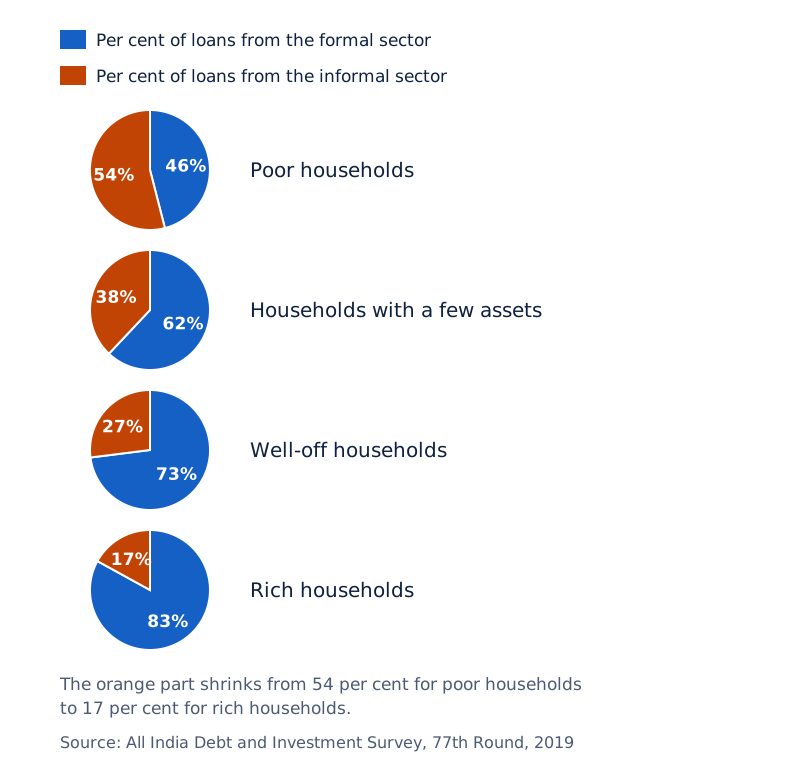
Four pie charts, labelled Poor Households, Households with a few assets, Well-off Households and Rich Households, are each split into a blue part (per cent of loans from the formal sector) and an orange part (per cent from the informal sector).
The orange part shrinks from 54 per cent for poor households to 17 per cent for rich households.
Drawn by One Young India.
How does high-cost credit lead to a debt trap?
Take Rama, an agricultural labourer in the village of Sonpur. There are several months in the year when she has no work and needs credit to meet daily expenses. She depends on her employer, a medium landowner, who charges 5 per cent interest per month.
Most of the time Rama has to take a fresh loan before the previous loan has been repaid. At present she owes the landowner ₹5,000.
Monthly interest = Loan amount × Monthly rate ÷ 100
Worked example 4. Rama owes ₹5,000, and the landowner charges interest at 5 per cent per month. Find the interest for one month and the equivalent yearly rate.
Answer: Monthly interest = 5,000 × 5 ÷ 100 = ₹250. There are 12 months in a year, so 5 per cent per month is 5 × 12 = 60 per cent per annum (per year).
A high interest rate can mean that the amount to be repaid is greater than the income of the borrower. This could lead to increasing debt and a debt trap, a situation in which credit pushes the borrower into difficulty from which recovery is very painful.
Cause 7: How do illiteracy and poor health cause poverty?
The labour skill of an educated person is more than that of an uneducated person, and the educated person is therefore able to generate more income. A sick labourer without access to medical facilities is compelled to abstain from work, and there is a loss of productivity.
In a developing country like India, with a large section of the population living below the poverty line, many people cannot afford to access basic education and health care facilities.
A large share of fishworker families are poor. Rampant underemployment, low per capita earnings, absence of mobility of labour to other sectors and a high rate of illiteracy and indebtedness are some of the major problems the fishing community faces today.
How do the causes of poverty reinforce one another?
The seven causes do not act alone. Each one lowers income, and low income makes the other causes worse. This pattern is called the vicious circle of poverty.
- A household has a low income.
- After meeting urgent needs such as food, little or nothing is left to save or to spend on education and health.
- With poor nutrition, poor health and little education, workers have low skills and lose working days, so output per worker is low.
- Low output means low earnings, or no work at all.
- The income stays low, and the circle starts again.
Diagram
The vicious circle of poverty
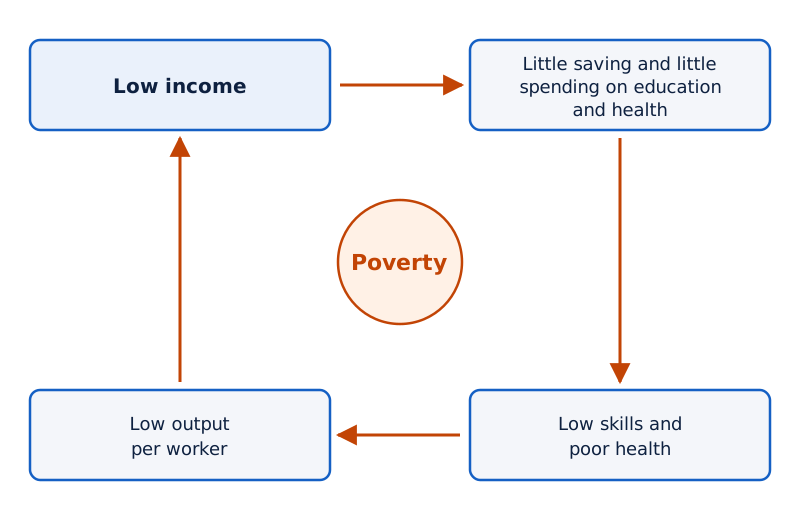
Draw four boxes joined by arrows in a circle: Low income, then Little saving and little spending on education and health, then Low skills and poor health, then Low output per worker, then back to Low income. Label the centre Poverty.
Drawn by One Young India.
How can the circle be broken?
Raising incomes at any point helps. Cheap and affordable credit is crucial for the country's development.
Many programmes that governments implement to alleviate poverty work through employment generation. They aim to provide not only employment but also services in areas such as primary health, primary education, rural drinking water and nutrition. Such programmes are studied as a separate topic.
What are the effects of poverty?
How does poverty affect borrowing and the market?
Poor households depend on costly informal credit, which can push a borrower into a debt trap.
In a market economy, only goods that are in demand, that is, goods that can be sold profitably, are produced. Goods go to those with purchasing power, the ability to buy goods and services.
Low-cost housing for the poor is much needed but will not count as demand in the market sense, because the poor do not have the purchasing power to back the demand.
What happens to families that fall into poverty after losing work?
In the early 1980s, textile mills all over the country began to close down. In Ahmedabad the closure was long drawn out and spread over 10 years. Over this period, approximately over 80,000 permanent workers and over 50,000 non-permanent workers lost their jobs and were driven to the informal sector.
Workers and enterprises in the informal sector do not get regular income, and they do not have any protection or regulation from the government.
A whole class of workers was thrown back from the middle class into the informal sector, into poverty. Children were withdrawn from school and sent to work.
Glossary
- Poverty — condition in which a person or household cannot afford basic needs such as food, shelter, education and health care.
- Poverty line — minimum level of spending per person, worked out from the cost of meeting basic needs, below which a person is counted as poor.
- Kilocalorie (kcal) — unit of food energy; the calories counted in food and in the poverty line are kilocalories.
- Calorie norm — minimum daily food energy fixed for one person, which is 2,400 kcal for rural areas and 2,100 kcal for urban areas.
- Poverty ratio — percentage of the population living below the poverty line, also called the head-count ratio.
- Per capita expenditure — total household spending divided by the number of members of the household.
- Per capita income — total income of a country divided by its total population, also called average income.
- Absolute poverty — inability to afford the minimum basic needs of life, judged against a fixed standard such as the poverty line.
- Relative poverty — poverty judged by comparing the income or living standard of one group with that of others in the same society.
- Underemployment — situation in which people are apparently working but all work less than their potential; also called disguised unemployment.
- Collateral — asset owned by a borrower and used as a guarantee to a lender until the loan is repaid.
- Debt trap — situation in which credit pushes the borrower into debt from which recovery is very painful, as when the amount to be repaid exceeds the borrower's income.
Common errors and misconceptions
- Misconception: The poverty line is one fixed amount for the whole country. Correct: It is worked out separately for rural and urban areas, with a calorie norm of 2,400 kcal for rural areas and 2,100 kcal for urban areas, and it is revised from time to time.
- Misconception: The urban calorie norm is higher because cities are costlier. Correct: The rural norm is higher, because people in rural areas usually do more physical work.
- Misconception: Absolute and relative poverty are two names for the same idea. Correct: Absolute poverty is judged against a fixed standard such as the poverty line, while relative poverty is judged by comparing the incomes of different groups.
- Misconception: If the average income is high, nobody in the country is poor. Correct: An average hides disparities. Two countries can have the same average income while one has most citizens poor and one extremely rich.
- Misconception: The poverty ratio is the number of poor people. Correct: It is the percentage of the population below the poverty line, found by dividing the number below the line by the total population and multiplying by 100.
- Misconception: Poverty exists only in villages. Correct: The majority of the poor live in rural areas, but poor households are found in urban areas too.
- Misconception: Poverty has one cause, such as population growth. Correct: Several causes work together, including unemployment and underemployment, low farm productivity, unequal land, lack of cheap credit and low education and health.
Exam-style questions with model answers
Q1. What is meant by the poverty line? State the daily calorie norm used for rural areas. [2 marks]
- The poverty line is the minimum level of spending per person, worked out from the cost of meeting basic needs, below which a person is counted as poor.
- For rural areas the calorie norm is 2,400 kcal per person per day (kcal means kilocalorie, the unit of food energy).
Q2. In a town of 50,000 people, 12,500 people live below the poverty line. Calculate the poverty ratio and the number of people above the line. [3 marks]
- The poverty ratio is the percentage of the population below the poverty line, found as (Number of people below the poverty line ÷ Total population) × 100.
- Substituting, (12,500 ÷ 50,000) × 100 = 25 per cent, so the poverty ratio is 25 per cent.
- The number of people above the line is 50,000 − 12,500 = 37,500, which is 75 per cent of the population.
Q3. The poverty line is taken as ₹1,000 per person per month (a practice figure). A household of 5 members spends ₹4,500 in a month. State, with working, whether it is below the poverty line. [3 marks]
- Per capita expenditure = Total household expenditure ÷ Number of members = 4,500 ÷ 5 = ₹900 per person per month.
- The poverty line is ₹1,000 per person per month, and ₹900 is lower than ₹1,000.
- Therefore the household is below the poverty line, with its spending ₹100 per person per month short of the line.
Q4. Explain how the poverty line in India is based on calorie intake. [4 marks]
- A calorie norm is fixed as the minimum daily food energy for one person: 2,400 kcal in rural areas and 2,100 kcal in urban areas.
- The rural norm is higher because people in rural areas usually do more physical work.
- The cost of the food items that give these calories, together with essential non-food items such as clothing, fuel and light, education and medical needs, is stated as spending per person, separately for rural and urban areas.
- Household spending found from sample surveys is compared with this line, and the line is revised from time to time as prices rise.
Q5. Explain any five causes of poverty in India. [5 marks]
- Colonial legacy: under British rule growth was slow, agriculture stagnated, handicraft industries declined and literacy was low.
- Rapid population growth: when population grows faster than total income, per capita income falls and more people share the same resources.
- Unemployment and underemployment: people without work, or working less than their potential, earn too little to meet their needs.
- Low agricultural productivity: old technology, dependence on the monsoon and lack of irrigation keep farm incomes low.
- Unequal distribution of land and income: vast inequality in landholding continues, and landless labourers and sharecroppers did not benefit from land reforms.
Q6. Two countries each have five citizens. Monthly incomes in rupees: Country A: 9500, 10500, 9800, 10000, 10200. Country B: 500, 500, 500, 500, 48000. Find the average income of each country and say what the averages do not show. [3 marks]
- Average income of Country A = (9500 + 10500 + 9800 + 10000 + 10200) ÷ 5 = 50000 ÷ 5 = ₹10000.
- Average income of Country B = (500 + 500 + 500 + 500 + 48000) ÷ 5 = 50000 ÷ 5 = ₹10000, the same as Country A.
- The averages do not show how income is distributed. In Country B four citizens earn ₹500 while one earns ₹48000, so relative poverty is far greater there than in Country A.
Q7. Distinguish between absolute poverty and relative poverty on five points. Use the example of Country B, where four citizens earn ₹500 a month each and a fifth earns ₹48000. [5 marks]
- Meaning: absolute poverty is the inability to afford the minimum basic needs of life; relative poverty is low income compared with others in the same society.
- Standard: absolute poverty is judged against a fixed standard such as the poverty line; relative poverty against the income of others, such as the average or the richest group.
- Question answered: absolute poverty asks whether a household can meet its basic needs; relative poverty asks how far behind others it is.
- Link with others' income: absolute poverty does not depend on what others earn; relative poverty does, and is closely linked to inequality.
- Example: a household that cannot afford enough food to reach the calorie norm is in absolute poverty, while the four citizens of Country B, who earn ₹500 a month each when a fifth earns ₹48000, are in relative poverty.
Q8. In a survey of urban households, 54 per cent of the loans of poor households came from informal sources, compared with 17 per cent for rich households. Explain how lack of cheap credit keeps households poor. [4 marks]
- The figures show that poor households depend much more on informal lenders (54 per cent of their loans) than rich households do (17 per cent).
- Most informal lenders charge a much higher interest than banks, so a larger part of the borrower's earnings goes to repay the loan.
- Banks usually require collateral, an asset kept as a guarantee until the loan is repaid, and its absence keeps poor people out of bank loans.
- When the amount to be repaid is greater than the borrower's income, debt can keep rising into a debt trap, and the household may stay poor.
Q9. Explain the vicious circle of poverty in four steps. [4 marks]
- A household with a low income can spend little on food, education and health, and has little or nothing left to save.
- Poor nutrition, poor health and little education mean low skills and lost working days, so output per worker is low.
- Low output means low earnings, or no work at all, so the income of the household remains low.
- The household stays poor, and the circle repeats.
Key takeaways
- Poverty is the condition in which a person or household cannot afford basic needs such as food, shelter, education and health care.
- The poverty line is the minimum spending per person needed to meet basic needs. People below it are counted as poor, and the line is revised from time to time.
- The calorie norm is 2,400 kcal per person per day for rural areas and 2,100 kcal for urban areas. The rural norm is higher because rural work usually involves more physical effort.
- The poverty ratio is the percentage of the population below the poverty line: (number below the line ÷ total population) × 100. It does not show how far below the line people are.
- Absolute poverty is judged against a fixed standard such as the poverty line, while relative poverty is judged by comparing the incomes of different groups.
- Average income hides disparities. Two countries can have identical average income while one has most citizens poor and one person extremely rich.
- Seven causes of poverty are the colonial legacy, rapid population growth, unemployment and underemployment, low farm productivity, unequal land and income, lack of cheap credit, and illiteracy and poor health.
- The causes reinforce one another in a vicious circle, and poverty in turn limits access to education, health care and cheap credit.
Test yourself
What calorie norms are used for rural and urban areas?
The norm is 2,400 kcal per person per day for rural areas and 2,100 kcal per person per day for urban areas.
What does the poverty ratio show?
It shows the percentage of the population living below the poverty line, found by dividing the number of people below the line by the total population and multiplying by 100.
Why can an average income hide poverty?
An average does not show how income is distributed. Countries A and B have the same average of ₹10000, yet in Country B four of five citizens earn only ₹500.
Which kind of poverty is judged against a fixed standard such as the poverty line?
Absolute poverty. Relative poverty is instead judged by comparing the income of one group with that of others in the same society.
What is underemployment?
It is the situation in which people are apparently working but all work less than their potential, as when five family members work on a small plot that needs fewer. It is also called disguised unemployment.
What does the vicious circle of poverty show?
It shows that low income leads to little spending on education and health, which leads to low output per worker and low earnings, so income stays low.
Take this further
How does India make policy?
The Model NITI Aayog self-paced course: 41 chapters, about 19 hours of study, on how India makes policy, from the policy cycle and writing a white paper to the economy, the Union Budget and governance. It comes with Learnacy Essential.
Learnacy Essential is ₹1,499 for the year. It also adds feedback from an AI writing coach, submission to The OYI Review, World 101’s member tools and the 3D labs. Publication is not guaranteed. See what a year includes
Or create a free account to draft in the Writing Studio, explore World 101’s map and open the 2D version of every lab. Create a free account