
Principles of Management | CBSE Class 12 Business Studies Notes
On this page
Try an idea before you read. Design a 2-step scenario interactive for a study note. Explore →

This note covers the meaning, nature and significance of management principles, Taylor’s scientific management and its techniques, Fayol’s fourteen principles, comparisons between their contributions, numerical applications, business cases and developments in production management.
What are principles of management, and how do they differ from techniques and values?
Definition: A management principle is a broad and general guideline for decision-making and behaviour. It helps managers decide how to act in a work situation.
For example, one manager may use seniority when deciding an employee’s promotion, while another may use merit. The principle guides the decision; it does not perform the managerial activity itself.
Management principles are not as rigid as principles of pure science. They concern human behaviour, which is never static, and must keep pace with technological changes. Their application therefore requires judgement and creativity suited to the situation.
| Concept | Meaning | Distinction |
|---|---|---|
| Principle | A broad guideline for decisions and behaviour | Guides action while applying a technique |
| Technique | A procedure or method involving a series of steps | Explains how to accomplish a desired goal |
| Value | Something regarded as acceptable or desirable, with moral significance | Develops through common social practice |
Principles develop through research in work situations. Values concern individual behaviour in society. Nevertheless, applying principles does not permit a business to neglect values: businesses have social and ethical responsibilities towards society.
How have management ideas developed?
Management thought developed through early perspectives, classical theory, the human relations approach, the behavioural science approach, management science or operational research, and modern management. Operational research uses quantitative techniques to assist decisions. Modern management views organisations as complex systems and stresses dependence on circumstances.
The human relations approach developed between the 1920s and 1950s. It recognised that employees respond to social needs and attitudes as well as rules, authority and economic incentives. Taylor’s scientific management and Fayol’s administrative principles belong to the classical school.
How did Toyota use principles?
Toyota’s guiding principles linked corporate conduct with law, local cultures, clean and safe products, advanced technology, creativity and teamwork, harmonious growth, and mutually beneficial partnerships. They guided its global vision 2010, including innovation, environmentally friendly technologies and interaction with society.
Information and Communications Technology (ICT) widened managers’ ability to oversee geographically dispersed operations. Infosys illustrates its use for interaction between managers, employees and customers across the world.
What are the seven characteristics of management principles?
How widely do principles apply?
- Universal applicability: Principles are intended for business and non-business organisations, large and small enterprises, public and private organisations, and manufacturing and services. However, their extent of applicability varies with the organisation, activity and scale. Division of work can serve both a government office and a company.
- General guidelines: Principles guide action but do not supply ready-made solutions to every problem. Business situations are complex, dynamic and affected by many factors. In a departmental conflict, emphasising the organisation’s overall goals provides a useful direction without resolving every detail automatically.
- Formed by practice and experimentation: Principles arise from managers’ experience, collective wisdom and experiments. Discipline reflects practical experience. An experiment improving factory conditions can examine whether workers’ fatigue and stress decline.
- Flexible: Principles can be modified when the situation demands. They give managers discretion rather than requiring absolute obedience to a rigid prescription. The appropriate concentration or dispersal of authority depends on an enterprise’s circumstances.
- Mainly behavioural: Principles mainly influence human behaviour. They also concern things and the relationship between human and material resources. Factory orderliness, for example, requires coordination of workflows, materials and people’s movement.
- Cause and effect relationships: Principles indicate the likely effect of applying a guideline in a situation. These relationships are less than perfect because people and circumstances differ. Accurate relationships may be difficult to establish, although principles help to some extent.
- Contingent: Application depends on the prevailing situation at a particular time. Fair remuneration, meaning payment for employees’ work, depends on their contribution, the employer’s capacity to pay and prevailing wages for the occupation.
What are the limitations of applying principles mechanically?
Universal applicability does not mean identical application. Similarly, flexibility does not mean that principles have no value. Managers must select and adapt the appropriate guideline instead of expecting a guaranteed result from following a rule mechanically.
In an emergency, someone taking charge while others follow is desirable. When establishing a new factory requires expertise from different functions, a more participative approach would be advisable. Both decisions depend on the circumstances.
Note: Principles describe likely relationships, not perfectly predictable human responses. Their derivation may be regarded as science, while their creative application may be regarded as art.
What advantages make management principles significant?
The significance of management principles lies in their practical usefulness. They improve understanding of work situations and guide both decisions and implementation. Their contribution extends from using resources efficiently to meeting society’s expectations.
- Useful insights into reality: Principles add to managers’ knowledge and understanding. Learning from previous mistakes helps them solve recurring problems quickly. Delegating routine decisions allows managers to concentrate on exceptional matters requiring their expertise.
- Optimum resource use and effective administration: Optimum use means securing maximum benefit at minimum cost. Understanding likely consequences reduces trial-and-error waste. Principles also restrain personal bias, so departmental budgets should reflect contributions to organisational objectives rather than personal preferences.
- Scientific decisions: Decisions should rest on facts, logic and objective assessment. They must be thoughtful, timely, realistic and justifiable in relation to their purposes, and capable of measurement and evaluation.
- Meeting changing environmental requirements: Flexible principles can adapt to changes. Division of work has extended to businesses concentrating on their core competency, meaning their specialised strength. Hindustan Lever Limited’s disposal of non-core chemicals and seeds businesses illustrates this application.
- Fulfilling social responsibility: Principles evolve with public expectations. Equity extends beyond wages to customer value, environmental care and dealings with business associates. BHEL’s development of Ranipur in Hardwar illustrates a public sector undertaking’s township development.
- Training, education and research: Principles form the basis of management teaching and further research. Master of Business Administration and Bachelor of Business Administration courses include them. Research on principles supports the refinement of management practices and techniques.
What do the Indian business cases illustrate?
Dr Kiran Mazumdar Shaw started Biocon India in her garage with 10,000 Indian rupees (₹10,000) in collaboration with Biocon Bio Chemical’s Limited of Ireland. The enterprise developed affordable biological medicines for patients in India and other emerging markets, illustrating purposeful innovation and managerial effort.
Shri Mahila Griha Udyog Lijjat Papad began with a loan of ₹80. Its values, followed since its inception in 1959, combine business, family and devotion. Mutual affection, concern and trust accompany work for collective benefit rather than individual benefit alone.
Lijjat’s support includes scholarships for children of papad-roller member sisters who pass the tenth and twelfth standards. The case connects enterprise with social responsibility and members’ self-reliance, rather than treating business activity and social commitments as separate concerns.
What is Taylor’s scientific management, and what principles guide it?
Fredrick Winslow Taylor, an American mechanical engineer, lived from 20 March 1856 to 21 March 1915. He became an apprentice machinist in 1874, an executive at Midvale Steel Company in 1884 and joined Bethlehem Iron Company in 1898.
His work addressed the efficiency of factory production. He served as president of the American Society of Mechanical Engineers from 1906 to 1907. His work on The Principles of Scientific Management appeared in 1911; his testimony before a United States House of Representatives special committee followed in 1912.
Definition: Scientific management uses standardised tools and methods, scientific investigation and trained personnel to increase output, improve quality and reduce costs and waste.
Rule of thumb means relying on personal judgement when handling work problems. It helped managers respond to situations but suffered from trial and error. Taylor proposed defining problems, developing alternatives, anticipating consequences, measuring progress and drawing conclusions scientifically.
A Japanese work-culture illustration combines paternalistic management, which cares for employees’ needs, with openness between workers and management. If at all workers strike in this illustration, they wear black badges but work beyond normal hours to gain management’s sympathy.
How do the four main principles work together?
- Science, not rule of thumb: Taylor believed that one best method could maximise efficiency. Investigation and work-study should identify good practices and combine them into a standard method throughout the organisation. Even loading pig iron, meaning crude iron cast into blocks, could be scientifically planned.
- Harmony, not discord: Management and workers should recognise their mutual importance. Conflict benefits neither side. Management should share the company’s gains, if any, while workers should work hard and accept changes that benefit the enterprise.
- Cooperation, not individualism: Management should listen to constructive suggestions, reward substantial cost-saving ideas and take workers into confidence over important decisions. Workers should avoid unreasonable demands. Taylor called for an almost equal division of work and responsibility between management and workers.
- Development of each person to greatest efficiency and prosperity: Workers should be scientifically selected and assigned duties suited to their physical, mental and intellectual capabilities. Training in the best method helps them produce more and earn more, benefiting both workers and the company.
Mental revolution is the change in management’s and workers’ attitudes towards one another, from competition to cooperation. Both should enlarge the surplus rather than quarrel over its division. The related emphasis on maximum, rather than restricted, output supports this common purpose.
What the figure shows
Cartoon of sharing gains
A worker and a manager shake hands while the manager holds a paper marked “BONUS”. Behind them is a display labelled “PRODUCTION” with an upward line. Caption: “Sharing of gains between management and workers leading to complete harmony”.
Reference: NCERT Class 12, page 45
How does functional foremanship organise supervision?
A foreman is the supervisor who meets workers directly in daily factory work. The role links production planning, implementation and control. Taylor found that the many qualities expected of a good foreman could not be found together in one person.
Functional foremanship separates planning from execution and divides supervision among eight specialists. Under the factory manager are a planning incharge and a production incharge. Each has four specialists, and each worker receives orders from them in their respective functions.
| Side | Specialist | Responsibility |
|---|---|---|
| Planning | Instruction card clerk | Prepares instructions for workers |
| Planning | Route clerk | Specifies the route of production |
| Planning | Time and cost clerk | Prepares time and cost sheets |
| Planning | Disciplinarian | Ensures discipline |
| Production | Speed boss | Ensures timely and accurate completion |
| Production | Gang boss | Keeps machines and tools ready for use |
| Production | Repair boss | Keeps machines and tools in proper working condition |
| Production | Inspector | Checks the quality of work |
Why assign the work to specialists?
The qualities required include intelligence, education, tact, judgement, special knowledge, manual dexterity, energy, honesty and good health. Specialisation allows each supervisor’s duties to match their qualities. Technical mastery and judgement suit planning work; energy and good health support execution work.
This extends division of work to factory supervision. It also creates a clear contrast with Fayol’s unity of command: Taylor’s worker takes functional instructions from eight specialists, whereas Fayol advocates one superior for an individual employee.
What the figure shows
Functional foremanship
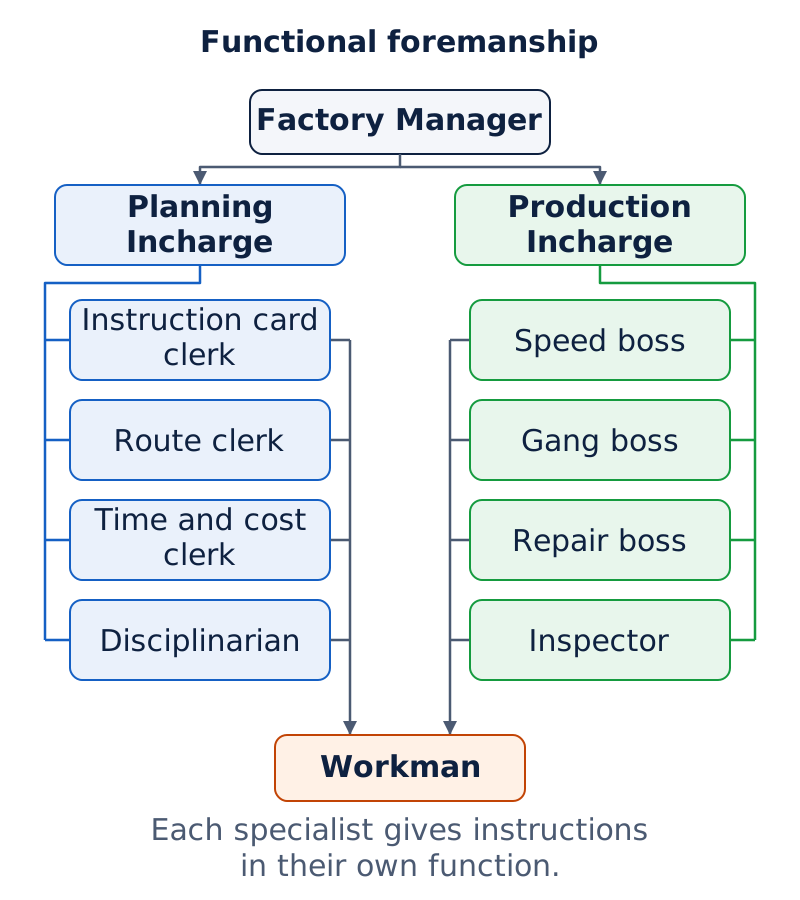
The Factory Manager branches into Planning Incharge and Production Incharge. Four specialist boxes appear under each branch. Lines from all eight specialists converge on the Workman box below.
Drawn by One Young India. Reference: NCERT Class 12, page 48
How do standardisation, simplification and work-study improve production?
Standardisation means setting standards for business activities, including materials, products, methods, machines, working conditions and time. These standards become benchmarks for production. They emerge from examining existing methods and retaining and refining the best practices.
What are the objectives of standardisation?
- Reduce a product line to fixed types, sizes and characteristics.
- Make manufactured parts and products interchangeable.
- Set standards of excellence and quality for materials.
- Set standards of performance for workers and machines.
Simplification eliminates unnecessary varieties, sizes and dimensions. It reduces product diversity, labour and tooling costs, and inventories, meaning stocks held by the business. Fuller equipment use and increased sales turnover are further benefits.
How do the four work studies differ?
| Study | What it examines | Purpose |
|---|---|---|
| Method study | Alternative ways of doing a job, from acquiring materials to delivering the product | Find the best method, minimise cost and maximise quality and customer satisfaction |
| Motion study | Movements such as lifting, placing objects and changing position | Remove unnecessary movements and complete work efficiently |
| Time study | The time required for elements of a well-defined task | Set standard time, staffing needs, incentives and labour costs |
| Fatigue study | Tiredness and the need for breaks during work | Determine the amount and frequency of rest intervals |
In car production, method study covers the sequence of assembly operations and the placement of workers, machines and materials. An assembly line moves production through a sequence of operations. Ford Motor Company used assembly-line production successfully.
Motion study distinguishes productive, incidental and unproductive movements. Bricklaying movements were reduced from 18 to 5 through Taylor and Frank Gilbreth’s work. Productivity increased to about four times. Equipment improvements included an adjustable scaffold and provision for holding bricks.
Time study fixes standard time using several readings. Its method depends on the task’s volume and frequency, the operation’s cycle time and measurement costs. Fatigue study considers long hours, unsuitable work, poor relations with a superior and bad working conditions.
In the calculations, ÷ means division, × means multiplication, − means subtraction and = means equality.
Worked example 1. A cardboard box takes 20 minutes to make. A shift lasts 8 hours, including 1 hour for rest and lunch. Determine the standard daily task.
Answer: The worker makes 60 ÷ 20 = 3 boxes per hour. Available working time is 8 − 1 = 7 hours. Standard output is 7 × 3 = 21 boxes per shift. This task can guide wage decisions.
Taylor’s shovelling experiments identified an optimum load of 21 pounds per shovel per worker at Bethlehem Steel Company. Implementation saved the company 75,000 to 80,000 US dollars ($75,000 to $80,000) annually, illustrating how systematic work-study could improve resource use.
How does the differential piece wage system connect efficiency with pay?
A piece wage pays a worker according to the number of units produced. Taylor’s differential piece wage system applies different rates according to whether performance reaches the standard. Work-study should establish the standard time and other relevant performance measures first.
The purpose is to distinguish efficient and inefficient workers and reward efficient performance. The wage rate applies to each unit produced by the worker. In the numerical example, reaching the standard qualifies the worker for the higher rate.
Worked example 2. Standard output is 10 units per worker per day. Output at or above the standard earns ₹50 per unit; output below it earns ₹40 per unit. Find daily wages for outputs of 11 and 9 units.
Answer: At 11 units, the worker earns 11 × ₹50 = ₹550. At 9 units, the worker earns 9 × ₹40 = ₹360. The difference is ₹550 − ₹360 = ₹190. Taylor considered this difference an incentive to improve performance.
| Output | Applicable rate | Daily earnings |
|---|---|---|
| 11 units, above the 10-unit standard | ₹50 for each unit | ₹550 |
| 9 units, below the 10-unit standard | ₹40 for each unit | ₹360 |
Why must the techniques operate together?
A fair daily task follows from the best method, suitable conditions and trained workers. Pay incentives alone do not constitute scientific management. Management and workers jointly create efficiency, so the incentive system belongs within cooperation and a change of attitude.
At Bethlehem Steel, the worker Schmidt increased daily pig-iron loading from 12.5 tons to 47 tons, while wages rose from $1.15 to $1.85. The wider pig-iron application reduced the number of labourers from 500 to 140.
These applications connect higher output with gains for workers and the enterprise. Taylor’s aim was to expand output and surplus through cooperation, with management sharing part of that surplus with workers. Worker well-being supports the business’s long-term prosperity.
How do Fayol’s principles govern work, authority, discipline and direction?
Henri Fayol, a French mining engineer and management theorist, lived from 1841 to 1925. He served as managing director of his mining company from 1888 to 1918. His emphasis was on managerial efficiency and overall administration.
His administrative work, published in 1917, appeared in English as General and Industrial Management in 1949. His management functions were to plan, organise, command, coordinate and control. His fourteen principles are broad administrative guidelines.
What do the first five principles require?
- Division of work: Divide work into smaller tasks and assign trained specialists. Specialisation seeks more and better work for the same effort. It applies to technical and managerial activities, such as finance, marketing and production.
- Authority and responsibility: Authority is the right to give orders and obtain obedience; responsibility is the associated obligation. Managers need authority proportionate to their responsibilities, alongside safeguards against abuse. Official authority comes from the position; personal authority belongs to the individual manager.
- Discipline: Employees and management should obey organisational rules and employment agreements. Good superiors, clear and fair agreements, and judicious penalties support discipline. If workers accept unpaid extra hours to revive a company, management must honour its promise of higher wages after revival.
- Unity of command: Each employee should receive orders from and answer to one superior. Dual subordination, meaning reporting to two superiors, can confuse instructions and disturb authority, discipline, order and stability.
- Unity of direction: Each group of activities with the same objective should have one head and one plan. A business making cars and motorcycles should have separate divisions, with their own plans and resources, to prevent overlap.
Worked example 3. A sales manager is likely to secure a deal expected to yield a net margin, meaning profit after relevant costs, of, say, ₹50 crores by offering 60 days’ credit, meaning time allowed for payment. Her authority permits only 40 days. Identify the management problem.
Answer: The 60-day credit period needed for the proposed deal exceeds the manager’s 40-day authority. Authority and responsibility are not balanced. The principle calls for authority proportionate to responsibility; the example does not establish that the deal is certain.
Worked example 4. A marketing manager allows a salesperson to offer a 10% discount, where % means per cent, but the finance department directs that the discount must not exceed 5%. Which principle is violated?
Answer: The conflicting 10% and 5% instructions violate unity of command. The salesperson faces directions from two sources. Coordination between the departments should prevent this conflict and support clear instructions from one superior.
| Basis | Unity of command | Unity of direction |
|---|---|---|
| Meaning | One superior for each employee | One head and one plan for activities with a shared objective |
| Aim | Prevent dual subordination | Prevent overlapping activities |
| Implication | Concerns the individual employee | Concerns the entire organisation |
How do general interest, remuneration, centralisation and scalar chain guide decisions?
How should interests and authority be balanced?
Subordination of individual interest to general interest gives the organisation’s interests priority over those of an individual. Managers should avoid using power for personal or family benefit at the expense of employees, the enterprise and other stakeholders, meaning groups with an interest in the business.
Remuneration of employees should be fair to both employees and the organisation. Wages should provide at least a reasonable living standard while remaining within the company’s capacity to pay. Just and equitable compensation encourages good relations and smooth working.
Centralisation concentrates decision-making authority, whereas decentralisation disperses it among more than one person. Fayol sought a balance between subordinates’ involvement and managers’ final authority. The appropriate degree depends on circumstances; in general, large organisations decentralise more than small organisations.
Panchayats receiving greater powers to decide and spend government funds for village welfare illustrate decentralisation at the national level. The important point is the dispersal of decision-making authority, rather than a rule that every organisation should decentralise equally.
How does scalar chain permit emergency communication?
Scalar chain is the formal line of authority from the highest to the lowest rank. In normal formal communication, managers and subordinates should follow this chain. A gang plank provides a shorter direct route in an emergency to prevent delay.
In the example, letters represent positions in the hierarchy. A is the common head; one branch is B, C, D, E, F and the other is L, M, N, O, P. E and O occupy the same level.
Normal communication from E to O follows E, D, C, B, A, L, M, N, O. In an emergency, E can contact O directly through the gang plank. The emergency provision does not abolish the normal chain.
What the figure shows
Fayol’s scalar chain
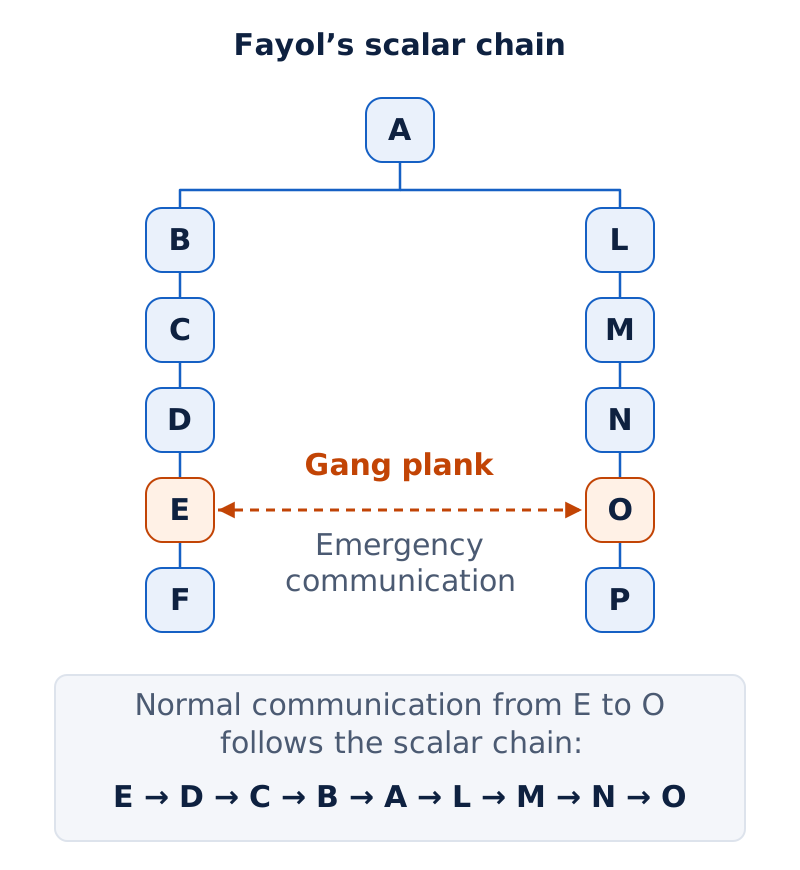
A is at the top of two descending branches. The left has B to F and the right has L to P. A dashed horizontal connection joins E and O, showing the gang plank.
Drawn by One Young India. Reference: NCERT Class 12, page 59
How do order, equity, stability, initiative and team spirit support employees?
How do suitable conditions and fair treatment help?
Order means placing people and materials appropriately at the right time. Everything and everyone should have a suitable place. When resources are available where required, avoidable hindrances decline and productivity and efficiency improve.
Equity combines kindliness and justice. Employees should be treated as fairly as possible, without discrimination based on gender, religion, language, caste, belief or nationality. Fayol does not rule out stern treatment of lazy personnel; fairness does not mean abandoning discipline.
Stability of personnel means minimising employee turnover, or employees leaving and being replaced. Selection should be rigorous, but selected employees should receive a minimum fixed tenure and reasonable time to show results. Instability can increase insecurity and recruitment, selection and training costs.
How do employees contribute ideas and cooperation?
Initiative means taking the first step through self-motivation, thinking out a plan and carrying it out. Employees should be encouraged to develop improvements. It does not mean breaking established practices simply to be different.
An employee suggestion system should reward ideas that substantially reduce costs or time. This gives practical expression to initiative by encouraging workers to contribute to improvements in the organisation.
What the figure shows
Cartoon of employee suggestions
Two seated people face a standing manager. One holds a project-analysis document, while the manager holds a report on opportunities for growth. An upward graph appears behind them. Caption: “Employee suggestion system: Encourage initiative among trainee managers”.
Reference: NCERT Class 12, page 60
Esprit de corps means team spirit, unity and harmony. Managers should encourage teamwork, especially in large organisations. Replacing “I” with “We” in conversations helps build mutual trust and belonging, while reducing the need for penalties.
These five principles address distinct concerns: orderly resources, fair treatment, continuity of employment, constructive ideas and group cooperation. Stability should give employees time to contribute; initiative lets them improve work; team spirit helps their efforts support shared objectives.
How do Fayol and Taylor compare, and how have their ideas developed?
Fayol and Taylor made complementary contributions. Efficient factory work and effective overall administration support each other. Differences in focus do not mean that an organisation must choose one thinker and reject all the ideas of the other.
| Basis | Fayol | Taylor |
|---|---|---|
| Perspective | Top management | Factory shop floor |
| Unity of command | Strongly supported it | Allowed eight specialist supervisors through functional foremanship |
| Applicability | Universal | Specialised situations |
| Basis | Personal experience | Observation and experimentation |
| Focus | Overall administration | Productivity |
| Orientation | Practitioner | Scientist |
| Expression | General theory of administration | Scientific management |
What developments extend these ideas?
Just in Time manufacturing reduces inventory held during production and its associated costs. Kanban uses visual signals to indicate whether replenishment is required. Both connect production decisions with the need to use resources efficiently.
Lean manufacturing seeks to reduce seven wastes: overproduction, waiting time, transportation, processing, motion, inventory and scrap. Eliminating waste improves quality and reduces production time and cost.
Kaizen means change for better or improvement. It applies continuous improvement and scientific experimentation to work. Its goals include eliminating activities that add cost without value, standardising work and improving the workplace.
Six Sigma is a data-driven approach to reducing quality variation and inefficiency. It seeks no more than 3 to 4 defects per million opportunities under prescribed norms. Its customer focus depends on data and organisational support. These developments extend the concern with productivity and efficient processes.
Interpretations of Fayol’s principles also change. Carl A. Rodrigues’s 2001 “Then and Now” discussion contrasts empowering managers with empowering employees, and formal hierarchical communication with flatter, less formal structures. Changing interpretation reflects the flexibility of principles.
How can these business cases be analysed?
What do Wales Limited and Mr Rathore illustrate?
At Wales Limited, a printing press, SanakLal and Gagan underwent rigorous recruitment. As they lacked prior work experience, the firm gave them one year to prove themselves. This illustrates stability of personnel: careful selection followed by reasonable time to show results.
For the financial year 2017-18, Mr Rathore placed a raw-material order with his cousin at a higher price, although the usual supplier offered to lower rates. This violates subordination of individual interest to general interest by favouring a family connection over the firm.
What went wrong at Bhasin Limited?
Bhasin Limited, a food-processing business, expanded as demand increased. To protect market share it required overtime without creating the necessary supporting arrangements. Work pressure reduced efficiency, employees served multiple superiors, divisions handled overlapping products, and discipline and teamwork declined.
The case connects multiple instructions with unity of command and overlapping product responsibilities with unity of direction. Declining teamwork concerns esprit de corps; reduced willingness to propose improvements concerns initiative. Indiscipline calls for fair rules and agreements rather than simply demanding more output.
Mukti Consultants recommended scientific management, production planning, functional foremanship, work-study, standardisation and differential piece rates. Production planning included routing, meaning the production route; scheduling, meaning timing; dispatching, meaning issuing work instructions; and feedback on performance.
The recommendations require coordinated implementation. Establish suitable methods, working conditions and standards before applying incentive rates. Explain responsibilities and secure cooperation so that changes support efficiency and worker development. No technique by itself guarantees recovery when the supporting arrangements remain inadequate.
Glossary
- Management principle — A broad guideline that assists managers in making decisions and directing behaviour in work situations.
- Scientific management — An approach using scientific investigation, standard methods and trained workers to improve output, quality and efficiency.
- Rule of thumb — Reliance on personal judgement and experience when dealing with managerial problems as they arise.
- Mental revolution — A change in workers’ and management’s attitudes from competition towards cooperation and shared prosperity.
- Functional foremanship — A supervisory arrangement separating planning and execution, with eight specialists guiding workers in their respective functions.
- Standardisation — Setting benchmarks for business activities, materials, methods, time, products, machines and working conditions.
- Simplification — Removing unnecessary product varieties, sizes and dimensions to reduce diversity, costs and inventories.
- Method study — Examination of ways of performing a job to identify the best method and improve efficiency.
- Motion study — Examination of movements during a job to identify and eliminate unnecessary motions.
- Time study — Measurement of task elements to establish the standard time required for a well-defined job.
- Fatigue study — Investigation of the amount and frequency of rest intervals required while completing a task.
- Differential piece wage — Payment at different per-unit rates according to whether a worker achieves the established performance standard.
- Scalar chain — The formal line of authority connecting the highest and lowest positions in an organisation.
- Gang plank — A shorter direct communication route used in an emergency to avoid delays along the scalar chain.
- Esprit de corps — Team spirit based on unity, harmony, mutual trust and a sense of belonging among employees.
Common errors and misconceptions
- Misconception: Universal principles must be applied identically everywhere. Correct: Their extent of applicability varies with the organisation, activity, scale and circumstances.
- Misconception: Principles guarantee exact outcomes like rigid scientific laws. Correct: Human behaviour and changing situations make cause and effect relationships less than perfect.
- Misconception: Unity of command and unity of direction are the same. Correct: The first concerns an employee’s superior; the second concerns the head and plan for activities sharing an objective.
- Misconception: Functional foremanship gives each worker only one specialist supervisor. Correct: Taylor’s arrangement uses eight specialists, divided between planning and production.
- Misconception: Motion study fixes rest breaks, while fatigue study sets task time. Correct: Motion study removes unnecessary movement, fatigue study fixes rest intervals, and time study establishes standard task time.
- Misconception: A gang plank replaces the scalar chain in normal communication. Correct: It is a shorter emergency route; normal formal communication should follow the chain.
- Misconception: Equity prevents firm treatment, while initiative permits breaking rules at will. Correct: Equity can include stern treatment of laziness, and initiative does not mean defying established practices merely to be different.
- Misconception: Scientific management consists only of higher piece rates. Correct: Pay incentives belong with scientific methods, worker selection and training, suitable standards and cooperation.
Exam-style questions with model answers
Q1. What is a management principle, and why is it flexible? [2 marks]
- A management principle is a broad and general guideline for managerial decision-making and behaviour.
- It is flexible because managers can modify its application to suit changing situations and circumstances rather than obeying a rigid prescription.
Q2. Explain four characteristics of management principles: universal applicability, general guidelines, mainly behavioural nature and contingency. [4 marks]
- Universal applicability means principles are intended for different kinds of organisations, though the extent of application varies.
- General guidelines assist decisions without supplying a ready-made solution to every complex business problem.
- Their mainly behavioural nature means they primarily influence human behaviour, while also relating human and material resources.
- Contingency means applying a principle depends on prevailing circumstances, such as the factors determining fair remuneration.
Q3. A cardboard box requires 20 minutes. An 8-hour shift includes 1 hour for lunch and rest; 1 hour equals 60 minutes. Identify the study that establishes standard task time, then calculate hourly output, working hours and standard shift output. [4 marks]
- Time study establishes the standard time for a well-defined task from several observations and readings.
- With 60 minutes in an hour and 20 minutes per box, hourly output is 60 ÷ 20 = 3 boxes.
- Deducting the stated lunch and rest allowance gives 8 − 1 = 7 working hours per shift.
- The standard shift task is therefore 7 × 3 = 21 boxes, providing a basis for setting expected output.
Q4. Standard daily output is 10 units. Workers producing at least 10 units receive ₹50 per unit; those below standard receive ₹40 per unit. Calculate daily pay at 11 units and 9 units, and the pay difference. [3 marks]
- The worker making 11 units exceeds the standard and receives the higher rate for each unit: 11 × ₹50 = ₹550 daily.
- The worker making 9 units falls below the standard and receives the lower rate: 9 × ₹40 = ₹360 daily.
- The difference in daily earnings is ₹550 − ₹360 = ₹190, which Taylor considered an incentive for the less efficient worker to improve.
Q5. Explain the six areas of significance of management principles. [6 marks]
- They provide useful insights into real situations, helping managers build understanding, learn from previous mistakes and handle recurring problems more efficiently.
- They support optimum resource use and effective administration by reducing trial-and-error waste and limiting decisions based on personal preferences.
- They encourage scientific decisions based on facts, logical assessment and intended purposes, with scope for measurement and evaluation of results.
- They help meet changing environmental requirements because flexible principles can be adapted as business conditions and organisational needs change.
- They support social responsibility, including fair treatment, customer value, environmental care and responsible dealings with other groups connected with the business.
- They provide the basis for management training, education and research, supporting professional learning and the development and refinement of techniques.
Q6. Explain functional foremanship under six heads: meaning, reason for specialisation, division of supervision, planning specialists, production specialists and relation to unity of command. [6 marks]
- Functional foremanship organises shop-floor supervision through specialists, extending division of work and specialisation to the daily guidance of factory workers.
- Taylor proposed it because a single foreman could not possess all the required technical, intellectual, personal and physical qualities.
- Under the factory manager, supervision separates into planning and production, with four specialists supporting each incharge and eight specialists overall.
- The instruction card clerk prepares instructions, route clerk specifies the production route, time and cost clerk prepares sheets, and disciplinarian ensures discipline.
- The speed boss ensures timely completion, gang boss prepares equipment, repair boss maintains its condition, and inspector checks work quality.
- Workers receive instructions from eight specialists in their respective functions, whereas Fayol’s unity of command requires one superior for each employee.
Q7. Marketing permits a salesperson to offer a 10% discount, while finance directs that it must not exceed 5%. Identify and explain the principle violated. [2 marks]
- The conflicting 10% and 5% instructions violate unity of command because the salesperson receives directions from two sources.
- The principle requires one superior for each employee; coordination between departments should prevent contradictory instructions and confusion.
Q8. In Bhasin Limited, staff received orders from multiple superiors, product divisions overlapped, teamwork declined and employees’ initiative weakened. Identify the four relevant Fayol principles and recommend their application. [4 marks]
- Unity of command requires one superior for each employee, so management should remove conflicting reporting instructions.
- Unity of direction requires one head and one plan for activities sharing an objective, preventing overlapping product responsibilities.
- Esprit de corps requires renewed teamwork, mutual trust and belonging instead of allowing cooperation to decline.
- Initiative requires encouragement for employees to develop and implement improvements, supported by a suggestion system rewarding substantial savings.
Key takeaways
- Management principles are broad, flexible and contingent guidelines whose application depends on the organisation and prevailing circumstances.
- Principles improve decisions, resource use, administration, adaptation, social responsibility and the development of management knowledge.
- Taylor’s scientific management combines systematic methods, trained workers, appropriate standards and cooperation between workers and management.
- Functional foremanship divides supervision between four planning specialists and four production specialists, each responsible for a particular function.
- Method, motion, time and fatigue studies address the best method, movements, task duration and rest intervals respectively.
- Fayol’s fourteen principles cover the organisation of work, authority, communication, fair treatment, stability, initiative and teamwork.
- Unity of command concerns one employee’s superior; unity of direction concerns a shared objective, one head and one plan.
- Fayol and Taylor complement each other by addressing overall administration and factory productivity from different perspectives.
Test yourself
Which principle extends harmony, not discord?
Cooperation, not individualism extends harmony by requiring management and workers to cooperate, listen and support each other.
What makes management principles contingent?
Their application depends on the prevailing circumstances and must change when the requirements of the situation change.
Which specialist keeps machines and tools ready, and which maintains their condition?
The gang boss keeps equipment ready for operation, while the repair boss ensures its proper working condition.
How does simplification differ from standardisation?
Simplification removes unnecessary varieties, sizes and dimensions. Standardisation establishes benchmarks for activities, materials, methods, products, equipment and performance.
What does a gang plank permit?
It permits shorter direct communication in an emergency, avoiding delay along the normal scalar chain.
Why did Wales Limited give newly recruited employees time to prove themselves?
It applied stability of personnel by allowing carefully selected employees reasonable time to demonstrate their performance.
Why is mental revolution essential to scientific management?
It changes management’s and workers’ attitudes from competition to cooperation so that both seek greater output and shared prosperity.
Does equity rule out stern treatment of lazy personnel?
No. Equity requires fairness and freedom from discrimination, while allowing stern treatment when needed to uphold discipline.
Try it
CBSE Class 12 Business Studies: Comprehensive Guide to Principles of Management
Design a 2-step scenario interactive for a study note.
1What is the primary characteristic of management principles that distinguishes them from rigid laws of pure science?
Management principles are inherently flexible, human-centric, and adapted to complex, ever-changing business environments.
Management principles serve as fundamental truths providing broad and general guidelines for managerial decision-making and organizational behavior.
Management principles are universally applicable to all types of organizations, regardless of size or scale.
2What is the core philosophy of F.W. Taylor's Scientific Management?
Taylor's approach rests upon four foundational principles, including Science, Not Rule of Thumb, which emphasizes standardizing work methods through systematic study.
Taylor introduced Scientific Management to substitute intuitive rule-of-thumb practices with systematically engineered methods.
Taylor's approach is more comprehensive, aiming to maximize productivity while minimizing resource waste through standardized work methods.
3What is the purpose of the Differential Piece Wage System designed by F.W. Taylor?
The system rewards efficient workers and penalizes inefficiency by linking compensation directly to performance standards.
The system utilizes dual wage rates to create a financial motivator for workers to reach standard efficiency.
The system relies on precise Time and Motion studies to establish standard performance times.
Mastering both Henri Fayol's administrative doctrine and F.W. Taylor's scientific methods equips students to analyze workplace challenges with diagnostic clarity and exam precision.