
Private, Public and Global Enterprises | CBSE Class 11 Business Studies Notes
On this page
Try an idea before you read. Apply your knowledge of India's mixed economy and public sector enterprises to solve these scenarios. Explore →
This note covers private and public sectors, forms of public enterprises, their features, merits and limitations, the changing role of the public sector, global enterprises, joint ventures and public private partnerships.
What distinguishes the private sector from the public sector?
The private sector consists of businesses owned by individuals or groups of individuals. The public sector consists of organisations owned and managed by government. Public enterprises may be partly or wholly owned by the central government or state governments.
A mixed economy allows privately owned and government-owned enterprises to operate together. India has adopted this arrangement. Shops, service providers and government undertakings coexist with global enterprises or multinational corporations (MNCs), which operate in more than one country.
How are the sectors organised?
Private businesses take five forms: sole proprietorship, owned by one person; partnership, where persons agree to share business profits; joint Hindu family business, owned and carried on by members of a Hindu undivided family; cooperative, a voluntary association serving members; and company, an incorporated business organisation. Public enterprises take three principal forms: departmental undertaking, statutory corporation and government company. Their suitability depends on operational requirements and the relationship needed with government.
| Basis | Private sector | Public sector |
|---|---|---|
| Ownership | Individuals or groups of individuals | Central or state government, partly or wholly |
| Organisational forms | Sole proprietorship, partnership, joint Hindu family, cooperative and company | Departmental undertaking, statutory corporation and government company |
| Examples | Privately owned neighbourhood shops and legal or medical service businesses | Railways and the post and telegraph department |
Public accountability means being answerable to the public through Parliament. Public ownership, use of public funds and public accountability characterise public enterprises. Organisational arrangements should also support performance, productivity and quality standards.
What the figure shows
Organisation of the Indian economy
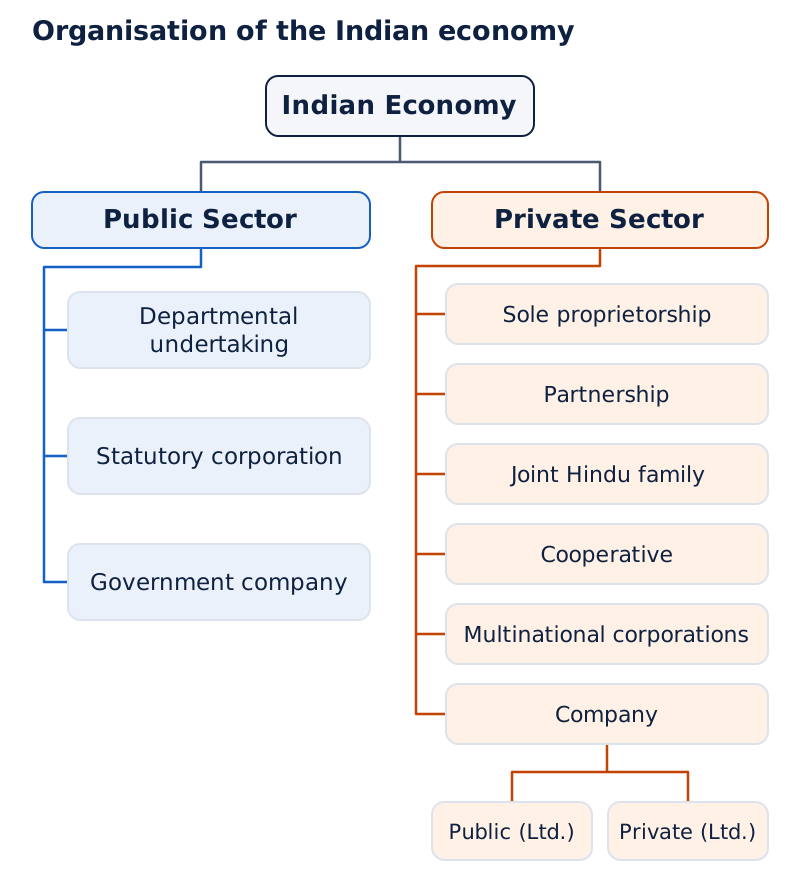
Indian Economy branches into Public Sector and Private Sector. The public branch shows the three public enterprise forms. The private branch shows sole proprietorship, partnership, joint Hindu family, cooperative, company and multinational corporations. Company divides into Public (Ltd.) and Private (Ltd.).
Drawn by One Young India. Reference: NCERT Class 11, unnumbered diagram, page 60
Anita, a Class XI student, reads about government share sales, a loss-making public company and successful private companies. A business's profit or loss alone does not identify its sector; ownership and government participation distinguish the sectors.
How does a departmental undertaking function?
Definition: A departmental undertaking is an enterprise established as a department or extension of a government ministry. It is part of government rather than an independent legal entity.
This is the oldest and most traditional public enterprise form. It operates through government officers and employees. Central or state government rules apply according to the government concerned. Railways and the post and telegraph department are examples.
What are its main features?
- Budgetary finance: Funds come directly from the government treasury through an annual budget allocation. Revenue earned also goes into the treasury.
- Accounting and audit: The undertaking follows the accounting and audit controls applicable to other government activities.
- Government employees: Recruitment and service conditions follow government rules. Indian Administrative Service (IAS) officers and civil servants head these undertakings and may move between ministries.
- Ministerial control: The undertaking is generally considered a major subdivision of a government department and remains under the ministry's direct control.
- Accountability: Management is directly under the concerned ministry and is accountable to it.
What are its merits?
The arrangement facilitates effective parliamentary control and a high degree of public accountability. Revenue paid into the treasury provides government income. Where national security is involved, this form is most suitable because the concerned ministry directly controls and supervises operations.
What are its limitations?
Lack of flexibility makes commercial operations difficult. Heads and employees cannot make independent decisions without ministry approval, delaying urgent action. Over-cautious, conservative approval procedures prevent undertakings from taking risky business opportunities.
Red tapism, meaning delays through formal channels of authority, affects everyday work. Political interference occurs through the ministry. These organisations are usually insensitive to consumer needs and do not provide adequate services to them.
The same close supervision therefore has two consequences: it supports public control, but restricts business decisions. The form is particularly relevant when direct government supervision matters more than operational freedom.
How does a statutory corporation combine public ownership with autonomy?
A statutory corporation is a public enterprise created by a Special Act of Parliament. The Act specifies its powers, functions, employee rules and relationship with government departments. It combines government powers with considerable operating flexibility associated with private enterprises.
What are its features?
- Creation by statute: The parliamentary Act defines the corporation's objects, powers and privileges and governs its activities.
- State ownership: Government wholly owns the corporation, bears ultimate financial responsibility, may appropriate profits and must bear losses.
- Separate legal identity: It can sue, be sued, enter contracts and acquire property in its own name.
- Independent finance: It is usually independently financed through government or public borrowings and revenue from goods and services. It can use its own revenue.
- Different financial procedures: It does not follow the same accounting and audit procedures as government departments and is not concerned with the central budget.
- Employee conditions: Employees are not government or civil servants. Their service conditions follow the Act. At times, government officers head these organisations on deputation, or temporary assignment.
What are its merits?
Operational flexibility and independence are important advantages. Since funds do not come from the central budget, government generally does not interfere with financial matters, including income and receipts.
The corporation frames policies and procedures within its statutory powers. However, the Act may reserve some matters for prior ministry approval. Combining public authority with enterprise initiative makes this form an instrument of economic development.
What are its limitations?
Actual autonomy falls short of formal autonomy because rules and regulations constrain actions. Government and political interference affects major decisions or decisions involving large funds. Corruption in dealings with the public is another limitation.
Government-appointed advisers to the board restrict freedom over contracts and other decisions. Disagreements are referred to government for a final decision, causing further delays. Autonomy, or freedom to manage operations within assigned powers, therefore does not mean complete independence from government.
What makes an enterprise a government company?
A government company is established and registered under the Companies Act, 2013. It is formed for business purposes and competes with private companies. It may be a private limited company, which restricts share transfers and prohibits invitations to the public to subscribe for its securities, or a public limited company, which may invite public subscription subject to legal requirements. Securities are financial instruments such as shares and bonds.
Definition: Under Section 2(45) of the Companies Act, 2013, not less than 51 per cent of a government company's paid-up capital must be held by the central government, a state government, or partly by the central government and partly by one or more state governments. The definition also includes a subsidiary of a government company.
Paid-up capital is share capital for which payment has been received. A subsidiary is a company controlled by another company. Government's major shareholding gives it management control; shares are purchased in the name of the President of India.
What are its features?
The company has a separate legal entity: it can sue and be sued, contract and hold property in its own name. Management is regulated by company law, including provisions on appointment and retirement of directors and other managerial personnel.
Employees are appointed under the company's own rules. Its Memorandum and Articles of Association are the main documents setting out its objects and rules. It obtains finance from government shareholdings, private shareholders and the capital market, where businesses raise funds.
An auditor is appointed by the central government, and the annual report goes before Parliament or the state legislature. Exemption from the departmental accounting and audit rules does not mean absence of an auditor or reporting obligations.
What are its merits?
Formation requires compliance with the Companies Act rather than a separate parliamentary Act. Separate legal identity and autonomy allow decisions based on business prudence. Supplying goods and services at reasonable prices can control markets and curb unhealthy business practices.
What are its limitations?
In companies where government is the sole shareholder, company law provisions may have little practical relevance. Management and administration remain with government, defeating the purpose of using an ordinary company form. The company is not directly answerable to Parliament, weakening constitutional responsibility.
Note: Presentation of an annual report before Parliament and direct answerability to Parliament are distinct points. A government company has the reporting requirement, while lack of direct parliamentary answerability remains a limitation.
How do the three forms of public enterprise differ?
The three forms differ in legal status, finance, employees and control. A departmental undertaking forms part of government. A statutory corporation and a government company possess identities separate from government, although government ownership and influence remain important.
| Basis | Departmental undertaking | Statutory corporation | Government company |
|---|---|---|---|
| Establishment | Department or extension of a ministry | Special Act of Parliament | Registration under company law |
| Legal identity | No independent legal entity | Separate corporate person | Separate legal entity |
| Ownership | Government | Wholly state-owned | At least 51 per cent government-held paid-up capital, with the subsidiary inclusion |
| Finance | Annual government budget allocation | Usually independent finance and authority to use revenues | Government and private shareholdings and capital market funds |
| Employees | Government servants | Service conditions under the establishing Act | Company's own appointment rules |
| Control | Direct ministerial control | Powers defined by its Act, with practical government interference | Company law framework and government management influence |
Which distinction matters when choosing a form?
Direct supervision supports the departmental form in matters of national security. A statutory corporation combines defined public powers with operational flexibility. A government company offers a separate business organisation without requiring a special Act for its establishment.
The choice depends on the nature of operations and the required relationship with government. A legal promise of autonomy does not establish that every decision is free from interference. Statutory corporations and government companies both illustrate this difference between organisational design and actual working.
Similarly, public limited company and public sector enterprise are different classifications. The first is a company form; the second concerns government ownership and management. A government company may adopt either a private limited or public limited form.
Why was the public sector important in India's early development?
At Independence, public enterprises were expected to participate directly in business and stimulate wider economic development. Private businesses were unwilling to undertake projects requiring heavy investment and long gestation periods, meaning long waits before projects begin yielding returns.
How did infrastructure and regional development benefit?
Infrastructure includes transport, communication, fuel, energy and basic industrial facilities needed for industrialisation. Government could mobilise large funds, coordinate construction and train technicians and workers when private enterprises lacked the resources and trained personnel.
| Investment purpose | Examples |
|---|---|
| Build core infrastructure | Steel, power generation, civil aviation, railways, petroleum, state trading and coal |
| Lead investment where private activity was inadequate | Fertilisers, pharmaceuticals, petrochemicals, newsprint and medium and heavy engineering |
| Guide future investment | Hotels, project management, consultancies, textiles and automobiles |
Regional balance means reducing disparities in development between regions. Most industrial progress before Independence was limited to a few areas, such as port towns. After 1951, Five Year Plans gave particular attention to regions lagging behind.
Four major steel plants were established in backward areas to encourage development, employment and ancillary industries, which support larger industries. This was achieved to some extent, but there was scope for a lot more. New enterprises also countered excessive industrial concentration in already advanced areas.
What other economic purposes did public enterprises serve?
Economies of scale are cost advantages associated with large-scale operation. Electric power, natural gas, petroleum and telephone industries needed substantial capital and a large operating base. Government resources enabled such investment and mass production.
Public investment also checked concentration of economic power. Few private industrial houses were willing to invest in heavy industries, encouraging concentrated wealth and monopolistic practices, where market power is concentrated rather than competitively dispersed. Public enterprises spread the income and benefits of large industries among many employees and workers.
Import substitution means replacing imports with domestic production. During the second and third Five Year Plans, foreign exchange shortages made heavy machinery imports difficult. Public heavy-engineering enterprises supported self-reliance. STC (State Trading Corporation) and MMTC (Minerals and Metals Trading Corporation) also helped expand exports.
How did policy towards the public sector change after 1991?
The Industrial Policy Resolution of 1948 defined public and private sector roles. The 1956 resolution emphasised public sector growth and industrialisation while recognising mutual dependence between sectors. The 1991 industrial policy allowed greater private-sector freedom, considered public-sector share sales and invited investment from businesses abroad.
Liberalisation means easing restrictions on business; privatisation involves greater private participation in ownership or control; globalisation involves closer links across national economies. In the post-1990s setting, public enterprises were expected to compete actively and answer for losses and returns on investment.
What were the main policy directions?
- Restructure and revive potentially viable Public Sector Undertakings (PSUs). PSUs are government enterprises; potentially viable units are those capable of being restored to workable operation.
- Close PSUs that could not be revived rather than continue supporting accumulated losses indefinitely.
- Reduce government equity, or ownership share capital, in non-strategic PSUs, meaning those outside strategically important areas, to 26 per cent or lower, if necessary.
- Fully protect workers' interests during these changes.
How did reservation and disinvestment change?
| Year | Industries reserved for the public sector | Policy significance |
|---|---|---|
| 1956 | 17 industries | Extensive reservation under the industrial policy resolution |
| 1991 | 8 industries | Wider entry for private enterprises |
| 2001 | 3 industries: atomic energy, arms and rail transport | Private entry into other areas increased competition |
Disinvestment involves selling equity shares to private investors and the public. It aimed to raise resources and widen participation by the public and workers. Better management and financial discipline were expected outcomes, rather than automatic results of every share sale.
Privatisation objectives included releasing resources for basic health, family welfare and primary education, reducing public debt and interest, transferring commercial risk to private investors, and freeing enterprises from government control through corporate governance, or arrangements for directing and controlling companies.
In areas such as telecom, greater choice, lower prices and improved quality benefited consumers. Public and private enterprises were to be viewed as mutually complementary parts of the national sector, with greater public responsibilities for private businesses and stronger competitive performance from public enterprises.
How were sick units and performance addressed?
In this reform setting, financially troubled or sick units were referred to the Board for Industrial and Financial Reconstruction (BIFR) for restructuring or closure. The National Renewal Fund supported retraining, redeployment and compensation for employees seeking voluntary retirement.
Its resources were insufficient for the cost of the Voluntary Separation Scheme or Voluntary Retirement Scheme. Closure of units incapable of revival therefore involved the need for a safety net for employees and workers.
A Memorandum of Understanding (MoU) between a PSU and its administrative ministry defined their relationship, autonomy and expected results. Managers received clear targets and operational freedom but remained accountable for performance. These are historical reform arrangements associated with the changing public-sector role, which differed from that envisaged in the early 1960s or 1970s.
What features distinguish global enterprises?
Global enterprises, also called multinational corporations (MNCs), extend industrial and marketing operations through branches in several countries. Their large size, multiple products, advanced technology and worldwide networks distinguish them from businesses operating on a smaller geographical scale.
How do finance, collaboration and technology strengthen them?
- Huge capital resources: They raise money from various sources, including share issues, borrowing instruments such as debentures and bonds, financial institutions and international banks. Their capital-market credibility attracts investors and banks in host countries, the countries where they operate.
- Foreign collaboration: They usually enter into agreements with Indian companies on technology, production or use of brand names. Partners may belong to either sector. Agreements usually contain restrictive clauses concerning technology transfer, pricing, dividend payments, meaning distributions of company profits to shareholders, or control by foreign technicians.
- Advanced technology: Superior production methods enable international quality standards and effective use of local resources and raw materials. Technological advances support industrial progress in the countries where these enterprises operate.
- Product innovation: Sophisticated research and development departments develop new products and improve existing designs. These activities involve substantial investment.
Collaboration can help large industrial houses diversify and expand through resources, technology rights and foreign exchange. However, it has also encouraged monopolies and concentration of power. The advantages therefore need to be considered alongside these consequences.
How do marketing, reach and control operate?
Marketing strategies include aggressive promotion supported by reliable, current market information. Advertising and sales promotion techniques are normally very effective. Established global brands assist product sales.
Expansion of market territory occurs through subsidiaries, branches and affiliated businesses in host countries. The international network builds brand recognition. Their giant size gives these enterprises a dominant market position.
Centralised control comes from headquarters in the home country. However, control is limited to the parent company's broad policy framework. It does not involve interference in day-to-day operations. A large international network therefore combines overall direction with local operational freedom.
What is a joint venture and how do its two types differ?
A joint venture pools the resources and expertise of two or more businesses to achieve a particular goal, sharing risks and rewards. Partners may be private, government-owned or foreign organisations. Ventures may support long-term relationships or short-term projects.
Reasons often include business expansion, new product development and entry into new markets, particularly abroad. Complementary finance, technology and distribution channels can support cooperation. An agreement between businesses in different countries must follow the relevant provisions of both governments.
How does a contractual joint venture work?
A Contractual Joint Venture (CJV) creates no new jointly owned entity. Parties agree to cooperate without sharing business ownership, although each exercises some control. A franchisee relationship, a business arrangement involving the use of another business's brand or system, is an example.
Its four key elements are common intention to run a venture, inputs from each party, some control exercised by both parties, and a relationship of relatively long duration rather than isolated transactions.
How does an equity-based joint venture work?
An Equity-based Joint Venture (EJV) involves a separate jointly owned business entity. The agreement may create a new entity or allow a party to enter ownership of an existing one. Joint ownership is the central feature.
| Basis | Contractual venture | Equity-based venture |
|---|---|---|
| Entity | No new jointly owned entity | Separate jointly owned business entity |
| Ownership | No shared ownership of the business | Shared ownership |
| Control | Some control exercised by participating parties | Shared management of the jointly owned entity |
| Commitments | Inputs and cooperation under the agreement | Shared investment and financing responsibilities, and agreed sharing of profits and losses |
A limited liability partnership is a partnership form in which partners' liability is limited; a strategic alliance is cooperation between businesses pursuing shared objectives. Equity ventures may adopt different organisational forms according to their agreement.
What the figure shows
Types of joint venture
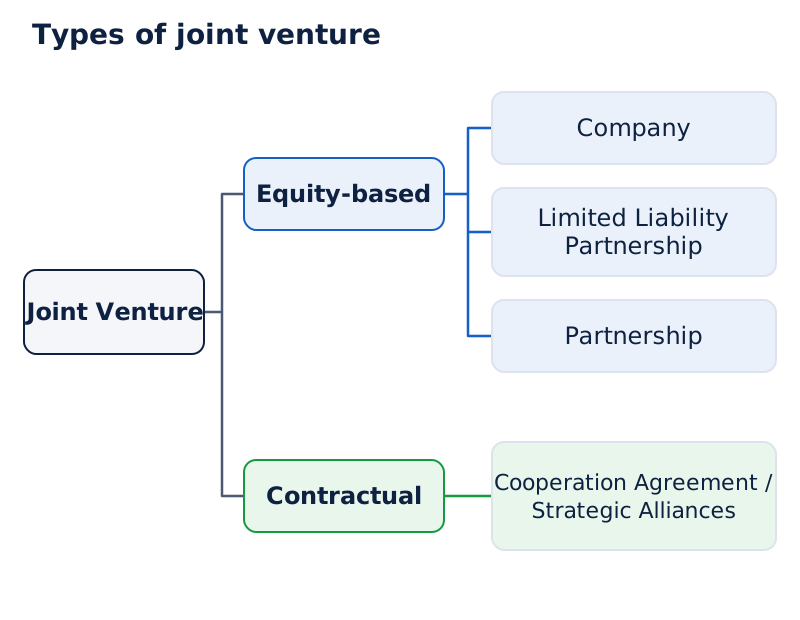
A Joint Venture box branches into Equity-based and Contractual. Equity-based branches into Company, Limited Liability Partnership and Partnership. Contractual leads to Cooperation Agreement / Strategic Alliances.
Drawn by One Young India. Reference: NCERT Class 11, unnumbered diagram, page 71
The venture should rest on a signed MoU. Terms must be discussed and negotiated with attention to cultural and legal backgrounds. The agreement must provide for necessary government approvals and licences within a specified period. Indian-incorporated joint venture companies are treated like domestic companies, without separate joint venture laws.
What benefits can businesses gain from joint ventures?
A business with innovative ideas and growth potential can still benefit from a partner's resources and expertise. Joint venture benefits arise because partners combine strengths that would otherwise have to be developed separately. Six major benefits explain their attraction.
How do resources, markets and technology help?
- Increased resources and capacity: Pooling finance and human resources supports faster, more efficient expansion. The venture is better equipped to face market challenges and use new opportunities.
- Access to new markets and distribution networks: A foreign partner can gain access to the Indian market. Products with saturated home markets can reach new buyers through established retail outlets, avoiding expensive creation of a separate distribution network.
- Access to technology: Technology is a major reason for most businesses to enter ventures. Advanced production techniques support quality, save time, energy and investment, and improve efficiency without requiring the venture to develop its own technology.
How do innovation, cost and reputation help?
- Innovation: New ideas and technologies, particularly from foreign partners, allow businesses to develop creative products for increasingly demanding markets.
- Low cost of production: International corporations investing in India benefit from lower raw-material and labour costs, technically qualified workers and professional expertise. These support products meeting global quality requirements at lower costs than in the home country.
- Established brand name: A partner can benefit from the other's goodwill, meaning an established favourable business reputation. An Indian partner may save the time and money otherwise needed to develop a product brand and distribution system.
Distribution channels are the routes and outlets through which products reach buyers. Access to these channels and an established brand can reinforce one another: customers can recognise a product and obtain it through an existing retail network.
These benefits explain why firms with different resources may cooperate. The agreement still needs to clarify contributions, ownership where applicable, responsibilities, control and the sharing of risks and rewards so that differences do not become later conflicts.
How does a public private partnership share responsibilities?
A Public Private Partnership (PPP) is a relationship between public and private entities in infrastructure and other services. It allocates tasks, obligations and risks among partners. Public partners include ministries, departments, municipalities and state-owned enterprises.
Private partners may be local or foreign businesses and investors with relevant technical or financial expertise. Non-governmental organisations (NGOs) and community-based organisations directly affected by a project can also participate as stakeholders, meaning parties affected by its activities.
What does each partner contribute?
The public partner ensures social obligations, sector reforms and public investment are met. Contributions include investment capital and assets, together with social responsibility, environmental awareness and local knowledge.
The private partner contributes expertise in operations, task management and innovation to run the business efficiently. PPPs have been completed in power, water and sanitation, refuse disposal, pipelines, hospitals, schools, stadiums, air traffic control, prisons, railways, roads, information technology systems and housing.
What are the merits and limitations of the design-and-build model?
| Aspect | Design-and-build PPP arrangement |
|---|---|
| Contract | Private party designs and builds a public facility |
| Finance and ownership | Public sector finances and owns the facility |
| Application | Capital projects with small operating requirements or where government wishes to retain operating responsibility |
| Strengths | Transfers design and construction risk and has potential to accelerate the project |
| Weaknesses | Environmental considerations may cause conflict; private finance is not easily attracted |
Kundli Manesar Expressway Ltd. provides a concrete example. For the 135 km expressway, where km means kilometres, government provided the land and the company laid the surface. The contributions illustrate how partners can undertake different parts of a development project.
Note: PPP describes a wider partnership approach. Public finance and ownership are features of the design-and-build model described here; they should not be treated as a universal description of every partnership arrangement.
Glossary
- Mixed economy — An economy in which privately owned and government-owned business enterprises are both allowed to operate.
- Private sector — The part of the economy consisting of businesses owned by individuals or groups of individuals.
- Public sector — Organisations owned and managed by government, with ownership partly or wholly central or state.
- Departmental undertaking — A public enterprise established as a ministry department without an independent legal identity.
- Statutory corporation — A public enterprise created by a Special Act of Parliament defining its powers, functions and governing rules.
- Government company — A company with at least 51 per cent government-held paid-up capital; the definition includes its subsidiaries.
- Public accountability — The responsibility of public enterprises to answer to the public through Parliament.
- Disinvestment — Sale of equity shares in public enterprises to the private sector and the public.
- Import substitution — Replacement of imported goods by domestic production to support self-reliance.
- Global enterprise — A large industrial organisation extending production and marketing through branches in several countries.
- Joint venture — Pooling of resources and expertise by businesses for a goal with shared risks and rewards.
- Contractual joint venture — Cooperation through agreement without creating a new jointly owned entity or sharing business ownership.
- Equity-based joint venture — An arrangement involving a separate jointly owned business entity with shared management and financing responsibilities.
- Public private partnership — A relationship between public and private entities allocating responsibilities in infrastructure and other services.
- Memorandum of Understanding — An agreement recording the basis of a relationship, including expected responsibilities or performance commitments.
Common errors and misconceptions
- Misconception: Every public enterprise is wholly government-owned. Correct: Public enterprises may be partly or wholly government-owned; a government company uses the 51 per cent threshold and subsidiary inclusion.
- Misconception: Departmental undertakings have independent legal identities. Correct: They are extensions of ministries, unlike statutory corporations and government companies.
- Misconception: Every public limited company belongs to the public sector. Correct: Public limited is a company form; government ownership and management distinguish the public sector.
- Misconception: A statutory corporation's autonomy prevents government interference. Correct: Rules, political interference and government-appointed advisers can restrict practical freedom.
- Misconception: Government companies require a special parliamentary Act. Correct: They are formed under company law; a Special Act establishes a statutory corporation.
- Misconception: Every joint venture creates a jointly owned company. Correct: A contractual venture creates no new jointly owned entity, while an equity venture involves joint ownership.
- Misconception: Centralised MNC control means headquarters manages every daily activity. Correct: Control is limited to the broad policy framework without interference in day-to-day operations.
- Misconception: A PPP must obtain private finance. Correct: In the design-and-build model described, the public sector finances and owns the facility.
Exam-style questions with model answers
Q1. Distinguish the private sector from the public sector on the basis of ownership. [2 marks]
- The private sector comprises businesses owned by individuals or groups of individuals.
- The public sector comprises organisations owned and managed by government, with central or state ownership that may be partly or wholly held.
Q2. Explain three features of departmental undertakings concerning finance, employees and control. [3 marks]
- Finance comes directly from the government treasury through annual budget allocations, and the undertaking pays its earned revenue back into the treasury.
- Employees are government servants whose recruitment and service conditions follow the rules applicable to other government employees.
- The undertaking operates as part of a ministry, remains under its direct control and is accountable to the concerned ministry for management.
Q3. State four merits of the government company form of organisation. [4 marks]
- Formation requires fulfilment of company law requirements, avoiding the need for a separate parliamentary Act to establish the enterprise.
- It has a separate legal entity apart from government, allowing it to act in its own name.
- It enjoys autonomy in management decisions and can take action according to business prudence.
- By supplying goods and services at reasonable prices, it can control markets and curb unhealthy business practices.
Q4. Explain five roles of the public sector in India's early economic development. [5 marks]
- It developed infrastructure such as transport, communication and energy by mobilising capital and training workers when private businesses lacked the required resources.
- It promoted regional balance by establishing enterprises in backward areas, creating employment and encouraging supporting industries where industrial development had lagged.
- It enabled economies of scale in capital-intensive industries such as electric power, petroleum and natural gas through government resources and large-scale production.
- It checked concentration of economic power by establishing large industries whose income and benefits were shared among many employees and workers.
- It supported import substitution through domestic heavy-engineering production when foreign exchange shortages made machinery imports difficult during the second and third Five Year Plans.
Q5. Explain the four major reform measures introduced towards the public sector in the 1991 policy framework. [4 marks]
- Reservation was reduced from 17 industries to 8 in 1991 and later to 3 in 2001, widening private entry and competition.
- Disinvestment sold public-enterprise equity shares to private investors and the public to raise resources and broaden ownership.
- Sick units faced restructuring or closure under a policy similar to that for private enterprises, with support measures for affected workers.
- MoUs between enterprises and administrative ministries provided clear performance targets and greater operational autonomy while retaining accountability for specified results.
Q6. Explain any six features of global enterprises. [6 marks]
- Huge capital resources allow funds to be raised through share issues, borrowing instruments, financial institutions and international banks, supported by capital-market credibility.
- Foreign collaboration usually involves agreements with Indian companies over technology, production or brands, usually accompanied by restrictive contractual conditions.
- Advanced production technology enables conformity with international standards and quality requirements and supports effective use of local resources.
- Product innovation is supported by sophisticated research and development departments that create new products and improve existing designs.
- Marketing strategies use current market information, aggressive promotion and established global brands; advertising and sales promotion are normally very effective.
- Centralised control from home-country headquarters is confined to the parent's broad policy framework, without interference in day-to-day branch operations.
Q7. Explain the six major benefits of joint ventures. [6 marks]
- Increased resources and capacity arise from pooling financial and human resources, enabling faster expansion and a stronger response to market opportunities.
- New markets and distribution networks become accessible through partners, reducing the need to establish expensive retail channels independently.
- Access to technology saves the time, energy and investment needed to develop production techniques while improving quality and efficiency.
- Innovation is encouraged by combining new ideas and technologies to develop creative products for increasingly demanding markets.
- Lower production costs can benefit international investors in India through raw materials, labour and technically qualified or professional personnel.
- An established brand name gives access to a partner's goodwill, saving expenditure and time needed to build product recognition and distribution.
Q8. In the 135 km Kundli Manesar Expressway example, government provided the land and the company laid the surface. Identify the partnership approach and explain the contribution of each party. [3 marks]
- The approach is a public private partnership, a relationship between public and private entities for infrastructure or other services with allocated responsibilities.
- The government contributed land, illustrating the public partner's provision of assets supporting the infrastructure project.
- The company laid the road surface, illustrating the private partner's participation in carrying out the project's construction work.
Key takeaways
- India's mixed economy permits private and government enterprises to operate together, with global businesses also participating across national borders.
- Departmental undertakings provide direct ministerial control and public accountability, but limited flexibility and lengthy approvals obstruct commercial decisions.
- Statutory corporations derive powers from a Special Act, while government companies are established under company law.
- The government company definition uses at least 51 per cent government-held paid-up capital and also includes subsidiaries of government companies.
- Public enterprises supported infrastructure, regional balance, economies of scale, limits on concentrated economic power and import substitution.
- Historical reforms emphasised competition, disinvestment, restructuring or closure of sick units, and performance accountability linked to greater autonomy.
- Global enterprises combine financial strength, technology, innovation and international networks with headquarters control over broad policy.
- Joint ventures combine business resources, while public private partnerships allocate responsibilities between public and private participants in infrastructure and services.
Test yourself
What are the five private-sector organisational forms?
They are sole proprietorship, partnership, joint Hindu family business, cooperative and company.
Where does a departmental undertaking's revenue go?
Its revenue goes into the government treasury, while finance comes through annual budget allocations.
Who bears the ultimate financial responsibility for a statutory corporation?
Government bears ultimate financial responsibility, can appropriate profits and must also bear losses.
Does exactly 51 per cent government-held paid-up capital meet the government company threshold?
Yes. The definition requires not less than 51 per cent, so the threshold includes exactly 51 per cent.
Which three industries remained reserved in the 2001 policy account?
The three reserved industries were atomic energy, arms and rail transport.
What distinguishes contractual and equity-based joint ventures?
A contractual venture creates no new jointly owned entity. An equity-based venture involves joint ownership of a separate business entity.
How does an MoU connect public-enterprise autonomy with accountability?
It defines the enterprise-ministry relationship and performance targets, granting operational freedom while holding management accountable for specified results.
What is the main risk transferred in the design-and-build PPP model?
Design and construction risk is transferred to the private party contracted to design and build the public facility.
Try it
Private Sector and Public Sector | Business Studies | Class 11
Apply your knowledge of India's mixed economy and public sector enterprises to solve these scenarios.
1The government has set up a new enterprise to deliver postal services across the country. This enterprise operates as a division of the Ministry of Communications, its employees are civil servants, and all money it earns goes directly to the government treasury. Which form of public sector organisation is this?
A government company is registered under the Companies Act and is a separate legal entity. The postal service is not set up as a company but operates directly under a ministry.
A statutory corporation is created through a Special Act of Parliament and is an autonomous body, distinct from the ministry. The scenario describes integration with the ministry, not independence.
This is a departmental undertaking - the oldest form where enterprises are set up as departments of a ministry, treated as part of the ministry itself. Employees are government servants (often IAS officers), and funding/revenue flows through the treasury.
2The government wants to set up a public enterprise where Parliament can exercise direct oversight and ensure that revenue earned contributes to public funds. Which form of public sector organisation best satisfies this requirement?
While statutory corporations are publicly accountable, they are autonomous bodies. The text states departmental undertakings specifically allow Parliament to exercise 'effective control' and ensure revenue goes directly to the treasury.
Departmental undertakings allow Parliament to exercise effective control over operations and ensure a high degree of public accountability. The revenue earned is paid directly into the treasury, making it a source of income for the government.
Government companies, though owned by the public, are registered under the Companies Act and have more operational autonomy. The text specifically highlights departmental undertakings as providing Parliament with effective control.
Well done! You've demonstrated understanding of how different public sector enterprises are organised in India's mixed economy.