
Public Finance | ICSE Class 10 Economics Notes
On this page
Watch & explore
Start with a few high-quality watches, then dive into the notes below.

This note covers the meaning of public finance, sources of public revenue, direct and indirect taxes, patterns of taxation, Goods and Services Tax, non-tax revenue, public expenditure, reasons for its growth in India, and the meaning and types of public debt.
What is public finance and why does it matter?
Definition: Public finance is the study of government revenue, government expenditure and government borrowing, together with their effects on the economy.
Public revenue means the government's income from taxes and non-tax sources, which are sources other than taxation. Public expenditure means spending by public authorities. Public debt means the government's outstanding borrowing, which it owes to its lenders. These concepts connect the raising of resources with their use.
How are the main branches connected?
The government needs resources to provide services and undertake development. Revenue helps to finance this expenditure. Borrowing provides additional funds but creates an obligation to repay. Interest is the payment for using borrowed funds; it becomes an expenditure obligation for the government.
A government budget is a statement of estimated government receipts and expenditure for a financial year, the annual period used for its accounts. Receipts are amounts received by the government. They include revenue as well as amounts such as borrowing, which must be distinguished from income that does not require repayment.
| Branch | Central question | Illustration |
|---|---|---|
| Public revenue | How does the government obtain income? | Taxes on personal income |
| Public expenditure | How does the government spend? | Spending on education and health |
| Public debt | How does the government borrow? | Money borrowed to finance expenditure |
How does public finance affect people?
Government spending supports services such as roads, administration and national defence. Taxes and payments to households can also change the distribution of income. A household is a person or group sharing living arrangements and consumption decisions.
Public finance therefore concerns more than balancing accounts. It connects government decisions with people's welfare, meaning their well-being, and with the resources available for production. An asset is a resource owned. Whether a payment raises income, buys an asset or creates a debt determines how it should be understood.
How is public revenue different from other government receipts?
Revenue receipts do not create a repayment claim against the government. They are divided into tax revenue and non-tax revenue. This distinction identifies whether income arises from taxation or from another source, such as a service fee or interest on a government loan.
Definition: A tax is a compulsory payment imposed by the government without a direct, proportionate service being promised to the individual taxpayer in return.
Tax revenue is income collected through taxes. Paying a tax does not buy an individual entitlement to a matching amount of government service. Tax receipts help finance expenditure for public purposes, rather than a separate purchase made by each taxpayer.
What distinguishes revenue from capital receipts?
A loan is money lent on an obligation to repay. Capital receipts create a government liability or reduce its financial assets. A liability is an amount owed. A financial asset is a financial claim or investment owned, such as money owed to the government by a borrower or shares in an enterprise.
Borrowing creates a liability because the loan must be repaid. Selling government-held shares reduces an asset. Shares represent ownership interests in a company. Such receipts differ from taxes or service fees, even though all bring money into government accounts.
| Receipt | Classification | Reason |
|---|---|---|
| Personal income tax | Tax revenue | Collected through taxation of individual income |
| Interest received on government loans | Non-tax revenue | Income earned from lending |
| Government borrowing | Capital receipt | Creates an obligation to repay |
| Sale of government-held shares | Capital receipt | Reduces government financial assets |
How can a receipt be classified?
- Identify why the money is received.
- Check whether it arises from a tax.
- If it is not a tax, check whether repayment is required or a financial asset is reduced.
- Classify income such as interest and service fees as non-tax revenue, while keeping borrowing and asset sales under capital receipts.
Worked example 1. The government receives interest on loans it has made and also raises a fresh loan. Classify the two receipts.
Answer: Interest received is non-tax revenue. The fresh loan is a capital receipt because it creates a repayment liability. Here, interest is income from lending, while fresh borrowing creates a liability. The two receipts affect government finances differently.
What are direct taxes, and what are their merits and demerits?
A direct tax is imposed on the person who bears its burden; that person cannot shift the tax burden to someone else. Taxes on individual incomes and on business profits are direct taxes.
Personal income tax is a tax on an individual's income. Corporation tax is a tax on company profits. Profit means the excess of a business's revenue over its costs. These taxes relate to income earned rather than a particular purchase of goods or services.
What are the merits?
- Ability to pay: Direct taxation can take account of the taxpayer's income. Ability to pay means the capacity to contribute towards government revenue.
- Redistribution: Progressive income taxation can help reduce income inequality. Progressive taxation means that the tax rate, the proportion charged as tax, rises as income rises.
- Certainty: When tax rules are clear, the taxpayer can know the basis, amount and time of payment, helping personal and government financial planning.
Income inequality means differences in the incomes received by different people or groups. Redistribution means changing the distribution of income through government action. Direct taxes can contribute to this objective alongside expenditure benefiting households.
What are the demerits?
- Risk of evasion: Taxpayers may conceal income or give false information to escape payment. Tax evasion is the illegal avoidance of a tax liability.
- Possible disincentives: Very high rates may discourage saving or additional effort because a smaller part of additional income remains with the earner.
- Compliance burden: Keeping records, declaring income and completing payment procedures can involve time and expense. Compliance means following the applicable tax rules.
High income-tax rates were considered an important reason for evasion during India's tax reforms. Moderate rates are widely accepted as encouraging savings and voluntary disclosure of income. Saving is the part of income not spent on consumption, while disclosure means reporting income to the tax authorities.
Note: Direct taxation and progressive taxation describe different features. Direct describes who bears the tax; progressive describes how the rate changes with income. A tax should not be called progressive simply because it is direct.
What are indirect taxes, and how do they compare with direct taxes?
An indirect tax is levied on goods and services, and its burden can be passed to another person through the price. The person or business paying it to the government may therefore differ from the person ultimately bearing its cost.
Impact means the initial burden of paying a tax to the government. Incidence means its final burden. Impact and incidence fall on the same person for a direct tax, while they can fall on different people for an indirect tax.
What are the merits and demerits?
- Convenience: The burden can be paid through purchases, in amounts spread across spending rather than as a separate large payment.
- Wide coverage: Taxes on goods and services can collect revenue from a broad range of consumers.
- Influence on consumption: Taxation can make selected goods dearer, helping discourage consumption of goods such as tobacco.
These advantages must be considered alongside limitations. Indirect taxes can raise prices. When necessities are taxed, the burden can be relatively heavy for low-income households. Their capacity to pay is not directly measured by a tax attached to a purchase.
Revenue from indirect taxes also depends on purchases of taxed goods and services. Changes in such purchases can affect collections. This makes the amount collected dependent on spending as well as on the tax rate, meaning the proportion or amount charged as tax.
| Basis | Direct tax | Indirect tax |
|---|---|---|
| What is taxed? | Income or profits in the examples discussed | Goods and services |
| Who bears the burden? | The person on whom it is imposed | The burden can pass to another person |
| Impact and incidence | Fall on the same person | Can fall on different people |
| Ability to pay | Can be considered through income taxation | Not directly measured by a tax on purchases |
Worked example 2. Compare personal income tax with a tax on goods and services whose burden can be included in the selling price.
Answer: Personal income tax is direct. The tax on goods and services is indirect because its burden can pass through the price to the purchaser. The classification concerns the burden, not simply who sends money to the government.
What do progressive, proportional, regressive and degressive taxation mean?
A tax can also be classified by the relationship between income and the tax rate. This is a different basis from the direct and indirect distinction. Here, the focus is the proportion of income taken in tax as income changes.
How do the four patterns differ?
| Pattern | Meaning | Point to remember |
|---|---|---|
| Progressive taxation | The tax rate rises as income rises | Higher income attracts a higher rate |
| Proportional taxation | The tax rate remains constant as income rises | The same proportion of income is taxed |
| Regressive taxation | The tax rate falls as income rises | Lower incomes bear a larger proportional burden |
| Degressive taxation | The tax rate rises up to a limit and then becomes constant | Progression gives way to proportional taxation |
Under a proportional tax, the tax amount can increase even though the rate remains unchanged. A constant proportion of a larger income gives a larger payment. Therefore, an increase in tax paid does not by itself prove that taxation is progressive.
Under a regressive tax, the important comparison is the burden relative to income. It does not mean that the government returns money to the taxpayer. It describes how the proportion taken in tax changes between lower and higher incomes.
How does this relate to fairness?
Progressive income taxation is used to pursue redistribution because higher incomes face higher rates. By contrast, taxes on consumption can place a relatively greater burden on lower-income groups when the same tax on a purchase represents a larger share of their income.
These patterns describe rates, not the services a taxpayer receives. They also do not identify whether a payment is a tax or a fee. First identify the nature of the receipt, then the type of tax, and finally its rate pattern where that information is available.
Note: Keep tax amount and tax rate separate. “The payment increases” and “the proportion of income paid increases” are different statements. Only the second establishes progression when incomes are being compared.
What is Goods and Services Tax, and what are its objectives?
Goods and Services Tax (GST) is a comprehensive indirect tax on the supply of goods and services. Supply means providing goods or services. GST is a destination-based consumption tax, meaning that it relates to consumption at the destination rather than merely to the place of production.
GST brought together a large number of central and state indirect taxes. Its objectives include a common national market, greater consistency in taxation and a reduction in the cascading effect of taxes. A common national market allows goods and services to move more freely across the country.
What is cascading, and how does tax credit help?
Cascading means tax being charged on a value that already includes tax paid at an earlier stage. When this happens repeatedly, taxation can accumulate as goods or services move through production and sale.
Input tax credit means using tax paid on eligible purchases to offset tax payable on supplies. An input is a good or service used in producing or supplying another good or service. Credit for earlier tax helps prevent repeated taxation of the same value.
Value addition means the increase in value created at a stage of production or supply. The credit mechanism makes GST effectively a tax on the value added at successive stages, rather than repeatedly taxing earlier tax payments.
What improvements does GST seek?
- Simplification: Reduce the multiplicity of taxes on goods and services and make procedures more consistent.
- Lower cascading: Provide credit for tax paid at previous stages of supply.
- Market integration: Facilitate movement of goods and services within a common market.
- Better compliance: Make registration, returns and payments available through a common online system. A return is a statement submitted to tax authorities.
GST is expected to generate additional government revenue and reduce tax evasion. These are expected effects, not promises that every taxpayer will comply or that every product will become cheaper. Its stated aim of reducing business costs must be distinguished from a guaranteed outcome for every transaction.
Note: Comprehensive coverage does not mean that GST replaced every tax. Personal income tax and corporation tax belong to direct taxation. The term “one tax” should not be interpreted as one identical rate for every good and service.
What are the main sources of non-tax revenue?
Non-tax revenue is government income from sources other than taxes. The central government's non-tax revenue mainly consists of interest receipts, dividends and profits from investments, fees and other receipts for services. Cash grants from foreign countries and international organisations are also included.
How does the government earn these receipts?
Interest receipts arise when the government lends money and receives interest from the borrower. They must be distinguished from interest payments, which the government makes when it is itself the borrower. The direction of the payment determines whether it is revenue or expenditure.
Dividends are distributions of company profits to shareholders. Government investments can produce dividends and profits. A fee is a payment connected with a particular service provided by a public authority, unlike a tax that does not promise a direct, proportionate return.
A grant is financial assistance that does not require repayment. Cash grants received from foreign countries or international organisations therefore differ from foreign loans. The source being outside the country does not, by itself, make a receipt debt.
| Source | Why the government receives it | Distinction |
|---|---|---|
| Interest | It has lent money | Not a fresh loan taken by the government |
| Dividends and profits | It has made investments | Not the sale of the investment itself |
| Fees | It has provided services | Connected with a particular service |
| Cash grants | It receives financial assistance | No loan repayment obligation |
Why does the distinction from asset sales matter?
Income from an investment is different from selling it. A dividend is non-tax revenue; selling government-held shares reduces a financial asset and gives a capital receipt. Both bring in money, but their implications for future government income are different.
Worked example 3. The government receives a dividend on shares it owns and sells some government-held shares. Distinguish the receipts.
Answer: The dividend is non-tax revenue from an investment. The sale proceeds are capital receipts because the government's financial assets decrease. A receipt should be classified by its nature, not merely by whether taxation was involved.
How do revenue expenditure and capital expenditure differ?
Revenue expenditure is expenditure for purposes other than creating government physical or financial assets. It includes the normal functioning of departments and services, interest payments on government debt and grants to other parties.
Capital expenditure creates physical or financial assets or reduces financial liabilities. Physical assets are tangible resources such as land, buildings, machinery and equipment. Investments in shares and loans made by the government are examples of financial assets.
Principal means the original amount borrowed, excluding interest. Pensions are payments to people following retirement.
Which examples belong in each category?
| Government payment | Classification | Reason |
|---|---|---|
| Salaries and pensions | Revenue expenditure | Meet current payment obligations |
| Interest on government debt | Revenue expenditure | Pays for the use of borrowed money |
| Purchase of land and machinery | Capital expenditure | Creates government physical assets |
| Loans to state governments | Capital expenditure | Create financial claims for the lender |
| Repayment of loan principal | Capital expenditure | Reduces a financial liability |
Repaying principal reduces the government's debt. Paying interest meets the cost of borrowing but does not itself repay the principal. The two payments therefore fall into different expenditure categories.
What common shortcut should be avoided?
Do not classify expenditure merely by whether it seems useful or large. Revenue expenditure can support essential education and health services. Capital expenditure is identified by asset creation or liability reduction, not by an assumption that every capital payment is more beneficial.
Grants made by the central government are revenue expenditure in its accounts even though some may be intended for asset creation by recipients. A recipient is the person or body receiving a payment. The relevant question is whose assets the expenditure creates.
Worked example 4. A government pays interest on debt and purchases machinery. Classify both payments and give the reason.
Answer: Interest is revenue expenditure because it meets a borrowing cost without creating an asset or reducing principal. Machinery purchase is capital expenditure because it creates a physical asset owned by the government.
Note: “Revenue expenditure” describes a type of spending. “Revenue receipts” describes a type of money received. The shared word does not make these the same side of government accounts.
How can spending and taxes affect income?
Fiscal policy uses government expenditure and taxation to influence output and income. Aggregate demand is total planned spending. In the income model, equilibrium occurs where aggregate demand equals output, so planned spending matches production.
Government purchases directly increase aggregate demand. A tax cut increases disposable income, the income available to households for consumption and saving, and raises demand through consumption. Here, taxes are lump-sum amounts independent of income, while government transfers remain constant.
What the figure shows
Effect of higher government expenditure
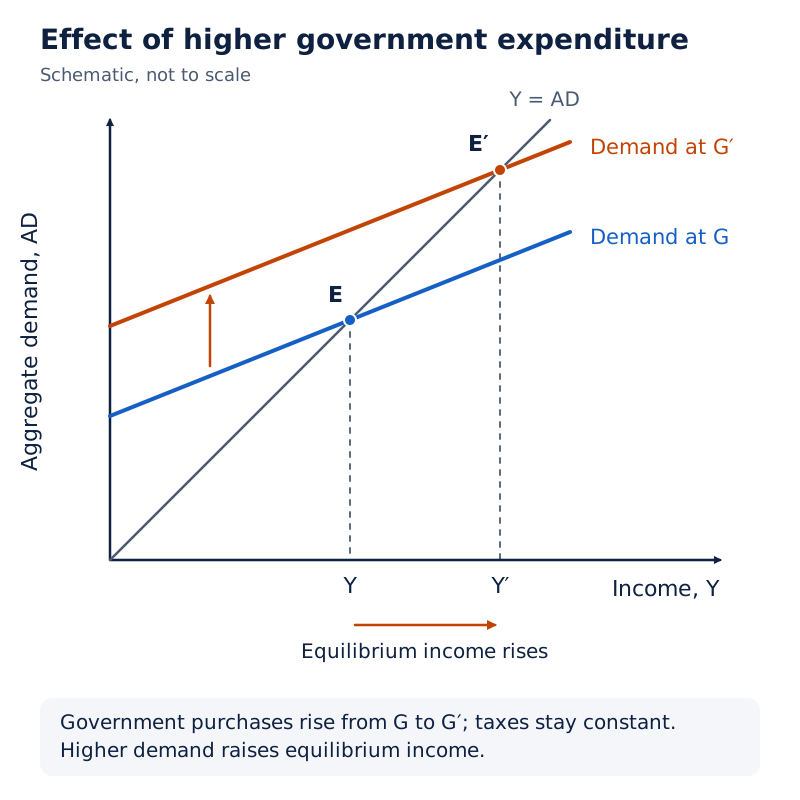
The vertical axis shows aggregate demand, AD, and the horizontal axis shows income, Y. The diagonal line marks equality between income and aggregate demand.
The two parallel upward-sloping demand lines meet the diagonal at E and E′. Higher government purchases, from G to G′, shift demand upwards while taxes stay constant. Vertical guides from the intersections show that equilibrium income rises.
Drawn by One Young India.
What the figure shows
Effect of a reduction in taxes
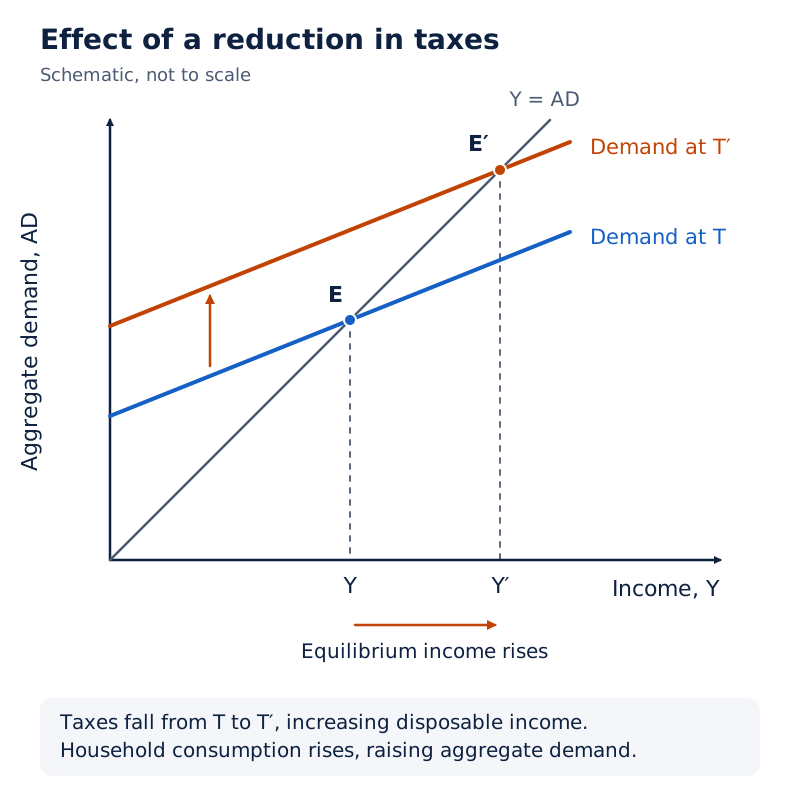
Aggregate demand, AD, is on the vertical axis and income, Y, is on the horizontal axis. The diagonal marks equality between income and aggregate demand.
Reducing taxes from T to T′ shifts the demand line upwards in parallel. Its intersection with the diagonal moves from E to E′, and the vertical guides show higher equilibrium income. The rise in demand begins with increased household consumption.
Drawn by One Young India.
Why has public expenditure grown in India?
The growth of public expenditure reflects the government's responsibilities for development, public services and welfare. It is useful to distinguish spending on additional facilities from the continuing cost of running existing services. Both place demands on government resources.
How do development and welfare increase spending?
- Economic development: Expanding roads and other infrastructure requires public investment. Infrastructure means basic facilities and services that support economic activity.
- Social services: Wider provision of education and health requires facilities, staff and continuing service expenditure.
- Population growth: More people can increase the need for public services, requiring their scale to expand.
- Urbanisation: Growth of towns and cities increases demand for public infrastructure and civic services.
Urbanisation means an increase in the share of people living in urban areas. Its financial significance lies in the need to provide services for a larger urban population, rather than in any automatic improvement in people's living conditions.
Welfare expenditure supports people's well-being, including measures addressing poverty and access to essential services. Subsidies are government assistance that lowers costs or prices for beneficiaries. Food and fertiliser subsidies are examples of spending used as a policy instrument to improve welfare.
What other pressures raise expenditure?
Defence and administration require resources to perform government functions. National security concerns leave little scope for drastic reductions in defence spending. Expansion of public responsibilities also creates a need for the administration that delivers them.
Interest obligations rise as debt accumulates through repeated borrowing. These payments themselves place pressure on future expenditure. Past borrowing decisions therefore affect the resources needed in later budgets, even before new services or investments are considered.
Rising prices can increase the money needed to purchase a given quantity of goods and services. Thus, a rise in expenditure does not necessarily mean a matching rise in services provided. Distinguishing price increases from an expansion of activities helps explain expenditure growth more carefully.
These factors can operate together. Development projects require investment, expanded services need continuing expenditure, and borrowing may add interest costs. A sound explanation links each reason to the expenditure it creates instead of simply listing broad social changes.
What is public debt, and how are its main types distinguished?
Public debt is the government's accumulated borrowing outstanding at a particular time. A budget deficit occurs when expenditure exceeds revenue; borrowing is one way of financing this gap. Repeated borrowing can add to the stock of debt and increase interest obligations.
A stock is measured at a particular point in time. A flow is measured over a period. Debt is a stock, whereas a deficit relates to a period. Confusing the two hides the connection between present borrowing and accumulated obligations.
How are government deficits measured?
Revenue deficit measures the excess of revenue expenditure over revenue receipts. It shows that current revenue is insufficient to meet current expenditure, so borrowing may finance consumption as well as investment.
Gross fiscal deficit measures total expenditure less receipts excluding borrowing. It indicates the government's total borrowing requirement. Non-debt capital receipts, such as recovery of loans and proceeds from selling public sector undertakings, do not create new debt.
The connection between revenue and fiscal deficits can also be expressed by separating total expenditure into its revenue and capital components.
A large revenue deficit within the fiscal deficit indicates that much of the borrowing meets consumption expenditure needs rather than investment.
Gross primary deficit removes net interest liabilities from gross fiscal deficit to focus on present fiscal imbalances. Net interest liabilities are interest payments minus the government's interest receipts on net domestic lending.
How is debt classified?
Debt service means meeting interest and repayment obligations.
| Basis | Type | Meaning |
|---|---|---|
| Source | Internal debt | Borrowing from lenders within the country |
| Source | External debt | Borrowing from lenders outside the country |
| Repayment arrangement | Redeemable debt | Debt repayable according to an agreed arrangement |
| Repayment arrangement | Irredeemable debt | Debt with no fixed date for repayment of principal |
| Use | Productive debt | Borrowing used for projects that yield income to help service the debt |
| Use | Unproductive debt | Borrowing used for purposes that do not directly yield such income |
| Willingness of lenders | Voluntary debt | Borrowing to which lenders contribute willingly |
| Willingness of lenders | Compulsory debt | Borrowing to which lenders are legally required to contribute |
| Period | Short-term debt | Borrowing repayable over a relatively short period |
| Period | Long-term debt | Borrowing repayable over a relatively long period |
The classifications answer different questions. Internal and external identify the source; redeemable and irredeemable concern repayment; productive and unproductive concern use; short-term and long-term concern duration. Voluntary and compulsory debt distinguish willingness from a legal obligation to lend.
Irredeemable does not mean interest-free. Likewise, unproductive in this financial classification does not mean socially useless. It means that the expenditure does not directly produce income with which to meet the debt obligation. Different classifications can apply to the same borrowing.
Must public debt be harmful?
Borrowing can finance investment, but debt also creates future obligations. If government borrowing reduces funds available for private investment, growth may be affected. Private investment means investment undertaken by individuals and businesses outside government.
If the government invests in infrastructure, future generations may be better off, provided the return on the investment exceeds the interest rate. Return means the benefit or income yielded by an investment. This condition must remain attached to the claim that borrowing can benefit future generations.
Debt should therefore be understood through its source, terms, use and effects. Neither “all debt is harmful” nor “borrowed money is free income” is an adequate explanation. The funds received today must be considered alongside the obligations and possible benefits they create.
Glossary
- Public finance — The study of government revenue, expenditure and borrowing, including their effects on the economy.
- Public revenue — Government income obtained through taxation and through sources such as fees, interest and dividends.
- Tax — A compulsory government levy without a direct, proportionate service promised to the individual taxpayer.
- Direct tax — A tax imposed on the person who bears its burden rather than shifting it to another person.
- Indirect tax — A tax on goods and services whose burden can pass to another person through prices.
- Progressive taxation — A pattern of taxation in which the tax rate rises as income increases.
- Proportional taxation — A pattern of taxation in which the tax rate remains constant as income increases.
- Regressive taxation — A pattern of taxation in which the tax rate falls as income increases.
- Degressive taxation — Taxation that is progressive up to a limit and then becomes proportional.
- Goods and Services Tax — A comprehensive indirect tax on the supply of goods and services, based on consumption at the destination.
- Input tax credit — Credit for tax paid on eligible purchases, used to offset tax payable on supplies.
- Non-tax revenue — Government income from sources other than taxation, including interest, investment earnings and service fees.
- Revenue expenditure — Government expenditure for purposes other than creating its physical or financial assets, including interest and departmental expenses.
- Capital expenditure — Government expenditure that creates physical or financial assets or reduces financial liabilities.
- Public debt — The accumulated borrowing that the government owes to its lenders at a particular time.
Common errors and misconceptions
- Misconception: Every receipt other than a tax is non-tax revenue. Correct: Borrowing and asset sales are capital receipts because they create liabilities or reduce financial assets.
- Misconception: A higher tax payment proves that a tax is progressive. Correct: Progression requires a higher rate as income rises; proportional taxation can also produce larger payments from higher incomes.
- Misconception: The business remitting an indirect tax must bear its final burden. Correct: The burden can pass through the price to the purchaser.
- Misconception: GST means that every tax has disappeared and every product has an identical rate. Correct: GST concerns goods and services, and neither conclusion follows from its comprehensive nature.
- Misconception: Revenue expenditure is necessarily wasteful. Correct: It includes the continuing costs of essential services such as education and health.
- Misconception: Interest payments and repayment of principal are the same. Correct: Interest meets a borrowing cost; principal repayment reduces the outstanding liability.
- Misconception: Every public debt necessarily harms future generations. Correct: Infrastructure investment may benefit them, provided its return exceeds the interest rate.
Exam-style questions with model answers
Q1. Define public finance and identify its three main branches. [2 marks]
- Public finance studies government revenue, expenditure and borrowing, together with their effects on the economy.
- Its three main branches are public revenue, public expenditure and public debt, connecting government income, spending and accumulated borrowing.
Q2. Distinguish between progressive and proportional taxation by explaining how the tax rate changes when income rises. [2 marks]
- In progressive taxation, the tax rate rises as income rises, so higher income faces a higher proportional charge.
- In proportional taxation, the tax rate remains constant as income rises, although the amount of tax paid can increase.
Q3. Personal income tax is borne by the person on whom it is imposed. A tax on goods and services can pass to purchasers through prices. Classify both taxes and explain the difference between impact and incidence. [3 marks]
- Personal income tax is a direct tax because the person on whom it is imposed bears the burden.
- The tax on goods and services is indirect because the burden can pass through prices to purchasers.
- Impact is the initial burden of paying a tax to the government; incidence is its final burden. These fall on the same person for direct taxation but can differ for indirect taxation.
Q4. A government receives interest on loans it has given, dividends on shares it owns, a fresh loan and proceeds from selling government-held shares. Classify each receipt and explain why. [4 marks]
- Interest received is non-tax revenue because it is income earned from money the government has lent to others.
- Dividends are non-tax revenue because they are earnings from investments, rather than proceeds from selling the investments themselves.
- The fresh loan is a capital receipt because the government acquires a liability that must be repaid.
- Proceeds from selling government-held shares are capital receipts because the transaction reduces the government's financial assets.
Q5. Explain five objectives or features of GST: its scope, destination basis, input tax credit, common market objective and simplification of compliance. [5 marks]
- GST is a comprehensive indirect tax on the supply of goods and services. It brings together a large number of earlier central and state indirect taxes.
- It is destination-based, relating taxation to consumption at the destination rather than merely to the location where production takes place.
- Input tax credit offsets tax paid on eligible earlier purchases against tax payable on supplies, helping reduce cascading or tax on tax.
- Its common market objective involves greater consistency in taxation and easier movement of goods and services within the country.
- Simpler compliance is supported by common online arrangements for registration, returns and payment, making the fulfilment of tax obligations easier.
Q6. Classify these government payments and give one reason for each: salaries, interest on debt, purchase of machinery and repayment of loan principal. [4 marks]
- Salaries are revenue expenditure because they meet the continuing costs of government functioning without directly creating government assets.
- Interest on debt is revenue expenditure because it pays the cost of borrowing rather than reducing the principal owed.
- Machinery purchase is capital expenditure because the government acquires a physical asset through the payment.
- Repayment of principal is capital expenditure because it reduces the financial liability represented by outstanding government borrowing.
Q7. Explain five reasons for growth of public expenditure in India: development, social services, population growth, rising prices and interest obligations. [5 marks]
- Economic development requires investment in roads and other infrastructure. Creating or expanding these facilities places demands on the government's expenditure.
- Wider education and health provision requires spending on facilities and continuing services. These responsibilities increase both investment needs and operating expenditure.
- Population growth can increase the number of people requiring public services, so the scale of service provision may need to expand.
- Rising prices increase the money needed to buy a given quantity of goods and services, even without a matching increase in provision.
- Accumulated borrowing creates interest obligations. Repeated borrowing can raise these obligations, increasing the expenditure required in later budgets.
Q8. Distinguish internal from external debt, redeemable from irredeemable debt, and productive from unproductive debt. Give one separate definition for each of the six types. [6 marks]
- Internal debt is government borrowing from lenders within the country. The classification identifies the domestic source of the borrowed funds.
- External debt is government borrowing from lenders outside the country. It is distinguished from internal debt by the source of lending.
- Redeemable debt is repayable according to an agreed arrangement. Its terms provide for the repayment of the amount borrowed.
- Irredeemable debt has no fixed date for repayment of principal. This description does not mean that the debt carries no interest.
- Productive debt finances projects yielding income that can help service the borrowing. Its defining feature concerns the use of the funds.
- Unproductive debt finances purposes that do not directly yield such income. This financial description does not necessarily mean that the spending lacks social value.
Key takeaways
- Public finance connects government revenue, expenditure and debt with the provision of services and the welfare of people.
- Revenue receipts include tax and non-tax income; borrowing and sales of financial assets belong to capital receipts.
- Direct and indirect taxation differ in whether the tax burden can pass from the person initially paying to another person.
- Progressive, proportional, regressive and degressive taxation describe how the tax rate changes as income changes.
- GST is a comprehensive indirect tax that uses input tax credit to help reduce cascading and support a common market.
- Revenue expenditure supports current functions, while capital expenditure creates assets or reduces financial liabilities of the government.
- Development, service expansion, population, prices and debt interest can all increase the demands on public expenditure.
- Public debt creates obligations, but investment may benefit future generations when its return exceeds the interest rate.
Test yourself
Why is a fresh government loan not non-tax revenue?
It creates a repayment liability, making it a capital receipt rather than non-tax revenue.
Does a rising tax payment necessarily mean a rising tax rate?
No. Under proportional taxation, the same rate applied to a larger income produces a larger tax payment.
What distinguishes tax impact from tax incidence?
Impact is the initial burden of payment to the government; incidence is the final burden of the tax.
What is the purpose of input tax credit?
It offsets tax paid on eligible purchases against tax payable on supplies, helping prevent cascading of taxes.
How does a dividend differ from selling government-held shares?
A dividend is non-tax revenue from an investment. Selling the shares reduces a financial asset and produces a capital receipt.
Why do interest payment and principal repayment have different classifications?
Interest meets a borrowing cost and is revenue expenditure. Principal repayment reduces a financial liability and is capital expenditure.
Does irredeemable debt mean that no interest is payable?
No. Irredeemable describes the absence of a fixed principal repayment date, not the absence of interest.
Under what condition may infrastructure investment financed by borrowing benefit future generations?
Future generations may be better off provided the return on the infrastructure investment exceeds the interest rate.
Take this further
How does India make policy?
The Model NITI Aayog self-paced course: 41 chapters, about 19 hours of study, on how India makes policy, from the policy cycle and writing a white paper to the economy, the Union Budget and governance. It comes with Learnacy Essential.
Learnacy Essential is ₹1,499 for the year. It also adds feedback from an AI writing coach, submission to The OYI Review, World 101’s member tools and the 3D labs. Publication is not guaranteed. See what a year includes
Or create a free account to draft in the Writing Studio, explore World 101’s map and open the 2D version of every lab. Create a free account