
Rectilinear Figures | ICSE Class 9 Maths Notes
On this page

This note covers rectilinear figures, parallelogram properties and tests, rhombuses, rectangles and squares, constructions of quadrilaterals and regular hexagons, and area relationships involving parallelograms, triangles, bases and altitudes.
What are rectilinear figures and how are they named?
Definition: A rectilinear figure is a figure bounded by straight line segments. A polygon is a closed plane figure with straight sides; a quadrilateral is a polygon with four sides.
A plane is a flat surface. A line segment is the part of a straight line between two endpoints. A vertex is a corner where adjacent sides meet. The plural of vertex is vertices.
Let A, B, C and D be the vertices of a quadrilateral, named consecutively around its boundary. Its sides are AB, BC, CD and DA. The notation AB means the segment joining A and B, or its length when used in a calculation.
The vertices are distinct, lie in one plane and have no three collinear, meaning on the same straight line. The sides meet at consecutive endpoints without crossing. The quadrilaterals considered here are convex: each interior angle is less than 180°, where ° denotes degrees.
Which parts are adjacent or opposite?
Adjacent sides share a vertex; opposite sides do not. Adjacent angles occur at the endpoints of a side. Opposite angles occur at vertices not joined by a side. A diagonal joins opposite vertices, so AC and BD are the diagonals.
| Part of ABCD | Adjacent parts | Opposite part |
|---|---|---|
| Side AB | BC and DA | CD |
| Side BC | AB and CD | DA |
| Angle at A | Angles at B and D | Angle at C |
The symbol ∠ means angle: ∠ABC is the angle with vertex B and arms BA and BC. In an unambiguous quadrilateral, ∠A means its interior angle at A. A triangle has three sides; △ABC denotes the triangle with vertices A, B and C.
The symbols =, +, −, × and ÷ mean equal to, addition, subtraction, multiplication and division. An interior angle lies inside the figure. A straight angle measures 180°; a right angle measures 90°. These angle facts help connect parallel lines with quadrilateral properties.
How do the sides and angles identify a parallelogram?
Definition: A parallelogram is a quadrilateral with both pairs of opposite sides parallel. Parallel lines lie in the same plane and do not meet when extended; ∥ means parallel to.
In parallelogram ABCD, AB ∥ CD and AD ∥ BC. Its opposite sides are equal: AB = CD and AD = BC. Conversely, a quadrilateral with both pairs of opposite sides equal is a parallelogram. These side results may be used directly.
Theorem: Opposite angles of a parallelogram are equal
A transversal is a line cutting two other lines at distinct points. Interior angles on the same side of a transversal across parallel lines total 180°. Such angles are supplementary, meaning that their sum is 180°.
- Since AD ∥ BC and AB cuts them, ∠A + ∠B = 180°.
- Since AB ∥ CD and BC cuts them, ∠B + ∠C = 180°.
- Subtracting the common angle ∠B gives ∠A = ∠C.
- Also, ∠A + ∠D = 180°. Comparing this with the first equality gives ∠B = ∠D.
Thus opposite angles are equal, while adjacent angles are supplementary. These are different relationships. If x represents the angle at A in degrees, the angles in boundary order are x, 180° − x, x and 180° − x.
What does one equal and parallel pair establish?
A quadrilateral is a parallelogram if one pair of opposite sides is both equal and parallel. For ABCD, AB = CD together with AB ∥ CD is sufficient. The equality and parallelism must concern the same pair of opposite sides.
Worked example 1. Is a parallelogram with one right angle a rectangle?
Answer: Yes. A rectangle is a parallelogram with four right angles. The opposite angle equals 90°, and each adjacent angle equals 180° − 90° = 90°. Therefore all four angles are right angles.
Why do diagonals bisect a parallelogram and each other?
To bisect a segment means to divide it into two equal lengths. Its midpoint is the dividing point. Bisecting an angle means dividing it into two equal angles. These meanings must be distinguished from dividing a figure into two equal areas.
Congruent triangles have the same shape and size, with equal corresponding sides and angles. The symbol ≅ means congruent to. The angle-side-angle test, abbreviated ASA, establishes congruence when two angles and the side between them match in two triangles.
Theorem: A diagonal divides a parallelogram into congruent triangles
Draw AC in parallelogram ABCD. Alternate interior angles lie between two lines on opposite sides of a transversal; they are equal when the lines are parallel. Thus ∠BAC = ∠DCA and ∠BCA = ∠DAC. AC is common, so △BAC ≅ △DCA by ASA.
Consequently, the two triangles have equal areas. The diagonal therefore bisects the parallelogram's area. This does not mean that a diagonal of every parallelogram bisects its vertex angles.
Theorem: The diagonals of a parallelogram bisect each other
Let E be the intersection of diagonals AC and BD. In triangles AED and CEB, AD = CB. Also ∠DAE = ∠BCE and ∠ADE = ∠CBE by alternate interior angles. Hence △AED ≅ △CEB by ASA.
Corresponding sides give AE = CE and DE = BE. Therefore E is the midpoint of each diagonal. Each diagonal is divided into equal halves; the two whole diagonals need not be equal to one another.
What the figure shows
Parallelogram proofs
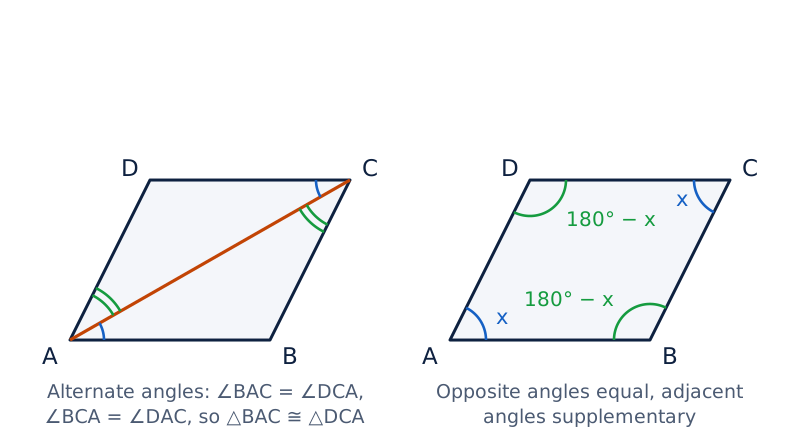
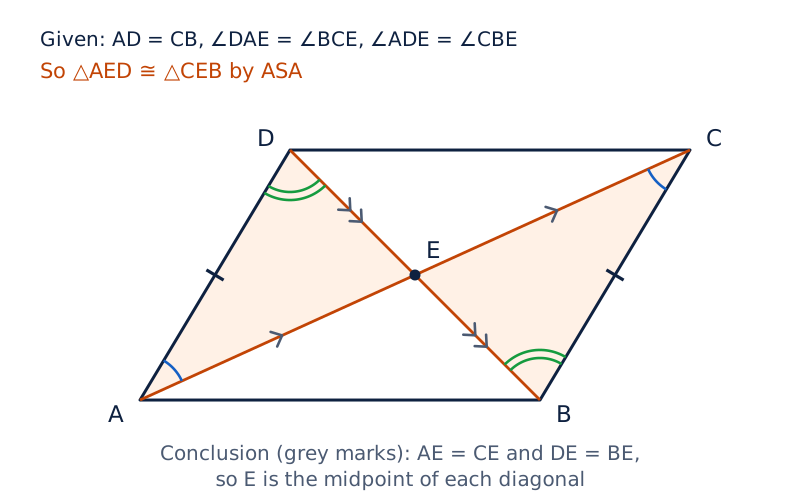
Three drawings of ABCD show a diagonal with angle markings, opposite equal angles labelled x and adjacent angles labelled 180° − x, and two diagonals crossing at E. Here x denotes an interior angle.
Drawn by One Young India.
The converse, obtained by reversing a theorem's hypothesis (given condition) and conclusion (result), is also true here: a quadrilateral whose diagonals bisect each other is a parallelogram. A converse requires its own justification; reversing a statement does not automatically make it true.
What makes a rhombus special?
A rhombus is a parallelogram with all four sides equal. It inherits opposite equal angles and diagonals that bisect each other. It also has perpendicular diagonals: lines are perpendicular when they meet at a right angle.
Theorem: The diagonals of a rhombus meet at right angles
Let ABCD be a rhombus with diagonals meeting at E. Compare triangles AEB and CEB. AB = CB because all sides are equal; AE = CE because diagonals bisect each other; BE is common.
The side-side-side test, abbreviated SSS, gives congruence when all three corresponding side lengths are equal. Thus △AEB ≅ △CEB, giving ∠AEB = ∠CEB. These adjacent angles lie on straight line AC, so each is 180° ÷ 2 = 90°.
The same congruence gives ∠ABE = ∠CBE. Comparing the corresponding triangles at the other vertices similarly shows that each diagonal bisects a pair of opposite angles of the rhombus.
Worked example 2. If the diagonals of quadrilateral ABCD bisect each other at right angles, must it be a rhombus?
Answer: Yes. Bisection makes ABCD a parallelogram. Call the intersection E. AE = CE, BE is common and ∠AEB = ∠CEB = 90°. The side-angle-side test, abbreviated SAS, uses two sides and their included angle; it gives △AEB ≅ △CEB. Hence AB = CB. Together with opposite equal sides, this makes all four sides equal.
How do perpendicular diagonals give an area formula?
Area measures the space enclosed by a plane figure. Let d₁ and d₂ denote the lengths of the two diagonals. The subscripts ₁ and ₂ distinguish these lengths. A right triangle has one right angle. Splitting the rhombus into four such triangles gives area = ½d₁d₂, where ½ means one half and adjoining letters indicate multiplication.
Worked example 3. One diagonal of a rhombus is twice the other. Its area is 128 cm². Find the shorter diagonal. Here cm means centimetres and cm² means square centimetres.
Answer: Let d be the shorter diagonal's length in centimetres. The longer diagonal is 2d. Therefore 128 = ½ × d × 2d = d², where d² means d multiplied by itself. Since a length is positive, d = √128 = 8√2. Here √ denotes the positive square root. The shorter diagonal is 8√2 cm.
How do rectangles and squares differ from general parallelograms?
A rectangle has four right angles and opposite equal parallel sides. A square has four equal sides and four right angles. Thus a square is both a rectangle and a rhombus, and its diagonals combine the special properties of both.
Theorem: The diagonals of a rectangle are equal
In rectangle ABCD, compare triangles ABC and BAD. AB is common, BC = AD, and ∠ABC = ∠BAD = 90°. The included right angles lie between the equal side pairs. SAS congruence therefore gives AC = BD.
The diagonals also bisect each other because a rectangle is a parallelogram. A square inherits these equal, bisecting diagonals from the rectangle and their perpendicularity from the rhombus.
| Figure | Diagonal property | Additional conclusion |
|---|---|---|
| Parallelogram | Diagonals bisect each other | Opposite sides and angles are equal |
| Rhombus | Diagonals bisect each other perpendicularly | Each diagonal bisects opposite angles |
| Rectangle | Diagonals are equal and bisect each other | All interior angles are right angles |
| Square | Diagonals are equal and bisect each other perpendicularly | All sides are equal and all angles are right angles |
Worked example 4. Show that a parallelogram ABCD with equal diagonals is a rectangle.
Answer: Compare △ABC and △BAD. AB is common, BC = AD by the parallelogram property, and AC = BD by the given condition. SSS gives congruence, so ∠ABC = ∠BAD. Adjacent angles of a parallelogram sum to 180°; these equal angles are therefore 90° each. Opposite angles are equal, so the remaining angles are also 90°. Hence ABCD is a rectangle.
A rhombus with perpendicular diagonals need not be a square: perpendicularity is already a property of a rhombus. Likewise, equal diagonals identify a rectangle only when the required parallelogram condition has also been established.
How are quadrilaterals constructed with ruler and compasses?
A construction produces a figure from specified data using geometric steps. A ruler draws straight lines; compasses draw circles or arcs and transfer lengths. An arc is part of a circle. Its radius is the distance from its centre to any point on it.
Four side lengths alone do not generally fix a quadrilateral. A diagonal can divide the task into constructing two triangles. An included angle is the angle between two specified sides. An angle supplied by a drawing can be copied with compasses.
How do four sides and one diagonal determine a construction?
Suppose the given lengths are AB, BC, CD, DA and diagonal AC, and a convex quadrilateral is required. Each group of three lengths used below must form a triangle: the sum of any two must exceed the third.
- Draw AC equal to its supplied length. It will be the common side of two triangles.
- With centres A and C and radii equal to the supplied AB and CB, draw intersecting arcs. Choose their intersection B on one side of AC.
- With centres A and C and radii equal to the supplied AD and CD, draw arcs meeting at D on the other side of AC.
- Join AB, BC, CD and DA. Check that the resulting boundary is convex and that all five specified lengths are satisfied.
Opposite-side placement prevents the two triangles from overlapping internally, but convexity must still be checked. Some supplied lengths do not produce the required convex quadrilateral, even when the two separate triangles can be drawn.
How can a supplied angle be copied?
Draw an arc centred at the supplied angle’s vertex, cutting its two arms. Draw an arc with the same radius centred at the new vertex, cutting the chosen first arm. Transfer the distance between the original arc’s two intersections onto the new arc.
Join the new vertex to the transferred point to obtain the second arm. The triangles formed by the two radii and the transferred segment have three equal corresponding sides, so SSS justifies the equal angles. This uses compasses to copy the angle without measuring it in degrees.
How can a parallelogram or rhombus be constructed?
For a parallelogram with two adjacent side lengths and their included angle given, draw AB. Copy the given angle at A and mark AD on its second arm. Locate C using an arc centred at B with radius AD and an arc centred at D with radius AB.
Select the intersection giving the intended convex boundary ABCD. Then BC = AD and DC = AB, so both opposite side pairs are equal. This establishes the parallelogram. Equal adjacent side lengths make the construction a rhombus.
A rhombus can also be constructed from its two diagonal lengths. A perpendicular bisector is a line through a segment’s midpoint at right angles to it. Draw AC, construct its perpendicular bisector and call the midpoint E. Mark B and D on opposite sides of AC on that bisector, each half the given second diagonal from E. Join the boundary.
How is a regular hexagon constructed?
A regular polygon has all sides equal and all interior angles equal. A hexagon is a polygon with six sides. A regular hexagon can be constructed by stepping the radius of a circle around its circumference, the circle's boundary.
What are the ruler-and-compasses steps?
Let O be the centre of a circle and let its radius be the required side length. Label the six successive boundary points A, B, C, D, E and F. These letters identify vertices, not numerical quantities.
- Draw the circle with centre O. Choose A on its circumference and leave the compass opening equal to the radius.
- With centre A, mark the next intersection with the circle as B.
- Continue in the same direction, using B, C, D and E as successive centres to mark C, D, E and F. At each stage choose the next point, not the previous one.
- The next step returns to A. Join AB, BC, CD, DE, EF and FA with a ruler.
Why does the construction close?
OA and OB are radii, while AB equals the radius by construction. Thus triangle OAB is equilateral, meaning that its three sides are equal. Its equal angles sum to 180°, so each is 60°. The same reasoning applies to each successive triangle formed with O.
Six central angles of 60° total 360°, a complete turn about O. A central angle has its vertex at the centre. At each hexagon vertex, two angles of 60° combine to give an interior angle of 120°.
Diagram
Regular hexagon construction
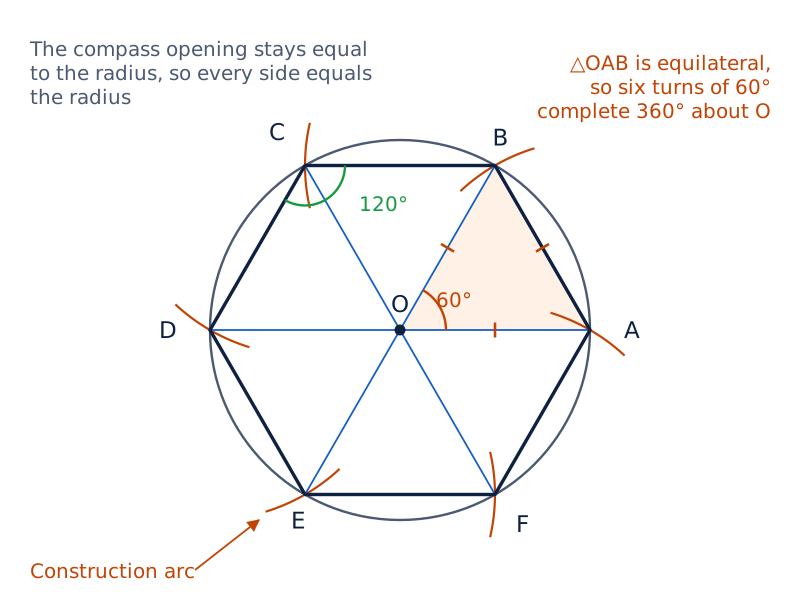
Draw the circle centred at O, mark A to F in boundary order using its radius, and join successive vertices. Join O to every vertex to show the six equilateral triangles. Keep the construction arcs visible.
Drawn by One Young India.
For the rhombus construction, a perpendicular bisector can be made by drawing equal-radius arcs from both endpoints of a segment, using a radius greater than half its length. Joining the two arc intersections gives the required line.
Why do parallelograms on the same base have equal areas?
A base is a side chosen for an area calculation. Its corresponding height is the perpendicular distance between that side's line and the opposite parallel side. The height is not generally the length of the sloping side.
Let b denote the base length and h the corresponding perpendicular height. Then area of a parallelogram = bh. The base and height must use the same length unit; the area is expressed in the corresponding square unit.
Theorem: Same base and same parallels give equal parallelogram areas
Suppose parallelograms ABCD and ABFE share base AB. Their opposite sides CD and FE lie on one line parallel to AB. The phrase between the same parallels means that both figures occupy this common strip between the base line and that other line.
- Let b be the length of the common base AB.
- Let h be the perpendicular separation of the two parallel lines.
- The area of ABCD equals bh because its base and height are b and h.
- The area of ABFE also equals bh. Therefore the two areas are equal.
The upper side can shift along its parallel line without changing the height. The parallelogram's angles and sloping sides can change, but its base and perpendicular height remain the quantities that determine its area.
What the figure shows
Area of a parallelogram
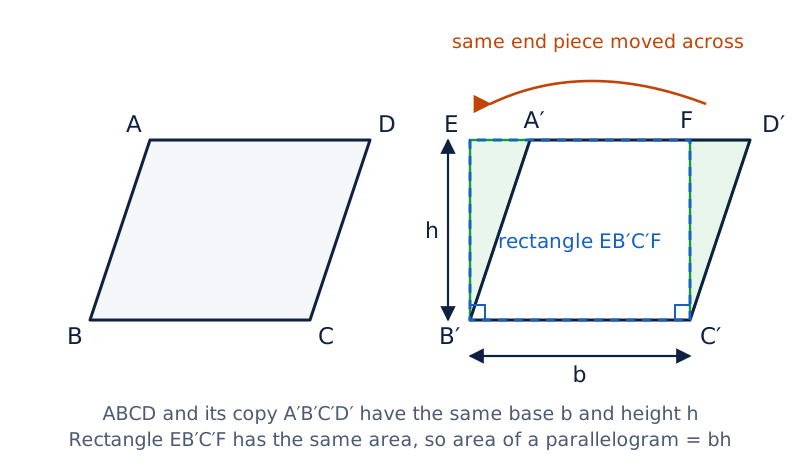
ABCD appears beside a copy labelled A′B′C′D′. The right-hand drawing shows a rectangle EB′C′F with a horizontal base marked b and perpendicular height marked h. Primes distinguish the copied vertices from the original ones.
Drawn by One Young India.
Rearranging the triangular end portion produces a rectangle with equal area, base and height. For a very sloping parallelogram, the perpendicular may meet an extended side; the height remains the perpendicular distance between the parallel lines.
Note: Sharing a base alone does not establish equal area. The equal-height condition is supplied by the second requirement: the figures lie between the same parallel lines.
How are triangle areas related to parallelogram areas?
An altitude of a triangle is a perpendicular segment from a vertex to the line containing the opposite side. Its length is the height corresponding to that base. The foot of the altitude, where the perpendicular meets the base line, can lie on the side or its extension.
Theorem: A triangle has half the area of the corresponding parallelogram
Let a triangle and a parallelogram have the same base length b and lie between the same parallel lines separated by height h. The parallelogram has area bh. The triangle has area ½bh, so its area is half the parallelogram's area.
To justify the triangle formula geometrically, join two congruent copies of a triangle along a suitable corresponding side to form a parallelogram. The copies have equal area, and the resulting parallelogram has the triangle's base and corresponding height.
What the figure shows
Two triangles make a parallelogram
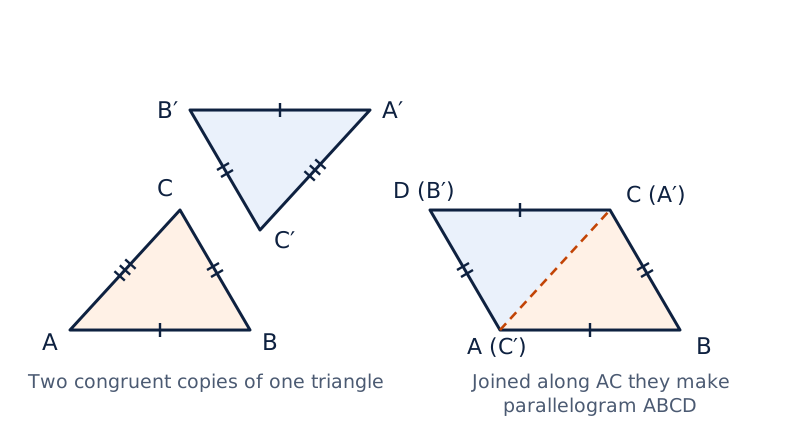
The first drawing shows separate congruent triangles ABC and A′B′C′. The second shows parallelogram ABCD with diagonal AC separating its two triangular parts; primes identify the copied triangle's vertices.
Drawn by One Young India.
What follows for triangles between the same parallels?
Triangles on the same base and between the same parallels have equal areas. This result can be used directly. It does not require the triangles to have equal sloping sides or equal angles.
Worked example 5. ABCD is a rectangle with DC = 10 cm and BC = 8 cm. E lies on side BC. Find the area of triangle ADE.
Answer: AD = BC = 8 cm. Taking AD as the base, the perpendicular distance of E from AD is DC = 10 cm because BC ∥ AD. Therefore area of △ADE = ½ × 8 × 10 = 40 cm². Moving E along BC does not change this area.
Worked example 6. ABCD is a parallelogram. P and Q are any two points on side AB. Find the ratio of the areas of triangles PCD and QCD. A ratio compares two quantities by division; the colon separates its two terms.
Answer: Both triangles have base CD. Their vertices P and Q lie on AB, which is parallel to CD. Their perpendicular heights are therefore equal. Their areas are equal, so area of △PCD : area of △QCD = 1 : 1.
When selecting a base, pair it with its own perpendicular height. In the rectangle example, using AD as the base makes the rectangle's horizontal width the required height. The side that looks horizontal need not be the most convenient base.
How do equal areas help compare altitudes and divided figures?
Theorem: Equal triangle areas on equal bases imply equal altitudes
Suppose two triangles have equal areas and the same base, or equal base lengths. Let b be that positive base length, and let h₁ and h₂ be their corresponding altitude lengths. The subscripts distinguish the two heights.
The area equality is ½bh₁ = ½bh₂. Dividing both sides by the common non-zero quantity ½b gives h₁ = h₂. Equal areas alone do not establish equal heights when the base lengths differ.
How does a median divide a triangle?
A median joins a triangle's vertex to the midpoint of its opposite side. Its direction need not be perpendicular to that side. Equal-area reasoning uses the equal base segments created by the midpoint.
Worked example 7. In triangle ABC, D is the midpoint of BC and AD is a median. Show that triangles ABD and ACD have equal areas.
Answer: BD = DC. Let a be their common length and h the perpendicular height from A to line BC. Both triangles have area ½ah. Hence their areas are equal, with ratio 1 : 1, each being half the area of △ABC. The triangles need not be congruent.
The common height in this argument belongs to both smaller triangles because their bases lie on the same straight line. It is not necessary for the median itself to equal that height. This distinction separates a median's defining property from an altitude's defining property.
How can opposite triangular regions in a square be compared?
Worked example 8. P is an interior point of square ABCD. Join PA, PB, PC and PD. Find the ratio of the combined areas of △PAB and △PCD to those of △PBC and △PDA.
Answer: Let s be the square's side length. Let h₁ and h₂ be the perpendicular distances from P to AB and CD. Since P is inside the square, h₁ + h₂ = s. The first combined area is ½s(h₁ + h₂) = ½s². The distances to BC and DA similarly sum to s, giving the second combined area ½s². The required ratio is 1 : 1.
For an area proof, identify the base, perpendicular height and relevant parallel lines before calculating. For a congruence proof, identify corresponding sides and angles. Equal areas can follow from congruence, but equal areas do not by themselves prove congruence.
Glossary
- Rectilinear figure — A plane figure whose boundary is formed from straight line segments.
- Quadrilateral — A closed plane figure with four sides meeting at four consecutive vertices without crossing.
- Diagonal — A segment joining two vertices of a polygon that are not adjacent.
- Parallelogram — A quadrilateral in which both pairs of opposite sides are parallel.
- Rhombus — A parallelogram whose four sides are all equal in length.
- Rectangle — A parallelogram with four right angles and equal opposite sides.
- Square — A quadrilateral with four equal sides and four right angles.
- Congruent triangles — Triangles of the same shape and size, with equal corresponding sides and angles.
- Supplementary angles — Two angles whose measures add up to one hundred and eighty degrees.
- Perpendicular bisector — A line passing through a segment's midpoint at right angles to that segment.
- Altitude — A perpendicular segment from a triangle's vertex to the line containing its opposite side.
- Median — A segment joining a triangle's vertex to the midpoint of the opposite side.
- Regular hexagon — A polygon with six equal sides and six equal interior angles.
- Converse — A statement obtained by exchanging the hypothesis and conclusion of an implication.
Common errors and misconceptions
- Misconception: Adjacent angles of a parallelogram are equal. Correct: Adjacent angles are supplementary; opposite angles are equal. Adjacent angles are equal in the special case of a rectangle.
- Misconception: Bisecting diagonals must be equal diagonals. Correct: Bisection compares the two halves of each diagonal separately; it does not compare the lengths of the whole diagonals.
- Misconception: A rhombus with perpendicular diagonals must be a square. Correct: A rhombus already has perpendicular diagonals; that condition alone does not establish right interior angles.
- Misconception: Equal diagonals prove that any quadrilateral is a rectangle. Correct: The rectangle test requires a parallelogram with equal diagonals, so the parallelogram condition must also be established.
- Misconception: The sloping side is the height in a parallelogram area calculation. Correct: Use the perpendicular distance between the chosen base line and the opposite parallel side.
- Misconception: Triangles sharing a base have equal areas. Correct: They also need equal corresponding heights, as when their opposite vertices lie on a common parallel to the base.
- Misconception: Equal areas imply congruent triangles. Correct: Equal area measures enclosed space; congruence additionally requires matching shape and size.
Exam-style questions with model answers
Q1. Define a parallelogram and state what it means for its diagonals to bisect each other. [2 marks]
- A parallelogram is a quadrilateral with both pairs of opposite sides parallel.
- Its diagonals meet at the midpoint of each, dividing each diagonal into two equal segments.
Q2. ABCD is a parallelogram with a right angle at A. Explain why it is a rectangle. [3 marks]
- Since A is a right angle, ∠A = 90°. Opposite angles of a parallelogram are equal, so ∠C = 90° as well.
- Adjacent angles are supplementary. Therefore ∠B = 180° − 90° = 90°, and ∠D = 180° − 90° = 90°.
- All four interior angles are right angles. A parallelogram with this property is a rectangle, so ABCD is a rectangle.
Q3. ABCD is a rectangle with DC = 10 cm and BC = 8 cm. Point E lies on side BC. Calculate the area of triangle ADE and explain whether moving E along BC changes it. [3 marks]
- Choose AD as the triangle's base. Opposite sides of a rectangle are equal, so AD = BC = 8 cm.
- Since BC is parallel to AD, the perpendicular distance from E to AD equals DC = 10 cm. Thus area of △ADE = ½ × 8 × 10 = 40 cm².
- Moving E along BC leaves that perpendicular distance unchanged. The base and height stay the same, so the area remains 40 cm².
Q4. One diagonal of a rhombus is twice the other, and its area is 128 cm². Find the shorter diagonal, explaining the area formula used. [4 marks]
- Let d denote the shorter diagonal's length in centimetres. Then the longer diagonal has length 2d centimetres.
- The diagonals are perpendicular and bisect each other. A right triangle has one right angle. Splitting the rhombus into four such triangles gives its area as half the product of its diagonals.
- Substitution gives 128 = ½ × d × 2d = d². Thus the square of the shorter diagonal's numerical length is 128.
- Taking the positive square root because a length is positive, d = √128 = 8√2. The shorter diagonal is 8√2 cm.
Q5. In parallelogram ABCD, diagonals AC and BD meet at E. Prove that they bisect each other. [5 marks]
- Compare triangles AED and CEB. The opposite sides AD and CB are equal because ABCD is a parallelogram, giving one pair of equal corresponding sides.
- Since AD ∥ BC and AC cuts them, ∠DAE = ∠BCE by the alternate interior angle property of parallel lines.
- Using the same parallel sides and transversal BD gives ∠ADE = ∠CBE. We now have two corresponding angle pairs and the included side pair equal.
- Therefore △AED ≅ △CEB by the angle-side-angle test, so their corresponding remaining sides are equal.
- Consequently AE = CE and DE = BE. Thus E is the midpoint of both AC and BD, proving that the diagonals bisect each other.
Q6. Describe how to construct a regular hexagon with a supplied side length using ruler and compasses only. Explain why the construction works. [6 marks]
- Draw a circle with centre O and radius equal to the supplied side length. Choose a point A on its circumference.
- Keep the compass opening equal to that radius. With centre A, mark an intersection B on the circle to begin stepping around its boundary.
- Continue in the same direction with centres B, C, D and E, marking successive points C, D, E and F. Avoid returning to the preceding point.
- Join the six successive vertices and close the boundary by joining F to A. These straight segments form the required hexagon.
- Each triangle joining O to two consecutive vertices has three sides equal to the radius. It is equilateral and has a central angle of 60°, so six steps complete 360°.
- The six boundary sides are equal. Each interior angle consists of two angles of 60°, making 120°. Equal sides and equal interior angles establish that the hexagon is regular.
Q7. Parallelograms ABCD and ABFE share base AB, and their opposite sides CD and FE lie on the same line parallel to AB. Prove that their areas are equal. [3 marks]
- Let b be the length of AB. Since both parallelograms share this segment, their chosen bases have the same length b.
- Let h be the perpendicular distance from line AB to the line containing CD and FE. This is the corresponding height for both figures because their opposite sides lie on that same parallel.
- The area of each parallelogram is base multiplied by perpendicular height, namely bh. Therefore the areas of ABCD and ABFE are equal.
Q8. Triangles ABC and DBC share base BC and have equal areas. Prove that their corresponding altitudes to line BC are equal. [3 marks]
- Let b be the positive length of BC. Let h₁ and h₂ be the perpendicular altitude lengths from A and D respectively to the line containing BC.
- The triangle area formula gives the two areas as ½bh₁ and ½bh₂. By the given equality of areas, these expressions are equal.
- Divide both sides of ½bh₁ = ½bh₂ by the same non-zero quantity ½b. This gives h₁ = h₂, proving that the corresponding altitudes are equal.
Key takeaways
- A parallelogram has opposite equal sides and angles, while each pair of adjacent angles is supplementary.
- A diagonal divides a parallelogram into congruent triangles, and the two diagonals bisect each other.
- A rhombus has perpendicular bisecting diagonals; a rectangle has equal bisecting diagonals; a square has both sets of properties.
- A valid parallelogram test needs its full conditions, such as the same opposite side pair being both equal and parallel.
- Constructing quadrilaterals often means constructing triangles, while a regular hexagon is formed by stepping a circle's radius around its boundary.
- Parallelograms on the same base and between the same parallel lines have equal perpendicular heights and equal areas.
- A triangle has half the area of a parallelogram on the same base and between the same parallels.
- Equal triangle areas on equal bases imply equal corresponding altitudes, but equal areas alone do not establish congruence.
Test yourself
Which side is opposite AB in quadrilateral ABCD?
CD is opposite AB; the two sides have no common vertex.
What is the angle relationship between adjacent angles of a parallelogram?
They are supplementary, so their angle measures add up to 180°.
What does the intersection of a parallelogram's diagonals represent?
It is the midpoint of each diagonal, dividing each into equal lengths.
Why does a square have equal perpendicular diagonals?
It is a rectangle, giving equal diagonals, and a rhombus, giving perpendicular diagonals.
What compass opening constructs a regular hexagon in a circle?
Use the circle's radius and step it around the circumference six times.
What is the height corresponding to a parallelogram's chosen base?
It is the perpendicular distance between the base line and the opposite parallel side.
Why does a median divide a triangle into equal areas?
It gives equal base segments, and the two smaller triangles share the corresponding perpendicular height.
Can equal areas alone show that two triangles are congruent?
No. Equal areas do not establish the matching shape and size required for congruence.
Write about it
Turn a question from this chapter into a paper.
The Writing Studio has a structure guide, a rubric and citation tools for 15 formats, from essays to research papers. Drafting is free with an account. Learnacy Essential adds feedback from an AI writing coach and submission to The OYI Review.
Learnacy Essential is ₹1,499 for the year. Publication depends on review and is not guaranteed.