
Sets | ISC Class 11 Maths Notes
On this page
This note covers sets and their representations, empty, finite, infinite and equal sets, subsets, real-number intervals, power sets, universal sets, Venn diagrams, union, intersection, difference, complements and the properties of set operations.
What is a set, and how is membership written?
Definition: A set is a well-defined collection of objects. Well-defined means that it is possible to decide whether a particular object belongs to the collection.
The words object, element and member refer to the objects belonging to a set. Sets are usually denoted by capital letters such as A and B. Small letters such as a and x are used for elements.
The symbol ∈ means “belongs to”, while ∉ means “does not belong to”. Thus, a ∈ A states that a is an element of the set A. The statement b ∉ A states that b is not an element of A.
How does a definite membership rule help?
Let V be the set of vowels in the English alphabet. Then V contains a, e, i, o and u. We can decide membership without relying on personal opinion: a ∈ V, whereas b ∉ V.
The collection of the five most renowned mathematicians is not well-defined because people may use different criteria for “most renowned”. A description that expresses a preference does not provide the same definite membership test as the description “vowels in the English alphabet”.
A set can also be described through a mathematical condition. The solution set of an equation contains the values that satisfy it. For the equation x² − 5x + 6 = 0, where x is the number to be found and x² means x multiplied by itself, the solutions are 2 and 3.
Membership concerns the objects themselves. Before deciding whether something belongs, identify the collection and the rule defining it. In an equation-based set, a proposed member must satisfy both the equation and any restriction on the kind of number allowed.
How are sets written in roster and set-builder forms?
In roster form, also called tabular form, the elements are listed between braces, { }, and separated by commas. The set of even positive integers less than 7 is {2, 4, 6}. Integers comprise zero, positive counting numbers and their negatives. Positive integers are the counting numbers 1, 2, 3 and so on; an even integer is divisible by 2.
The order of elements does not matter. An element is not generally repeated when writing a roster. Thus, the set of letters in SCHOOL is {S, C, H, O, L}; the repeated occurrence of O in the word does not create a different element.
In set-builder form, a property identifies the members. For example, V = {x : x is a vowel in the English alphabet}. Here x stands for a possible element, the braces mean “the set of all”, and the colon means “such that”.
How do we convert a description into a list?
The condition must describe every member and exclude objects outside the set. In inequalities, < means “less than” and > means “greater than”; ≤ and ≥ mean “less than or equal to” and “greater than or equal to”.
Worked example 1. Write {x : x is a positive integer and x² < 40} in roster form.
Answer: {1, 2, 3, 4, 5, 6}. These are precisely the positive integers whose squares are less than 40. The number restriction matters: the answer must contain positive integers, rather than every number satisfying the inequality.
Worked example 2. Write the solution set of x² + x − 2 = 0 in roster form.
Answer: Factorising, which means expressing the left-hand expression as a product, gives (x − 1)(x + 2) = 0. Hence x = 1 or x = −2, so the solution set is {1, −2}. Both solutions belong in the roster.
For an infinite set, whose elements cannot be exhausted by a finite count, dots can indicate a continuing pattern. The roster {1, 3, 5, ...} describes the odd natural numbers. Natural numbers are 1, 2, 3 and so on; odd integers are integers not divisible by 2. A set-builder description gives their shared property directly, without trying to finish an endless list.
How do empty, finite, infinite and equal sets differ?
The empty set, also called the null or void set, contains no elements. We use the symbol φ or empty braces { } for it. The set of natural numbers strictly between 1 and 2 is empty: natural numbers are 1, 2, 3 and so on.
A finite set is empty or has a definite finite number of elements. A set that is not finite is an infinite set. The set of days of the week is finite, whereas the set of points on a line is infinite.
For a finite set S, n(S) denotes its number of distinct elements, also called its cardinal number. Distinct means different from one another. Repeated writing of the same member does not increase this number. A singleton set has exactly one element.
Why is equality different from counting?
Two sets A and B are equal, written A = B, when they have exactly the same elements. If they do not, A ≠ B, where ≠ means “is not equal to”. Comparing the number of elements alone does not establish equality.
For example, {1, 2, 3, 4} and {3, 1, 4, 2} are equal. Every element of the first belongs to the second and every element of the second belongs to the first. Their different listing orders are irrelevant.
Worked example 3. Classify {x : x is a natural number and 2x − 1 = 0} as finite or infinite.
Answer: Solving the equation gives x = 1/2, which is not a natural number. The set is therefore φ and is finite. Having no admissible solution is different from having one solution equal to zero.
Note: The set {0} contains the number zero and is a singleton. It is not the empty set. The notation describes membership, not the numerical size of the member.
Some infinite sets can be indicated by a continuing roster pattern. This does not mean that every infinite set has such a roster representation; the set of real numbers cannot be listed in that way.
What is a subset, and how does it differ from an element?
A set A is a subset of a set B when every element of A belongs to B. We write A ⊂ B. Here the symbol ⊂ allows equality: it does not by itself mean that A must be smaller than B.
The symbol ⊄ means “is not a subset of”. To show A ⊄ B, it is enough to identify an element of A that is absent from B. The definition requires every element of A to pass the membership test.
Property: Subsets and equality
Every set is a subset of itself, and φ is a subset of every set. If A ⊂ B and B ⊂ A, then A = B. Conversely, equal sets satisfy both subset statements because their elements coincide.
A proper subset is a subset that is not equal to the containing set. If A is a proper subset of B, then B is a superset of A. For example, {1, 2, 3} is a proper subset of {1, 2, 3, 4}.
Worked example 4. Let A = {1, 3}, B = {1, 5, 9} and C = {1, 3, 5, 7, 9}. Decide whether A ⊂ B, A ⊂ C and B ⊂ C.
Answer: A ⊄ B because 3 belongs to A but not B. However, A ⊂ C and B ⊂ C because every element in each of those sets occurs in C.
How can a set itself be an element?
Consider A = {1}, B = {{1}, 2} and C = {{1}, 2, 3}. The objects listed in B are the set {1} and the number 2. Thus A ∈ B, and B ⊂ C.
Nevertheless, A ⊄ C: the number 1 belongs to A but is not listed as an element of C. C contains {1} as a single object. Carefully distinguish membership, which identifies an object in a set, from containment, which compares all members of two sets.
How are real-number subsets and intervals represented?
The symbols N, Z, Q and R denote the sets of natural numbers, integers, rational numbers and real numbers respectively. Real numbers are the numbers represented by points on the number line. A rational number can be written as p/q, where p and q are integers and q ≠ 0.
An irrational number is a real number that is not rational. Denote the set of irrational numbers by T. Then N ⊂ Z ⊂ Q, Q ⊂ R and T ⊂ R. The restriction on the denominator in p/q excludes division by zero.
How do interval brackets show endpoint membership?
An interval describes the real numbers between specified bounds, with endpoints included or excluded as stated. Let a and b be real numbers with a < b, and let x represent a real number being tested for membership.
| Interval | Condition on x | Endpoint membership |
|---|---|---|
| (a, b), an open interval | a < x < b | Neither a nor b is included |
| [a, b], a closed interval | a ≤ x ≤ b | Both a and b are included |
| [a, b), closed at the left | a ≤ x < b | a is included; b is excluded |
| (a, b], closed at the right | a < x ≤ b | a is excluded; b is included |
For these intervals, the length is b − a. Each contains infinitely many real numbers, even though its length is finite. An interval between two bounds must not be replaced by a list containing just the integers between them.
Worked example 5. Convert {x : x ∈ R, −5 < x ≤ 7} to interval notation, and write [−3, 5) in set-builder form.
Answer: The first set is (−5, 7], because −5 is excluded and 7 is included. The second is {x : x ∈ R, −3 ≤ x < 5}, because the left endpoint is included and the right endpoint is excluded.
What the figure shows
Endpoint notation
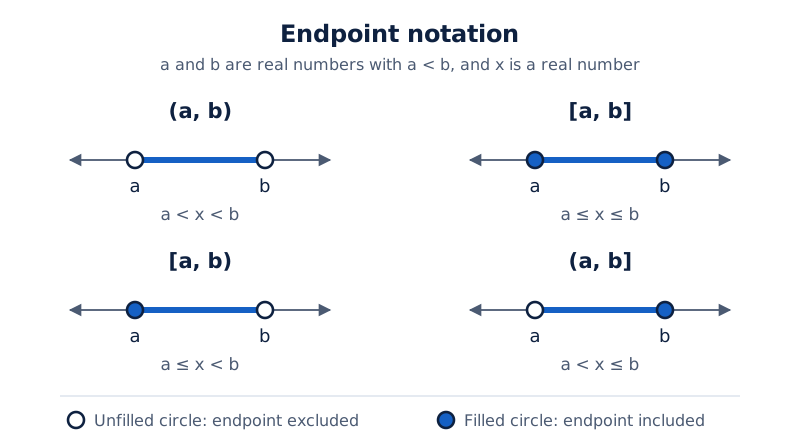
Four number-line drawings show (a, b), [a, b], [a, b) and (a, b]. Unfilled endpoint circles mark excluded endpoints; filled circles mark included endpoints.
Drawn by One Young India.
The symbol ∞, infinity, indicates that a bound is not finite. Thus [0, ∞) represents non-negative real numbers, meaning zero and positive real numbers; (−∞, 0) represents negative real numbers; and (−∞, ∞) represents R.
What is a power set, and how are its members listed?
The power set of a set A, written P(A), is the set of all subsets of A. In P(A), each element is itself a set. This makes the distinction between a member and a subset especially important.
To form P(A), list the subsets of A and enclose that entire collection in another pair of braces. Include φ because the empty set is a subset of A, and include A because every set is a subset of itself.
Result: The number of subsets of a finite set
If A has n distinct elements, where n is zero or a positive integer, then n(P(A)) = 2ⁿ. Here 2ⁿ means 2 raised to the power n. Each element has two possibilities in forming a subset: it is included or it is excluded.
These choices account for every subset, including the empty set and the complete set A. The power set counts collections of elements, so it is different from merely rewriting A with its members in another order.
Worked example 6. List the power set of A = {−1, 0, 1} by first listing all its subsets.
Answer: P(A) = {φ, {−1}, {0}, {1}, {−1, 0}, {−1, 1}, {0, 1}, {−1, 0, 1}}. There is one empty subset, three singletons, three subsets containing two elements and the full set. Thus n(P(A)) = 8 = 2³.
Notice the nested braces in the answer. The number 0 is an element of A, while {0} is a subset of A and an element of P(A). Removing the inner braces would change the kind of object being listed.
The empty set also has a power set: P(φ) = {φ}. Its only subset is itself. Thus the power set of the empty set contains one element, even though the empty set contains none. This is another reason to read braces carefully.
How do universal sets and Venn diagrams organise sets?
A universal set is the basic set relevant to a particular discussion, containing the sets being considered as subsets. It is usually denoted by U. Its choice depends on the context rather than being a single fixed collection for every problem.
When discussing integers, Q or R can serve as a universal set. When studying natural numbers and collections such as even natural numbers, N can serve that purpose. Check that the chosen universal set includes every element under discussion.
Most relationships between sets can be represented using Venn diagrams. These use rectangles and closed curves, usually circles. The universal set is usually represented by a rectangle, with its subsets represented by circles inside it.
How does a diagram represent containment?
Elements are written in their appropriate regions. A circle completely inside another circle represents a subset of the containing set. An element outside a subset circle can still belong to U because it remains inside the universal-set rectangle.
What the figure shows
A subset of the universal set
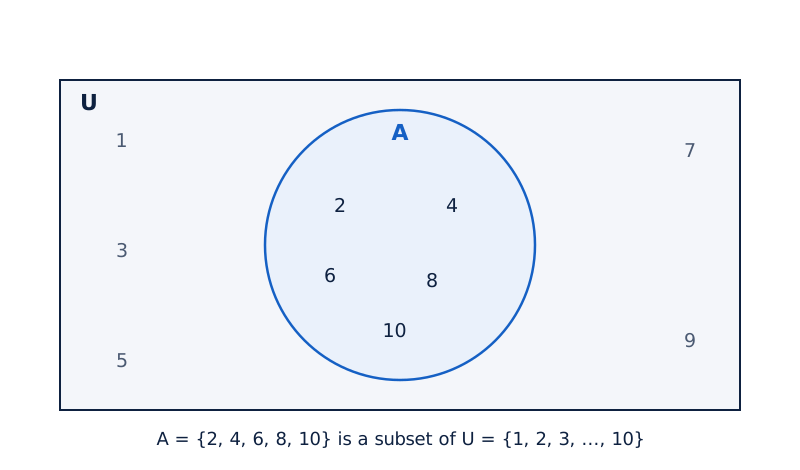
The rectangle U contains the numbers 1 to 10. The circle A contains 2, 4, 6, 8 and 10. The numbers 1, 3, 5, 7 and 9 lie outside A but inside U.
Drawn by One Young India.
What the figure shows
One subset inside another
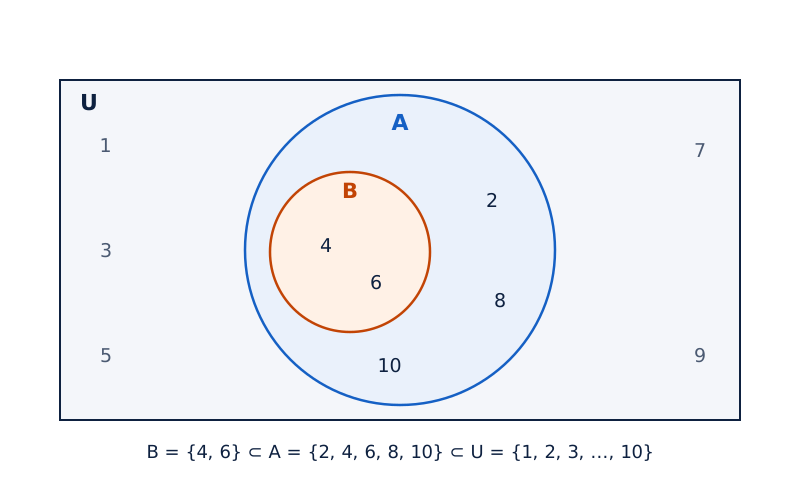
Inside the rectangle U, the circle B lies inside the circle A. B contains 4 and 6; A also contains 2, 8 and 10. The odd numbers shown lie outside A.
Drawn by One Young India.
These diagrams illustrate A ⊂ U and B ⊂ A. Read each number according to its position relative to every relevant boundary. A number inside B is also inside A and U; it does not stop belonging to the larger sets.
How is the union of sets found?
The union of sets A and B contains every element belonging to A, to B, or to both. Its symbol is ∪, so A ∪ B is read “A union B”. Common elements are included only once.
In set-builder notation, A ∪ B = {x : x ∈ A or x ∈ B}. Here “or” includes membership in both sets. A member does not have to belong exclusively to one set to qualify for the union.
Worked example 7. Let A = {2, 4, 6, 8} and B = {6, 8, 10, 12}. Find A ∪ B.
Answer: A ∪ B = {2, 4, 6, 8, 10, 12}. Start with the members of A and add the members of B that are not already listed. The common elements 6 and 8 are taken only once.
Property: Laws of union
A commutative law allows the order of the two sets to be reversed. An associative law allows the grouping of three sets to change. Let C denote a third set, with A, B and C all subsets of U.
| Law | Statement | Meaning |
|---|---|---|
| Commutative | A ∪ B = B ∪ A | Changing order preserves the union |
| Associative | (A ∪ B) ∪ C = A ∪ (B ∪ C) | Changing grouping preserves the union |
| Identity | A ∪ φ = A | The empty set adds no elements |
| Idempotent | A ∪ A = A | Combining a set with itself leaves it unchanged |
| Universal-set law | U ∪ A = U | U already contains all members of A |
An identity for an operation leaves the other set unchanged. Idempotent means that applying the operation to a set and itself gives that same set. If B ⊂ A, then A ∪ B = A because B adds no new members.
What the figure shows
Union
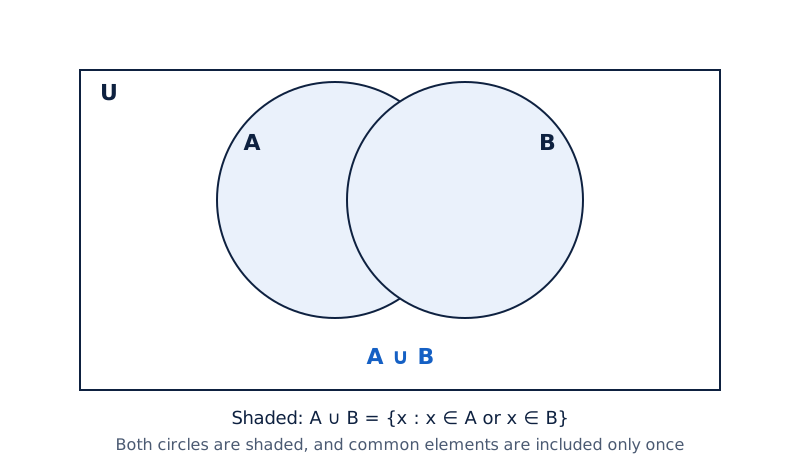
Two overlapping circles A and B lie inside U. Both circles, including their common region, are shaded to represent A ∪ B.
Drawn by One Young India.
How are intersection and disjoint sets identified?
The intersection of sets A and B contains exactly their common elements. The symbol ∩ means intersection. Thus A ∩ B = {x : x ∈ A and x ∈ B}. The word “and” requires membership in both sets.
For A = {2, 4, 6, 8} and B = {6, 8, 10, 12}, the intersection is {6, 8}. Unlike union, intersection excludes elements belonging to only one of the two sets.
Property: Laws of intersection
Intersection is commutative and associative: A ∩ B = B ∩ A and (A ∩ B) ∩ C = A ∩ (B ∩ C). Here A, B and C are subsets of the same universal set U.
The further laws are φ ∩ A = φ, U ∩ A = A and A ∩ A = A. In each case, check which elements can satisfy membership in both sets. No element can belong to the empty set.
If B ⊂ A, then A ∩ B = B. Every element of B is already in A, so all of B survives the common-membership test. Members that belong to A alone do not survive it.
Two sets are disjoint when they have no common elements, so their intersection is φ. The sets {2, 4, 6, 8} and {1, 3, 5, 7} are disjoint. Being unequal does not by itself establish disjointness.
What the figure shows
Intersection and disjoint sets
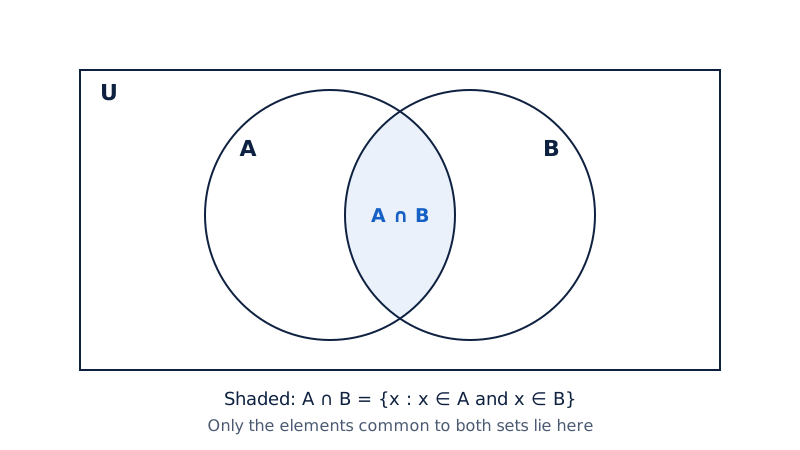
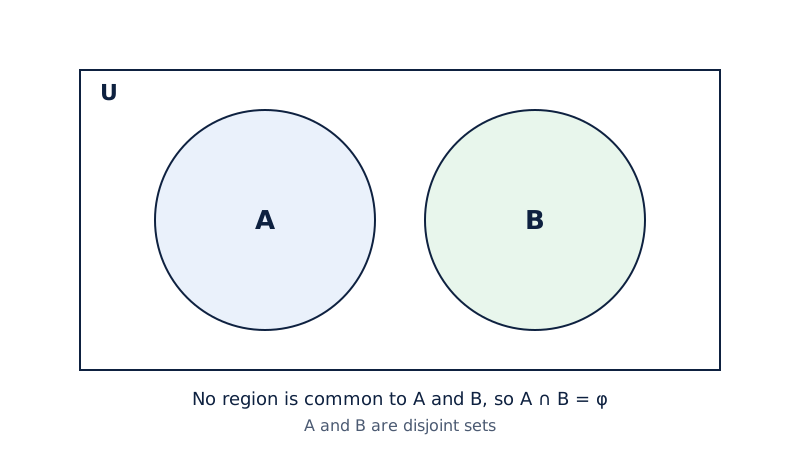
Figure 1.5 shades only the overlap of A and B inside U. Figure 1.6 shows two separate, non-overlapping circles A and B inside the universal-set rectangle.
Drawn by One Young India.
Property: Intersection distributes over union
A distributive law relates an operation on a combined set to operations on its parts. Here A ∩ (B ∪ C) = (A ∩ B) ∪ (A ∩ C). Membership requires belonging to A and to at least one of B and C.
How is the difference of two sets calculated?
The difference A − B contains the elements of A that do not belong to B. The minus symbol in this expression denotes a set operation, rather than subtraction of the numerical values of individual members.
In set-builder notation, A − B = {x : x ∈ A and x ∉ B}. Begin with A and remove the members also in B. Reversing the expression changes which set supplies the starting elements.
Worked example 8. Let A = {1, 2, 3, 4, 5, 6} and B = {2, 4, 6, 8}. Find A − B and B − A.
Answer: A − B = {1, 3, 5}, because those elements belong to A but not B. B − A = {8}, because 8 belongs to B but not A. Therefore A − B ≠ B − A in this example.
How should the three regions be read?
The sets A − B, A ∩ B and B − A are mutually disjoint: the intersection of any two of them is empty. They identify membership in A alone, in both sets, and in B alone, respectively.
Do not put common elements into either difference. An element in the overlap belongs to both sets, so it fails the “not in the other set” requirement. The order of the set names determines which outer region is selected.
What the figure shows
Difference
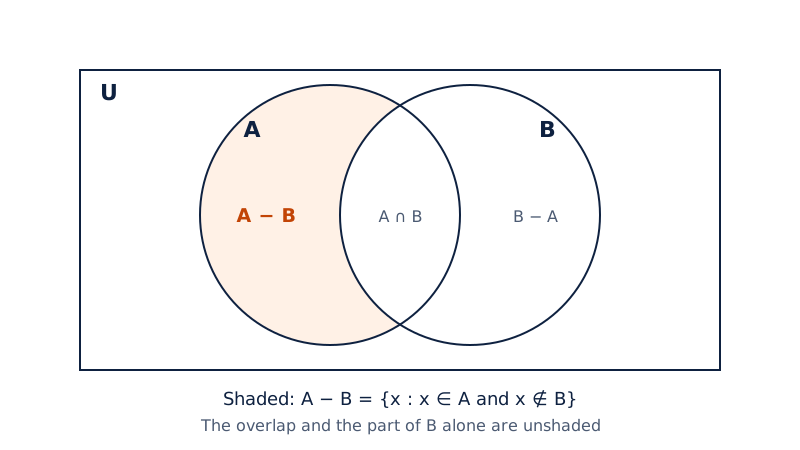
The circles A and B overlap inside U. The part of A outside B is shaded and labelled A − B; the overlap and the part belonging to B alone are unshaded.
Drawn by One Young India.
For real-number sets, R − Q is the set of irrational numbers: it retains real numbers and excludes rational numbers. This uses the same membership rule as a finite roster, even though the elements cannot all be listed.
What is a complement, and why must the universal set be known?
For A ⊂ U, the complement of A consists of the elements of U that are not in A. Its notation is A′, read “A complement”; the prime mark here denotes complementation.
Thus A′ = {x : x ∈ U and x ∉ A}, or equivalently A′ = U − A. A complement is therefore a difference taken from the chosen universal set. Both A and A′ remain subsets of U.
How do we calculate a complement?
Let U = {1, 2, 3, 4, 5, 6, 7, 8, 9, 10} and A = {1, 3, 5, 7, 9}. Then A′ = {2, 4, 6, 8, 10}. These are the members of U absent from A.
The restriction to U matters. Describing A′ simply as “everything outside A” leaves out the boundary of the problem. The intended objects must lie within the universal set before the exclusion of A is applied.
What the figure shows
Complement
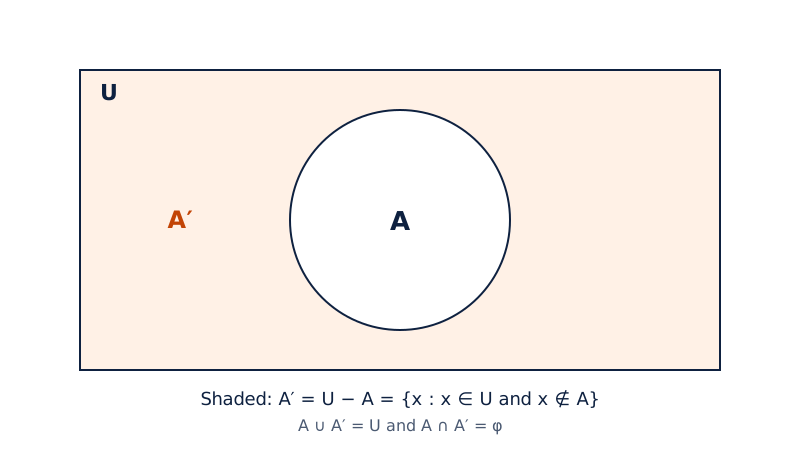
A circle A lies inside a rectangle U. The region inside U but outside A is shaded and labelled A′. The interior of A is unshaded.
Drawn by One Young India.
Property: Complement and double complement laws
The complement laws are A ∪ A′ = U and A ∩ A′ = φ. Every member of U belongs either to A or to its complement, and no member belongs to both.
The double complement law is (A′)′ = A. Taking the complement again, relative to the same U, restores the original set. The related laws φ′ = U and U′ = φ follow by excluding no members or excluding every member of U.
How do De Morgan’s laws and membership proofs work?
De Morgan’s laws connect complements with union and intersection. For two subsets A and B of the same universal set U, they state (A ∪ B)′ = A′ ∩ B′ and (A ∩ B)′ = A′ ∪ B′.
The first law says that being outside the union requires being outside both sets. The second says that being outside the intersection requires being outside at least one of the sets. All complements in a calculation refer to the same U.
How can the first law be verified with sets?
Let U = {1, 2, 3, 4, 5, 6}, A = {2, 3} and B = {3, 4, 5}. Then A′ = {1, 4, 5, 6} and B′ = {1, 2, 6}, giving A′ ∩ B′ = {1, 6}.
Also, A ∪ B = {2, 3, 4, 5}, so (A ∪ B)′ = {1, 6}. The two sides therefore contain exactly the same elements. This calculation verifies the law for these sets; the law itself holds for any two subsets of U.
How does a proof establish equality for general sets?
A membership proof establishes a relationship by following an arbitrary element through the definitions. “Arbitrary” means that the reasoning does not depend on choosing one particular member. To establish equality, prove containment in both directions.
Suppose A ∪ B = A ∩ B. We can prove A = B as follows, using x and y to denote arbitrary elements of A and B respectively.
- Take x ∈ A. It follows that x ∈ A ∪ B.
- The assumed equality puts x in A ∩ B, so x ∈ B. Hence A ⊂ B.
- Take y ∈ B. Then y ∈ A ∪ B and, by the same assumed equality, y ∈ A ∩ B.
- Therefore y ∈ A, giving B ⊂ A. The two containments establish A = B.
Keep a numerical verification distinct from a general proof. The verification compares particular rosters; the proof uses definitions and arbitrary membership. Both depend on the same criterion for equality: the sets must contain exactly the same elements.
Glossary
- Set — A well-defined collection of objects for which membership can be decided.
- Element — An object belonging to a set, also called a member of that set.
- Roster form — Representation listing the distinct elements of a set within braces, separated by commas.
- Set-builder form — Representation specifying a common property that identifies exactly the members of a set.
- Empty set — A set containing no elements, also called the null or void set.
- Finite set — A set that is empty or contains a definite finite number of elements.
- Equal sets — Sets containing exactly the same elements, irrespective of listing order or repetition.
- Subset — A set whose every element also belongs to another specified set.
- Power set — The set of all subsets of a given set, including the empty and complete subsets.
- Universal set — The basic set relevant to a discussion, containing all the sets under consideration as subsets.
- Union — The set of elements belonging to either of two sets, including elements belonging to both.
- Intersection — The set containing exactly those elements that belong to both of two given sets.
- Disjoint sets — Sets with no common elements, so that their intersection is the empty set.
- Difference — The set of elements belonging to the first set but not to the second.
- Complement — The set of elements in the specified universal set that do not belong to the given subset.
Common errors and misconceptions
- Misconception: Reordering elements changes a set. Correct: Equality depends on membership; {1, 2, 3, 4} and {3, 1, 4, 2} are equal.
- Misconception: {0} is empty because zero means nothing. Correct: {0} contains one element, the number zero; φ contains no elements.
- Misconception: An empty set cannot be finite. Correct: The definition of finite set includes the empty set as well as sets with finitely many members.
- Misconception: ∈ and ⊂ express the same relationship. Correct: ∈ expresses membership of an object; ⊂ compares every element of one set with another set.
- Misconception: The union excludes common elements. Correct: Union includes members of either set or both, with each common element taken once.
- Misconception: A − B must equal B − A. Correct: Set difference depends on order because the first set supplies the elements being retained or excluded.
- Misconception: A′ contains every imaginable object outside A. Correct: It contains only elements of the specified universal set that are absent from A.
- Misconception: Complementing a union gives the union of complements. Correct: De Morgan’s law gives (A ∪ B)′ = A′ ∩ B′; the operation changes to intersection.
Exam-style questions with model answers
Q1. Let V = {a, e, i, o, u}. State whether a and b belong to V, using the appropriate symbols and giving reasons. [2 marks]
- a ∈ V because a is listed among the elements of V.
- b ∉ V because b is absent from the given list of elements.
Q2. Write {x : x is a positive integer and x² < 40} in roster form. Explain how the number restriction determines the answer. [3 marks]
- The required elements must be positive integers, so zero, negative numbers and non-integer values are excluded before the inequality is considered.
- The positive integers whose squares satisfy x² < 40 are 1, 2, 3, 4, 5 and 6. Each meets both stated conditions.
- Thus the roster is {1, 2, 3, 4, 5, 6}, written within braces with the elements separated by commas.
Q3. Let A = {1, 3}, B = {1, 5, 9} and C = {1, 3, 5, 7, 9}. Decide whether A ⊂ B, A ⊂ C, B ⊂ C and φ ⊂ B, with reasons. [4 marks]
- A ⊄ B because 3 is an element of A but is not an element of B.
- A ⊂ C because both elements of A, namely 1 and 3, occur in the given set C.
- B ⊂ C because each of the elements 1, 5 and 9 belongs to C.
- φ ⊂ B because the empty set is a subset of every set, including the given set B.
Q4. Convert {x : x ∈ R, −5 < x ≤ 7} into interval notation and [−3, 5) into set-builder form. Explain endpoint membership in each case. [4 marks]
- The first set is (−5, 7], because its members are real numbers between the two stated bounds.
- The round bracket at −5 excludes that endpoint, while the square bracket at 7 includes it.
- The second set is {x : x ∈ R, −3 ≤ x < 5}, expressing both the real-number restriction and the inequalities.
- Here −3 belongs to the interval, while 5 does not, as shown by the different endpoint brackets.
Q5. Let A = {−1, 0, 1}. List its subsets grouped by number of elements, write P(A), and state n(P(A)). [5 marks]
- The subset containing no elements is φ. It must be included because the empty set is a subset of every set.
- The subsets containing one element are {−1}, {0} and {1}. Each is a singleton drawn from A.
- The subsets containing two elements are {−1, 0}, {−1, 1} and {0, 1}. Changing their listing order does not produce new subsets.
- The subset containing all three elements is {−1, 0, 1}, which is A itself.
- Therefore P(A) = {φ, {−1}, {0}, {1}, {−1, 0}, {−1, 1}, {0, 1}, {−1, 0, 1}} and n(P(A)) = 8.
Q6. Let A = {1, 2, 3, 4, 5, 6} and B = {2, 4, 6, 8}. Find A − B and B − A, and decide whether they are equal. [3 marks]
- A − B = {1, 3, 5}. These members occur in A but not B; the common members 2, 4 and 6 are removed.
- B − A = {8}. Starting instead with B, the only member that does not occur in A is 8.
- The two differences are unequal because they contain different elements. Thus reversing the order of these sets changes the result.
Q7. Let U = {1, 2, 3, 4, 5, 6}, A = {2, 3} and B = {3, 4, 5}. Find A′, B′, A′ ∩ B′, A ∪ B and (A ∪ B)′, then verify the first De Morgan law. [6 marks]
- A′ = {1, 4, 5, 6}, obtained by retaining exactly those elements of the specified universal set U that are not in A.
- B′ = {1, 2, 6}, obtained by removing the elements 3, 4 and 5 of B from the same universal set.
- A′ ∩ B′ = {1, 6}, since these are the elements common to the two complements just calculated.
- A ∪ B = {2, 3, 4, 5}, with the common element 3 included once rather than repeated.
- (A ∪ B)′ = {1, 6}, because these are precisely the members of U outside the union.
- Both sides contain exactly 1 and 6. Hence (A ∪ B)′ = A′ ∩ B′, verifying the first De Morgan law for these sets.
Q8. For sets A and B, suppose A ∪ B = A ∩ B. Prove A = B by showing both subset relations. [4 marks]
- Let x be any element of A. Then x belongs to A ∪ B by the definition of union.
- By the given equality, x belongs to A ∩ B, so x belongs to B. Therefore A ⊂ B.
- Likewise, any element y of B belongs to A ∪ B and therefore to A ∩ B, giving y ∈ A and B ⊂ A.
- Since every element of either set belongs to the other, A and B have exactly the same elements. Hence A = B.
Key takeaways
- A set needs a definite membership rule; roster and set-builder forms express the same collection in different ways.
- Order and repeated writing do not change a set; equality requires exactly the same members in both sets.
- The empty set is finite and is a subset of every set; {0} is a singleton.
- Membership and containment differ: a set can itself be one element within a larger set.
- Interval brackets specify endpoint inclusion, while the real-number restriction includes all real values satisfying the inequalities.
- A power set contains subsets as its elements, including the empty set and the original set.
- Union includes members of either set, intersection retains common members, and difference depends on the order of sets.
- Complements depend on the universal set; De Morgan’s laws exchange union and intersection when complements are taken.
Test yourself
Why is the collection of the five most renowned mathematicians not well-defined?
The criterion for “most renowned” can vary from person to person, so it does not supply a definite membership rule.
What is the set of distinct letters in SCHOOL?
It is {S, C, H, O, L}; repeating O in the word does not create another distinct element.
Why is {0} different from φ?
The set {0} contains one element, zero, whereas φ contains no elements at all.
If A ⊂ B and B ⊂ A, what follows?
A = B, because every element of each set also belongs to the other set.
Which endpoints belong to the interval [a, b), where a < b?
The left endpoint a belongs to the interval, but the right endpoint b does not.
Why does P(φ) contain one element?
The empty set has exactly one subset, itself, so its power set is {φ}.
When are two sets A and B disjoint?
They are disjoint when they have no common elements, which means A ∩ B = φ.
How do you express the complement of A ∪ B using A′ and B′?
De Morgan’s law gives (A ∪ B)′ = A′ ∩ B′, with every complement taken relative to the same universal set.
Write about it
Turn a question from this chapter into a paper.
The Writing Studio has a structure guide, a rubric and citation tools for 15 formats, from essays to research papers. Drafting is free with an account. Learnacy Essential adds feedback from an AI writing coach and submission to The OYI Review.
Learnacy Essential is ₹1,499 for the year. Publication depends on review and is not guaranteed.