
The Three Main Organs of the Indian Government: Legislature, Executive and Judiciary | ICSE Class 8 History & Civics Notes
On this page
This note covers the three organs of the Indian government, the composition and working of Parliament, the President and Vice-President, the Prime Minister and Council of Ministers, the Supreme Court and High Courts, judicial independence, jurisdiction, judicial review, courts of record and writs.
What are the three organs of the Indian government?
An organ of government is a branch with particular responsibilities. The legislature makes laws, the executive implements laws and administers the country, and the judiciary interprets laws and settles disputes through courts. Together, these organs perform the work of government.
The Constitution is the body of fundamental rules that establishes the institutions of government, distributes their powers and protects rights. Each organ must work within these rules. Dividing responsibilities helps prevent the misuse of power by any one branch.
How are their responsibilities connected?
The Union refers to the national level of government. Its legislature is Parliament, consisting of the President, the constitutional head of state, and two Houses: the Lok Sabha (House of the People) and Rajya Sabha (Council of States). The two Houses discuss proposed laws, while the President has a constitutional role in making them law.
The executive carries laws into practice. Courts decide disputes about their meaning and application. Separation of powers means assigning different functions to different organs. In India, this division also includes connections through which the organs check one another.
| Organ | Main responsibility | Connection with another organ |
|---|---|---|
| Legislature | Debates and makes laws | Questions ministers about their administration |
| Executive | Implements laws and policies | Answers to Parliament for its work |
| Judiciary | Interprets laws and settles disputes | Examines whether laws conform to the Constitution |
These connections are called checks and balances: powers through which institutions restrain misuse by other institutions. Cooperation is necessary, but cooperation does not give any organ unlimited authority. Constitutional limits remain binding even when an institution enjoys strong public support.
How is the Lok Sabha composed and elected?
The Lok Sabha, or House of the People, is the directly elected House of Parliament. Its members represent territorial constituencies, meaning geographical areas from which representatives are elected. Each Lok Sabha constituency elects one member.
Universal adult franchise means the right of adult citizens to vote, subject to legal requirements. It gives people a direct part in choosing their representatives. A member of either House is a Member of Parliament, abbreviated as MP.
The Government of India Act 1909 allowed some elected representation under colonial rule. These early legislatures did not provide voting rights to all adults. Independent India adopted universal adult franchise, giving adult citizens the right to vote.
What are its membership, qualifications and term?
The Lok Sabha has 543 elected members. A candidate must be an Indian citizen, be at least 25 years old, possess the qualifications prescribed by law and be free from legal disqualifications. Disqualification means a legal condition that makes someone ineligible for membership.
An office of profit is an office under government that brings financial benefit. Holding such an office can disqualify a parliamentary candidate unless the law exempts that office. This restriction helps protect the independence of representatives from government influence.
The Lok Sabha is usually elected once every five years. It can be dissolved, meaning that the House's term ends, before completing that period. A fresh election then provides a new House. The House's term should not be confused with a lifetime appointment.
Who presides over its proceedings?
The Speaker is the Lok Sabha's presiding officer, responsible for conducting its proceedings and maintaining order. Members elect the Speaker from among themselves. They also elect a Deputy Speaker, who performs the Speaker's duties when required.
The Lok Sabha's direct connection with voters explains its special importance. The Council of Ministers, the team of ministers running the Union government, must retain its confidence, meaning its support. The Lok Sabha also has stronger powers over Money Bills, proposed laws dealing with specified public financial matters.
How does the Rajya Sabha represent the states?
The Rajya Sabha, or Council of States, provides representation to the states in Parliament. Its maximum membership is 250: up to 238 elected representatives of states and Union territories, and 12 members nominated by the President. A Union territory is an area administered under the Union's constitutional arrangements.
Nomination means appointment to membership rather than election. The nominated members have special knowledge or practical experience in literature, science, art or social service. This provision brings experience from these fields into parliamentary discussion.
How are members chosen?
Elected members of a state's Legislative Assembly elect that state's Rajya Sabha representatives. A Legislative Assembly is a state's directly elected legislative House. Its members are called Members of the Legislative Assembly, or MLAs. This is an indirect election because voters first elect the representatives who choose Rajya Sabha members.
State representatives are elected by proportional representation through the single transferable vote, an electoral method using ranked preferences to distribute representation. Union territory representation follows the arrangements prescribed by law. States do not all have equal numbers of Rajya Sabha seats.
A Rajya Sabha candidate must be an Indian citizen, be at least 30 years old and meet the other legal requirements for parliamentary membership. The minimum age is therefore different from the Lok Sabha's minimum age of 25 years.
Why is it called a permanent House?
Members serve six-year terms, with one-third retiring every two years. The whole Rajya Sabha is not dissolved together. Permanent House describes this continuity of the institution, not permanent membership for each individual.
The Vice-President, the office-holder who acts as President when required by the Constitution, is its ex-officio Chairman, meaning Chairman by virtue of holding the vice-presidential office. The House elects a Deputy Chairman from among its members. The Rajya Sabha continues to exist when the Lok Sabha is dissolved.
How do the two Houses compare, and what does Parliament do?
India has a bicameral legislature, meaning a legislature with two Houses. The Lok Sabha represents the people directly, while the Rajya Sabha represents the states. A second House provides an opportunity to reconsider proposals and examine them from another representative perspective.
| Feature | Lok Sabha | Rajya Sabha |
|---|---|---|
| Other name | House of the People | Council of States |
| Main electoral basis | Direct election by voters in constituencies | Indirect election of state representatives by elected MLAs |
| Minimum age | 25 years | 30 years |
| Term | Usually five years; can be dissolved earlier | Six-year membership; the House is permanent |
| Presiding officer | Speaker | Vice-President as Chairman |
| Responsibility of ministers | Can withdraw confidence in the Council of Ministers | Can question and criticise ministers, but cannot remove the Council through a no-confidence vote, a vote declaring loss of support |
What are Parliament's principal functions?
Legislation means making laws. Parliament makes laws on subjects assigned to it by the Constitution. The Union List contains subjects for Union law-making; the Concurrent List contains subjects on which both Parliament and state legislatures can make laws.
Parliament also controls public finance. A budget sets out the government's expected receipts and expenditure. Parliamentary scrutiny examines how money will be raised and spent, and requires the government to account for its use of public resources.
Its representative and debating functions bring different regional and social concerns into national discussion. Members raise people's problems, question government action and debate proposed policies. Parliament therefore does more than approve prepared laws.
Parliament participates in constitutional change and specified electoral and removal functions. A constitutional amendment is a change to the Constitution. Both Houses participate in the prescribed processes concerning the President, Vice-President and judges of the Supreme Court and High Courts.
Note: The Lok Sabha's stronger financial powers do not make the Rajya Sabha unnecessary. Both Houses take part in ordinary law-making, national debate and scrutiny of the executive.
How does Parliament make laws and control the executive?
A Bill is a draft proposal for a law. An ordinary Bill follows the general legislative process, as distinct from special categories such as Money Bills and constitutional amendment Bills. An ordinary Bill can be introduced in either House.
What happens to an ordinary Bill?
- A member introduces the proposed law in one House of Parliament.
- The House discusses it. A committee, meaning a smaller group of members assigned detailed work, may examine it and report recommendations.
- The House considers the proposal and votes on it. If passed, it goes to the other House for consideration.
- The other House discusses and votes on the Bill. The two Houses must agree on the text through the applicable constitutional process.
- The Bill goes to the President for assent, meaning formal constitutional approval. Assent turns the passed Bill into law.
A disagreement over an ordinary Bill can, in specified circumstances, be resolved through a joint sitting, a meeting of both Houses together. This mechanism should not be treated as the procedure for every kind of Bill.
The Protection of Women from Domestic Violence Act 2005 illustrates how public demands can lead to legislation. Women’s organisations pressed for protection from violence at home and made submissions to the Parliamentary Standing Committee.
A new Bill was reintroduced in Parliament in 2005. After both Houses passed it, it was sent to the President for assent. The law came into effect in 2006, providing civil relief to women affected by domestic violence.
How is a Money Bill different?
A Money Bill deals exclusively with specified matters such as taxation, government borrowing and public funds. An Article is a numbered provision of the Constitution. Article 109 provides that a Money Bill cannot be introduced in the Rajya Sabha.
After the Lok Sabha passes it, the Rajya Sabha can recommend changes. It has 14 days to return the Bill. The Lok Sabha can accept or reject those recommendations. If it is not returned within that period, it is deemed passed in the Lok Sabha's form.
How are ministers held answerable?
During Question Hour, members put questions to ministers about government work. Debates, examination of Bills and financial scrutiny also support accountability, meaning the duty to explain and justify decisions.
A no-confidence motion asks the Lok Sabha to declare that it no longer supports the Council of Ministers. If it passes, the Council must resign. Parliamentary control depends on members using their powers actively and examining the executive's actions.
Who can become President, and how is the President elected?
The President is India's constitutional head of state. The office represents the country as a whole. The Constitution formally places Union executive power in the President, but the parliamentary system requires that power to operate through the Council of Ministers.
What are the main qualifications?
- The candidate must be an Indian citizen.
- The candidate must have completed 35 years of age.
- The candidate must be qualified for election as a member of the Lok Sabha.
- The candidate must not hold a disqualifying office of profit under government.
For this qualification, holding the office of President, Vice-President, state Governor or a Union or state minister does not by itself count as holding an office of profit. A Governor is the constitutional head of a state.
What is the method of election?
The President is indirectly elected by an electoral college, meaning the body entitled to vote in this election. It consists of elected members of both Houses of Parliament and elected members of state Legislative Assemblies, including those of Delhi and Puducherry.
Nominated MPs do not vote in the presidential election. The method is proportional representation through the single transferable vote, with a secret ballot. A secret ballot keeps each elector's choice confidential. Citizens do not directly vote for a presidential candidate in this election.
The President is elected for five years and is eligible for re-election. Impeachment is the special parliamentary process for removing the President for violation of the Constitution. It is different from an ordinary disagreement with government policy.
The fixed presidential term provides continuity even when the Council of Ministers changes. Distinguish the method of choosing the head of state from the political support needed by the head of government.
What powers does the President exercise?
The President has executive, legislative, judicial and emergency powers under the Constitution. Their exercise must be understood through the parliamentary system. The Prime Minister, the head of government, heads the Council of Ministers, the group of ministers that advises the President and runs the Union government.
Article 74(1) provides for this Council to aid and advise the President. The President may ask the Council to reconsider advice, but must act on the advice given after reconsideration. In most of the cases, the President has to follow the Council's advice.
What are the main categories of power?
| Category | Functions |
|---|---|
| Executive | Appoints the Prime Minister; appoints other ministers on the Prime Minister's advice |
| Legislative | Gives assent to Bills; can return a Bill for reconsideration unless it is a Money Bill or a constitutional amendment Bill |
| Judicial | Appoints judges through the constitutional process; has powers of pardon, forgiving an offence and relieving punishment, in specified cases |
| Emergency | Exercises emergency powers under constitutional conditions and safeguards |
A pardon is an exercise of authority to forgive an offence and relieve its punishment within the constitutional scope of that power. Emergency powers are special powers available in situations defined by the Constitution, rather than unrestricted personal authority.
Does the President have any discretion?
Discretion means room for judgement within constitutional limits. If no leader clearly commands the Lok Sabha's majority, the President must assess who can form a government with the required support. A majority means more than half of the relevant total.
The President can return a Bill for reconsideration unless it is a Money Bill or a constitutional amendment Bill, but must give assent if Parliament passes the returned Bill again. The President must give assent to a constitutional amendment Bill duly passed under Article 368. The President is also entitled to information about important government matters. These functions explain why the office is neither an independently governing presidency nor an office without constitutional responsibilities.
How is the Vice-President chosen, and what does the office do?
The Vice-President has responsibilities connecting the executive with Parliament. The office-holder presides over the Rajya Sabha as its ex-officio Chairman and acts as President when the circumstances provided by the Constitution require it.
What qualifications and election method apply?
A candidate must be an Indian citizen, have completed 35 years of age and be qualified for election to the Rajya Sabha. The candidate must not hold a disqualifying office of profit. The exceptions for the President, Vice-President, Governors and ministers apply here too.
Members of both Houses of Parliament elect the Vice-President. Unlike the presidential electoral college, this body includes nominated as well as elected MPs. Members of state Legislative Assemblies do not take part.
The election uses proportional representation through the single transferable vote and a secret ballot. The Vice-President's term is five years. Eligibility for the Rajya Sabha is a qualification for the office; it does not mean that the Vice-President must be an elected Rajya Sabha member.
How do the two main functions differ?
As Chairman, the Vice-President conducts Rajya Sabha proceedings. When the presidency becomes vacant through death, resignation, removal or another cause, the Vice-President acts as President until the newly elected President takes office. The Vice-President also discharges presidential functions during the President's temporary inability to perform them.
While acting as President or discharging presidential functions, the Vice-President does not perform the duties of Rajya Sabha Chairman. This distinguishes the responsibilities attached to the two offices.
The removal process begins with a Rajya Sabha resolution passed by the required majority and agreed to by the Lok Sabha. This is not the presidential impeachment process. The two offices differ in their electoral colleges, qualifications and regular functions.
How do the Prime Minister and Council of Ministers govern?
The Prime Minister is the head of government, responsible for leading the Council of Ministers. The President appoints the Prime Minister. Normally, the person appointed is the leader who commands majority support in the Lok Sabha.
A coalition is an alliance of political parties. When no single party commands the necessary support, parties can form a coalition that has a majority. The Prime Minister must retain the Lok Sabha's confidence, whether that support comes from one party or several.
What qualifications and appointments are involved?
The Prime Minister and other ministers must meet the requirements for parliamentary membership. They can belong to either House, so the minimum membership age is 25 for the Lok Sabha or 30 for the Rajya Sabha. They are not separately elected by the public as ministers.
A person appointed Prime Minister or minister without being an MP must become a member of Parliament within six months. The President appoints the other ministers on the Prime Minister's advice. The Prime Minister chooses ministers and distributes their portfolios, meaning areas of ministerial responsibility.
The 91st Amendment Act (2003) limited the size of the Union Council of Ministers to 15 per cent of the total membership of the Lok Sabha. This addressed the growth of large Councils and the use of ministerial posts to secure parliamentary support.
What does the Prime Minister coordinate?
The Prime Minister directs government policy, coordinates ministers and communicates the Council's decisions to the President. The Cabinet is the central group of senior ministers within the larger Council of Ministers. It considers major policy decisions.
The political executive consists of political leaders responsible for government policy. The permanent executive consists of officials who conduct continuing administration. These officials, called civil servants, help implement laws and policies under ministerial direction.
What does collective responsibility mean?
Collective responsibility means that the Council of Ministers is answerable as a team to the Lok Sabha. If it loses the House's confidence, the whole Council must resign. Ministers cannot treat a Cabinet decision as someone else's responsibility while remaining part of the team.
A minister who disagrees with a Cabinet decision must accept it or resign. The Prime Minister's resignation brings the Council to an end. The resignation of another minister creates a vacancy rather than automatically ending the whole Council.
Diagram
Parliamentary responsibility
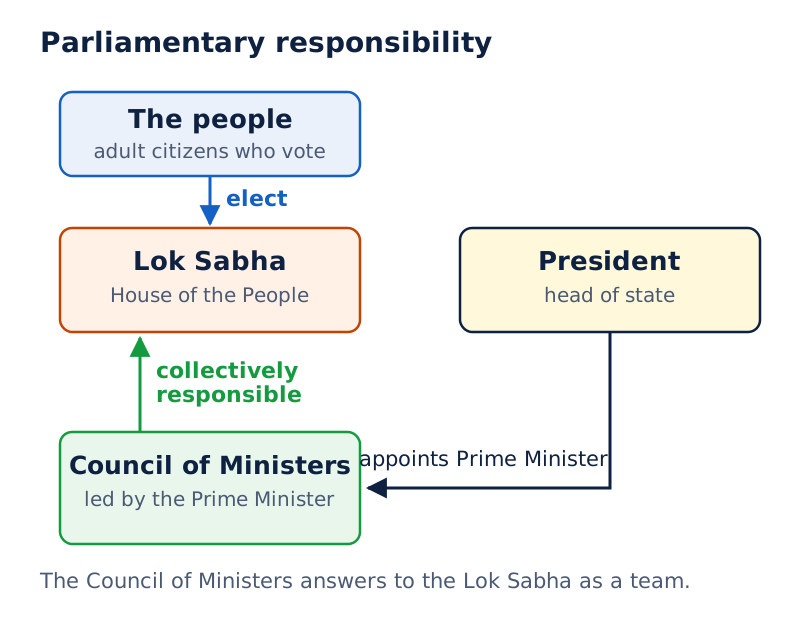
Draw boxes for the people, Lok Sabha, and Council of Ministers. Label the link from the people to the Lok Sabha “elect”; label the link from the Council to the Lok Sabha “collectively responsible”. Add the President in a separate box, with “appoints Prime Minister” beside the connecting line.
Drawn by One Young India.
How are the Supreme Court and High Courts composed?
India has an integrated judiciary, meaning a connected system of courts in which higher court decisions bind lower courts. The Supreme Court is at the top, with High Courts below it and district and subordinate courts at lower levels.
The Supreme Court, located in New Delhi, consists of the Chief Justice of India and other judges provided for by law. A Chief Justice heads a court. Each High Court consists of a Chief Justice and other judges appointed under the Constitution.
A High Court is the highest court for its state or the area assigned to it. Some states share a common High Court. The existence of High Courts does not create judicial systems disconnected from the Supreme Court.
What qualifications must judges possess?
An advocate is a lawyer entitled to practise before courts. A jurist is a person distinguished in legal learning. Judicial office means a post involving judicial duties.
| Court | Citizenship | Professional qualification | Retirement age |
|---|---|---|---|
| Supreme Court | Indian citizen | At least five years as a High Court judge; or at least ten years as a High Court advocate; or a distinguished jurist in the President's opinion | 65 years |
| High Court | Indian citizen | At least ten years holding judicial office in India; or at least ten years as a High Court advocate | 62 years |
The qualifying periods can cover service in successive High Courts where the constitutional provision allows it; the alternatives are not cumulative requirements.
How are judges appointed and protected?
The President appoints Supreme Court and High Court judges through the constitutional consultation process. For other Supreme Court judges, the Chief Justice of India is consulted. High Court appointments involve consultation with the Chief Justice of India and the state Governor, and, for judges other than its Chief Justice, the Chief Justice of that High Court. A collegium is a group of senior judges involved in making judicial appointment recommendations. Appointment is not a popular election.
Judicial independence means that judges decide without improper interference, fear or favour. Security of tenure, meaning protection against arbitrary removal, supports this independence. Judges can be removed for proved misbehaviour or incapacity through the constitutionally prescribed process involving both Houses and the President.
Independence does not mean freedom from the Constitution. Courts remain accountable to constitutional limits. Protection from political pressure enables them to decide disputes involving powerful people and government institutions without treating those parties as their superiors.
What kinds of jurisdiction do the Supreme Court and High Courts exercise?
Jurisdiction means a court's legal authority to hear and decide particular matters. Different kinds of jurisdiction describe how a case comes before a court and what the court is empowered to do. They should not be treated as interchangeable names.
What are original and appellate jurisdiction?
Original jurisdiction is the authority to hear a case in the first instance. The Supreme Court directly hears specified disputes between the Union and states or between states. These disputes concern the constitutional relationship between governments.
Appellate jurisdiction is the authority to hear an appeal, meaning a request for a higher court to reconsider a lower court's decision. The Supreme Court hears appeals in constitutional, civil and criminal matters under the applicable legal conditions.
Civil matters concern disputes about rights and obligations, while criminal matters concern alleged offences against the law. High Courts hear appeals from courts below them. An appeal is subject to legal requirements, rather than an automatic unlimited right to repeated hearings.
High Courts also exercise original jurisdiction in matters assigned to them by law. Their powers include issuing writs, special judicial orders, and supervising subordinate courts. The precise scope of their ordinary original jurisdiction is not identical in every High Court.
What are advisory and revisory powers?
Advisory jurisdiction allows the President to seek the Supreme Court's opinion on matters of public importance or constitutional interpretation. For such references, the Court is not bound to give advice and the President is not bound to accept it.
Revisory jurisdiction includes the power to reconsider judicial decisions within legal limits. Article 137 gives the Supreme Court power to review its own judgements and orders. High Courts have powers of revision over subordinate courts to correct specified legal or jurisdictional errors.
| Power | Central question | Distinction |
|---|---|---|
| Original jurisdiction | Can this matter begin in this court? | No earlier lower-court decision is required for that proceeding |
| Appellate jurisdiction | Can this lower-court decision be challenged here? | Concerns an appeal against an existing decision |
| Review of its own decision | Can the court reconsider its judgement? | Different from an appeal to a higher court |
Article 144 requires civil and judicial authorities to act in aid of the Supreme Court. Its decisions bind the other courts in India. These relationships help the integrated judiciary maintain a connected system of legal authority.
How do judicial review, courts of record and writs protect justice?
Judicial review is the power of the Supreme Court and High Courts to examine whether laws conform to the Constitution. If a law conflicts with constitutional provisions, the court can declare it unconstitutional and inapplicable. This is different from reviewing an earlier judgement.
Article 13 supports protection against laws inconsistent with Fundamental Rights, the basic rights guaranteed by the Constitution. Judicial review also concerns the constitutional distribution of powers between the Union and states. A legislative majority does not place a law beyond constitutional examination.
What is a court of record?
A court of record preserves an authoritative record of its proceedings and judgements. Its recorded decisions can serve as precedents, earlier judicial decisions used as authority in later cases. It also has power to punish contempt of court, including obstruction of justice or disobedience of judicial authority.
The Supreme Court is a court of record under Article 129; High Courts have this status under Article 215. Keeping records and protecting judicial authority are connected features of this status.
What is a writ, and what are some examples?
A writ is a special court order directing a person or authority to act, or refrain from acting, in a particular way. Article 32 empowers the Supreme Court to issue writs for enforcing Fundamental Rights. Article 226 gives High Courts writ powers, including for other legal rights.
| Writ | Meaning and function |
|---|---|
| Habeas corpus | Requires an arrested person to be produced before the court so that the legality of detention can be examined; unlawful detention can lead to release |
| Mandamus | Directs an office-holder or public authority to perform a legal duty that has not been performed |
| Quo warranto | Questions the legal authority of a person holding public office and can prevent an unauthorised person from continuing in it |
Detention means keeping a person in custody. Habeas corpus protects against unlawful detention; it does not declare every arrested person innocent. Mandamus concerns a neglected legal duty, while quo warranto concerns entitlement to hold a public office.
These examples show why rights need remedies, meaning means of obtaining legal protection or correction. Independent judges must be able to examine complaints against authorities. Their task is to apply constitutional and legal standards, rather than merely approve executive decisions.
Diagram
Three judicial safeguards
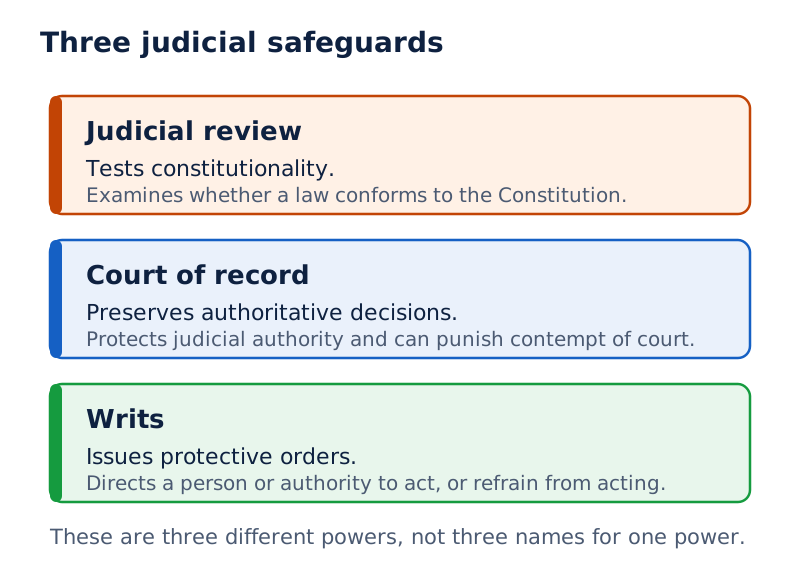
Draw separate boxes labelled “Judicial review”, “Court of record” and “Writs”. Under them write “tests constitutionality”, “preserves authoritative decisions and protects judicial authority”, and “issues protective orders”. Keep them separate because they describe different powers.
Drawn by One Young India.
Glossary
- Legislature — The organ of government responsible for debating and making laws.
- Executive — The organ responsible for implementing laws, directing policy and administering government.
- Judiciary — The system of courts that interprets laws, settles disputes and protects rights.
- Constituency — A defined geographical area whose voters choose a representative in an election.
- Bicameral legislature — A legislature with two Houses that participate in its constitutional work.
- Electoral college — The body of persons entitled to vote in a particular indirect election.
- Assent — The President's formal constitutional approval through which a passed Bill becomes law.
- Collective responsibility — The Council of Ministers' responsibility as a team to the Lok Sabha.
- Jurisdiction — The legal authority of a court to hear and decide particular matters.
- Original jurisdiction — Authority to hear a case in the first instance, rather than on appeal.
- Appellate jurisdiction — Authority to reconsider a lower court's decision through a legally permitted appeal.
- Judicial review — The power to examine laws for conformity with provisions of the Constitution.
- Court of record — A court preserving authoritative judicial records and empowered to punish contempt of itself.
- Writ — A special judicial order directing a person or authority to act or refrain from acting.
- Judicial independence — Freedom for judges to decide according to law without improper interference, fear or favour.
Common errors and misconceptions
- Misconception: Parliament means only the Lok Sabha. Correct: Parliament consists of the President, Lok Sabha and Rajya Sabha. The two Houses form its debating and legislative chambers.
- Misconception: A permanent Rajya Sabha means that its members remain for life. Correct: Members serve six-year terms, with one-third retiring every two years. The whole House is not dissolved together.
- Misconception: The two Houses have identical financial powers. Correct: Money Bills originate in the Lok Sabha. The Rajya Sabha can recommend changes, which the Lok Sabha can accept or reject.
- Misconception: The President normally runs the government independently of ministers. Correct: The Council headed by the Prime Minister advises the President. Reconsidered ministerial advice is binding.
- Misconception: The President and Vice-President have identical electoral colleges. Correct: Nominated MPs vote for the Vice-President but not the President; elected state MLAs participate in the presidential election but not the vice-presidential election.
- Misconception: The Prime Minister must belong to the Lok Sabha. Correct: The Prime Minister can belong to either House, but the Council must retain the confidence of the Lok Sabha.
- Misconception: Judicial review means appealing against every judgement. Correct: Judicial review tests constitutional validity. An appeal challenges a lower court's decision; review of a court's own judgement is another distinct power.
- Misconception: Independence allows judges to ignore the Constitution. Correct: Independence protects decisions from improper pressure. Courts remain subject to constitutional powers, limits and responsibilities.
Exam-style questions with model answers
Q1. Parliament debates and makes laws; the Council of Ministers implements laws and administers government. Identify the organ performing each function. Give two separate answers. [2 marks]
- Parliament performs the legislative function: the legislature debates proposals and makes laws.
- The Council of Ministers performs the executive function: the executive implements laws and administers government.
Q2. Use these facts: the Lok Sabha is directly elected, is usually elected every five years and is chaired by the Speaker; state representatives in the Rajya Sabha are indirectly elected by elected MLAs, members serve six years and the Vice-President chairs it. Compare the Houses on election, term and presiding officer. [3 marks]
- The Lok Sabha is directly elected by the people, whereas state representatives in the Rajya Sabha are indirectly elected by elected members of state Legislative Assemblies.
- The Lok Sabha is usually elected every five years. Rajya Sabha members have six-year terms, so the membership periods of the two Houses differ.
- The Speaker presides over the Lok Sabha, while the Vice-President serves as the Chairman of the Rajya Sabha.
Q3. A Money Bill originates in the Lok Sabha. After passage there, the Rajya Sabha has 14 days to return it with recommendations; the Lok Sabha can accept or reject these. If it is not returned in time, it is deemed passed in the Lok Sabha's form. Explain four features of this procedure. [4 marks]
- A Money Bill must originate in the Lok Sabha, giving that House the power to initiate this category of legislation.
- The Rajya Sabha receives the Bill after Lok Sabha passage and has 14 days to return it.
- The Rajya Sabha can recommend changes, but the Lok Sabha decides whether to accept or reject those recommendations.
- If the Rajya Sabha does not return it within 14 days, the Bill is deemed passed in the form passed by the Lok Sabha.
Q4. The President formally holds Union executive power. A Council of Ministers headed by the Prime Minister advises the President. Article 74(1) permits a request for reconsideration but makes reconsidered advice binding. The President can seek information about important government matters. Explain the President's constitutional position in five points using these facts. [5 marks]
- The President formally holds the executive power of the Union. This establishes the office's constitutional position within the national government.
- The Council of Ministers provides advice to the President, connecting the exercise of presidential functions with the work of ministers.
- The Prime Minister heads this Council. Presidential executive power must therefore be understood alongside the Prime Minister's leadership of the ministerial team.
- Article 74(1) allows the President to ask for reconsideration, but the advice given after reconsideration is binding on the President.
- The President can seek information on important government matters. The office has a right to be informed as well as a responsibility to follow reconsidered advice.
Q5. The President appoints the Prime Minister, who must command Lok Sabha majority support. Other ministers are appointed on the Prime Minister's advice. A non-member appointed minister must enter Parliament within six months. The Council resigns if it loses Lok Sabha confidence. A minister must accept a Cabinet decision or resign. Explain these five rules. [5 marks]
- The President appoints the Prime Minister, but the person must command majority support in the Lok Sabha. Appointment and parliamentary support are both relevant.
- The President appoints the other ministers on the Prime Minister's advice. The Prime Minister therefore has a central role in selecting the ministerial team.
- A minister appointed without being a member of Parliament must enter Parliament within six months. Appointment does not remove this membership requirement.
- The whole Council resigns if it loses the Lok Sabha's confidence. This expresses collective responsibility to that House.
- A minister must accept a Cabinet decision or resign. Remaining in the Council requires acceptance of the team's decisions.
Q6. Original jurisdiction lets a court hear a case at its beginning; appellate jurisdiction lets it reconsider a lower court's decision; Article 137 lets the Supreme Court review its own judgements. Distinguish these three powers. [3 marks]
- Original jurisdiction concerns the beginning of a case in the court authorised to hear it, without requiring an earlier lower-court decision.
- Appellate jurisdiction concerns a challenge to a lower court's existing decision. The higher court reconsiders that decision through an appeal.
- Review under Article 137 concerns the Supreme Court's own earlier judgement. It differs from an appeal because the decision being reconsidered is its own.
Q7. Habeas corpus requires an arrested person to be produced in court and permits release if detention is unlawful. Mandamus directs performance of a neglected legal duty. Quo warranto questions entitlement to public office. Identify the writ for each of these three purposes and explain why habeas corpus does not automatically establish innocence. [4 marks]
- Habeas corpus requires production of an arrested person before the court so that the legality of detention can be examined.
- Mandamus addresses a neglected legal duty by directing the responsible office-holder or authority to perform that duty.
- Quo warranto questions whether a person has the legal authority required to hold a public office.
- Habeas corpus examines the legality of detention. Release from unlawful detention does not itself establish that the person is innocent of an alleged offence.
Q8. Use these facts: courts must decide without improper political pressure; security of tenure protects judges against arbitrary removal; courts settle disputes involving government; judicial review tests laws against the Constitution; courts themselves remain subject to constitutional limits. Explain five features of an independent judiciary. [5 marks]
- Courts must decide without improper political pressure. Independence protects their decision-making from the influence of those who want a particular result.
- Security of tenure protects judges against arbitrary removal. This reduces the threat that a judge could lose office for making an unwelcome decision.
- Courts hear disputes involving government itself. Independence allows them to examine government action without treating the government as their superior in deciding the case.
- Judicial review tests laws against the Constitution. It allows courts to examine whether legislative action meets the constitutional standards that govern it.
- Judges remain subject to constitutional limits. Independence protects lawful decision-making; it does not grant an unrestricted power to act outside the Constitution.
Key takeaways
- The legislature makes laws, the executive implements them, and the judiciary interprets laws and settles disputes within constitutional limits.
- Parliament consists of the President and two Houses: the directly elected Lok Sabha and the Rajya Sabha.
- The Rajya Sabha is permanent, but its members serve six-year terms, with one-third retiring every two years.
- The Lok Sabha has stronger powers over Money Bills and determines whether the Council of Ministers retains parliamentary confidence.
- The President acts on ministerial advice, with power to request reconsideration; advice given after reconsideration is binding.
- The Prime Minister leads the Council of Ministers, which is collectively responsible to the Lok Sabha.
- The Supreme Court and High Courts form part of an integrated judiciary whose independence supports impartial decisions.
- Judicial review, courts of record and writs are distinct features that support constitutional government and the protection of rights.
Test yourself
What are the three constituent parts of Parliament?
Parliament consists of the President, the Lok Sabha and the Rajya Sabha.
Why does a permanent Rajya Sabha still have elections?
Its members serve six-year terms, with one-third retiring every two years. The House continues, while its membership changes.
Who chairs the Lok Sabha and the Rajya Sabha?
The Speaker chairs the Lok Sabha; the Vice-President is the ex-officio Chairman of the Rajya Sabha.
What must the President do after ministers reconsider their advice?
The President must act on the advice given by the Council of Ministers after reconsideration.
What happens when the Council loses Lok Sabha confidence?
The entire Council of Ministers must resign because it is collectively responsible to the Lok Sabha.
How does original jurisdiction differ from appellate jurisdiction?
Original jurisdiction concerns hearing a case at its beginning. Appellate jurisdiction concerns reconsidering a lower court's decision.
How does judicial review differ from reviewing a court's own judgement?
Judicial review examines constitutional validity, while review of a judgement reconsiders the court's own earlier decision.
Which writ examines whether a person's detention is lawful?
Habeas corpus requires the detained person to be produced before the court so that the legality of detention can be examined.
Take this further
How does India make policy?
The Model NITI Aayog self-paced course: 41 chapters, about 19 hours of study, on how India makes policy, from the policy cycle and writing a white paper to the economy, the Union Budget and governance. It comes with Learnacy Essential.
Learnacy Essential also adds feedback from an AI writing coach, submission to The OYI Review, World 101’s member tools and the 3D labs. Publication is not guaranteed. See what a year includes
Or create a free account to draft in the Writing Studio, explore World 101’s map and open the 2D version of every lab. Create a free account