
Thermal Properties of Matter | ISC Class 11 Physics Notes
On this page
This note covers heat and temperature, temperature scales, the ideal gas equation, thermal expansion, anomalous expansion of water, heat capacities, calorimetry, changes of state, latent heat, conduction, Searle’s experiment, convection, thermal radiation, radiation laws and Newton’s law of cooling.
How do heat, temperature and temperature scales differ?
Definition: Heat is energy transferred between bodies, or between a body and its surroundings, because of a temperature difference. Temperature measures relative hotness or coldness and determines the direction of this transfer.
The SI unit of heat is the joule, symbol J. The SI unit of temperature is the kelvin, symbol K. SI means International System of Units. A hot cup of tea loses heat to cooler surroundings; ice-cold water gains heat from warmer surroundings.
Heat is transferred, rather than stored as heat inside a body. The stored microscopic kinetic and potential energy is called internal energy. Heating can raise temperature, produce expansion or change the physical state, so heat transfer need not cause a temperature rise.
How is temperature measured?
A thermometer measures temperature through a thermometric property, meaning a measurable property that changes with temperature. Liquid-in-glass thermometers use changes in liquid volume. Mercury and alcohol have volumes that vary linearly with temperature over a wide range.
Calibration assigns numerical readings to temperatures. In the original Celsius and Fahrenheit scales, the ice and steam points of pure water at standard pressure provide the reference points. Equal scale intervals then specify temperatures between them.
| Reference point | Celsius scale | Fahrenheit scale |
|---|---|---|
| Ice point | 0 °C | 32 °F |
| Steam point | 100 °C | 212 °F |
| Intervals between these points | 100 | 180 |
Let t꜀ be the Celsius reading, tꜰ the Fahrenheit reading and T the absolute temperature in kelvin. The conversion equations are tꜰ = (9/5)t꜀ + 32 and T = t꜀ + 273.15.
Absolute zero corresponds to 0 K or −273.15 °C. A temperature change has the same numerical value in kelvin and degrees Celsius because their intervals have equal size. Their temperature readings differ because their zero points differ.
Note: Use kelvin in the ideal gas and radiation laws. A Celsius temperature difference can be used in expansion and heat-capacity calculations, but a Celsius temperature reading cannot replace absolute temperature.
How does the ideal gas equation describe temperature and expansion?
Low-density gases exhibit similar expansion behaviour. Their state can be described using pressure P, volume V and absolute temperature T. Pressure is force per unit area, measured in pascals, symbol Pa; volume is the space occupied, measured in cubic metres, m³.
For a fixed amount of gas at constant temperature, Boyle’s law states that PV is constant. At constant pressure, Charles’ law states that V/T is constant. The condition attached to each relation is part of the law.
The combined relation is PV = nRT, where n is the amount of gas in moles, symbol mol, and R is the universal gas constant, 8.31 J mol⁻¹ K⁻¹. A mole specifies an amount of substance rather than its mass.
Why can a gas measure temperature?
At constant volume and fixed n, pressure is proportional to absolute temperature. A constant-volume gas thermometer therefore measures temperature through gas pressure. The pressure-temperature relation is approximately linear over a large temperature range.
Real gases deviate from ideal behaviour at low temperatures. Extending the straight pressure-temperature line backwards suggests zero pressure at −273.15 °C if the gas continued to be a gas. This is an extrapolation, not a claim that real gases remain gaseous down to absolute zero.
How does a gas’s expansion coefficient depend on temperature?
Let ΔV mean the small change in volume and ΔT the corresponding temperature change; Δ means “change in”. The coefficient of volume expansion, αᵥ, is the fractional volume change per unit temperature change: αᵥ = ΔV/(VΔT), measured in K⁻¹.
At constant pressure, the ideal gas equation gives PΔV = nRΔT. Dividing by PV = nRT gives ΔV/V = ΔT/T, hence αᵥ = 1/T. Its value decreases as absolute temperature increases. Gases at ordinary temperature expand more than solids and liquids.
How do solids and liquids expand on heating?
Thermal expansion means an increase in a body’s dimensions when its temperature increases. Most substances expand on heating and contract on cooling. Linear expansion changes length, area expansion changes surface area, and volume expansion changes volume.
For a rod, let l be its initial length in metres, symbol m, and Δl its increase in length. The coefficient of linear expansion αₗ is its fractional length change per unit temperature rise: Δl = αₗlΔT. The SI unit of linear expansivity is K⁻¹.
The relation applies for sufficiently small expansion with the coefficient treated as constant over the interval. Expansion coefficients generally depend on temperature; they are not universal constants independent of the material and conditions.
Derivation: How is area expansion related to linear expansion?
- Take a rectangular sheet with length a and breadth b, measured in metres. Its original area A = ab, measured in m². Assume the same linear expansivity along both directions.
- After a temperature rise ΔT, its dimensions become a(1 + αₗΔT) and b(1 + αₗΔT). Multiplying gives the new area A(1 + 2αₗΔT + αₗ²ΔT²).
- When αₗΔT is small, neglect its square. If ΔA is the area increase, ΔA/A ≈ 2αₗΔT. Defining area expansivity αₐ = ΔA/(AΔT) gives the result.
αₐ ≈ 2αₗ, with αₐ measured in K⁻¹.
Derivation: How is volume expansion related to linear expansion?
- Consider a cube of side l and initial volume V = l³. Assume it expands equally in all directions.
- Its new volume is (l + Δl)³. Subtracting l³ and neglecting terms containing (Δl)² and (Δl)³ gives ΔV ≈ 3l²Δl.
- Divide by V = l³ and use Δl/l = αₗΔT. Then ΔV/V ≈ 3αₗΔT; compare this with ΔV/V = αᵥΔT.
αᵥ ≈ 3αₗ for small expansion that is equal in all directions.
Worked example 1. An iron ring has diameter 5.231 m at 27 °C. A wooden wheel rim has diameter 5.243 m. Find the temperature needed to fit the ring, taking αₗ = 1.20 × 10⁻⁵ K⁻¹ and neglecting changes in the rim.
Formula: Δl = αₗlΔT; T₂ = T₁ + ΔT, where T₁ and T₂ denote initial and final Celsius temperatures here. The expansion relation applies to the diameter too.
Substitute: ΔT = (5.243 − 5.231)/(5.231 × 1.20 × 10⁻⁵) ≈ 191 K.
Answer: T₂ ≈ 27 + 191 = 218 °C.
Heating a tight metallic lid can loosen it by expansion. Liquids are described using volume expansion. If rigid supports prevent a rod’s thermal expansion, they can produce thermal stress, meaning force per unit area arising from the prevented expansion.
Why is water’s expansion anomalous?
Water behaves differently from most substances between 0 °C and 4 °C: it contracts on heating through this interval. Conversely, cooling water from 4 °C towards 0 °C increases its volume. This behaviour is called anomalous expansion.
Density, denoted by ρ, means mass divided by volume: ρ = m/V, where m denotes mass in kilograms, symbol kg. Its SI unit is kg m⁻³. For fixed mass, a smaller volume means a greater density.
A fixed amount of water therefore has its minimum volume and maximum density at 4 °C. Cooling water from room temperature first decreases its volume down to 4 °C. Further cooling reverses this trend.
What the figure shows
Thermal expansion of water
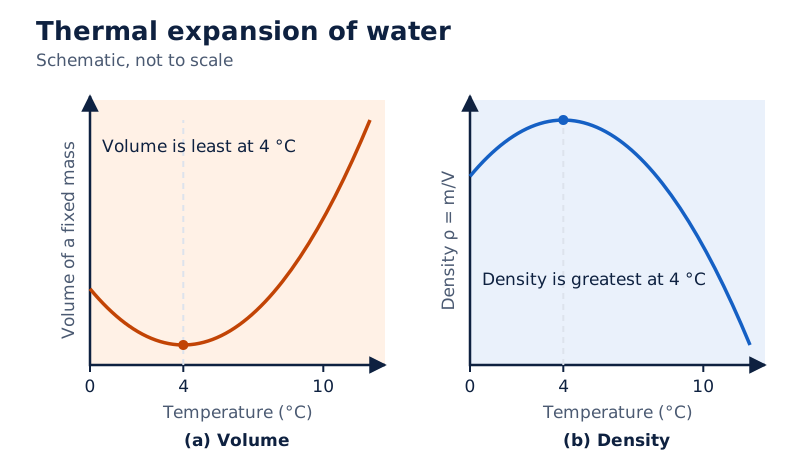
Two graphs plot volume and density against temperature. The volume curve falls to a minimum at 4 °C and then rises. The density curve rises to a maximum at 4 °C and then falls.
Drawn by One Young India.
How does this affect freezing lakes?
- Surface water loses energy to the colder atmosphere. As it cools towards 4 °C, it becomes denser and sinks.
- Warmer, less dense water from below rises, permitting further transfer of energy to the atmosphere.
- Once surface water cools below 4 °C, it becomes less dense instead of denser. It therefore remains near the surface.
- This surface water freezes first. The lake’s freezing begins at the top, which helps protect aquatic animal and plant life below.
What do heat capacity and specific heat capacity measure?
The heat needed for a temperature change depends on the substance’s mass, the temperature change and the nature of the material. Equal heat inputs into equal masses of different substances do not generally produce equal temperature rises.
Definition: Heat capacity S is heat supplied per unit temperature rise of a body: S = ΔQ/ΔT, where ΔQ is transferred heat in joules. The SI unit of heat capacity is J K⁻¹.
Specific heat capacity s is heat required per unit mass per unit temperature rise without a change of state. Thus s = ΔQ/(mΔT) and ΔQ = msΔT. The SI unit of specific heat capacity is J kg⁻¹ K⁻¹.
The value of s depends on the substance and its temperature. Treating it as constant in a numerical problem is an approximation over the stated temperature range. Heat capacity depends on how much material is present, whereas specific heat capacity is defined per unit mass.
How is heat capacity expressed per mole?
Molar heat capacity C is heat supplied per mole per unit temperature rise: C = ΔQ/(nΔT). The SI unit of molar heat capacity is J mol⁻¹ K⁻¹. For gases, the pressure or volume condition must also be specified.
Cₚ denotes molar heat capacity at constant pressure; Cᵥ denotes molar heat capacity at constant volume. These specify different heating conditions. They should not be confused with S, which refers to the whole body, or s, which refers to unit mass.
| Quantity | Meaning | Unit |
|---|---|---|
| Heat capacity S | Heat per unit temperature rise of the body | J K⁻¹ |
| Specific heat capacity s | Heat per unit mass per unit temperature rise | J kg⁻¹ K⁻¹ |
| Molar heat capacity C | Heat per mole per unit temperature rise | J mol⁻¹ K⁻¹ |
Water’s high specific heat capacity makes it useful in automobile radiators and hot-water bags. It can absorb or release considerable heat for a relatively small temperature change. This property also helps explain why large bodies of water warm more slowly than land.
How does calorimetry determine an unknown heat capacity?
Calorimetry means measurement of heat. Its working principle is that heat lost by hotter parts equals heat gained by colder parts, provided no heat escapes to or enters from the surroundings. The final mixture reaches a common temperature.
A calorimeter is a vessel used for this measurement. A metal vessel and stirrer may be surrounded by an insulating jacket containing material such as glass wool. A thermometer measures temperature. The insulation reduces heat exchange with the surroundings.
How should a heat balance be written?
- Identify every body losing heat and every body gaining heat, including the calorimeter when its heat capacity matters.
- Write each temperature fall or rise as a positive difference appropriate to that body.
- Use mass × specific heat capacity × temperature change for each part undergoing no change of state.
- Equate total heat lost to total heat gained and solve for the unknown quantity. Check that the final temperature is consistent with the process.
Worked example 2. A 0.047 kg aluminium sphere at 100 °C enters a 0.14 kg copper calorimeter containing 0.25 kg water at 20 °C. The final temperature is 23 °C. Find aluminium’s specific heat capacity, neglecting heat exchange with the surroundings.
Given: water’s specific heat capacity sᵥ = 4.18 × 10³ J kg⁻¹ K⁻¹ and copper’s s꜀ = 0.386 × 10³ J kg⁻¹ K⁻¹. Write sₐ for aluminium’s unknown specific heat capacity.
Formula: Qₗ = 0.047sₐ(100 − 23); Q𝓰 = (0.25sᵥ + 0.14s꜀)(23 − 20), where Qₗ and Q𝓰 are the heat lost and gained in joules.
Substitute: 0.047 × sₐ × 77 = (0.25 × 4180 + 0.14 × 386) × 3.
Answer: sₐ = 0.911 kJ kg⁻¹ K⁻¹, where 1 kJ = 1000 J.
Ignoring the copper vessel would omit a body that also warms from 20 °C to 23 °C. The vessel and water have the same temperature rise, but their heat gains differ because their masses and specific heat capacities differ.
What happens during changes of state?
Matter normally exists as solid, liquid or gas. A change of state is a transition between these forms. Melting, also called fusion, changes solid to liquid; freezing changes liquid to solid. Vaporisation changes liquid to vapour, and condensation changes vapour to liquid.
At the melting point, solid and liquid can coexist in thermal equilibrium, meaning they have the same temperature with no net heat flow between them. At the boiling point, liquid and vapour coexist. These temperatures depend on pressure.
During melting or boiling at fixed pressure, supplied heat changes the state while the temperature remains constant until the transformation is complete. After all the ice melts, further heating raises the water’s temperature until boiling begins.
What is specific latent heat?
Specific latent heat L is heat transferred per unit mass during a change of state at the same temperature and pressure. Thus Q = mL, where Q is the heat transferred. The SI unit of specific latent heat is J kg⁻¹.
Lꜰ denotes specific latent heat of fusion, and Lᵥ denotes specific latent heat of vaporisation. Their values depend on the substance and pressure and are usually quoted at standard atmospheric pressure. They are different from specific heat capacity because the temperature does not change.
What the figure shows
Heating water through changes of state
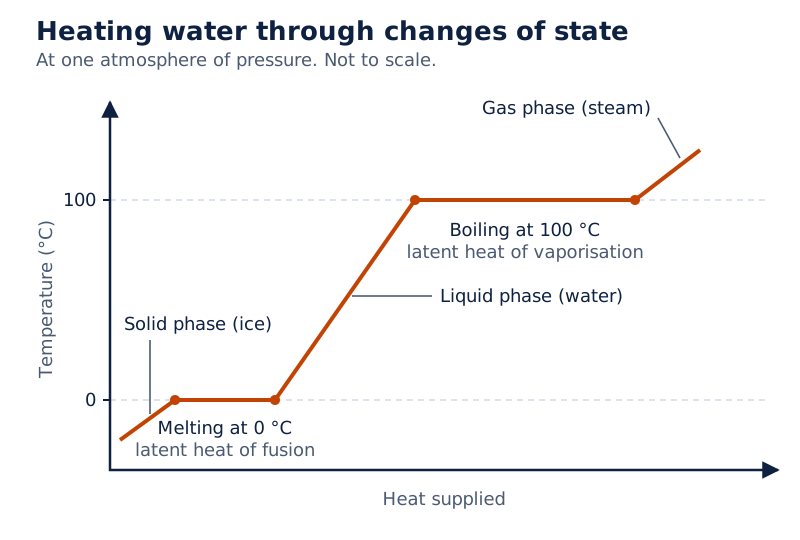
Temperature is plotted vertically and supplied heat horizontally. Sloping portions show solid ice, liquid water and gaseous steam. Horizontal portions at 0 °C and 100 °C show melting and boiling at one atmosphere of pressure; the graph is not to scale.
Drawn by One Young India.
The different slopes show that the specific heat capacities of the different states are not equal.
Worked example 3. Mix 0.15 kg ice at 0 °C with 0.30 kg water at 50 °C. The final temperature is 6.7 °C. Find Lꜰ, taking water’s specific heat capacity as 4186 J kg⁻¹ K⁻¹ and neglecting the container’s heat capacity and external heat exchange.
Formula: Qₗ = 0.30 × 4186 × (50 − 6.7); Q𝓰 = 0.15Lꜰ + 0.15 × 4186 × 6.7.
Substitute: 54376.14 = 0.15Lꜰ + 4206.93.
Answer: Lꜰ ≈ 334000 J kg⁻¹ (3.34 × 10⁵ J kg⁻¹). The melted ice must also warm to the final temperature.
Increasing pressure raises water’s boiling point; reduced pressure lowers it. This explains faster cooking in a pressure cooker and slower cooking at high altitude. Sublimation changes solid directly into vapour, as with dry ice and iodine.
How are calculations with several heating stages organised?
A process may contain both temperature changes and changes of state. Separate it into stages before calculating the total heat. Within a single state use Q = msΔT; during a transition at fixed temperature use Q = mL.
Do not use one temperature difference to represent melting and boiling as well as warming. A temperature interval measures warming within a state, while latent heat accounts for a transition that occurs without a temperature rise.
Worked example 4. Convert 3 kg ice at −12 °C into steam at 100 °C at atmospheric pressure. Take ice’s specific heat capacity as 2100 J kg⁻¹ K⁻¹, water’s as 4186 J kg⁻¹ K⁻¹, Lꜰ = 3.35 × 10⁵ J kg⁻¹ and Lᵥ = 2.256 × 10⁶ J kg⁻¹. Ignore the vessel’s heat capacity and external losses.
Formula: Q₁ = msᵢΔT₁; Q₂ = mLꜰ; Q₃ = msᵥΔT₃; Q₄ = mLᵥ. Here Q₁ to Q₄ denote the successive heat inputs, sᵢ and sᵥ the specific heat capacities of ice and water, and ΔT₁ and ΔT₃ their warming intervals.
Substitute: Q₁ = 3 × 2100 × 12 = 75600 J; Q₂ = 3 × 3.35 × 10⁵ = 1005000 J.
Then Q₃ = 3 × 4186 × 100 = 1255800 J; Q₄ = 3 × 2.256 × 10⁶ = 6768000 J.
Answer: Total Q = Q₁ + Q₂ + Q₃ + Q₄ ≈ 9100000 J (9.1 × 10⁶ J).
Why does steam transfer so much energy?
The vaporisation stage requires much more heat than the fusion stage for the data given. Steam condensing on contact can therefore transfer considerable additional energy. Burns from steam are usually more serious than those from boiling water at the same temperature.
How does conduction transfer heat through a material?
Conduction transfers heat between neighbouring parts because of a temperature difference, without bulk flow of matter. A metal rod heated at one end becomes hot farther along as energy passes through its material. Metals are generally good thermal conductors; gases are poor conductors.
Consider a uniform bar whose sides are insulated and whose ends remain at fixed temperatures Tₕ and T꜀, with Tₕ higher. In the steady state, each point’s temperature remains constant with time, although different points have different temperatures.
Let H be heat current, meaning heat transferred per unit time, A the cross-sectional area, ℓ the bar’s length and κ its thermal conductivity. Then H = κA(Tₕ − T꜀)/ℓ. The SI unit of heat current is the watt, symbol W; 1 W = 1 J s⁻¹, where s is the unit symbol for second.
Temperature gradient is temperature change per unit distance. Its magnitude in this uniform bar is (Tₕ − T꜀)/ℓ, measured in K m⁻¹. The SI unit of thermal conductivity is W m⁻¹ K⁻¹. Greater conductivity means greater heat current for the same geometry and temperature difference.
How are joined rods analysed?
In steady state, joined rods with insulated sides carry equal heat currents. If the currents differed, their junction would accumulate or lose energy and its temperature would change. Equality of currents determines the junction temperature.
Worked example 5. A steel rod 15.0 cm long joins a copper rod 10.0 cm long. The steel’s free end is at 300 °C and the copper’s at 0 °C. Steel has twice the copper’s cross-sectional area. Find the steady junction temperature with insulated sides.
Given: thermal conductivities are 50.2 W m⁻¹ K⁻¹ for steel and 385 W m⁻¹ K⁻¹ for copper. Let θ be the junction’s Celsius temperature and A꜀ the copper’s cross-sectional area in m².
Formula: Hₛ = 50.2(2A꜀)(300 − θ)/0.150; H꜀ = 385A꜀θ/0.100, where Hₛ and H꜀ are the steel and copper heat currents.
Substitute: equate Hₛ and H꜀ and cancel A꜀, giving 50.2 × 2(300 − θ)/0.150 = 385θ/0.100.
Answer: θ = 44.4 °C.
Copper-coated cooking pots distribute heat effectively. Plastic foams insulate mainly because they contain trapped air. Conductivity values vary slightly with temperature, but can be treated as constant over a normal temperature range.
How does Searle’s experiment measure thermal conductivity?
Searle’s experiment determines the thermal conductivity of a good conductor by comparing conduction through a rod with heat gained by cooling water. Steam heats one end of a metal rod; a flowing-water arrangement cools the other. Insulation reduces heat loss from its sides.
Two thermometers measure rod temperatures θ₁ and θ₂ at points separated by distance x. Let A be the rod’s cross-sectional area and κ its conductivity. At steady state, the conducted heat current is κA(θ₁ − θ₂)/x.
What readings and calculations are needed?
- Keep the steam supply and cooling-water flow steady. Wait until the thermometer readings remain constant so that the rod is no longer storing additional energy.
- Measure the rod temperatures θ₁ and θ₂, their separation x and the cross-sectional area A. Measure cooling-water inlet temperature θᵢ and outlet temperature θₒ.
- Collect cooling water of mass mᵥ during a measured time τ. If its specific heat capacity is sᵥ, its heat gain per unit time is mᵥsᵥ(θₒ − θᵢ)/τ.
- Equate this rate to the heat conducted between the rod thermometers, assuming negligible heat leakage and steady conditions.
κ = mᵥsᵥ(θₒ − θᵢ)x/[Aτ(θ₁ − θ₂)]. Use mᵥ in kg, sᵥ in J kg⁻¹ K⁻¹, x in m, A in m² and τ in seconds. Temperature differences may be in kelvin or degrees Celsius.
Draw and label
Searle’s apparatus
Draw a lagged metal rod, meaning a rod wrapped in thermal insulation. Show steam heating one end, water cooling the other, two rod thermometers separated by x, and inlet and outlet water thermometers.
Experimental precautions follow from the heat balance: insulate the rod, maintain steady water flow, wait for stable temperatures and measure collected water mass and collection time carefully. Heat escaping sideways would invalidate the simple equality of the two heat currents.
How do convection and radiation transfer heat?
Convection transfers heat through actual bulk motion of a fluid, meaning a liquid or gas. In natural convection, fluid heated from below expands, becomes less dense and rises because of buoyancy, the upward force exerted by surrounding fluid. Cooler fluid replaces it.
Repeated rising and replacement establish circulation. In forced convection, a pump or another device drives the flow. Automobile cooling systems and blood circulation provide examples; the heart acts as a pump carrying heat with circulating blood.
Why do coastal breezes reverse?
During the day, land warms faster than water. Air touching the warm land gains heat by conduction, expands and rises. Cooler air moves in from the sea, forming a sea breeze. Mixing and water’s high specific heat capacity help keep the water cooler.
At night, land loses heat faster and the water surface becomes warmer than the land. The circulation reverses. The explanation combines heat capacity differences, contact heating and convection; these describe different parts of the same process.
| Mode | How energy travels | Material requirement |
|---|---|---|
| Conduction | Between neighbouring parts without bulk flow | Material medium needed |
| Convection | With bulk movement of matter | Fluid needed |
| Radiation | By electromagnetic waves | Can travel through vacuum |
What is thermal radiation?
Thermal radiation is electromagnetic radiation emitted because of a body’s temperature. Electromagnetic waves carry energy through oscillating electric and magnetic fields. They do not require a material medium, explaining energy transfer from the Sun through space.
A thermos flask reduces all three modes. The evacuated gap reduces conduction and convection. Silvered walls reflect radiation, while an insulating support reduces heat flow through the support. These measures reduce heat exchange for both hot and cold contents.
What do radiation laws and Newton’s cooling law describe?
An ideal radiator, also called a black body or cavity radiator, absorbs all incident radiation and represents the ideal limit of thermal emission. A cavity with a small opening provides a practical approximation: radiation entering the opening undergoes repeated internal reflections and absorption.
Spectral radiancy R(λ) is emitted power per unit surface area per unit wavelength interval. Here λ is wavelength in metres, the distance between successive corresponding points of a wave. The unit of R(λ) is W m⁻³ when wavelength is measured in metres.
The area under a graph of R(λ) against λ gives total radiant power per unit area I(T), measured in W m⁻²: I(T) = ∫₀∞ R(λ)dλ. The integral means summing contributions over all wavelengths. The spectrum is continuous, with a peak rather than a single emitted wavelength.
What the figure shows
Radiation spectra
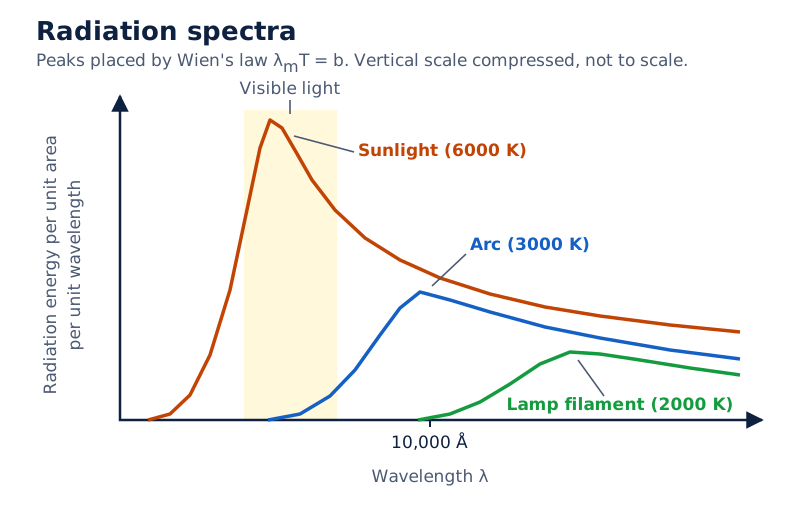
Curves of radiation energy per unit wavelength against wavelength are labelled sunlight at 6000 K, arc at 3000 K and lamp filament at 2000 K. The higher-temperature curves have higher peaks at shorter wavelengths; visible light is marked near the short-wavelength region.
Drawn by One Young India.
What do Wien’s and Stefan-Boltzmann laws state?
Wien’s displacement law gives λₘT = b, where λₘ is the wavelength of maximum spectral radiancy and b is Wien’s constant, 2.9 × 10⁻³ m K. Increasing temperature shifts the maximum towards shorter wavelengths.
The Stefan-Boltzmann law gives I(T) = σT⁴ for an ideal radiator. Here σ is the Stefan-Boltzmann constant, 5.67 × 10⁻⁸ W m⁻² K⁻⁴. Its dimensions are [M T⁻³ Θ⁻⁴], where M denotes mass, T inside dimensional brackets denotes time, and Θ denotes temperature.
For a practical radiator, I(T) = eσT⁴. Emissivity e is the dimensionless fraction of ideal emission at the same temperature; e = 1 for an ideal radiator. A surface of area A emits total power H = AeσT⁴.
Worked example 6. A tungsten lamp has surface area 0.3 cm², temperature 3000 K and emissivity about 0.4. Calculate its emitted radiant power using σ = 5.67 × 10⁻⁸ W m⁻² K⁻⁴.
Formula: H = AeσT⁴. Substitute: A = 0.3 × 10⁻⁴ m², so H = 0.3 × 10⁻⁴ × 0.4 × 5.67 × 10⁻⁸ × 3000⁴.
Answer: H ≈ 60 W to one significant figure. This is emitted power; surrounding radiation has not been subtracted.
If the surroundings have absolute temperature Tₛ, the net outward radiant power is Hₙ = eσA(T⁴ − Tₛ⁴), where Hₙ denotes net power loss. At equal temperatures, emission and absorption balance even though radiation continues.
When does Newton’s law of cooling apply?
Newton’s law of cooling states that heat-loss rate is proportional to temperature excess over the surroundings for small temperature differences. Write Hₗ = k(Tᵦ − Tₛ), where Hₗ is positive heat-loss rate, Tᵦ body temperature and k a positive constant in W K⁻¹ depending on exposed area and surface nature.
For a body of mass m and constant specific heat capacity s, −dTᵦ/dt = [k/(ms)](Tᵦ − Tₛ). Here t is time, and dTᵦ/dt means instantaneous temperature change per unit time. The minus sign represents falling temperature.
With surroundings held at constant temperature, greater temperature excess gives faster cooling. The cooling curve becomes less steep as the body approaches its surroundings’ temperature. For small differences, this proportionality can approximate conduction, convection and radiation combined.
What the figure shows
Cooling curve
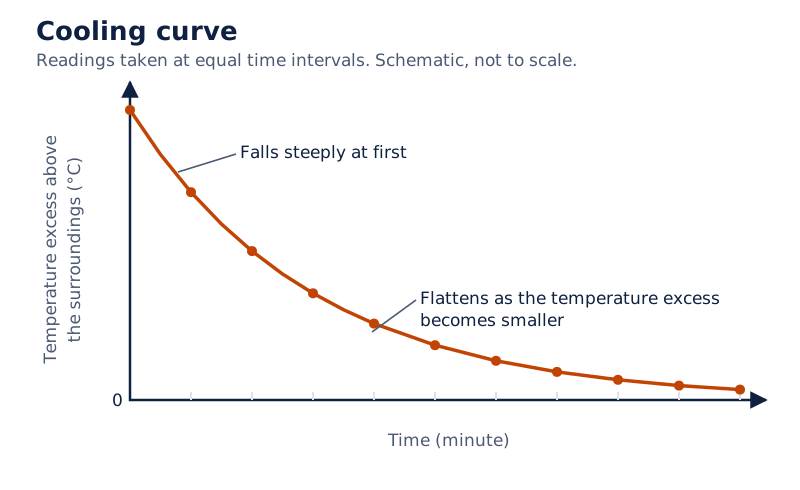
Temperature excess above the surroundings is plotted vertically against time in minutes. The curve falls steeply at first and gradually flattens as the temperature excess becomes smaller.
Drawn by One Young India.
To study cooling, record the body’s temperature at equal time intervals while also measuring the surrounding temperature. Plot the temperature excess against time. The successive temperature falls become smaller as the body approaches the surrounding temperature.
Glossary
- Heat — Energy transferred between bodies or systems because of a difference in temperature.
- Temperature — Measure of relative hotness or coldness that determines the direction of heat transfer.
- Thermometric property — Measurable property that varies with temperature and can be used in a thermometer.
- Thermal expansion — Increase in a body’s dimensions caused by an increase in its temperature.
- Anomalous expansion — Water’s unusual increase in volume when cooled from 4 °C towards 0 °C.
- Specific heat capacity — Heat needed per unit mass per unit temperature rise without changing the substance’s state.
- Calorimetry — Measurement of heat using temperature changes and, where relevant, changes of state.
- Specific latent heat — Heat transferred per unit mass during a change of state at unchanged temperature and pressure.
- Steady state — Condition in which each point’s temperature remains constant with time despite continuing heat flow.
- Thermal conductivity — Material property linking conductive heat current to cross-sectional area and temperature gradient.
- Convection — Heat transfer through actual bulk movement of matter within a liquid or gas.
- Emissivity — Dimensionless ratio of a surface’s emission to ideal emission at the same temperature.
- Spectral radiancy — Radiant power emitted per unit surface area per unit wavelength interval.
Common errors and misconceptions
- Misconception: Heat and temperature are interchangeable. Correct: Heat is transferred energy, measured in joules; temperature measures hotness or coldness, with kelvin as its SI unit.
- Misconception: Celsius readings can be used directly in radiation laws. Correct: Use absolute temperature in kelvin for Wien’s and Stefan-Boltzmann laws and the ideal gas equation.
- Misconception: Every substance expands whenever heated. Correct: Most substances expand; water contracts when heated from 0 °C to 4 °C.
- Misconception: Melting ice rises in temperature as it absorbs heat. Correct: During melting at fixed pressure, heat changes the state while the temperature remains constant.
- Misconception: The calorimeter can always be ignored. Correct: Include its heat gain unless its heat capacity is explicitly neglected or already accounted for.
- Misconception: Steady conduction means the entire rod has one temperature. Correct: Temperature varies along the rod, but each point’s temperature is constant with time.
- Misconception: Newton’s cooling law is exact for every temperature difference. Correct: It is a small-temperature-difference approximation, with surface and surrounding conditions maintained.
Exam-style questions with model answers
Q1. Distinguish heat from temperature and state their SI units. [2 marks]
- Heat is energy transferred because of a temperature difference between bodies or systems. Its SI unit is the joule, J.
- Temperature measures relative hotness or coldness and determines heat-flow direction. Its SI unit is the kelvin, K.
Q2. Derive the approximate relation between volume expansivity αᵥ and linear expansivity αₗ for a solid expanding equally in all directions. State the approximation. [3 marks]
- Take a cube of initial side l and volume V = l³. For temperature rise ΔT, its side increases by Δl = αₗlΔT, where Δl denotes the small increase in length.
- The volume increase is ΔV = (l + Δl)³ − l³ ≈ 3l²Δl. This neglects terms containing (Δl)² and (Δl)³ because Δl is small compared with l.
- Dividing by V gives ΔV/V ≈ 3Δl/l = 3αₗΔT. Since αᵥ = ΔV/(VΔT), the required relation is αᵥ ≈ 3αₗ.
Q3. Explain why a lake freezes first at its surface, using water’s density changes around 4 °C. [3 marks]
- As surface water cools towards 4 °C, its density increases. It sinks, and warmer, less dense water rises to replace it, allowing continued cooling at the surface.
- Water has maximum density at 4 °C. Further cooling below this temperature makes surface water less dense, so it remains above the denser water beneath.
- The surface layer therefore reaches its freezing point first and freezes at the top. This pattern helps protect aquatic organisms in the water below.
Q4. A 0.047 kg aluminium sphere at 100 °C is transferred into a 0.14 kg copper calorimeter containing 0.25 kg water at 20 °C. The final temperature is 23 °C. Find aluminium’s specific heat capacity. Use water’s value 4180 J kg⁻¹ K⁻¹ and copper’s 386 J kg⁻¹ K⁻¹; neglect heat exchange with the surroundings. [4 marks]
- Let sₐ denote aluminium’s unknown specific heat capacity. The sphere cools through 100 − 23 = 77 K, so its heat loss is 0.047 × sₐ × 77 joules.
- Water and the calorimeter each warm through 23 − 20 = 3 K. Their combined heat gain is (0.25 × 4180 + 0.14 × 386) × 3 joules.
- Equating heat lost and heat gained gives 0.047 × sₐ × 77 = (0.25 × 4180 + 0.14 × 386) × 3.
- Solving gives sₐ ≈ 911 J kg⁻¹ K⁻¹, or 0.911 kJ kg⁻¹ K⁻¹. The copper vessel’s heat gain is included.
Q5. Calculate the heat needed to convert 3 kg ice at −12 °C into steam at 100 °C at atmospheric pressure. Use specific heat capacities 2100 J kg⁻¹ K⁻¹ for ice and 4186 J kg⁻¹ K⁻¹ for water, specific latent heat of fusion 3.35 × 10⁵ J kg⁻¹, and specific latent heat of vaporisation 2.256 × 10⁶ J kg⁻¹. Neglect the vessel’s heat capacity and heat loss. [5 marks]
- First warm the ice from −12 °C to 0 °C. Calling this heat Q₁, use mass × specific heat capacity × temperature rise: Q₁ = 3 × 2100 × 12 = 75600 J.
- Next melt the ice at 0 °C without changing its temperature. This heat is Q₂ = 3 × 3.35 × 10⁵ = 1005000 J.
- Warm the resulting water from 0 °C to 100 °C. This heat is Q₃ = 3 × 4186 × 100 = 1255800 J.
- Convert the water at 100 °C into steam at the same temperature. The vaporisation heat is Q₄ = 3 × 2.256 × 10⁶ = 6768000 J.
- Add the four successive heat inputs: total Q = Q₁ + Q₂ + Q₃ + Q₄ ≈ 9.1 × 10⁶ J. Both warming and both phase-change stages are required.
Q6. Describe Searle’s experiment for a good conductor. Explain its heat balance and give the conductivity formula, defining the quantities used. [5 marks]
- Heat one end of an insulated metal rod with steam and cool the other using flowing water. Wait until the temperature readings remain constant, establishing steady conditions.
- Measure rod temperatures θ₁ and θ₂ at separation x, and its cross-sectional area A. If κ is thermal conductivity, the conducted heat current is κA(θ₁ − θ₂)/x.
- Measure water inlet and outlet temperatures θᵢ and θₒ. Collect water mass mᵥ in time τ. With water specific heat capacity sᵥ, its heat-gain rate is mᵥsᵥ(θₒ − θᵢ)/τ.
- At steady state, neglecting heat leakage, equate the conducted heat current to the water’s heat-gain rate. The rod then stores no additional energy.
- Rearrange to obtain κ = mᵥsᵥ(θₒ − θᵢ)x/[Aτ(θ₁ − θ₂)]. Consistent SI quantities give κ in W m⁻¹ K⁻¹; insulation and stable flow support the assumed heat balance.
Q7. State Wien’s displacement law and the Stefan-Boltzmann law for an ideal radiator, defining their symbols. Describe how its spectrum changes when temperature rises. [4 marks]
- Wien’s law is λₘT = b, where λₘ is wavelength of maximum spectral radiancy, T is absolute temperature and b is Wien’s displacement constant.
- The Stefan-Boltzmann law is I(T) = σT⁴, where I(T) is total emitted radiant power per unit surface area and σ is the Stefan-Boltzmann constant.
- As temperature rises, λₘ decreases. The peak of the continuous radiation spectrum therefore shifts towards shorter wavelengths.
- The area under the spectral-radiancy curve increases because it equals I(T). Thus the total power emitted per unit area increases with absolute temperature to the fourth power.
Q8. State Newton’s law of cooling and its temperature-difference condition. [2 marks]
- For fixed surface conditions, a body’s heat-loss rate is proportional to its temperature excess above the surroundings.
- The relation applies for small temperature differences; it should not be treated as an exact law for arbitrarily large differences.
Key takeaways
- Heat is energy transferred because of temperature difference; temperature identifies relative hotness and determines the direction of heat flow.
- Use absolute temperature in gas and radiation laws, while equal temperature differences have equal numerical values in Celsius and kelvin.
- Most substances expand on heating; water contracts between 0 °C and 4 °C and has maximum density at 4 °C.
- Heat-capacity calculations describe temperature changes, while specific latent heat describes energy transferred during a change of state.
- Calorimetry balances total heat lost against total heat gained, including the vessel when its heat capacity matters.
- Steady conduction maintains a temperature gradient while each point’s temperature remains constant with time and heat continues to flow.
- Convection transports matter within fluids; radiation transfers energy electromagnetically and can cross a vacuum without a material medium.
- Wien’s law describes the spectrum’s peak, Stefan-Boltzmann describes total emission, and Newton’s cooling law applies to small temperature differences.
Test yourself
Why is touch unsuitable for precise temperature measurement?
The temperature sense is somewhat unreliable and has too limited a range for scientific measurement.
What must remain constant for Boyle’s law to apply?
The gas temperature and amount must remain constant while pressure and volume change.
What happens to water’s volume when it cools from 4 °C towards 0 °C?
Its volume increases and its density decreases, which is its anomalous expansion behaviour.
Why can melting ice absorb heat without becoming warmer?
The supplied energy changes its state from solid to liquid at the melting temperature.
What distinguishes steady state from uniform temperature?
Steady state means each point’s temperature is constant with time; temperatures at different points may differ.
Why does a thermos flask use both a vacuum gap and silvered walls?
The gap reduces conduction and convection, while the silvered surfaces reduce radiation transfer by reflection.
How does the peak wavelength change as an ideal radiator becomes hotter?
It decreases because peak wavelength multiplied by absolute temperature remains constant in Wien’s law.
Why does a cooling curve flatten as the body approaches room temperature?
The temperature excess decreases, so the heat-loss rate decreases under Newton’s cooling approximation.
Write about it
Turn a question from this chapter into a paper.
The Writing Studio has a structure guide, a rubric and citation tools for 15 formats, from essays to research papers. Drafting is free with an account. Learnacy Essential adds feedback from an AI writing coach and submission to The OYI Review.
Learnacy Essential is ₹1,499 for the year. Publication depends on review and is not guaranteed.