
Waves | ISC Class 11 Physics Notes
On this page

This note covers mechanical waves, transverse and longitudinal motion, wave quantities and graphs, progressive-wave equations, wave speed, sound propagation, Newton’s formula and Laplace’s correction, superposition, reflection, standing waves, stretched strings, the sonometer, organ pipes, harmonics, overtones and beats.
What travels in a wave, and how do transverse and longitudinal waves differ?
Definition: A mechanical wave is a disturbance that propagates through a material medium by the interaction of its particles, transferring energy without carrying the medium as a whole from one place to another.
A medium is the material through which the disturbance travels. Its particles oscillate, meaning that they move repeatedly about equilibrium positions. An equilibrium position is the undisturbed position about which a particle moves.
Neighbouring particles influence one another through elastic restoring forces, which oppose deformation and tend to restore the original arrangement. A disturbance at one point therefore affects adjacent regions. Mechanical waves require a medium and cannot propagate through a vacuum.
How are the two directions compared?
| Feature | Transverse wave | Longitudinal wave |
|---|---|---|
| Particle oscillation | Perpendicular to wave propagation | Parallel to wave propagation |
| Example | Wave on a stretched string | Sound travelling through air |
| Disturbance | Sideways displacement relative to propagation | Successive compressions and rarefactions |
| Elastic response in bulk material | Requires resistance to shearing deformation | Requires resistance to compression |
A compression is a region of greater pressure and density than the undisturbed medium. A rarefaction has lower pressure and density. Density means mass per unit volume; pressure means force per unit area.
In air, a vibrating source repeatedly compresses and releases nearby air. Pressure differences disturb the next region, so compressions and rarefactions advance. Individual air elements move backwards and forwards; sound propagation is not a wind carrying the air bodily forwards.
Solids can support both kinds of elastic wave. Fluids, meaning liquids and gases, cannot sustain the shearing stress required for transverse waves within their bulk. They can support longitudinal waves. Generally, transverse and longitudinal waves have different speeds in the same medium.
Note: Water-surface waves involve both upward-and-downward and backward-and-forward particle motion. Do not classify all water waves as purely transverse or apply the restriction on bulk fluids directly to their free surfaces.
Which quantities describe a harmonic wave, and how are its graphs read?
A progressive wave travels from one region to another. A harmonic or sinusoidal wave has a disturbance described by a sine or cosine function. At a fixed position, its particles execute simple harmonic motion: acceleration is proportional and opposite to displacement.
Let x denote position along propagation, t elapsed time, and y particle displacement from equilibrium. Displacement has a sign indicating direction. Let A be amplitude, the maximum magnitude of displacement. Position, displacement and amplitude have dimensions of length.
Dimensional notation uses M for mass, L for length and T for time inside square brackets. These dimensional symbols are distinct from quantities outside brackets. Elapsed time t has unit s and dimensions [T]. SI means the International System of Units.
| Quantity and meaning | SI unit | Dimensions |
|---|---|---|
| x, y and A: position, displacement and amplitude | Metre, m | [L] |
| T: time period, the time for one complete oscillation | Second, s | [T] |
| f: frequency, the number of complete oscillations per second | Hertz, Hz | [T⁻¹] |
| λ: wavelength, the shortest separation of equal-phase points at one instant | Metre, m | [L] |
| v: wave speed, the distance travelled by the pattern per unit time | Metre per second, m s⁻¹ | [LT⁻¹] |
Phase specifies the stage of an oscillation. Equal-phase points are at the same stage of their cycles. A crest is a maximum positive displacement; a trough is a maximum negative displacement.
f = 1/T
The SI unit of frequency is hertz: 1 Hz = 1 s⁻¹. The SI unit of wavelength is metre. The SI unit of amplitude is metre. The SI unit of time period is second. The SI unit of wave speed is metre per second.
What must the horizontal axis show?
A displacement-position graph is a snapshot at one instant. Consecutive crests are separated horizontally by λ. A displacement-time graph follows one particle; corresponding points in successive cycles are separated horizontally by T. Both graphs show amplitude vertically.
What the figure shows
Displacement against time
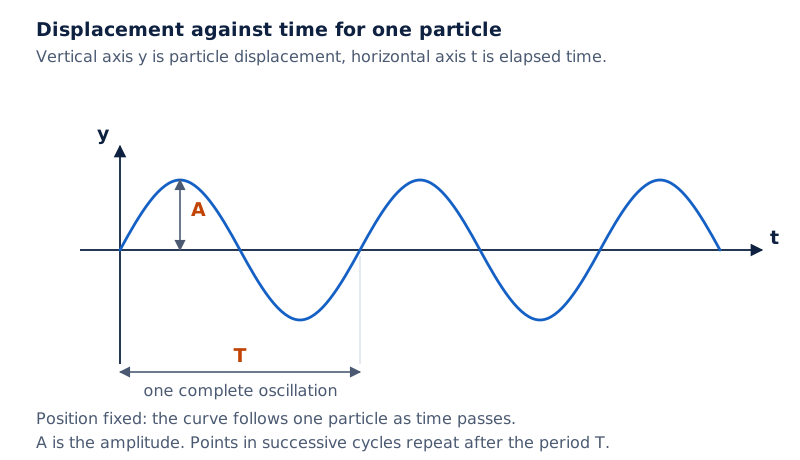
The sinusoidal curve has y on the vertical axis and t on the horizontal axis. A vertical arrow labelled a marks amplitude, while a horizontal interval labelled T below the curve marks one period. The figure’s a corresponds to A here.
Drawn by One Young India.
Diagram
Displacement against position
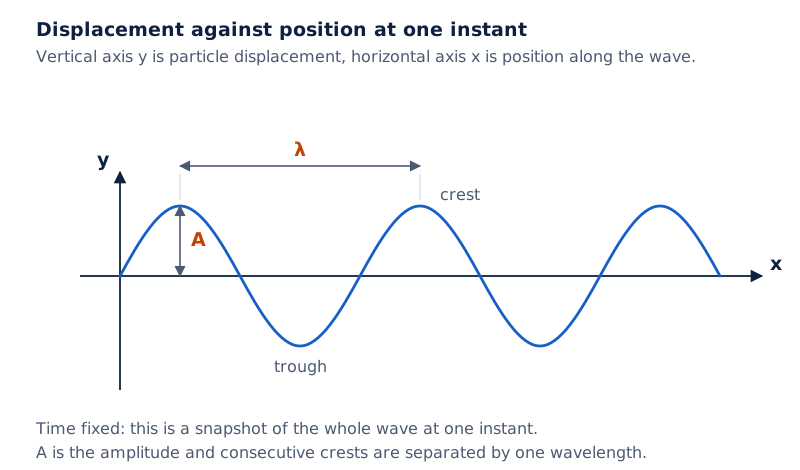
Draw a sinusoidal snapshot with vertical axis y and horizontal axis x. Mark A from the equilibrium line to a crest and λ horizontally between consecutive crests. State that time is fixed.
Drawn by One Young India.
How does a progressive-wave equation give its direction and speed?
Define k as angular wave number or propagation constant, measuring phase change per unit distance. Define ω as angular frequency, measuring phase change per unit time. The constant π is the ratio of a circle’s circumference to its diameter.
k = 2π/λ
ω = 2πf
The units of k and ω are radian per metre, rad m⁻¹, and radian per second, rad s⁻¹. A radian measures angle by arc length divided by radius. Angles are dimensionless, so k has dimensions [L⁻¹] and ω has [T⁻¹].
The initial phase, φ, is the phase at x = 0 and t = 0; it is measured in radians and is dimensionless. A wave travelling along increasing x has the displacement relation:
y = A sin(kx − ωt + φ)
The full sine argument is the phase. A fixed-phase point must move towards increasing x as t increases. Replacing −ωt by +ωt gives propagation towards decreasing x, with k and ω taken positive. Choosing suitable origins can make φ zero.
Derivation: How is v = fλ obtained?
- Follow a crest, or any point of constant phase, in the positive-direction wave. Its phase kx − ωt + φ remains unchanged as it moves.
- Let Δx be its position change in a time interval Δt; Δ means a change. Constant phase requires kΔx − ωΔt = 0.
- Divide to obtain v = Δx/Δt = ω/k. Substitute ω = 2πf and k = 2π/λ.
v = fλ
Equivalently, v = λ/T: the wave advances one wavelength during one particle oscillation. This is the speed of the pattern. It is not the instantaneous velocity of a particle oscillating about equilibrium.
Worked example 1. A string wave obeys y = 0.005 sin(80.0x − 3.0t), with x and y in metres and t in seconds. Find its amplitude, wavelength, period and frequency.
Formula: λ = 2π/k; T = 2π/ω; f = 1/T.
Substitute: A = 0.005 m, k = 80.0 rad m⁻¹ and ω = 3.0 rad s⁻¹.
Answer: A = 5 mm; λ = 7.85 cm; T = 2.09 s; f = 0.48 Hz. Here mm means millimetre and cm means centimetre.
What determines wave speed in strings, liquids and solids?
Mechanical wave speed depends on the medium’s elasticity, its resistance to deformation, and inertia, its resistance to changes in motion. A restoring interaction transfers the disturbance, while the material’s mass affects its response.
For a stretched string, let F be the tension, the pulling force along the string. Let m be its mass and L its stretched length. Its linear mass density, μ, means mass per unit length.
μ = m/L
v = √(F/μ)
Mass is measured in kilograms, kg, with dimensions [M]; length is measured in metres, with [L]. Tension is measured in newtons, N, with [MLT⁻²]. Linear mass density has unit kg m⁻¹ and dimensions [ML⁻¹].
At constant μ, increasing tension increases speed. At constant tension, greater linear mass density decreases speed. For this ideal string model, speed does not depend on frequency; the source fixes frequency and λ = v/f then fixes wavelength.
Worked example 2. A steel wire has length 0.72 m, mass 5.0 × 10⁻³ kg and tension 60 N. Find the speed of transverse waves.
Formula: μ = m/L; v = √(F/μ).
Substitute: μ = (5.0 × 10⁻³)/0.72 = 6.9 × 10⁻³ kg m⁻¹, rounded.
Answer: v = √[60/(6.9 × 10⁻³)] = 93 m s⁻¹, to the stated precision.
How is the sound-speed formula used?
Let B be bulk modulus, the ratio of pressure increase to fractional decrease in volume. Let ρ be mass density. For sound in a fluid:
v = √(B/ρ)
The SI unit of bulk modulus is pascal, Pa, with dimensions [ML⁻¹T⁻²]. Density has unit kg m⁻³ and dimensions [ML⁻³]. For longitudinal waves along a solid bar, use v = √(Y/ρ).
Here Y is Young’s modulus, longitudinal stress divided by longitudinal strain. Stress is force per area; strain is fractional length change. Y has the same unit and dimensions as B. This bar formula applies when lateral expansion is negligible.
Liquids and solids generally have higher sound speeds than gases. Their greater resistance to compression more than compensates for their greater density. Density alone cannot determine which of two different materials transmits sound faster.
Worked example 3. An ultrasonic scanner operates at 4.2 MHz in tissue where sound speed is 1.7 km s⁻¹. Ultrasonic means frequency above 20 kHz; kHz and MHz mean 10³ and 10⁶ hertz. Find wavelength.
Formula: λ = v/f. Substitute: v = 1.7 × 10³ m s⁻¹ and f = 4.2 × 10⁶ Hz.
Answer: λ = (1.7 × 10³)/(4.2 × 10⁶) = 4.0 × 10⁻⁴ m, or 0.40 mm, approximately.
Why is Laplace’s correction needed, and what changes the speed of sound?
Newton’s formula treats the pressure changes accompanying sound in air as isothermal, meaning at constant temperature. With P denoting equilibrium gas pressure, this assumption gives B = P. Pressure has unit Pa and dimensions [ML⁻¹T⁻²].
v = √(P/ρ)
At standard temperature and pressure, meaning 0 °C (degrees Celsius) and approximately 1.01 × 10⁵ Pa here, the predicted speed is 280 m s⁻¹, about 15% below the experimental value of 331 m s⁻¹. The error lies in the assumed thermal process, rather than in the general connection between elasticity, density and speed.
What is the corrected assumption?
Laplace’s correction recognises that sound-pressure changes occur so rapidly that there is little time for heat flow to maintain constant temperature. They are treated as adiabatic, meaning without heat exchange during the change. The appropriate bulk modulus is γP.
Here γ is the dimensionless ratio Cₚ/Cᵥ. The quantities Cₚ and Cᵥ are molar heat capacities at constant pressure and constant volume: heat required per mole per unit temperature rise under the stated condition.
Both heat capacities have unit J mol⁻¹ K⁻¹. The joule, J, is the energy unit; mol denotes mole, the unit of amount of substance; K denotes kelvin, the unit of temperature. Their dimensions are energy divided by amount of substance and temperature.
v = √(γP/ρ)
For air, γ = 7/5. The corrected speed is 331.3 m s⁻¹ at standard temperature and pressure, agreeing with the measured speed. The correction increases the effective elastic modulus used in calculating the propagation speed.
Which conditions must remain fixed?
| Change | Condition | Effect on sound speed |
|---|---|---|
| Pressure changes | Same ideal gas at constant temperature | Density changes proportionally, so P/ρ and speed remain unchanged |
| Density increases | Elastic modulus kept constant | Speed decreases as the inverse square root of density |
| Temperature increases | Same ideal gas with γ effectively constant | Speed increases as the square root of absolute temperature |
| Humidity increases | Air compared at the same pressure and temperature | Speed increases; moist air has lower density than dry air |
Absolute temperature is temperature measured in kelvin. Humidity refers to water vapour in air. At fixed pressure and temperature, replacing some dry-air molecules with lighter water molecules lowers density; the usual school-level comparison treats the change in γ as negligible.
Ultrasonic describes sound frequency above 20 kHz. Supersonic describes motion faster than the local speed of sound. An aircraft can move supersonically; a high-frequency sound wave is ultrasonic. These terms compare different physical quantities and are not interchangeable.
How do superposition, interference and reflection change a wave?
Definition: The principle of superposition states that, when waves overlap, the resultant displacement at a point is the algebraic sum of the displacements that the individual waves would produce there.
Let y₁ and y₂ denote the separate particle displacements at the same position and time, each measured in metres. Their resultant displacement is:
y = y₁ + y₂
Adding algebraically means retaining signs. Positive and negative displacements may cancel. After two pulses cross, each continues to propagate with its identity retained; zero displacement during overlap does not mean that the pulses have permanently disappeared.
Why does relative phase matter?
Interference is the reinforcement or cancellation produced by superposition. For two equal-amplitude harmonic waves of the same frequency travelling in the same direction, the result depends on their relative phase, the difference between their phases.
When they are in phase, their crests and troughs coincide. Constructive interference gives a resultant amplitude twice either individual amplitude. When they are exactly opposite in phase, their equal and opposite displacements cancel: this is complete destructive interference.
Diagram
Relative phase and interference
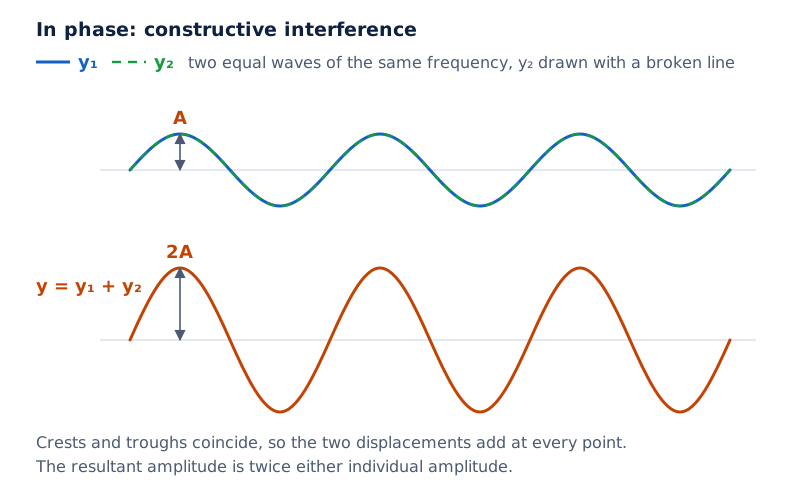
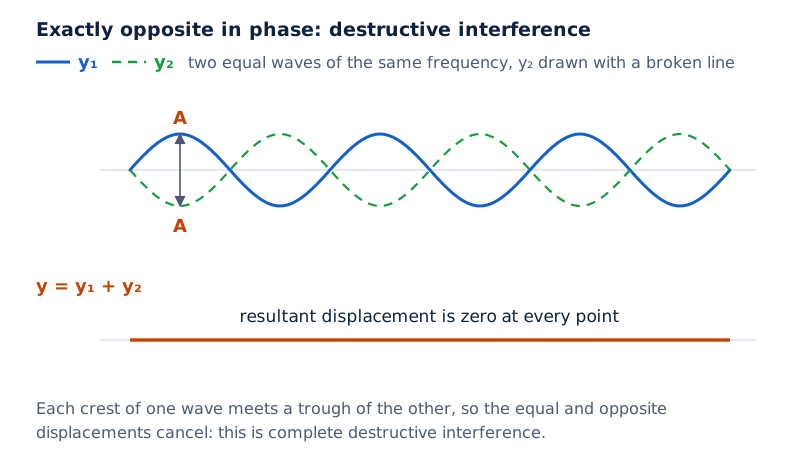
Draw two equal sinusoidal waves with matching crests, then their larger resultant. In a second set, place each crest opposite a trough and show a straight equilibrium line for the resultant. Label the separate waves and their sum.
Drawn by One Young India.
What happens at fixed and free boundaries?
Reflection is the return of a wave from a boundary. An incident wave approaches the boundary; the reflected wave travels away from it. At a rigid end of a string, displacement must remain zero.
The reflected displacement therefore reverses sign, corresponding to a phase change of π radians. At a completely free end, the reflected displacement has no phase reversal. The reflected pulse retains amplitude and shape in these ideal cases, assuming no energy loss.
A free end can be modelled by attaching the string to a ring that moves freely along a rod. At an interface between elastic media, part of a wave may be reflected and part transmitted. Boundary conditions determine the resulting motion.
Note: For sound, specify whether a reflection statement concerns particle displacement or pressure variation. At a closed pipe end, displacement is zero but pressure variation is greatest; these are different descriptions of the same wave.
How are standing waves formed, and where are their nodes and antinodes?
A standing wave, also called a stationary wave, results when equal-amplitude progressive waves of the same frequency and wavelength travel in opposite directions and superpose. Reflections at the boundaries of a string or air column can establish this pattern.
Let a be the displacement amplitude of each constituent wave, measured in metres. Take y₁ = a sin(kx − ωt) and y₂ = a sin(kx + ωt). The choice places a permanent zero-displacement point at x = 0.
Derivation: What is the stationary-wave equation?
- Apply superposition at each position and time: y = y₁ + y₂.
- Insert the two travelling-wave expressions: y = a[sin(kx − ωt) + sin(kx + ωt)].
- Use the sine-sum identity: the sum of the two sines equals 2 sin(kx) cos(ωt).
- Separate the position-dependent factor from the time-dependent oscillation to identify the stationary pattern.
y = 2a sin(kx) cos(ωt)
The factor 2a sin(kx) is a signed coefficient; the physical amplitude at position x is 2a |sin(kx)|. Vertical bars mean absolute value, or magnitude without a negative sign. Unlike a progressive wave, this pattern does not advance along the string.
Which points remain at rest?
A node has zero amplitude at all times. Nodes occur where sin(kx) = 0, giving x = nλ/2, where n is a dimensionless integer taking values 0, 1, 2 and so on.
An antinode has the greatest amplitude, 2a. Antinodes lie at x = (2n + 1)λ/4. Consecutive nodes are λ/2 apart; consecutive antinodes are also λ/2 apart. A node and its nearest antinode are λ/4 apart.
| Property | Harmonic progressive wave | Standing wave |
|---|---|---|
| Pattern | Travels through the medium | Has fixed nodes and antinodes |
| Amplitude in the ideal model | Same at every position | Depends on position |
| Phase | Varies with position | Same within each interval between adjacent nodes |
| Energy transfer | Transfers energy along its direction of travel | No net energy transfer along an ideal equal-wave standing pattern |
Particles in neighbouring intervals between nodes oscillate in opposite phase. Nodes themselves do not oscillate. At some instants the whole string passes through equilibrium, but that does not turn every point into a node: a node remains at zero displacement throughout.
How do stretched strings, their harmonics and the sonometer work?
A string fixed at both ends must have a displacement node at each support. Its permitted standing-wave patterns are normal modes, each with a natural frequency. The lowest natural frequency is the fundamental frequency, also called the first harmonic.
Derivation: Which frequencies fit a fixed string?
- Let L be the vibrating length. Both ends must be nodes, and adjacent nodes are separated by half a wavelength.
- Therefore L = nλ/2, with n = 1, 2, 3 and so on; the string contains an integer number of half-wavelengths.
- Rearrange to get λ = 2L/n, then substitute in f = v/λ to obtain the frequency of each mode.
- For the fundamental, set n = 1 and use v = √(F/μ), retaining the same tension and linear mass density.
fₙ = nv/(2L)
Here fₙ is the frequency of the nth harmonic, with unit Hz and dimensions [T⁻¹]. Denote the fundamental frequency by f₀ in the following string formula:
f₀ = (1/2L)√(F/μ)
A harmonic has frequency equal to a whole-number multiple of the fundamental. An overtone is an allowed frequency above the fundamental. For a fixed string, the first overtone is the second harmonic; the second overtone is the third harmonic.
What the figure shows
String harmonics
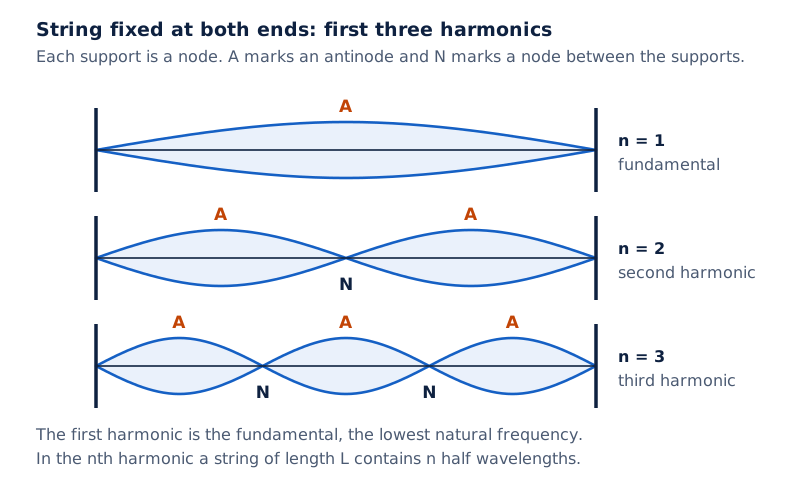
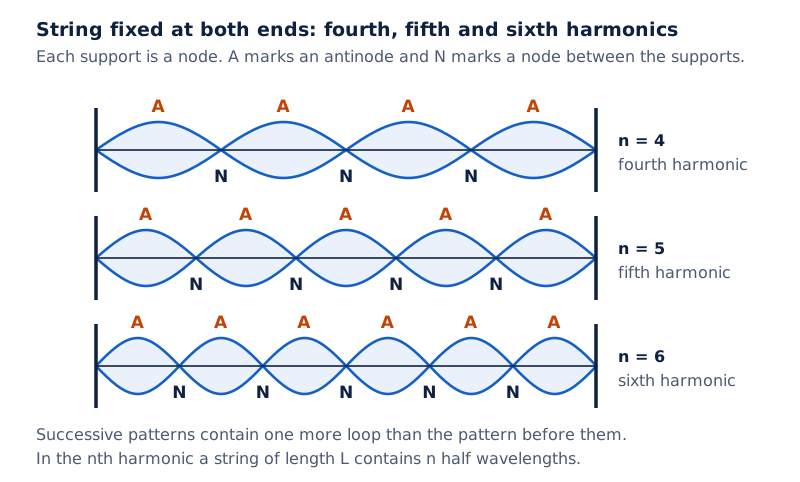
Six patterns show a string fixed at both ends, from the fundamental to the sixth harmonic. Successive patterns contain one to six loops. A marks antinodes and N marks internal nodes; each support is also a node.
Drawn by One Young India.
What are the laws of vibrating strings?
| Law | Quantities held constant | Fundamental-frequency relation |
|---|---|---|
| Law of length | Tension and linear mass density | f₀ is inversely proportional to L |
| Law of tension | Vibrating length and linear mass density | f₀ is proportional to √F |
| Law of mass per unit length | Vibrating length and tension | f₀ is inversely proportional to √μ |
A sonometer uses a stretched wire supported by bridges, which set its vibrating length, on a sounding box. A load applied through a pulley controls tension. A tuning fork supplies a periodic driving force, meaning a force that repeats regularly.
Resonance is the large response when the driving frequency is close to a natural frequency. Adjusting the bridge separation brings the wire into resonance with a fork. Comparing resonant lengths at controlled tension and linear mass density tests the string relations.
Worked example 4. A fixed wire has fundamental frequency 45 Hz, mass 3.5 × 10⁻² kg and linear mass density 4.0 × 10⁻² kg m⁻¹. Find its wave speed and tension.
Formula: L = m/μ; v = 2Lf₀; F = μv².
Substitute: L = 0.875 m; v = 2 × 0.875 × 45 = 78.75 m s⁻¹.
Answer: v ≈ 79 m s⁻¹ and F = 0.040 × (78.75)² ≈ 2.5 × 10² N.
Which standing-wave modes occur in open and closed organ pipes?
An organ pipe contains an air column that can support longitudinal standing waves. An open pipe is open at both ends. A closed pipe in this discussion is closed at one end and open at the other.
At a closed end, the air cannot move through the wall: it forms a displacement node and a pressure antinode. A pressure antinode is a position of greatest pressure-variation amplitude. At an open end, displacement is greatest and pressure variation is least.
A pressure node is a position of zero pressure-variation amplitude in the ideal model. Open ends are displacement antinodes and pressure nodes. The following formulas neglect the small end effects associated with the air just outside a pipe opening.
How does an open pipe admit every harmonic?
The shortest pattern with displacement antinodes at both ends has a node midway between them. Thus L = λ/2 for the fundamental, where L now means the air-column length. Its fundamental frequency is v/(2L), with v the sound speed in that air.
Adding successive half-wavelengths preserves the two end antinodes. Hence L = nλ/2 and fₙ = nv/(2L), for n = 1, 2, 3 and so on. All positive integral harmonics are allowed.
What the figure shows
Open-pipe harmonics
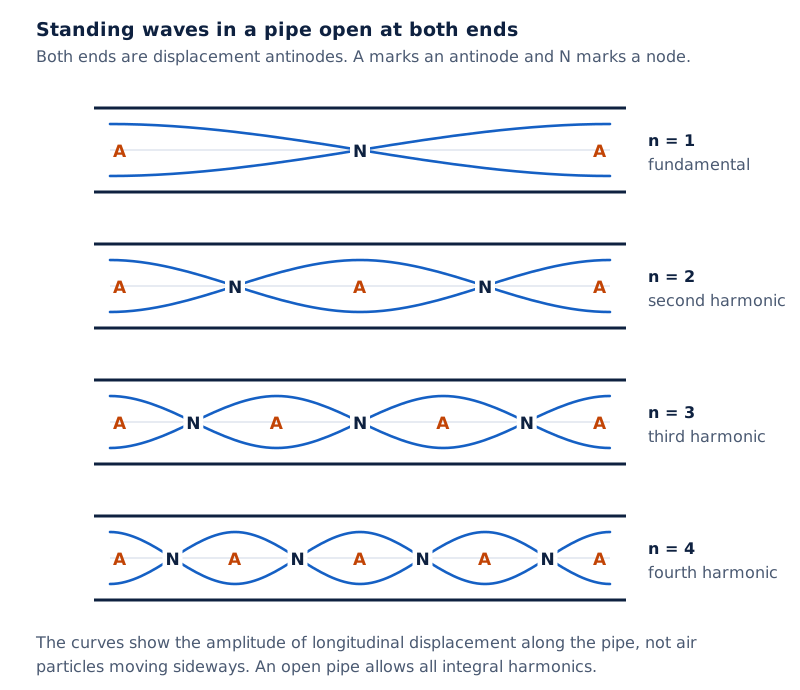
Four patterns show the fundamental and the second, third and fourth harmonics. Each has A at both ends. The fundamental has one internal N; the higher harmonics have internal N and A labels. These curves represent longitudinal-displacement amplitudes, not air particles moving sideways.
Drawn by One Young India.
Why does a closed pipe admit only odd harmonics?
The shortest pattern from a closed-end node to an open-end antinode spans λ/4. Thus its fundamental frequency is v/(4L). Each added half-wavelength preserves a node at the closed end and an antinode at the open end.
Let r be the dimensionless mode index, with values 1, 2, 3 and so on. Then L = (2r − 1)λ/4 and the frequency of that mode is:
f = (2r − 1)v/(4L)
| Mode | Open pipe | Pipe closed at one end |
|---|---|---|
| Fundamental | v/(2L), first harmonic | v/(4L), first harmonic |
| First overtone | 2v/(2L), second harmonic | 3v/(4L), third harmonic |
| Second overtone | 3v/(2L), third harmonic | 5v/(4L), fifth harmonic |
Count overtones by the permitted modes above the fundamental. Do not automatically add one to an overtone number to obtain its harmonic number: that shortcut fails for the closed pipe because its even harmonics are absent.
Worked example 5. A pipe 30.0 cm long is driven at 1.1 kHz. Sound speed is 330 m s⁻¹. Neglect end effects. Identify resonance with both ends open and then with one end closed.
Formula: For the open pipe, fₙ = nv/(2L). For the closed pipe, f = (2r − 1)v/(4L).
Substitute: L = 0.300 m. Open-pipe fundamental = 550 Hz; closed-pipe fundamental = 275 Hz.
Answer: The 1100 Hz source excites the open pipe’s second harmonic. It is four times the closed pipe’s fundamental, an excluded even harmonic, so the same source does not resonate after one end is closed.
How are beats produced and used to compare frequencies?
Beats are periodic increases and decreases in sound intensity when waves of slightly different frequencies and comparable amplitudes superpose. Intensity is energy passing per unit area perpendicular to the direction of wave propagation per unit time, measured in watts per square metre, W m⁻², with dimensions [MT⁻³].
A watt is a joule per second. Beat intensity changes are heard as repeated waxing and waning of sound. Because the frequencies differ slightly, the relative phase changes slowly: the waves move between reinforcement and cancellation.
Let f₁ and f₂ be the two frequencies, and fᵦ the beat frequency, all measured in Hz. Beat frequency is the number of complete loudness variations per second:
fᵦ = |f₁ − f₂|
How does tuning remove the ambiguity?
A measured beat frequency alone does not say which source has the higher frequency. The unknown frequency can lie above or below the known one. Changing one source in a known direction and observing the beat change distinguishes the possibilities.
For a string at fixed length and linear mass density, increasing tension increases frequency. If a slight tension increase makes beats slower, the string was initially below the other frequency, provided it has not crossed it. The frequency difference has narrowed.
Worked example 6. Two sitar strings labelled A and B produce 5 Hz beats. String A has frequency 427 Hz. Slightly increasing B’s tension reduces the beats to 3 Hz. Find B’s original frequency.
Formula: Beat frequency = absolute difference between the string frequencies.
Substitute: Increasing B’s tension raises its frequency. Since the beat frequency decreases, B was originally below 427 Hz.
Answer: B’s original frequency = 427 − 5 = 422 Hz.
Musicians often use beats when tuning instruments together, adjusting until their ears no longer detect beats. Beats involve a varying resultant amplitude at a listening point. A stationary-wave pattern instead has amplitude varying with position and fixed nodes.
Glossary
- Mechanical wave — A disturbance travelling through a material medium and transferring energy without transporting the medium as a whole.
- Transverse wave — A wave whose particles oscillate perpendicular to the direction in which the disturbance propagates.
- Longitudinal wave — A wave whose particles oscillate parallel to the direction of propagation of the disturbance.
- Amplitude — The maximum magnitude of a particle’s displacement from its equilibrium position during oscillation.
- Wavelength — The shortest separation between points of equal phase in a progressive wave at one instant.
- Frequency — The number of complete oscillations performed per second, measured in the SI unit hertz.
- Phase — The quantity specifying the stage of an oscillation at a particular position and time.
- Superposition — Addition of individual signed displacements to obtain resultant displacement where waves overlap in a medium.
- Node — A fixed position in a standing wave where displacement remains zero at all times.
- Antinode — A position in a standing wave where particles have the greatest amplitude of oscillation.
- Fundamental frequency — The lowest natural frequency allowed by the boundary conditions of a vibrating system.
- Harmonic — A frequency that is an integral multiple of the fundamental frequency of a system.
- Overtone — An allowed vibration frequency above the fundamental, counted in order of increasing frequency.
- Resonance — A large oscillatory response when an external driving frequency is close to a natural frequency.
- Beats — Periodic waxing and waning of resultant sound intensity from waves with slightly different frequencies.
Common errors and misconceptions
- Misconception: Air travels from a speaker to the listener with the sound. Correct: Air elements oscillate locally while the disturbance and energy propagate through neighbouring regions.
- Misconception: Horizontal crest spacing always gives wavelength. Correct: It gives wavelength on a position graph, but period on a time graph of one particle.
- Misconception: Increasing sound frequency must increase speed in a given ideal medium. Correct: Medium properties fix speed; wavelength changes when frequency changes.
- Misconception: Higher gas pressure automatically means faster sound. Correct: At constant temperature in the same ideal gas, pressure and density increase proportionally, leaving their ratio unchanged.
- Misconception: Every point at equilibrium in a snapshot is a node. Correct: A node stays at zero displacement throughout the oscillation, not just at one instant.
- Misconception: A closed pipe’s first overtone is its second harmonic. Correct: Its first overtone is its third harmonic because only odd harmonics are permitted.
- Misconception: Ultrasonic and supersonic mean the same thing. Correct: Ultrasonic concerns frequency above 20 kHz; supersonic concerns motion faster than local sound speed.
- Misconception: Beat frequency identifies whether the unknown frequency is higher or lower. Correct: It gives the magnitude of the difference; a controlled frequency change can resolve the ambiguity.
Exam-style questions with model answers
Q1. Distinguish transverse and longitudinal waves by particle motion, giving one example of each. [2 marks]
- In a transverse wave, particles oscillate perpendicular to propagation; waves on a stretched string provide an example.
- In a longitudinal wave, particles oscillate parallel to propagation; sound travelling in air provides an example.
Q2. A wave is y = 0.005 sin(80.0x − 3.0t), where x and y are in metres and t is in seconds. Find its amplitude, wavelength and period. [3 marks]
- Compare with y = A sin(kx − ωt), where A is amplitude, k angular wave number and ω angular frequency. Thus A = 0.005 m.
- The wavelength is λ = 2π/k. Using k = 80.0 rad m⁻¹ gives λ = 0.0785 m, or 7.85 cm.
- The period is T = 2π/ω. With ω = 3.0 rad s⁻¹, T = 2.09 s.
Q3. A steel wire of length 0.72 m and mass 5.0 × 10⁻³ kg is under tension 60 N. Calculate transverse wave speed, explaining the quantities used. [3 marks]
- The linear mass density μ is mass per unit length: μ = m/L = (5.0 × 10⁻³)/0.72 = 6.9 × 10⁻³ kg m⁻¹, rounded.
- Wave speed is v = √(F/μ), where F is the string tension. Here F = 60 N; the relation combines the restoring tension with the string’s inertia per unit length.
- Substitution gives v = √[60/(6.9 × 10⁻³)] ≈ 93 m s⁻¹. The answer is a propagation speed, not a particle’s oscillatory velocity.
Q4. Explain Newton’s assumption for sound in air and Laplace’s correction, and state the corrected formula with its symbols defined. [4 marks]
- Newton assumed isothermal pressure variations, meaning temperature stays constant during compression and rarefaction.
- This gives bulk modulus B equal to pressure P, and sound speed v = √(P/ρ), where ρ is mass density.
- Laplace recognised that changes are too rapid for sufficient heat exchange to maintain constant temperature; they are treated as adiabatic.
- The corrected modulus is γP, so v = √(γP/ρ). The dimensionless γ is the ratio of heat capacities at constant pressure and constant volume.
Q5. Two waves are y₁ = a sin(kx − ωt) and y₂ = a sin(kx + ωt), where a is each amplitude, k = 2π/λ the angular wave number, λ wavelength, ω angular frequency, x position and t time. Obtain their resultant and explain its nodes, antinodes and adjacent-node separation. [5 marks]
- By superposition, the resultant displacement at any position and time is y = y₁ + y₂. The two equal waves propagate in opposite directions.
- Using the sine-sum identity gives y = 2a sin(kx) cos(ωt). The position and time factors are separate, producing a stationary pattern.
- Its physical amplitude is 2a |sin(kx)|, so amplitude depends on position. Nodes occur where sin(kx) = 0 and remain at rest throughout.
- With k = 2π/λ, node positions are x = nλ/2, where n is an integer. Therefore adjacent nodes are separated by λ/2.
- Antinodes occur where |sin(kx)| = 1, giving amplitude 2a. Each lies midway between neighbouring nodes, a distance λ/4 from either.
Q6. A pipe of length 30.0 cm is driven by a 1.1 kHz source. Take sound speed as 330 m s⁻¹ and neglect end effects. Explain resonance when both ends are open and whether it persists when one end is closed. [5 marks]
- Convert the data: pipe length L = 0.300 m and driving frequency = 1100 Hz. An open pipe has displacement antinodes at both ends.
- Its fundamental frequency is v/(2L), where v is sound speed. Substitution gives 330/(2 × 0.300) = 550 Hz.
- The source frequency is twice 550 Hz. Since an open pipe permits all integral harmonics, it resonates in its second harmonic.
- Closing one end introduces a displacement node there. The fundamental becomes v/(4L) = 330/(4 × 0.300) = 275 Hz, and only odd harmonics are allowed.
- The source frequency 1100 Hz equals four times 275 Hz. This even harmonic is excluded for the closed pipe, so resonance with the same source does not persist.
Q7. Sitar strings A and B produce 5 Hz beats; A has frequency 427 Hz. A slight increase of B’s tension reduces the beat frequency to 3 Hz. Find B’s original frequency and justify the choice. [3 marks]
- Beat frequency is the magnitude of the frequency difference. Initially B could have frequency 427 − 5 = 422 Hz or 427 + 5 = 432 Hz.
- Increasing tension raises B’s frequency. If it were initially 432 Hz, this would increase its separation from 427 Hz and make beats faster.
- Beats instead become slower, so B was initially below A. Its original frequency was therefore 422 Hz.
Q8. State the three laws for the fundamental frequency of a stretched string, specifying what is held constant for each. [3 marks]
- The law of length states that fundamental frequency is inversely proportional to vibrating length when tension and linear mass density are constant.
- The law of tension states that fundamental frequency is proportional to the square root of tension when length and linear mass density are constant.
- The law of mass per unit length states that fundamental frequency is inversely proportional to the square root of linear mass density when length and tension are constant.
Key takeaways
- Mechanical waves transfer energy through a medium while its particles oscillate locally about equilibrium positions.
- Frequency, wavelength and speed obey v = fλ; graph axes distinguish wavelength from time period.
- The medium determines mechanical wave speed through its elastic and inertial properties under the stated conditions.
- Laplace’s correction treats rapid sound-pressure changes as adiabatic and gives v = √(γP/ρ) for an ideal gas.
- Superposition adds signed displacements; relative phase determines whether overlapping waves reinforce or cancel one another.
- Standing waves have fixed nodes and antinodes; adjacent nodes are half a wavelength apart.
- Fixed strings and open pipes allow all integral harmonics, while pipes closed at one end allow only odd harmonics.
- Beat frequency equals the magnitude of the frequency difference; controlled tuning reveals which source initially has the higher frequency.
Test yourself
Why is sound in air a mechanical wave?
It requires material particles whose interactions transmit compressions and rarefactions; it cannot propagate through a vacuum.
What does crest-to-crest spacing mean on a displacement-time graph?
It gives the oscillation period of the particle at the fixed position being observed.
With positive k and ω, which way does y = A sin(kx + ωt) travel?
It travels towards decreasing x, because x must decrease as time increases to preserve a fixed phase.
Why does a pressure increase not change ideal-gas sound speed at constant temperature?
Density rises proportionally with pressure, leaving their ratio unchanged for the same gas.
Is a standing-wave antinode permanently at maximum displacement?
No. It has the largest oscillation amplitude but passes through equilibrium during each cycle.
Where are displacement nodes found in a fixed string and in a closed pipe?
The string has nodes at both supports; the pipe has a displacement node at its closed end.
Which harmonic is the first overtone of a pipe closed at one end?
It is the third harmonic, since the second harmonic is excluded by the end conditions.
What changes when two nearly equal frequencies produce beats?
The resultant amplitude and intensity vary periodically as the relative phase of the waves changes.
Write about it
Turn a question from this chapter into a paper.
The Writing Studio has a structure guide, a rubric and citation tools for 15 formats, from essays to research papers. Drafting is free with an account. Learnacy Essential adds feedback from an AI writing coach and submission to The OYI Review.
Learnacy Essential is ₹1,499 for the year. Publication depends on review and is not guaranteed.