
Air and Atmosphere | ICSE Class 7 Chemistry Notes
On this page
This note covers air and its composition, the atmosphere, uses of air’s components, oxygen and combustion, laboratory preparation of oxygen, catalysts, mass changes during burning, word equations, respiration, rusting, acid rain and air quality.
What are air and the atmosphere?
Air is a mixture of gases surrounding us. A mixture contains two or more substances together, with each retaining its own properties. The individual substances in a mixture are its components. The atmosphere is the layer of air surrounding the Earth.
Nitrogen and oxygen form the bulk of air. Argon, carbon dioxide and other gases occur in smaller quantities. Air also contains water vapour, which is water in its gaseous state. Dust particles can be suspended in air, but dust is not a gas.
Why is air a mixture?
The proportions of air’s components are not fixed at all places. Water vapour and pollutants can vary. A pollutant is a substance that contaminates the environment and can cause harm. Dust, soot and certain gases contribute to air pollution.
Air’s components retain different properties: oxygen supports burning, whereas nitrogen does not support the burning of a candle. Mixing these gases does not turn them into a single new substance. This helps explain why the properties of air depend on its components.
How can we show that air is present?
An apparently empty bottle contains air. In a classroom demonstration, a bottle is inverted in a tub of water and then tilted. Air escapes as bubbles while water enters the bottle. The escaping bubbles make the presence of air visible.
The atmosphere provides the air used by living organisms and helps make Earth suitable for life. It also protects life from harmful effects of the Sun’s rays. Air is therefore more than the gas drawn into our lungs: it is part of the surroundings on which life depends.
What is the composition of air?
Composition means the substances present in a material and their relative amounts. Percentage means the number of parts in a hundred; its symbol is %. A simple composition chart represents air using nitrogen, oxygen and a combined group of other gases.
| Component | Percentage in the composition chart | Meaning in a hundred-part representation |
|---|---|---|
| Nitrogen | 78% | 78 parts represent nitrogen. |
| Oxygen | 21% | 21 parts represent oxygen. |
| Argon, carbon dioxide and other gases | 1% | One part represents these gases together. |
Nitrogen is the most abundant gas in air. Oxygen is the second most abundant. The small remaining group contains several gases; the entire group must not be labelled carbon dioxide. Carbon dioxide is one member of that group.
What the figure shows
Composition of air
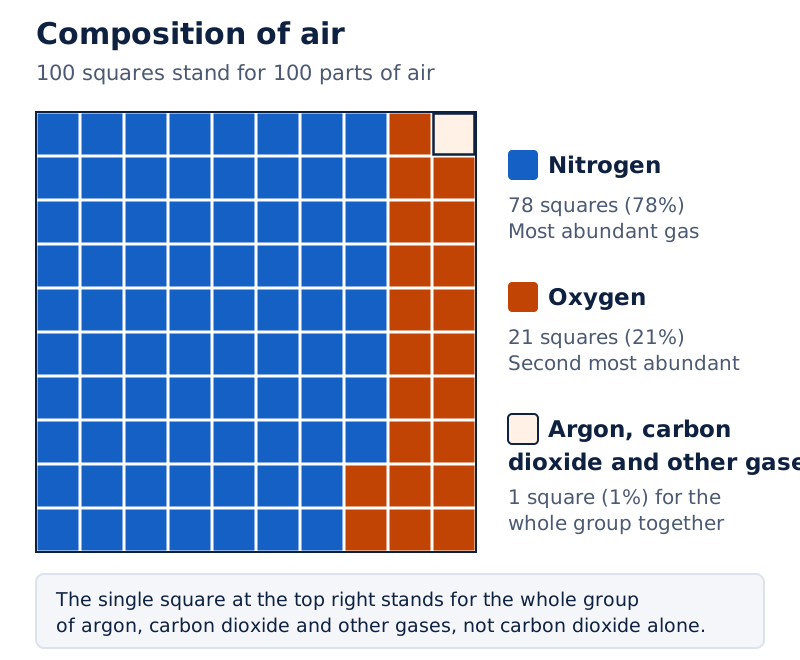
A hundred-square grid has 78 blue squares for nitrogen, 21 red squares for oxygen and one pink square for argon, carbon dioxide and other gases. The key identifies the three groups and their percentages.
Drawn by One Young India.
Does every air sample have exactly the same composition?
The chart gives a useful broad representation, not a claim that every sample has identical proportions. The amount of water vapour varies. The nature and number of dust particles can also vary from place to place and from time to time.
Concentration describes how much of a component is present in a given amount of a mixture. Factory emissions and vehicle exhaust can change the concentrations of substances in the surrounding air. Thus, a composition chart and the statement that local air quality varies are compatible.
When interpreting a chart, name the whole category attached to each value. In particular, distinguish a gas’s abundance from its importance: oxygen is essential for our survival even though nitrogen occupies the larger share.
How do living things use the components of air?
Respiration is the breakdown of food in living cells to release energy. A cell is the basic structural and functional unit of a living organism. Energy is the capacity to do work. Most living beings need oxygen for their survival, and oxygen helps release energy from food.
Respiration using oxygen is called aerobic respiration. Glucose is a simple sugar used in this process. Oxygen helps break glucose down into carbon dioxide and water, releasing energy. Breathing brings air into the body and removes air containing more carbon dioxide.
Why are carbon dioxide and nitrogen important?
Photosynthesis is the process in which green plants use sunlight to make food from carbon dioxide and water. Chlorophyll, the green pigment in plants, helps capture light energy. Oxygen is released during this process. Plants also respire; photosynthesis does not replace respiration.
Nitrogen is needed to make proteins, nitrogen-containing substances important for growth and body functions. Plants cannot absorb gaseous nitrogen directly from air. Certain soil bacteria change it into forms that plants can absorb along with water.
Bacteria are microscopic living organisms. Some bacteria associated with soil and plant roots help make nitrogen available to plants. Fertilisers are substances added to soil to supply plant nutrients. Nitrogen is used in manufacturing fertilisers, linking an atmospheric gas to plant growth.
| Component | Use or importance | Distinction to remember |
|---|---|---|
| Oxygen | Used in aerobic respiration and supports combustion, the process of burning. | It is not the most abundant gas in air. |
| Nitrogen | Needed for plant proteins and used to manufacture fertilisers. | Plants need nitrogen in a usable form; they cannot absorb atmospheric nitrogen gas directly. |
| Carbon dioxide | Used in photosynthesis and in carbon dioxide fire extinguishers. | Its role in plant food production differs from oxygen’s role in respiration. |
In a carbon dioxide extinguisher, the gas helps separate burning fuel from oxygen. This illustrates why the gases in air cannot be treated as interchangeable: different properties allow different uses.
What are oxygen’s properties, and why is it needed for combustion?
Oxygen is a colourless, odourless gas: it has no colour and no smell. These are physical properties, meaning characteristics observed without changing the substance into another substance. Its ability to support burning describes its chemical behaviour.
Definition: Combustion is a chemical process in which a substance reacts with oxygen and releases heat. Sometimes light is also given off, either as a flame or as a glow.
A chemical change forms one or more new substances. A substance that burns is combustible; a combustible material used to provide heat is a fuel. Oxygen supports combustion but is not itself the fuel in a burning candle.
What does the candle demonstration show?
- Place two identical candles on separate shallow dishes and light them in a supervised demonstration.
- Leave one candle uncovered so that it has a continuing supply of air.
- Cover the other candle with an inverted glass tumbler.
- Observe that the uncovered candle continues burning, while the covered candle stops burning after some time.
The covered candle lacks a continuous supply of fresh air. As oxygen is consumed, combustion can no longer continue. The result shows that oxygen is needed for burning. It does not mean that all gases under the tumbler burn or disappear.
What the figure shows
Uncovered and covered candles
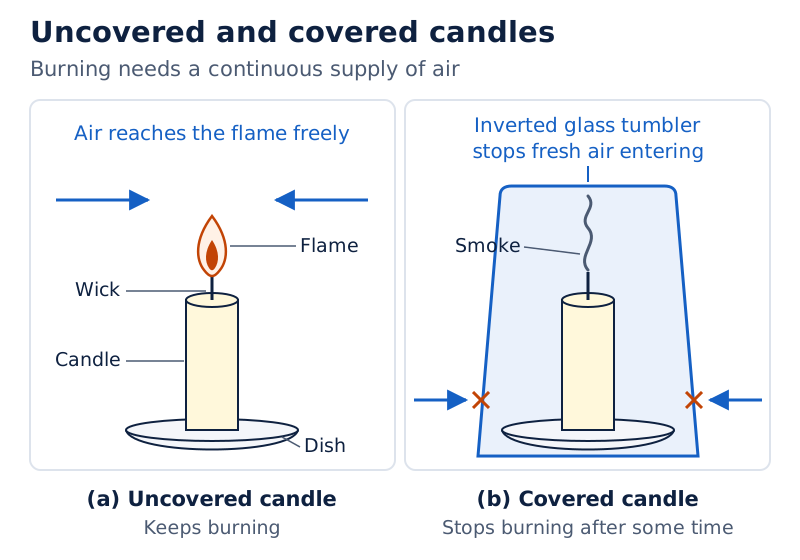
Drawing (a) shows a burning candle on a dish. Drawing (b) shows a candle under an inverted glass tumbler, with smoke above its wick. The two arrangements compare continued access to air with restricted access.
Drawn by One Young India.
Is oxygen alone enough to start a fire?
A combustible substance must also reach its ignition temperature, the lowest temperature at which it catches fire. The three requirements are fuel, oxygen and sufficient heat. Removing a requirement can stop burning. Merely exposing paper to air does not make it burst into flame.
How is oxygen prepared in the laboratory?
Oxygen can be obtained by breaking down an oxygen-containing compound. A compound contains elements chemically combined in a fixed proportion. An element is a substance that cannot be broken down into simpler substances by chemical means.
Decomposition is a chemical reaction in which a compound breaks down into simpler substances. Hydrogen peroxide and potassium chlorate are compounds used to prepare oxygen. Manganese dioxide is the substance used to speed up these preparations.
Definition: A catalyst changes the rate of a chemical reaction without being used up overall in that reaction. In these oxygen preparations, manganese dioxide acts as a catalyst that speeds up decomposition.
What happens when hydrogen peroxide decomposes?
In a supervised laboratory demonstration, hydrogen peroxide solution is brought into contact with manganese dioxide. Oxygen bubbles are produced, and water is the other product. A solution is a uniform mixture in which a substance is dissolved in another substance.
Hydrogen peroxide → Water + Oxygen
This is a word equation, a representation of a reaction using substance names. The arrow, →, means “forms” or “produces”; the plus sign, +, separates substances. Manganese dioxide is stated as the catalyst, not as a product or the supply of oxygen.
How does the potassium chlorate method differ?
Potassium chlorate is heated with manganese dioxide in a supervised laboratory preparation. It decomposes into potassium chloride and oxygen. Potassium chloride is the other compound formed in this reaction.
Potassium chlorate → Potassium chloride + Oxygen
Here, heating is a required condition of the preparation. The hydrogen peroxide method can proceed at room temperature with manganese dioxide. A catalyst speeds a reaction; its presence does not mean that every reaction can take place without heating.
Oxygen can be collected over water because it is only slightly soluble in water. A glowing splint, a wooden splint with a glowing tip but no flame, relights in oxygen. This provides a test based on oxygen’s ability to support combustion.
Note: Distinguish the source compound, the catalyst, the conditions and the products. Hydrogen peroxide or potassium chlorate supplies the oxygen. Manganese dioxide accelerates the reaction without being consumed overall.
Why does magnesium gain mass while a burning candle becomes smaller?
Mass is the quantity of matter in an object. Burning can change the mass of the material left on a balance because matter may enter from the air or leave as gases. The measurement must identify which substances are included.
What happens when magnesium burns?
Metals are generally lustrous, meaning shiny, and conduct heat and electricity well. Magnesium is a metal that burns with a dazzling white flame and forms white magnesium oxide. An oxide is a compound of oxygen with another element. Magnesium oxide contains magnesium joined chemically with oxygen taken from air.
- Weigh the magnesium before the demonstration, allowing for the mass of its container.
- Burn it under supervision and collect the solid magnesium oxide formed.
- Allow the product to cool and weigh it, again allowing for the container.
- Compare the mass of the collected oxide with the original magnesium: the oxide has gained the mass of oxygen that combined with the metal.
Magnesium + Oxygen → Magnesium oxide
The increased mass is explained by oxygen joining the metal. It is not evidence that heat has become extra magnesium. This comparison assumes that the product is collected without loss. Losing some powder would make the measured comparison unreliable.
Why does a candle show a different change?
Near a candle flame, solid wax melts. Liquid wax rises through the wick and evaporates, meaning it changes into vapour. Wax vapour burns. Melting and evaporation are physical changes, changes that do not form a new substance; burning is a chemical change.
When wax burns completely, it reacts with oxygen to form carbon dioxide and water vapour. These products escape into the surrounding air. The candle therefore becomes smaller and its remaining mass decreases. Measuring the remaining candle excludes the gases that have escaped.
| Observation | Movement of matter | Explanation |
|---|---|---|
| Collected magnesium oxide is heavier than the original magnesium. | Oxygen enters from air and remains in the solid product. | The solid includes both magnesium and added oxygen. |
| The remaining candle loses mass. | Gaseous products move away into the air. | The remaining candle does not include those products. |
If all reacting substances and all products are included, total mass is conserved. Conserved means unchanged in total. An explanation of either demonstration must therefore track matter entering and leaving, rather than judge the reaction from the visible material alone.
How do metals and non-metals react with oxygen?
Metals and non-metals are groups of elements. Most non-metals are non-lustrous and are generally poor conductors of heat and electricity. Magnesium, calcium, sodium and potassium are metals; sulphur, carbon and phosphorus are non-metals.
Word equations identify reactants, the starting substances, and products, the substances formed. Reactants appear before the arrow and products after it. Include relevant conditions because an element can form different oxygen compounds under different conditions.
Which word equations should we understand?
| Element and condition | Word equation |
|---|---|
| Magnesium burning in oxygen | Magnesium + Oxygen → Magnesium oxide |
| Calcium reacting with oxygen | Calcium + Oxygen → Calcium oxide |
| Sodium with a limited supply of oxygen | Sodium + Oxygen → Sodium oxide |
| Potassium burning in excess oxygen | Potassium + Oxygen → Potassium superoxide |
| Sulphur burning in oxygen | Sulphur + Oxygen → Sulphur dioxide |
| Carbon burning completely in sufficient oxygen | Carbon + Oxygen → Carbon dioxide |
| Phosphorus burning in sufficient oxygen | Phosphorus + Oxygen → Phosphorus pentoxide |
Potassium superoxide is an oxygen compound of potassium containing more oxygen relative to potassium than the simple oxide. With excess oxygen, sodium can form sodium peroxide, another oxygen compound. Therefore, “metal plus oxygen” does not specify a unique product without suitable conditions.
Phosphorus pentoxide is the conventional name used for the oxide formed when phosphorus burns in sufficient oxygen. Sulphur dioxide and carbon dioxide are gaseous oxides of non-metals. The names identify distinct substances, not different names for air.
How do the products differ in their behaviour?
Generally, metal oxides are basic in nature. Many non-metal oxides are acidic. Acidic substances turn blue litmus red; basic substances turn red litmus blue. Litmus is a colour-changing indicator used to distinguish acidic and basic solutions.
The mixture obtained by adding water to magnesium oxide turns red litmus blue. Sulphur dioxide dissolves in water to form sulphurous acid, giving an acidic solution. These observations compare the products’ behaviour. They do not justify claiming that every oxide behaves identically.
How does respiration differ from ordinary combustion?
Aerobic respiration and ordinary burning both involve reactions with oxygen and release energy. However, they occur in different ways. Respiration releases energy from food within living cells, whereas a burning candle releases heat and light through combustion of wax vapour.
Glucose + Oxygen → Carbon dioxide + Water + Energy
This word equation represents aerobic respiration. Energy is written to show that it is released; it is not a material substance collected alongside water. The carbon dioxide and water are chemical products of glucose breakdown.
What distinctions make the comparison clear?
| Feature | Aerobic respiration | Ordinary burning of a candle |
|---|---|---|
| Where it occurs | Inside living cells | At the candle flame |
| Material used | Food such as glucose | Wax vapour |
| How energy is released | Through controlled chemical processes in cells | Rapidly as heat and light |
| Visible flame | No flame accompanies cellular respiration. | A visible flame accompanies burning wax vapour. |
| Role of oxygen | Used in aerobic breakdown of food | Supports burning of the fuel |
Breathing and respiration also differ. Breathing is the physical movement of air into and out of respiratory organs. Respiration is the chemical release of energy from food. Taking air into the lungs and using oxygen within cells are connected but distinct processes.
Do not extend the oxygen requirement to every form of respiration. Anaerobic respiration releases energy from food without using oxygen. The comparison above deliberately specifies aerobic respiration, so it describes the oxygen-using process accurately.
Plants carry out respiration as well as photosynthesis. Photosynthesis uses carbon dioxide to make food and releases oxygen; aerobic respiration uses oxygen to break down food. Keeping these processes separate explains why a plant needs both food production and energy release.
How does rusting differ from combustion?
Rusting is the formation of a brown coating called rust on iron exposed to air and moisture. Moisture means water present in the surroundings. Rust is a new substance, so rusting is a chemical change rather than a simple change of shape.
The presence of both air and water is essential for rusting in the comparison experiment. The oxygen in air participates in the process. A nail kept in dry air and a nail kept in water from which air has been excluded provide useful comparisons.
What do the three nail arrangements show?
- Place a nail in a tightly closed bottle labelled A with silica gel, a material that keeps the air dry.
- Place a nail in bottle B under freshly boiled and cooled water. Add an oil layer to prevent air dissolving in it, and close the bottle.
- Place a nail partly under water in an open bottle labelled C, giving it contact with both water and air.
- Leave the bottles undisturbed and compare the nails after 8 to 10 days. Brown deposits appear in C, while A and B do not show them.
What the figure shows
Glass bottles containing iron nails
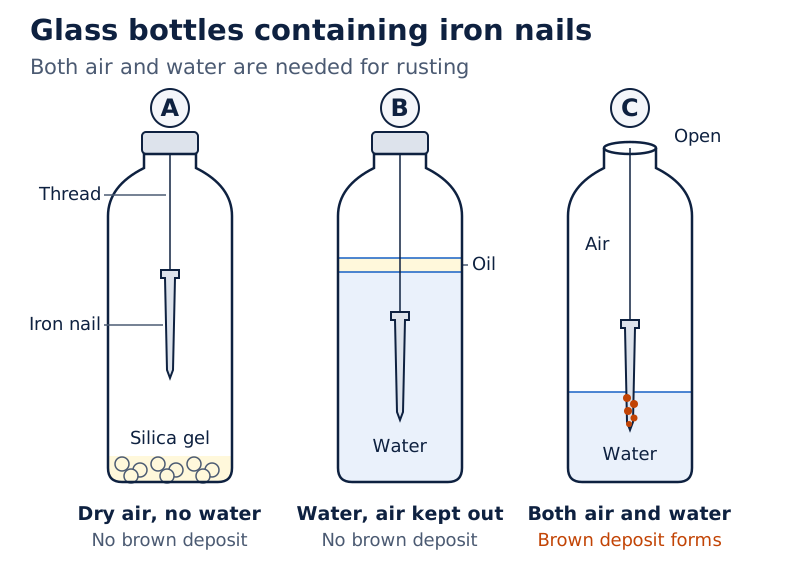
Bottle A shows a suspended nail and silica gel. Bottle B shows a nail under water with oil above it. Open bottle C shows a suspended nail partly under water. The drawings label the nails, thread, water, oil and silica gel.
Drawn by One Young India.
What distinguishes rusting from rapid burning?
Rusting develops gradually and does not produce a visible flame. Ordinary burning of wood or a candle releases heat rapidly and may give light. Both involve chemical change, but their rates and visible effects differ.
Rusting damages iron objects such as spades and structures. Painting, oiling or greasing can protect the iron surface from contact with air and moisture. Galvanisation means applying a protective zinc coating to iron. These methods help prevent conditions needed for rusting.
Use “rusting” specifically for iron. Corrosion is the broader deterioration of a metal through reactions with its surroundings. Other metals can corrode, but their surface changes should not all be called iron rust.
How does acid rain form, and what does it damage?
Acid rain is rain made unusually acidic by atmospheric pollutants, especially oxides of sulphur and nitrogen. These gases dissolve and react in rainwater to form acids. Burning coal and diesel releases sulphur dioxide, while petrol engines give off nitrogen oxides.
Which substances connect air pollution with rainwater?
Sulphur dioxide dissolved in water forms sulphurous acid. Further reactions involving oxygen can produce sulphuric acid. Nitrogen oxides can give rise to nitric acid. These are names of different acids associated with polluted rainwater.
Carbon dioxide also dissolves in rainwater to form carbonic acid. This gives ordinary rain some natural acidity. Distinguish that natural effect from the additional acidity associated with sulphur and nitrogen pollution; naming carbon dioxide does not make every rainfall a pollution event.
Sulphur dioxide + Water → Sulphurous acid
Carbon dioxide + Water → Carbonic acid
Why are buildings and living things affected?
Acid rain is harmful to crops, soil and buildings. The Taj Mahal provides an example of damage to a heritage building. Its marble contains calcium carbonate, a compound that reacts with acids in rainwater. This reaction damages the stone.
The connection can be traced from a source to an effect: fuel burning releases gases; gases enter air; acids form in rainwater; acidic rain contacts materials and living environments. Pollution released into air can therefore cause damage after substances are carried down by rain.
Keep the explanation chemical and specific. Smoke merely staining a surface and acid reacting with stone are different effects. For acid rain, identify the gases, the acids formed and the material or environment affected. “Dirty rain damages things” leaves out the process that links cause and damage.
What determines air quality, and how can it be protected?
Air quality describes the condition of air in relation to pollutants. Factory waste gases, vehicle emissions and burning fuels can change air’s composition and harm the environment. The air quality index, abbreviated AQI, is a tool used to describe air quality.
Which pollutants should we recognise?
Particulate matter consists of tiny particles suspended in air, including dust and soot. Soot contains fine carbon particles produced during incomplete burning. Such particles can cause breathing problems. Their presence is different from the presence of useful atmospheric gases.
Incomplete combustion occurs when fuel does not burn completely. It can produce carbon monoxide, a very poisonous gas. Carbon monoxide and carbon dioxide are different compounds. The word “carbon” in both names does not make their properties or effects identical.
| Pollutant or pollution source | Relevant effect |
|---|---|
| Unburnt carbon particles from fuels | Can cause respiratory problems. |
| Carbon monoxide from incomplete combustion | Acts as a poisonous gas. |
| Oxides of sulphur and nitrogen | Contribute to acid rain that harms crops, buildings and soil. |
| Factory and vehicle emissions | Change local air composition and contribute to pollution. |
How can we reduce the problem?
Reducing pollution requires reducing harmful emissions. Cleaner energy sources, improved energy use and environmentally friendly travel choices help. Burning wood produces harmful smoke, so the type of fuel and the way it is burned matter for air quality.
Plants and animals depend on the atmosphere, but that does not mean every substance released into air is harmless. Carbon dioxide has a useful role in photosynthesis, while excessive emissions alter its atmospheric concentration. Evaluate a substance’s amount and effects as well as its name.
Connect protective action to the cause: cutting fuel waste reduces unnecessary burning, and reducing polluting emissions addresses their entry into air. Understanding the source, substance and effect provides a clearer explanation than simply saying that air should be kept clean.
Glossary
- Atmosphere — The layer of air surrounding the Earth and supporting conditions needed by living organisms.
- Mixture — Two or more substances present together while retaining their individual properties rather than forming one new substance.
- Component — An individual substance that forms part of a mixture, such as oxygen in air.
- Combustion — A chemical process in which a substance reacts with oxygen and releases heat, sometimes with light.
- Ignition temperature — The lowest temperature at which a combustible substance catches fire and starts to burn.
- Catalyst — A substance that changes a reaction’s rate without being used up overall during the reaction.
- Decomposition — A chemical reaction in which a compound breaks down into two or more simpler substances.
- Word equation — A reaction description using names of starting substances and products, separated by an arrow.
- Oxide — A compound formed by the chemical combination of oxygen with another element.
- Aerobic respiration — The breakdown of food in living cells using oxygen, with the release of energy.
- Rusting — The chemical process that forms rust on iron in the presence of air and water.
- Acid rain — Rain made unusually acidic by pollutants, especially sulphur and nitrogen oxides that form acids in rainwater.
- Pollutant — A substance that contaminates the environment and can harm living organisms or their surroundings.
- Particulate matter — Tiny particles suspended in air, including dust and soot, that can contribute to air pollution.
Common errors and misconceptions
- Misconception: Air is a single gas called oxygen. Correct: Air is a mixture. Nitrogen forms its largest share, while oxygen forms the second largest share.
- Misconception: The remaining 1% in the simple air chart is entirely carbon dioxide. Correct: It includes argon, carbon dioxide and other gases together.
- Misconception: Oxygen is the fuel that burns in a candle. Correct: Wax vapour is the fuel; oxygen supports its combustion.
- Misconception: Manganese dioxide is consumed to supply oxygen during its laboratory preparation. Correct: It acts as a catalyst; hydrogen peroxide or potassium chlorate supplies the oxygen.
- Misconception: Burning makes matter disappear, so every material must become lighter. Correct: Magnesium gains oxygen, while a candle loses material into gaseous products. Account for all substances involved.
- Misconception: Every form of respiration requires oxygen. Correct: Aerobic respiration uses oxygen; anaerobic respiration releases energy without using it.
- Misconception: Iron rusts because of water alone. Correct: The nail experiment shows that both air and water are needed for rusting.
- Misconception: All acidity in rain proves pollution by sulphur gases. Correct: Carbon dioxide causes natural rainwater acidity; sulphur and nitrogen pollution can cause additional harmful acidity.
Exam-style questions with model answers
Q1. An air-composition chart shows nitrogen 78%, oxygen 21%, and argon, carbon dioxide and other gases together 1%. Name the most abundant gas and explain why “carbon dioxide is 1%” misreads the chart. [2 marks]
- Nitrogen is the most abundant gas, occupying 78% in the chart.
- The 1% represents argon, carbon dioxide and other gases together, not carbon dioxide alone.
Q2. Two identical candles burn on separate dishes. One is left uncovered and continues burning. The other is covered with an inverted glass tumbler and goes out after some time. Identify the required gas, explain the difference, and state the conclusion. [3 marks]
- Oxygen is the component of air that supports combustion. It reacts with the candle’s wax vapour during burning.
- The uncovered candle receives a continuous supply of air, while the tumbler restricts fresh air reaching the covered candle.
- As oxygen is consumed under the tumbler, burning cannot continue. The comparison supports the conclusion that oxygen is needed for combustion.
Q3. Hydrogen peroxide solution produces water and oxygen when manganese dioxide is added at room temperature. State the reaction type, write the word equation, identify the catalyst, and explain what “catalyst” means here. [4 marks]
- The reaction is decomposition because the starting compound, hydrogen peroxide, breaks down into simpler substances.
- The word equation is: Hydrogen peroxide → Water + Oxygen. The arrow identifies the products formed from the starting compound.
- Manganese dioxide is the catalyst used in this preparation; it is not the compound supplying the oxygen.
- It speeds up the reaction without being used up overall. It should therefore not be described as a product of decomposition.
Q4. A weighed magnesium sample is burned, all the magnesium oxide formed is collected, and the cooled product is heavier than the starting magnesium. Separately, a candle burns completely to carbon dioxide and water vapour, which escape, and the remaining candle loses mass. Explain both observations in five points, including the magnesium word equation and how total mass is accounted for. [5 marks]
- The word equation for the metal’s reaction is: Magnesium + Oxygen → Magnesium oxide. A new substance forms during burning.
- Oxygen from the surrounding air combines with magnesium and becomes part of the collected solid product, explaining the increase in its mass.
- Wax reacts with oxygen during the candle’s combustion. The question states that carbon dioxide and water vapour are the products.
- Those gaseous products escape into the surroundings, so weighing the remaining candle does not include all the material formed during burning.
- Total mass is conserved when all reactants and products are included. The opposite measured changes arise from matter entering or leaving the material being weighed.
Q5. Compare aerobic respiration in living cells with the ordinary burning of candle wax. Give four differences covering location, material used, energy release and visible flame. [4 marks]
- Aerobic respiration occurs inside living cells, whereas the ordinary burning of wax vapour occurs at the candle flame.
- Respiration breaks down food such as glucose; the candle uses wax vapour as its combustible material.
- Respiration releases energy through controlled chemical processes in cells, while ordinary candle combustion releases energy rapidly as heat and light.
- Cellular respiration does not produce a visible flame, whereas burning wax vapour produces the visible flame of the candle.
Q6. Nail A is kept in dry air with silica gel. Nail B is submerged in freshly boiled and cooled water under an oil layer in a closed bottle. Nail C is partly submerged in water in an open bottle. After 8 to 10 days, only C has brown deposits. Explain A, explain B, and state the conclusion from C. [3 marks]
- Silica gel keeps the air around nail A dry. Its lack of brown deposits shows that air without moisture does not provide both required conditions.
- Boiling removes dissolved gases from B’s water, and the oil layer prevents air dissolving again. Water without available air does not provide both conditions.
- Nail C contacts both air and water and forms rust. Together, the observations show that both are needed for rusting.
Q7. A polluted area receives sulphur dioxide from fuel burning and nitrogen oxides from vehicle emissions. Explain the connection to acid rain in five points: entry into rainwater, two acids associated with these pollutants, damage to calcium-carbonate marble such as the Taj Mahal’s, and another harmful effect. [5 marks]
- Sulphur dioxide and nitrogen oxides enter the atmosphere and dissolve or react in rainwater, making the rain more acidic than it would otherwise be.
- Sulphur dioxide forms sulphurous acid in water. Further reactions involving oxygen can produce sulphuric acid, contributing to the acidity of polluted rain.
- Nitrogen oxides can give rise to nitric acid. This is another acid associated with the pollutants described in the question.
- Acids in the rain react with calcium carbonate in marble. This damages stone in heritage buildings such as the Taj Mahal.
- Acid rain also harms crops and soil. Its consequences therefore extend beyond changes to the appearance or condition of buildings.
Q8. Write word equations for (a) magnesium burning to magnesium oxide, (b) sulphur burning to sulphur dioxide, and (c) carbon burning completely in sufficient oxygen to carbon dioxide. Explain how to read the reactant and product sides for each. [3 marks]
- Magnesium + Oxygen → Magnesium oxide. The reactants magnesium and oxygen are named before the arrow; the product magnesium oxide is named after it.
- Sulphur + Oxygen → Sulphur dioxide. Sulphur and oxygen are the starting substances, while sulphur dioxide is the new substance formed.
- Carbon + Oxygen → Carbon dioxide. With sufficient oxygen for complete burning, carbon dioxide is the product shown on the right of the arrow.
Key takeaways
- Air is a mixture whose main components are nitrogen and oxygen; water vapour and local pollutants can vary.
- The simple composition chart assigns 78% to nitrogen, 21% to oxygen and 1% to argon, carbon dioxide and other gases.
- Oxygen supports combustion, while a combustible fuel and enough heat to reach ignition temperature are also required.
- Manganese dioxide catalyses oxygen preparation from hydrogen peroxide or heated potassium chlorate without being consumed overall.
- Magnesium gains oxygen when it burns, whereas a candle loses material into gaseous products that escape.
- Word equations name reactants and products; conditions matter because some elements can form different oxygen compounds.
- Aerobic respiration releases energy from food in cells, while rusting gradually damages iron exposed to air and water.
- Sulphur and nitrogen oxides contribute to acid rain, linking fuel burning and emissions with damage to crops, soil and buildings.
Test yourself
Why is an apparently empty bottle not really empty?
It contains air. When the inverted bottle is tilted under water, air escapes as bubbles and water enters.
Why should the 1% sector in a simple air chart not be labelled carbon dioxide alone?
It represents argon, carbon dioxide and other gases together, so carbon dioxide is only part of that group.
What is manganese dioxide’s role in preparing oxygen?
It acts as a catalyst, speeding up decomposition without being used up overall in the reaction.
Why must magnesium oxide be collected carefully for the mass comparison?
Loss of solid product would make the measured mass unreliable and obscure the gain caused by oxygen joining magnesium.
Does every form of respiration require oxygen?
No. Aerobic respiration uses oxygen, while anaerobic respiration releases energy from food without using oxygen.
What conditions are required for iron to rust?
Iron needs contact with both air and water. The oxygen in air participates in forming rust.
How does acid rain damage the Taj Mahal’s marble?
Acids in rainwater react with calcium carbonate in the marble, damaging the stone.
How does incomplete combustion affect air quality?
It can release poisonous carbon monoxide and unburnt carbon particles, which contribute to harmful air pollution.
Write about it
Turn a question from this chapter into a paper.
The Writing Studio has a structure guide, a rubric and citation tools for 15 formats, from essays to research papers. Drafting is free with an account. Learnacy Essential adds feedback from an AI writing coach and submission to The OYI Review.
Learnacy Essential is ₹1,499 for the year. Publication depends on review and is not guaranteed.