
Atomic Structure | ICSE Class 7 Chemistry Notes
On this page
This note covers atoms and molecules, element symbols, atomicity, charged radicals, differences between particles, valency based on hydrogen, valencies of common radicals, and the relationship between valency and groups in the periodic table.
What are atoms and why are they called the building blocks of matter?
Matter is anything that has mass and occupies space. Mass describes the quantity of matter in an object. Matter is made up of tiny particles, including atoms and molecules. Understanding these particles helps explain what substances are made of.
Definition: An atom is the smallest particle of an element. An element is a substance made of one kind of atom and cannot be broken down into simpler substances by chemical means.
The atoms making up an element determine its properties. Hydrogen and oxygen are different elements because they have different kinds of atoms. Combining atoms does not mean that every substance formed has the same properties as its constituent elements.
Can an atom exist independently?
The atoms of most elements cannot exist independently. Two or more such atoms combine to form a stable particle called a molecule. Independent existence means being able to exist as a separate particle of the substance.
Hydrogen provides an example: two hydrogen atoms combine to form one hydrogen molecule. Oxygen also has molecules containing two oxygen atoms. These examples show why the words atom and molecule do not mean the same thing.
Some elements, such as helium, exist as separate atoms. Helium therefore provides an exception to the idea that atoms must combine with other atoms to exist independently. Keep this exception alongside the statement about most elements.
Atoms are called the building blocks of matter because molecules are themselves made of atoms. Start with the kind of atom present, then ask whether the particle is a separate atom or a combination of atoms.
How do molecules of elements differ from molecules of compounds?
Definition: A molecule is the smallest particle of an element or compound capable of independent existence and retaining the properties of that substance. A compound contains different elements chemically combined in a fixed ratio.
A molecule of an element contains atoms of the same element. A molecule of a compound contains atoms of different elements. Count the kinds of atoms, as well as the total number, before deciding which description applies.
How do we represent a molecule?
A chemical symbol is the short written representation of an element. H represents hydrogen, O represents oxygen, and Cl represents chlorine. A chemical formula uses symbols and numbers to show the composition of a substance.
A subscript is a small number written at the lower right of a symbol. It tells how many atoms of that element are represented. When no subscript is written after a symbol, one atom is indicated.
| Substance and formula | Atoms in one molecule | Classification |
|---|---|---|
| Hydrogen, H₂ | Two hydrogen atoms | Molecule of an element |
| Oxygen, O₂ | Two oxygen atoms | Molecule of an element |
| Hydrogen chloride, HCl | One hydrogen and one chlorine atom | Molecule of a compound |
| Water, H₂O | Two hydrogen and one oxygen atom | Molecule of a compound |
Water contains three atoms per molecule but only two kinds of atoms. Hydrogen chloride contains two atoms per molecule, just as hydrogen does, but its atoms belong to different elements. A two-atom molecule is therefore not necessarily a molecule of an element.
Diagram
Hydrogen and hydrogen chloride molecules
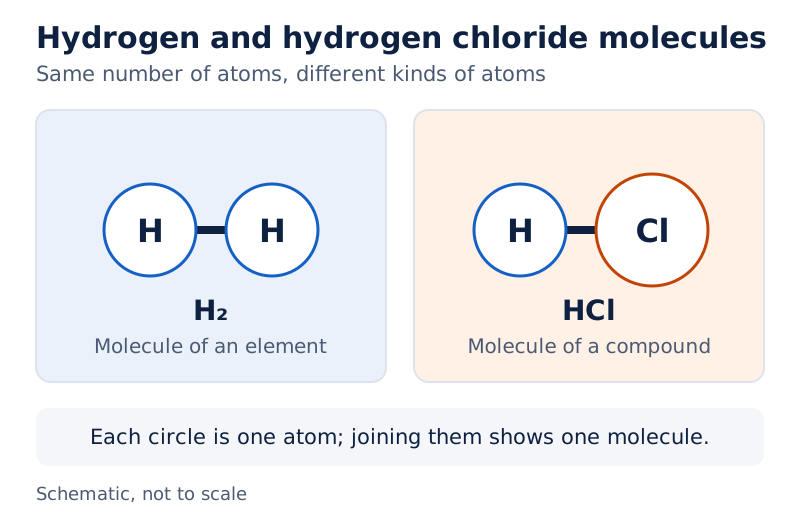
Draw two joined circles labelled H for hydrogen. Beside them, draw one circle labelled H joined to one labelled Cl for hydrogen chloride. Label the first pair H₂ and the second pair HCl.
Drawn by One Young India.
The circles represent atoms, and joining them represents their combination in a molecule. The labels identify the elements; they are essential for distinguishing a molecule of an element from a molecule of a compound.
What are the names and symbols of the first twenty elements?
Symbols make it possible to represent elements without repeatedly writing their full names. Each symbol has a particular meaning. Learning the name and symbol together helps you read a formula and recognise which elements it contains.
The periodic table is a classification of elements that brings relationships between their properties into an organised arrangement. The following list gives the first twenty elements in their order in this table. The position numbers here identify that sequence.
| Position | Element | Symbol |
|---|---|---|
| 1 | Hydrogen | H |
| 2 | Helium | He |
| 3 | Lithium | Li |
| 4 | Beryllium | Be |
| 5 | Boron | B |
| 6 | Carbon | C |
| 7 | Nitrogen | N |
| 8 | Oxygen | O |
| 9 | Fluorine | F |
| 10 | Neon | Ne |
| 11 | Sodium | Na |
| 12 | Magnesium | Mg |
| 13 | Aluminium | Al |
| 14 | Silicon | Si |
| 15 | Phosphorus | P |
| 16 | Sulphur | S |
| 17 | Chlorine | Cl |
| 18 | Argon | Ar |
| 19 | Potassium | K |
| 20 | Calcium | Ca |
Why does the size of the letters matter?
The first letter of a chemical symbol is always a capital letter. If there is a second letter, it is a small letter. Aluminium is written Al, and chlorine is written Cl. Both letters belong to a single symbol.
Capitalisation, meaning the use of capital and small letters, is part of the symbol. Ca represents calcium, whereas C represents carbon. Do not treat a second small letter as the symbol of another element.
Some symbols do not resemble the English name closely. Sodium has the symbol Na, from natrium, and potassium has the symbol K, from kalium. Learn these associations directly instead of trying to guess every symbol from the English name.
For revision, cover the symbol column and recall each symbol from its name. Then cover the names and work in the other direction. This checks both the recognition needed for reading formulae and the accuracy needed for writing them.
What is atomicity and how do we count it?
Definition: Atomicity is the number of atoms in one entity. Here, an entity means the individual particle being considered, such as an atom or a molecule.
Monoatomic means containing one atom, diatomic means containing two atoms, and triatomic means containing three atoms. In the classification used here, polyatomic describes a molecule with more than three atoms. Helium is a monoatomic element.
Hydrogen and oxygen are diatomic in their familiar molecular forms, H₂ and O₂. Ozone, O₃, is a triatomic form of oxygen. Phosphorus, P₄, and sulphur, S₈, provide examples of polyatomic elemental molecules.
How is atomicity different from the number of elements?
Atomicity counts every atom in the particle, including repeated atoms of the same element. It does not count just the different symbols. Water has atomicity three because one molecule contains two hydrogen atoms and one oxygen atom.
| Particle | Atom count | Description |
|---|---|---|
| Helium, He | 1 | Monoatomic element |
| Hydrogen, H₂ | 2 | Diatomic molecule of an element |
| Ozone, O₃ | 3 | Triatomic molecule of an element |
| Phosphorus, P₄ | 4 | Polyatomic molecule of an element |
| Sulphur, S₈ | 8 | Polyatomic molecule of an element |
| Water, H₂O | 2 + 1 = 3 | Triatomic molecule of a compound |
Worked example 1. Carbon dioxide has the formula CO₂, where C means carbon and O means oxygen. Find the atomicity of one molecule.
Answer: One carbon atom and two oxygen atoms give 1 + 2 = 3 atoms. Carbon dioxide is triatomic, although it contains only two elements.
Diagram
Comparing oxygen and water particles
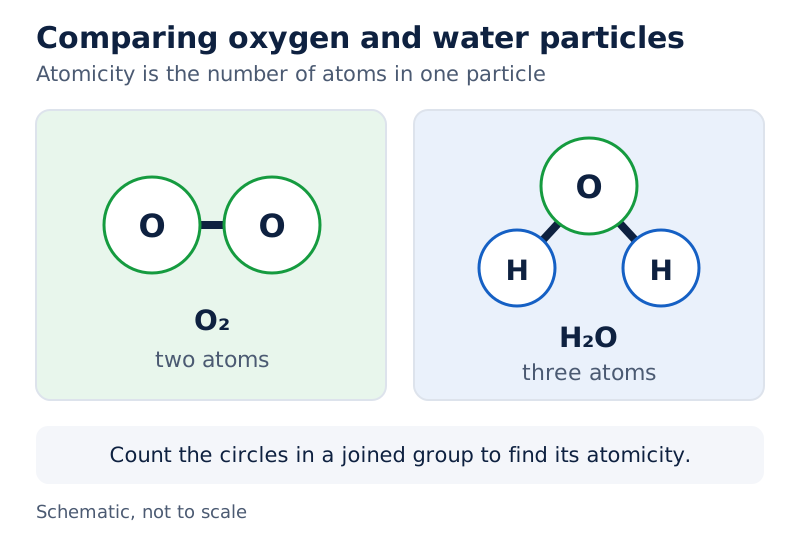
Draw a joined pair of circles labelled O for O₂. Draw a separate group containing one O circle joined to two H circles for H₂O. Write “two atoms” and “three atoms” beneath the respective groups.
Drawn by One Young India.
The distinction between particle count and atom count is useful when reading these diagrams. Each joined group represents one molecule, even when that molecule contains several atoms. Count the circles within a group to find its atomicity.
What is a radical and how is its charge written?
Definition: A radical is a single atom or a group of atoms of different elements that behaves as one charged unit. In this usage, radicals are ions: particles with an overall electric charge.
Electric charge is the property described as positive or negative. A neutral particle has no overall electric charge. A positively charged ion is a cation; a negatively charged ion is an anion.
A sodium ion is written Na⁺, with a positive sign. A chloride ion is written Cl⁻, with a negative sign. These are examples of single-atom radicals. Chlorine is the element name, while chloride is the name of its negative ion.
How do single-atom and group radicals differ?
A polyatomic ion contains more than one atom behaving as one charged unit. In this term, polyatomic includes a two-atom group. The hydroxide ion, OH⁻, contains one oxygen atom and one hydrogen atom but has one overall negative charge.
The ammonium ion, NH₄⁺, contains one nitrogen atom and four hydrogen atoms. The positive sign applies to the whole ammonium group. It does not mean that a separate positive sign must be assigned to each atom.
| Radical | Representation | Kind of particle and overall charge |
|---|---|---|
| Sodium | Na⁺ | Single atom; one positive charge |
| Chloride | Cl⁻ | Single atom; one negative charge |
| Calcium | Ca²⁺ | Single atom; two positive charges |
| Hydroxide | OH⁻ | Group of atoms; one negative charge |
| Ammonium | NH₄⁺ | Group of atoms; one positive charge |
A superscript is written at the upper right. In an ion formula it shows charge. The superscript ²⁺ means two positive charges. A plus or minus sign without a number means one positive or one negative charge respectively.
Note: A subscript counts atoms; a superscript gives charge. The ₄ in NH₄⁺ counts hydrogen atoms. The ⁺ describes the charge of the whole ion. The two marks answer different questions.
How can we distinguish atoms, molecules and radicals?
Use two questions to distinguish these particles: what atoms are present, and does the particle have an overall charge? Merely counting the number of atoms is insufficient because a group of atoms can be either a neutral molecule or a charged radical.
Which features should a comparison include?
| Particle | Meaning | Example | Charge description |
|---|---|---|---|
| Atom | Smallest particle of an element | Helium atom, He | Neutral atom |
| Molecule | Independent particle of an element or compound | Water molecule, H₂O | Electrically neutral |
| Radical | Atom or group behaving as one charged unit | Hydroxide ion, OH⁻ | Overall negative charge |
A molecule can contain atoms of the same element, as in H₂, or different elements, as in H₂O. Therefore, “molecule” does not automatically mean “compound”. The element-or-compound distinction depends on the kinds of atoms making up the substance.
Likewise, “radical” does not automatically mean “many atoms”. Sodium ions and chloride ions each contain a single atom. Hydroxide and ammonium ions contain groups of atoms. Both kinds satisfy the requirement of behaving as one charged unit.
How should we read an unfamiliar representation?
- Identify each element symbol, keeping a second small letter with the capital letter before it.
- Read each subscript to find the number of atoms of the corresponding element.
- Look for a superscript charge and decide whether the particle is positive, negative or neutral.
- Combine the information to describe the particle, including whether it contains one or several kinds of atoms.
Applied to H₂O, this method gives a neutral molecule containing two hydrogen atoms and one oxygen atom. Applied to OH⁻, it gives a negatively charged group containing one oxygen atom and one hydrogen atom. Similar symbols do not make the particles identical.
Helium needs particular care: its independently existing particle is a single atom. The broad elementary description of an independent particle can include this monoatomic case; it must not lead you to draw two helium atoms where only one is represented.
How does hydrogen help us understand valency?
Definition: Valency is the combining capacity of an element. It can be expressed as the number of hydrogen atoms with which one atom of that element combines, or which it replaces.
Combining capacity describes how an atom combines with other atoms to form a compound. Hydrogen has valency one and provides a reference. Compare the number of hydrogen atoms associated with one atom of the other element.
In hydrogen chloride, HCl, one chlorine atom combines with one hydrogen atom. Chlorine therefore has valency one in this compound. In water, H₂O, one oxygen atom combines with two hydrogen atoms, so oxygen has valency two.
In ammonia, NH₃, one nitrogen atom combines with three hydrogen atoms. Nitrogen therefore has valency three in ammonia. In methane, CH₄, one carbon atom combines with four hydrogen atoms, showing carbon's valency of four.
| Compound | Hydrogen atoms per atom of the other element | Valency shown |
|---|---|---|
| Hydrogen chloride, HCl | 1 per chlorine atom | Chlorine: 1 |
| Water, H₂O | 2 per oxygen atom | Oxygen: 2 |
| Ammonia, NH₃ | 3 per nitrogen atom | Nitrogen: 3 |
| Methane, CH₄ | 4 per carbon atom | Carbon: 4 |
How do we apply the definition carefully?
- Read the formula and identify hydrogen and the other element.
- Count the atoms of each element represented in one molecule.
- Express the hydrogen count relative to one atom of the other element.
- State the valency shown by that element in the given compound.
Worked example 2. Ammonia, NH₃, contains one nitrogen atom and three hydrogen atoms per molecule. Hydrogen has valency one. What valency does nitrogen show?
Answer: One nitrogen atom combines with three hydrogen atoms. Nitrogen therefore shows valency 3 in ammonia. The atomicity of ammonia is 1 + 3 = 4, which is a different quantity.
Diagram
Hydrogen counts and combining capacity
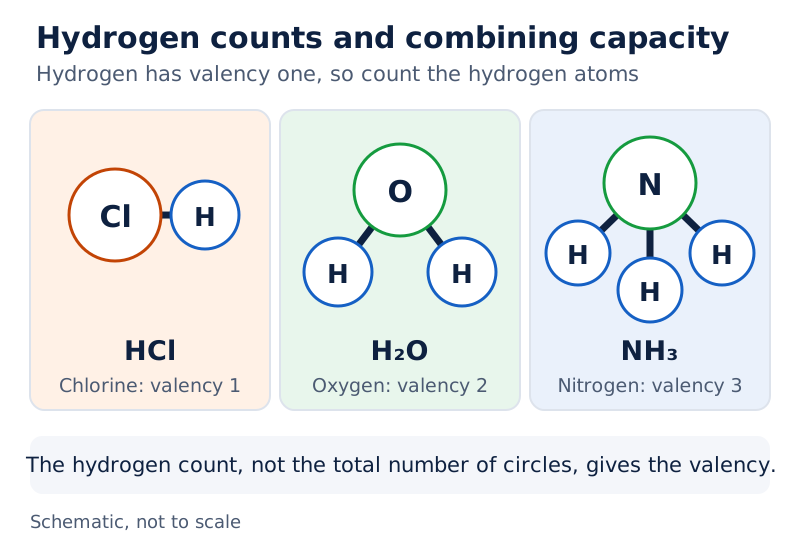
Draw three separate groups: one Cl circle joined to one H circle; one O circle joined to two H circles; and one N circle joined to three H circles. Label them HCl, H₂O and NH₃.
Drawn by One Young India.
The replacement part of the definition can also be used. Zinc, symbol Zn, replaces two hydrogen atoms from sulphuric acid when zinc sulphate and hydrogen are formed. Zinc shows valency two in this reaction.
These are counting models. Their purpose is to show the number of hydrogen atoms combined with one atom of another element. The hydrogen count, rather than the total number of circles in each group, gives the required valency.
What are the valencies of common radicals?
For a charged radical, its valency corresponds to the size of its charge without the positive or negative sign. The size of a charge is its numerical magnitude: one for a single charge, two for a double charge, and so on.
Sodium, Na⁺, and chloride, Cl⁻, both have valency one, although their charges have opposite signs. Calcium, Ca²⁺, has valency two. Aluminium, Al³⁺, has valency three. The superscript ³⁺ means three positive charges.
How do we use the whole group?
When a radical contains several atoms, treat the group as one combining unit. The number of atoms inside that group is not its valency. Ammonium contains five atoms altogether, but the charge on NH₄⁺ is one positive charge, giving valency one.
| Polyatomic radical | Formula | Valency |
|---|---|---|
| Hydroxide | OH⁻ | 1 |
| Nitrate | NO₃⁻ | 1 |
| Hydrogencarbonate | HCO₃⁻ | 1 |
| Carbonate | CO₃²⁻ | 2 |
| Sulphate | SO₄²⁻ | 2 |
| Ammonium | NH₄⁺ | 1 |
In these formulae, N means nitrogen, C means carbon, and S means sulphur, as in the element list. The names nitrate, carbonate and sulphate identify the particular charged groups shown. A superscript ²⁻ means two negative charges on the group.
Worked example 3. Sulphate is SO₄²⁻. Find its total number of atoms, its charge and its valency.
Answer: One sulphur atom and four oxygen atoms give 5 atoms. The ion has two negative charges, and its valency is 2. The subscript four counts oxygen atoms; it does not give the valency.
The hydrogen-based idea also applies to negative groups. One hydrogen combines with one chloride group in HCl. Two hydrogens correspond to one sulphate group in sulphuric acid, H₂SO₄, showing the sulphate group's combining capacity of two.
Valency cards can pair each radical's name, formula and valency. Reading all three together prevents confusion between similarly written particles and keeps the charge attached to the whole group.
How is valency related to groups in the periodic table?
A group is a vertical column in the periodic table. A period is a horizontal row. Modern groups are numbered from 1 to 18. Elements in the same group show similarities in their chemical properties.
For the first twenty elements, useful simple valencies can be associated with their groups. A group number is a table position, while valency is a combining capacity. They are connected, but the numbers do not always equal one another.
Which simple pattern is useful?
| Modern group | Examples among the first twenty elements | Simple valency used here |
|---|---|---|
| 1 | Lithium, sodium, potassium | 1 |
| 2 | Beryllium, magnesium, calcium | 2 |
| 13 | Boron, aluminium | 3 |
| 14 | Carbon, silicon | 4 |
| 15 | Nitrogen, phosphorus | 3 in their simple hydrogen compounds |
| 16 | Oxygen, sulphur | 2 in their simple hydrogen compounds |
| 17 | Fluorine, chlorine | 1 in their hydrogen compounds |
| 18 | Helium, neon, argon | 0 in this elementary pattern |
Hydrogen has valency one, but it is a special case in periodic classification. Use lithium, sodium and potassium when comparing the group 1 elements in this list. Their common valency is one.
Group 18 elements are called noble gases. They have very low chemical reactivity, meaning little tendency to undergo chemical change. Helium, neon and argon are examples. Their zero valency belongs to the elementary pattern shown here.
What limits must we remember?
Variable valency means that an element can show different combining capacities in different compounds. The group pattern is a useful guide, not a claim that every member has one unchanging valency in all its compounds.
For example, the value three for nitrogen is supported by ammonia, NH₃. A formula supplied in a question gives the specific combination to examine. Use that information rather than assuming that a group number is itself a valency.
Worked example 4. Silicon belongs to group 14, and the simple valency pattern assigns four to that group. What valency should be used in this pattern?
Answer: Silicon has valency 4 in the stated pattern. Its group number is 14, but its combining capacity is not fourteen.
The periodic table brings many element facts together. The symbol identifies the element, the group places it among related elements, and valency describes a combining relationship. Keeping these three roles distinct makes the table easier to use.
Glossary
- Atom — The smallest particle of an element, forming a basic building block of matter.
- Element — A substance containing one kind of atom that cannot be chemically broken into simpler substances.
- Compound — A substance formed when different elements combine chemically in a fixed ratio.
- Molecule — The smallest independently existing particle of an element or compound retaining that substance's properties.
- Atomicity — The total number of atoms in the individual particle being considered.
- Chemical symbol — A short representation identifying an element, written with the correct capital and small letters.
- Chemical formula — A representation using element symbols and numbers to show a substance's composition.
- Radical — An atom or group of atoms behaving as a single charged unit.
- Cation — An ion carrying an overall positive electric charge rather than a negative charge.
- Anion — An ion carrying an overall negative electric charge rather than a positive charge.
- Polyatomic ion — A group containing more than one atom and behaving as one charged unit.
- Valency — Combining capacity expressed through hydrogen combination or replacement, or through the magnitude of an ion's charge.
- Group — A vertical column in the periodic table containing elements with related chemical properties.
- Period — A horizontal row of elements in the arrangement called the periodic table.
- Variable valency — The ability of an element to show different combining capacities in different compounds.
Common errors and misconceptions
- Misconception: No atom can exist independently. Correct: Atoms of most elements cannot exist independently, but helium exists as separate atoms.
- Misconception: Every molecule is a compound. Correct: H₂ contains atoms of one element, whereas H₂O contains atoms of different elements and is a compound.
- Misconception: H₂O has atomicity two because it has two element symbols. Correct: Two hydrogen atoms and one oxygen atom give atomicity three.
- Misconception: Every radical contains several atoms. Correct: A radical can be a single charged atom, such as Na⁺, or a charged group, such as OH⁻.
- Misconception: The four in SO₄²⁻ gives its valency. Correct: Four counts oxygen atoms; the double negative charge gives sulphate valency two.
- Misconception: Nitrogen has valency four because NH₃ has four atoms. Correct: Nitrogen combines with three hydrogen atoms in ammonia, so its valency there is three.
- Misconception: Capital and small letters can be interchanged in symbols. Correct: Write the first letter as a capital and any second letter as a small letter, as in Al.
- Misconception: A modern group number always equals valency. Correct: Group 14 has simple valency four, and some elements show variable valency.
Exam-style questions with model answers
Q1. Hydrogen is represented by H₂, containing two hydrogen atoms. Hydrogen chloride is HCl, containing one hydrogen and one chlorine atom. Classify each as a molecule of an element or a compound, giving a reason. [2 marks]
- H₂ is a molecule of an element because both atoms in the molecule are hydrogen atoms.
- HCl is a molecule of a compound because it contains atoms of two different elements, hydrogen and chlorine.
Q2. Water has the formula H₂O, with two hydrogen atoms and one oxygen atom per molecule. Find its atomicity, classify it by atomicity, and distinguish this count from the number of elements present. [3 marks]
- The atomicity is three: adding the two hydrogen atoms and the one oxygen atom gives three atoms in one water molecule.
- Water is triatomic because the word triatomic describes a particle containing three atoms, regardless of whether those atoms are identical.
- There are two elements, hydrogen and oxygen. Atomicity counts individual atoms, so the repeated hydrogen atom must still be counted.
Q3. Hydrogen has valency one. HCl, H₂O and NH₃ each contain one atom of chlorine, oxygen and nitrogen respectively, combined with the indicated hydrogen atoms. Define valency and determine the valency shown by each of these three elements. [4 marks]
- Valency is an element's combining capacity, expressed here as the number of hydrogen atoms that combine with one atom of the element.
- In HCl, one chlorine atom combines with one hydrogen atom. Chlorine therefore shows valency one in hydrogen chloride.
- In H₂O, one oxygen atom combines with two hydrogen atoms. Oxygen therefore shows valency two in water.
- In NH₃, one nitrogen atom combines with three hydrogen atoms. Nitrogen therefore shows valency three in ammonia.
Q4. Sulphate is SO₄²⁻, where S represents sulphur, O represents oxygen, the subscript 4 counts oxygen atoms, and ²⁻ denotes two negative charges on the whole group. State its composition, total atom count, kind of ion, charge and valency. [5 marks]
- The sulphate group contains one sulphur atom and four oxygen atoms. The absence of a subscript after S indicates one sulphur atom.
- Its total atom count is five, obtained by adding the one sulphur atom to the four oxygen atoms in the group.
- It is a polyatomic anion: it contains several atoms acting as one unit and has an overall negative charge.
- The whole group carries two negative charges, as shown by the superscript ²⁻; that charge is separate from the oxygen count.
- Its valency is two, the magnitude of its charge. Valency is written without the negative sign used in the ion formula.
Q5. The symbols are Na for sodium, K for potassium, Ca for calcium, and Cl for chlorine. Explain the capitalisation rule, illustrate it with calcium and chlorine, and give the symbols of sodium and potassium. [4 marks]
- A chemical symbol begins with a capital letter. If it contains a second letter, that letter is written in small form.
- Calcium is Ca: the capital C and small a together form one symbol representing the element calcium.
- Chlorine is Cl: the capital C and small l belong together and identify chlorine, rather than two separate elements.
- Sodium is represented by Na, and potassium by K. These supplied symbols must be associated with their respective names.
Q6. Use this simple periodic pattern: group 1 has valency 1, group 2 has valency 2, group 14 has valency 4, and group 18 has valency 0. Sodium, calcium, silicon and argon belong to those groups respectively. Explain what a group is, assign these four valencies, and state why group number should not be copied directly as valency. [6 marks]
- A group is a vertical column in the periodic table. Elements in a group have similarities in their chemical properties.
- Sodium belongs to group 1, so the supplied pattern assigns sodium valency one. This describes its combining capacity in this pattern.
- Calcium belongs to group 2, so the supplied pattern assigns calcium valency two. Its value follows directly from the given group relationship.
- Silicon belongs to group 14, whose stated simple valency is four. Thus silicon is assigned valency four rather than fourteen.
- Argon belongs to group 18, so the given elementary pattern assigns argon valency zero. The group number itself remains eighteen.
- Group number identifies a column, whereas valency describes combining capacity. Silicon and argon demonstrate that the two numbers need not be equal.
Key takeaways
- Atoms are the building blocks of matter; atoms of most elements combine, while helium can exist as separate atoms.
- Molecules of elements contain one kind of atom; molecules of compounds contain atoms of different elements chemically combined.
- Element symbols begin with a capital letter, followed by a small letter when a second letter is needed.
- Atomicity counts all atoms in one particle, including repeated atoms of the same element.
- A radical behaves as one charged unit and can contain either a single atom or a group of atoms.
- Subscripts count atoms, while superscripts show ionic charge; these numbers must be read separately.
- Hydrogen-based valency counts hydrogen atoms combined with or replaced by one atom of another element.
- Group number and valency describe different features; simple group patterns are useful but some elements have variable valency.
Test yourself
Why is helium an exception to the statement about most atoms?
Helium exists as separate atoms, whereas atoms of most elements cannot exist independently.
What does the formula H₂ tell you about one hydrogen molecule?
It contains two hydrogen atoms, both belonging to the same element.
Carbon dioxide is CO₂. What is its atomicity?
Its atomicity is three: one carbon atom plus two oxygen atoms.
How many atoms are present in one ammonium ion, NH₄⁺?
Five atoms are present: one nitrogen atom and four hydrogen atoms.
Why is the valency of NH₄⁺ one rather than four?
Its charge has magnitude one; four counts hydrogen atoms within the ion.
In H₂O, one oxygen combines with two hydrogens. What is oxygen's valency?
Oxygen has valency two because it combines with two hydrogen atoms.
What is the difference between a group and a period?
A group is a vertical column; a period is a horizontal row in the periodic table.
Does the simple valency pattern make silicon's valency fourteen because it is in group 14?
No. Silicon has simple valency four; fourteen is its modern group number.
Write about it
Turn a question from this chapter into a paper.
The Writing Studio has a structure guide, a rubric and citation tools for 15 formats, from essays to research papers. Drafting is free with an account. Learnacy Essential adds feedback from an AI writing coach and submission to The OYI Review.
Learnacy Essential is ₹1,499 for the year. Publication depends on review and is not guaranteed.