
Chemical Reactions | ICSE Class 8 Chemistry Notes
On this page
This note covers chemical changes, reactants and products, chemical equations, combination and decomposition, displacement and double displacement, the reactivity series, heat changes, neutralisation, and the preparation and classification of oxides.
What happens during a chemical reaction?
A chemical reaction is a change in which new substances form. The substances undergoing the change are called reactants. The new substances formed are called products. Their properties differ from those of the starting substances.
An atom is a basic particle of an element. An element contains one kind of atom; a compound contains different elements chemically combined. A chemical bond holds atoms together. Reactions involve breaking existing bonds and making new bonds.
During a reaction, atoms of one element do not become atoms of another element. Atoms are rearranged into new combinations. This explains how the substances can change while the kinds of atoms taking part remain the same.
Which observations help us recognise a reaction?
An oxide is a compound of oxygen with another element. A change in colour or state, the evolution of a gas, or a change in temperature can help identify a reaction. Gas evolution means gas is produced. Record the observation first, then connect it to the substances formed.
| Example | Observation | Chemical change |
|---|---|---|
| Magnesium burning in air | A dazzling white flame and white powder | Magnesium oxide forms |
| Iron in copper sulphate solution | The blue colour fades and the nail becomes brownish | Iron sulphate and copper form |
| Calcium oxide reacting with water | The mixture becomes warm | Calcium hydroxide forms |
A physical change changes a physical property without producing a new substance. Melting wax and boiling water are physical changes. Burning paper, digestion and rusting are chemical changes. A visible change alone must therefore be interpreted carefully.
What the figure shows
Burning magnesium
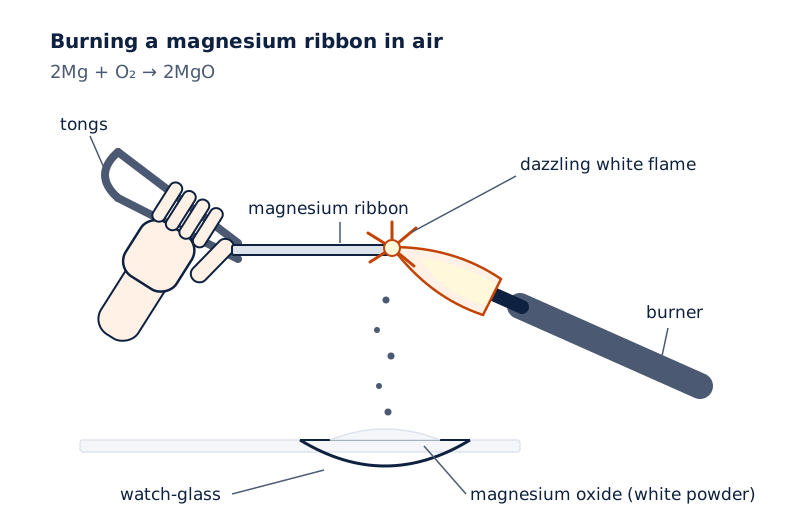
A hand holds magnesium ribbon with tongs above a watch-glass. A burner is directed towards the ribbon. The labels identify the tongs, magnesium ribbon, burner, watch-glass and magnesium oxide collected below.
Drawn by One Young India.
Note: Burning magnesium requires a teacher's assistance. Keep the burning ribbon well away from the eyes; suitable eye protection is advisable.
How do chemical equations represent and balance reactions?
A word equation gives the names of reactants and products. A chemical equation uses their symbols and formulae. A chemical formula shows which elements a substance contains and the relative numbers of their atoms.
The arrow, →, means “forms” and points from reactants to products. The plus sign, +, separates substances on the same side. Magnesium + oxygen → magnesium oxide therefore identifies both starting substances and the product.
What do the symbols mean?
The element symbols used below are Mg for magnesium, O for oxygen, H for hydrogen, Ca for calcium, C for carbon, Fe for iron, Cu for copper, Zn for zinc, S for sulphur, Na for sodium, Cl for chlorine, Ba for barium, Ag for silver, N for nitrogen, Pb for lead and Al for aluminium.
A molecule is a group of bonded atoms. A small lower numeral, called a subscript, belongs to the formula: O₂ represents oxygen molecules containing two oxygen atoms each. MgO is magnesium oxide. A coefficient is a number placed before a formula and multiplies the whole formula.
2Mg + O₂ → 2MgO
The equation contains two magnesium atoms and two oxygen atoms on each side. The law of conservation of mass states that mass is neither created nor destroyed during a chemical reaction. The number of atoms of each element remains the same before and after reaction.
How should balancing be checked?
- Write the correct formulae of the reactants and products.
- Count the atoms of each element on both sides.
- Change coefficients to equalise the counts, keeping the formulae unchanged.
- Check every element again and use the smallest whole-number coefficients.
A balanced equation has equal numbers of each kind of atom on both sides. Changing MgO into a different formula would change the substance, so it cannot be used to balance this reaction.
State symbols add information: (s) means solid, (l) liquid, (g) gas and (aq) aqueous. Aqueous means dissolved in water. A condition such as heat or sunlight tells us what is needed for that reaction.
Derivation: How is the magnesium equation balanced?
- Start with the skeletal equation . There is one magnesium atom on each side, but two oxygen atoms on the left and one on the right.
- Put 2 before magnesium oxide: . The oxygen counts now agree, but the right side contains two magnesium atoms.
- Put 2 before magnesium. Both sides now contain two atoms of each element, without changing any chemical formula.
Balanced equation: .
Derivation: How is the reaction between iron and steam balanced?
- Start with . The iron atom counts are 1 and 3; the oxygen counts are 1 and 4.
- Balance oxygen by putting 4 before water. This gives hydrogen atoms on the left, so put 4 before hydrogen on the right.
- Put 3 before iron. Check the final counts: three iron atoms, four oxygen atoms and eight hydrogen atoms occur on each side.
Balanced equation: . Water is present as steam in this reaction.
How can masses verify a balanced reaction?
The total mass of reactants equals the total mass of products: . Include every product, including any gas. A gas escaping from an open vessel can lower the measured mass without violating conservation of mass.
Worked example 1. In a closed container, 4.0 g of calcium carbonate reacts with 2.92 g of hydrochloric acid. The products are 1.76 g of carbon dioxide, 0.72 g of water and 4.44 g of calcium chloride. Verify conservation of mass.
Formula: and , where R and P are total reactant and product masses; a and b are the two reactant masses, and c, d and e are the three product masses in the order given.
Substitute: . Thus . Also, , giving .
Answer: Both totals are 6.92 g. Mass is conserved because the total product mass equals the total reactant mass.
Worked example 2. Sodium carbonate of mass 5.3 g reacts with 6.0 g of acetic acid, producing 2.2 g of carbon dioxide, 0.9 g of water and 8.2 g of sodium acetate. Verify conservation of mass.
Formula: and . R and P are the total reactant and product masses; a and b are the reactant masses, and c, d and e are the product masses in the order given.
Substitute: , so . Also, , so .
Answer: The reactants and products each have a total mass of 11.3 g, so the law is obeyed.
Worked example 3. When 20 g of hydrogen reacts completely with 160 g of oxygen, how much water forms?
Formula: . Water is the product, so its mass equals the sum of the reacting masses.
Substitute: .
Answer: 180 g of water forms. Both reactants are consumed completely in the stated reaction.
How do given mass ratios help with reaction calculations?
A compound contains its elements in a fixed ratio by mass. Use the stated mass relationship to scale a reaction calculation. The coefficients of a balanced equation count particles; they must not be read directly as masses in grams.
Worked example 4. Carbon of mass 12 g combines with 32 g of oxygen to form 44 g of carbon dioxide. How much carbon dioxide forms when 2.4 g of carbon reacts completely with oxygen?
Formula: , where the masses are in grams. First divide 44 g by 12 to obtain the carbon dioxide produced per gram of carbon, then multiply by the reacting carbon mass.
Substitute: .
Answer: 8.8 g of carbon dioxide forms. Its mass includes the oxygen that combines with the carbon.
Worked example 5. Sodium chloride contains sodium and chlorine in the mass ratio 23:35.5. What mass of chlorine is needed when 46 g of sodium reacts completely?
Formula: . The ratio gives the chlorine mass required for each gram of sodium.
Substitute: . Since , multiply 35.5 g by 2.
Answer: 71 g of chlorine is needed to form sodium chloride.
Worked example 6. Carbon monoxide contains carbon and oxygen in the mass ratio 3:4. What mass of oxygen combines with 9 g of carbon?
Formula: . Use the mass ratio for carbon monoxide.
Substitute: . Since , multiply 4 g by 3.
Answer: 12 g of oxygen combines with 9 g of carbon to form carbon monoxide.
How do combination reactions produce a single product?
Definition: A combination reaction forms a single product from two or more reactants. The reactants may be elements or compounds.
When magnesium burns, magnesium and oxygen combine to produce magnesium oxide. The bright flame is an observation; the formation of one product from the two reactants is the reason for classifying the change as a combination reaction.
Carbon, represented by C, burns in oxygen to form carbon dioxide, CO₂. Its formula contains one carbon atom and two oxygen atoms. The equation is C + O₂ → CO₂. There is one product substance even though its formula contains different elements.
What happens when quicklime meets water?
Quicklime is calcium oxide, CaO. It reacts vigorously with water, H₂O, to produce calcium hydroxide, Ca(OH)₂, also called slaked lime. In this formula, the numeral outside the brackets applies to both O and H inside them.
CaO(s) + H₂O(l) → Ca(OH)₂(aq) + heat
The reaction releases a large amount of heat. Calcium oxide and water are the two reactants; calcium hydroxide is the single chemical product. Heat describes an energy change, rather than an additional substance formed in the reaction.
What the figure shows
Quicklime and water
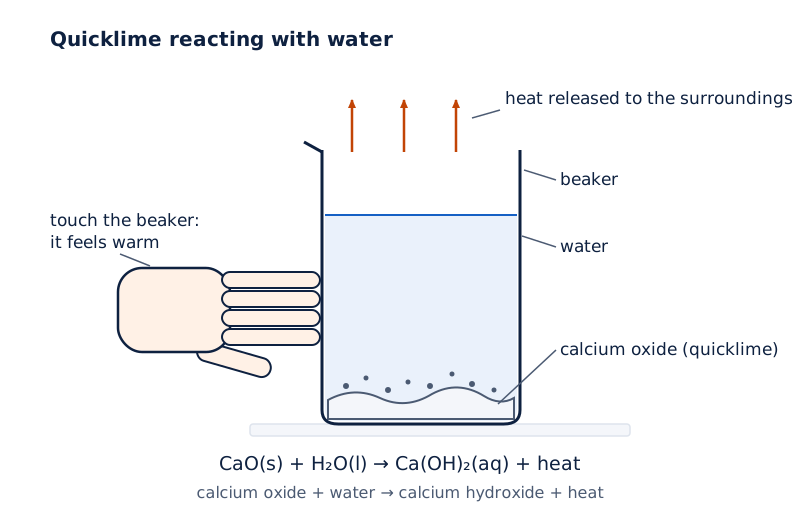
The drawing shows a beaker containing water and calcium oxide, with a hand against its side. The labels identify the beaker, water and calcium oxide.
Drawn by One Young India.
How is this connected with whitewashing?
A solution of slaked lime is used for whitewashing. Calcium hydroxide reacts slowly with carbon dioxide in air to form calcium carbonate, CaCO₃, and water. Calcium carbonate forms after two to three days and gives the wall a shiny finish.
Ca(OH)₂(aq) + CO₂(g) → CaCO₃(s) + H₂O(l)
A carbonate contains the carbonate group, a charged group containing carbon and oxygen. This later equation has two products. It must not be confused with the combination of quicklime and water. Identify reaction types from the substances in the equation, rather than assuming that every stage of whitewashing is a combination reaction.
How do decomposition reactions break compounds down?
In a decomposition reaction, one reactant breaks down into two or more simpler products. This is the opposite pattern to combination. Combination joins reactants into one product; decomposition starts with one substance and gives several products.
Decomposition may require energy supplied as heat, light or electricity. Name the energy source where it is needed. An equation without its required condition leaves out useful information about how the change occurs.
What is thermal decomposition?
Thermal decomposition is decomposition brought about by heating. Calcium carbonate, found in limestone, decomposes on heating to give calcium oxide and carbon dioxide. Calcium oxide is useful in the manufacture of cement.
CaCO₃(s) → CaO(s) + CO₂(g), on heating.
Calcium carbonate is the single reactant. The solid calcium oxide and gaseous carbon dioxide are the products. Carbon dioxide leaving as a gas does not mean that atoms have disappeared from the reaction.
A nitrate contains the nitrate group, a charged group containing nitrogen and oxygen. Lead nitrate, Pb(NO₃)₂, also decomposes when heated. It forms lead oxide, PbO, nitrogen dioxide, NO₂, and oxygen. The observed brown fumes are nitrogen dioxide. The subscript outside the brackets in lead nitrate applies to the entire nitrate group inside them.
2Pb(NO₃)₂(s) → 2PbO(s) + 4NO₂(g) + O₂(g), on heating.
How can light cause decomposition?
Silver chloride, AgCl, is white. It turns grey in sunlight because it decomposes into silver and chlorine, Cl₂. The equation is 2AgCl(s) → 2Ag(s) + Cl₂(g), in sunlight. The energy source here is light.
Breaking water down by electricity provides another energy route. This process is called electrolysis. Hydrogen, H₂, and oxygen are produced. Heat, light and electricity are different ways of supplying energy; they should not all be described as thermal decomposition.
Note: The defining feature of decomposition is a single reactant giving simpler products. The presence of heating alone does not identify a reaction as decomposition.
How do displacement reactions reveal relative reactivity?
A displacement reaction occurs when an element replaces another element in its compound. For metals in salt solutions, the metal that displaces the other is more reactive. Reactivity describes the tendency of a substance to take part in chemical reactions.
An ion is an atom or group of atoms carrying an electric charge. A salt is an ionic compound, meaning a compound made of ions, such as copper sulphate. A salt solution contains dissolved ions. A sulphate contains the sulphate group, a charged group containing sulphur and oxygen. Copper sulphate has the formula CuSO₄.
What happens to iron in copper sulphate?
Iron placed in copper sulphate solution displaces copper. Iron sulphate, FeSO₄, forms in solution and copper is deposited on the nail. The nail becomes brownish and the blue colour of the copper sulphate solution fades.
Fe(s) + CuSO₄(aq) → FeSO₄(aq) + Cu(s)
Iron is therefore more reactive than copper. The observation and the equation support the same conclusion. Copper has been removed from its compound, while iron has become part of a compound in solution.
What the figure shows
Comparing iron nails and solutions
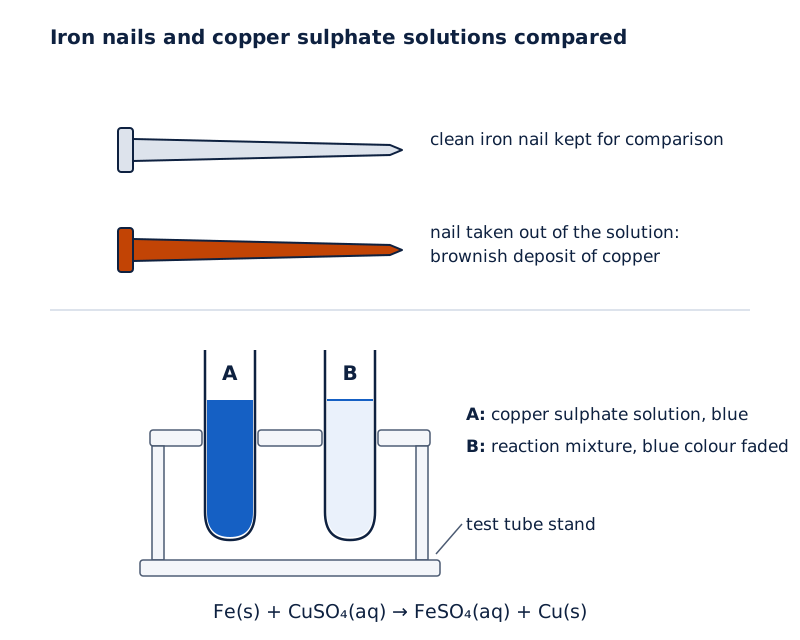
Two nails are shown side by side, with the treated nail brown. A stand holds test tubes A and B. A contains blue copper sulphate solution; B contains the paler reaction mixture.
Drawn by One Young India.
What does the reactivity series tell us?
The reactivity series arranges metals in decreasing order of reactivity. For the five metals magnesium, aluminium, iron, copper and silver, the decreasing order is magnesium, aluminium, iron, copper, silver. “Decreasing” means that reactivity becomes lower as we move along this list.
Zinc also displaces copper from copper sulphate. Zinc sulphate has the formula ZnSO₄: Zn(s) + CuSO₄(aq) → ZnSO₄(aq) + Cu(s). This provides another example of a more reactive metal replacing a less reactive metal.
Copper does not displace iron from iron sulphate solution. Use the direction of replacement carefully: a reaction showing iron displacing copper does not mean the reverse replacement will also occur.
How do double displacement and precipitation reactions differ?
A double displacement reaction involves an exchange of ions between reacting compounds. This differs from a metal replacing another metal in a salt: here the reacting substances exchange their ionic partners to produce new compounds.
A precipitate is an insoluble substance formed during a reaction in solution. Insoluble means that it does not dissolve in the water. A reaction producing a precipitate is called a precipitation reaction.
What happens when two salt solutions are mixed?
Sodium sulphate solution and barium chloride solution produce a white precipitate of barium sulphate. Sodium sulphate is Na₂SO₄, barium chloride is BaCl₂, barium sulphate is BaSO₄ and sodium chloride is NaCl.
Na₂SO₄(aq) + BaCl₂(aq) → BaSO₄(s) + 2NaCl(aq)
The barium sulphate is insoluble, while sodium chloride remains in solution. The equation is balanced: both sides contain two sodium atoms, one sulphur atom, four oxygen atoms, one barium atom and two chlorine atoms.
This reaction can be described in two ways. It is double displacement because ions exchange partners. It is precipitation because an insoluble solid forms. The labels describe different features of the same chemical change.
| Feature | Displacement | Double displacement |
|---|---|---|
| Reactants in the examples | An element and a compound | Two compounds in solution |
| Change involved | One element replaces another | Ions exchange partners |
| Example | Iron with copper sulphate | Sodium sulphate with barium chloride |
What is another double displacement equation?
Silver nitrate, AgNO₃, reacts with sodium chloride to form silver chloride and sodium nitrate, NaNO₃. The balanced equation is AgNO₃ + NaCl → AgCl + NaNO₃. Track the silver changing from nitrate to chloride and sodium changing from chloride to nitrate.
Do not classify a reaction simply by counting two products. Decomposition can also produce two products. Check what the reactants are and whether the change involves one compound splitting or two compounds exchanging ions.
How do reactions release or absorb energy?
An exothermic reaction releases heat as products form. An endothermic reaction absorbs energy. These terms describe energy changes. They do not replace the structural descriptions combination, decomposition, displacement and double displacement.
Quicklime reacting with water is both combination and exothermic. It produces a single substance from two reactants, and it releases a large amount of heat. The reaction mixture becomes warm because energy is transferred from the reaction to its surroundings.
Which familiar reactions release energy?
Burning natural gas is exothermic. Combustion means burning in oxygen. Methane, CH₄, reacts with oxygen to form carbon dioxide and water. Its formula contains one carbon atom and four hydrogen atoms.
CH₄(g) + 2O₂(g) → CO₂(g) + 2H₂O(g)
Respiration, the process in which glucose combines with oxygen in our cells and supplies energy, is also exothermic. The decomposition of vegetable matter into compost is another exothermic change. Thus, decomposition should not be treated as a guarantee that every process absorbs heat.
Which changes absorb energy?
The decomposition examples involving limestone, silver chloride and water require energy as heat, light or electricity. State the appropriate source. Limestone needs heating; the silver chloride example uses sunlight; electrolysis of water uses electricity.
Dissolving ammonium chloride in water is an endothermic process. Ammonium chloride is a salt. Its dissolution is a physical change that absorbs heat. “Endothermic” can therefore describe a process without proving that a new substance has formed.
| Change | Energy description | Reason |
|---|---|---|
| Quicklime with water | Exothermic reaction | Heat is released as calcium hydroxide forms |
| Heating limestone | Endothermic decomposition | Heat is supplied to break down calcium carbonate |
| Dissolving ammonium chloride | Endothermic physical process | Heat is absorbed during dissolution |
Separate the energy question from the product question. Ask whether energy is absorbed or released, and then ask what substances appear. These two observations allow a more complete description of the change.
What happens during neutralisation?
An acid turns blue litmus red; a base turns red litmus blue. Litmus is an indicator, a substance whose colour helps distinguish acidic and basic solutions. Neutralisation is a reaction between an acid and a base producing salt and water.
Definition: In neutralisation, an acid and a base react to form salt and water, and their effects counteract one another.
Hydrochloric acid has the formula HCl, and sodium hydroxide has the formula NaOH. Their reaction produces sodium chloride and water: NaOH(aq) + HCl(aq) → NaCl(aq) + H₂O(l).
Sodium hydroxide is the base and hydrochloric acid is the acid. Sodium chloride is the salt. Naming these roles explains the word equation base + acid → salt + water instead of merely memorising its order.
How can an indicator show the change?
Phenolphthalein is an indicator that is pink in a basic solution and colourless in an acidic solution. Sodium hydroxide solution containing phenolphthalein is pink. Adding hydrochloric acid drop by drop removes the pink colour as the base is neutralised.
Adding more sodium hydroxide can make the pink colour reappear. The indicator is responding to the nature of the mixture. Its colour is an observation, while the formation of sodium chloride and water describes the chemical reaction.
How is neutralisation connected with heat and oxides?
Neutralisation of an acid by a base is an exothermic reaction. It can therefore be classified by the reacting substances and by the release of heat. An indicator change and a temperature change provide different information about the process.
Basic oxides also react with acids to form salt and water. Copper oxide reacting with hydrochloric acid is an example. This similarity helps explain why such oxides are described as basic, even though most metal oxides are insoluble in water.
Keep the names “sodium chloride” and “salt” distinct: sodium chloride is one particular salt. The general neutralisation statement refers to the salt produced by the particular acid and base involved.
How are oxides formed by combination and heating?
An oxide is a compound of oxygen with another element. Oxides can form when elements combine with oxygen. They can also be products of the thermal decomposition of suitable compounds. The method depends on the starting substance.
How does direct combination form an oxide?
Almost all metals combine with oxygen to form metal oxides. Magnesium produces magnesium oxide. When copper is heated in air, it becomes coated with black copper oxide, CuO. The equation is 2Cu + O₂ → 2CuO.
The black coating is a new substance produced by combination with oxygen. Copper does not burn in this example. Distinguish the observation of a coating on hot copper from the dazzling white flame seen when magnesium burns.
Can a metal oxide itself decompose?
Mercuric oxide, HgO, gives mercury and oxygen on further heating. Here Hg is the symbol for mercury. The equation is 2HgO(s) → 2Hg(l) + O₂(g), on heating. This illustrates decomposition of a metal oxide itself, rather than formation of an oxide from a salt.
How do carbonates, nitrates and sulphates behave on heating?
A carbonate is a compound containing the carbonate group, as in calcium carbonate. Limestone gives calcium oxide and carbon dioxide on strong heating. Lead carbonate similarly produces lead oxide. The oxide contains oxygen combined with the metal.
A nitrate contains the nitrate group, as in lead nitrate. Heating lead nitrate produces lead oxide, nitrogen dioxide and oxygen. A sulphate contains the sulphate group, as in ferrous sulphate. These names identify different compounds and must not be interchanged.
Ferrous sulphate, FeSO₄, is iron sulphate. Its crystals contain water and are green. Such compounds containing a fixed amount of water in their crystals are called hydrates. Heating first removes water and changes the colour; further heating decomposes the salt.
Ferrous sulphate gives ferric oxide, Fe₂O₃, sulphur dioxide, SO₂, and sulphur trioxide, SO₃. Ferric oxide is an oxide of iron and is solid; the sulphur oxides are gases.
2FeSO₄(s) → Fe₂O₃(s) + SO₂(g) + SO₃(g), on heating.
Compare the products carefully. Calcium carbonate releases carbon dioxide, whereas lead nitrate releases nitrogen dioxide and oxygen. Ferrous sulphate releases sulphur oxides. A statement that all these salts give the same gas would ignore the different elements present in them.
How are oxides classified by acidic and basic behaviour?
Oxides are classified as basic, acidic, amphoteric or neutral according to their chemical behaviour. Most metals give rise to basic oxides. Most non-metals produce acidic oxides when dissolved in water. Preserve “most”: these statements have exceptions.
What distinguishes basic and acidic oxides?
A basic oxide reacts with an acid to give salt and water. Black copper oxide dissolves in dilute hydrochloric acid, forming a blue-green solution of copper chloride. This reaction illustrates its basic behaviour.
An acidic oxide reacts with a base to produce salt and water. Carbon dioxide reacts with calcium hydroxide solution to give calcium carbonate and water. This is the same reaction involved when slaked lime reacts with carbon dioxide.
An alkali is a base soluble in water. Most metal oxides are insoluble in water, but some dissolve to form alkalis. Do not confuse “basic” with “water-soluble”: they describe different properties.
What makes an oxide amphoteric or neutral?
An amphoteric oxide reacts with both acids and bases. Aluminium oxide, Al₂O₃, and zinc oxide, ZnO, show this behaviour. Lead oxide is another example. These exceptions explain why all metal oxides should not be described as exclusively basic.
A neutral oxide has neither acidic nor basic properties. Carbon monoxide, CO, is an example. Its formula contains one carbon atom and one oxygen atom. Carbon dioxide and carbon monoxide therefore have different formulae and different chemical behaviour.
| Class of oxide | Characteristic behaviour | Example |
|---|---|---|
| Basic | Reacts with acids to give salt and water | Copper oxide |
| Acidic | Reacts with bases to give salt and water | Carbon dioxide |
| Amphoteric | Reacts with both acids and bases | Aluminium oxide and zinc oxide |
| Neutral | Has neither acidic nor basic properties | Carbon monoxide |
Being able to react with both acids and bases is not the same as being neutral. Classify an oxide from its chemical behaviour and use its exact formula when identifying an example.
Glossary
- Chemical reaction — A change in which reactants form new substances with different properties.
- Reactants — The starting substances that undergo chemical change during a reaction.
- Products — The new substances formed from reactants during a chemical reaction.
- Balanced equation — A chemical equation with equal numbers of each kind of atom on both sides.
- Combination reaction — A reaction in which two or more reactants form a single product.
- Decomposition reaction — A reaction in which one reactant breaks down into two or more simpler products.
- Displacement reaction — A reaction in which one element replaces another element in its compound.
- Double displacement — A reaction involving an exchange of ions between the reacting compounds.
- Precipitate — An insoluble substance formed during a chemical reaction in solution.
- Exothermic reaction — A chemical reaction that releases heat along with the formation of products.
- Endothermic reaction — A chemical reaction in which energy is absorbed from the surroundings.
- Neutralisation — A reaction between an acid and a base producing salt and water.
- Reactivity series — A list of metals arranged in decreasing order of their reactivity.
- Amphoteric oxide — An oxide that reacts with both acids and bases to form salts and water.
- Neutral oxide — An oxide that has neither acidic nor basic properties.
Common errors and misconceptions
- Misconception: A change of state proves a chemical reaction. Correct: Boiling water is a physical change. Identify whether new substances form.
- Misconception: Formulae can be changed to balance an equation. Correct: Change coefficients while retaining the correct formula of each substance.
- Misconception: Every reaction involving heat is decomposition. Correct: Decomposition starts with one reactant that breaks into simpler products.
- Misconception: Copper can displace iron because iron displaces copper. Correct: Iron is more reactive; the reverse displacement does not occur in iron sulphate solution.
- Misconception: All decomposition processes absorb heat. Correct: Decomposition of vegetable matter into compost is exothermic.
- Misconception: Every metal oxide is exclusively basic. Correct: Aluminium oxide and zinc oxide are amphoteric and react with both acids and bases.
- Misconception: Neutral and amphoteric oxides mean the same thing. Correct: Neutral oxides have neither acidic nor basic properties; amphoteric oxides react with both acids and bases.
- Misconception: Heated carbonates, nitrates and sulphates all produce carbon dioxide. Correct: Compare their actual products: lead nitrate gives nitrogen dioxide and oxygen, while ferrous sulphate gives sulphur oxides.
Exam-style questions with model answers
Q1. Magnesium burns in oxygen, producing magnesium oxide as a white powder. Identify the reactants and the product. [2 marks]
- The reactants are magnesium and oxygen, the two starting substances that undergo chemical change.
- The product is magnesium oxide, the new white solid formed during the reaction.
Q2. Magnesium reacts with oxygen to form magnesium oxide. Using the formulae Mg, O₂ and MgO, give the balanced equation and explain why changing MgO would be incorrect. [2 marks]
- The balanced equation is 2Mg + O₂ → 2MgO. It contains two magnesium atoms and two oxygen atoms on each side.
- Changing MgO would change the identity of the compound. Balancing must change coefficients while preserving the correct chemical formulae.
Q3. Calcium carbonate, CaCO₃, gives calcium oxide, CaO, and carbon dioxide, CO₂, when heated. Write the equation, classify the reaction and explain the role of heat. [3 marks]
- The equation is CaCO₃ → CaO + CO₂, with heating stated as the condition. The calcium, carbon and oxygen atom counts balance on the two sides.
- It is decomposition because a single compound, calcium carbonate, breaks down into two simpler products, calcium oxide and carbon dioxide.
- It is thermal decomposition because heat supplies the energy required to bring about the breakdown of the starting compound.
Q4. An iron nail placed in blue copper sulphate solution becomes brownish, and the blue colour fades. The products are iron sulphate and copper. Using Fe, CuSO₄, FeSO₄ and Cu, write the equation, explain the nail coating, classify the reaction and infer relative reactivity. [4 marks]
- The balanced equation is Fe + CuSO₄ → FeSO₄ + Cu. Iron and copper sulphate are the reactants; iron sulphate and copper are the products.
- The brownish deposit on the nail is copper, which has been removed from the copper sulphate solution during the reaction.
- This is a displacement reaction because one element, iron, replaces another element, copper, in its compound.
- Iron is more reactive than copper. The element that displaces another metal from its salt solution is the more reactive one.
Q5. Sodium sulphate solution, Na₂SO₄, reacts with barium chloride solution, BaCl₂. White, insoluble barium sulphate, BaSO₄, forms, and sodium chloride, NaCl, remains dissolved. Write a balanced equation, describe the observation, name the precipitate, and justify both double displacement and precipitation classifications. [5 marks]
- The balanced equation is Na₂SO₄(aq) + BaCl₂(aq) → BaSO₄(s) + 2NaCl(aq). Here (aq) means dissolved in water, while (s) identifies the solid product.
- The observation is the appearance of a white solid when the two solutions are mixed. This solid is distinct from the sodium chloride remaining dissolved.
- Barium sulphate is the precipitate. A precipitate is an insoluble substance formed during a reaction in solution, matching the information given.
- The reaction is double displacement because ions exchange partners: barium becomes associated with sulphate, while sodium becomes associated with chloride.
- It is also precipitation because an insoluble solid forms. These two classifications describe different aspects of the same reaction and can both apply.
Q6. Calcium oxide reacts with water to form calcium hydroxide and releases a large amount of heat. Use CaO, H₂O and Ca(OH)₂ to write its equation and explain its classification as both combination and exothermic. [3 marks]
- The equation is CaO + H₂O → Ca(OH)₂ + heat. Calcium oxide and water are the reactants; calcium hydroxide is the chemical product formed.
- It is a combination reaction because two reactant substances combine to produce a single product. The heat released is energy, not a second chemical substance.
- It is exothermic because heat is released during product formation. This release explains why the reaction mixture becomes warm.
Q7. An oxide reacts with both acids and bases. A second oxide has neither acidic nor basic properties. Name the two oxide classes and distinguish their behaviour. [2 marks]
- The first is amphoteric: its reactions with both acids and bases demonstrate the two kinds of chemical behaviour.
- The second is neutral: it has neither acidic nor basic properties, so it is not described as amphoteric.
Q8. Sodium hydroxide solution, NaOH, neutralises hydrochloric acid, HCl, producing sodium chloride, NaCl, and water, H₂O, with heat release. Identify the acid and base, write the balanced equation, define neutralisation and classify the energy change. [4 marks]
- Hydrochloric acid is the acid and sodium hydroxide is the base. They are the two reactants whose effects counteract each other.
- The balanced equation is NaOH + HCl → NaCl + H₂O. Sodium chloride is the salt, and water is the other product.
- Neutralisation is the reaction of an acid with a base to produce salt and water, as illustrated by these products.
- The reaction is exothermic because the question states that heat is released. This describes the energy change accompanying neutralisation.
Key takeaways
- Chemical reactions form new substances through rearrangement of atoms and changes in the bonds between them.
- Balance chemical equations by changing coefficients while keeping the formulae of all reactants and products unchanged.
- Combination forms one product from several reactants, whereas decomposition starts with one reactant and produces simpler substances.
- A more reactive metal displaces a less reactive metal from its salt solution, revealing their relative reactivities.
- Double displacement involves ion exchange; precipitation describes the formation of an insoluble substance during a reaction.
- Exothermic reactions release heat, while endothermic reactions absorb energy; these descriptions can accompany other reaction classifications.
- Neutralisation produces salt and water from an acid and a base and is an exothermic reaction.
- Most metal oxides are basic, but amphoteric exceptions react with both acids and bases; neutral oxides show neither property.
Test yourself
What is the difference between a reactant and a product?
A reactant undergoes chemical change; a product is a new substance formed during that change.
Why must a chemical equation be balanced?
The number of atoms of each element remains the same during a chemical reaction, consistent with conservation of mass.
Why is quicklime reacting with water a combination reaction?
The two reactants, calcium oxide and water, form one chemical product, calcium hydroxide.
What supplies the energy when silver chloride decomposes in sunlight?
Light supplies the energy for silver chloride to decompose into silver and chlorine.
What does iron displacing copper from copper sulphate establish?
It establishes that iron is more reactive than copper under the salt-solution conditions described.
What is a precipitate?
A precipitate is an insoluble substance formed during a reaction taking place in solution.
Does an endothermic change have to be a chemical reaction?
No. Dissolving ammonium chloride in water is an endothermic physical change that absorbs heat.
How does an amphoteric oxide differ from a neutral oxide?
An amphoteric oxide reacts with both acids and bases; a neutral oxide has neither acidic nor basic properties.
Write about it
Turn a question from this chapter into a paper.
The Writing Studio has a structure guide, a rubric and citation tools for 15 formats, from essays to research papers. Drafting is free with an account. Learnacy Essential adds feedback from an AI writing coach and submission to The OYI Review.
Learnacy Essential is ₹1,499 for the year. Publication depends on review and is not guaranteed.