
Elements, Compounds and Mixtures | ICSE Class 8 Chemistry Notes
On this page
Watch & explore
Start with a few high-quality watches, then dive into the notes below.
Try an idea before you read. Apply your understanding of elements, compounds, and mixtures to analyze two laboratory scenarios. Explore →
This note covers matter, pure substances, elements, atoms and molecules, compounds, uniform and non-uniform mixtures, air, alloys, the decomposition of water and sugar, the iron and sulphur experiment, physical separation, minerals, and everyday uses of materials.
What is matter, and what makes a substance pure?
Matter is anything that has mass and occupies space. Water, air, food, clothes, books and trees are examples. Matter is made of tiny particles, but different materials do not necessarily contain the same kinds of particles.
Light, heat, electricity, thoughts and emotions are not matter. They are part of our experience, but they are not materials that can be classified as elements, compounds or mixtures.
How does scientific purity differ from everyday purity?
In everyday language, a product described as pure is usually understood to be unadulterated. Adulteration involves adding cheaper or poorer-quality substances to a product. It can reduce quality and may make the product harmful to health.
Scientific purity has a different meaning. A substance is pure when no other substance is present in it. Milk can be unadulterated yet still contain more than one substance, so an everyday claim of purity does not establish scientific purity.
Definition: A pure substance consists of the same type of particles and cannot be separated into other kinds of matter by a physical process.
Both elements and compounds are pure substances. Hydrogen is an element; water is a compound. A compound does not become a mixture merely because more than one element takes part in its formation.
The distinction depends on what particles are present and how the material is formed. A sample containing a single compound can have the same kind of compound particles throughout. A mixture contains different substances together.
| Material | Classification | Reason |
|---|---|---|
| Oxygen | Pure substance: element | Contains atoms of one element. |
| Water | Pure substance: compound | Contains hydrogen and oxygen chemically combined. |
| Sugar dissolved in water | Mixture | Sugar and water remain separate substances within the mixture. |
| Air | Mixture | Contains several gases mixed together. |
A clear appearance is therefore not a sufficient test of purity. Sugar solution looks uniform, yet contains sugar and water. Classification requires evidence about the substances present, rather than appearance alone.
What are elements, atoms and molecules?
An element is a substance that cannot be broken down into simpler substances. Elements are the building blocks of matter. Gold, silver, sulphur, carbon, hydrogen and oxygen are examples.
Each element is made of particles called atoms. The atoms of one element differ from those of another element. Combining atoms does not necessarily produce a compound: the kinds of atoms involved also matter.
Can an element have molecules?
The atoms of most elements cannot exist independently. Two or more atoms can combine to form a stable particle called a molecule. Two hydrogen atoms form a hydrogen molecule, and two oxygen atoms form an oxygen molecule.
These molecules still belong to elements because each contains atoms of just one element. A molecule containing more than one atom is therefore not automatically a compound. Hydrogen molecules contain hydrogen atoms; oxygen molecules contain oxygen atoms.
How are elements grouped?
| Group | Examples | Classification point |
|---|---|---|
| Metals | Gold, silver, magnesium, iron, aluminium | These are elements classified as metals. |
| Non-metals | Carbon, sulphur, hydrogen, oxygen | These are elements classified as non-metals. |
| Metalloids | Silicon, boron | Have properties intermediate between metals and non-metals. |
There are 118 known elements, and most are solids. Eleven are gases at room temperature, including oxygen, helium and nitrogen. All these gaseous elements are non-metals.
Mercury and bromine are the two elements that are liquid at room temperature. Mercury is a metal, whereas bromine is a non-metal. Thus, being liquid does not by itself decide whether an element is metallic.
Gallium and caesium are solids that become liquid at temperatures around 30 degrees Celsius. An element's physical state and its classification as a metal or non-metal answer different questions about that element.
Note: Count the kinds of atoms when distinguishing an element from a compound. The number of atoms in a molecule, by itself, does not settle the classification.
How do compounds differ from the elements that form them?
A compound forms when two or more different elements combine chemically in a fixed ratio. It is a new substance with properties different from those of its constituent elements. Its elements cannot be separated by physical methods.
Water contains hydrogen and oxygen chemically combined. The ratio of the number of hydrogen atoms to oxygen atoms is 2:1. This means two hydrogen atoms for every oxygen atom, not two arbitrary quantities of hydrogen and oxygen.
What the figure shows
Water molecules
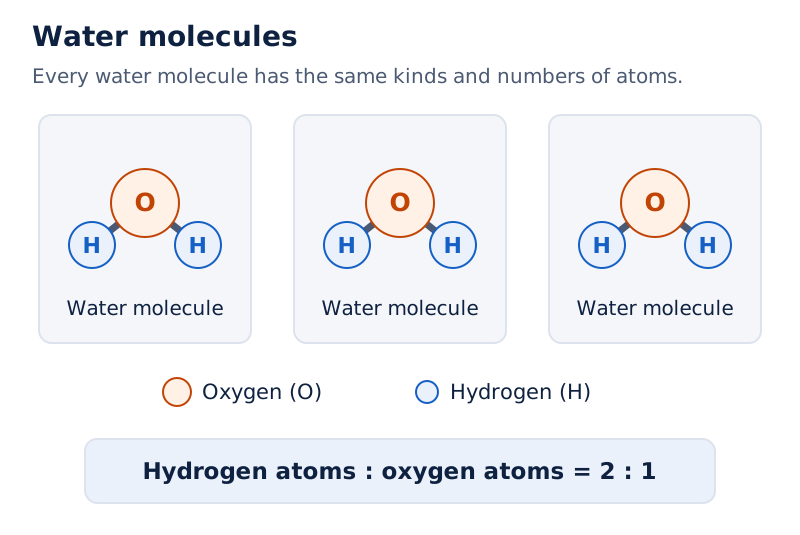
The drawing shows repeated groups of one larger red sphere joined to two smaller pale spheres. The labels identify oxygen and hydrogen. Each group represents a water molecule with the same arrangement of constituent atoms.
Drawn by One Young India.
Why are properties important evidence?
Hydrogen is a fuel, and oxygen supports combustion. Water has different properties and is used to extinguish fire. The behaviour of water cannot be described simply by assigning it the separate properties of hydrogen and oxygen.
Another example is sodium chloride, or common salt. Sodium is a soft metal, while chlorine is a hazardous gas. Their chemical combination produces a substance with very different properties, used to enhance the taste of food.
The sodium and chlorine particles in sodium chloride are present in a 1:1 ratio. The ratio belongs to the compound's composition. The individual elements are not merely placed beside one another as separate components of a mixture.
| Compound | Constituent elements | Composition detail |
|---|---|---|
| Water | Hydrogen and oxygen | Hydrogen atoms to oxygen atoms: 2:1. |
| Sodium chloride | Sodium and chlorine | Sodium particles to chlorine particles: 1:1. |
| Sugar | Carbon, hydrogen and oxygen | These elements are chemically combined. |
Separating dissolved salt from water does not separate sodium from chlorine. Evaporation recovers the compound sodium chloride from a mixture. The compound itself remains chemically different from its constituent elements.
Pure substance therefore includes compounds as well as elements. A compound has a definite chemical composition, even though it contains more than one kind of element.
What are mixtures, and how can their components be arranged?
A mixture contains two or more substances mixed together. The substances retain their individual properties and do not react chemically with one another in forming the mixture. The individual substances are called its components.
Poha, sprout salad, soup and lemonade are familiar everyday mixtures. The ingredients in a sprout salad, such as green gram, chickpeas, onion and tomato, can be distinguished. Sugar mixed with water provides a different kind of arrangement.
What is the difference between uniform and non-uniform mixtures?
In a uniform mixture, the components are evenly distributed and cannot be distinguished separately. Sugar and water particles cannot be seen separately in sugar solution, even with a microscope. Air is another example of a uniform mixture.
In a non-uniform mixture, different components are generally visible with the unaided eye or a magnifying device. Their distribution does not give the same uniform appearance throughout. Sprout salad illustrates this distinction.
Everyday ingredients may themselves be mixtures. When describing a mixture scientifically in terms of its substances, the components are identified as pure substances. This separates a food ingredient list from a description of chemical composition.
Can mixtures contain solids, liquids and gases?
| States of components | Examples |
|---|---|
| Gas and gas | Air. |
| Gas and liquid | Aerated water; oxygen dissolved in water. |
| Solid and gas | Carbon particles in air. |
| Liquid and liquid | Acetic acid in water, called vinegar; oil and water. |
| Solid and liquid | Sand and water; seawater. |
| Solid and solid | Baking powder containing baking soda and tartaric acid; alloys. |
The states of the components and the uniformity of a mixture describe different features. A gas can be mixed with a liquid, while two solids can also form a mixture. Mixtures are not restricted to liquids in beakers.
A uniform appearance must not be confused with chemical combination. Sugar solution remains a mixture even though its components cannot be seen separately. The same distinction becomes especially useful when studying alloys.
Why is air a mixture, and what evidence shows its components?
Air is a uniform mixture consisting mainly of nitrogen, oxygen, argon, carbon dioxide and water vapour. These gases are present together without forming a single new compound.
Nitrogen makes up about 78 per cent of air and does not take part in combustion. Oxygen supports combustion and is needed by most living beings. These different behaviours help show that the components retain their own properties.
Water vapour is also present in air. When warm air touches a cool surface, this vapour can turn into liquid water, forming tiny droplets. This provides evidence of a component that cannot ordinarily be seen as a separate gas.
How does lime water reveal carbon dioxide?
Lime water is a solution of calcium hydroxide. When it reacts with carbon dioxide, insoluble white particles of calcium carbonate form, making the liquid appear milky. Water is also produced.
Calcium hydroxide + carbon dioxide → calcium carbonate + water. On the left, the plus sign means “reacts with”; on the right, it means “and”. The arrow means “produces”.
- Begin with filtered, colourless lime water in a petri dish.
- Leave it exposed to air for a few hours.
- Stir the solution at regular intervals and observe its appearance.
- Use the change to a milky appearance as evidence that carbon dioxide in air has reacted with it.
What the figure shows
Lime water exposed to air
Two petri dishes are shown. The first contains clear lime water; the second is labelled “Lime water turns milky”. The paired views illustrate the visible change during the carbon dioxide test.
Preparing lime water from calcium oxide and water releases heat in a vigorous reaction. The preparation requires care; the observation to remember is the later milkiness caused by carbon dioxide.
Are dust particles normal gaseous components?
A clean black sheet left near an open window or in a garden for a few hours may collect particles. This shows that dust can be suspended in air. Its amount and nature may vary with place and time.
Dust is considered a pollutant rather than an integral gaseous component of air. Other pollutants include soot, carbon monoxide, ozone, nitrogen dioxide and sulphur dioxide. The air quality index, abbreviated AQI, is a tool for describing air quality.
How does passing electricity through water demonstrate chemical decomposition?
Cooling water into ice and boiling water into vapour change its physical state. The water particles remain the same. Heating ice or cooling water vapour can produce liquid water again.
Passing electricity through water produces a different result: hydrogen and oxygen form. This is chemical decomposition, because the original compound changes into different substances. It is not simply a change from liquid water into water vapour.
What happens in the demonstration?
The demonstration uses water containing a few drops of dilute sulphuric acid, two small water-filled test tubes, a beaker and a 9-volt battery. The test tubes are placed over the battery terminals to collect the gases produced.
Note: This is a teacher-supervised demonstration. Sulphuric acid requires careful handling. A lithium-ion battery must not be used, and gas tests require care and a safe distance from the apparatus.
- Observe the water-filled tubes placed over the battery terminals in the beaker.
- Watch for gas bubbles forming at both terminals and entering the tubes.
- After 10 to 15 minutes, compare the gas collected in the tubes.
- Observe the supervised gas tests and connect their results with the identities of the gases.
Hydrogen gives a pop sound when tested with a flame. Oxygen makes the flame of a burning candle glow brighter. These different results identify different gases, rather than two samples of water vapour.
What the figure shows
Collecting gases from water
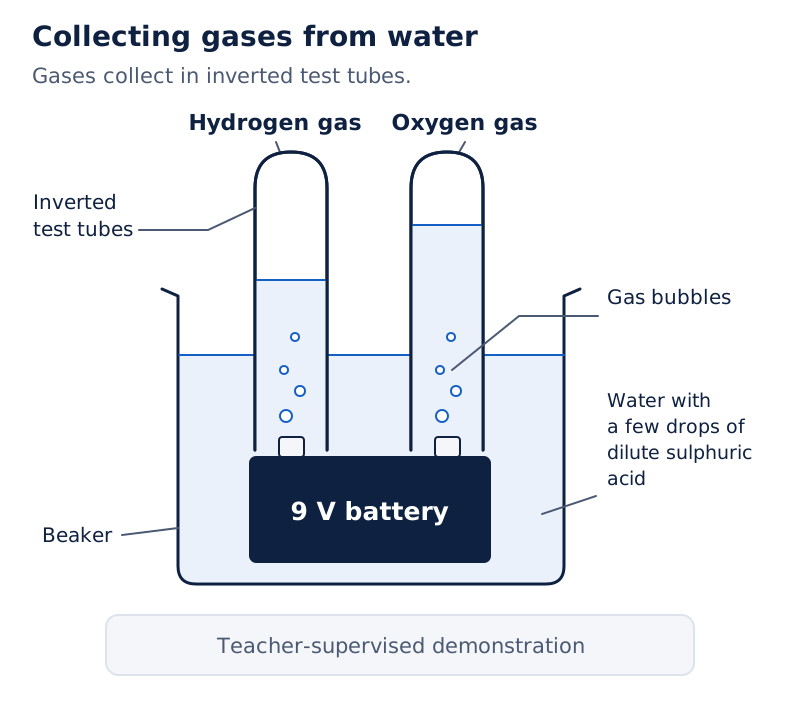
Two inverted test tubes stand over the terminals of a battery in a beaker. Labels identify gas bubbles, hydrogen gas, oxygen gas, and water containing a few drops of sulphuric acid.
Drawn by One Young India.
Water → hydrogen + oxygen. The word equation names the compound that breaks down and the two elements that form. The arrow has the same meaning, “produces”, as in the earlier word equation.
The demonstration provides evidence that water contains two different constituents. It also distinguishes physical change, where water particles remain water particles, from a chemical change that produces new substances.
What does heating sugar reveal about a compound?
Dry sugar looks like a single substance, but its appearance cannot establish whether it is an element. Heating provides evidence about its composition. Sugar is a compound containing carbon, hydrogen and oxygen.
In the demonstration, a teaspoon of sugar is placed in a boiling tube and gently heated. This activity is carried out in the presence of a teacher. The observations include changes both in the solid and near the open end of the tube.
Which observations support the conclusion?
- The sugar initially becomes brown as it is heated.
- On further heating it chars, becoming blackish.
- Small water droplets appear inside the boiling tube near its open end.
- A black residue of charcoal, or carbon, remains in the tube.
The black residue and water are products of decomposition. Water contains hydrogen and oxygen, while the residue provides evidence of carbon. Together, these observations show why sugar cannot be classified as an element.
What the figure shows
Heating sugar
A boiling tube held with a test-tube holder is heated over a spirit lamp. A later view labels water droplets and sugar after heating. A separate watch glass contains the black material labelled charcoal, or carbon.
Sugar → carbon + water. This word equation summarises the decomposition described by the activity. It identifies the products without suggesting that sugar originally contained visible pieces of charcoal or drops of liquid water.
The water produced is connected with the decomposition of the dry sugar. It is not evidence that sugar was merely wet or that sugar and water were already present as separate ingredients of a mixture.
Compare this with dissolving sugar in water. In a sugar solution, sugar and water are mixed together. In heated sugar, a chemical change produces different substances. The identity of the starting material and the process both matter when interpreting observations.
How does the iron and sulphur experiment distinguish a mixture from a compound?
The experiment compares iron and sulphur before and after they react on heating. It uses 5.6 grams of iron filings and 3.2 grams of sulphur powder. Mixing them first produces a mixture; heating part of that mixture produces a compound.
Sample A is the unheated mixture. Sample B is the black substance formed by heating half of Sample A. These labels refer to the samples in this experiment, not to chemical symbols.
How are the samples prepared and compared?
- Mix the iron filings and sulphur powder thoroughly on a watch glass to prepare Sample A.
- Heat half of Sample A gently in a china dish, stirring until a black mass forms.
- Allow the mass to cool, then grind it with a mortar and pestle to obtain Sample B.
- Compare the samples' appearance and their response to a magnet.
- Compare the reported observations when small portions react with dilute hydrochloric acid.
Note: Heating and acid tests belong to a supervised demonstration in a fume hood or well-ventilated area. Do not inhale the gases. Handle hydrochloric acid carefully; an odour description is not an instruction to smell a gas directly.
| Observation | Sample A: mixture | Sample B: compound |
|---|---|---|
| Appearance | Black iron particles and yellow sulphur particles remain visible. | The black mass has the same colour and texture throughout. |
| Magnet test | Iron filings are attracted and can be separated. | The sample is not attracted by the magnet. |
| Gas with dilute hydrochloric acid | Hydrogen is produced. | Hydrogen sulphide is produced. |
| Reported gas properties | Colourless, odourless; burns with a pop. | Colourless, with a rotten-egg-like odour. |
| Conclusion | Iron and sulphur retain their individual properties. | Iron sulphide has properties different from its constituent elements. |
What the figure shows
Comparing samples with a magnet
A magnet is held above each sample on a watch glass. Material from Sample A is shown attracted towards the magnet; Sample B remains on the watch glass.
What do the reactions show?
Iron + sulphur → iron sulphide. Heating causes chemical combination. The magnet cannot recover iron from the iron sulphide as it can from the original mixture.
Iron + dilute hydrochloric acid → iron chloride + hydrogen gas. In Sample A, sulphur remains as a yellow solid at the bottom of the test tube. It does not react with the dilute hydrochloric acid in this experiment.
Iron sulphide + dilute hydrochloric acid → iron chloride + hydrogen sulphide. Sample B produces a different gas. This difference supplies further evidence that a new substance has formed.
How can separation and comparison help classify an unfamiliar material?
A useful classification considers the kinds of substances present, whether chemical combination has occurred, and what separation can accomplish. Appearance can provide a clue, but physical separation and chemical behaviour provide stronger evidence.
Physical separation obtains components already present in a mixture. It does not turn the constituent elements of a compound back into separate elements. This explains the different outcomes of applying a magnet to iron mixed with sulphur and to iron sulphide.
Which distinctions should be compared?
| Feature | Element | Compound | Mixture |
|---|---|---|---|
| Composition | One kind of element. | Different elements chemically combined in a fixed ratio. | Two or more substances mixed together. |
| Properties | Has its own properties. | Different from those of its constituent elements. | Components retain their individual properties. |
| Physical separation | Does not separate it into simpler substances. | Does not separate its constituent elements. | Can separate components, as shown by magnetic separation and evaporation. |
| Scientific purity | A pure substance. | A pure substance. | Contains more than one substance. |
| Examples | Iron, oxygen, gold. | Water, sodium chloride, iron sulphide. | Air, seawater, iron mixed with sulphur. |
Evaporating water from a salt solution recovers sodium chloride. It does not produce sodium metal and chlorine gas. Name the material recovered before deciding whether a mixture has been separated or a compound has decomposed.
Likewise, melting ice produces water, while passing electricity through water produces hydrogen and oxygen. The first changes physical state; the second changes chemical identity.
How can a classification answer be reasoned out?
Worked classification: Iron reacts with moist air to form iron oxide, and magnesium burns in oxygen to form magnesium oxide. Classify the substances involved.
Answer: Iron, magnesium and oxygen are elements. Moist air is a mixture of gases that includes water vapour. Iron oxide and magnesium oxide are compounds because they contain different elements chemically combined.
This reasoning uses composition, not the fact that a substance is involved in a reaction. Reactants and products can belong to different categories. An element cannot simultaneously be a compound, because the two definitions require different kinds of composition.
How are alloys and other materials useful in everyday life?
Alloys are mixtures illustrated by stainless steel, brass and bronze. In stainless steel, the components are mixed so uniformly that individual substances cannot be seen. Its uniform appearance does not make it a compound.
| Alloy | Components | Example of use |
|---|---|---|
| Stainless steel | Iron, nickel, chromium and a small amount of carbon. | Utensils and durable materials. |
| Brass | Copper and zinc. | Utensils and Dhokra figures. |
| Bronze | Copper and tin. | Utensils and Dhokra figures. |
Stainless steel is stronger and more durable than pure iron. This shows why combining materials can be useful without every combination forming a compound. Wood, steel and concrete, used in construction, are mixtures.
Elements also have direct uses. Iron and aluminium are used in bridges, buildings and vehicles. Understanding chemical combination helps chemists develop medicines, vaccines and fertilisers, while material scientists design substances with useful properties.
How does traditional craft use mixtures?
Dhokra art, an old craft from Bihar and Odisha, uses metals to create figures often inspired by animals, people and nature. Brass or bronze fills a mould, giving the finished figures strength and a shiny golden colour.
- A design is first shaped in beeswax.
- The wax model is covered with clay to form a mould.
- After the clay hardens, the wax is melted out, leaving a hollow space.
- Molten brass or bronze is poured into that space to form the figure.
The term Mishraloha was used for a mixture of metals whose properties differed from those of its constituent metals. This historical vocabulary also connects the study of mixtures with the making and use of materials.
Graphene aerogel is a material made from carbon. Its highly porous structure gives it a high absorbing capacity. It can potentially be used for environmental cleaning, including oil spills, and is useful in energy-saving devices and special building coatings.
What are minerals, and can a mineral also be an element?
Minerals are natural solid substances found on Earth with a fixed chemical composition. Most are compounds, but some are pure elements. Most rocks are mixtures of minerals, rather than single pure substances.
Minerals in a rock may be examined with the eyes, a magnifying glass or a microscope. Their presence connects the classification of matter with the natural materials from which many useful substances are obtained.
How do native minerals differ from other minerals?
Native minerals are pure elements rather than compounds. Examples include the metals gold, silver and copper, as well as non-metals such as sulphur and carbon. Most other minerals contain more than one element chemically combined.
Gold can therefore be described as both a metal and a mineral. “Metal” identifies its material category, while its occurrence as a native mineral connects it with naturally occurring substances. These descriptions do not contradict one another.
Common mineral examples include quartz, calcite, mica, pyroxene and olivine. Talc is another mineral with a familiar use. Different minerals supply materials used in homes and industry.
| Material or product | Connection with minerals |
|---|---|
| Talcum powder | Made from the mineral talc. |
| Cement | Made using calcite, quartz, alumina and iron oxide, which are minerals or obtained from minerals. |
| Metals used in everyday objects | Various metals are obtained from minerals. |
The distinction between a rock and a mineral resembles the distinction between a mixture and its components. Most rocks contain a mixture of minerals. A mineral itself has a fixed chemical composition, whether it is a compound or a native element.
Classification becomes clearer when the question is precise. Ask whether the material is an element, compound or mixture; whether an element is metallic; and whether a natural substance is a mineral. These describe related but different features of matter.
Glossary
- Matter — Anything that has mass and occupies space, including air, water and materials in everyday objects.
- Pure substance — Matter consisting of the same type of particles, inseparable into other substances by physical processes.
- Element — A substance that cannot be broken down further into simpler substances and forms a building block of matter.
- Atom — A particle of an element, different from the atoms of other elements.
- Molecule — A stable particle formed when two or more atoms combine together.
- Compound — A substance containing different elements chemically combined in a fixed ratio, with properties different from its constituent elements.
- Mixture — Two or more substances mixed together while retaining their individual properties without chemical reaction between them.
- Component — An individual substance present along with other substances in a mixture.
- Uniform mixture — A mixture whose components are evenly distributed and cannot be distinguished separately.
- Non-uniform mixture — A mixture whose different components are generally visible with the unaided eye or a magnifying device.
- Alloy — A mixture such as brass, bronze or stainless steel, in which metals are combined with other constituents.
- Decomposition — A chemical change in which a compound breaks down into different substances.
- Mineral — A natural solid substance found on Earth that has a fixed chemical composition.
- Native mineral — A mineral that is a pure element rather than a chemical compound.
- Metalloid — An element with properties intermediate between those of metals and non-metals.
Common errors and misconceptions
- Misconception: Only elements are pure substances. Correct: Compounds are also pure substances. Water contains different elements chemically combined, but still consists of the same kind of compound particles.
- Misconception: Every clear, uniform material is pure. Correct: Sugar solution and air are uniform mixtures. Their components cannot be distinguished separately, but more than one substance is present.
- Misconception: Every molecule is a compound. Correct: Hydrogen and oxygen have molecules containing atoms of the same element. A compound requires different elements chemically combined.
- Misconception: Evaporation separates sodium chloride into sodium and chlorine. Correct: It recovers sodium chloride from water. It does not break the compound into its constituent elements.
- Misconception: Heating iron and sulphur merely makes a darker mixture. Correct: Their reaction produces iron sulphide, a compound with different magnetic behaviour and a different reaction with dilute hydrochloric acid.
- Misconception: Boiling water and decomposing water produce the same gas. Correct: Boiling produces water vapour; electrical decomposition produces hydrogen and oxygen, identified by different flame-test observations.
- Misconception: Every mineral is a compound. Correct: Most minerals are compounds, but native minerals such as gold and sulphur are pure elements.
- Misconception: Water's 2:1 ratio describes any two amounts chosen for mixing. Correct: It describes the number of hydrogen atoms relative to oxygen atoms in water.
Exam-style questions with model answers
Q1. Define a pure substance. Explain why water, although made from hydrogen and oxygen, is classified as pure. [2 marks]
- A pure substance consists of the same type of particles and cannot be separated into other substances by physical methods.
- Water is a compound containing hydrogen and oxygen chemically combined in a fixed ratio. Compounds, as well as elements, are pure substances.
Q2. Hydrogen molecules contain two hydrogen atoms; oxygen molecules contain two oxygen atoms; water molecules contain two hydrogen atoms and one oxygen atom. Classify each substance and explain the distinction. [3 marks]
- Hydrogen is an element because its molecules contain atoms of only one element, hydrogen.
- Oxygen is also an element. Having two atoms in a molecule does not make a substance a compound when both atoms belong to the same element.
- Water is a compound because different elements, hydrogen and oxygen, are chemically combined. Its hydrogen-to-oxygen atom ratio is fixed at 2:1.
Q3. Air contains nitrogen, oxygen, argon, carbon dioxide and water vapour. Explain why it is a mixture, identify its uniformity, and describe how exposed lime water provides evidence for one component. [4 marks]
- Air is a mixture because several gases are present together without combining to form a single new compound.
- It is a uniform mixture: its gaseous components are distributed evenly and cannot be distinguished separately.
- Carbon dioxide in air reacts with calcium hydroxide in the exposed lime water to form calcium carbonate and water.
- The calcium carbonate forms insoluble white particles, making the lime water milky. This change provides evidence for carbon dioxide in air.
Q4. In a supervised demonstration, electricity is passed through water containing a few drops of dilute sulphuric acid. Gases collect in two inverted test tubes: one gives a pop with a flame, and the other makes a candle flame glow brighter. Identify the gases, state the conclusion, write the word equation, and distinguish this change from boiling water. [5 marks]
- The gas that produces a pop sound is hydrogen.
- The gas that makes the burning candle flame glow brighter is oxygen.
- The observations show that water can be decomposed into two different elements. Water is therefore a compound, with hydrogen and oxygen chemically combined.
- The word equation is: water → hydrogen + oxygen. The arrow indicates the substances produced by decomposition.
- This is a chemical change because different substances form. Boiling water produces water vapour, which is still water and can condense back into liquid water. Boiling changes physical state rather than breaking water into its constituent elements.
Q5. A mixture prepared from 5.6 grams of iron filings and 3.2 grams of sulphur is called Sample A. Half is heated until a black mass forms, cooled and ground to make Sample B. Compare their appearance, magnetic behaviour and reactions with dilute hydrochloric acid. Name Sample B and write the formation word equation. [6 marks]
- Sample A is a mixture in which black iron particles and yellow sulphur particles remain visible. The substances retain their individual properties.
- Sample B has a uniform black appearance, unlike the separately visible black and yellow particles in Sample A.
- A magnet attracts the iron filings from Sample A, allowing separation. Sample B is not attracted by the magnet.
- In Sample A, iron reacts with dilute hydrochloric acid to form iron chloride and hydrogen. Hydrogen is colourless and odourless and burns with a pop. Sulphur remains as a yellow solid.
- Sample B is iron sulphide. With dilute hydrochloric acid it forms iron chloride and hydrogen sulphide, a colourless gas described as having a rotten-egg-like odour.
- The formation equation is: iron + sulphur → iron sulphide. Its changed properties show that a compound has formed.
Q6. Dry sugar is heated under supervision. It becomes brown and then blackish, water droplets appear near the open end of the tube, and a carbon residue remains. Explain why these observations show that sugar is a compound. [3 marks]
- The formation of carbon and water shows that sugar decomposes into different substances on heating. It is therefore not an element.
- The carbon residue identifies carbon as a constituent. Since water contains hydrogen and oxygen, the water produced provides evidence for those elements as well.
- Sugar is a compound containing carbon, hydrogen and oxygen chemically combined. The products do not mean that the original sugar was merely wet carbon.
Q7. Sodium chloride is recovered by evaporating water from its solution. Iron is removed from an unheated iron-and-sulphur mixture using a magnet. Explain what each process separates and why neither demonstrates decomposition of a compound. [4 marks]
- Evaporation separates the compound sodium chloride from water. It recovers a component of the solution, rather than producing sodium metal and chlorine gas.
- The magnet separates iron already present in the unheated mixture. Sulphur and iron have retained their own properties.
- Both are physical separations of mixture components; the separated substances retain their chemical identities.
- Decomposition would change a compound into different substances, as when electricity decomposes water into hydrogen and oxygen. Neither separation does this.
Q8. Gold is a metal that occurs as a native mineral. Define a native mineral and explain why calling gold both a metal and a mineral is consistent. [2 marks]
- A native mineral is a naturally occurring mineral that is a pure element rather than a compound.
- Gold is a metallic element and can occur as a native mineral. The two descriptions refer to different features of the same substance.
Key takeaways
- Pure substances include elements and compounds; mixtures contain two or more substances that retain their individual properties.
- An element contains one kind of atom, even when its particles are molecules formed from several atoms.
- Compounds contain different elements chemically combined in fixed ratios and have properties different from their constituent elements.
- Uniform appearance does not establish purity: sugar solution, air and alloys provide useful examples of mixtures.
- Water decomposes into hydrogen and oxygen, while boiling changes water into vapour without changing its chemical identity.
- Heating iron and sulphur forms iron sulphide, which differs from the original mixture in magnetic and chemical behaviour.
- Physical separation recovers components of mixtures; it does not separate the constituent elements of a compound.
- Most minerals are compounds, but native minerals such as gold and sulphur are pure elements.
Test yourself
Why is an oxygen molecule not a compound?
It contains two atoms of the same element, oxygen. A compound requires different elements chemically combined.
What does the 2:1 ratio in water describe?
It describes the number of hydrogen atoms compared with oxygen atoms: two hydrogen atoms for each oxygen atom.
What causes lime water to turn milky when exposed to air?
Carbon dioxide reacts with calcium hydroxide, producing insoluble white calcium carbonate particles and water.
How do uniform and non-uniform mixtures differ?
Uniform mixtures have evenly distributed, indistinguishable components. In non-uniform mixtures, the different components are generally visible directly or with magnification.
What can a magnet separate from an unheated iron-and-sulphur mixture?
It attracts the iron filings, allowing them to be separated from the sulphur in the mixture.
Which elements are present in sugar?
Sugar contains carbon, hydrogen and oxygen chemically combined as a compound.
What are the components of brass and bronze?
Brass contains copper and zinc, whereas bronze contains copper and tin. Both are alloys.
Why can gold be both a metal and a mineral?
Gold is a metallic element that occurs naturally as a native mineral. These descriptions concern different aspects of the substance.
Try it
Elements, Compounds and Mixtures: Practical Chemical Scenarios
Apply your understanding of elements, compounds, and mixtures to analyze two laboratory scenarios.
1A student is investigating a grey sample made of iron and sulphur. When a magnet is brought near the sample, the iron particles are attracted to it, leaving behind yellow sulphur powder. Later, another portion of the sample is heated until a black solid forms that is completely non-magnetic. How should the initial grey sample and the resulting black solid be classified?
Correct. In a mixture, components retain their individual properties (iron remains magnetic and can be physically separated). When chemically combined by heating, a compound (iron sulphide) forms, which is a new non-magnetic substance with properties different from its constituent elements.
Incorrect. In a compound, original elements lose their individual properties and cannot be separated by simple physical methods like magnetic separation. The initial sample is a physical mixture.
Incorrect. The black solid is a compound (iron sulphide) formed through a chemical change, resulting in fixed properties different from iron and sulphur.
2Water is a compound with a fixed hydrogen-to-oxygen mass ratio of 1:8. If 3 g of hydrogen reacts completely with 24 g of oxygen, what will be formed, and why?
Correct. According to the law of constant proportions, water always combines hydrogen and oxygen in a 1:8 mass ratio (3 g hydrogen requires 3 × 8 = 24 g oxygen), forming 3 + 24 = 27 g of the compound water.
Incorrect. Mixtures have variable composition, but a compound always has a fixed composition by mass governed by the law of constant proportions.
Incorrect. The mass of the compound formed is the sum of the reacting masses of its constituent elements (3 g hydrogen + 24 g oxygen = 27 g water).
Great job! You have demonstrated a clear understanding of how physical retention of properties distinguishes mixtures from chemically bonded compounds with fixed mass proportions.