Start with a few high-quality watches, then dive into the notes below.
What Is An Atom And How Do We Know? · Stated Clearly
A route into the idea
From 'atoms combine' to 'valency cross-over gives the formula' to 'mole converts formula to grams'
Identify the elements and their valencies
Cross-over valencies to get subscripts
Check charge balance
Use molar mass to convert moles ↔ grams
Chemical formulae are not arbitrary — they are charge-balanced valency cross-overs. The mole is not a magic number — it is the bridge that makes the microscopic countable in grams. Every stoichiometry problem is: balance the equation → convert grams to moles → use mole ratios → convert moles to grams.
Try an idea before you read. Explore how chemical combination laws lead to atomic theory, and how the mole bridges the microscopic and macroscopic worlds. Make a prediction before opening each section. Explore the discovery →
Laws of Chemical Combination
Antoine L. Lavoisier laid the foundation of chemical sciences by establishing two important Laws of Chemical Combinations, which are:
(i) Law of Conservation of Mass
(ii)Law of Constant Proportions
Law of Conservation of Mass
The law of conservation of mass states the “Mass can neither be created nor be destroyed in a Chemical reaction”. During a chemical reaction, the sum of the masses of the reactant and products remains unchanged.
Law of Constant Proportions
Lavoisier noted that many compounds were composed of two or more elements and each such compound had the same elements in the same proportions irrespective of where the compound came from or who prepared it.
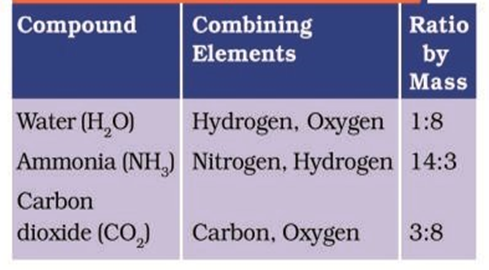
For example, in compound such as water, the ratio of the mass of hydrogen to the mass of the oxygen is always 1:8, whatever the source of water. Thus, if 9 gm of water is decomposed, 2 gm of hydrogen and 8 gm of oxygen are always obtained.
Similarly in ammonia, nitrogen and hydrogen are always present in the ratio of 14:3 by mass.
This led to the law of constant proportions which is also known as law of definite proportions.
Proust also stated the law as “In a chemical substance the elements are always present in definite proportions by mass”.
Dalton’s Atomic Theory:
According to this theory, all matter, whether an element, a compound or a mixture is composed of small particles called Atoms.
The postulates of the theory are as follows:
All matter is made up of very tiny particles called atoms, which participate in the chemical reactions.
Atoms are indivisible particles, which cannot be created or destroyed in a chemical reaction.
Atoms of a given element are identical in mass and chemical properties.
Atoms of different elements have different masses and chemical properties.
Atoms combine in the ratio of small whole number to form compounds.
The relative number and kinds of atoms are constant in a given compound.
An Indian philosopher, Maharishi Kanad, postulated that if we go on dividing matter (padarth), we shall get smaller and smaller particles and ultimately come cross the smallest particle beyond which further division will not be possible. He named these particles as Parmanu.
Pakudha Katyayama, an Indian philosopher stated that these particles (smallest particle of matter) normally exist in a combined form which gives us various forms of matter.
Democritus, an ancient Greek philosopher, suggested that if we go on dividing matter, a stage will come when particles obtained cannot be divided further, he called these indivisible particles as atoms.
What is an Atom?
An atom is the smallest particle of an element that cannot usually exist independently and retains all its chemical properties.
The building blocks of all the matter are atoms.
Atoms are very small. More than millions of atoms when stacked would make a layer barely as thick as sheet paper.
What are the modern-day symbols of atoms of different elements?
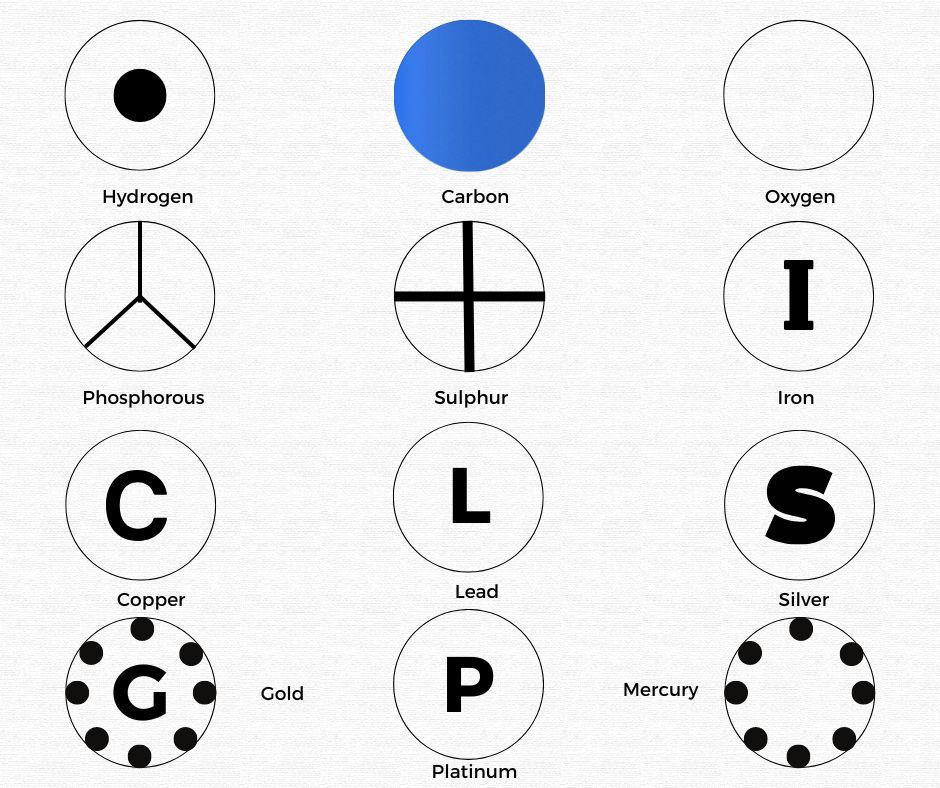
Dalton was the first to use the symbols for Elements in a very specific sense.
Berzilius suggested that the symbols of elements be made from one or two letters of the name of the element.
In the beginning, the name of the elements was derived from the name of the place where they were found for the first time.
For example, the name Copper was taken from Cyprus.
Some names were taken from specific colours. For example, Gold from English word meaning Yellow.
Now-a-days IUPAC (International Union for Pure and Applied Chemistry) approves names of elements, symbols and units.
1. Many symbols are the first one or two letters of the element’s name in English.
The first letter of symbol is always capital letter (uppercase) and the second the letter as a small letter (lowercase).
For example:
(a) hydrogen H
(b) aluminium Al (not AL)
(c) cobalt Co (not CO)
2. Symbols of some elements are formed from the first letter of the name and a
letter appearing later in the name.
For example:
(a) chlorine Cl
(b) zinc Zn
3. Other symbols have been taken from the names of the elements in Latin, German
and Greek.
For example: (a) the symbol of iron is Fe from its Latin name ferrous.
(b) sodium is Na from Natrium.
(c) potassium is K from kalium.
Each element has a name and a unique chemical symbol.
Symbols for some Elements
Element
Symbol
Element
Symbol
Element
Symbol
Aluminium
Al
Copper
Cu
Nitrogen
N
Argon
Ar
Fluorine
F
Oxygen
O
Barium
Ba
Gold
Au
Potassium
K
Boron
B
Hydrogen
H
Silicon
Si
Bromine
Br
Iodine
I
Silver
Ag
Calcium
Ca
Iron
Fe
Sodium
Na
Carbon
C
Lead
Pb
Sulphur
S
Chlorine
Cl
Magnesium
Mg
Uranium
U
Cobalt
Co
Neon
Ne
Zinc
Zn
What is Atomic Mass?
According to Dalton’s Atomic theory, each element had a characteristic atomic mass.
Initially, scientist took 1/16th of the mass of an oxygen atom as the unit. This was considered relevant for two reasons:
Oxygen reacted with a large number of elements and formed compounds.
This atomic mass unit gave masses of most of the elements as whole numbers.
However, in 1961 a universally accepted atomic mass unit, carbon-12 isotope was chosen as the standard reference for measuring atomic masses.
One atomic mass unit is a mass equal to exactly one-twelfth (1/12th) of the mass of one atom of carbon-12
Earlier atomic mass unit was designated as “amu” but it is designated as “u”.
Atomic masses of a few elements
Element
Atomic mass (u)
Hydrogen
1
Carbon
12
Nitrogen
14
Oxygen
16
Sodium
23
Magnesium
24
Sulphur
32
Chlorine
35.5
Calcium
40
Similarly, the relative atomic mass of the atom of an element is defined as the average mass of the atom, as compared to 1/12th the mass of one carbon-12 atom.
How do Atoms exist?
Atoms of most elements are not able to exist independently. Atoms form molecules and ions. These molecules or ions aggregate in large number to form the matter that we can see, feel or touch.
What is a Molecule?
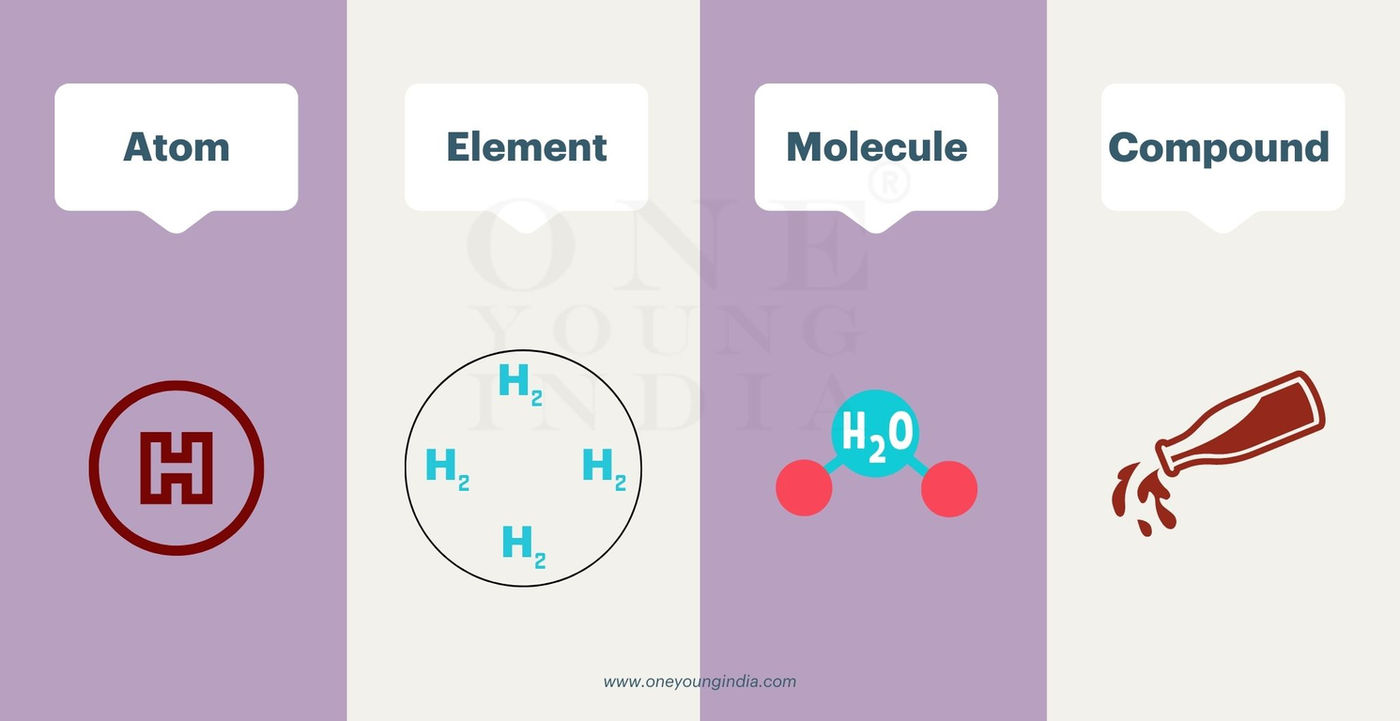
A molecule is in general a group of two or more atoms that are chemically bonded together, that is, tightly held together by attractive forces.
A molecule can be defined as the smallest particle of an elements or a compound that is capable of an independent existence and shows all the properties of that substance.
Atoms of the same elements or a different element can join together to form molecules.
Difference between the Molecules of Elements and Molecules of Compounds.
Molecule of Elements Molecule of Compounds
Definition
A combination of two or more atoms of same type.
A combination of two or more atoms of different type.
Chemical Elements
Has atoms of one chemical element.
Has atoms of two or more chemical elements.
Chemical Bonding
Has covalent bond.
Have Their covalent or ionic bond.
Examples
O2, Cl2, H2, Br2, etc.
H2O, NH3, SO3, etc
Atomicity of Some Elements
Molecules of some compounds
What is an Ion?
Compounds composed of metals or non-metals contains charged species. These species are known as ions.
It may consist of a single charged atom or a group of atoms that have a net charge on them.
An ion can be negatively or positively charged species.
A negatively charged ion is called an ‘anion’. For example, Cl-, SO43-, etc. and the positively charged ion is called a ‘cation’. For example, Na+, Al3+, etc.
In, Sodium Chloride (NaCl), its constituent particles are positively charged sodium ion (Na+) and negatively charged chloride ion (Cl-).
Single species carrying a charge is known as monoatomic ion, for example; Cu+ etc. whereas a group of atoms carrying a charge is known as polyatomic ion, for example; NO3- etc.
Names and Symbols of some ions
Writing Chemical Formulae
The chemical formula of a compound is a symbolic representation of its composition. (or A chemical formula of compound shows its constituent elements and the number of the atoms of each combing elements)
To write chemical formula we need to know the symbols and combining capacity of the elements.
The chemical formula of a molecular compound is determined by the valency of each element.
The combining power (or capacity) of an element is known as its valency.
The rules to be followed while writing a chemical formula:
The valencies or charges on the ion must balance.
When a compound consists of a metal and a non-metal, the name or symbol or the metal is written first (or left). For example: calcium oxide (CaO), sodium chloride (NaCl), iron sulphide (FeS), copper oxide (CuO)etc., where oxygen, chlorine, sulphur are non-metals and are written on the right.
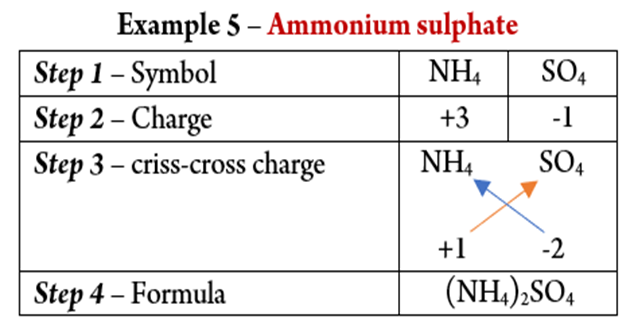
In compounds formed with polyatomic ions, the number of ions present in the compound is indicated by enclosing the formula of ion in a bracket and writing the number of ions outside the bracket. For example: Mg(OH)2.
In case the number of polyatomic ions is one the bracket is not required. For example, NaOH.
Formulae of Simple Compound:
The simplest compounds which are made up of two different elements are called binary compounds.
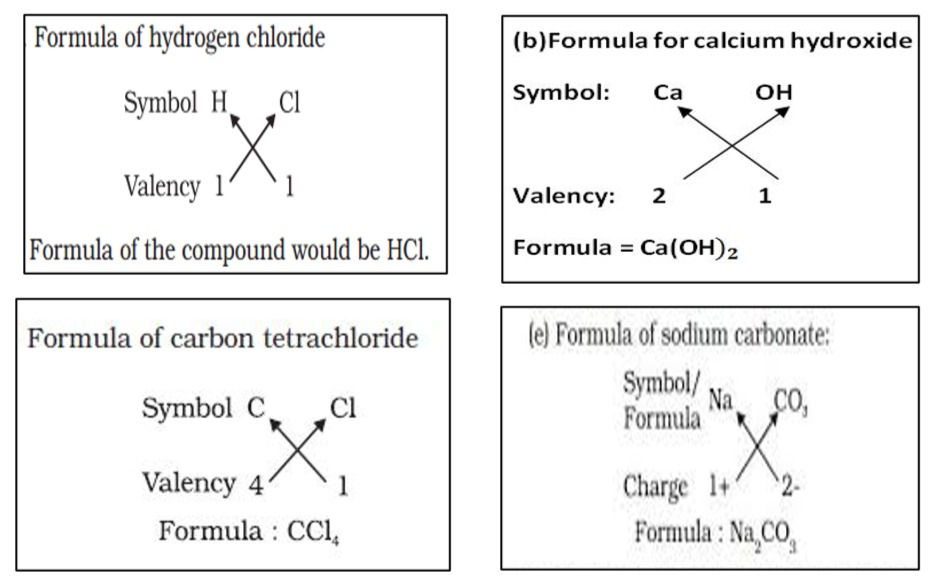
- While writing the chemical formulae for compounds, we write the constituent elements and their valencies as shown below.
- Then we must crossover the valencies of the combining atoms.
Some more examples:
Molecular Mass and Mole Concept
Molecular Mass: The molecular mass of a substance is the sum of the atomic masses of all the atoms in a molecule of the substance.
Formula Unit Mass: The formula unit mass of a substance is a sum of the atomic masses of all atoms in a formula unit of a compound.
The only difference in formula unit mass from molecular mass is that, we use it for those substances whose constituent particles are ions.
Mole Concept:
2H2 + O2 -> 2H2O
The above reaction indicates that
(i) Two molecules of hydrogen combine with one molecule of oxygen to form two molecules of water, or
(ii) 4 u of hydrogen molecules combine with 32 u of oxygen molecules to form 36 u of water molecules.
It is more, convenient to refer to the quantity of a substance in terms of the number of its molecules or atoms, rather than their masses.
One mole of any species (atoms, molecules, ions or particles) is that quantity in number having a mass equal to its atomic or molecular mass in grams.
The word mole was introduced by Wilhelm Ostwald in 1896
The number of particles (atoms, molecules, ions) present in 1 mole of any substance is fixed, with a value of 6.022 * 1023. This is known as Avogadro Number or Avogadro Constant (N0) and is an experimentally value.
1 mole (of anything) = 6.022 * 1023 in number
The mass of 1 mole of a substance is equal to its relative atomic or molecular mass in grams.
Molar mass of atoms is also known as gram atomic mass
Atomic mass of hydrogen = Gram atomic mass of hydrogen
1 u = 1 g
1 u (atomic unit) hydrogen has only 1 atom of hydrogen
1 g hydrogen has 1 mole atoms = 6.022 * 1023 atoms of hydrogen
Similarly,
16 u oxygen = 1 atom of oxygen
16 g oxygen = 1 mole of atom = 6.022 * 1023 atoms of oxygen
Key takeaways
The Law of Conservation of Mass states that mass cannot be created or destroyed in a chemical reaction.
The Law of Constant Proportions dictates that elements in a chemical compound are always present in a fixed ratio by mass.
John Dalton's Atomic Theory provided the first scientific model of the atom, defining it as an indivisible building block of matter.
A molecule is a chemically bonded group of atoms capable of independent existence, while ions are atoms or groups of atoms carrying an electrical charge.
The mole is a standard scientific unit for measuring large quantities of very small entities, containing 6.022 x 10^23 particles.
Test yourself
What is the difference between an anion and a cation?
An anion is a negatively charged ion, whereas a cation is a positively charged ion.
What does the term 'atomicity' refer to?
Atomicity is the total number of atoms present in a single molecule of an element or compound.
If the atomic mass of Oxygen is 16 u, what is the mass of one mole of Oxygen gas (O2)?
Since Oxygen gas is diatomic (O2), its molecular mass is 32 u. Therefore, one mole of Oxygen gas weighs 32 grams.
Play with the idea
Atoms and molecules: test the law, write the formula, cross the mole bridge
These scenarios explore the laws of chemical combination, Dalton's atomic theory, particle classification, formula writing, and the mole concept. Each question uses fictional but structurally accurate data from mass measurements, composition analysis, and mole calculations. The test is whether you can connect the macroscopic evidence to the particle-level explanation.
Situation 1
Explore the reasoning for every approach
Correct — calculate oxygen per gram of nitrogen: Oxide A = 36.4/63.6 = 0.57 g O per g N; Oxide B = 53.3/46.7 = 1.14 g O per g N. Ratio 0.57:1.14 = 1:2.
Yes. The law of multiple proportions states that when two elements form multiple compounds, the masses of one element combining with a fixed mass of the other are in a simple whole-number ratio. Here, fixing nitrogen at 1 g: Oxide A has 0.57 g O, Oxide B has 1.14 g O. The ratio 1:2 is exactly what the law predicts. The formulae are NO (Oxide A) and NO₂ (Oxide B).
Incorrect — the percentages are not in a simple ratio (63.6:36.4 vs 46.7:53.3).
The law applies to masses combining with a FIXED mass of one element, not the direct percentage ratios. You must normalise to a fixed mass of one element (usually 1 g). The raw percentages are not the test; the normalised masses are.
Cannot determine — need the actual molecular formulae to confirm.
The law of multiple proportions was DISCOVERED from mass composition data like this, before molecular formulae were known. The mass data alone is sufficient to test the law. The formulae (NO, NO₂) are inferred from the mass ratios, not prerequisites.
Situation 2
Explore the reasoning for every approach
Postulate 2 (identical atoms) modified by isotopes; Postulate 1 (indivisible) rejected by nuclear fission; Postulate 5 (conserved in reactions) still valid for chemistry.
Yes. (1) Isotopes show atoms of the same element can have different masses — modifies Postulate 2. (2) Nuclear fission splits atoms — rejects Postulate 1 (indivisibility) but only in nuclear, not chemical, reactions. (3) Chemical reactions conserve atoms — Postulate 5 holds for chemistry. Postulates 3 (different elements = different properties) and 4 (whole-number ratios) remain valid. A theory is a mosaic, not a monolith.
All postulates rejected — modern science proved Dalton completely wrong.
Incorrect. Scientific theories are refined, not discarded wholesale. Dalton's core insight — matter is made of discrete particles combining in integer ratios — remains the foundation of chemistry. Isotopes and nuclear reactions are boundary conditions, not falsifications of the chemical domain.
Only Postulate 1 rejected; the rest are exactly as Dalton stated.
Incorrect. Postulate 2 is modified by isotopes (same element, different mass). Postulate 5 (atoms cannot be changed into other atoms) is true for chemical reactions but false for nuclear reactions (transmutation). The domain of validity matters.
Situation 3
Explore the reasoning for every approach
First student is correct — CO₂ is a molecular compound; molecular mass (44 u) and molar mass (44 g/mol) are the right values.
Yes. CO₂ exists as discrete molecules (O=C=O). Its molecular mass is 44 u, so its molar mass is 44 g/mol. The calculation is correct: 0.4 mol × 44 g/mol = 17.6 g. 'Formula unit mass' applies to ionic compounds (NaCl, MgO) that do not exist as discrete molecules. The second student confuses the terminology.
Second student is correct — gases don't have molecular mass, only formula unit mass.
Incorrect. Gases like CO₂, H₂O, NH₃, CH₄ exist as discrete molecules. They have well-defined molecular masses. Formula unit mass is for ionic solids (NaCl, CaCO₃) where the 'molecule' does not exist as an independent unit in the solid state.
Both wrong — the Avogadro number is 6.02×10²³, not 6.022×10²³, so the moles are 0.4001 mol.
The Avogadro constant is defined as exactly 6.02214076×10²³ mol⁻¹ (2019 SI redefinition). Using 6.022×10²³ is appropriate for Class 9 precision. The first student's calculation is correct for the given significant figures.
Investigate before you memorise
Atoms and molecules: the laws, the particles, and the mole that connects them
Explore how chemical combination laws lead to atomic theory, and how the mole bridges the microscopic and macroscopic worlds. Make a prediction before opening each section.
Open the three laws of chemical combination
Lavoisier, Proust, Dalton — what the mass data forced them to conclude
Each law emerged from careful mass measurements. The particle interpretation came later.
Law
Statement
Mass Evidence
Particle View
Example
Law of Conservation of Mass (Lavoisier, 1789)
Mass is neither created nor destroyed in a chemical reaction
Total mass of reactants = total mass of products in a closed system
Atoms rearrange; no atoms are lost or gained
2H₂ + O₂ → 2H₂O: 4g H₂ + 32g O₂ = 36g H₂O
Law of Definite Proportions (Proust, 1799)
A chemical compound always contains the same elements in the same proportion by mass
Water from any source is always H₂O: 11.1% H, 88.9% O by mass
Fixed ratio of atoms in a compound (H₂O always 2:1)
CO₂ is always 27.3% C, 72.7% O; never CO or C₂O
Law of Multiple Proportions (Dalton, 1803)
When two elements form more than one compound, the masses of one element that combine with a fixed mass of the other are in a ratio of small whole numbers
CO (12g C : 16g O) vs CO₂ (12g C : 32g O) → oxygen ratio 16:32 = 1:2
Different compounds = different whole-number atom ratios
NO (14g N : 16g O), NO₂ (14g N : 32g O), N₂O (28g N : 16g O)
Why did the law of multiple proportions lead directly to atomic theory?
The law shows that when elements combine in different ratios, those ratios are always small whole numbers (1:2, 2:3, etc.). This is exactly what you expect if atoms combine as discrete, indivisible units — you cannot have half an atom. Continuous matter (no atoms) would allow any ratio. The whole-number pattern is the fingerprint of atomic discreteness.
Open the atomic theory scorecard
Dalton's five postulates — which survived, which fell
A scientific theory is not a monument; it is a living model. Each postulate was tested against new evidence.
Postulate
Status
Reason / Evidence
All matter is made of tiny indivisible particles called atoms
Modified: atoms are divisible (subatomic particles)
Atoms of the same element are identical in mass and properties
Modified: isotopes exist
Same element, different neutron numbers → different mass (e.g., ¹²C, ¹³C, ¹⁴C)
Atoms of different elements have different masses and properties
Still valid
Atomic number (protons) defines element; mass varies by isotope
Atoms combine in simple whole-number ratios to form compounds
Still valid
Chemical formulae reflect integer atom ratios (H₂O, CO₂, NaCl)
Atoms cannot be created, destroyed, or changed into other atoms in chemical reactions
Modified: nuclear reactions can transmute elements
Chemical reactions only rearrange atoms; nuclear reactions change protons
If atoms are divisible, why does chemical combination still use whole-number ratios?
Chemical reactions involve only electrons (valence shell). The nucleus (protons + neutrons) remains intact. Subatomic particles (electrons, protons, neutrons) do not participate as independent units in chemical bonding — atoms do. Nuclear reactions (fission, fusion, radioactivity) are a different domain where atoms are transmuted. The chemical atom (nucleus + core electrons) is effectively indivisible in chemistry.
Open the particle classification
Atom, molecule, ion — three particle types, different rules
Each has a distinct definition, size range, and charge behaviour. The key is chemical identity and independent existence.
Type
Definition
Size
Charge
Examples
Atom
Smallest particle of an element that retains its chemical identity
~0.1–0.5 nm
Neutral
H, O, C, Na, Fe; noble gases exist as single atoms
Molecule
Group of two or more atoms chemically bonded; smallest unit of a compound (or element) with independent existence
~0.2–2 nm
Neutral
H₂, O₂, N₂, H₂O, CO₂, CH₄; O₃ (ozone)
Ion
Atom or group of atoms with a net charge (lost or gained electrons)
Similar to parent atom/molecule
Positive (cation) or negative (anion)
Na⁺, Cl⁻, Ca²⁺, OH⁻, NH₄⁺, SO₄²⁻, NO₃⁻
Why is O₂ a molecule but not a compound? Why is H₂O both?
A molecule is any chemically bonded group of atoms with independent existence. O₂ has two atoms of the same element — it is a molecule of an element. H₂O has atoms of different elements — it is a molecule of a compound. All compounds are molecules (or formula units for ionic), but not all molecules are compounds. Noble gases (He, Ne) exist as single atoms, not molecules.
Open the formula writing lab
Writing formulae: valency cross-over and charge balance
The rules are algorithmic, but the logic is charge neutrality. Every formula must balance to zero net charge.
Rule
Detail
Example
Valency = combining capacity
H=1, O=2, N=3, C=4, Na=1, Mg=2, Al=3, Cl=1, S=2
NaCl (1:1), MgCl₂ (1:2), Al₂O₃ (2:3), Na₂O (2:1)
Cross-over valencies
Swap valencies to get subscripts; reduce to simplest ratio
C⁴⁺ + O²⁻ → C₂O₄ → CO₂; Al³⁺ + O²⁻ → Al₂O₃
Polyatomic ions as units
Treat NH₄⁺, OH⁻, NO₃⁻, SO₄²⁻, CO₃²⁻, PO₄³⁻ as single units
(NH₄)₂SO₄, Ca(OH)₂, Mg₃(PO₄)₂, NaNO₃
Charge balance
Total positive charge = total negative charge in a neutral compound
Al valency = 3, O valency = 2. Cross-over gives Al₂O₃. Check charge: 2×(+3) = +6, 3×(−2) = −6. Net zero. Al₃O₂ would give +9 and −4 — not neutral. The cross-over method automatically enforces charge balance. For transition metals with variable valency, the Roman numeral tells you which to use (Fe²⁺ → FeO, Fe³⁺ → Fe₂O₃).
Open the mole bridge
The mole: the bridge between atoms and grams
You cannot count atoms one by one. The mole lets you weigh a known number of them.
Term
Definition / Formula
Unit
Example
Molecular mass
Sum of atomic masses of all atoms in a molecule
u (unified atomic mass unit)
H₂O = 2×1 + 16 = 18 u; CO₂ = 12 + 2×16 = 44 u
Formula unit mass
Sum of atomic masses in a formula unit (for ionic compounds)
Why is the mole defined as 6.022×10²³ and not a round number like 10²⁴?
The mole is defined so that the molar mass in grams numerically equals the atomic/molecular mass in u. ¹²C has atomic mass exactly 12 u by definition. 1 mole of ¹²C has mass exactly 12 g. The number of atoms in 12 g of ¹²C is measured experimentally: 6.02214076×10²³. This number (Avogadro constant) is now fixed by definition (2019 SI redefinition), making the mole exact. The 'awkward' number comes from nature, not convention.
Open the calculation game
Predict the answer, then check the mole arithmetic
Q: How many molecules in 9 g of water? Prediction: 9 g / 18 g/mol = 0.5 mol → 0.5 × 6.022×10²³ = 3.011×10²³ molecules.
Q: Mass of 0.2 mol CO₂? Prediction: 0.2 × 44 = 8.8 g.
Q: Moles in 117 g NaCl? Prediction: 117 / 58.5 = 2 mol.
Q: Which has more atoms: 1 g H₂ or 1 g O₂? Prediction: 1 g H₂ = 0.5 mol H₂ = 1 mol H atoms; 1 g O₂ = 1/32 mol O₂ = 1/16 mol O atoms. H₂ has more atoms.
Q: Formula of a compound with 40% C, 6.7% H, 53.3% O by mass? Prediction: C: 40/12 = 3.33; H: 6.7/1 = 6.7; O: 53.3/16 = 3.33. Ratio 1:2:1 → CH₂O (formaldehyde).
Why does percentage composition give the empirical formula, not the molecular formula?
Percentage composition gives the simplest whole-number ratio of atoms (empirical formula). CH₂O could be formaldehyde (CH₂O), acetic acid (C₂H₄O₂), glucose (C₆H₁₂O₆), etc. To get the molecular formula, you need the molar mass. If molar mass = 180 g/mol and empirical formula mass = 30 g/mol, the multiplier is 6 → molecular formula = C₆H₁₂O₆.
Test your understanding of atoms, molecules, and chemical combinations.
1A piece of wood burns in a sealed container. According to the Law of Conservation of Mass, what happens to the total mass?
This is incorrect. In a sealed container, gases cannot escape. The text states that in such a scenario, 'the total mass of the resulting ash, smoke, and gases will exactly equal the mass of the original wood and the oxygen it reacted with.'
Correct! The text explicitly states that 'the atoms simply rearrange themselves; none are lost, and none are magically created.' This is why the total mass stays constant in a closed system.
This is incorrect. According to Dalton's atomic theory (which explains this law), atoms are 'indivisible and indestructible particles.' No new atoms are created; they only reorganize into different substances.
2Why do atoms of most elements not exist independently?
While atoms are indeed tiny, this doesn't explain why they don't exist independently. The text provides a specific reason related to stability, not visibility.
Correct! The text states that 'atoms of most elements are not stable enough to exist independently' and 'to achieve stability, they bond with other atoms to form molecules or ions.'
This contradicts the text. Dalton's atomic theory (which the text presents as a crucial milestone) states that atoms are indivisible and indestructible. Atoms bond to form molecules, not decompose.
Great work! You've demonstrated understanding of how atoms rearrange in chemical reactions and why molecules form for stability.